


You uploaded a video. It hit 1,000 views. Now you want to know: how much did YouTube actually pay you for that?
The short answer is $2 to $12 per 1,000 views in 2026. But that range is so wide it's almost useless. A finance creator in Australia can earn 50x more per view than a gaming creator in India. The real answer depends entirely on three things: what your content is about, where your viewers live, and whether they're watching long-form videos or Shorts.
This guide breaks down the actual numbers. Not averages pulled from thin air — real CPM and RPM data by niche, by country, and by video format so you can estimate what your specific channel should be earning.
How YouTube Actually Pays You (CPM vs. RPM Explained)
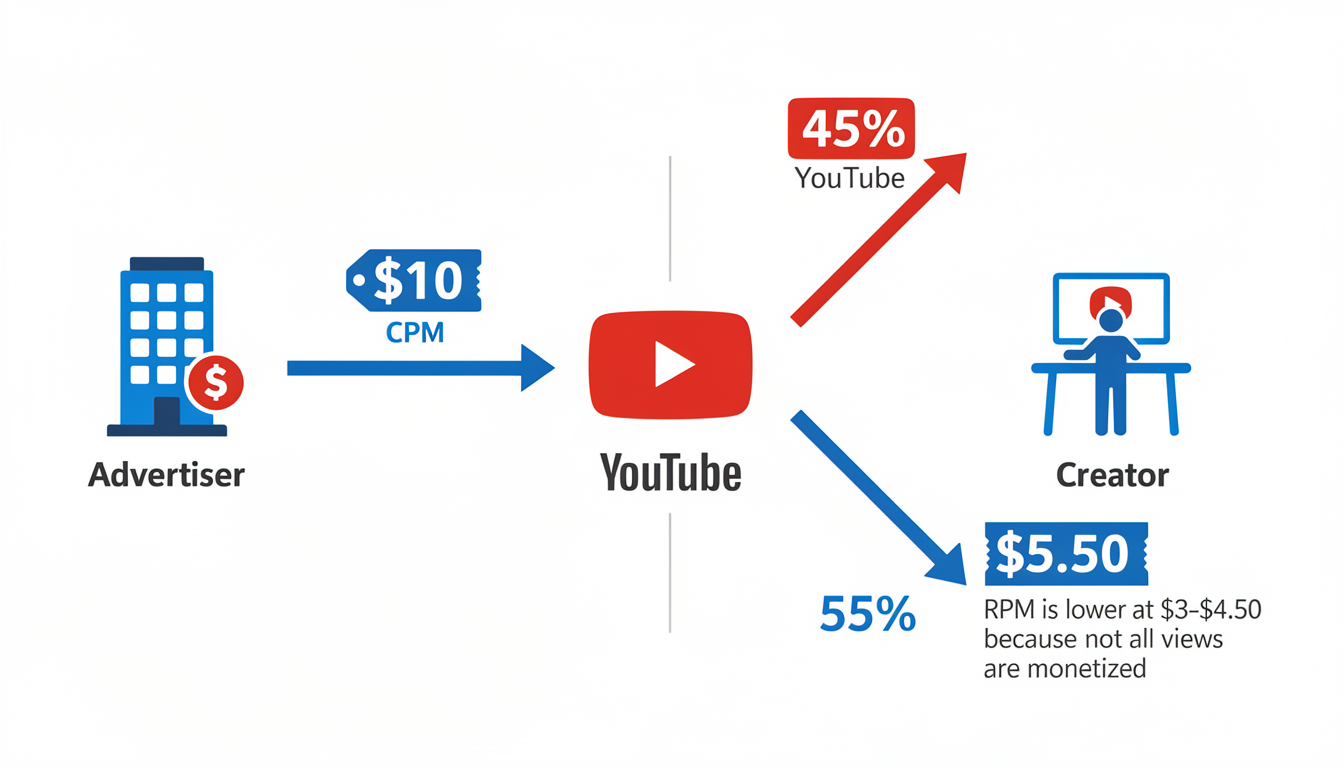
Before looking at any numbers, you need to understand two metrics that YouTube uses to measure earnings. Mixing them up is the single biggest reason creators misunderstand their income.
CPM (Cost Per Mille) is what advertisers pay YouTube for 1,000 ad impressions. This is the gross number — the total ad spend before YouTube takes its cut.
RPM (Revenue Per Mille) is what you actually earn per 1,000 video views. This is after YouTube takes its 45% cut, and it's calculated across all your views — not just monetized ones.
Here's how the math works in practice:
| Metric | What It Measures | Who Gets It | Example |
|---|---|---|---|
| CPM | Cost per 1,000 ad impressions | YouTube + Creator combined | $10.00 |
| YouTube's Cut (45%) | Platform fee | YouTube | $4.50 |
| Your Share (55%) | Creator payout | You | $5.50 |
| RPM | Earnings per 1,000 total views | You | $3.00–$4.50 |
Notice that RPM is always lower than your 55% share of CPM. That's because not every view generates an ad impression. Ad blockers, YouTube Premium subscribers, skipped ads, and non-monetizable content all create views that earn nothing. On average, only 40–60% of your total views are monetized views.
The number that matters for your bank account is RPM. Whenever you see big CPM numbers online, mentally cut them in half (or more) to get closer to what you'll actually earn.
YouTube Earnings Per 1,000 Views by Niche (2026 Data)
Your content niche is the single biggest factor in how much you earn. A finance channel can make 10–15x more per view than a gaming channel, simply because financial services companies pay premium ad rates to reach potential customers.
Here's what creators are actually earning in 2026, organized from highest to lowest paying:
High-Paying Niches ($10+ RPM)
| Niche | CPM Range | Estimated RPM | Monthly Earnings (100K Views) |
|---|---|---|---|
| Finance & Investing | $20–$50 | $8–$25 | $800–$2,500 |
| Insurance & Legal | $25–$45 | $10–$22 | $1,000–$2,200 |
| B2B / SaaS Software | $20–$40 | $8–$20 | $800–$2,000 |
| Real Estate | $15–$35 | $6–$18 | $600–$1,800 |
| Education & Online Courses | $10–$25 | $5–$14 | $500–$1,400 |
Why these niches pay so much: the advertisers in these spaces have high customer lifetime values. A single insurance customer is worth thousands of dollars, so insurers are willing to pay $30+ CPM to reach them. Compare that to a mobile game ad where the average user might spend $2.
Mid-Tier Niches ($4–$10 RPM)
| Niche | CPM Range | Estimated RPM | Monthly Earnings (100K Views) |
|---|---|---|---|
| Technology & Reviews | $15–$22 | $6–$12 | $600–$1,200 |
| Health & Fitness | $7–$20 | $4–$10 | $400–$1,000 |
| DIY & Home Improvement | $8–$18 | $4–$9 | $400–$900 |
| Travel | $6–$15 | $3–$8 | $300–$800 |
| Food & Cooking | $5–$12 | $3–$7 | $300–$700 |
| Beauty & Fashion | $5–$12 | $3–$7 | $300–$700 |
Lower-Paying Niches ($1–$4 RPM)
| Niche | CPM Range | Estimated RPM | Monthly Earnings (100K Views) |
|---|---|---|---|
| General Entertainment | $2–$8 | $1–$4 | $100–$400 |
| Gaming | $4–$15 | $2–$6 | $200–$600 |
| Comedy & Skits | $2–$6 | $1–$3 | $100–$300 |
| Music | $1–$4 | $0.50–$2 | $50–$200 |
| Vlogs (Non-Niche) | $2–$5 | $1–$3 | $100–$300 |
A few important notes on these numbers:
- Gaming's range is wide on purpose. A Minecraft "let's play" earns very differently from a PC hardware review. Tech-adjacent gaming content (GPU benchmarks, setup tours) can hit mid-tier CPMs.
- "Make Money Online" content sits inside Finance and often hits the highest CPMs because affiliate advertisers bid aggressively for that audience.
- Kids and family content sits near the bottom because advertisers pay less to reach younger audiences, and COPPA restrictions limit ad targeting. If you're a parent considering this space, our guide on how to start a YouTube channel for kids covers the unique rules and realistic earning expectations.
- Hybrid niches outperform. A tech + finance channel reviewing trading apps will earn more than a pure tech channel reviewing phones.
- Faceless and automated channels are growing in popularity, particularly in niches like compilations, tutorials, and meditation content. If you're curious whether that model can generate real ad revenue, our breakdown of whether YouTube automation actually works covers the realistic earnings and risks.
 PostPlanify
All your social media in one simple dashboard
Schedule posts, track analytics, and reply to comments/DMs without switching tabs.

Engagement
+18%
Views
52.8k
YouTube CPM Rates by Country (2026 Breakdown)
Where your viewers live matters almost as much as what you talk about. A US viewer can be worth 30–40x more than a viewer from a lower-CPM country. This is why two channels in the same niche with the same view count can have wildly different earnings.
Top-Tier Countries (Highest CPM)
| Country | Average CPM | Why It Pays Well |
|---|---|---|
| 🇦🇺 Australia | $36.21 | High advertiser competition, strong purchasing power |
| 🇺🇸 United States | $32.75 | Largest ad market in the world |
| 🇨🇦 Canada | $29.15 | English-speaking, high-income audience |
| 🇳🇿 New Zealand | $28.15 | Similar profile to Australia |
| 🇬🇧 United Kingdom | $25.80 | Major ad market, premium brands |
| 🇩🇪 Germany | $24.50 | Europe's largest economy |
| 🇨🇭 Switzerland | $23.13 | Highest GDP per capita in Europe |
Mid-Tier Countries
| Country | Average CPM |
|---|---|
| 🇳🇴 Norway | $20.17 |
| 🇸🇪 Sweden | $18.40 |
| 🇩🇰 Denmark | $17.90 |
| 🇳🇱 Netherlands | $16.50 |
| 🇫🇷 France | $15.20 |
| 🇯🇵 Japan | $14.80 |
| 🇪🇸 Spain | $14.22 |
| 🇰🇷 South Korea | $12.50 |
| 🇮🇹 Italy | $11.80 |
| 🇸🇬 Singapore | $11.50 |
| 🇵🇹 Portugal | $10.32 |
| 🇦🇪 UAE | $9.80 |
Lower-Tier Countries
| Country | Average CPM |
|---|---|
| 🇧🇷 Brazil | $4.50 |
| 🇲🇽 Mexico | $3.80 |
| 🇹🇷 Turkey | $2.10 |
| 🇹🇭 Thailand | $1.90 |
| 🇮🇩 Indonesia | $1.50 |
| 🇵🇭 Philippines | $1.20 |
| 🇮🇳 India | $0.83 |
| 🇧🇩 Bangladesh | $0.45 |
| 🇵🇰 Pakistan | $0.40 |
This is why audience geography is so important. Consider this example: a tech channel with 100,000 monthly views from US viewers at a $32 CPM earns roughly $1,760/month (after YouTube's 45% cut). The same channel, same niche, same 100,000 views — but from Indian viewers at $0.83 CPM — earns roughly $46/month. That's a 38x difference for the same content and the same view count.
What You Can Do About It
You can't control where viewers come from, but you can influence it:
- Language matters. English-language content naturally attracts viewers from high-CPM countries (US, UK, Canada, Australia). Creating content in English, even if it's not your first language, typically earns more per view.
- Topic selection pulls geography. Content about US tax laws will attract US viewers. Content about Bollywood attracts Indian viewers. Choose topics that naturally align with high-CPM regions if maximizing revenue is your goal.
- Publish timing targets time zones. Uploading when your highest-value audience is awake means those viewers are more likely to watch early and trigger algorithmic promotion. Check out our guide on the best time to upload a YouTube video for specific time slots.
YouTube Shorts vs. Long-Form: The Earnings Gap
This is where a lot of creators get a rude awakening. YouTube Shorts look attractive because they can rack up millions of views quickly. But the pay per view is dramatically lower.
Long-Form Video Earnings
For standard videos (typically 8+ minutes), creators earn through the YouTube Partner Program's standard ad revenue share:
- Average RPM: $3–$12 per 1,000 views
- Videos over 8 minutes can include mid-roll ads, significantly boosting earnings
- Higher retention = more ad slots = more money
YouTube Shorts Earnings
Shorts monetization works through a shared ad revenue pool, not individual video ads. The math is very different:
| Metric | Shorts | Long-Form |
|---|---|---|
| Average RPM | $0.03–$0.10 | $3–$12 |
| Earnings per 1M views | $30–$100 | $3,000–$12,000 |
| Ad format | Shared revenue pool | Individual video ads |
| Music penalty | Yes (splits revenue with rights holders) | No |
| Mid-roll ads | Not possible | Available for 8+ min videos |
Real creator example: A TubeBuddy case study showed a creator who received 7 million Shorts views and earned approximately $383 total. That's about $0.055 per 1,000 views. The same 7 million views in long-form content at even a modest $4 RPM would have earned $28,000.
The Music Tax on Shorts
If your Short uses licensed music, YouTube splits the revenue with music rights holders before you see a cent:
- One music track: ~50% goes to music licensing, ~50% to the creator pool
- Two music tracks: ~66% goes to music licensing, ~34% to the creator pool
- No music (original audio only): 100% stays in the creator pool
This means a Short with two music tracks earns roughly one-third of what an identical Short with original audio would earn. If you're creating Shorts for revenue (not just growth), use original audio whenever possible.
Should You Bother With Shorts?
Shorts aren't worthless — they're just not a direct revenue play. Think of them as:
- A growth tool: Shorts can funnel new subscribers to your long-form content, where the real money is
- A testing ground: Use Shorts to test topics and hooks before investing in full-length videos
- A supplement, not a strategy: Don't build a channel around Shorts if ad revenue is your primary income goal
When Does YouTube Start Paying You?
You can't earn anything until you're accepted into the YouTube Partner Program (YPP). For a complete breakdown of eligibility timelines, payment thresholds, and how long the process actually takes, see our dedicated guide on when YouTube starts paying you. Here are the current requirements as of 2026:
Standard Monetization (Ad Revenue)
| Requirement | Threshold |
|---|---|
| Subscribers | 1,000 |
| Watch hours (past 12 months) | 4,000 hours |
| OR Shorts views (past 90 days) | 10 million views |
| YouTube community guidelines | No active strikes |
| Two-factor authentication | Enabled |
| AdSense account | Linked |
Early Monetization (Fan Funding Only)
YouTube introduced a lower tier that lets smaller creators access features like Super Thanks and channel memberships:
| Requirement | Threshold |
|---|---|
| Subscribers | 500 |
| Watch hours (past 12 months) | 3,000 hours |
| OR Shorts views (past 90 days) | 3 million views |
| Public uploads in last 90 days | 3 |
This lower tier does not include ad revenue — only fan-funded features. You still need the full 1,000 subscribers and 4,000 watch hours for ads. If you're not sure where you stand, our guide on how to see your YouTube subscribers walks through every way to check your count and track growth toward these milestones.
PostPlanifyAll your social media in one simple dashboard
Schedule posts, track analytics, and reply to comments/DMs without switching tabs.
Engagement
+18%
Views
52.8k
7 Factors That Determine Your Actual Earnings
Understanding the data above is one thing. Knowing what you can actually control is another. Here are the seven factors that move the needle on your per-view earnings, ranked by impact:
1. Content Niche (Biggest Impact)
As shown in the tables above, niche selection alone can create a 10–25x difference in earnings. If you're starting a new channel and care about revenue, picking a high-CPM niche is the single most impactful decision you'll make.
But there's a tradeoff: high-CPM niches are often harder to grow in because the competition is fierce and the content requires expertise. A gaming channel might earn $2 RPM but grow 5x faster than a finance channel that earns $15 RPM. Consider whether raw view growth or per-view revenue matters more for your goals.
2. Audience Geography
A channel where 80% of viewers are from the US, UK, Canada, and Australia will significantly outperform an identical channel where 80% of viewers are from South Asia or Southeast Asia. You can check your audience geography in YouTube Studio under Analytics > Audience > Top Countries.
3. Video Length
Videos over 8 minutes can include mid-roll ads. This is a step-function increase in earnings — not a gradual one. Going from a 7-minute video to a 9-minute video can roughly double your ad revenue because you go from 1 ad slot to 2–3.
But don't pad your videos just to hit 8 minutes. If retention drops because you're adding fluff, the algorithm will punish you with less reach, which costs more in lost views than you'd gain in extra ad slots.
4. Audience Retention
YouTube's algorithm heavily favors videos that keep viewers watching. Higher retention → more recommendations → more views → more ad impressions. A video with 60% average retention will dramatically outperform one with 30% retention, even in the same niche.
5. Click-Through Rate (CTR)
Your thumbnail and title determine how many people click when they see your video in their feed. A higher CTR means more views from the same number of impressions. Most successful channels maintain a 4–10% CTR.
6. Upload Frequency & Consistency
The algorithm rewards consistency. Channels that upload on a regular schedule (whether that's daily, weekly, or biweekly) typically see better overall performance than channels with erratic posting patterns. A social media scheduling tool can help you maintain consistency across YouTube and other platforms.
7. Seasonality
Ad rates are not constant throughout the year. They follow advertiser demand:
| Period | CPM Trend | Why |
|---|---|---|
| Q4 (Oct–Dec) | Highest (+20–40%) | Holiday spending, Black Friday, year-end budgets |
| Q1 (Jan–Mar) | Lowest (−20–30%) | Advertisers reset budgets post-holidays |
| Q2 (Apr–Jun) | Rising | Spring campaigns, summer planning |
| Q3 (Jul–Sep) | Moderate | Back-to-school, pre-holiday ramp-up |
Many creators see their December earnings jump 30–50% compared to January — even with the same view count. Don't panic if January feels slow; it's the natural cycle.
YouTube vs. Other Platforms: Pay Per 1,000 Views (2026)
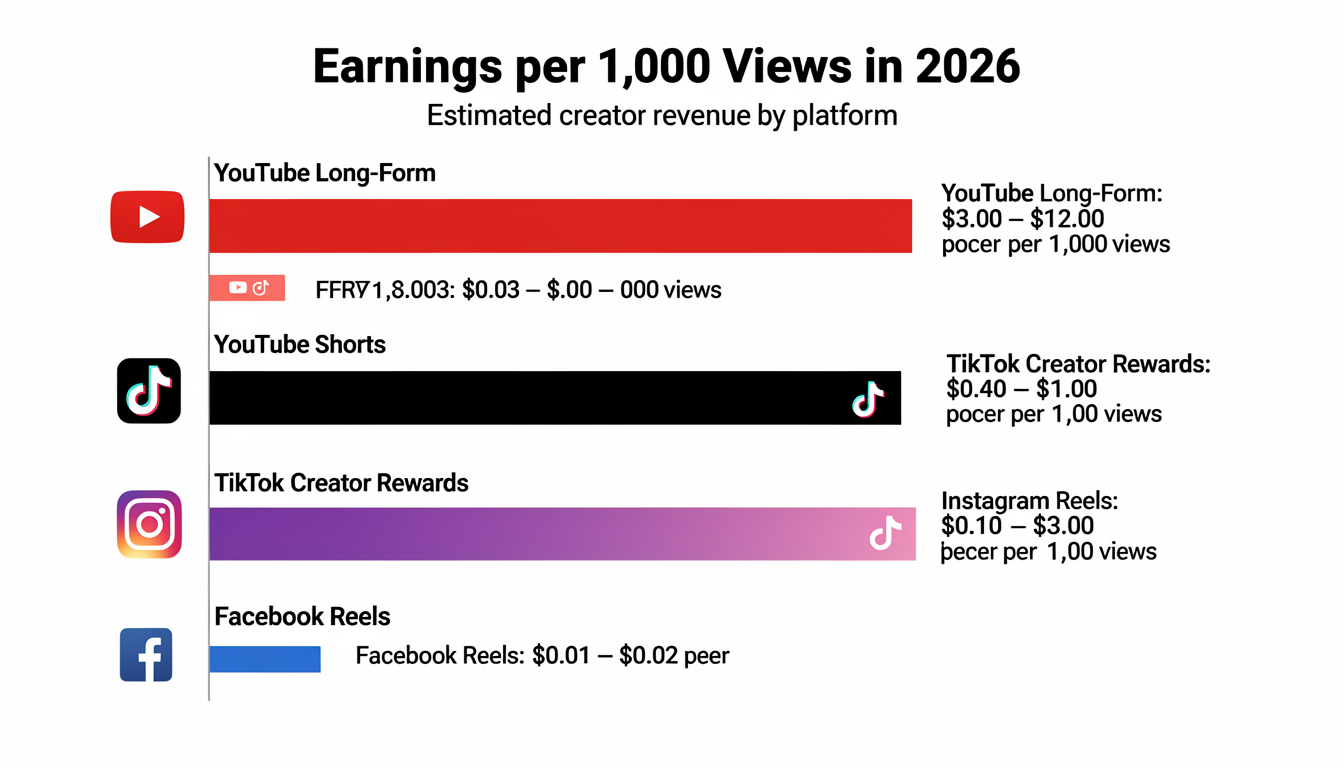
If you're a creator choosing where to invest your time, here's how the platforms stack up purely on a per-view basis:
| Platform | Pay Per 1,000 Views | Revenue Model | Best For |
|---|---|---|---|
| YouTube (Long-Form) | $3–$12 | 55% ad revenue share | Consistent, scalable ad income |
| YouTube (Shorts) | $0.03–$0.10 | Shared ad revenue pool | Growth funnel to long-form |
| TikTok (Creator Rewards) | $0.40–$1.00 | Creator Rewards Program | Viral reach, brand deals |
| TikTok (Creator Fund) | $0.02–$0.04 | Legacy fund (being phased out) | Minimal direct income |
| Instagram Reels | $0.10–$3.00 | Bonuses + brand partnerships | Sponsorship leverage |
| Facebook Reels | $0.01–$0.02 | In-stream ads (limited) | Supplemental income |
The clear winner for ad revenue is YouTube long-form — by a wide margin. No other platform comes close to paying $3–$12 per 1,000 views consistently.
However, platforms like TikTok and Instagram aren't primarily about ad revenue. Their real value is in:
- Sponsorships: Instagram creators with 100K followers can earn $1,000+ per sponsored post, regardless of view count
- TikTok Shop: Creators earn commissions on products sold through their videos
- Audience building: Going viral on TikTok or Reels can drive subscribers to your YouTube channel where monetization is stronger
The smartest creators don't choose one platform. They repurpose content across all of them — using YouTube as their primary revenue source and TikTok/Instagram as discovery channels. If you're looking to manage posting across multiple platforms efficiently, a social media management tool can help you schedule and coordinate content everywhere from a single dashboard.
How to Increase Your YouTube Earnings Per 1,000 Views
Knowing the data is step one. Here's what to actually do with it.
Optimize for Higher-CPM Advertisers
You don't need to switch niches entirely. You can adjust the framing of your existing content to attract higher-value ads:
- A fitness channel can create content about "best home gym equipment under $500" (attracts e-commerce ads with higher CPMs) instead of only workout routines
- A gaming channel can review gaming laptops or monitors (tech CPMs) alongside gameplay content
- A cooking channel can feature specific kitchen appliances or meal delivery service comparisons
Structure Videos for Multiple Ad Breaks
For videos over 8 minutes:
- Place a natural break point at the 3–4 minute mark for the first mid-roll ad
- Add breaks every 4–5 minutes after that for additional mid-rolls
- Use chapter markers so viewers can navigate around ads without abandoning the video entirely
- Front-load value in the first 30 seconds to hook viewers before the first pre-roll ad ends
Improve Audience Retention
Every percentage point of retention increases your earnings in two ways: more ad impressions per viewer and better algorithmic distribution.
- Hook viewers in the first 5 seconds. Open with a question, a surprising stat, or a preview of the payoff
- Cut ruthlessly. Every second that doesn't add value costs you retention
- Use pattern interrupts — change the camera angle, add a graphic, or shift your energy every 30–60 seconds to combat viewer fatigue
- Deliver on your title and thumbnail promise within the first third of the video. Nothing kills retention faster than clickbait that doesn't pay off
Target High-CPM Geographies
If your content could reasonably appeal to multiple markets:
- Publish in English to access the US, UK, Canada, and Australia ad markets
- Use US-centric examples and references when possible
- Upload during US/UK active hours to get initial traction from high-CPM viewers
- Add English captions to make your content accessible to English-speaking audiences worldwide
How Much Can You Realistically Earn?
Let's put all these numbers together into realistic scenarios for different types of channels:
Scenario 1: Small Gaming Channel
- Views: 50,000/month
- Niche RPM: $2
- Audience: 60% US, 40% international
- Monthly ad revenue: ~$100
- Annual ad revenue: ~$1,200
Scenario 2: Mid-Size Tech Review Channel
- Views: 200,000/month
- Niche RPM: $7
- Audience: 70% US/UK/Canada
- Monthly ad revenue: ~$1,400
- Annual ad revenue: ~$16,800
Scenario 3: Established Finance Channel
- Views: 500,000/month
- Niche RPM: $15
- Audience: 80% US/Australia
- Monthly ad revenue: ~$7,500
- Annual ad revenue: ~$90,000
Scenario 4: Large Entertainment Channel
- Views: 2,000,000/month
- Niche RPM: $3
- Audience: 50% US, 50% global
- Monthly ad revenue: ~$6,000
- Annual ad revenue: ~$72,000
Notice something interesting: the finance channel with 500K views earns more than the entertainment channel with 2 million views. Niche selection and audience quality consistently outperform raw view count when it comes to revenue.
YouTube Premium Revenue: The Hidden Income Stream
Most YouTube earnings guides focus exclusively on ad revenue, but there's another income stream built into every monetized video: YouTube Premium.
How YouTube Premium Pay Works
YouTube Premium subscribers pay $13.99/month (US) for ad-free viewing. YouTube pools a portion of these subscription fees and distributes them to creators based on how much Premium members watched their content.
| Factor | How It Works |
|---|---|
| Who earns it | Any YPP creator whose content is watched by Premium subscribers |
| How it's calculated | Based on your share of total watch time from Premium members |
| Revenue split | Same 55/45 split as ad revenue |
| Where to see it | YouTube Studio → Analytics → Revenue → "YouTube Premium" row |
| Typical share of total revenue | 5–15% for most creators |
How Much Does YouTube Premium Actually Pay?
Premium RPM varies by niche but is generally $1–$3 per 1,000 Premium views. This sounds low, but consider:
- Every Premium view earns you money — unlike ad-supported views where only 40–60% are monetized (due to ad blockers, skipped ads, etc.)
- No ad fatigue — Premium viewers don't skip ads because there are none, so their entire watch session generates revenue for you
- Higher watch time — Premium subscribers tend to watch longer sessions, which increases your share of the pool
For a channel earning $5,000/month from ads, YouTube Premium typically adds an additional $400–$750/month on top. It's not life-changing, but it's passive income that requires zero extra effort.
Why Premium Revenue Is Growing
YouTube Premium reached 100 million subscribers globally in 2024 and continues growing. As the subscriber base expands, the revenue pool grows proportionally. Creators in high-income countries (where Premium adoption is highest) benefit the most.
PostPlanifyAll your social media in one simple dashboard
Schedule posts, track analytics, and reply to comments/DMs without switching tabs.
Engagement
+18%
Views
52.8k
Tax Withholding on YouTube Earnings
This isn't the fun part of YouTube monetization, but ignoring it can cost you thousands of dollars. YouTube (via Google AdSense) is required to withhold taxes on creator earnings, and the rules differ based on where you live.
For US-Based Creators
| Tax Detail | What You Need to Know |
|---|---|
| Tax form required | W-9 (submitted through AdSense) |
| Withholding rate | 0% (no withholding — you pay taxes when you file) |
| Self-employment tax | Yes — YouTube income is self-employment income (15.3% SE tax + income tax) |
| Quarterly estimated payments | Required if you expect to owe $1,000+ in taxes |
| 1099 form | Google sends a 1099-MISC if you earn $600+ in a calendar year |
For Non-US Creators
This is where it gets expensive if you don't act:
| Tax Detail | What You Need to Know |
|---|---|
| Tax form required | W-8BEN (individuals) or W-8BEN-E (businesses) — submitted through AdSense |
| Default withholding rate | 24% on US-sourced earnings if you don't submit tax info |
| With tax treaty | Reduced rate (often 0–15%) depending on your country's treaty with the US |
| What counts as "US-sourced" | Revenue from views originating in the United States only |
| Example | If 40% of your views are from the US and you earn $1,000, $400 is US-sourced. Without a tax treaty, $96 is withheld. With a treaty (0% rate), $0 is withheld. |
Countries With Favorable US Tax Treaties
Creators in these countries can reduce or eliminate US withholding by submitting a W-8BEN:
- 0% withholding: UK, Canada, Australia, Germany, Japan, South Korea, India, and most EU countries
- 10% withholding: China, Brazil, Mexico
- 15% withholding: Thailand, Indonesia, Philippines
- 24% (no treaty): Many African and some Southeast Asian countries
Critical action: If you haven't submitted your W-8BEN form in AdSense, Google is withholding 24% of your US-sourced earnings right now. Go to AdSense → Payments → Manage settings → Tax info and complete the form. You cannot recover previously withheld taxes retroactively.
Beyond Ad Revenue: How Top YouTubers Actually Make Money
Here's a reality check that most "YouTube earnings" articles won't tell you: for successful creators, ad revenue is often the smallest slice of their income. The real money comes from leveraging your audience into other revenue streams.
| Revenue Stream | Typical Earnings | When It Becomes Viable |
|---|---|---|
| Sponsorships | $20–$50 per 1,000 views (2–10x ad revenue) | 10,000+ subscribers |
| Affiliate Marketing | 5–30% commission per sale | Any size (niche dependent) |
| Digital Products | $5–$500 per sale | 5,000+ engaged subscribers |
| Channel Memberships | $2–$25/month per member | 1,000+ subscribers (YPP) |
| Super Chats/Thanks | Varies widely | YPP membership |
| Merchandise | $5–$30 profit per item | 10,000+ subscribers |
| Consulting/Services | $100–$500/hour | Niche authority channels |
A tech reviewer with 100,000 subscribers might earn $1,500/month from ads but $5,000–$10,000/month from a single sponsor deal. A fitness creator might earn $800/month from ads but $3,000/month selling a $29 workout program.
The takeaway: Don't obsess over maximizing RPM if it means ignoring these larger opportunities. Ad revenue builds the foundation, but sponsorships, products, and affiliate income build the house.
Frequently Asked Questions
How much does YouTube pay for 1,000 views in the US?
In the US specifically, most creators earn between $5 and $15 per 1,000 views, depending on their niche. The US has one of the highest CPMs globally at $32.75 on average. After YouTube's 45% cut, this translates to roughly $4–$8 RPM for most niches, with finance and insurance content going much higher.
How much does YouTube pay for 1 million views?
At the average RPM range of $3–$12, one million views earns between $3,000 and $12,000. Finance creators can earn $15,000–$25,000 per million views, while gaming or entertainment creators might see $1,000–$4,000. The variation depends entirely on niche and audience geography.
How much do YouTube Shorts pay per 1,000 views?
YouTube Shorts pay between $0.03 and $0.10 per 1,000 views on average, with finance-niche Shorts at the higher end ($0.15–$0.25) and entertainment Shorts at the lower end ($0.01–$0.05). This is roughly 50–100x less than long-form content per view. Using licensed music further reduces your share.
Is 1,000 views on YouTube good?
For a new channel, 1,000 views is a solid start — it means your content is being discovered. In terms of earnings, 1,000 views will earn you between $2 and $12 depending on your niche. The real value isn't the direct revenue; it's the audience you're building and the momentum toward YouTube Partner Program eligibility.
Why is my YouTube RPM so low?
Common reasons include: your audience is primarily from low-CPM countries (check YouTube Studio > Analytics > Audience), your content niche has low advertiser demand, your videos are under 8 minutes (no mid-roll ads), you have low audience retention (fewer ad impressions per view), or you're checking during Q1 when ad rates are seasonally low.
How many views do you need to make $1,000 on YouTube?
At an average RPM of $5, you'd need 200,000 views to earn $1,000. But this varies widely: a finance creator at $15 RPM needs only ~67,000 views, while a gaming creator at $2 RPM would need 500,000 views. Focus on RPM optimization alongside view growth for faster results.
Does YouTube pay for views from all countries?
YouTube pays for monetized views from all countries, but the rate varies dramatically. Views from the US, Australia, and Western Europe earn 20–40x more than views from South Asia or Africa due to differences in advertiser demand and purchasing power in those regions.
The Bottom Line
YouTube pays $2–$12 per 1,000 views in 2026, but your actual earnings are shaped by factors you can control: your niche, your content format, your target audience's geography, and how well you retain viewers.
Here's the framework for thinking about YouTube earnings:
- Pick a niche with strong advertiser demand if revenue is a priority — finance, education, and tech consistently outperform entertainment and gaming on a per-view basis
- Prioritize long-form content over Shorts for direct ad revenue — the pay gap is 50–100x
- Target English-speaking, high-CPM audiences through your content topics and upload timing
- Make videos over 8 minutes to unlock mid-roll ads, but only if you can maintain strong retention
- Diversify beyond ad revenue — sponsorships, affiliates, and products will eventually dwarf your AdSense income
Stop comparing your earnings to other creators without accounting for niche and geography. A $3 RPM in gaming is perfectly normal. A $3 RPM in finance means something is broken. Use the tables in this guide to benchmark your channel against realistic expectations for your specific situation.
And if you're serious about growing your YouTube presence alongside other social platforms, PostPlanify helps you schedule and manage content across YouTube, Instagram, TikTok, LinkedIn, and more — all from one place. Start your free 7-day trial and see how consistent posting compounds your growth over time.
Related Reading
YouTube earnings & monetization:
- When Does YouTube Start Paying You?
- How to See Your YouTube Subscribers
- Does YouTube Automation Work?
- How to Recover Your YouTube Account
- How to Start a YouTube Channel for Kids
Earnings on other platforms:
- How Much Does TikTok Pay for 1 Million Views?
- How Much Does Facebook Reels Pay Per 1,000 Views?
- What Social Media Platform Pays the Most?
YouTube scheduling & growth:
PostPlanifyAll your social media in one simple dashboard
Schedule posts, track analytics, and reply to comments/DMs without switching tabs.
Engagement
+18%
Views
52.8k
About the Author

Hasan Cagli
Founder of PostPlanify, a content and social media scheduling platform. He focuses on building systems that help businesses, agencies, and teams plan, publish, and manage content and social media more efficiently across platforms.


