


Choosing the right social media management platform isn't just about scheduling posts—it's about fixing real business problems. The right tool acts as your command center, cutting through the chaos of manual posting, inconsistent branding, and the constant struggle to prove your social media efforts are actually working.
The best social media management platform in 2026 is PostPlanify for most creators, teams, and agencies, offering AI-assisted content creation, a visual content calendar, Link in Bio, analytics, social inbox, and bulk scheduling on the Growth plan starting at $99/month. Premium adds team collaboration with approval workflows, and Scale adds white-label PDF reports. Buffer suits small businesses needing basic simplicity, while Sprout Social serves enterprise teams requiring advanced governance and social listening.
Why Do You Need a Social Media Management Platform?
Trying to manage social media manually is a recipe for errors, burnout, and missed opportunities. When you're just starting, it might seem manageable. But as you grow, the cracks start to show. Imagine trying to juggle ten client accounts or five different brand profiles using spreadsheets and phone reminders. It quickly becomes unsustainable.
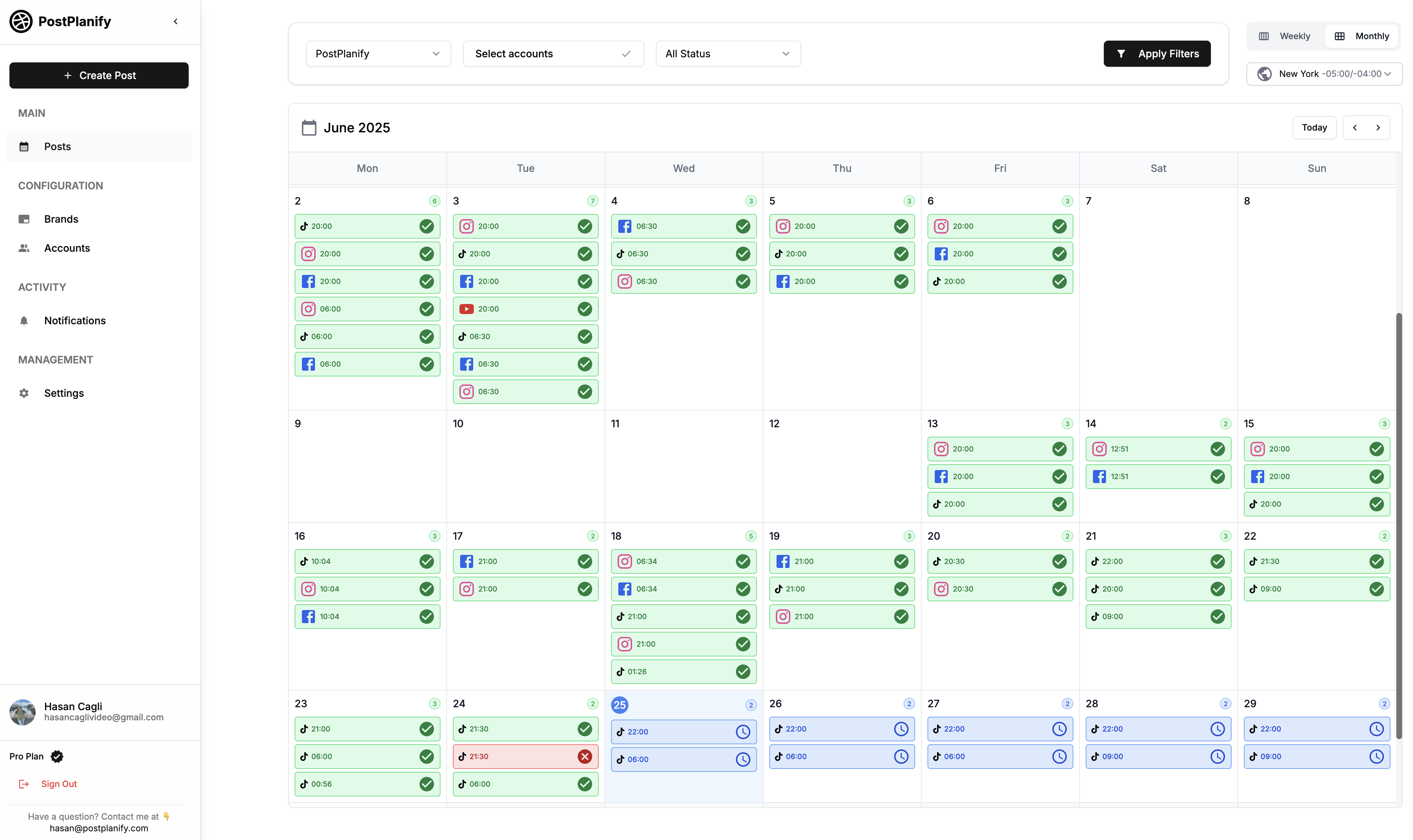
This disorganized workflow leads to bigger strategic failures. Without a central system, your brand's voice becomes inconsistent across platforms like Instagram and LinkedIn. Worse, you have no reliable way to connect your social media activities to actual business results. You’re just guessing.
The Problem: The High Cost of Manual Management
When you manage social media by hand, you introduce friction at every step. A single piece of content needs to be manually adapted for Facebook’s link-friendly format, re-cropped for Instagram’s visual feed, and then reformatted for TikTok’s vertical video standard. This turns into a massive time sink.
Common Causes of Failure:
- Repetitive Tasks: Constant copying, pasting, and reformatting content for each platform.
- Lack of a Central Hub: Content, assets, and plans are scattered across different folders, documents, and devices.
- No Single Source of Truth: It's impossible to see your entire content plan at a glance, leading to gaps and inconsistencies.
This isn’t just about wasted hours; it's about lost opportunities. While your team is stuck in a loop of manual tasks, your competitors are analyzing performance data and engaging with their audience in real-time. It’s no surprise that a primary reason businesses invest in these platforms is to simplify how they manage multiple social media accounts, bringing everything under one roof to prevent costly mistakes.
The biggest problem with manual workflows is the lack of a single source of truth. Without it, planning becomes disjointed, content creation feels repetitive, and proving your work is valuable is nearly impossible.
This pain is fueling significant industry growth. The social media management market was valued at USD 29.93 billion in 2025 and is expected to explode to USD 171.62 billion by 2033. Businesses are racing to connect with the billions of people on these platforms, and they need the right tools to do it effectively.
The Solution: How a Unified Dashboard Fixes These Problems
A dedicated platform transforms this chaos into a smooth, strategic operation. It provides a central hub where your entire team can plan, create, schedule, and analyze content together.
Here’s an actionable look at how a platform like PostPlanify solves these specific pain points:
- Ends Brand Inconsistency: Plan, create, and preview posts for every channel from one dashboard. This ensures your message, tone, and visuals are consistent everywhere.
- Eliminates Repetitive Work: Schedule content in bulk and adapt it for different platforms without ever having to leave the tool. If cross-platform publishing is your priority, see our list of the best apps to post to all social media at once.
- Proves Your Impact: Pull all your analytics into one place to see what’s working and what isn’t. This makes it much easier to connect your efforts to real business goals. For more on that, check out our guide on how to measure social media ROI.
What to Look For in a Social Media Management Tool
Choosing the best social media management platform isn't about finding the one with the longest feature list. It's about finding the one that solves your specific workflow problems without getting in the way. A flashy dashboard is useless if the tool fails when you're trying to schedule a critical post.
The demand for these tools is growing for a reason. The social media management software market is expected to grow by USD 54.98 billion between 2024 and 2029, because businesses need smarter ways to stay efficient. When you’re trying to reach an audience on platforms like Facebook, which has 3.07 billion monthly users, you can't just wing it. You can dig into the full industry analysis on Technavio if you're curious about the numbers.
Here are the nine practical criteria you should use to evaluate your options.
Comprehensive Channel Support
The Problem: A tool claims it "supports" Instagram, but all it does is send a push notification to your phone, forcing you to finish the post manually. That’s a glorified reminder, not true automation.
What to Look For:
- Direct API Integration: Does the platform offer direct, one-click scheduling for key formats like Instagram Reels, Stories, and Carousels?
- Platform-Specific Features: Can it handle nuances like TikTok videos, LinkedIn documents, or multi-image Facebook posts without workarounds?
- Account Type Compatibility: Can it manage both Business and Creator accounts on Instagram? Does it support both Facebook Pages and Groups?
- Future-Proofing: Does the platform have a history of quickly adding support for new features or networks as they emerge?
Advanced Scheduling and Publishing
The Problem: You spend hours each week manually scheduling posts one by one, creating a tedious and error-prone process.
What to Look For:
- Bulk Scheduling: Can you upload a CSV file with a month's worth of content in a single action? This is a non-negotiable for agencies and campaign-focused teams. You can learn more about how to automate social media posts to see how much time this saves.
- Content Queues: Can you create a library of pre-approved, evergreen content that the platform automatically pulls from to fill gaps in your schedule? A strong media library is essential for this workflow.
- Optimal Timing Suggestions: Does the tool analyze your audience data and recommend the best times to post for maximum reach and engagement?
AI-Assisted Content Creation
The Problem: You're constantly battling writer's block, and the AI caption tools you've tried produce generic, robotic text that requires heavy editing.
What to Look For:
- Brand-Aware AI: Does the AI learn your brand’s unique voice and tone from your past content to generate captions that sound authentic?
- Idea Generation: Can the tool help you brainstorm content ideas, hooks, and calls to action that are relevant to your industry?
- Seamless Media Integration: Does it connect directly with tools like Canva or cloud storage like Google Drive? This eliminates the tedious download-and-re-upload process.
The real value of AI here isn’t just about writing faster. It’s about smashing through creative blocks and making sure every single post feels on-brand, which is exactly what platforms like PostPlanify are built for.
Actionable Analytics and Reporting
The Problem: Your current analytics are just vanity metrics (likes, follower counts) that don't connect to actual business goals like website traffic or leads.
What to Look For:
- Goal-Oriented Metrics: Does the dashboard clearly show which post formats are driving the most engagement, what times yield the most reach, and how your audience is growing?
- Customizable Reports: Can you build and export clean, professional-looking PDF reports that highlight the metrics your clients or stakeholders actually care about?
- Ease of Use: Is the data presented in a clear, intuitive way, or do you need a data science degree to understand it? The best tools make complex data easy to digest.
Comparing the Top Social Media Management Platforms
The best social media management platform depends entirely on your specific workflow. Instead of a generic feature list, let's analyze how the top contenders—PostPlanify, Buffer, Later, and Sprout Social—solve problems for different types of users.
A great platform must excel in three core areas: comprehensive channel support, an intuitive scheduling system, and analytics you can actually use to make better decisions.
Get these three pillars right, and you have a tool that works with you, not against you.
 PostPlanify
All your social media in one simple dashboard
Schedule posts, track analytics, and reply to comments/DMs without switching tabs.

Engagement
+18%
Views
52.8k
Platform Feature Comparison for Key Workflows
Here is a side-by-side look at how these platforms handle critical social media tasks. This isn't just about whether a feature exists, but how it actually performs in a real-world scenario for creators, agencies, and in-house teams.
| Feature/Workflow | PostPlanify | Buffer | Later | Sprout Social |
|---|---|---|---|---|
| Visual Calendar | ✅ Clean, drag-and-drop interface across all platforms. Great for spotting content gaps. | ✅ Simple and straightforward. Excellent for basic queue management. | ✅ Best-in-class for Instagram grid planning. Visual-first approach. | ✅ Enterprise-level with campaign tagging and approval workflows. |
| AI Captions | ✅ Brand Voice AI learns your tone. Generates unique, on-brand text. | ✅ Basic AI for overcoming writer's block. More generic suggestions. | ✅ Good for generating ideas and hashtag suggestions, but less personalized. | ✅ AI is focused more on analytics, trend spotting, and social listening. |
| Bulk Scheduling | ✅ Yes, a massive time-saver for agencies and campaigns. | ❌ No. Focuses on a single-post queue system. | ❌ No. Designed for more granular, post-by-post visual planning. | ✅ Yes, built for enterprise-scale campaign planning. |
| First Comment | ✅ Yes. Schedule a first comment with links to keep main posts clean. | ❌ No. Not a supported feature. | ❌ No. Focuses on the main post's visual elements. | ✅ Yes, part of its advanced publishing toolset. |
| Approval Workflows | ✅ Yes, on Premium ($199/mo), Scale, and Enterprise — add team members and manage approval workflows for your posts. | ✅ Yes, on higher-tier plans. Simple approval steps. | ✅ Yes, on team plans. Good for small team collaboration. | ✅ The gold standard. Multi-step approvals, user roles, and audit trails. |
| Actionable Analytics | ✅ Clean dashboard showing top-performing content and key metrics. | ✅ Clear, easy-to-read reports. Perfect for small businesses. | ✅ Strong visual analytics, especially for Instagram and TikTok. | ✅ Deep, customizable reporting with competitive analysis. Enterprise-grade. |
This table shows a clear difference in philosophy. PostPlanify is built for speed and AI-powered efficiency, Buffer for simplicity, Later for visual planning, and Sprout Social for large-scale team governance and data analysis. For detailed side-by-side breakdowns, see our tool comparison hub — including Buffer vs Later, Hootsuite vs Sprout Social, and Buffer vs Hootsuite.
Content Planning and Calendars
A good content calendar is your strategic command center. It helps you see the bigger picture, find gaps in your content plan, and ensure you maintain a consistent posting schedule.
- Later is the go-to for visual creators, particularly on Instagram. Its drag-and-drop grid preview is excellent for planning an aesthetic feed. However, this visual focus can be a limitation if your strategy is heavily based on text, links, or multi-platform campaigns.
- Buffer offers a clean, minimalist calendar that is incredibly easy to use. Its focus on simplicity makes it a great fit for small businesses or solo creators who need to get content scheduled without navigating complex features.
- Sprout Social provides an enterprise-grade calendar designed for large teams with multiple layers of oversight. It’s packed with campaign tags, sophisticated filters, and detailed approval workflows, making it ideal for large organizations but overkill for smaller teams.
- PostPlanify strikes a balance. The calendar is designed to be clean and visual, allowing you to drag and drop drafts, see your entire multi-platform schedule, and instantly spot content gaps without unnecessary complexity.
Content Creation and AI Assistance
A modern social media platform shouldn't just publish your content; it should actively help you create it. This workflow is all about efficiency—writing better captions faster, sourcing media without friction, and maintaining brand consistency.
Most AI caption generators produce generic text that still requires significant editing. The real breakthrough is AI that understands your brand.
The game-changer with AI isn't just generating words; it's generating words that sound like you. PostPlanify's Brand Voice AI is a standout here, learning from your past posts to create captions that genuinely match your tone and style, which is a massive time-saver.
For a broader look at creation tools, this list of the 12 best social media content creator tools offers a great overview of what's available beyond scheduling platforms.
- Sprout Social excels in a different area of content creation: social listening. Its tools are fantastic for uncovering user-generated content and spotting trends, providing enterprise teams with a significant advantage in content ideation.
- Later and Buffer offer solid, foundational AI features like caption ideas and hashtag suggestions. They are helpful for overcoming writer's block but lack the deep, brand-specific personalization of more advanced systems.
Publishing and Scheduling Workflows
This is where a platform's reliability is tested. Its value depends on how consistently and flexibly it publishes your content across different networks, each with its own API limitations and quirks.
Common API Limitations and Headaches:
- Instagram Stories: Many tools still can't post Stories directly. Instead, they send a push notification to your phone for you to complete the post manually, breaking any automated workflow.
- TikTok: While direct, automated posting is more common now, some tools still struggle with certain video formats or revert to the mobile notification workaround.
- Reliability Issues: If a platform's connection to an API fails, your scheduled posts won't go live. Rock-solid reliability is non-negotiable.
PostPlanify is engineered for reliable, direct publishing across all major formats. Whether you need a YouTube scheduler, Pinterest scheduler, or Threads scheduler, it covers every major platform. It handles images, videos, carousels, and text posts directly to the platforms, minimizing manual intervention. Its bulk scheduling feature is a lifesaver for agencies and creators planning content weeks in advance. For a deeper look at your options, check out our guide on the best social media scheduling tools.
Buffer is renowned for its simple, bulletproof queuing system. You set a schedule, fill the queue, and it just works. This legendary reliability is its core strength and a major reason for its loyal user base.
Analytics and Performance Reporting
If you can't measure your results, you can't improve your strategy. Good analytics go beyond vanity metrics to show you what truly matters: which posts drive engagement, what content formats perform best, and how your audience is responding.
- Sprout Social is the leader in this category, offering incredibly deep, customizable analytics designed for data-driven corporate teams. It provides competitive analysis, paid performance reports, and team productivity metrics, though this comes at a premium price.
- Later and Buffer offer excellent core analytics that are perfect for small businesses and creators. Their dashboards are easy to understand, showing top-performing posts, engagement rates, and follower growth at a glance.
- PostPlanify focuses on delivering the most actionable metrics in a clean, uncluttered dashboard. It makes it easy to see which content is resonating on platforms like TikTok, Instagram, and X, so you can make smarter decisions without needing to be a data analyst.
Finding the Right Tool for Your Workflow
The search for the "best" social media management tool is misguided. The perfect platform is entirely relative to your needs. What works for a solo creator will be a poor fit for a corporate marketing team.
The key is to match a tool’s core strengths to your specific day-to-day workflow.
Let's break down what four common user types actually need to solve their problems and identify which platform is the right fit.
For Solo Creators and Influencers
Your Problem: You are your entire team—strategist, creator, editor, and community manager. Platforms built for creators address this directly. Your biggest challenge is time, and you need tools that help you create high-quality content quickly without getting bogged down in manual tasks.
Actionable Fixes You Need:
- A Fast, Visual Content Calendar: You need to see your schedule at a glance and be able to drag and drop ideas into place.
- High-Quality AI Captioning: Generating on-brand captions in seconds is essential for saving hours each week.
- Direct Media Integrations: Connections to Canva and Google Drive are non-negotiable to avoid the tedious download-re-upload cycle.
- Reliable Direct Publishing: The tool must post directly to Instagram (including Reels), TikTok, and other key platforms without push notification workarounds.
Best Fit: PostPlanify. Platforms built for speed and AI-assisted creation are ideal. PostPlanify’s Brand Voice AI, simple calendar, and direct media integrations are designed to help you produce better content, faster.
For Small Businesses and E-commerce Brands
Your Problem: You are focused on the bottom line—website clicks, leads, and sales. You don't have a large team or an enterprise budget, so your tool must be straightforward and provide clear analytics that connect social media to business results. Our guide to social media management for small businesses dives deeper into these needs.
Actionable Fixes You Need:
- An Intuitive User Interface: The platform must be easy to use from day one, with no steep learning curve.
- Simple, Actionable Analytics: You need to quickly see which posts are driving traffic and engagement, without getting lost in complex reports.
- Affordable and Scalable Pricing: The cost must fit a small budget, with a clear path to upgrade as your business grows.
- First Comment Scheduling: A critical feature for keeping promotional links out of your main caption, which improves post aesthetics and engagement.
Best Fit: Buffer. Small businesses thrive on simplicity and reliability. Buffer's clean interface and easy-to-digest analytics make it a fantastic choice for teams who need to stay consistent and track performance without being overwhelmed. If you are considering other options, see our detailed Buffer alternative comparison.
For Marketing Agencies
Your Problem: You are juggling multiple client accounts, each with a distinct brand voice. Agencies depend on efficiency, organization, and the ability to prove their value with professional reports.
Actionable Fixes You Need:
- Multi-Brand Workflows: The ability to seamlessly switch between client accounts—with separate assets, calendars, and analytics—is essential. Learn more in our guide to managing multiple social media accounts.
- Bulk Scheduling Capabilities: Uploading a month's worth of content for multiple clients from a single CSV file is a non-negotiable time-saver.
- White-Label or Customizable Reports: You need to generate clean, professional reports branded with your agency’s logo to send to clients.
- Team Collaboration (on higher plans): Simple approval queues for client review become increasingly important as you scale.
Best Fit: PostPlanify (Premium, Scale, or Enterprise). Agencies need a combination of raw efficiency and scalability. PostPlanify’s Premium plan offers 30 social accounts, 15 workspaces, and 6 team members with approval workflows, while Scale offers 100 social accounts, 50 workspaces, 12 team members, and white-label PDF reports. Enterprise provides custom accounts and unlimited team members/workspaces. The straightforward analytics also simplify client reporting.
For In-House Corporate Teams
Your Problem: You operate within a larger marketing ecosystem and require strict governance, collaboration tools, and deep data analysis to ensure brand safety and strategic alignment.
Actionable Fixes You Need:
- Advanced Collaboration Tools: Multi-step approval workflows, user-specific roles (editor, publisher, analyst), and internal commenting are essential for team coordination.
- Deep, Customizable Analytics: You must be able to create detailed reports that track campaign performance against KPIs, benchmark against competitors, and measure team productivity.
- Social Listening and Monitoring: Your tool must go beyond publishing to monitor brand mentions, track industry trends, and identify engagement opportunities in real-time.
- Integrations with Other Marketing Software: The platform must connect to your CRM, analytics dashboard, and other business intelligence tools.
The screenshot below from Sprout Social shows a pricing structure reflecting this enterprise focus.
This model is built for large organizations where deep analytics and team governance justify the investment.
Best Fit: Sprout Social. Corporate teams should invest in platforms built for enterprise-level control and data. Sprout Social is a gold standard for its sophisticated approval workflows, powerful social listening, and the in-depth analytics that complex organizations demand.
Quick Summary Checklist
- Solo Creator? Prioritize speed, AI creation tools, and visual planning.
- Small Business? Focus on ease of use, affordability, and clear business metrics.
- Agency? Look for multi-client management, bulk scheduling, and professional reporting.
- Corporate Team? Demand advanced collaboration, governance, and deep analytics.
Frequently Asked Questions
What is the best social media management platform for beginners?
For beginners, Buffer and PostPlanify are the top choices due to their clean interfaces and minimal learning curves. Buffer excels in simplicity with its queue-based system, while PostPlanify adds AI-powered caption generation that helps new users create professional content quickly. Both offer free trials, so test each with your actual workflow before committing.
How much does a social media management platform cost?
Pricing ranges from free or low-cost per-channel tools for basic solo scheduling to $250+/month for enterprise organizations. PostPlanify starts with Growth at $99/month for 15 accounts, 5 workspaces, 3 team members, unlimited posts, analytics, social inbox, AI assistant, and Link in Bio. Premium is $199/month for 30 accounts, 15 workspaces, 6 team members, reports, and approval workflows. Scale is $299/month for 100 accounts, 50 workspaces, 12 team members, and white-label PDF reports. Hootsuite pricing begins at $249/user/month, while Buffer pricing starts lower at around $6/month per channel. Choose based on your specific feature needs.
Can I manage all social media platforms from one tool?
Yes, most management platforms support the major networks including Instagram, Facebook, TikTok, LinkedIn, X, YouTube, and Pinterest. PostPlanify covers all of these from a single dashboard. However, verify support for specific post formats you need, as API limitations may affect features like Instagram Story stickers or TikTok trending audio on some tools.
Is PostPlanify better than Hootsuite or Buffer?
It depends on your needs. PostPlanify offers stronger AI caption generation and more competitive pricing than Hootsuite, which starts at $249/month. Compared to Buffer, PostPlanify provides bulk scheduling and more advanced analytics. For enterprise social listening, Sprout Social leads. See our detailed platform comparisons for specific feature breakdowns.
Do social media management tools affect post reach or engagement?
No, using an API-partnered scheduling tool does not negatively impact your reach or engagement. Instagram, Facebook, and other platforms have confirmed this officially. In fact, these tools typically improve engagement by ensuring consistent posting at optimal times. Focus on content quality and engagement strategies rather than worrying about algorithmic penalties.
Is it safe to connect my social accounts to a management platform?
Yes, as long as the platform uses official API access through OAuth. A reputable tool never asks for your social media password — it redirects you to the network (Instagram, Facebook, LinkedIn, and others) to grant permission, and you can revoke that access at any time from your account's security settings. If a tool asks for your direct username and password, treat it as a red flag.
What features matter most when choosing a management platform?
Prioritize three core capabilities: reliable scheduling across your key platforms, actionable analytics that connect to business goals, and a content creation workflow that saves time. For teams, add collaboration features and approval workflows. AI caption generation is increasingly important for maintaining consistency at scale. Avoid paying for features you will not use.
A Practical Checklist for Switching Platforms
Switching to a new social media management platform can feel overwhelming, but a step-by-step process removes the anxiety. Whether you're moving from a messy spreadsheet system or migrating from another tool, this checklist ensures a smooth transition.
This process is broken into three phases: preparation, implementation, and monitoring.
Phase 1: Pre-Migration Audit and Export
The Problem: You start setting up the new tool without a clear inventory, leading to lost assets, forgotten passwords, and a chaotic, stressful migration.
Actionable Fixes:
- Audit Your Accounts and Content: List every social media account you manage. Document which team members have access and their permission levels. You can learn more by performing a social media audit in our detailed guide.
- Export Essential Data: Identify and download your most valuable assets. This includes top-performing posts (text and media), your library of approved images and videos, and any evergreen content you plan to repurpose.
Phase 2: Implementation and Onboarding
The Problem: You rush the setup process, leading to incorrect account connections, a disorganized content calendar, and a confused team.
Actionable Fixes:
- Securely Connect Your Accounts: Follow the platform’s instructions to connect your social profiles using official API authorization (OAuth). A reputable tool will never ask for your direct login credentials. It will always redirect you to the social network to approve access.
- Rebuild Your Content Calendar: Use this as an opportunity to improve your workflow. Use features like bulk scheduling to upload content from a CSV file. If using a tool like PostPlanify, integrate with Canva or Google Drive to import media directly.
- Onboard Your Team: Invite team members and assign them the appropriate roles (e.g., editor, publisher). Walk them through the new workflow for drafting, approving, and scheduling posts, focusing on the core features they will use daily.
Common Pitfall: Don't forget to disconnect your old platform from your social media accounts. Go into the security settings of Facebook, Instagram, and X and revoke access for any old third-party apps to prevent publishing conflicts or security issues.
Phase 3: Monitoring and Optimization
The Problem: You set up the new tool and assume everything is working perfectly, only to discover days later that posts have been failing or formatting incorrectly.
Actionable Fixes:
- Monitor Publishing Success: For the first 5-7 days, manually check that scheduled posts are going live correctly on each platform. Pay close attention to platform-specific formats like Instagram Reels or multi-image carousels to ensure they are displayed as intended.
- Gather Team Feedback: Check in with your team. Is the new workflow intuitive? Are there any points of friction? Addressing these small issues early prevents them from becoming major frustrations.
Finding the best social media management platform means choosing a tool that solves your specific problems. If you need reliable scheduling, smart AI that learns your brand voice, and clear analytics without the enterprise price tag, PostPlanify was built for you. Start your 7-day free trial today.
PostPlanifyAll your social media in one simple dashboard
Schedule posts, track analytics, and reply to comments/DMs without switching tabs.
Engagement
+18%
Views
52.8k
About the Author

Hasan Cagli
Founder of PostPlanify, a content and social media scheduling platform. He focuses on building systems that help businesses, agencies, and teams plan, publish, and manage content and social media more efficiently across platforms.


