


You're spending time and money on social media, but can you prove it's actually working? If you can't connect your posts, ads, and campaigns to real business results, you're essentially guessing. Measuring social media return on investment (ROI) isn't an optional task for a report; it's a critical part of a successful strategy.
This guide will give you a step-by-step process to stop reporting on fluffy vanity metrics and start measuring the financial impact of your social media efforts.
Why You Can't Afford to Ignore Social Media ROI
With marketing budgets under constant scrutiny, every dollar has to justify its existence. Executives and clients don't care about follower counts if those followers don't translate into customers. If you can't demonstrate a clear link between your social media activity and the bottom line, your budget is often the first to get cut.
This is where the problem starts for many marketers: they focus on metrics that are easy to track (likes, shares) instead of metrics that are tied to business value (leads, revenue).
The Problem: Vanity Metrics vs. ROI Metrics
For years, social media success was measured by surface-level engagement. But likes and follower growth don't pay salaries. The conversation has shifted to metrics that directly impact business objectives.
Here’s why the distinction matters:
| Metric Type | Examples | What It Tells You | Business Impact |
|---|---|---|---|
| Vanity Metrics | Likes, Follower Count, Shares, Reach | "People saw our content and engaged with it." | Low. Indicates brand awareness but doesn't prove business value. |
| ROI Metrics | Leads Generated, Sales Revenue, Customer Lifetime Value (LTV), Cost Per Acquisition (CPA) | "Our social media efforts are directly generating revenue and attracting valuable customers." | High. Directly ties social media activity to profit, growth, and efficiency. |
Focusing on ROI metrics like leads, direct sales, and customer lifetime value (LTV) tells the true story of your impact. It answers the questions that matter: How many qualified leads came from that LinkedIn campaign? What was the total revenue from our Instagram Shop? Are we attracting customers who stick around and buy again?

The Fundamental ROI Formula
The pressure to prove value is real. Deloitte's Annual CMO Survey found that digital marketing budgets saw a massive drop of 47.3% between 2022 and 2023. When money is tight, the teams that can demonstrate clear financial returns are the ones that survive and thrive.
The formula itself is your most important tool:
Social Media ROI = [(Total Return - Total Investment) / Total Investment] * 100
This equation is the foundation for every step that follows. From setting goals to tracking conversions, the entire process is about plugging accurate numbers into this formula to build an undeniable case for your social media strategy.
For any growing company, this isn't just about justification—it's about smart growth. A solid social media marketing strategy for small business built around measurable outcomes ensures you're investing resources wisely. This guide provides the exact steps to do it.
Step 1: Define What "Success" Means for Your Business
You cannot measure return on investment if you haven't defined what "return" means for your specific business. This is the most common point of failure. Before you track a single metric, you must establish a clear finish line tied to a business outcome.
Why This Step is Crucial
Skipping this step is why many marketing teams get stuck reporting on vanity metrics. They haven't connected their social media activity to a real business goal. Your objectives must be specific, measurable, and directly linked to what moves the needle for your company.

How to Map Business Goals to Social Conversions
A "conversion" is not always a sale. It's any valuable action a user takes as a result of your social media efforts. The key is to identify which actions are valuable for your business model.
Here are some real-world examples:
-
For a SaaS Company:
- Problem: You need more qualified leads for your sales team.
- Business Goal: Increase demo requests by 20% this quarter.
- Social Media Conversion: A user clicks a link on your LinkedIn post and completes the "Request a Demo" form on your website. Success is measured by the number of form submissions, not post likes.
-
For an E-commerce Brand:
- Problem: You need to drive direct sales from social platforms.
- Business Goal: Generate $15,000 in revenue from social channels.
- Social Media Conversion: A user clicks a product tag on an Instagram post or a link in your TikTok bio and completes a purchase. Success is measured by the total revenue generated.
-
For a Local Service Business (e.g., Plumber, Consultant):
- Problem: Your phone isn't ringing enough.
- Business Goal: Book 10 new client appointments per week.
- Social Media Conversion: A user clicks a "Call Now" button on a Facebook ad, submits a "Get a Quote" form from a targeted post, or books an appointment through your integrated calendar.
-
For a New Startup:
- Problem: No one knows who you are, and you have no audience to market to later.
- Business Goal: Build an email list of 1,000 potential customers.
- Social Media Conversion: A user signs up for your newsletter or downloads a free resource (e.g., an ebook or whitepaper) from a link shared on X or LinkedIn.
Actionable Fix: Stop setting isolated social media goals. Start with your primary business objective (e.g., "increase Q3 revenue by 15%") and work backward to define what a social media conversion looks like for that goal (e.g., "generate 200 sales from social channels").
Defining these conversions is the foundation for accurate measurement. They are the "Return" in your ROI calculation. Once you have this clarity, you can start tracking the right metrics on the right platforms.
For a deeper look at this process, check out our guide on effective social media analytics and reporting.
 PostPlanify
All your social media in one simple dashboard
Schedule posts, track analytics, and reply to comments/DMs without switching tabs.

Engagement
+18%
Views
52.8k
Step 2: Match Your Metrics to the Right Platform
Tracking the same metrics across all social platforms is a common mistake that leads to inaccurate data and wasted effort. The KPIs that indicate success on LinkedIn are completely different from what matters on TikTok. You must align your metrics with how people use each platform and what you're trying to achieve there.
Why a One-Size-Fits-All Approach Fails
Trying to measure lead form completions on a visual discovery platform like Instagram is inefficient. It's not what the tool was built for. The key is to play to each platform's inherent strengths.
Here’s how to align your goals with the right platforms and metrics:
-
LinkedIn for B2B Lead Generation
- Common Cause of Failure: Focusing on post engagement (likes, comments) instead of actions that generate leads.
- Why it Happens: Users on LinkedIn are in a professional mindset, looking for industry insights, solutions to business problems, and career opportunities. They are receptive to B2B offers.
- Actionable Fix: Track these ROI-driving KPIs:
- Lead Form Completions: The number of users who fill out a lead gen form directly on LinkedIn.
- Cost Per Lead (CPL): How much you spend on ads to acquire one lead.
- Website Clicks to Demo/Pricing Pages: Traffic driven to high-intent pages on your site.
-
Instagram for E-commerce Sales
- Common Cause of Failure: Measuring follower growth instead of purchase-related actions.
- Why it Happens: Instagram is a visual-first platform built for product discovery and impulse buys through features like Shops and product tagging.
- Actionable Fix: Focus on these e-commerce metrics:
- Product Tag Clicks: Shows direct interest in a specific item.
- Website Clicks (from Stories/Bio): Measures traffic driven to your online store.
- Purchase Conversion Rate: The percentage of visitors from Instagram who make a purchase. Use our free Instagram engagement calculator to gauge content performance before investing in ads.
-
Facebook for Community and Local Conversions
- Common Cause of Failure: Tracking broad reach instead of direct customer actions.
- Why it Happens: Facebook's large, diverse user base and powerful ad targeting make it ideal for local businesses and community-driven sales.
- Actionable Fix: Track conversions that lead to business:
- Messages Initiated: Users starting a conversation to ask about services.
- Phone Calls (from "Click to Call" ads): A direct line to a potential customer.
- Appointment Form Fills: Users booking a service directly.
Platform-Specific KPIs for ROI Tracking
| Platform | Primary Goal Example | Key ROI-Driving KPIs to Track |
|---|---|---|
| B2B Lead Generation | • Lead Form Completions • Cost Per Lead (CPL) • Clicks to Demo Page | |
| E-commerce Product Sales | • Product Tag Clicks • Website Clicks (from Stories) • Add to Carts | |
| Local Service Bookings | • Messages Initiated • Clicks to Call • Appointment Form Fills | |
| TikTok | Direct-to-Consumer Sales | • Clicks to Link-in-Bio • Cost Per Click (CPC) • Purchase Conversion Value |
| X (Twitter) | Driving Event Signups | • Link Clicks to Registration Page • Cost Per Result (for ad campaigns) • Website Conversions (Signups) |
The Rise of TikTok for Direct ROI
Once seen as just an entertainment app, TikTok is now a major player for ROI. A September 2023 survey showed that 24% of marketers rank TikTok third for social media ROI, behind only Facebook and Instagram.
This is because the platform has high conversion rates and a relatively low Cost Per Click (CPC). In fact, 51% of small businesses advertising on TikTok report a positive ROI, making it a powerful channel for direct-to-consumer brands. You can dig deeper into these numbers by checking out the latest social media ROI stats.
For e-commerce brands on TikTok, focus on metrics like Video View-Through Rate on Spark Ads and, most importantly, Clicks to Your Link-in-Bio. These are the leading indicators of purchase intent on the platform.
Using a central analytics tool, like the one built into PostPlanify, helps you avoid juggling dozens of separate reports. It provides a single, clear view of your performance across every channel, focused on the metrics that matter. If you're evaluating options, our guide to the best social media analytics tools compares 11 platforms side by side.
Step 3: Build Your Tracking and Attribution System
With your goals and platform-specific metrics defined, it's time to set up the technical infrastructure to measure everything accurately. Without a solid tracking system, you can't connect social media activity to website conversions, making any ROI calculation pure guesswork.
The Problem: Not Knowing Where Your Conversions Come From
If you don't use tracking parameters, all your social media traffic might show up as "Direct" or "Referral" in Google Analytics. You won't know if a sale came from a Facebook ad, a LinkedIn post, or an Instagram story. This makes it impossible to know what's working and what's not.
Actionable Fix #1: Implement UTM Parameters Consistently
Urchin Tracking Modules (UTMs) are small text snippets added to the end of a URL. They tell your analytics software exactly where a visitor came from. Think of them as unique ID tags for every link you share.
Here’s a step-by-step guide to using them:
-
Understand the Components:
utm_source: The platform (e.g.,facebook,linkedin,tiktok).utm_medium: The type of traffic (e.g.,social,cpc,influencer).utm_campaign: The specific campaign name (e.g.,spring_sale_2024,q4_leadgen).
-
Establish a Naming Convention: Be consistent.
linkedinandLinkedInwill show up as two different sources in your analytics. Decide on a lowercase, underscore-separated format and stick to it. -
Automate the Process: Manually building UTMs is prone to error. Many social media scheduling tools, including PostPlanify, can automatically add UTM parameters to every link you schedule, ensuring your tracking is always clean and consistent.
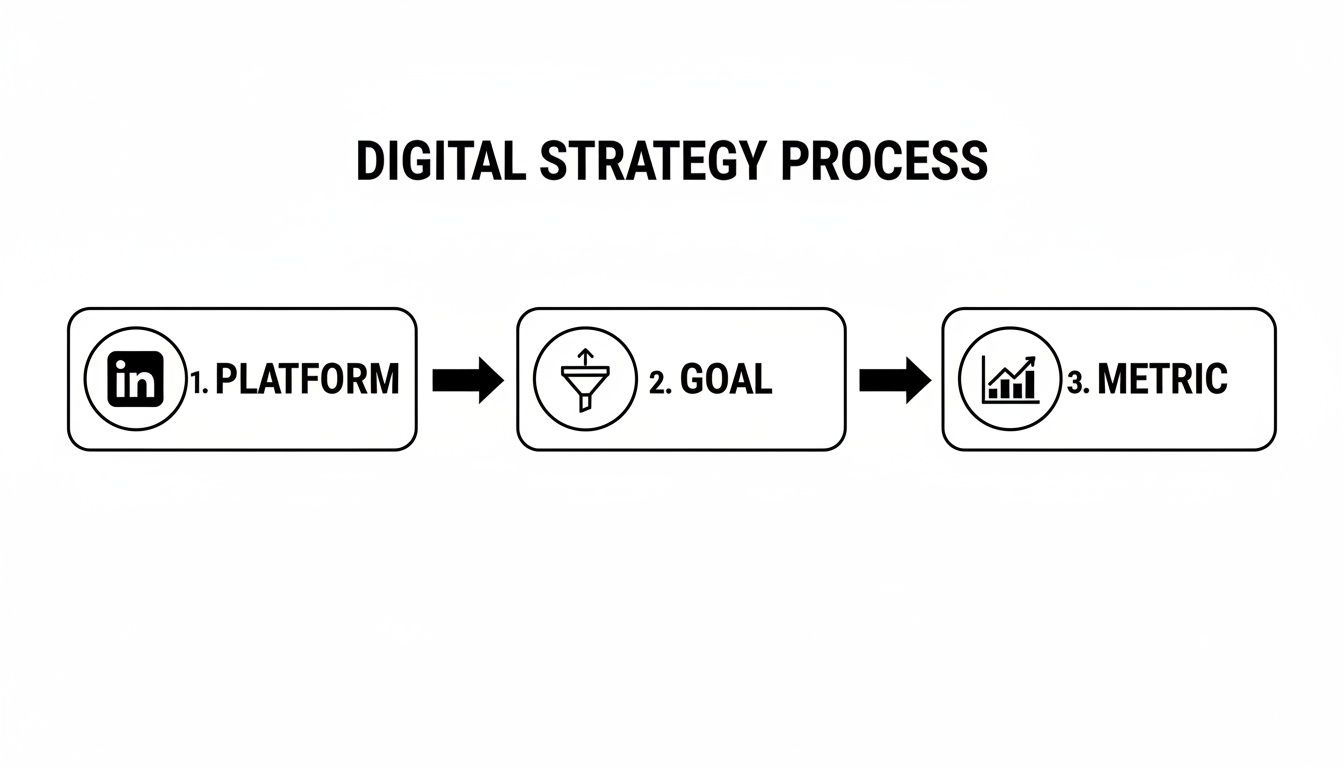
This visual shows the direct flow: you pick a platform, define a goal, and then choose a metric. That metric is what you track with tools like UTMs.
Actionable Fix #2: Set Up Tracking Pixels
While UTMs track clicks, tracking pixels monitor actions on your website. A pixel is a small piece of code from a social platform (like the Meta Pixel or TikTok Pixel) that you install on your site.
Here's how to use them for ROI tracking:
- Install the Base Code: Add the main pixel code to the header of every page on your website.
- Set Up Conversion Events: Configure the pixel to fire on specific actions that align with your goals. Common events include:
ViewContent: A user views a product page.AddToCart: A user adds an item to their cart.Lead: A user submits a form.Purchase: A user completes a transaction.
Limitations to Note:
- iOS 14+ Updates: Apple's privacy changes allow users to opt out of tracking, which can lead to underreporting of conversions. Pixel data is now a strong directional signal rather than a perfect 1-to-1 count.
- Ad Blockers: Some users have ad blockers that can prevent pixels from firing correctly.
Actionable Fix #3: Understand Attribution Models
A customer's journey is rarely linear. They might see your Facebook ad, then click a tweet a few days later, and finally make a purchase after a Google search. Attribution is how you assign credit for that sale.
-
Last-Click Attribution (The Default): Gives 100% of the credit to the final touchpoint before the conversion (the Google search in our example).
- Problem: This model systematically undervalues social media's role in building awareness and consideration at the top of the funnel.
-
Multi-Touch Attribution (The Better Way): Distributes credit across multiple touchpoints that influenced the decision.
- Why it Matters for ROI: Using a Multi-Touch Attribution model in tools like Google Analytics 4 gives you a more accurate picture of how your social media efforts contribute to conversions, even when they aren't the final click. This ensures social media gets the credit it deserves.
Step 4: Calculate Your Social Media ROI
With your goals defined and tracking in place, it’s time to run the numbers. This is where you translate your data into a clear financial result.
Let's use a real-world scenario: a small e-commerce brand selling handcrafted leather goods ran a social media campaign last quarter to launch a new product line.
How to Calculate the Total Investment
First, you must account for every cost associated with the campaign. Forgotten expenses are the quickest way to inflate your ROI.
- Ad Spend: The total budget for their Facebook and Instagram ads was $2,500.
- Content Creation: They hired a freelance photographer for a product shoot, which cost $1,000.
- Tool Subscriptions: A portion of their social media scheduling tool's cost (like PostPlanify) for the quarter is about $150.
- Team Hours (Labor Cost): Their social media manager spent approximately 40 hours on this campaign. At a blended rate of $20/hour, that's an $850 investment of time.
Adding these up, their Total Investment for the campaign is $4,500.
How to Calculate the Total Return
Because they correctly set up their UTM parameters and the Meta Pixel, they can filter their Google Analytics or e-commerce dashboard to see revenue directly attributed to their social channels. During the campaign period, they generated $10,000 in revenue from social media traffic.
Now, we plug these numbers into the ROI formula:
ROI = [($10,000 Revenue - $4,500 Investment) / $4,500 Investment] * 100
The result is a Social Media ROI of 122%.
This means for every $1 they invested in their social media campaign, they earned that dollar back plus an additional $1.22 in profit. That’s a clear win you can take to your boss. For a deeper dive into the core principles, check out this guide on how to calculate marketing return on investment.
How to Value Non-Monetary Conversions
What if your goal is lead generation, not direct sales? This is a common challenge for B2B and service-based businesses. The solution is to assign a monetary value to each lead.
Here’s a simple, step-by-step method:
- Calculate Customer Lifetime Value (CLV): Determine the average total revenue a customer generates over their entire relationship with your business. Let's say your CLV is $5,000.
- Determine Your Lead-to-Customer Conversion Rate: Look at historical data to find out what percentage of leads become paying customers. Let's assume 1 in 10 leads convert, so your conversion rate is 10%.
- Calculate the Value of a Single Lead: Multiply the CLV by the conversion rate.
- Lead Value = $5,000 (CLV) x 0.10 (Conversion Rate) = $500
Now you know that each qualified lead generated from social media is worth $500 to your business. If your LinkedIn campaign generated 20 leads, your "Return" is $10,000 (20 leads x $500/lead). You can now calculate your ROI just as you would with direct sales.
This focus on the bottom line is now the standard. A HubSpot report found that 60% of marketers measure their social success by the sales it generates. For B2B marketers, this is even more critical. A Statista poll from May 2023 named Facebook the top platform for B2B ROI, with 22% of professionals saying it delivers the best value for lead generation.
For content creators, the "return" might be potential earnings from brand deals. You can estimate this using tools like a TikTok money calculator to get a baseline revenue figure to measure against your content creation investment.
Troubleshooting & FAQs
Even with a solid plan, measuring social media ROI can be tricky. Here are solutions to common problems.
Problem: "How do I value goals like brand awareness or engagement?"
Cause: These goals don't have a direct, obvious monetary value like a sale.
Actionable Fixes:
- Calculate Lead Value (as shown above): This is the best method. Connect top-of-funnel activities to a down-funnel metric like leads, which has a calculable value.
- Benchmark Against Paid Channels: Determine the cost to achieve the same results with paid ads. If an organic post that cost you $100 in time gets the same reach as a $500 ad campaign, you've generated a "return" of $400 in equivalent media value. To understand what competitors are spending on and how they position their ads, explore the Meta Ads Library for transparent insights into active ad campaigns.
The goal isn't to find a perfect, to-the-penny value for a single "like." It's about creating a consistent, logical model to track progress and justify your strategy.
Problem: "What is a good social media ROI benchmark?"
Cause: Marketers often look for a universal number to compare against, but one doesn't exist.
Solution: It depends entirely on your industry, profit margins, and business goals. An e-commerce brand with high margins might aim for a 150% ROI, while a SaaS company with high overhead could be thrilled with 50% ROI from a high-quality lead generation campaign.
Focus on these two benchmarks instead:
- Your Own Past Performance: Your most important benchmark is your historical data. Aim for continuous improvement quarter-over-quarter.
- Profitability: At a minimum, your ROI must be positive. If you are consistently losing money on your efforts, it’s a clear signal that your strategy or tracking needs a complete overhaul.
Problem: "How often should I calculate my ROI?"
Cause: Daily or weekly ROI calculation is often impractical and the data can be noisy.
Solution: A comprehensive ROI report should be done on a quarterly basis. This gives your campaigns enough time to mature and collect meaningful data without letting an underperforming strategy run for too long. For short-term campaigns (e.g., a flash sale or holiday promotion), calculate the ROI immediately after the campaign concludes.
Summary Checklist for Measuring Social Media ROI
- Define Your Business Goal: Start with a clear business objective (e.g., increase revenue, generate leads).
- Identify Your Social Media Conversion: Determine the specific user action that supports your business goal (e.g., form submission, completed purchase).
- Align Metrics with Platforms: Choose KPIs that match each platform's strengths (e.g., Lead Form Completions on LinkedIn, Product Tag Clicks on Instagram).
- Set Up Tracking: Implement consistent UTM parameters and install tracking pixels (Meta, TikTok, etc.) on your website.
- Calculate Total Investment: Add up all costs, including ad spend, content creation, tools, and labor.
- Calculate Total Return: Measure the revenue or assign a monetary value to your conversions (e.g., lead value).
- Use the ROI Formula:
ROI = [(Return - Investment) / Investment] * 100. - Analyze and Optimize: Review your results quarterly and adjust your strategy based on what the data tells you.
Ready to get a clear, unified view of your social media performance without juggling a dozen different reports? PostPlanify brings all your key analytics into one dashboard, making it easier to track the metrics that truly matter. Stop guessing and start measuring what works. Start your free 7-day trial of PostPlanify today.
PostPlanifyAll your social media in one simple dashboard
Schedule posts, track analytics, and reply to comments/DMs without switching tabs.
Engagement
+18%
Views
52.8k
About the Author

Hasan Cagli
Founder of PostPlanify, a content and social media scheduling platform. He focuses on building systems that help businesses, agencies, and teams plan, publish, and manage content and social media more efficiently across platforms.


