


Jumping into content creation without a plan is a recipe for burnout and mediocre results. You post when you feel inspired, engagement is flat, and you’re not sure why nothing is working. The problem isn’t a lack of effort; it’s a lack of foundation. Building a social media presence that actually drives business outcomes starts with a clear, actionable strategy.
This guide will walk you through the practical steps to build that foundation: setting measurable goals, defining your audience, and choosing the right platforms to reach them.
Step 1: Lay the Groundwork with a Clear Strategy

It’s easy to get caught up in chasing hashtags or the latest viral trend. But the brands that succeed on social media operate with intention. Posting without a strategy is like driving without a map—you'll burn a lot of fuel, but you won’t get where you need to go.
The social media landscape is massive. As of early 2026, there are 5.66 billion users worldwide, spending an average of 2 hours and 23 minutes a day scrolling across multiple platforms. This proves that a focused, strategic approach is essential to cut through the noise.
Problem: Your social media efforts feel disconnected from business results.
Why it happens: Your goals are too vague. A goal like "get more followers" isn't a business objective. It doesn't tell you what content to create or how to measure success, leading to random acts of content that don't add up to anything meaningful.
The Fix: Set specific, measurable goals tied to business outcomes.
- Identify Your Primary Objective: What is the #1 thing you need social media to do for your business right now? Is it increasing brand awareness, generating qualified leads, driving website traffic, or building a loyal community?
- Attach a Number and a Deadline: Turn your objective into a specific, measurable target.
- Instead of: "Increase brand awareness."
- Try: "Increase Instagram profile reach by 25% this quarter by collaborating with three micro-influencers."
- Instead of: "Generate more leads."
- Try: "Capture 50 new email subscribers per month from a link in my LinkedIn bio promoting a free webinar."
- Instead of: "Boost engagement."
- Try: "Increase our average engagement rate on Facebook from 2% to 4% by replying to every comment within two hours."
- Use These Goals to Guide Your Strategy: These clear targets make it simple to see what's working and what's not, allowing you to make data-driven decisions instead of guessing.
Problem: Your content isn't resonating with anyone.
Why it happens: You don't have a deep, specific understanding of your audience. Generic demographics like "women, ages 25-40" are not enough. This leads to creating content for a faceless crowd, which ends up connecting with no one.
The Fix: Build a detailed persona of your ideal follower.
- Go Beyond Demographics: Think about a real person. What are their biggest professional or personal challenges? What are their goals and aspirations? What kind of content do they find genuinely helpful or entertaining?
- Identify Their Pain Points: What specific problems do they face that your product or service solves? Your content should be the answer to their questions.
- Scenario: A financial advisor targeting millennials might find their audience is overwhelmed by financial jargon and trusts TikTok creators more than traditional ads. This insight tells the advisor to create simple, jargon-free video content on TikTok, not complex articles on a blog.
- Discover Where They Spend Their Time Online: Don't assume. Use surveys, customer interviews, or analytics to find out which platforms they actually use and for what purpose. They might use LinkedIn for their career but scroll Instagram for lifestyle inspiration.
Problem: You're spread too thin across too many platforms.
Why it happens: The fear of missing out (FOMO) pushes you to create profiles everywhere. This leads to burnout and posting low-quality, generic content across all channels because you don't have the bandwidth to do any of them well.
The Fix: Choose one or two platforms to master first.
- Match Platforms to Your Goals and Audience: Based on your audience persona, identify the platforms where they are most active and engaged. If monetization is a priority, our guide to which social media platform pays the most can help you weigh earning potential alongside audience fit, and our full guide on how to monetize social media covers every strategy from brand deals to digital products.
- Prioritize Based on Your Strengths: Consider what kind of content you can realistically create consistently and well. If you're great on camera, TikTok or Instagram Reels might be a perfect fit. If you're a strong writer, LinkedIn or X could be your sweet spot.
- Focus Your Energy: It's better to create amazing, platform-native content for one channel than to post mediocre content on five. Dominate one platform before considering another.
Platform-Specific Use Cases:
- LinkedIn: The go-to for B2B brands, consultants, and building professional authority. Best for long-form text posts, articles, and professional video.
- Instagram & TikTok: Ideal for visual brands in e-commerce, fashion, food, and travel. Perfect for reaching younger audiences with short-form video, high-quality images, and influencer collaborations.
- Facebook: A powerhouse for building local communities, running targeted ads, and connecting with a broad, diverse age range. Great for video, live streams, and community groups.
- X (formerly Twitter): Excellent for real-time news, joining industry conversations, customer service, and driving traffic with short, punchy updates.
For a deeper dive into the foundational principles, this guide on how to build a social media presence provides a fantastic overview.
Step 2: Optimize Your Profiles for Discovery and Conversion
Your social media profile is your digital storefront. It’s often the first impression a potential follower has of your brand. A weak, incomplete, or confusing profile is a major missed opportunity.
Problem: New visitors land on your profile and immediately leave.
Why it happens: Your profile doesn't instantly communicate who you are, what you do, and why they should follow you. It lacks clarity and a compelling reason to stick around. This results in low follower conversion rates, even if your content is getting some reach.
The Fix: Nail the universal profile essentials for a consistent brand identity.
- Secure a Consistent Username: Your handle (@username) should be as close to your brand name as possible and identical across all platforms. This makes you easy to find, remember, and tag. Before you settle on a handle, check Instagram username availability to make sure it's not already taken.
- Edge Case: If your exact username is taken, add a clean, simple modifier like "@[brand]hq," "@get[brand]," or "@[brand]app." Avoid random numbers or underscores.
- Use a High-Quality Profile Picture: For personal brands, use a clear, professional headshot. For companies, use a crisp logo that is recognizable even as a tiny circle in a feed.
- Write a Bio That Converts: This is your elevator pitch. In 1-2 lines, clearly state who you help and how you help them. Ditch jargon and focus on the value you provide. Use keywords your audience would search for. Our guide to crafting the perfect social media bio can help you write one that works.
- Maximize Your One Link: Most platforms give you only one clickable link in your bio. Use it wisely. A "link-in-bio" tool turns this single spot into a landing page for your most important content, products, or lead magnets. Not sure which one to pick? Our comparison of the best link in bio tools breaks down the top options.
Problem: Your profile looks generic and doesn't stand out.
Why it happens: You're not using the unique features each platform offers to showcase your brand's personality and value. This makes your profile blend in with the millions of others and fails to capture a visitor's attention.
The Fix: Leverage platform-specific features to add depth and value.
Each social network has its own unique real estate. Using these features shows you understand the platform's culture and gives visitors more reasons to follow.
| Platform | Key Feature to Optimize | Actionable Steps |
|---|---|---|
| Highlights | 1. Create branded cover icons that match your visual identity. 2. Organize your best Stories into categories like "About Us," "Services," "Reviews," and "FAQs." | |
| Featured Section | 1. Pin your most valuable content directly below your bio. 2. Showcase your top-performing articles, links to your portfolio, or client testimonials. | |
| X (Twitter) | Pinned Post | 1. Pin a tweet that perfectly summarizes your value proposition. 2. Use it to promote a current offer, a major win, or an evergreen piece of content. |
| TikTok | Pinned Videos | 1. Pin your top 3 videos to the top of your feed. 2. Use these slots for a viral hit, a "start here" video introducing your account, or a video that explains your offer. |
A fully optimized profile works as a silent salesperson. It qualifies visitors, answers their first questions, and guides them to the next step, all before they've seen a single post.
Step 3: Develop a Content Strategy That Connects
Posting content without a plan is a fast track to burnout. A content strategy is the bridge between your goals and what your audience actually wants, ensuring every post has a purpose. It stops the last-minute scramble for ideas and turns your social media into a proactive growth engine.
Problem: You're constantly running out of content ideas.
Why it happens: You're thinking post-by-post instead of creating a thematic framework. This reactive approach is stressful and leads to inconsistent, off-brand content.
The Fix: Define your core content pillars.
- Identify 3-5 Core Themes: Brainstorm the main topics at the intersection of your brand's expertise and your audience's interests. If your brand were a magazine, these would be the main sections.
- Create Pillars That Solve Problems: Each pillar should directly address a pain point or interest of your target audience.
- Scenario: A personal trainer might choose these pillars:
- Effective Workouts: (Tutorials, form tips, workout routines)
- Simple Nutrition: (Healthy recipes, meal prep ideas, myth-busting)
- Mindset & Motivation: (Building habits, overcoming plateaus, success stories)
- Scenario: A personal trainer might choose these pillars:
- Use Pillars for Brainstorming: Now, instead of staring at a blank page, you can simply brainstorm ideas under each pillar. This makes content creation systematic and ensures you stay on-topic.
Problem: Your feed feels repetitive or overly promotional.
Why it happens: Your content mix is unbalanced. If all you do is post educational tips or, even worse, sales pitches, your audience will quickly tune out.
The Fix: Create a balanced mix of content formats and purposes.
A healthy content mix provides value in different ways to keep your audience engaged. Aim for a mix of these four types:
- Educational (Value): Solves your audience's problems. Think "how-to" guides, tutorials, quick tips, and industry insights. This builds authority and trust.
- Entertaining (Humanizing): Captures attention and shows personality. This could be memes, behind-the-scenes content, or participating in relevant trends.
- Inspirational (Community): Builds an emotional connection. Share client success stories, user-generated content, or motivational quotes that resonate with your audience's goals.
- Promotional (Sales): Talks directly about your products or services. This is essential but should be the smallest part of your mix. Follow the 80/20 rule: 80% value-driven content, 20% promotion.
Problem: Your content doesn't look or sound like it comes from the same brand.
Why it happens: You lack a defined brand voice and visual style. Inconsistency confuses your audience and makes it impossible to build brand recognition in a crowded feed.
The Fix: Cultivate a unique and consistent brand identity.
- Define Your Brand Voice: Is your brand's personality witty and playful, or professional and authoritative? Choose a voice and use it consistently in every post, comment, and DM.
- Establish a Visual Style: Create a cohesive look for your feed. This includes:
- Consistent Color Palette: Use a specific set of brand colors in your graphics and photos.
- Font Choices: Stick to 1-2 brand fonts for all text overlays.
- Photo Editing Style: Apply similar filters or presets to all images.
Consistency builds brand recognition, a critical component of a strong social media presence.
Problem: You know what to post, but you struggle to do it consistently.
Why it happens: You don't have a system for execution. A great strategy is useless without a process to bring it to life.
The Fix: Use a content calendar and a scheduling tool.
A content calendar is your most important tool for planning your content mix and maintaining a steady posting rhythm. Our guide explains how to plan social media content from scratch.
Pairing your calendar with a scheduler like PostPlanify lets you put that plan into action. You can bulk-schedule a week or a month of content in one session. This automates consistency, freeing you up to focus on engaging with your community in real-time.
Step 4: Execute with Consistent Posting and Engagement
A great strategy is just a document until you put it into action. This is where daily habits transform your plans into a growing social media presence. Posting sporadically confuses both the algorithms and your audience, killing any momentum.
Problem: Your growth has stalled, and your reach is declining.
Why it happens: Inconsistent posting. Social media algorithms favor active, reliable accounts. When you post erratically, you signal to platforms like Instagram and TikTok that your account is less valuable, so they show your content to fewer people. For your audience, it breaks trust and makes your brand seem unreliable.
The Fix: Commit to a consistent posting cadence.
Brands that post daily see 3x more interactions than those who post randomly. This framework shows how your strategy elements work together.
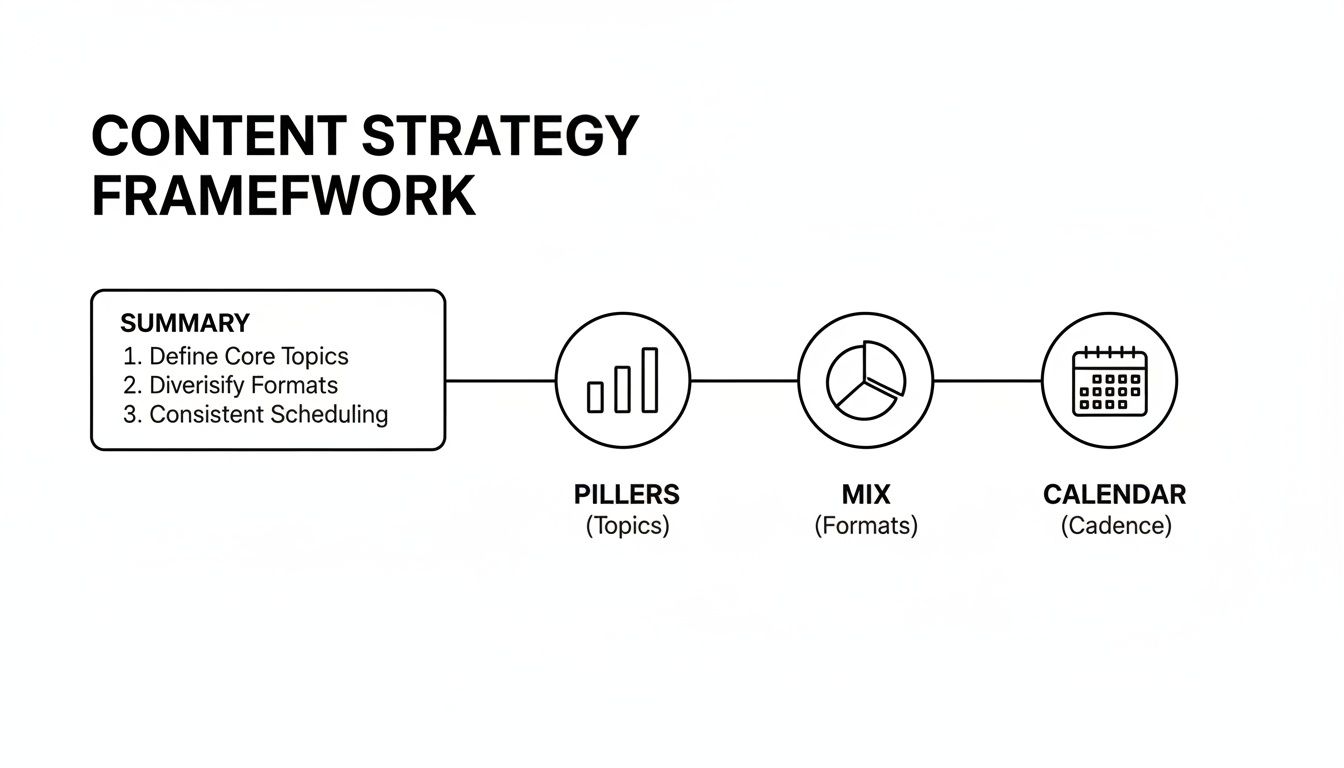
There's no single magic number for posting frequency, but each platform has its own rhythm.
- Instagram and Facebook: Aim for 3-5 high-quality posts per week. Supplement with daily Stories and Reels to stay top-of-mind.
- X (formerly Twitter): A high-volume platform. 1-3 times per day is a good starting point to stay relevant in the fast-moving feed.
- LinkedIn: Quality trumps quantity. 2-4 times per week with insightful, professional content is ideal.
- TikTok: The algorithm rewards frequency. Aim for 1-3 videos per day, especially in a growth phase.
Key Takeaway: Consistency isn't about posting 24/7. It's about choosing the right frequency for your key channels and sticking to it. A scheduling tool like PostPlanify automates this process, turning a daily grind into a simple workflow.
Problem: You're posting content, but nobody is talking back.
Why it happens: You're treating social media like a broadcast, not a conversation. Simply pushing content out without actively engaging is like shouting into an empty room. Engagement is what turns passive followers into a community and gets your content seen by new audiences.
The Fix: Make proactive engagement a non-negotiable daily task.
- Reply to Every Comment and DM: When someone takes the time to comment, acknowledge it. Ask a follow-up question to keep the conversation going. This makes your followers feel heard and boosts your post's visibility.
- Limitation: Be aware of platform limitations on DM automation and response rates. Authentic, manual replies are always best.
- Engage with Other Accounts in Your Niche: Spend 15-20 minutes a day leaving thoughtful, relevant comments on posts from others in your industry. Don't just say "Great post!" Add value to the conversation.
- Participate in Relevant Conversations: Use platform search features to find people talking about your key topics. On X, this could be a trending hashtag. On LinkedIn, it might be adding your perspective to a popular industry post.
For a deeper dive, our guide can help you improve your social media engagement. Integrating these 11 effective social media strategies will blend great content with smart interaction.
| Platform | Optimal Content Type | Recommended Frequency | Key Engagement Tactic |
|---|---|---|---|
| High-quality visuals: Reels, Carousels, Stories | 3-5 times/week | Respond to DMs and story replies quickly. Use interactive stickers. | |
| X (Twitter) | Short text updates, memes, threads, links | 1-3 times/day | Join trending conversations and use relevant hashtags. |
| Professional articles, case studies, text posts | 2-4 times/week | Comment thoughtfully on industry leaders' posts. Engage in groups. | |
| TikTok | Short-form vertical video, trends, tutorials | 1-3 times/day | Duet/stitch popular videos and use trending audio. |
| Videos, community posts, event promotion | 3-5 times/week | Engage actively in relevant groups and respond to all comments. |
Step 5: Use Analytics to Refine and Scale Your Strategy
Posting content without analyzing performance is like flying blind. You're wasting time on what doesn't work and missing opportunities for growth. Analytics turn your social media from a guessing game into a repeatable system.
Problem: You're tracking metrics but don't know what they mean for your business.
Why it happens: You're focused on vanity metrics instead of actionable metrics. Likes and follower count feel good, but they don't tell you if your content is actually driving results.
The Fix: Focus on the metrics that align with your goals.
- Vanity Metrics: Follower count, likes. They look good but offer little insight into business impact.
- Actionable Metrics: Engagement rate, click-through rate (CTR), reach, shares, saves. These numbers tell you what your audience responds to and how your content performs against your goals.
A post with 100 likes and a 10% engagement rate is more valuable than one with 500 likes and a 1% engagement rate. The first post resonated more deeply with your audience.
Problem: You don't know which numbers to track.
Why it happens: You haven't connected your goals to specific Key Performance Indicators (KPIs). Each goal has different success metrics.
The Fix: Align your KPIs directly with your goals.
| If Your Goal Is... | ...Then Your Primary KPIs Are | What to Look For |
|---|---|---|
| Increase Brand Awareness | Reach and Impressions | How many unique accounts saw your Instagram Reel? What were the total views on your LinkedIn article? |
| Drive Website Traffic | Click-Through Rate (CTR) and Link Clicks | How many people clicked the link in your X bio? What was the CTR on your last Facebook post with a link? |
| Build Community | Engagement Rate (comments, shares, saves) | What's the average engagement on your TikTok videos? How many shares did your last Facebook post get? |
Our guide on social media analytics and reporting breaks down how to find and track these metrics.
Problem: You collect data but don't do anything with it.
Why it happens: You don't have a simple, repeatable process for reviewing your performance.
The Fix: Conduct simple monthly performance reviews.
Once a month, look at your core KPIs and ask these three questions:
- What was our top-performing content? Look at the engagement rate, not just likes. Why did it work? Was it the format (carousel vs. video), the topic, or the caption?
- What was our worst-performing content? Why did it flop? Was the topic too niche? Was the visual uninspired? Learn from what doesn't work.
- What trends are we seeing? Is video consistently outperforming static images? Do text-only posts on LinkedIn get more comments? Double down on what your data tells you your audience wants.
Your data is the most honest feedback you'll ever get. Use these check-ins to make small, informed tweaks to your strategy.
Troubleshooting & FAQs
"How long does it really take to build a social media presence?"
It's a marathon, not a sprint. With a consistent, value-driven strategy, you can expect to see tangible traction within 3-6 months. This doesn't mean a huge follower count. It means consistent engagement, real conversations, and predictable traffic. The first few months are about building the right habits and a loyal core audience.
"Should I be on every social media platform?"
No. This is one of the most common mistakes. Trying to be everywhere leads to burnout and low-quality content. Start with one or two platforms where you know your target audience is most active. Master those channels first, then consider expanding strategically if it aligns with your goals.
"What do I do if my growth stalls?"
Plateaus are normal. Instead of panicking, diagnose the problem.
- Check Your Analytics: Is it your follower growth that's flat, or has your engagement rate also dropped?
- Revisit Your Content Pillars: Are your topics still relevant to your audience? Their needs may have changed.
- Experiment with New Formats: If you've only been posting images, commit to video. If videos are falling flat, try text-based posts that spark discussion.
- Increase Outbound Engagement: Spend extra time leaving thoughtful comments on other accounts in your niche. This is often the fastest way to get new eyes on your profile.
Quick Checklist for Building Your Social Media Presence:
- Define Your Goals: Set 1-2 specific, measurable business objectives.
- Know Your Audience: Create a detailed persona of your ideal follower.
- Choose Your Platforms: Pick 1-2 channels to master first.
- Optimize Your Profiles: Nail your bio, profile picture, and use platform-specific features.
- Establish Content Pillars: Define 3-5 core themes to guide your content creation.
- Plan Your Content Mix: Balance educational, entertaining, inspirational, and promotional posts.
- Commit to a Cadence: Choose a realistic posting schedule and stick to it.
- Engage Proactively: Spend at least 15 minutes a day interacting with your community and niche.
- Review Your Analytics: Conduct monthly check-ins to see what's working and refine your strategy.
 PostPlanify
All your social media in one simple dashboard
Schedule posts, track analytics, and reply to comments/DMs without switching tabs.

Engagement
+18%
Views
52.8k
About the Author

Hasan Cagli
Founder of PostPlanify, a content and social media scheduling platform. He focuses on building systems that help businesses, agencies, and teams plan, publish, and manage content and social media more efficiently across platforms.


