


Every week, the same question shows up in every social media group, subreddit, and DM thread: "Should I be posting Reels, Stories, or regular posts?"
And every week, someone replies with the same useless answer: "All three!"
That's not a strategy. That's a to-do list.
The real answer depends on what you're trying to do, who you're trying to reach, and how much time you actually have. A solopreneur running a bakery doesn't have the same content needs as a SaaS startup or a fitness influencer — and the Instagram algorithm treats each format differently.
This guide breaks down exactly how Posts, Stories, and Reels perform in 2026, what the algorithm actually prioritizes for each one, and how to build a strategy around your specific situation — not some generic "post everything" advice.
No fluff. No filler. Just the data and the playbook.
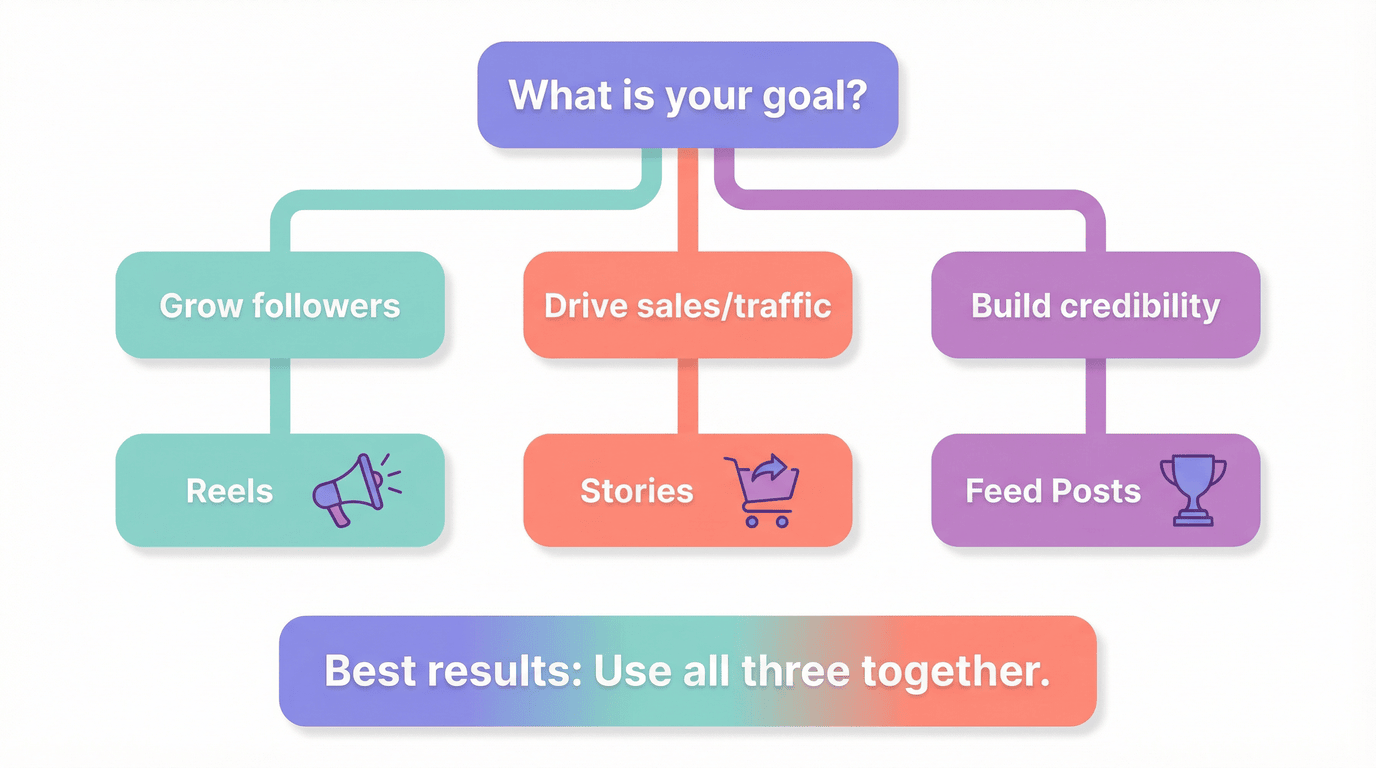
The short answer: Use Reels for growth and reaching new audiences (30%+ reach rate including non-followers). Use Stories for driving sales and deepening relationships with existing followers (50% of users have made a purchase after seeing a Story). Use Feed Posts for building long-term credibility, ranking in Instagram search, and creating saveable content. The best strategy combines all three using a single-idea repurposing workflow — which we break down below.
At a Glance: Posts vs Stories vs Reels
Before we go deep, here's the side-by-side comparison. Bookmark this table — you'll come back to it.
| Feed Posts | Stories | Reels | |
|---|---|---|---|
| Lifespan | Permanent | 24 hours (unless Highlighted) | Permanent |
| Average reach | 13–14% of followers | 20–50% of followers | 30–33% (includes non-followers) |
| Primary audience | Existing followers | Engaged followers | New + existing audiences |
| Engagement strength | Saves, comments, shares | Replies, poll taps, link clicks | Views, shares, follows |
| Best for | Brand credibility, education, portfolio | Connection, real-time updates, conversions | Discovery, growth, virality |
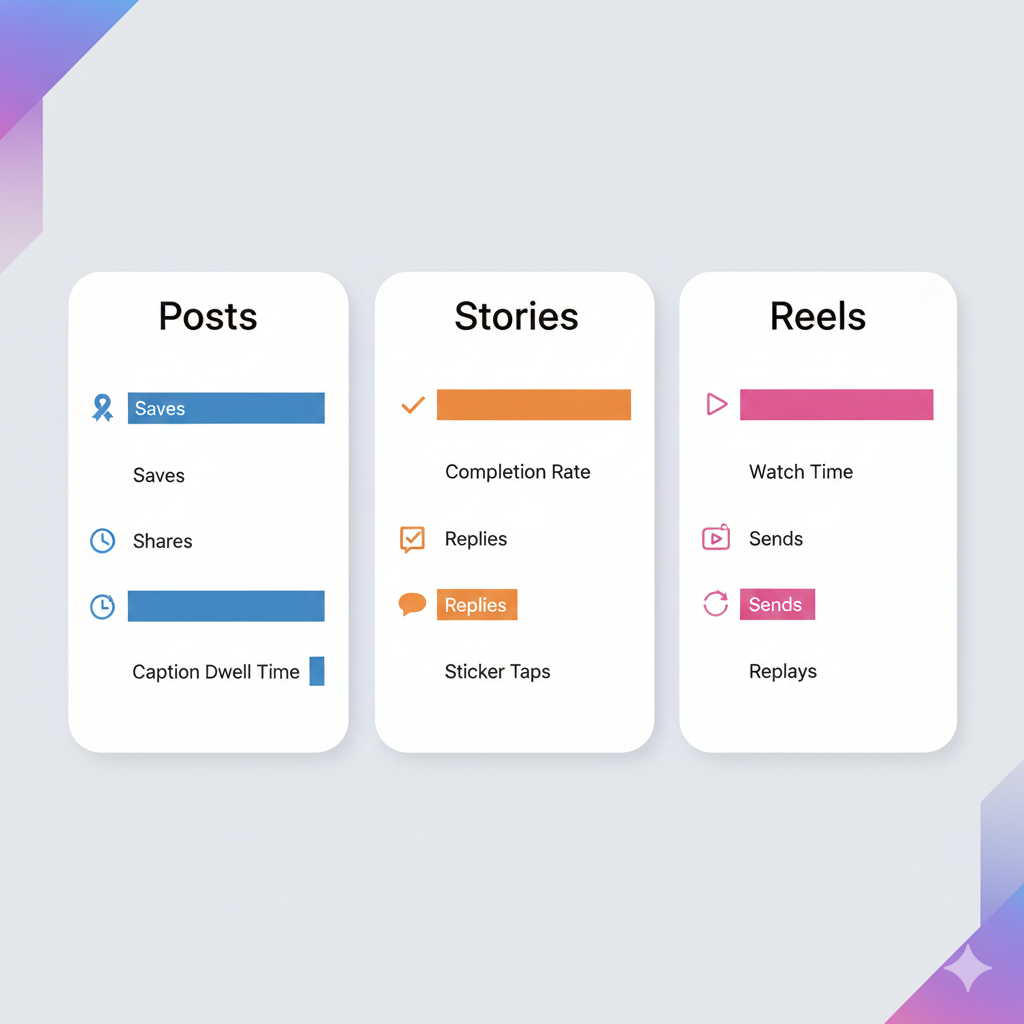
| Algorithm priority (2026) | Caption dwell time, saves, shares | Completion rate, reply depth | Sustained watch time, shares, replays |
| Max length | 10 carousel slides / 2,200 char caption | 60 sec per slide | Up to 20 minutes |
| Effort level | Medium | Low | High |
| Discoverability | Low–Medium (Explore page) | Very low (followers only) | Very high (Reels tab, Explore, Search) |
Key Takeaways
- Reels have the highest reach (30-33%) and are the best format for attracting new followers — but they require the most production effort
- Stories reach 20-50% of your followers and drive the highest conversion rates — 50% of users visit a website after seeing a product in a Story
- Feed Posts (especially carousels) generate the most saves and rank in Instagram search — they're your permanent portfolio
- The 2026 algorithm prioritizes DM shares (Sends) over likes across all formats
- You don't need to create 3x the content — repurpose one idea into all three formats (see the workflow below)
Now let's break each one down.
Instagram Feed Posts: Your Permanent First Impression
Feed posts are the foundation of your Instagram presence. When someone lands on your profile — whether from a Reel, a Google search, or a friend's tag — your grid is the first thing they evaluate before deciding to follow.
Think of your feed as a landing page, not a diary.
What Feed Posts Are Good At
Building trust and credibility. A well-organized grid with valuable carousel posts, clear branding, and thoughtful captions tells visitors: "This account knows what it's doing." That first impression directly impacts your follower conversion rate.
Driving saves and shares. Feed posts — especially carousels — generate the highest save rates of any format. Saves matter because they signal to Instagram that your content has long-term value, which pushes it further in the algorithm.
Ranking in search. Instagram's search engine indexes your captions, alt text, and hashtags from feed posts. Unlike Stories (which disappear) and Reels (which are video-dependent), feed posts give you the most surface area for keyword-rich, searchable content.
The 2026 Feed Post Playbook
The game has changed. Instagram now measures caption dwell time — how long someone pauses to actually read your caption. This means:
- Captions that tell stories, teach something, or provoke genuine thought get rewarded
- "Link in bio" one-liners are dead weight
- The first line needs to hook hard enough to make people tap "...more"
Carousels still outperform single images. The data hasn't shifted here — carousels get roughly 2x the engagement of single-image posts because each swipe counts as additional interaction. But in 2026, the key metric isn't just swipe-through rate. It's whether people save the carousel and share it via DMs. If you're new to carousels, our Instagram carousel guide covers the full strategy, and you'll want to nail the correct Instagram image sizes before designing your slides.
What to post as feed content:
- Educational carousels (step-by-step guides, myth-busting, tips)
- Before/after transformations
- Data breakdowns or industry insights
- Customer testimonials and case studies
- Product announcements and launches
- Brand story or mission posts
What to skip:
- Low-effort single images with no context
- Motivational quotes with no original commentary
- Posts you're making just to "stay consistent" without adding value
Feed Post Metrics That Matter in 2026
Forget vanity likes. Here's what the algorithm actually weighs:
- Saves — The strongest positive signal. A save says "I want to come back to this."
- Shares (Sends) — DM shares now carry more weight than likes in Instagram's ranking system.
- Caption dwell time — Longer reads = higher relevance score.
- Comments with depth — Instagram now distinguishes between a fire emoji and a genuine multi-word response. Comments over 5 words are categorized as "high social relevance."
- Profile visits after viewing — If your post drives someone to check your profile, that's a strong intent signal.
Instagram Stories: Where Followers Become Customers
Stories are the most underrated format on Instagram. They don't go viral. They don't bring in new followers. And that's exactly why they're so valuable — they deepen relationships with the people who already follow you.
500 million accounts use Stories daily. And unlike Reels, which compete for attention in a global feed, Stories sit at the top of the app in a space reserved exclusively for accounts people have already chosen to follow.
That's not a limitation. That's a captive audience.
What Stories Are Good At
Driving direct action. 50% of users have visited a website to make a purchase after seeing it in a Story. No other Instagram format comes close to that conversion rate. Link stickers, product tags, and swipe-to-DM all live natively in Stories. For a deeper look at how Story reach actually works, see our guide on views on Instagram Stories.
Building parasocial connection. Stories feel personal. They're unpolished, in-the-moment, and often filmed face-to-camera. That "raw" quality is the point — it creates the feeling of a 1-on-1 conversation rather than a broadcast.
Gathering audience intelligence. Polls, quizzes, question boxes, and emoji sliders aren't just engagement tricks. They're free market research. You can test product ideas, validate content topics, and segment your audience — all without leaving Instagram.
The 2026 Stories Playbook
Instagram now tracks Story completion rate and reply quality as the two primary signals for Story ranking. Here's what that means practically:
Keep sequences short and intentional. The 88% completion rate stat you see floating around? That's the average. Accounts posting 7+ Story slides per sequence see completion drop to around 60%. The sweet spot is 3-5 slides per sequence with a clear narrative arc:
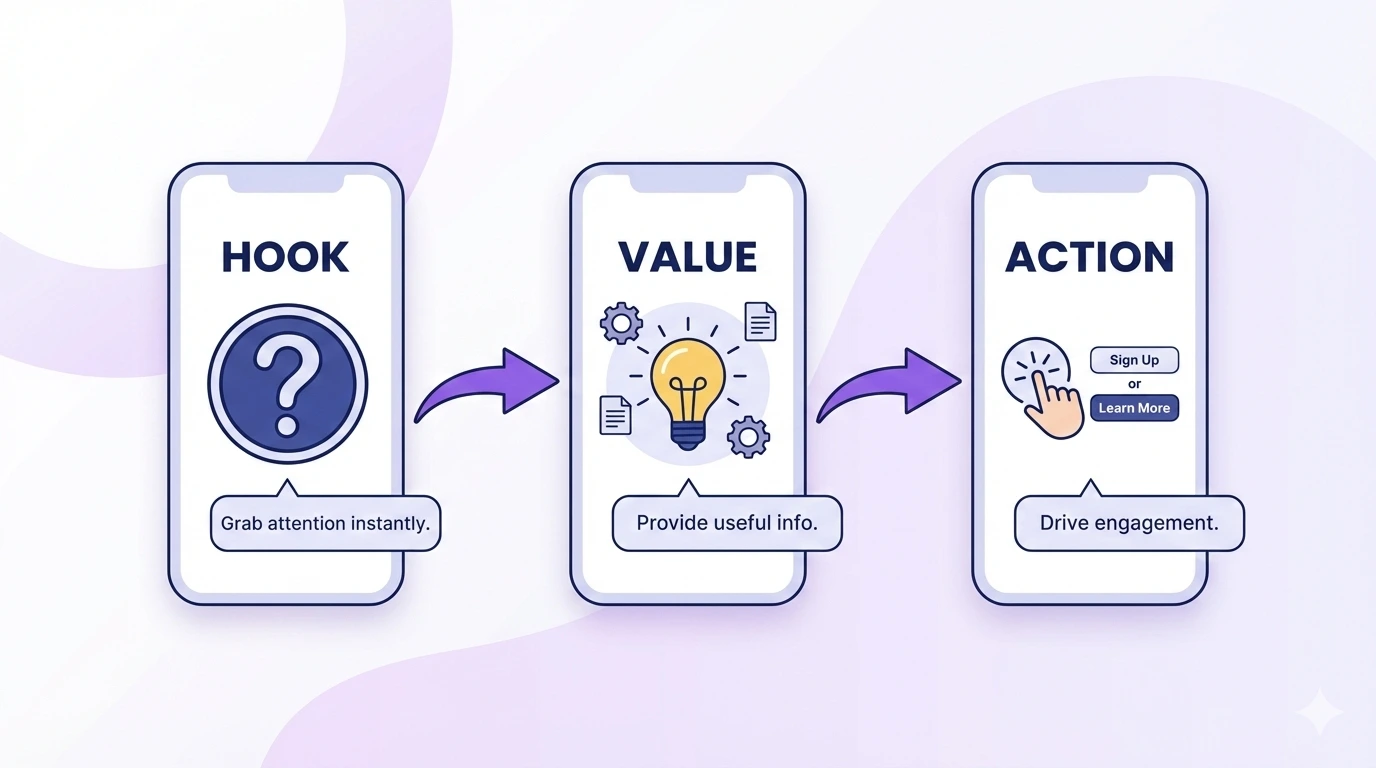
- Hook slide — A bold statement, question, or "hot take" that makes people stop tapping through
- Context slides — The substance: a tutorial, a behind-the-scenes moment, a process breakdown
- Action slide — A poll, question box, link sticker, or direct CTA
Use interactive stickers on every sequence. Not because they're fun — because they generate measurable engagement signals. A poll tap or a question reply tells Instagram that your Stories are worth showing to more of your followers. Accounts that consistently use interactive stickers see 15-25% higher reach on subsequent Stories.
Highlights are your secondary navigation. Treat your Highlights like website pages: FAQ, testimonials, pricing, tutorials, behind-the-scenes. New visitors use Highlights to quickly assess what your account is about before following. For a step-by-step walkthrough on keeping your best Stories front and center, see our guide on how to pin a Story on Instagram.
Story Strategy by Business Type
E-commerce / DTC brands:
- Daily product showcases with link stickers
- Customer UGC reposts (ask permission, tag them)
- "Poll this or that" for product preference data
- Flash sales and limited drops (urgency works best in Stories)
Service providers / Coaches / Agencies:
- Client result stories with before/after
- Quick tip sequences (3 slides max)
- "Ask me anything" Q&A sessions weekly
- Behind-the-scenes of your process
Local businesses:
- Daily specials, menu updates, event announcements
- Staff spotlights
- Customer shoutouts
- "Come visit" location stickers with real-time photos
Content creators / Personal brands:
- Day-in-the-life sequences
- Hot takes on trending topics
- Polls to crowdsource next content ideas
- Casual face-to-camera opinions
Instagram Reels: The Growth Engine
If feed posts are your landing page and Stories are your email list, Reels are your billboard on the highway. They're the only format designed to push your content to people who don't follow you yet.
The numbers are hard to ignore: Reels average a 30-33% reach rate, compared to 13-14% for feed posts. And that reach includes non-followers, meaning every Reel is a potential growth lever.
But here's what most guides won't tell you: Reels are expensive in time and energy. A single well-produced Reel can take 2-4 hours from concept to publish. If you're going to invest that effort, you need to be strategic about it.
What Reels Are Good At
Reaching new audiences at scale. Reels appear in the dedicated Reels tab, the Explore page, and increasingly in Google search results. No other Instagram format gives you this level of discoverability.
Generating follows. A single viral Reel can drive more followers in 48 hours than a month of feed posts. The path is clear: someone watches your Reel, taps your profile, sees a strong grid, and hits follow. If virality is your goal, our guide on how to go viral on Instagram covers the full playbook.
Building topical authority. Instagram's algorithm clusters your content by topic. Consistently publishing Reels around a specific theme (fitness, SaaS tips, cooking, marketing) trains the algorithm to show your content to people interested in that topic.
The 2026 Reels Playbook
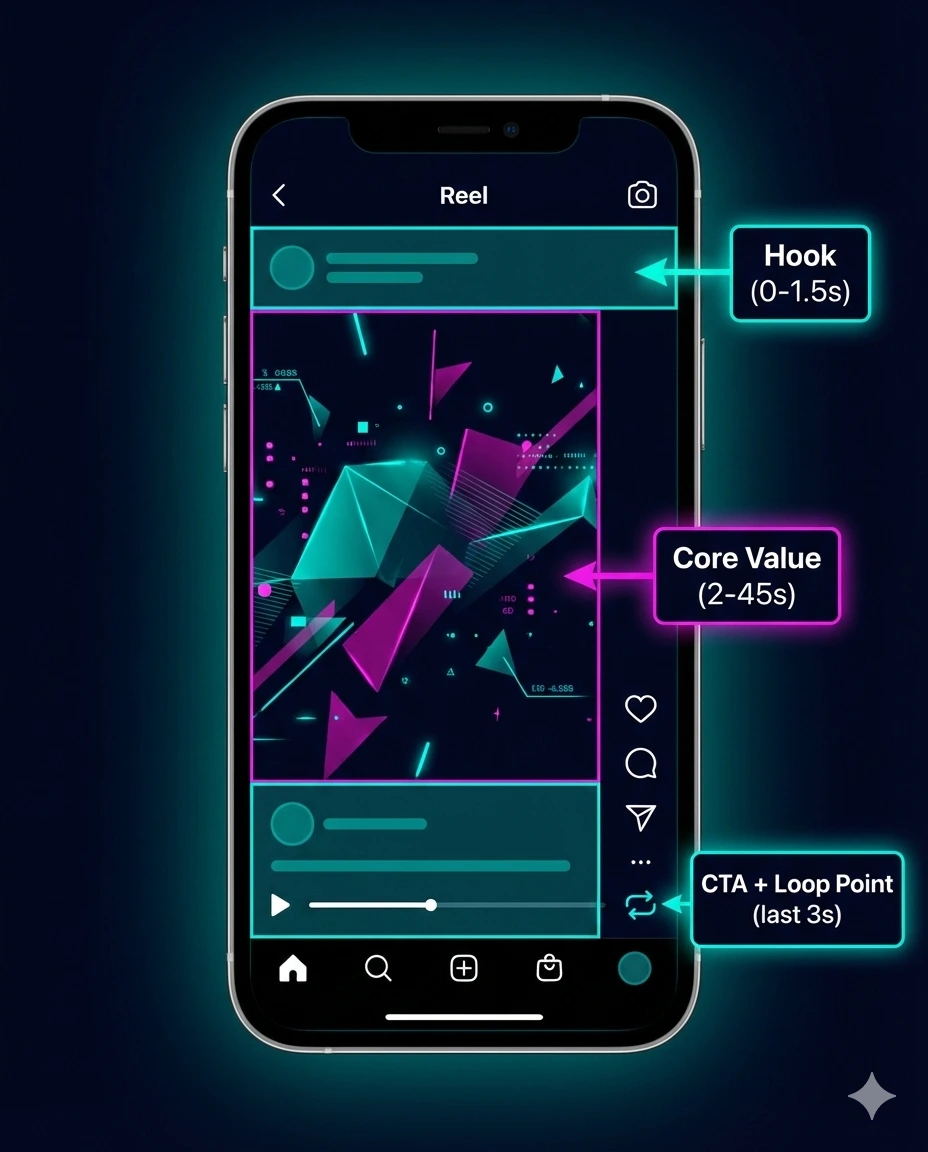
The single biggest algorithm shift in 2026: Instagram now prioritizes sustained watch time over raw view counts. The algorithm tracks whether people watch your Reel all the way through (or replay it) versus swiping away after 2 seconds.
This changes everything about how you should structure Reels:
Hook in the first 1.5 seconds. Not 3 seconds. Not "build up to it." The swipe-away window is brutally short. Your opening frame needs to create an information gap — a question, a surprising visual, a bold claim — that makes swiping away feel like a loss.
Effective hooks:
- "Stop doing [common mistake] on Instagram"
- Show the end result first, then rewind
- "Here's what nobody tells you about [topic]"
- Open with a controversial take or surprising stat
Optimize for shares over likes. Instagram has confirmed that Sends (DM shares) are now the most heavily weighted engagement signal. Content that gets shared is content that makes people think "my friend needs to see this." That means:
- Relatable observations beat polished productions
- Genuinely useful tips beat entertainment
- Niche-specific content beats broad generic content (people share what feels relevant to their circle)
Use text overlays. 40% of Reels are watched with sound off. Your Reel needs to make sense on mute. Text overlays, captions, and visual cues aren't optional — they're the difference between a view and a swipe-away.
Reels Length: Shorter Isn't Always Better
Instagram now supports Reels up to 20 minutes long. But should you use that?
Here's the framework:
| Length | Best for | Watch-time potential |
|---|---|---|
| 5-15 seconds | Quick tips, transitions, trending audio | High completion rate, lower total watch time |
| 30-60 seconds | Tutorials, storytelling, product demos | Best balance of completion + total watch time |
| 1-3 minutes | In-depth education, vlogs, reviews | Lower completion rate, but high total watch time if content is strong |
| 3-20 minutes | Full tutorials, podcasts clips, deep dives | Only works with a loyal, engaged niche audience |
The algorithm rewards total watch time, not just completion percentage. A 60-second Reel watched to 80% (48 sec) beats a 10-second Reel watched to 100% (10 sec) in algorithmic weight.
The sweet spot for most creators and brands: 30-90 seconds. If you're working with longer content, see our guide on how to post a long video on Instagram.
How the 2026 Instagram Algorithm Treats Each Format
Instagram doesn't run a single algorithm. Each surface — Feed, Stories, Reels, Explore, Search — has its own ranking system. Here's what you need to know about each in 2026:
The Big Shifts You Can't Ignore
1. "Views" is now the universal metric. Instagram unified all format performance under a single "Views" metric in late 2025. A view on a post, a view on a Story, a view on a Reel — they're all measured and displayed the same way. This simplifies comparison but also means Instagram is standardizing how it evaluates content value across formats. If you're confused about the difference between views and impressions, our views vs impressions guide and what are impressions on Instagram breakdown clarify the distinction.
2. Shares > Likes. Adam Mosseri (Instagram's head) has repeatedly confirmed that Sends (the paper airplane icon — sharing content via DM) carry more algorithmic weight than Likes. Content that gets shared gets distributed further. Full stop.
3. Conversation depth matters. A comment that says "love this" is now algorithmically worth less than a comment with 5+ words. Instagram tracks reply chains, comment length, and conversation threads. Posts that spark discussions outperform posts that collect emoji reactions.
4. Caption dwell time is tracked. When someone stops scrolling and spends time reading your caption, Instagram counts that as a relevance signal. This benefits educational and story-driven content on feed posts.
5. "Your Algorithm" user control. Launched in late 2025, this feature lets users manually adjust what topics their Reels algorithm prioritizes. The implication for creators: being clearly associated with a topic (through consistent content themes) is more important than ever, because users are actively curating their feed by topic.
The Content Repurposing Workflow: 1 Idea, 3 Formats
Posting across three formats doesn't mean creating three times the content. It means extracting three outputs from one core idea. Here's the system:
Step 1: Start with a "Pillar" Piece
Choose a topic you know well. This becomes your source material. It could be:
- A lesson you've learned
- A question your customers always ask
- A trending topic in your industry
- A result you got for a client
Example: "5 Instagram caption mistakes that kill your engagement"
Step 2: Create the Reel (Discovery)
Film a 30-60 second Reel covering the core idea. This is the wide net — it's designed to reach new people.
- Hook: "Your captions are killing your engagement. Here's why."
- Content: Cover 2-3 of the 5 mistakes (save the rest for the carousel)
- CTA: "Follow for the full list" or "Save this for later"
Step 3: Create the Carousel Post (Depth)
Turn the full topic into a 7-10 slide carousel with all 5 mistakes, explanations, and fixes. This is the searchable, saveable, shareable version.
- Slide 1: Bold hook headline
- Slides 2-9: One mistake per slide with fix
- Slide 10: CTA ("Save this. Share it with someone who needs it.")
- Caption: Full written breakdown with keywords for search
Step 4: Create the Story Sequence (Engagement)
Take the same topic and turn it into an interactive Story sequence:
- Slide 1: "What's the #1 caption mistake you see?" (Poll sticker with options)
- Slide 2: Reveal the answer with your take
- Slide 3: "Want my full caption guide?" (Link sticker or DM prompt)
One idea. Three formats. Three different jobs.
The Reel brings new people in. The carousel gives them a reason to save and follow. The Story converts followers into engaged community members (or customers). For a deeper dive into this approach, check out our guide on content repurposing strategies.
Batch Production Schedule
Don't try to create content daily. Batch it:
- Monday: Brainstorm and outline 3-4 content themes for the week
- Tuesday: Film 3-4 Reels back to back (batch recording saves hours)
- Wednesday: Design carousels and write captions
- Thursday-Sunday: Schedule posts, publish Stories daily from real-time content
Tools like PostPlanify let you schedule your feed posts and Reels in advance, so your "publishing" work happens on autopilot while you focus on real-time Stories and community interaction. Learn more about content batching to streamline your workflow, and see our guides on how to schedule Instagram Reels and automating Instagram posts for step-by-step setup.
How Often Should You Post? (Realistic Frequency by Account Size)
Ignore anyone who says you need to post 3 Reels a day. Sustainable consistency beats burnout-driven volume every time.
For accounts under 1K followers (Growth phase)
| Format | Frequency | Why |
|---|---|---|
| Reels | 4-5 per week | You need discovery. Reels are your fastest path to new eyeballs. |
| Feed posts | 1-2 per week | Build a grid that converts profile visitors into followers. |
| Stories | Daily | Even simple ones. It keeps you visible to the followers you have. |
For accounts between 1K-10K (Building phase)
| Format | Frequency | Why |
|---|---|---|
| Reels | 3-4 per week | Still prioritize growth, but focus on quality over volume. |
| Feed posts | 2-3 per week | Carousels and educational content to build authority. |
| Stories | Daily (3-5 slides) | Start using interactive stickers and link features. |
For accounts over 10K (Authority phase)
| Format | Frequency | Why |
|---|---|---|
| Reels | 2-3 per week | Focus on share-worthy content over posting frequency. |
| Feed posts | 2-3 per week | Double down on saves and search-optimized captions. |
| Stories | Daily (3-7 slides) | Use as your primary conversion and community tool. |
For brands and businesses (Any size)
| Format | Frequency | Why |
|---|---|---|
| Reels | 2-4 per week | Product demos, customer stories, industry tips. |
| Feed posts | 3-4 per week | Product launches, testimonials, educational content. |
| Stories | Daily | Promotions, behind-the-scenes, UGC reposts, polls. |
The key rule: If you can only do one thing consistently, do Reels for growth or Stories for conversions. Don't try to do everything poorly. Timing matters too — check our breakdown of the best time to post on Instagram to maximize each format's initial push.
Mistakes That Waste Your Time
These are the patterns we see over and over from accounts that post consistently but don't grow:
1. Posting Reels without a profile that converts. You get 10,000 views on a Reel but gain 12 followers. Why? Because people tap your profile and see a messy grid, no clear bio, and no reason to follow. Fix your profile before going hard on Reels. Our Instagram grid layout guide can help with that.
2. Treating Stories like a second feed. Stories are not for polished content. They're for raw, real-time, interactive content. If your Stories look like your feed posts, you're using them wrong.
3. Chasing trending audio on every Reel. Trending audio helps, but only when it's relevant to your niche. A B2B marketing agency lip-syncing to pop songs is not a strategy. Use trending audio when it naturally fits your message. Use original audio or voiceover when it doesn't.
4. Ignoring DMs and comments. The algorithm rewards conversations. If someone comments on your post and you never reply, you're telling Instagram that your content doesn't generate meaningful interaction. Reply to every comment in the first hour after posting. Every single one. For more tactics, see our guide on how to improve social media engagement.
5. Copying what works for big accounts. An account with 500K followers operates in a completely different algorithmic reality than an account with 2K followers. Their Reels work because they already have distribution. Yours need to earn it. Focus on the fundamentals: strong hooks, genuine value, clear niche.
FAQ
Should I post the same content as a Reel and a feed post?
No. They serve different purposes and audiences. Instead, repurpose the idea across formats — cover the same topic but tailor the format to what works best in each placement. A Reel should hook fast and deliver visually. A carousel should go deep and be saveable.
Are Instagram Reels better than TikTok for growth?
It depends on your audience. TikTok still has higher organic reach for brand-new accounts, but Instagram Reels drive more website traffic and conversions for most businesses. If your audience is over 25, Instagram likely gives you better ROI.
Do hashtags still matter in 2026?
They matter, but less than before. Instagram's AI now categorizes your content based on the visual content, caption text, and audio — not primarily hashtags. Use 3-5 relevant hashtags for discoverability, but don't stuff 30 thinking it'll help. It won't. Check out our Instagram hashtag guide for more detail.
How long should my Instagram Reels be?
30-60 seconds is the sweet spot for most accounts. The algorithm rewards total watch time, so a 45-second Reel watched to 85% outperforms a 7-second Reel watched to 100%. Only go longer (1-3 min) if your content genuinely justifies the length. For a deeper look at how the Reels algorithm works, read our Instagram Reels algorithm guide.
What time should I post Reels, Stories, and Posts?
There's no universal "best time." Check your Instagram Insights under "Most Active Times" for your specific audience. Generally: post Reels when your audience is most active for the initial push, post Stories throughout the day for steady visibility, and post feed content during peak hours for maximum immediate engagement. We break this down further in our best time to post on Instagram guide.
Can I schedule Instagram Stories?
Yes. Most social media management tools, including PostPlanify, now support Story scheduling. This is a game-changer for businesses that want to maintain daily Story presence without being glued to their phone. Here's our guide on how to schedule Instagram Stories.
Should small businesses focus on Reels or Stories?
If you're a local business, Stories may actually be more valuable than Reels. Your customers are already following you — Stories keep you top-of-mind and drive repeat visits. Use Reels to attract new local followers, but don't neglect the conversion power of Stories.
Instagram Posts vs Reels: which gets more engagement?
Reels get more reach (30%+ vs 13-14%), but carousels often get more saves and meaningful comments per impression. For pure engagement rate, carousels and Reels are close — the difference is that Reels bring new people in while carousels deepen relationships with existing followers.
Do Instagram Reels get more followers than posts?
Yes, significantly. Reels are the only format that consistently surfaces your content to non-followers via the Reels tab, Explore page, and search results. A single high-performing Reel can generate more new followers in a day than a week of feed posts. That said, feed posts (especially carousels) are what convince profile visitors to actually hit "Follow" — so you need both working together. Learn more in our guide on how to grow Instagram followers organically.
Are Instagram carousels better than Reels in 2026?
They serve different purposes. Carousels generate more saves and longer engagement per impression — they're ideal for educational content and building authority. Reels generate more raw reach and attract new audiences. In terms of the algorithm, carousels benefit from swipe-through signals and caption dwell time, while Reels benefit from watch time and shares. The strongest strategies use both: Reels to attract, carousels to convert. Check out our full Instagram carousel guide for carousel-specific strategies.
How do I know which Instagram format to use?
Match the format to your goal. Ask: "What do I need this content to do?" If you need discovery and new followers, use a Reel. If you need to drive a sale, click, or DM, use a Story with a link sticker or CTA. If you need to build credibility, educate, or create something people will save and share, use a carousel post. When in doubt, start with whatever format you can produce consistently — an inconsistent mix of all three is worse than being great at one.
Do Instagram Stories help with the algorithm?
Stories don't directly boost your feed post or Reel rankings — they run on a separate ranking system. But they help indirectly. When followers engage with your Stories (replies, poll taps, sticker interactions), Instagram flags your account as having a strong relationship with those users. That makes your feed posts and Reels more likely to appear in their Home feed. Consistent Story activity also keeps you in the top row of the Stories tray, maintaining visibility between posts.
Can I turn a Reel into a feed post?
When you publish a Reel, you can choose to share it to your feed grid as well — and in most cases, you should. This makes the Reel visible on your profile grid alongside your other posts, so profile visitors see it when evaluating whether to follow. You can also share existing Reels to Stories to give them an extra visibility boost with your current followers.
The Bottom Line
There's no single "best" format on Instagram. There's only the best format for what you're trying to achieve right now.
- Need followers? Post Reels consistently and make sure your profile converts visitors.
- Need sales or leads? Use Stories with link stickers, product tags, and direct CTAs.
- Need credibility? Build a grid of high-value carousels and educational posts.
- Need all three? Use the repurposing workflow: one idea, three formats, three jobs.
Stop asking "which format should I use?" and start asking "what do I need this content to do?"
That question changes everything.
Related: How to Schedule Instagram Posts | Instagram Carousel Guide | How to Grow Instagram Followers Organically | Instagram Reels Algorithm Guide | How to Go Viral on Instagram | Instagram Image Size Guide | How to Create Engaging Social Media Content | Best Time to Post on Instagram | How to Pin a Story on Instagram
 PostPlanify
All your social media in one simple dashboard
Schedule posts, track analytics, and reply to comments/DMs without switching tabs.

Engagement
+18%
Views
52.8k
About the Author

Hasan Cagli
Founder of PostPlanify, a content and social media scheduling platform. He focuses on building systems that help businesses, agencies, and teams plan, publish, and manage content and social media more efficiently across platforms.


