


How the Instagram Reels Algorithm Works in 2026
Ever feel like you’ve cracked the code with a Reel, only for it to stall at 200 views? Meanwhile, a seemingly random video goes viral. This isn’t luck — it’s the Instagram Reels algorithm at work.
The algorithm is a recommendation engine, not a quality judge. Its only job is to connect the right Reel with the right viewer to keep them on the app longer. More watch time means more ad revenue — which is how Meta pays the bills. In January 2025, Instagram head Adam Mosseri publicly confirmed the three signals that matter most: watch time, DM shares, and likes per reach — in that order.
But the algorithm changed significantly in late 2025 and early 2026. Instagram now penalizes engagement bait, uses visual fingerprinting to suppress reposted content, replaced "impressions" with a unified "Views" metric, and introduced Trial Reels that let creators test content with non-followers before publishing. Mosseri declared 2026 "The Year of Raw Content" — signaling a hard pivot toward authenticity over polish.
This guide breaks down exactly how the Reels algorithm ranks content in 2026, what it penalizes, and how to use its mechanics to grow your reach.
How the Reels Algorithm Actually Works
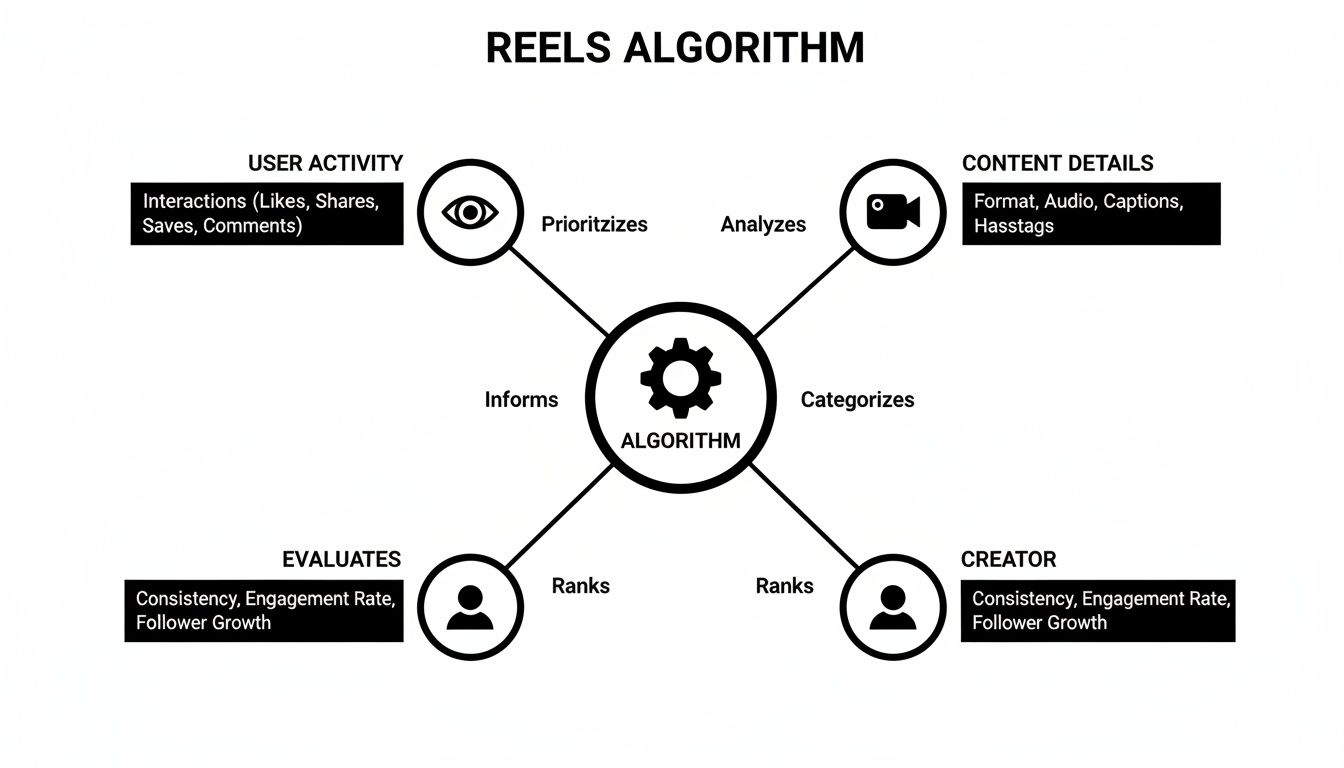
Instagram doesn’t use one algorithm — it uses multiple AI-powered ranking systems, one each for Feed, Stories, Reels, and Explore. The Reels algorithm specifically analyzes three categories of information to decide what to show each user next:
- Your Activity: The algorithm meticulously tracks your behavior. It notes the Reels you watch to the end, the ones you replay, the accounts you follow, and every like, comment, save, and share. This creates a detailed profile of your interests.
- Information About the Reel: The system analyzes the video's content—pixels, frames, and audio—to understand what it's about. It also reads the caption, checks the hashtags, and identifies the audio track to categorize it.
- Information About the Creator: The algorithm considers the creator's history. Are they consistently posting? What kind of engagement do their other Reels receive? Have other users interacted with them recently? An account with a strong track record is seen as more reliable.
The algorithm weighs data from all three areas to rank every potential Reel for each user’s feed. No single factor guarantees success — performance is always a blend of content quality, relevance to a specific viewer, and the creator’s track record.
How Reels Get Distributed (The Pipeline)
When you publish a Reel, it doesn’t go to all your followers immediately. Instead, Instagram uses a staged distribution pipeline:
- Initial test — Your Reel is shown to a small audience of non-followers whose interests match the content’s topic signals
- Follower distribution — If the Reel clears the initial test (strong watch time, shares, likes), it begins appearing in your followers’ feeds and the Reels tab
- Broad distribution — High-performing Reels get pushed to Explore and the broader Reels feed, reaching progressively larger audiences of non-followers
This is why the first few hours matter so much — strong early engagement triggers step 2 and 3. A Reel that gets ignored in the initial test will stall at a few hundred views. For a broader look at growing view counts across all Instagram formats, see our guide on how to get Instagram views.
Key Ranking Signals at a Glance
| Ranking Signal | Weight | What It Means | Your Strategy |
|---|---|---|---|
| Watch Time | Highest | Did the user watch to the end? Replay? | Hook in 3 seconds, create loops, keep Reels tight (15-30s sweet spot, up to 3 min max) |
| DM Shares | Very High | Did the user send this to someone via DM? | Create content so relatable or useful people feel compelled to share it privately |
| Likes per Reach | High | What percentage of viewers liked? | Matters most for distribution among existing followers |
| Saves | High | Did the user save for later? | Create reference-worthy content (tutorials, checklists, tips) |
| Comments | Medium | Did the user take time to write something? | Ask specific questions, not generic engagement bait |
| Audio & Effects | Medium | Is it using trending audio? | Trending sounds give the algorithm a pre-built audience to test with |
| Captions & Keywords | Medium | What is the Reel about? | Descriptive captions with keywords help categorization |
The Key Ranking Signals That Drive Reach
To get the Instagram Reels algorithm to work for you, you need to think less like a creator and more like a data-driven TV producer. Netflix doesn't promote shows people sample for a few minutes; it pushes the content they binge-watch from start to finish. The Reels algorithm operates on the exact same principle: it rewards content that captures and holds attention.
While many metrics contribute to a Reel's success, two stand out as the ultimate indicators of high-quality content.
Watch Time and Completion Rate: The Ultimate Signals
The most important signal you can send the algorithm is that your Reel is worth watching from start to finish. Watch time (the total duration a user watches) and completion rate (the percentage of your video they finish) are the two metrics the algorithm prioritizes above all else when evaluating quality.
Instagram's internal ranking systems analyze how long viewers stick around before deciding whether to push your content to a wider audience. Although Instagram extended the maximum Reel length to 3 minutes in January 2025, data consistently shows that Reels between 15 and 30 seconds tend to perform best for reach and engagement. Longer Reels can work if the pacing is tight, but every additional second is another chance for viewers to drop off. If you're working with longer video content, our guide on how to post a long video on Instagram explains the best approach for each format.
A high completion rate is a direct command to the algorithm: "This is good content." If you can achieve a completion rate over 100% (meaning people are rewatching it), you're sending an even stronger signal: "This content is so compelling, people can't get enough. Show it to more of them!" This is why a Reel with 1,000 views and a high completion rate will often outperform one with 10,000 views and a low completion rate over time.
The Hierarchy of User Interactions
Here’s something many creators miss: not all engagement is created equal. The algorithm weighs user actions based on the level of intent and effort they require. Think of it as a value pyramid, with low-effort actions at the bottom and high-intent actions at the top.
In January 2025, Adam Mosseri confirmed the hierarchy publicly. Here’s how the algorithm ranks interactions, from least to most valuable:
- Likes: A quick, low-effort acknowledgment. It carries the least weight but still matters for distribution among existing followers.
- Comments: Requires more thought and effort. Indicates your Reel sparked a reaction — more valuable than a like, but less impactful than shares.
- Saves: Signals that your content is useful enough to revisit. Strong indicator of evergreen value that the algorithm rewards with extended distribution.
- DM Shares (Sends): The most valuable interaction. Mosseri stated that sending a Reel via DM is the strongest signal for reaching non-followers. A Reel with 50 DM shares and moderate likes will outperform one with 500 likes and zero shares. This is because a DM share is an active endorsement — you’re recommending content to a specific person.
Actionable Takeaway: A strategy focused on earning DM shares and saves will do far more for your reach than one focused on likes. Create content that is either incredibly relatable (worth sharing via DM) or incredibly useful (worth saving for later).
The User Interaction Feedback Loop
Finally, the algorithm closely monitors a user's personal history with your account. If someone has liked, commented on, or shared your Reels in the past, the algorithm is much more likely to show them your new content immediately.
This creates a powerful feedback loop: engaging your current audience is the first step to reaching a new one. When your followers interact with your content, it signals to the algorithm that your Reel is high-quality, giving it the initial momentum needed to be tested with a broader audience of non-followers.
A note on hashtags in 2026: Hashtags have shifted from growth levers to categorization labels. They help Instagram understand what your Reel is about, but they no longer drive significant discovery on their own. Recent data shows posts without hashtags achieved 23% higher reach than hashtag-heavy posts. If you use them, stick to 3-5 niche-specific hashtags — not 30. To learn more, check out our guide on how many hashtags to use on Instagram.
Creating Reels the Algorithm Loves
Knowing the theory is one thing, but consistently creating content that the algorithm favors is another. To make the Instagram Reels algorithm work for you, you need a practical, repeatable playbook that focuses on the specific tactics it's designed to reward.
Think of each Reel as a product being tested with a focus group. The algorithm's initial feedback loop is incredibly fast, so every detail matters—from the first frame to the final call-to-action. The goal isn't a one-off viral hit; it's to build a system for producing content that the algorithm naturally wants to promote.
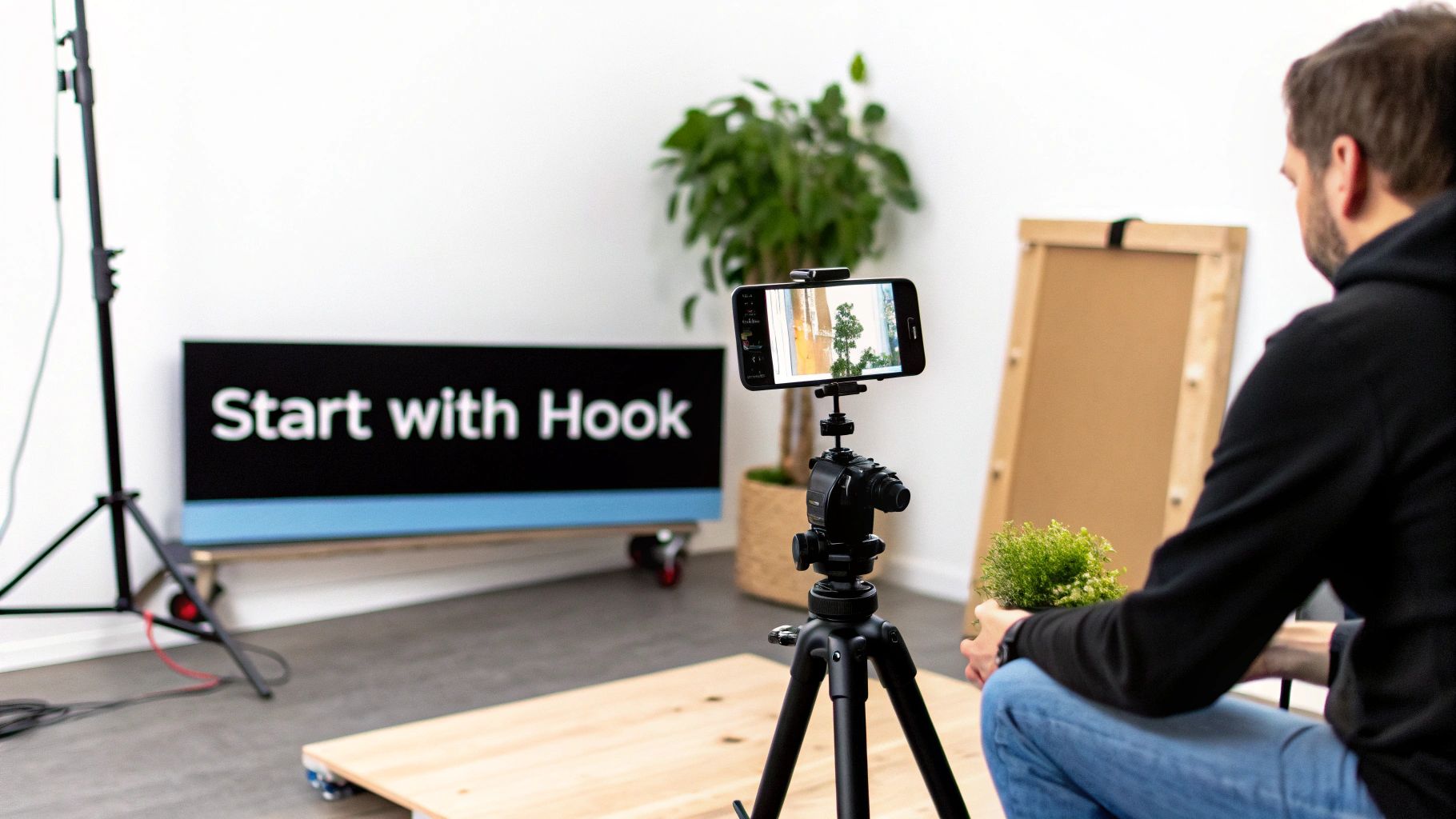
Step 1: Craft an Irresistible Hook in the First 3 Seconds
The modern social media feed is a battle for attention. According to engineers familiar with the algorithm, you have a 1-3 second window to convince someone to stop scrolling. If you fail, they're gone, and the algorithm records that short watch time as a negative signal.
A strong hook is a promise. It must immediately answer the viewer's subconscious question: "What's in this for me?"
Here are three hook formulas that work:
- The Problem-Solver: Start with a common pain point. For example, "Stop making this one mistake when editing your videos..."
- The Curiosity Gap: Pose a question or make a bold statement that demands an answer. For instance, "This is the one metric that matters more than likes and comments combined."
- The Visual Hook: Use a surprising, satisfying, or visually stunning opening that stops the scroll on its own.
Why it works: A strong hook is the single most important factor for improving your watch time. Master the first three seconds, and you give your Reel a fighting chance.
Step 2: Strategically Use Trending Audio and Effects
Using trending audio is more than just adding a popular song; it’s tapping into an ongoing cultural conversation. When you use a sound that’s already trending, the algorithm has a pre-built category and an existing audience ready for your content.
The algorithm often groups Reels using the same audio, serving them to people who have already engaged with other videos using that sound. This is a shortcut to reaching new audiences who are predisposed to enjoy your style of content.
However, relevance is key. Forcing a trend that doesn't fit your brand will feel inauthentic. Find sounds that align with your niche and use them to add a layer of entertainment or relatability to your message.
Step 3: Write SEO-Optimized Captions and CTAs
Your caption is a critical piece of data that helps the algorithm understand your Reel's topic and intended audience. Treat it like a mini, SEO-optimized blog post.
- Include Relevant Keywords: Describe what's in your Reel using the exact terms your target audience would search for. If your Reel is a tutorial on "making sourdough bread," ensure those keywords appear naturally in the caption.
- Use a Clear Call-to-Action (CTA): Tell people exactly what you want them to do next. Vague CTAs like "link in bio" are ineffective. Be specific and provide value. For example, "Comment 'GUIDE' below, and I'll send you my free sourdough starter checklist." This also boosts comments, another positive signal.
- Encourage High-Value Actions: Frame your CTA around saves and shares. Ask viewers to "Save this for later" for a useful tip, or "Share this with a friend who needs to see it" for a relatable video.
To streamline caption writing across multiple accounts, tools like PostPlanify's AI assistant can generate platform-specific captions matched to your brand voice.
Step 4: Prioritize High Visual Quality
The algorithm actively penalizes low-quality content. Instagram is committed to a premium viewing experience, which means it prioritizes content that looks and feels professional.
Here are the technical details that matter:
- No Visible Watermarks: The algorithm can detect watermarks from other platforms like TikTok and will suppress the reach of that content. Always upload a clean, watermark-free version of your video.
- Use the Correct Format: Stick to a 9:16 vertical aspect ratio (1080 x 1920 pixels). Anything else looks unprofessional and signals low effort. Our social media safe zones guide covers the exact dimensions and safe areas for every platform so your text and visuals never get cut off.
- Ensure High Resolution: Blurry or pixelated video is a guaranteed way to have your reach throttled. Film with good lighting and export your video in the highest possible quality.
By following these practical steps, you can move from guessing what works to intentionally creating Reels that the algorithm is designed to reward. You can learn more in our guide on how to create engaging social media content.
Why Reels Are Essential for Instagram Growth
If you've managed an Instagram account recently, you've felt the shift. Curated single-image posts that once drove steady engagement are no longer the primary engine for growth.
This is by design. Instagram has re-engineered its platform to prioritize Reels, making them the single most powerful tool for discovery and audience growth. Success today isn’t about chasing trends—it’s about working with the Instagram Reels algorithm, not against it.
Discovery Engine vs. Audience Nurturing
Think of your Instagram content formats as having two distinct jobs: one is to find new people, and the other is to build relationships with your existing followers.
- Reels for Reach: The algorithm is specifically designed to push Reels to non-followers. It shows your Reel to a small test audience it predicts will like it. If that group engages positively (high watch time, likes, shares), the algorithm distributes it to a much wider audience. This "snowball effect" is Instagram's primary discovery mechanism.
- Stories for Nurturing: In contrast, Stories are shown almost exclusively to your existing followers. They are perfect for building deeper connections, sharing behind-the-scenes content, and keeping your community engaged. They are not designed for growth.
Trying to grow your account with Stories alone is like trying to find new customers by only marketing to your current ones. It's a vital part of your strategy, but it won't expand your reach. If attracting new followers is your goal, check out our deep dive on how to grow Instagram followers organically.
The Data Doesn't Lie
The idea that Reels outperform other formats isn't just a feeling; the numbers are clear. Let's compare the performance of different content types.
Instagram Content Format Performance Comparison
| Content Format | Average Engagement Rate | Primary Algorithmic Purpose |
|---|---|---|
| Reels | 1.23% | Discovery & Reaching Non-Followers |
| Carousels | 1.02% | Nurturing Existing Followers & Driving Saves |
| Single Image | 0.70% | Quick Updates & Community Connection |
The data shows that Reels don't just perform slightly better; their average engagement rate of 1.23% is a staggering 75% higher than single image posts. For a full comparison of how Reels stack up against Posts and Stories, see our Instagram Post vs Story vs Reel guide. Instagram's own leadership has confirmed that Reels is its fastest-growing format, and the algorithm is intentionally built to test your videos with new audiences first. In October 2025, Mark Zuckerberg announced that Reels across Instagram and Facebook had surpassed a $50 billion annual ad revenue run rate — more than 50% of all Instagram ads now run on Reels.
For any social media manager needing to justify the resources for video production, this is your evidence. The return on investment for Reels is unmatched when it comes to reach and new audience acquisition.
The Bottom Line: If growth is your primary objective—reaching new people, expanding your brand's footprint, and increasing visibility—a Reels-first strategy is no longer optional. It's the most direct path to success.
The Psychology of the Full-Screen Experience
Beyond the data, there's a powerful psychological reason Reels are so effective. The full-screen, immersive format commands a user's complete attention.
When someone is scrolling through Reels, your content occupies their entire screen. There are no competing posts or distracting captions from other accounts. This combination of motion, sound, and full-screen visuals creates a far more captivating experience than a small square in a crowded feed.
This format is inherently better at holding attention—which, as we've established, is the most important metric the algorithm measures and rewards.
 PostPlanify
All your social media in one simple dashboard
Schedule posts, track analytics, and reply to comments/DMs without switching tabs.

Engagement
+18%
Views
52.8k
Working With the New Algorithm Customization Features
The Instagram Reels algorithm is no longer a one-way street where creators publish content and the algorithm decides its fate. Instagram has given users direct control over what appears in their feeds, fundamentally changing the game for creators.
Success is no longer about "hacking" the system. It's about genuinely understanding and delivering what your audience has explicitly told Instagram they want to see.
From Algorithmic Guesswork to Direct Feedback
Previously, the algorithm acted as a prediction engine, analyzing past behavior—likes, shares, watch time—to guess what a user might enjoy. Now, with Instagram's new customization tools, the algorithm has a more powerful data source: the user's stated interests.
In December 2025, Instagram launched the "Your Algorithm" feature, letting users see the topics Instagram thinks they care about, remove topics they don't want, and add new ones. This feature is expanding from the Reels tab to Feed and Explore.
This creates a new challenge for creators. If your content doesn't align with a user's chosen topics, the algorithm is less likely to show it to them, even if they are a follower. Conversely, if your content perfectly matches their interests, your visibility can increase significantly.
How to Adapt Your Content Strategy
To stay relevant, you must shift from guessing to listening. Your goal is to align your content with the preferences your audience is actively communicating to the platform.
Here is a step-by-step process to adjust your strategy:
- Use Instagram Stories to Run Polls: Don't assume you know what your audience wants. Use the poll and question stickers in your Stories to get direct feedback on their favorite topics, biggest challenges, and what content they find most valuable. This is free, actionable market research.
- Analyze Your Comment Section: Your comments are a direct line to your audience's thoughts. Look for recurring questions, common themes, and the specific language they use. If multiple people ask about the same sub-topic, that's a clear signal to create a Reel about it.
- Treat Keywords and Hashtags as Topic Signals: Once you identify your audience's core interests, embed those keywords everywhere. Use them in your captions, as on-screen text, and in your hashtags. This helps the algorithm accurately categorize your content and match it with users who are actively looking for it.
- Monitor Your "Saves" Metric: A "Save" is one of the strongest indicators of valuable content. When someone saves your Reel, they are telling you, "This is so useful, I want to come back to it." Pay close attention to which Reels get the most saves and create more content on those themes. This tactic works across platforms; for more, see our guide on how to post Reels on Facebook.
Expert Insight: Treat your content strategy as an ongoing conversation. Use Instagram’s interactive tools to gather feedback, create content based on what you learn, and analyze your metrics to refine your approach for the next batch of Reels.
By focusing on what your audience explicitly wants, you create content that the new, more customizable Instagram Reels algorithm is built to reward.
What Changed in the Instagram Reels Algorithm (2025-2026)
The algorithm underwent its most significant changes in late 2025. Here's what happened and why it matters for your strategy.
"Views" Replaced Impressions and Plays (April 2025)
On April 21, 2025, Instagram deprecated three metrics — impressions, plays, and video views — and replaced them with a single unified metric: Views. A "View" is counted every time content appears on a user's screen (even briefly). Replays within the same session don't count as additional views, but replays from separate sessions do.
This matters because Views are typically higher than the old impressions, which means engagement rates may appear lower even if actual engagement hasn't changed. The shift also aligns Instagram's metrics with TikTok, making cross-platform comparison easier. For a full breakdown of the difference, see our guides on views vs impressions and what are impressions on Instagram.
3-Minute Reels (January 2025)
Adam Mosseri announced the extension from 90 seconds to 3 minutes in January 2025, stating "90 seconds is just too short... we're upping that limit to three minutes to help you tell the stories you really want to tell." Instagram confirmed that longer Reels are treated equally by the recommendation system — but data consistently shows 15-30 second Reels still perform best for reach.
Original Content Crackdown (December 2025)
The December 2025 algorithm update hit aggregator accounts hard. Accounts that primarily repost others' content saw 60-80% reach drops, while original creators saw 40-60% reach increases. Instagram now uses visual fingerprinting to detect reposted content — if two accounts post the same video, only the original post gets recommended. Reposted material now appears with attribution labels crediting the original creator.
Engagement Bait Penalties (2025-2026)
Instagram's AI systems now detect and suppress engagement bait, reducing its reach by 50-90%. Worse, accounts that repeatedly use engagement bait face compounding penalties — not just on the bait posts but across all their content for weeks. Examples that trigger penalties:
- "Comment YES for our free guide"
- "Drop an emoji if you agree"
- "Tag 3 friends who need this"
- "Share this to win"
"Year of Raw Content" (2026)
On December 31, 2025, Adam Mosseri declared 2026 "The Year of Raw Content" — signaling a major algorithm shift that prioritizes authenticity over perfection and raw, real human content over AI-generated or overly polished material. This means less production value isn't a disadvantage anymore — it may actually help.
Early Access Reels (December 2025)
A new feature allowing creators to give followers exclusive 24-hour early access to new Reels before they're distributed to non-followers.
PostPlanifyAll your social media in one simple dashboard
Schedule posts, track analytics, and reply to comments/DMs without switching tabs.
Engagement
+18%
Views
52.8k
Trial Reels: How to Test Content Before Publishing
One of Instagram's most useful recent features is Trial Reels — launched in December 2024 and expanded to all public creators with 1,000+ followers in 2025.
How Trial Reels Work
- Create a Reel normally, then tap the "Test" button before publishing
- The Reel is shown only to a random selection of non-followers whose interests match the content
- It does not appear on your profile or in your followers' feeds
- It's saved in your drafts for later review
Why This Matters
- De-risks creative experiments — test a new content style without committing it to your profile
- Free exposure to non-followers — you get views and engagement data without any downside
- Performance data available after 24 hours — compare against your previous Trial Reels
- Auto-share option — if enabled, Instagram will automatically post the Trial Reel to your followers if it gains significant traction within 72 hours
Strategy: Use Trial Reels to A/B test hooks, topics, and formats. Run 2-3 trial Reels per week to identify what resonates before committing content to your main feed.
Instagram Reels vs TikTok: How the Algorithms Differ
If you post on both platforms, understanding the differences helps you tailor content for each algorithm.
| Factor | Instagram Reels | TikTok |
|---|---|---|
| Distribution trigger | Early engagement from existing followers helps trigger wider distribution | A random test audience (not followers) drives initial distribution |
| Virality for new creators | Slightly favors established accounts with existing engagement history | New accounts can go viral immediately if content resonates |
| Top ranking signal | Watch time, then DM shares, then likes | Watch time and completion rate, then overall engagement |
| Content longevity | Generally peaks within 48 hours | Can go viral weeks after posting |
| Avg. engagement rate | ~3.65% for smaller creators | ~7.5% for smaller creators |
| Algorithm control | Users can tune their feed by topic ("Your Algorithm") | For You Page is fully algorithm-driven |
| Originality enforcement | Visual fingerprinting, attribution labels, 60-80% reach drops for reposters | Less aggressive originality enforcement |
| Best for | Cultivating a dedicated community; leveraging existing Instagram audience | Fast growth and reaching entirely new audiences |
The key takeaway: Instagram Reels rewards community building and DM sharing, while TikTok rewards raw content discovery. If you cross-post, remove watermarks and ideally create platform-native versions of each video. For more on cross-platform scheduling, see our guide on scheduling Instagram Reels vs TikTok videos.
Reels Monetization in 2026
Reels aren't just a growth tool — they're now a revenue channel.
Current Monetization Methods
- Reels Play Bonus 2.0 — Instagram revamped its creator fund with more generous payouts (the original Reels Play Bonus was discontinued). Follower requirements were reduced from 50,000 to 10,000 followers
- Branded content/sponsorships — Businesses partner with creators for sponsored Reels. This remains the most lucrative method
- Instagram Gifts — Fans send virtual "gifts" (Stars) on Reels content, purchased in packs
- Affiliate marketing/Shopping — Tag products directly in Reels and earn commissions on purchases
Earning Potential (2026 Data)
| Follower Count | Estimated Monthly Reels Revenue |
|---|---|
| 10,000-50,000 | $50-$200/mo (bonuses + gifts) |
| 100,000 | $200-$1,000/mo |
| 500,000+ | $2,000-$10,000/mo |
These figures are for bonus payments and gifts only — branded sponsorships can be significantly higher depending on your niche and engagement rate.
Troubleshooting: Common Mistakes That Kill Your Reels Reach
Even with a solid strategy, common mistakes can sabotage your Reels' reach before they even have a chance. These errors send negative signals to the algorithm, flagging your content as low-quality, unoriginal, or simply uninteresting.
The result? Your reach is throttled, and your Reels get stuck with low view counts. Avoiding these pitfalls is just as critical as implementing best practices.

Mistake #1: Posting Low-Quality or Watermarked Videos
Why it's a problem: The algorithm's primary goal is to provide a seamless, high-quality user experience. Anything that disrupts this is penalized.
- Low-Resolution Content: Blurry, pixelated, or poorly lit videos are a major red flag. Viewers will immediately swipe away, crushing your watch time. The algorithm sees this and stops showing the Reel to new people.
- Recycled Videos with Watermarks: This is a critical error. Instagram actively suppresses Reels with visible watermarks from competing platforms like TikTok. The algorithm flags this content as unoriginal and severely limits its distribution.
The Fix:
- Always upload a clean, high-resolution version of your video directly to Instagram.
- If creating content for multiple platforms, save the original, unwatermarked file first.
- Ensure your videos are in a vertical 9:16 aspect ratio (1080 x 1920 pixels) to fill the screen and appear professional. For the full specs across all Instagram formats, see our Instagram image size guide.
Mistake #2: Creating Overly Promotional Content
Why it's a problem: Users browse Reels for entertainment, education, or inspiration—not to watch ads. Content that feels like a hard sales pitch causes viewers to scroll away instantly, which tanks your watch time and tells the algorithm your content is boring.
The Fix:
- Avoid direct sales pitches like "Buy Now!"
- Instead, frame your content around solving a problem or showing a transformation.
- A skincare brand, for example, should create a Reel demonstrating a "3-step routine for glowing skin" using their products. This provides value first, which naturally leads to sales.
Mistake #3: Using Engagement Bait
Why it's a problem: Instagram's AI now actively detects and penalizes engagement bait. Captions like "Comment YES," "Tag 3 friends," or "Share this to win" can reduce your reach by 50-90% — and repeated use causes compounding penalties across all your content for weeks.
The Fix:
- Replace generic engagement bait with specific, value-driven CTAs: "Save this routine for your next gym session" or "Send this to your cofounder"
- Ask genuine questions that invite real conversation, not one-word responses
- Let the content drive engagement naturally — if it's useful or relatable, people will share it without being asked
Mistake #4: Being Inconsistent with Your Posting Schedule
Why it's a problem: The algorithm favors active and reliable accounts. Posting five Reels one week and then going silent for a month kills your momentum. Consistency signals that you are a serious creator worth promoting.
The Fix:
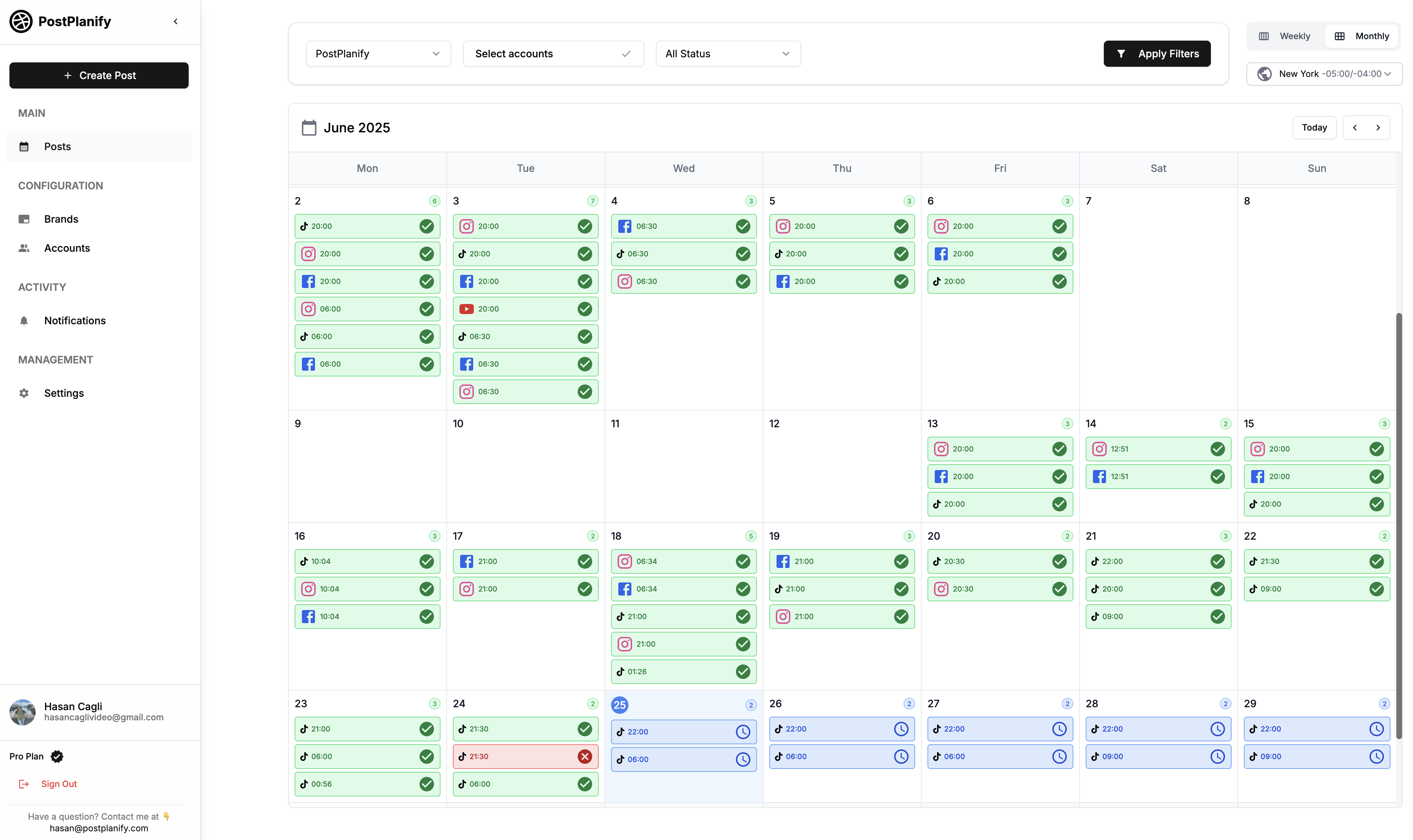
- Establish a realistic and sustainable posting schedule (e.g., 3-5 Reels per week). Content batching helps you create a week's worth of Reels in one session.
- Use a scheduling tool to plan and automate your posts. PostPlanify lets you bulk-schedule Reels in advance with best-time-to-post suggestions based on your audience data, ensuring you maintain consistency without the daily pressure of manual posting.
PostPlanifyAll your social media in one simple dashboard
Schedule posts, track analytics, and reply to comments/DMs without switching tabs.
Engagement
+18%
Views
52.8k
Frequently Asked Questions
How long does it take for a Reel to go viral?
There’s no set timeline, but the first 24 hours are critical. For the full playbook, see our guide on how to go viral on Instagram. The algorithm shows your video to a small test group first. If that initial audience responds well — high watch time, DM shares, likes — the system expands its reach to progressively larger audiences. Some Reels experience a "slow burn" and gain traction weeks later, but strong early engagement is the most reliable path to broad distribution.
Should I delete and repost an underperforming Reel?
No. Deleting and reposting the same video can be flagged by the algorithm as repetitive or spammy behavior, which can harm your account’s overall reach. Instead, treat an underperforming Reel as a data point. Analyze what went wrong (weak hook, wrong audio, bad timing) and apply those learnings to your next video. You can also use Trial Reels to test content risk-free before committing it to your profile.
What is the ideal number of hashtags for Reels in 2026?
The era of using 30 hashtags is over. Instagram recommends 3 to 5 highly relevant hashtags per Reel. Recent data actually shows posts without hashtags achieved 23% higher reach than hashtag-heavy posts. Think of hashtags as categorization labels rather than growth levers — they help the algorithm understand your content’s topic, but they no longer drive discovery the way they once did.
Does posting time still matter for Reels?
Yes, but its primary role has evolved. Posting at a peak time gets an immediate burst of engagement from your existing followers. This initial wave signals to the algorithm that your Reel is worth distributing wider. Check your Instagram Insights or use a scheduler with best-time-to-post suggestions to identify when your audience is most active.
How long should Instagram Reels be in 2026?
Instagram Reels now support up to 3 minutes (extended from 90 seconds in January 2025). However, data consistently shows that Reels between 15 and 30 seconds perform best for reach and engagement. Longer Reels can work if the pacing is tight and every second adds value — but every additional second is another chance for viewers to drop off, which hurts your watch time signal.
What is the "Views" metric on Instagram?
In April 2025, Instagram replaced impressions, plays, and video views with a single unified metric called "Views." A View is counted every time content appears on a user’s screen. Replays within the same session don’t count, but replays from separate sessions do. This change aligns Instagram’s reporting with TikTok and makes cross-format comparison easier.
What are Trial Reels on Instagram?
Trial Reels let creators test content with non-followers first before committing it to their profile. You need a public account with at least 1,000 followers. The Reel doesn’t appear on your profile or in followers’ feeds — it’s shown to a random selection of non-followers whose interests match. Performance data is available after 24 hours, and you can auto-share it to your profile if it performs well.
Does Instagram penalize engagement bait?
Yes — heavily. Instagram’s AI systems now detect engagement bait (like "comment YES," "tag 3 friends," or "share to win") and reduce its reach by 50-90%. Worse, accounts that repeatedly use engagement bait face compounding penalties across all their content for weeks. Use specific, value-driven CTAs instead.
Does cross-posting from TikTok hurt my Reels reach?
Yes, if the TikTok watermark is visible. Instagram’s algorithm specifically detects competitor watermarks and down-ranks that content — internal tests show watermarked content receives up to 20% less distribution. If you cross-post, always save the original unwatermarked file first and upload it directly to Instagram.
Are Reels or carousels better for Instagram growth?
They serve different purposes. Reels are designed for discovery — the algorithm pushes them to non-followers, making them the primary growth tool (1.23% average engagement rate). Carousels are better for nurturing existing followers and driving saves (1.02% average engagement rate). The best strategy is a mix of both — Reels to attract new followers, carousels to deepen engagement with existing ones. See our Instagram carousel guide for carousel-specific strategies.
How many Reels should I post per week?
Aim for 3-5 Reels per week for consistent growth. The algorithm rewards accounts that post regularly — but quality matters more than quantity. Posting 10 mediocre Reels hurts more than posting 3 high-quality ones, because low-engagement posts send negative signals that can suppress your future content’s distribution.
Can I schedule Instagram Reels in advance?
Yes. Instagram’s native scheduling allows you to schedule Reels up to 75 days in advance. Third-party tools like PostPlanify let you bulk-schedule Reels across multiple accounts with AI-generated captions and best-time-to-post suggestions — ensuring you maintain consistency without daily manual posting.
Key Takeaways
- Watch time is the #1 signal — hook viewers in the first 3 seconds and keep them watching to the end. Reels between 15-30 seconds perform best, though you can go up to 3 minutes.
- DM shares > saves > likes — create content so relatable or useful that people send it to friends via DM. This is the strongest signal for reaching non-followers.
- The algorithm penalizes engagement bait — "comment YES" and "tag 3 friends" can cut your reach by 50-90% with compounding penalties across all your content.
- Original content gets rewarded — the December 2025 update gave original creators 40-60% reach boosts while aggregators lost 60-80%. No more reposting.
- Use Trial Reels to test hooks and topics risk-free with non-followers before committing content to your profile.
- "Views" is now the unified metric — impressions and plays were deprecated in April 2025. Replays within the same session don’t count.
- Hashtags are categorization labels, not growth levers — 3-5 niche-specific hashtags, or skip them entirely. Data shows posts without hashtags got 23% higher reach.
- Post 3-5 Reels per week consistently — the algorithm rewards reliability over sporadic bursts.
Making the Switch
If you’re ready to take your Reels strategy seriously, PostPlanify helps you stay consistent without the daily grind:
- Schedule Reels in advance — bulk-schedule a week or month of Reels across multiple accounts
- Best-time-to-post suggestions — analytics show when your audience is most active so you hit the engagement window every time
- AI captions — vision-powered AI analyzes your video and writes platform-specific captions matched to your brand voice
- Track what’s working — monitor Views, engagement rate, and follower growth across all 10 platforms from one dashboard
- Team workflows — approval workflows and shared calendars so your team stays aligned
👉 Start your 7-day free trial on PostPlanify here.
Related Reading
- How to Schedule Instagram Reels — step-by-step guide for auto-publishing Reels
- Best Instagram Post Scheduler Tools (2026) — compare 12 scheduling tools for Instagram
- How Many Hashtags to Use on Instagram — the data on hashtag performance in 2026
- Best Time to Post on Instagram — Instagram-specific timing guide
- Best Time to Post on Social Media — platform-by-platform timing guide
- Scheduling Instagram Reels vs TikTok Videos — cross-platform best practices
- How to Grow Instagram Followers Organically — growth strategies beyond Reels
- How to Create Engaging Social Media Content — content creation framework
- How to Increase Engagement on Instagram — the full 2026 engagement playbook for teams
- Social Media Safe Zones: Complete Guide for 2026 — exact dimensions and safe areas for every platform
- How to Post Reels on Facebook — cross-posting Reels to Facebook
- Instagram Post vs Story vs Reel — when to use each Instagram format
- How to Post a Long Video on Instagram — best practices for sharing extended video content
PostPlanifyAll your social media in one simple dashboard
Schedule posts, track analytics, and reply to comments/DMs without switching tabs.
Engagement
+18%
Views
52.8k
About the Author

Hasan Cagli
Founder of PostPlanify, a content and social media scheduling platform. He focuses on building systems that help businesses, agencies, and teams plan, publish, and manage content and social media more efficiently across platforms.


