


Search "how much does Facebook Reels pay" and you'll find wildly different answers. One site says $0.02 per 1,000 views. Another says $6. A third claims $10. They can't all be right — but they're not all wrong either.
The confusion exists because people are mixing up three completely different payment types. Once you understand the distinction, the actual numbers make sense.
The short answer for 2026: Most creators earn $0.02 to $0.20 per 1,000 Reels views through Facebook's Content Monetization program. Under specific conditions — US-heavy audience, high-value niche, strong engagement — some creators report rates closer to $1–$5 per 1,000 views. But those are outliers, not baselines.
This guide breaks down exactly what Facebook pays, why the numbers vary so dramatically, and what you can actually do to maximize your earnings.
Quick Earnings Lookup: Facebook Reels Pay Per Views
Use this table to estimate your Facebook Reels earnings based on your monthly view count:
| Monthly Views | Low Estimate ($0.02/1K) | Average ($0.08/1K) | High Estimate ($0.20/1K) | Outlier ($1.00/1K) |
|---|---|---|---|---|
| 100,000 | $2 | $8 | $20 | $100 |
| 500,000 | $10 | $40 | $100 | $500 |
| 1,000,000 | $20 | $80 | $200 | $1,000 |
| 5,000,000 | $100 | $400 | $1,000 | $5,000 |
| 10,000,000 | $200 | $800 | $2,000 | $10,000 |
| 50,000,000 | $1,000 | $4,000 | $10,000 | $50,000 |
Where you fall depends on your content niche, audience location, eligible play ratio, and engagement quality. Most creators land in the "Average" column. The "Outlier" column applies to finance/health niches with 90%+ US audiences — see the niche breakdown below.
 PostPlanify
All your social media in one simple dashboard
Schedule posts, track analytics, and reply to comments/DMs without switching tabs.

Engagement
+18%
Views
52.8k
Why Everyone Quotes Different Numbers (And Who's Right)
Before looking at any earnings data, you need to understand what's actually being measured. The conflicting numbers across the internet come from three different payment mechanisms being treated as the same thing.
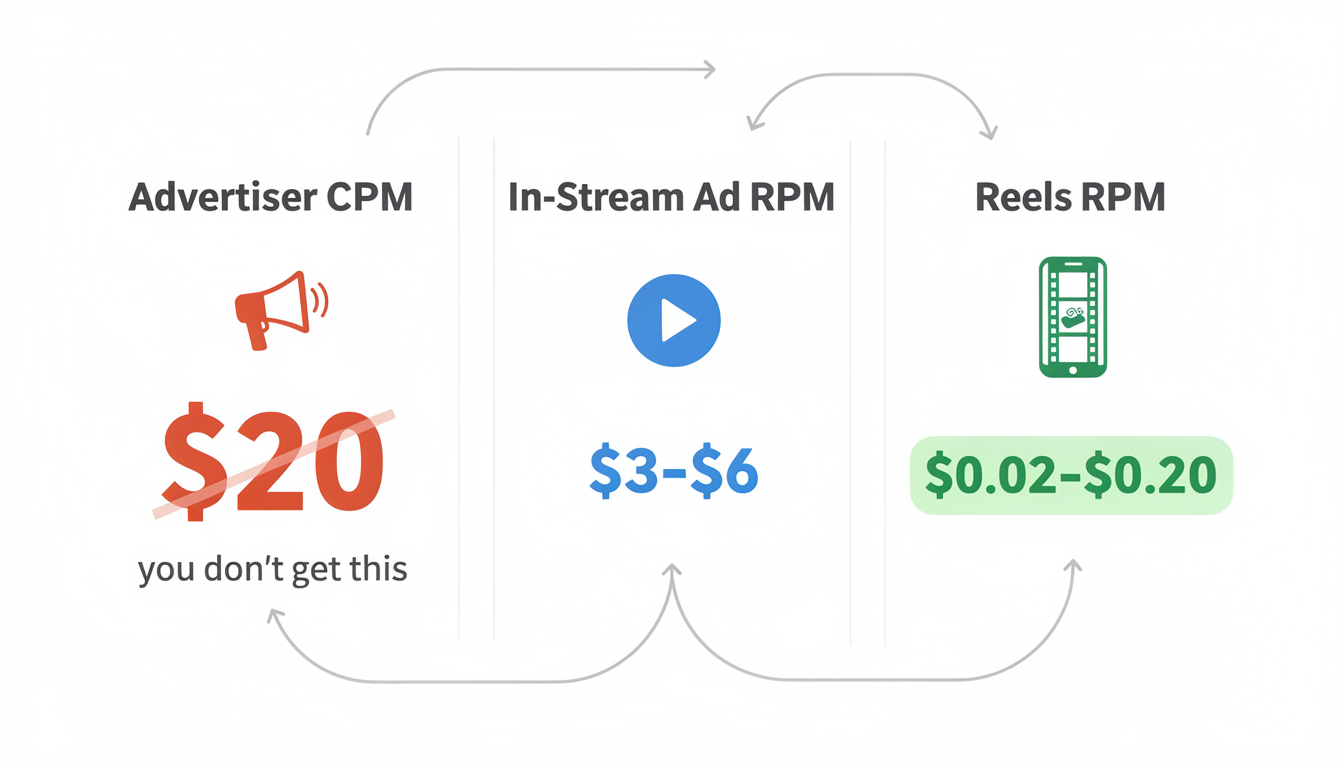
| What's Being Measured | Typical Range | What It Actually Is |
|---|---|---|
| Advertiser CPM | $10–$20+ | What brands pay Facebook for 1,000 ad impressions. You don't get this. |
| In-Stream Ad RPM (long-form video) | $3–$6 per 1K views | Your cut from ads placed in videos over 1 minute. The 55/45 revenue share. |
| Reels Content Monetization RPM | $0.02–$0.20 per 1K views | What most creators actually earn per 1,000 Reels views in 2026. |
When you see a blog post claiming "$6 per 1,000 views on Facebook," they're likely citing in-stream ad rates on long-form video — not Reels-specific payouts. When you see "$0.05 per 1,000 views," that's the Reels Content Monetization rate that the majority of creators actually experience.
Both numbers are real. They just measure different things. This article focuses on what Facebook actually pays for Reels views specifically, because that's what most creators are searching for.
Facebook's Content Monetization Program (How It Works in 2026)
On August 31, 2025, Facebook retired its legacy monetization programs and merged three separate systems — Performance Bonuses, Ads on Reels, and In-Stream Ads — into a single unified program called Facebook Content Monetization. Meta has since paid creators nearly $3 billion in 2025 alone — a 35% year-over-year increase — with Reels and short video payouts growing over 80%.
Important status note (2026): Content Monetization is the new unified program, but it is still invite-only. Meta distributes invitations periodically to eligible creators and has publicly stated it plans to "offer open enrollment in the near future." You can express interest by navigating to your Professional Dashboard → Monetization → Content Monetization. Meeting the eligibility thresholds below does not automatically grant access — you still need Meta to send the invite.
Here's what changed and why it matters for your earnings:
What was retired
- Reels Play Bonus Program — The invite-only program that paid up to $35,000/month for hitting view targets. Gone.
- Standalone Ads on Reels — The previous 55/45 revenue share specifically for Reels ad placements. Folded into the unified program.
- Performance Bonuses — One-time payouts for meeting engagement milestones. Discontinued.
What replaced it
The new Content Monetization program pays creators from a single pool based on a performance formula that considers:
- Total views and plays across all your content (Reels, long-form video, photos, text posts)
- Watch time and completion rates
- Engagement signals (comments, shares, saves)
- Ad impressions generated by your content
- Viewer geography and demographics
Facebook hasn't published the exact formula. What we know from creator reports is that the system heavily weights watch time and ad impressions over raw view counts. A Reel that keeps people watching generates more revenue than one that racks up views but gets scrolled past quickly.
Eligibility requirements
To join Facebook Content Monetization in 2026, you need:
- 10,000+ followers on your Page or Professional Mode profile
- 600,000 total minutes watched across all your videos in the last 60 days
- At least 5 active video uploads in the last 30 days (must be an active contributor, not a dormant archive)
- Professional Mode enabled on your profile, or a dedicated Facebook Page
- Account age of 90+ days
- Age 18+ and based in an eligible country (US, UK, Canada, Australia, and most major markets)
- Full compliance with Facebook's Partner Monetization Policies and Content Monetization Policies
Lower barrier option: Facebook Stars (where viewers tip you $0.01 per Star) only requires 500 followers for 30 consecutive days — a much more accessible entry point if you don't yet meet the Content Monetization thresholds.
The 600,000-minute watch time threshold is the barrier most creators struggle with. To put it in perspective: if your average video is watched for 30 seconds, you'd need roughly 1.2 million total views across 60 days to hit this requirement. If your average watch time is 1 minute, you'd need 600,000 views.
If you're working toward eligibility, consistency matters more than virality. Posting Reels regularly and optimizing for watch time will get you there faster than chasing one viral hit. Our guide on how to post Reels on Facebook covers the fundamentals, and scheduling your Facebook posts helps maintain a consistent publishing cadence without the daily grind.
Creator Fast Track: Meta's $1,000–$3,000/Month Bypass (Launched March 2026)
If you already have a sizable following on another platform, you can skip the usual eligibility grind entirely. On March 18, 2026, Meta launched Creator Fast Track — a program designed to pull established creators from TikTok, Instagram, and YouTube onto Facebook with guaranteed monthly pay.
How it works
| Creator Tier | Followers Required (on IG, TikTok, or YouTube) | Guaranteed Monthly Pay |
|---|---|---|
| Tier 1 | 100,000+ | $1,000/month |
| Tier 2 | 1,000,000+ | $3,000/month |
Participants receive three months of guaranteed pay plus immediate access to Facebook Content Monetization after the program ends — bypassing the usual 10K follower and 600K watch-minute eligibility thresholds entirely.
Requirements
- At least 100,000 followers on Instagram, TikTok, or YouTube (for Tier 1) or 1M+ for Tier 2
- Post at least 15 Eligible Reels per month, spread across at least 10 different days (no burst-posting)
- Currently available in the US and Canada only — global rollout expected
- Content must comply with Facebook's Partner Monetization Policies
Why this matters if you qualify
- Guaranteed income floor. Unlike standard Content Monetization where your RPM depends on niche, geography, and engagement, Fast Track pays a flat $1K or $3K for three months regardless of how your Reels perform
- Increased organic reach — Meta gives your Reels a distribution boost during the program
- Permanent access to Content Monetization after the program period, without having to clear the normal thresholds
- Stackable with brand deals, affiliate marketing, and Stars revenue
How to apply
Meta is actively inviting creators who meet the follower threshold. If you haven't received an invitation, you can express interest through the Facebook app under Professional Dashboard → Monetization. Connecting your Instagram, TikTok, and YouTube accounts to Meta (for the follower verification) speeds up consideration.
Context: Creator Fast Track is effectively Meta's response to TikTok's Creator Rewards payouts being higher per view than Facebook's standard Content Monetization. Rather than raise its baseline RPM across the board, Meta is buying audience migration directly with guaranteed monthly payouts. If you already meet the follower threshold on another platform, this is the highest-leverage Facebook monetization path available in 2026.
New Earnings Metrics You'll See (Introduced 2026)
Alongside Content Monetization and Creator Fast Track, Meta introduced a new set of metrics in 2026 to help creators understand what's actually driving their revenue. If you log into your Professional Dashboard or Meta Business Suite today, you'll see these numbers replacing the older view-based reporting:
| Metric | What It Measures | Why It Matters |
|---|---|---|
| Qualified Views | Views that meet monetization criteria (ad-served, eligible region, approved content) | This is what you actually get paid on — not your total view count |
| Non-Qualified Views | Views that don't generate revenue (too-short watch time, blocked audio, unfilled ad inventory) | Shows the gap between raw reach and earning potential |
| Earnings Rate | Your RPM on Qualified Views specifically | The most accurate indicator of your niche + geography combination |
| Content Format Breakdown | Earnings split across Reels, long-form video, photos, text posts, Stories | Tells you which format actually monetizes best for your audience |
Why track Earnings Rate over total RPM: Your total RPM includes non-qualified views, which artificially deflates the number. Earnings Rate shows what you'd make if every view were monetizable — useful for comparing niches and benchmarking. If your Earnings Rate is $1/1K but your total RPM is $0.30/1K, you have a Qualified View ratio problem (audio licensing, geography, or content flags), not a niche problem.
Real Facebook Reels Earnings Data (2026)
Here's what creators are actually reporting in 2026 through the Content Monetization program. These are Reels-specific figures, not in-stream ad rates on long-form video.
| Creator Profile | RPM (Per 1,000 Views) | Monthly Views | Monthly Earnings | Context |
|---|---|---|---|---|
| New creator (mixed audience) | $0.02–$0.05 | 500,000 | $10–$25 | Global audience, entertainment content |
| Mid-tier creator (US-focused) | $0.05–$0.12 | 1,000,000 | $50–$120 | Mostly US viewers, lifestyle niche |
| Established creator (high engagement) | $0.10–$0.20 | 2,000,000 | $200–$400 | US audience, niche content, high watch time |
| Top-performing outlier | $0.50–$2.00+ | 5,000,000+ | $2,500–$10,000+ | Finance/health niche, 90%+ US audience, viral engagement |
The pattern is clear: most creators earn between $0.02 and $0.20 per 1,000 Reels views, with the median sitting around $0.05–$0.10. Creators who break into the $0.50+ range have a specific combination of US-heavy audience, high-value niche, and exceptionally strong engagement metrics.
The "eligible views" problem
Not all of your views generate revenue. Facebook distinguishes between total views and eligible plays — the subset of views that actually count toward your payout. Common reasons a view becomes ineligible:
- The viewer scrolled past too quickly (under 1 second)
- The Reel uses copyrighted music that isn't cleared for monetization
- The viewer is in a country where ads aren't being served
- Ad inventory wasn't available at that moment
- The content was flagged or is under review
Creators typically report that 30–50% of their total views are ineligible for monetization. This means your effective RPM on total views is even lower than your rate on eligible plays. If Facebook shows you $0.10/1K on eligible plays but only 60% of your views qualify, your real rate is closer to $0.06/1K on total views.
Facebook Reels Earnings by Content Niche
Your content niche determines which advertisers bid on impressions shown alongside your content. Finance advertisers pay dramatically more than entertainment advertisers because each acquired customer is worth more to them.
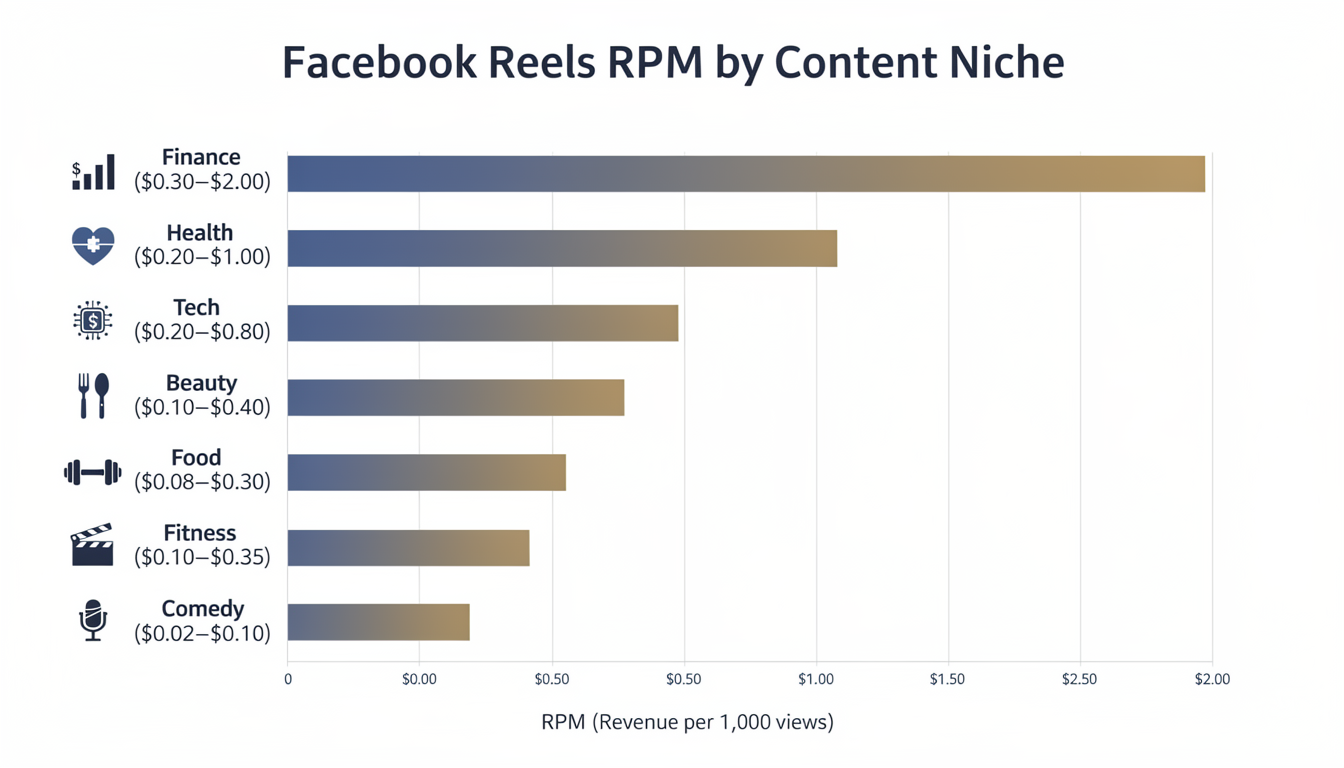
High-paying niches
| Niche | Estimated Reels RPM | Why It Pays More |
|---|---|---|
| Finance & Investing | $0.30–$2.00+ | Financial services companies have the highest customer LTV in advertising |
| Health & Wellness | $0.20–$1.00 | Supplement, pharma, and insurance advertisers bid aggressively |
| Technology & Software | $0.20–$0.80 | B2B and SaaS companies target tech-interested audiences |
| Real Estate | $0.15–$0.70 | High-ticket purchase cycle drives premium ad rates |
| Education | $0.15–$0.60 | EdTech and online course companies invest heavily in acquisition |
Mid-tier niches
| Niche | Estimated Reels RPM | Why It Pays More |
|---|---|---|
| Beauty & Skincare | $0.10–$0.40 | Strong brand advertiser demand, especially from DTC brands |
| Food & Cooking | $0.08–$0.30 | CPG and kitchen appliance advertisers run consistent campaigns |
| Fitness | $0.10–$0.35 | Gym, supplement, and athleisure brands are active buyers |
| Travel | $0.08–$0.30 | Tourism boards and booking platforms bid on travel audiences |
| Parenting | $0.10–$0.35 | Baby product and family-oriented brand spending |
Lower-paying niches
| Niche | Estimated Reels RPM | Notes |
|---|---|---|
| General Entertainment | $0.02–$0.10 | Broad audience, non-specific advertiser demand |
| Comedy & Memes | $0.02–$0.08 | High virality but low CPM advertisers |
| Music & Dance | $0.02–$0.08 | Licensed music often kills monetization eligibility entirely |
| Viral/Trend Content | $0.01–$0.06 | Undifferentiated audience, lowest ad rates |
The takeaway: if you create content in a high-value niche with a US-heavy audience, your Reels RPM can be 10–50x higher than entertainment creators with global audiences. This is the single biggest lever you have for increasing earnings.
For tips on improving your content quality and reach, check out our guide to improving social media engagement.
PostPlanifyAll your social media in one simple dashboard
Schedule posts, track analytics, and reply to comments/DMs without switching tabs.
Engagement
+18%
Views
52.8k
How Your Audience Location Affects Earnings
Audience geography is the second-largest factor after niche. Facebook's ad marketplace serves different rates based on the purchasing power of the viewers seeing your content.
Here's how Facebook's advertiser CPM (what brands pay) breaks down by country. Your creator RPM will be a fraction of these numbers (roughly 55% revenue share, further reduced by non-monetized views), but the relative differences between countries hold:
| Country | Advertiser CPM | Relative to US |
|---|---|---|
| United States | ~$20 | Baseline |
| Canada | ~$14 | ~70% of US |
| Australia | ~$11 | ~55% of US |
| United Kingdom | ~$11 | ~55% of US |
| Germany / France | ~$9–$10 | ~50% of US |
| Japan / South Korea | ~$7–$9 | ~40% of US |
| Brazil / Mexico | ~$3–$5 | ~20% of US |
| India | ~$2.70 | ~13% of US |
| Southeast Asia | ~$1–$3 | ~10% of US |
A creator with 1 million views from US audiences might earn $100–$200 in Reels revenue. The same 1 million views from Indian audiences might yield $10–$20. That's a 10x difference for identical content and identical view counts.
What you can do: Check your Facebook Page Insights (Audience tab) to see where your viewers are located. If you're creating English-language content, optimize your posting schedule for the best time to post on Facebook, with day-by-day timing recommendations. Even if you're based outside the US, capturing American eyeballs significantly increases your per-view earnings.
The Music Licensing Trap (Most Creators Miss This)
This is one of the most common — and most expensive — mistakes Facebook creators make. Using licensed music in your Reels can reduce or completely eliminate your monetization for that video.
Here's how it works:
- Meta Sound Collection music — fully safe for monetization. These tracks are royalty-free and pre-cleared.
- Popular/trending songs from the Reels audio library — monetization varies. Some are cleared, many are not. Facebook doesn't always tell you upfront.
- Music you add yourself (from your phone, Spotify recordings, etc.) — almost certainly kills monetization. Copyright detection flags these immediately.
The result: you can have a Reel with 500,000 views that earns $0 because the trending song you used wasn't cleared for monetization. Meanwhile, the same Reel with original audio or a Sound Collection track would have earned money on every eligible view.
How to protect your earnings
- Default to original audio — voiceovers, ambient sound, or talking-head format
- Use Meta's Sound Collection exclusively when you need background music
- Check monetization status in Creator Studio after publishing — if a video shows "limited" or "not eligible," the music is likely the cause
- Test before committing — publish a Reel with your chosen track, check its monetization status, and adjust before creating an entire series with that audio
This single change — switching from trending audio to original audio or Sound Collection tracks — can double or triple your effective RPM overnight.
6 Factors That Determine Your Actual Payout
Two creators with identical view counts can earn vastly different amounts. Here's what drives the gap, ranked by impact.
1. Content niche (biggest factor)
Finance creators can earn 50x more per view than entertainment creators. Your niche determines which advertisers compete for impressions alongside your content, and advertiser budgets vary by orders of magnitude.
2. Audience geography
US viewers generate roughly 10x more revenue than viewers from developing countries. A 90% US audience versus a 50% US audience can mean the difference between $0.15/1K and $0.05/1K.
3. Eligible play ratio
If 60% of your views are eligible for monetization versus 40%, your effective earnings scale proportionally. Original audio, longer watch times, and viewers from ad-served regions all improve this ratio.
4. Watch time and completion rate
Facebook's algorithm rewards Reels that keep viewers watching. Higher completion rates signal quality content, which leads to better ad placements and higher RPM. Aim for strong engagement metrics across all your content.
5. Video length
Longer Reels (60–90 seconds) tend to generate more ad revenue than 15-second clips because they offer more watch time and ad inventory. However, completion rate matters more than raw length — a 30-second Reel watched to completion outperforms a 90-second Reel where viewers drop off at 10 seconds.
6. Posting consistency
Facebook's algorithm favors consistent creators. Regular posting builds a larger library of monetized content and signals to the algorithm that you're an active, reliable creator worth promoting. Scheduling your content makes this sustainable without burning out.
How to Check Your Facebook Reels Earnings
If you're already monetized, here's how to see exactly what your Reels are earning:
- Go to Meta Business Suite (business.facebook.com) or Creator Studio
- Click Monetization in the left sidebar
- Select Earnings to see your total payouts, RPM, and eligible plays
- Click on individual Reels to see per-video performance — including total views vs. eligible plays, estimated earnings, and monetization status
- Check the Content tab to see if any Reels are flagged as "Limited" or "Not eligible" for monetization (usually caused by music licensing)
What to look for: Compare your eligible play ratio across Reels. If some Reels show significantly lower eligible play percentages, check whether they use licensed music or attract audiences from low-CPM regions. This tells you exactly which content is earning and which isn't.
Facebook Reels vs TikTok vs YouTube Shorts vs Instagram Reels
How does Facebook Reels monetization compare to other short-form video platforms? Here's the side-by-side comparison:
| Platform | Direct Pay Per 1K Views | Revenue Model | Eligibility Threshold | Best For |
|---|---|---|---|---|
| Facebook Reels | $0.02–$0.20 | Content Monetization (performance-based) | 10K followers + 600K min watched | Older demographics (25–55+), community content |
| TikTok | $0.40–$0.80 | Creator Rewards (RPM on qualified views) | 10K followers + 100K views/30 days | Gen Z/Millennial reach, viral discovery |
| YouTube Shorts | $0.01–$0.07 | Shorts revenue sharing (ads between Shorts) | 1K subscribers + 10M Shorts views/90 days | Funneling to long-form for higher RPM |
| Instagram Reels | $0.01–$0.05* | Bonuses (invite-only, inconsistent) | Varies by program invitation | Brand deals, visual niches |
| YouTube Long-Form | $2–$12 | AdSense 55% revenue share | 1K subscribers + 4K watch hours | Highest per-view earnings by far |
Instagram Reels bonus programs are inconsistent and not available to all creators.
Key insight: Facebook Reels falls in the middle of the short-form pack — better than YouTube Shorts and Instagram Reels for direct payouts, but significantly behind TikTok's Creator Rewards Program. However, none of these platforms pay enough from views alone to build a business. The real value is audience building.
For a detailed breakdown of TikTok's earnings, see our guide on how much TikTok pays for 1 million views. For YouTube comparisons, read our analysis of YouTube's pay per 1,000 views.
YouTube long-form remains the undisputed king of per-view earnings at $2–$12/1K — anywhere from 10x to 600x more than Facebook Reels. The smart strategy is using Reels for reach and audience growth, then monetizing through higher-paying channels and direct revenue streams.
Beyond View Payouts: How to Actually Make Money With Facebook Reels
Facebook's direct Reels payouts are a floor, not a ceiling. Here's how creators actually generate meaningful income from their Facebook audience.
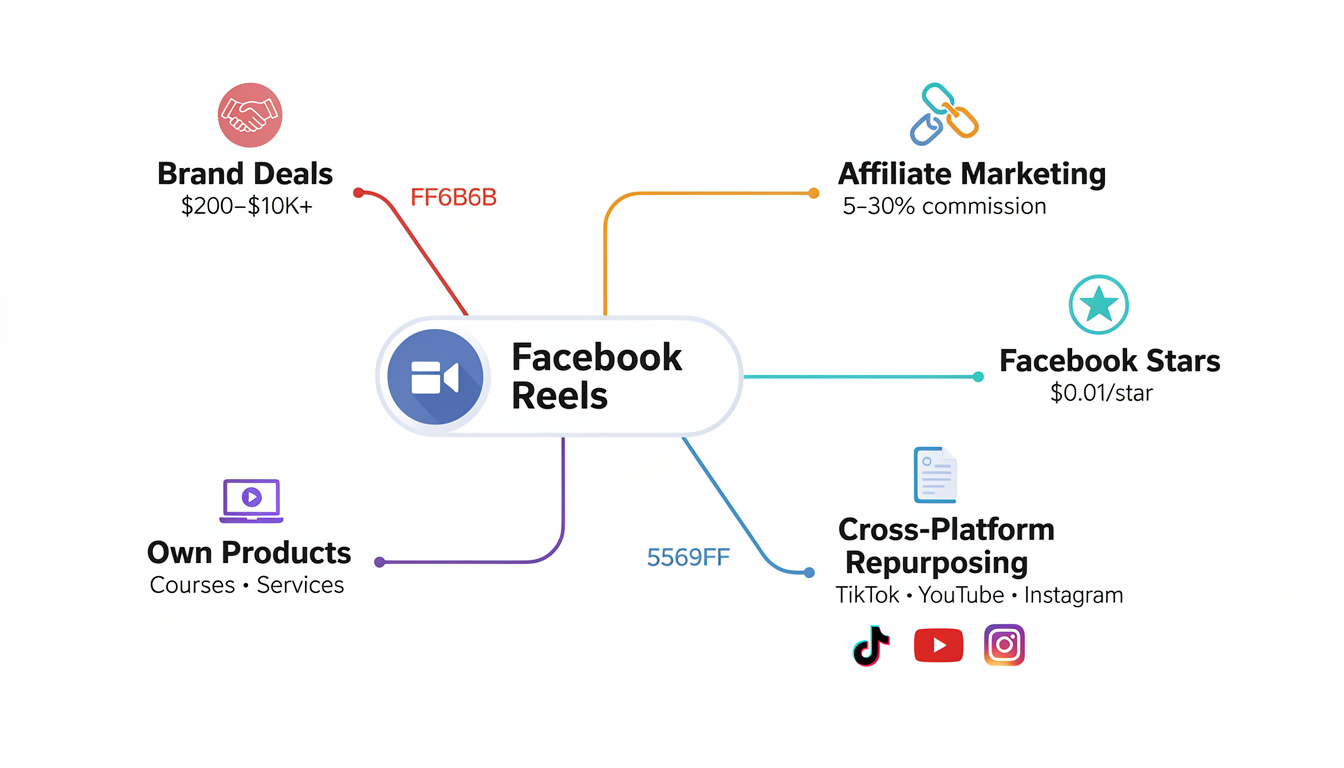
Brand sponsorships
Brand deals pay $200–$10,000+ per sponsored Reel depending on your follower count and engagement. Facebook's older demographic (25–55+) is actually a premium audience for many advertisers — these viewers have higher disposable income than TikTok's younger user base.
Even creators with 10,000–50,000 followers can land $200–$1,000 per sponsored post in the right niche. Build a media kit with your audience demographics, engagement rate, and content samples.
Affiliate marketing
Embed affiliate links in your Reel descriptions or direct viewers to your bio link. Facebook's audience tends to have higher purchase intent than other platforms — they're older, have more spending power, and are more likely to click through and buy.
Product review Reels, "things I use daily" content, and comparison videos perform particularly well for affiliate revenue. Typical commissions range from 5–30% per sale.
Facebook Stars
Viewers can send Stars during live streams and on published Reels. Each Star is worth $0.01 to you. While this adds up slowly, consistent creators with engaged communities report $50–$500/month from Stars alone. Encouraging Stars in your content (without being pushy) creates a passive revenue layer on top of Content Monetization payouts.
Cross-platform repurposing
A Facebook Reel that performs well can be reposted to TikTok, YouTube Shorts, and Instagram Reels — multiplying your total earnings from the same content. TikTok's Creator Rewards pays 2–8x more per view than Facebook for equivalent content. See our list of the best apps to post to all social media at once for tool options.
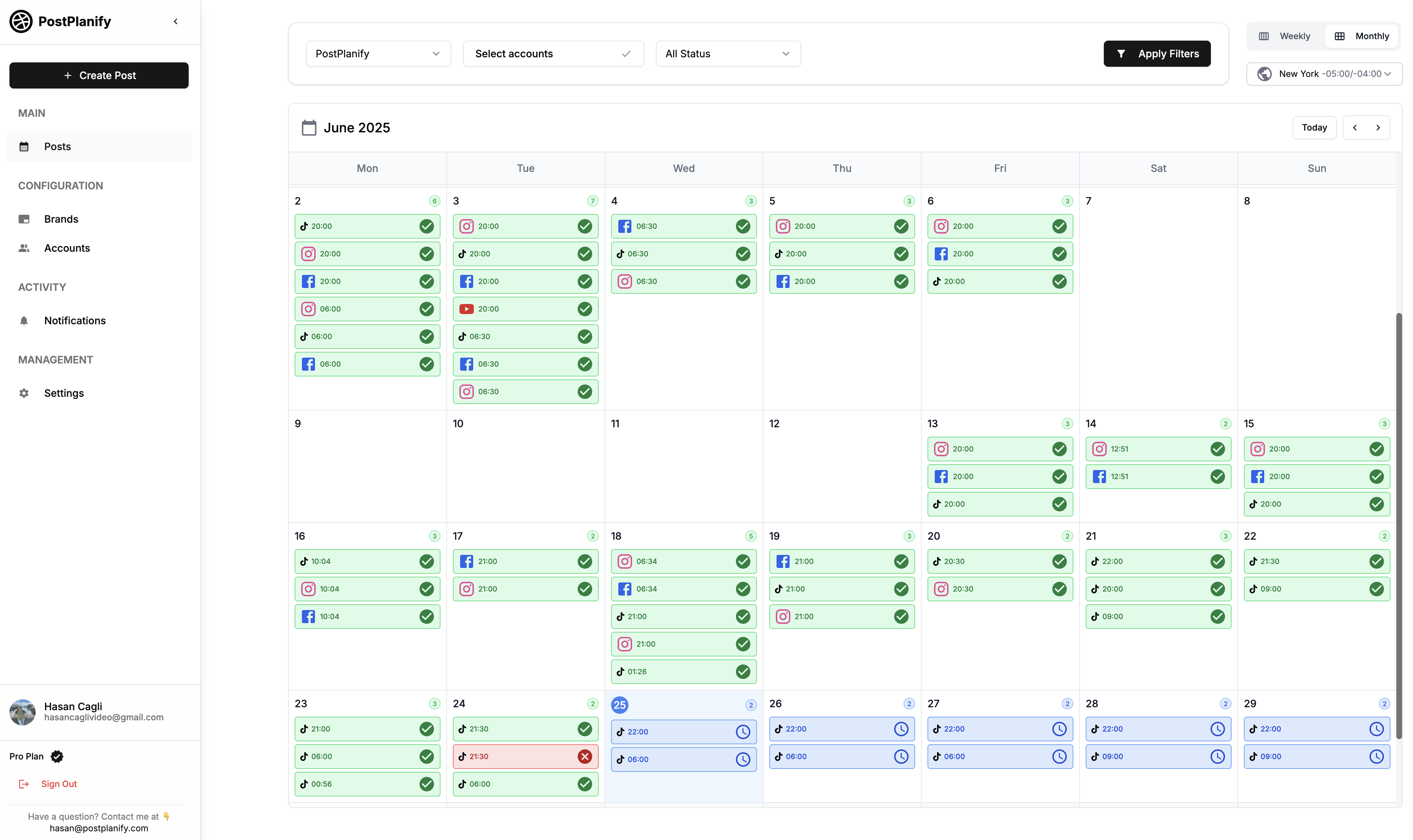
This is where a tool like PostPlanify saves serious time. Instead of manually uploading the same video to five platforms, you schedule it once and publish to Facebook, TikTok, YouTube, Instagram, and more from a single dashboard. Creators who repurpose content across platforms consistently report 2–3x total earnings from the same creative work — without 2–3x the effort.
Use our TikTok money calculator to estimate what your Facebook Reels audience could earn on TikTok.
Products, courses, and services
The highest-earning Facebook creators use Reels as a funnel. The views attract attention. The profile converts attention into email subscribers, customers, or clients. The actual revenue comes from:
- Online courses ($50–$2,000+ per sale)
- Coaching and consulting
- Physical or digital products
- Service business leads
Facebook's 25–55+ demographic is often more willing to pay for premium products and services than younger audiences on TikTok. A Reel that drives 100 email signups generates far more long-term revenue than the $5 Content Monetization payout on the same video.
Frequently Asked Questions
What is Facebook's Creator Fast Track program?
Creator Fast Track launched on March 18, 2026. It pays $1,000/month to creators with 100,000+ followers on Instagram, TikTok, or YouTube, and $3,000/month to creators with 1M+ followers — for three months of guaranteed pay. You need to post at least 15 Eligible Reels per month across at least 10 different days. After the program ends, you keep permanent access to Facebook Content Monetization without needing to meet the usual 10K follower and 600K watch-minute thresholds. Currently US/Canada only.
Is Facebook Content Monetization invite-only?
Yes, as of 2026. The Content Monetization program is invite-only — meeting the eligibility thresholds (10K followers, 600K watch minutes, etc.) makes you a candidate, but you still need Meta to send you an invitation before you can start earning. Meta has publicly stated it plans to open enrollment "in the near future" but hasn't committed to a date. Express interest through your Professional Dashboard → Monetization → Content Monetization.
How much does Facebook pay for 1 million Reels views?
At the typical Reels RPM range of $0.02–$0.20 per 1,000 views, 1 million views pays $20–$200 for most creators. Outliers in high-value niches with US-heavy audiences have reported $500–$2,000+ for 1 million views, but that's the exception. For comparison, TikTok pays $400–$800 for 1 million views and YouTube pays $2,000–$12,000.
Why do some sites say Facebook pays $3–$6 per 1,000 views?
Those figures typically refer to in-stream ad revenue on long-form videos (over 1 minute with mid-roll ads), not Reels-specific payouts. In-stream ads operate on a 55/45 revenue share model with higher CPMs because longer videos offer more ad inventory. Reels, as short-form content, earn significantly less per view through Facebook's Content Monetization program.
What are the requirements to monetize Facebook Reels?
You need 10,000+ followers, 600,000 minutes of watch time in the last 60 days, at least 5 active video uploads in the last 30 days, a Professional Mode profile or Page, an account that's 90+ days old, and you must be 18+ in an eligible country. You also need to comply with Facebook's Partner Monetization Policies and Content Monetization Policies. The 600K-minute threshold is roughly equivalent to 1.2 million total views if your average watch time is 30 seconds. If you don't yet qualify, you can start earning through Facebook Stars with just 500 followers.
Does using trending music affect my Reels earnings?
Yes, significantly. Using licensed music that isn't cleared for monetization can reduce or completely eliminate your payout for that Reel. Stick to original audio, voiceovers, or tracks from Meta's Sound Collection to ensure full monetization eligibility. This is one of the most common reasons creators see $0 earnings on Reels with high view counts.
Is Facebook Reels monetization available worldwide?
The Content Monetization program is available in most major markets including the US, UK, Canada, Australia, and Western Europe. It replaced all legacy monetization programs on August 31, 2025, making it the only unified system for creator payouts on Facebook. However, it is still invite-only in 2026 — Meta distributes invitations periodically based on audience quality, content originality, watch time depth, and compliance history. Meta has publicly stated it plans to open enrollment "in the near future" but hasn't given a date. Meeting the 10K follower / 600K watch-minute thresholds is necessary but not sufficient. Check your Professional Dashboard → Monetization → Content Monetization to express interest, and watch for in-product Facebook/Meta notifications (the Facebook app, email, Meta Business Suite, and Professional Dashboard are the official invitation channels).
Can you make a living from Facebook Reels views alone?
For the vast majority of creators, no. At $0.05–$0.10 per 1,000 views, you'd need 100–200 million views per month to earn $10,000. The creators earning real money from Facebook use Reels as an audience-building tool and monetize through brand deals, affiliate marketing, products, and cross-platform distribution. Direct view payouts are supplementary income, not a business model. Learn how to measure your true social media ROI across all revenue streams.
How often does Facebook pay creators?
Facebook processes Content Monetization payments monthly, typically between the 18th and 21st of each month for the previous month's earnings. You need to reach a minimum payout threshold of $100 before a payment is issued. If your earnings are below $100 in a given month, the balance carries over until the threshold is met. Payments are sent via direct deposit or PayPal, depending on your configured payout method.
Should I focus on Facebook Reels or TikTok for monetization?
For direct view payouts, TikTok pays 2–8x more per view through its Creator Rewards Program ($0.40–$0.80 per 1K qualified views). However, Facebook has advantages for certain creators: its audience skews older (higher purchasing power for brand deals and affiliate sales), the algorithm favors consistency over virality, and the platform supports a wider range of content formats. The best strategy is to post on both — repurpose your content across platforms to maximize total earnings from the same creative work.
What counts as a "view" on Facebook Reels?
Facebook counts a Reel view the moment it plays for just 1 millisecond in a user's feed — yes, milliseconds, not seconds. Every play and replay counts. (For comparison, standard Facebook videos still require 3 seconds to count as a view; Reels are measured much more aggressively.) This aggressive counting is why total view counts look impressive but earnings feel small — the vast majority of "views" at the 1ms threshold never convert into eligible plays or Qualified Views, which is what Meta actually pays on. A view only becomes monetizable if the viewer watches long enough for ad inventory to be served, the Reel is monetization-eligible (no flagged music, no policy violations), and ads are available in the viewer's region. This gap between total views and eligible plays is typically 50–70%.
How much does Facebook pay for 10,000 views on Reels?
At the typical RPM range of $0.02–$0.20 per 1,000 views, 10,000 views pays roughly $0.20–$2.00 for most creators. In high-value niches with US-heavy audiences, it could reach $5–$10. The reality is that 10,000 views on Facebook Reels generates very little direct revenue — monetization only becomes meaningful at scale (500K+ monthly views) or when combined with other revenue streams like brand deals and affiliate marketing.
How do I get paid from Facebook Reels?
Once you're accepted into Facebook's Content Monetization program, earnings accumulate automatically based on your content performance. Facebook processes payments monthly between the 18th and 21st for the previous month's earnings. You need to reach a $100 minimum payout threshold — balances below $100 carry over. Set up your payout method (direct deposit or PayPal) in Meta Business Suite under Monetization → Payout Settings.
Why are my Facebook Reels not monetized?
Common reasons include: not meeting eligibility requirements (10K followers, 600K minutes watched), using copyrighted music that isn't cleared for monetization, content flagged for policy violations, being in an ineligible country, or not having Professional Mode enabled. Check your monetization status in Meta Business Suite → Monetization to see specific reasons. The most frequently overlooked issue is music licensing — a single trending song can make an entire Reel ineligible for payouts.
Do Facebook Reels pay more than Instagram Reels?
Yes, currently. Facebook Reels pays $0.02–$0.20 per 1,000 views through the Content Monetization program, which is available to all eligible creators. Instagram Reels monetization is more limited — bonus programs are invite-only, inconsistent, and typically pay $0.01–$0.05 per 1,000 views. However, Instagram often delivers higher value through brand deals and shopping features, so total earnings potential depends on your monetization strategy beyond direct view payouts.
PostPlanifyAll your social media in one simple dashboard
Schedule posts, track analytics, and reply to comments/DMs without switching tabs.
Engagement
+18%
Views
52.8k
Key Takeaways
- Most Facebook Reels creators earn $0.02–$0.20 per 1,000 views through the Content Monetization program — outliers in finance/health niches with US audiences can reach $1–$5/1K
- Facebook retired all legacy monetization programs (Reels Play Bonus, Ads on Reels, Performance Bonuses) on August 31, 2025 and merged them into a single Content Monetization system — which remains invite-only in 2026 (Meta paid creators nearly $3 billion in 2025, 35% YoY growth)
- If you already have 100K+ followers on Instagram, TikTok, or YouTube, Creator Fast Track (launched March 18, 2026) guarantees $1,000–$3,000/month for 3 months and bypasses the usual eligibility thresholds entirely
- Content niche and audience geography are the two biggest factors — finance creators with US audiences can earn 50x more per view than entertainment creators with global audiences
- Using licensed/trending music can reduce or completely eliminate monetization for a Reel — stick to original audio or Meta's Sound Collection
- Only 30–50% of total views become eligible plays that generate revenue — your effective RPM on total views is lower than what Facebook reports on eligible plays
- Facebook Reels pays more than Instagram Reels and YouTube Shorts, but less than TikTok's Creator Rewards — the smart strategy is cross-platform repurposing to maximize total earnings
- Direct view payouts alone are not a viable income — successful creators use Reels as an audience-building tool and monetize through brand deals, affiliate marketing, products, and services
Related Reading
- How Much Does TikTok Pay for 1 Million Views? — TikTok Creator Rewards breakdown
- How Much Does YouTube Pay for 1,000 Views? — YouTube AdSense earnings guide
- What Social Media Platform Pays the Most? — Cross-platform earnings comparison
- How to Post Reels on Facebook — Step-by-step Reels publishing guide
- How to Schedule Facebook Posts — Facebook scheduling walkthrough
- Best Facebook Scheduling Tools — Top tools compared
- Best Time to Post on Facebook — Optimal posting times for reach
- Facebook Scheduled Posts Not Working? — Troubleshooting guide
- How to Link Facebook and Instagram — Cross-platform setup
- Content Repurposing Strategies — Maximize earnings across platforms
- Best Apps to Post to All Social Media at Once — Multi-platform tools
- How to Improve Social Media Engagement — Boost watch time and RPM
PostPlanifyAll your social media in one simple dashboard
Schedule posts, track analytics, and reply to comments/DMs without switching tabs.
Engagement
+18%
Views
52.8k
About the Author

Hasan Cagli
Founder of PostPlanify, a content and social media scheduling platform. He focuses on building systems that help businesses, agencies, and teams plan, publish, and manage content and social media more efficiently across platforms.


