


YouTube automation is one of the most hyped business models online right now. The pitch is everywhere: build faceless channels, outsource everything, collect passive income while you sleep. Thousands of courses promise six figures in six months, and the comment sections are full of people claiming to have cracked the code.
Here is the reality: YouTube automation can work, but it is not passive, it is not easy, and most people who attempt it fail. Not because the model itself is broken, but because their expectations are wildly unrealistic and their execution is poor.
This guide cuts through the noise. We will cover real revenue numbers from actual channels, the true cost of outsourcing production, YouTube's evolving policies on AI and automated content, and the specific steps that separate channels earning $5,000-$50,000 per month from the ones that never make a dollar.
One thing worth clarifying upfront: "YouTube automation" means different things to different people. Some mean fully outsourced faceless channels. Others mean using tools to automate the operational side of YouTube — scheduling uploads, cross-posting to other platforms, managing publishing workflows. Both are legitimate forms of automation, and the most successful creators use both. If the operational side is what you are interested in, tools like PostPlanify handle the scheduling and multi-platform distribution, so you can focus your time on content strategy instead of manually uploading to five platforms. We have a full guide on how to automate social media posts that covers this in depth.
But this article focuses primarily on the bigger question: can you build a profitable YouTube channel using outsourcing, AI tools, and systems — without being the on-screen talent? Let's find out.
What YouTube Automation Actually Means (Two Very Different Models)
The term "YouTube automation" covers two fundamentally different strategies, and conflating them is where most people go wrong:
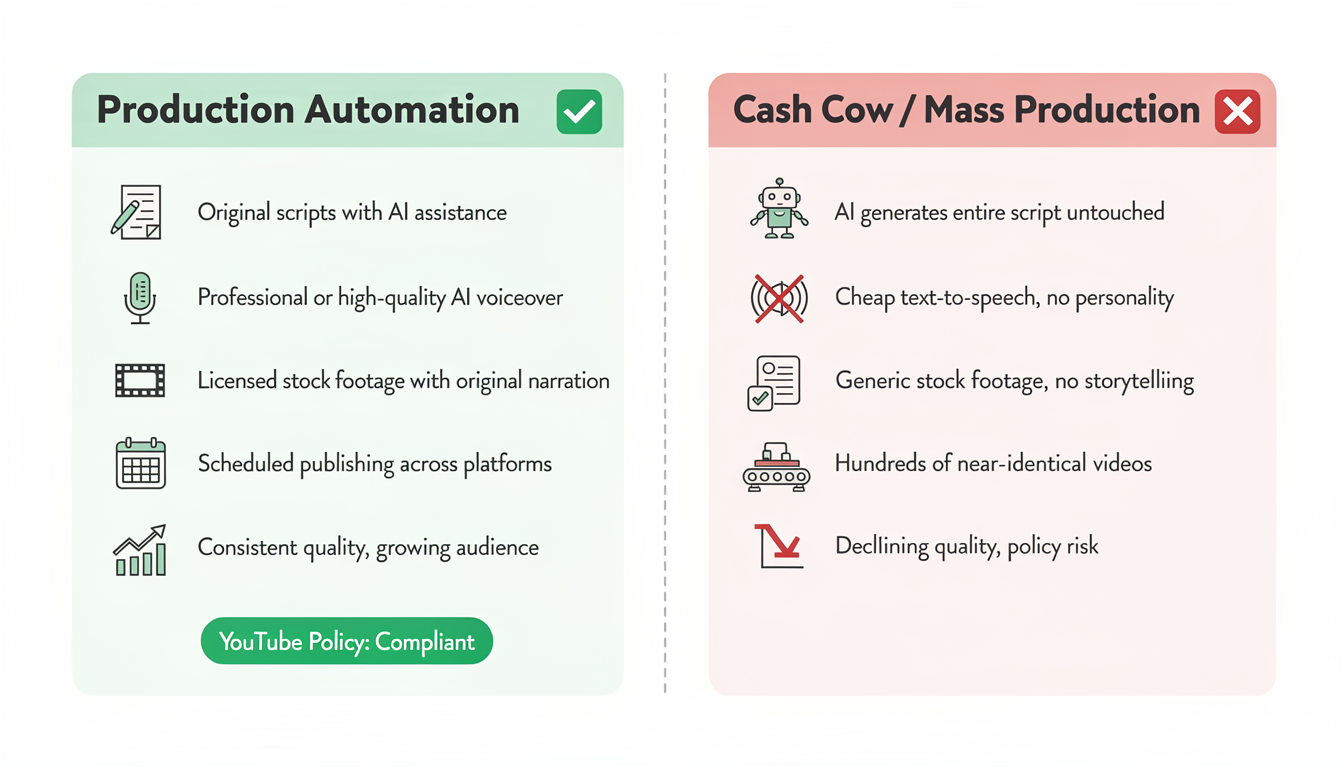
Model 1: Production Automation (Legitimate)
You build a real channel with genuine value, but you use tools, templates, AI, and freelancers to eliminate repetitive work from the production process. The content is original. You maintain creative control. You just systematize the execution.
What this looks like in practice:
- Using AI (ChatGPT, Claude) to draft scripts, then heavily editing and adding your own insights
- Hiring editors on Fiverr or Upwork to handle post-production
- Using stock footage libraries with original narration and storytelling
- Scheduling uploads and cross-posting with tools like PostPlanify instead of manually publishing
- Batching content creation — scripting 10 videos in one sitting, recording voiceovers for a full week's content in one session
- Building thumbnail templates that maintain brand consistency
This is how the most successful faceless channels operate. Bright Side (44M subscribers), WatchMojo (25M subscribers), and The Infographics Show all use production teams and systems. None of them are "passive income" — they are real media businesses with processes.
Model 2: Cash Cow / Mass Production (Risky)
You mass-produce low-effort content at scale, typically using AI-generated scripts, text-to-speech narration, stock footage compilations, and minimal editing. The goal is volume over value — publish dozens of videos per week and hope enough of them get views to generate meaningful ad revenue.
What this looks like in practice:
- AI generates the entire script with no human editing
- Cheap text-to-speech narration with no personality or original delivery
- Generic stock footage loosely related to the topic
- Identical video structure repeated across hundreds of uploads
- No genuine expertise or unique perspective in the content
This is the model YouTube is actively cracking down on. In July 2025, YouTube updated its monetization policies to specifically target "inauthentic content" — mass-produced, repetitive videos without meaningful value. Channels that rely on this approach are getting demonetized.
Which Model Actually Works?
| Factor | Production Automation | Cash Cow / Mass Production |
|---|---|---|
| Revenue potential | $1,000-$50,000+/month | $0-$500/month (declining) |
| YouTube policy risk | Low — compliant with all policies | High — actively targeted by policy updates |
| Time to profitability | 6-18 months | Often never (demonetized before reaching scale) |
| Scalability | High (with systems and team) | Low (volume without quality gets flagged) |
| Long-term viability | Strong — builds real audience and brand equity | Weak — one policy update can kill the channel |
| Startup cost | $500-$2,000 | $100-$500 |
| Required skills | Content strategy, storytelling, team management | Minimal (which is why it does not work) |
The bottom line: Production automation works because it creates genuine value for viewers. Cash cow channels fail because they try to extract value from the platform without adding any. YouTube's algorithm and policy teams are getting better at distinguishing between the two every year.
What YouTube's Algorithm Actually Rewards
YouTube's recommendation system does not care whether you show your face or not. It does not care whether you used AI to draft your script. It measures one thing above all: did viewers find this content valuable enough to keep watching?
Two metrics dominate how YouTube evaluates and distributes your content:
The Two Metrics That Determine Everything
| Metric | What It Measures | Benchmark | What It Tells the Algorithm |
|---|---|---|---|
| Click-Through Rate (CTR) | Percentage of people who see your thumbnail and title and click | 4-5% is solid, below 2% is a problem | Your packaging (thumbnail + title) is compelling enough to earn attention |
| Average View Duration (AVD) | How long viewers watch before leaving | 50%+ retention is strong, below 30% is a problem | Your content delivers on the promise of the thumbnail and title |
Why this matters for automation: A faceless channel with excellent scripts, professional editing, and compelling thumbnails will outperform a face-to-camera creator who rambles for 20 minutes. The algorithm does not reward personality — it rewards viewer satisfaction.
Secondary signals that also matter:
- Likes, comments, and shares — indicate active engagement beyond passive watching
- Subscriber conversion rate — viewers hitting subscribe signals they want more
- Session time — your video leading to more YouTube watching (not just your content) is a strong positive signal
For a detailed breakdown of how YouTube's revenue system works alongside these metrics, see our guide on how much YouTube pays for 1,000 views.
YouTube's 2025-2026 Monetization Policies: What You Must Know
This is where most "YouTube automation gurus" fail to update their advice. YouTube's policies have changed significantly, and ignoring them will get your channel demonetized — or worse, terminated.
The July 2025 Policy Update
YouTube renamed its "repetitious content" policy to "inauthentic content" and expanded its scope. The new policy explicitly targets:
| Content Type | Status | Example |
|---|---|---|
| AI-assisted scripting and editing | Allowed | Using ChatGPT to draft a script, then editing it significantly with your own insights |
| Faceless channels with original narration | Allowed | Stock footage + professional voiceover delivering genuine value |
| Outsourced production | Allowed | Hiring editors, voiceover artists, and thumbnail designers |
| Cross-platform scheduling tools | Allowed | Using PostPlanify or similar tools to schedule and distribute content |
| Mass-produced, repetitive videos | Flagged/demonetized | Hundreds of nearly identical videos using the same template |
| AI-generated content without human input | Flagged/demonetized | Fully automated slideshows, text-to-speech with no editing |
| Compilations of others' content | Flagged/demonetized | Re-uploading clips from other creators without transformation |
| Unlicensed third-party footage | Flagged/demonetized | Using copyrighted content without permission or fair use |
AI Disclosure Requirements
YouTube now requires creators to disclose when content contains realistic altered or synthetic material:
| AI Usage | Disclosure Required? |
|---|---|
| AI helped draft your script | No |
| AI generated a generic voiceover | No |
| AI generated realistic human faces or scenes | Yes |
| AI cloned a real person's voice | Yes |
| AI created deepfake or synthetic video of real people | Yes |
Content requiring disclosure gets a label: "Altered or synthetic content." Failing to disclose when required can result in content removal or channel penalties.
What This Means for Your Automation Strategy
The safest path is clear: use AI and automation as tools to enhance genuinely valuable content, not as replacements for human creativity. YouTube's enforcement will only intensify. Channels that add real value through original storytelling, unique insights, and quality production will thrive. Channels that try to game the system with volume and minimal effort will not survive.
For keeping your channel safe from policy issues, see our guide on how to recover your YouTube account if anything goes wrong.
 PostPlanify
All your social media in one simple dashboard
Schedule posts, track analytics, and reply to comments/DMs without switching tabs.

Engagement
+18%
Views
52.8k
The Real Numbers: How Much Do Automated YouTube Channels Make?
This is where the hype meets reality. Let's look at actual revenue data, not cherry-picked screenshots from course sellers.
YouTube RPM by Niche (2026)
RPM (Revenue Per Mille) is how much you earn per 1,000 monetized views after YouTube's 45% cut. It varies dramatically by niche:
| Niche | RPM Range (USD) | Automation Friendliness | Why |
|---|---|---|---|
| Finance & investing | $10-$25 | High | Explainer format works without face. High-value advertisers. |
| Technology & software | $8-$20 | High | Reviews, tutorials, and comparisons work with screen recordings and B-roll. |
| Business & entrepreneurship | $8-$18 | High | Case studies and strategy content suit narration-over-footage format. |
| Legal explainers | $9-$15 | High | Complex topics explained simply = high retention. Premium advertisers. |
| Health & wellness | $5-$12 | Medium | Requires careful accuracy. Misinformation can trigger policy issues. |
| Education & how-to | $4-$10 | High | Tutorial format naturally works without face. High save/bookmark rate. |
| Travel & culture | $3-$8 | Medium | Needs quality footage. Stock footage can feel generic. |
| Gaming | $2-$8 | Medium | Screen recordings work, but commentary personality matters. |
| Entertainment & pop culture | $2-$6 | Medium | List/ranking format works (WatchMojo), but copyright risks with clips. |
| Lifestyle & vlogs | $3-$8 | Low | Audience expects personal connection. Hard to automate authentically. |
Real Revenue Case Studies
These are documented examples, not hypothetical projections:
| Channel Profile | Monthly Revenue | Revenue Sources | Key Takeaway |
|---|---|---|---|
| Faceless science channel | ~$43,000/month | AdSense + sponsorships | Invested heavily in animation and scripting quality |
| Multi-channel operator (3 channels) | ~$250,000/month | AdSense + sponsorships + affiliates | Full-time operation with a remote team. Not passive at all. |
| Small faceless channel (5,800 subs) | ~$4,827/month | $973 AdSense + $190 affiliates + $3,664 sponsorships | Sponsorships generated nearly 4x more than ads |
| Recently monetized gaming channel | ~$9 in first 4 days | AdSense only | Reality check: early revenue is negligible |
| 700K-subscriber channel (cautionary) | $500-700/day → $7/day | AdSense (before policy enforcement) | Mass-produced content was removed. Revenue collapsed overnight. |
Pattern: Every profitable automated channel treats YouTube like a real business. The ones that fail treat it like a get-rich-quick scheme.
The Break-Even Math Most People Ignore
Before you see a single dollar of profit, you need to cover your production costs. Here is the formula:
Break-even views per video = Production cost ÷ (RPM ÷ 1,000)
| Production Cost | RPM | Views Needed to Break Even |
|---|---|---|
| $50 (AI-heavy, minimal outsourcing) | $5 | 10,000 views |
| $150 (mixed AI + freelancer) | $5 | 30,000 views |
| $150 (mixed AI + freelancer) | $15 | 10,000 views |
| $300 (fully outsourced, high quality) | $5 | 60,000 views |
| $300 (fully outsourced, high quality) | $15 | 20,000 views |
The uncomfortable truth: New channels average fewer than 100 views per video in their first 30 days. Most automated channels do not break even on production costs for 6-12 months. You need to be prepared to invest before you earn.
The True Cost of Outsourcing YouTube Production
The "automation" in YouTube automation usually means "paying other people to do the work." Here is what that actually costs in 2026:
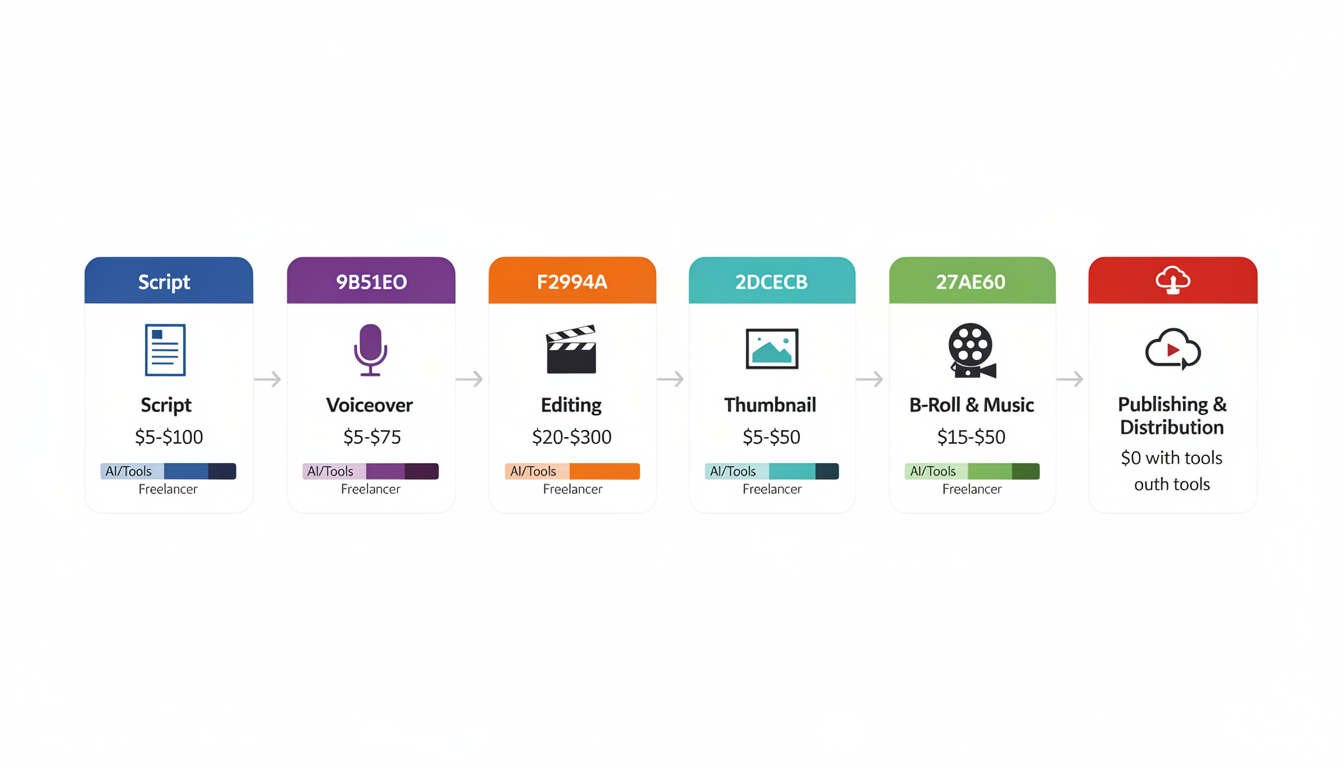
Cost Per Video: Freelancer vs AI vs Hybrid
| Production Step | Freelancer Cost | AI Tool Cost | Hybrid Approach | Recommended For |
|---|---|---|---|---|
| Script writing | $30-$100 | $0-$5 (ChatGPT/Claude) | $5-$20 (AI draft + human edit) | Hybrid — AI handles structure, you add insights and personality |
| Voiceover | $30-$75 (Fiverr/Upwork) | $0-$10 (ElevenLabs, Play.ht) | $10-$30 (AI voice + human polish) | Freelancer for premium feel, AI for scale |
| Video editing | $50-$300 | $5-$20 (CapCut, Descript) | $50-$150 (templates + freelancer) | Freelancer — editing quality directly impacts retention |
| Thumbnail design | $10-$50 | $0-$5 (Canva, AI generators) | $10-$25 (template + custom design) | Hybrid — template for consistency, custom elements per video |
| B-roll / stock footage | $10-$50 (licensed clips) | $0 (free stock) to $30/month (premium subscription) | $15-$30/month subscription | Subscription — Storyblocks, Artgrid, or Pexels Pro |
| Music / sound effects | $5-$20 per track | $0-$15/month (Epidemic Sound, Artlist) | $15/month subscription | Subscription — avoids Content ID claims |
| Total per video | $135-$595 | $5-$60 | $100-$275 | Hybrid provides the best quality-to-cost ratio |
Monthly Tool Stack Costs
| Creator Stage | Monthly Tool Budget | What You Need |
|---|---|---|
| Beginner (0-1K subs) | $40-$60/month | ChatGPT Plus ($20) + Canva Pro ($13) + PostPlanify for scheduling |
| Growing (1K-10K subs) | $80-$150/month | Above + ElevenLabs ($5-$22) + stock footage subscription ($15-$30) + music library ($15) |
| Scaling (10K+ subs) | $150-$300/month | Above + premium editing software + analytics tools + additional freelancer budget |
Best AI Tools for YouTube Automation (2026)
Here's the complete tool stack for running an automated YouTube channel, with what each tool does best and what it costs:
Content Creation Tools
| Tool | What It Does | Cost | Best For |
|---|---|---|---|
| ChatGPT (Plus) | Script drafting, research, outlining, SEO title suggestions | $20/mo | Script structure and research — always edit the output heavily |
| Claude | Long-form script writing, nuanced analysis, content strategy | $20/mo | More natural writing voice than ChatGPT for narration scripts |
| ElevenLabs | AI voice cloning and text-to-speech with natural intonation | $5–$22/mo | Best AI voiceover quality — indistinguishable from human at higher tiers |
| Play.ht | Text-to-speech with voice cloning | $14–$39/mo | Alternative to ElevenLabs with more language options |
| Pictory | Turns scripts into videos with stock footage automatically | $19–$39/mo | Fast production for simple explainer videos |
| InVideo AI | AI video generation from text prompts | $25–$50/mo | Quick first drafts — still needs human editing for quality |
Editing and Design Tools
| Tool | What It Does | Cost | Best For |
|---|---|---|---|
| CapCut | Video editing with auto-captions and effects | Free (Pro: $8/mo) | Beginners and Shorts editing |
| DaVinci Resolve | Professional video editing | Free (Studio: $295 one-time) | Advanced editing without subscription costs |
| Canva Pro | Thumbnail design, graphics, templates | $13/mo | Thumbnails and channel art — fastest workflow |
| Photoshop | Advanced thumbnail and graphic design | $23/mo | Professional-grade thumbnails |
Research and Analytics Tools
| Tool | What It Does | Cost | Best For |
|---|---|---|---|
| vidIQ | Keyword research, competitor analysis, SEO scoring | Free–$39/mo | Finding low-competition topics and optimizing titles |
| TubeBuddy | A/B testing thumbnails, SEO tools, bulk processing | Free–$49/mo | Thumbnail testing and bulk optimizations |
| Social Blade | Public channel analytics and growth tracking | Free | Researching competitor channels and revenue estimates |
Publishing and Distribution Tools
| Tool | What It Does | Cost | Best For |
|---|---|---|---|
| PostPlanify | Schedule YouTube Shorts + cross-post to TikTok, Instagram, and 7 more platforms | $29–$99/mo | Multi-platform scheduling from one dashboard |
| YouTube Studio | Native scheduling, analytics, channel management | Free | Basic scheduling for YouTube-only creators |
Stock Assets
| Tool | What It Does | Cost | Best For |
|---|---|---|---|
| Storyblocks | Unlimited stock footage, music, and sound effects | $20–$30/mo | Best value for high-volume video production |
| Artgrid | Premium cinematic stock footage | $25–$47/mo | Higher-quality footage for premium channels |
| Epidemic Sound | Royalty-free music and sound effects | $15/mo | Avoids Content ID claims — essential for monetized channels |
| Pexels / Pixabay | Free stock footage and images | Free | Budget-friendly starting option |
The recommended starter stack: ChatGPT Plus ($20) + ElevenLabs ($5) + CapCut (free) + Canva Pro ($13) + vidIQ (free tier) + PostPlanify ($19) = ~$57/month to run a complete YouTube automation operation. Scale up individual tools as your revenue justifies it.
Why Most YouTube Automation Courses Are Scams
Before you spend $1,500-$5,000 on a course, read this section carefully.
Red Flags That Identify Scam Courses
| Red Flag | What They Say | The Reality |
|---|---|---|
| Guaranteed income claims | "Make $10K/month in 90 days" | No one can guarantee YouTube revenue. Algorithm changes, niche competition, and content quality are all variables. |
| "Passive income" emphasis | "Set it and forget it" | Even the most successful automated channels require ongoing strategy, quality control, and optimization. |
| No verifiable proof | Screenshots with blurred channel names, anonymous testimonials | If their system works, they should be willing to show the actual channels. They rarely do. |
| High-pressure sales | "Price doubles at midnight," "Only 10 spots left" | Artificial scarcity is a manipulation tactic, not a sign of legitimate value. |
| Course costs more than starting | $2,000-$5,000 for a course | You can start a YouTube automation channel for $500-$1,000. The course costs more than the business itself. |
The Fundamental Problem With Course Sellers
Ask yourself one question: if someone had a truly reliable system for generating $10K/month in passive YouTube income, why would they sell you that system for $2,000 instead of just running more channels themselves?
The answer is almost always that the real money is in selling the course, not in running the channels. The course revenue is guaranteed; the YouTube revenue is not.
What you should do instead: Learn for free from creators who actually show their channels, analytics, and results publicly. YouTube itself is full of transparent creators sharing real data. Combine that with YouTube's own Creator Academy and you have everything a paid course offers.
How to Test YouTube Automation in 30 Days (Without Wasting Money)
Do not commit to a $2,000 course or six months of outsourcing before you validate the concept. Here is a 30-day test that costs you nothing but time:
Week 1: Validate Demand
Goal: Confirm that people actually want the content you plan to create.
| Research Method | How to Do It | What You Are Looking For |
|---|---|---|
| YouTube search autocomplete | Type your niche keyword and note the suggestions | Specific questions people are actively searching for |
| Competitor comment mining | Read the top 50 comments on successful competitor videos | Repeated questions, requests, complaints, and gaps |
| Reddit and forum research | Search r/[yourniche] for common questions and pain points | Topics that generate discussion and interest |
| vidIQ or TubeBuddy analysis | Check competitor video performance, keyword scores, and gaps | High-demand topics with low competition |
Output: A list of 50 video ideas, narrowed to your top 10 based on demand signals.
Week 2: Create Your First 6 Videos
Goal: Learn the full production process yourself before ever outsourcing it.
- Write scripts personally (use AI for research and outlining, but write the final version yourself)
- Record voiceover or use a high-quality AI voice (ElevenLabs or Play.ht, not cheap text-to-speech)
- Edit for retention: strong hook in the first 5 seconds, deliver core value by the 30-40% mark, cut everything unnecessary
- Design at least 2 thumbnail variations per video
Why you must do this yourself first: You cannot effectively manage freelancers if you do not understand the work. Creators who outsource before understanding production consistently get poor results because they cannot evaluate quality.
Week 3: Publish and Distribute
Goal: Get your content live and maximize its distribution.
- Upload to YouTube with optimized titles, descriptions, and tags
- Schedule uploads for optimal posting times using a scheduling tool
- Cut 60-second highlights from each video for YouTube Shorts
- Repurpose the same content to TikTok and Instagram Reels for additional reach
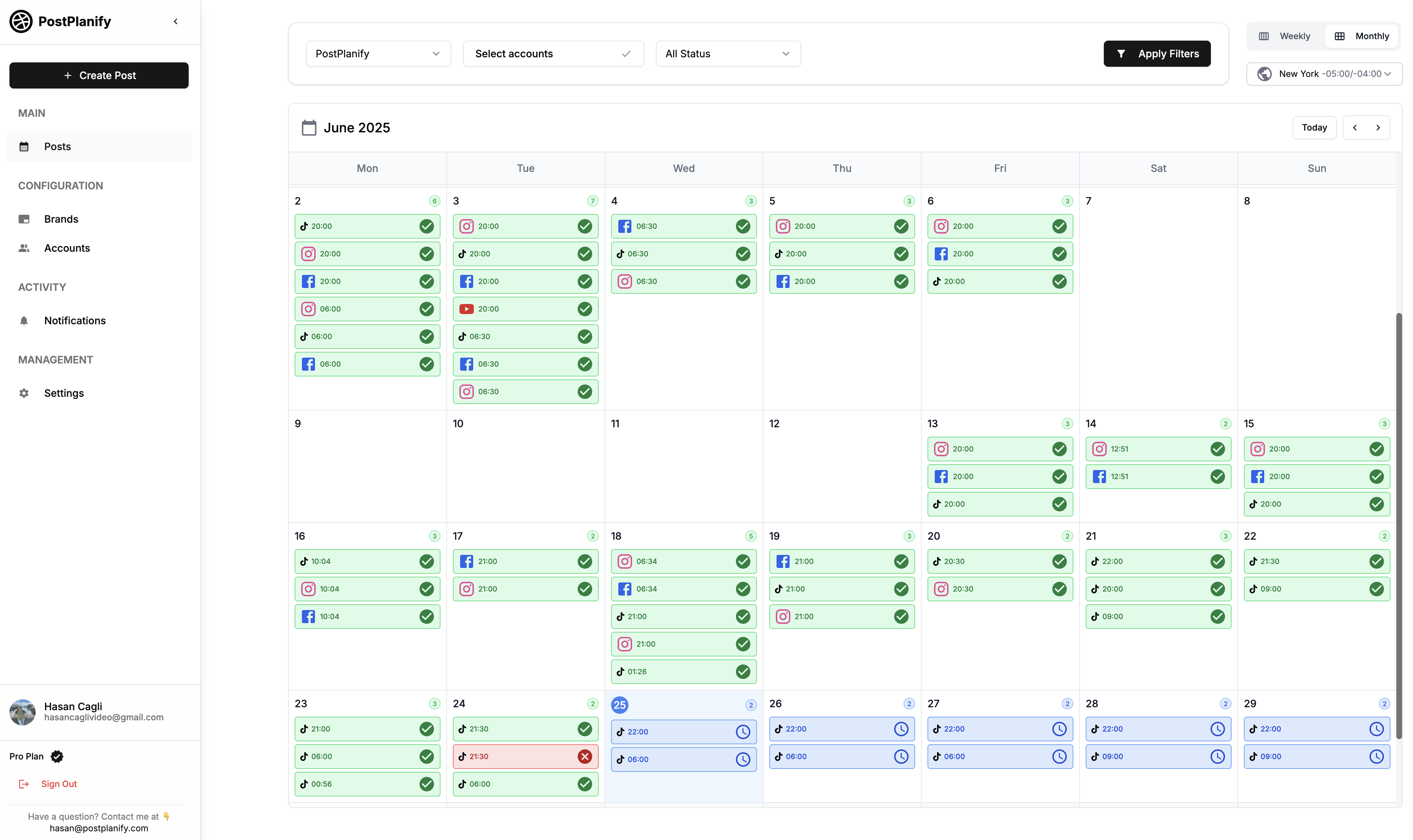
- Use PostPlanify to schedule everything across platforms from one dashboard — this is where automation saves you hours every week
Week 4: Measure and Decide
Goal: Use data to determine if your concept is viable.
| Metric | Benchmark | What It Means |
|---|---|---|
| CTR | Above 3% after 1,000+ impressions | Your packaging (title + thumbnail) works |
| Average view duration | Above 40% retention | Your content delivers on its promise |
| Comments and engagement | Any meaningful comments | Your content resonates with real people |
Decision framework:
- 2+ of your 6 videos hit these benchmarks: Your concept is validated. Move to scaling.
- 1 video hits but the rest do not: Analyze what made that one work. Pivot your approach toward those patterns.
- All 6 videos miss every benchmark: Pivot to a different niche or content angle before investing further.
How to Scale YouTube Automation the Right Way
You have validated your concept. Your test videos are performing. Now it is time to build systems that let you produce more content without sacrificing quality.
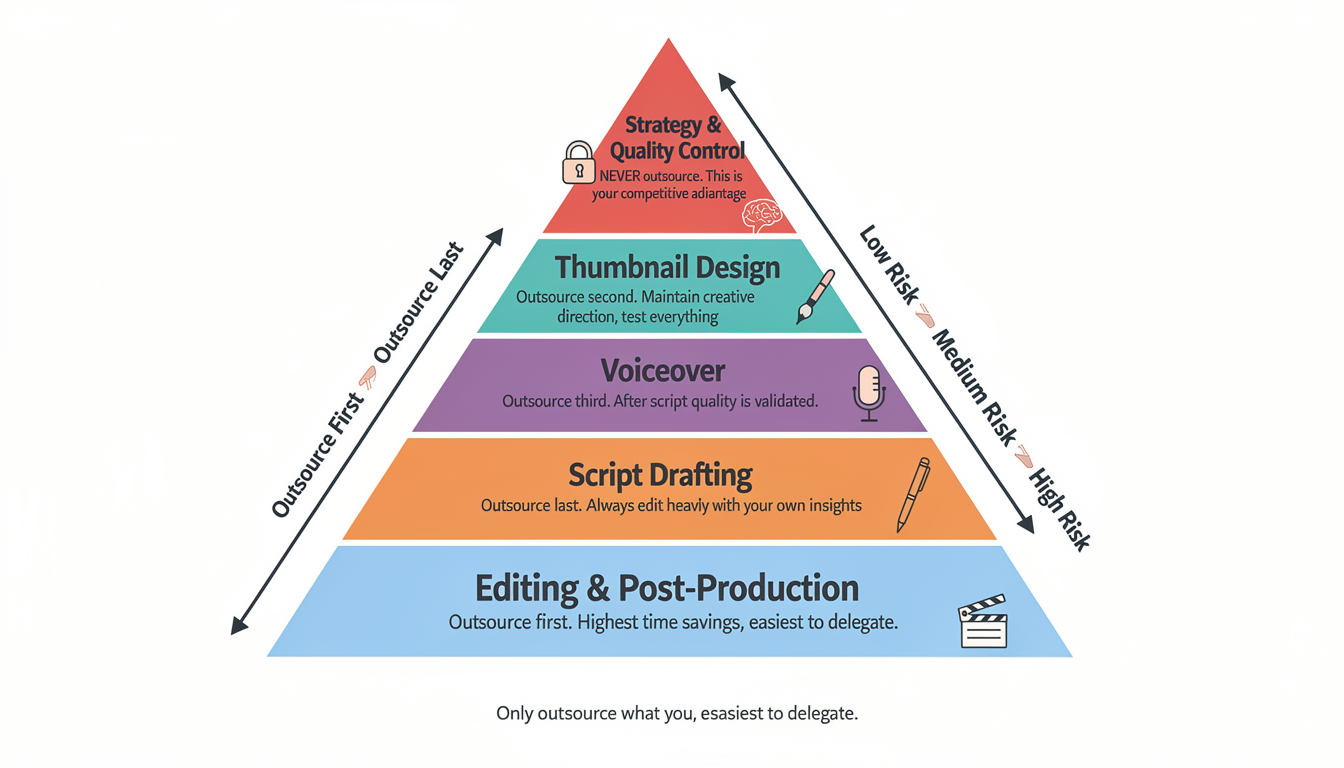
The Outsourcing Order (Do Not Skip Steps)
Outsource one function at a time, in this order. Moving too fast is the number one reason scaling fails:
| Order | Function | When to Outsource | Typical Cost | Risk if Outsourced Too Early |
|---|---|---|---|---|
| 1st | Video editing | After 20+ videos edited personally | $50-$200/video | Low risk — easiest to delegate with templates |
| 2nd | Thumbnail design | After testing 40+ thumbnails yourself | $10-$30/video | Medium risk — one case study showed 50% CTR drop with poor outsourced thumbnails |
| 3rd | Voiceover | After validating your script quality | $30-$75/video or AI at $5-$10 | Medium risk — voice quality directly impacts watch time |
| 4th | Script drafting | After 50+ scripts where you understand what works | $30-$100/video | High risk — outsourced writers do not know your audience. Always edit heavily. |
| Never | Content strategy & topic selection | N/A | N/A | This is your core competitive advantage. Outsourcing it means outsourcing your business judgment. |
| Never | Quality control & analytics review | N/A | N/A | Only you can decide what "good enough" means for your channel. |
Scaling Without Quality Loss
- Increase upload frequency gradually. Go from 1x/week to 2x/week, then 3x/week. Never jump from weekly to daily.
- Build production templates. Consistent intro, lower thirds, transitions, and outro. Editors follow the template, ensuring brand consistency.
- Create a content brief system. For every video, write a one-page brief: target keyword, hook, key points, CTA, thumbnail direction. This is what your freelancers work from.
- Set up a review workflow. Script draft → your edit → voiceover → rough cut → your review → final cut → thumbnail review → publish. No video goes live without your final approval.
- Automate the publishing workflow. Use PostPlanify to schedule YouTube Shorts and cross-post to TikTok and Instagram Reels automatically. This is the one part of the process that genuinely benefits from full automation — there is no creative judgment involved in clicking "publish" at the right time. For a detailed comparison of scheduling tools that support YouTube, see our guide to the best YouTube scheduling tools.
PostPlanifyAll your social media in one simple dashboard
Schedule posts, track analytics, and reply to comments/DMs without switching tabs.
Engagement
+18%
Views
52.8k
Beyond AdSense: How Automated Channels Actually Make Money
Here is a fact that changes the entire math of YouTube automation: AdSense is usually the smallest revenue stream for profitable automated channels.
Revenue Stream Comparison
| Revenue Stream | When to Start | Revenue Potential | Effort Level | Best For |
|---|---|---|---|---|
| YouTube AdSense | After monetization (1K subs + 4K watch hours) — see when YouTube starts paying you | $2-$25 per 1,000 views depending on niche | Low (passive once monetized) | Baseline revenue that grows with views |
| Affiliate marketing | Immediately (no subscriber threshold) | $100-$5,000+/month depending on niche and audience size | Medium (product research, link management) | Tech, finance, software, and tool-oriented niches |
| Sponsorships | 1,000+ subscribers with engaged audience | $500-$10,000+ per deal | Medium (outreach, negotiation, integration) | Any niche with a defined audience demographic |
| Digital products | After understanding audience needs | $500-$10,000+ per launch | High (product creation) | Education, business, and skill-based niches |
| YouTube memberships | 1,000+ subscribers | $100-$5,000+/month | Low-medium (exclusive content) | Channels with loyal, returning viewers |
Why Diversification Matters
The small faceless channel case study (5,800 subscribers) earned $4,827/month. But look at the breakdown:
- AdSense: $973 (20% of total)
- Affiliates: $190 (4%)
- Sponsorships: $3,664 (76%)
If that creator relied solely on AdSense, they would earn under $1,000/month. With diversification, they earn nearly $5,000. Your monetization strategy matters more than your view count.
For understanding how to measure the ROI of these different revenue streams, see our guide on how to measure social media ROI.
Why Multi-Platform Distribution Is Non-Negotiable
If you are creating video content for YouTube, you are sitting on content that can reach audiences on TikTok, Instagram Reels, Facebook Reels, LinkedIn, and more — with minimal extra effort. Not distributing across platforms is leaving money and growth on the table.
The Repurposing Workflow for One Video
| Platform | Format | What to Do |
|---|---|---|
| YouTube (long-form) | 8-15 minute horizontal video | Your primary content — full production quality |
| YouTube Shorts | 60-second vertical clip | Cut the most compelling 60 seconds from your long-form video — use the YouTube Shorts safe zone checker to ensure nothing important is hidden by UI overlays |
| TikTok | 60-second vertical clip | Same clip as Shorts, but remove any YouTube-specific references |
| Instagram Reels | 60-second vertical clip | Same clip, optimized caption with hashtags |
| X (Twitter) | Key quote or stat as text + 30-second clip | Pull the most shareable insight from the video |
| Key takeaway as text post + video clip | Professional framing of the same insight | |
| Blog post | Written version of the video content | Repurpose the script into an SEO-optimized article |
One 10-minute YouTube video becomes 7+ pieces of content across 6 platforms. This is where operational automation genuinely shines. Manually uploading and formatting content for each platform is time-consuming and error-prone. A scheduling tool handles the distribution logistics so you focus on content creation.
For a deeper dive into making one piece of content work everywhere, see our full guide on content repurposing strategies.
Successful Faceless Channels: What They Actually Do Differently
Let's study what works rather than theorizing. These channels prove the model is viable — but they also show what "viable" actually requires:
Case Studies of Channels That Work
| Channel | Subscribers | Est. Monthly Revenue | Niche | What They Do Differently |
|---|---|---|---|---|
| Bright Side | 44M | $23,000-$75,000 | General knowledge | Invested heavily in custom animation and upbeat storytelling. Professional production team. |
| WatchMojo | 25M | $120,000-$334,000 | Pop culture rankings | Wrote the playbook for the "Top 10" format. Punchy scripts, consistent structure, fast pacing. |
| Kurzgesagt | 23M | $50,000-$150,000 | Science explainers | World-class animation and deep research. Each video takes weeks to produce. |
| The Infographics Show | 15M | $30,000-$100,000 | General knowledge | Simple animation style but excellent scripting and topic selection. Highly consistent. |
| GENIAL | 32M | $4,100-$18,100 | General knowledge (Spanish) | Bright Side's Spanish counterpart. Proves the model works across languages. |
What These Channels Have in Common
- They all invested in production quality. None of them use cheap text-to-speech or random stock footage. Their animation, narration, and editing are professional.
- They all have clear content frameworks. WatchMojo has "Top 10." Kurzgesagt has "science explained beautifully." Each channel has a format viewers recognize and return for.
- They all treat this as a real business. Full teams, documented processes, quality control systems, and consistent upload schedules.
- None of them are passive. Every one of these channels has an active team making editorial decisions, reviewing content, and optimizing based on analytics.
The lesson: You do not need to show your face to build a massive YouTube channel. But you do need to provide genuine value, invest in quality, and run it like a business.
Is YouTube Automation Actually Passive Income?
No. Let's be direct about this.
Even creators running multiple successful automated channels spend significant time on:
| Task | Time Required | Can It Be Outsourced? |
|---|---|---|
| Content strategy and topic selection | 3-5 hours/week | No — this is your core judgment |
| Script review and editing | 3-8 hours/week | Partially — AI drafts, you edit |
| Freelancer management and feedback | 2-4 hours/week | No — quality control is yours |
| Thumbnail review and A/B testing | 1-2 hours/week | Partially — you approve, tools test |
| Analytics review and optimization | 2-3 hours/week | No — data interpretation is strategy |
| Community engagement (comments) | 1-2 hours/week | Partially — but authentic replies matter |
| Platform changes and policy monitoring | 1 hour/week | No — your business depends on this |
| Total | 13-25 hours/week |
That is a part-time to full-time job. It is far less physical labor than creating every video yourself, but it is not passive. The "automation" reduces production time, not strategic time.
Can it become more passive over time? Somewhat. After 12-18 months of building systems, training freelancers, and establishing content frameworks, some creators reduce their involvement to 5-10 hours/week. But you never reach zero. The moment you stop paying attention, quality drops, the algorithm notices, and revenue declines.
Is YouTube Automation Saturated in 2026?
This is the second most common question after "does it work?" — and the answer is nuanced.
The generic niches are saturated. The specific sub-niches are not.
"Top 10 facts" channels, generic motivation compilations, and basic "5 things you didn't know" formats are flooded. Thousands of channels produce nearly identical content in these spaces, and YouTube's algorithm increasingly deprioritizes repetitive content within oversaturated categories.
But within every broad niche, there are underserved sub-niches with strong demand and low competition:
| Saturated (Avoid) | Underserved (Opportunity) |
|---|---|
| Generic "top 10 facts" | Niche-specific deep dives (e.g., "history of failed tech startups" vs generic "tech facts") |
| Motivational quote compilations | Actionable frameworks for specific professions (e.g., "negotiation tactics for freelancers") |
| AI-narrated news summaries | Original analysis with unique data or perspective |
| "What I eat in a day" compilations | Condition-specific nutrition (e.g., "meal planning for IBS") |
| Random "did you know" content | Single-topic authority channels (e.g., only aviation incidents, only contract law) |
How to Find Unsaturated Sub-Niches
- Search YouTube for your broad niche and sort by "Upload date." If the recent uploads have fewer than 1,000 views and generic thumbnails, the broad niche is flooded with low-quality content — but that also means a high-quality channel can stand out.
- Mine the comments on successful competitor videos. Look for questions that don't have dedicated videos yet. Each unanswered question is a potential sub-niche.
- Check Google Trends for rising topics within your niche. Combine a rising trend with an evergreen format and you have a low-competition, high-demand angle.
- Use vidIQ or TubeBuddy to find keywords with high search volume but low competition scores. These are the gaps the saturated channels haven't filled.
The Saturation Paradox
Here's what most people get wrong: saturation in YouTube automation is actually good for creators who prioritize quality. When a niche is flooded with low-effort, mass-produced content, viewers become starved for something genuinely good. A channel that invests in real scripting, professional editing, and original insights will stand out dramatically against a sea of AI-generated mediocrity.
The channels that fail in "saturated" niches are the ones producing content indistinguishable from the other 500 channels. The ones that succeed are the ones viewers can't find anywhere else.
Should You Actually Try YouTube Automation? The Honest Assessment
| YouTube Automation Will Likely Work If You... | YouTube Automation Will Likely Fail If You... |
|---|---|
| Treat it as a real business, not a side hustle hack | Expect passive income within 90 days |
| Are willing to invest 6-12 months before meaningful income | Want to skip the learning phase and outsource immediately |
| Have $500-$2,000 to invest in tools, freelancers, and testing | Cannot afford to lose your initial investment |
| Are genuinely interested in your chosen niche | Pick a niche purely based on RPM without caring about the topic |
| Will create 20-30 videos yourself before outsourcing | Plan to outsource everything from day one |
| Understand that most early videos will underperform | Expect every video to go viral |
| Are comfortable with entrepreneurial uncertainty | Need guaranteed returns before committing |
| Will diversify revenue beyond AdSense | Plan to rely solely on ad revenue |
The Timeline Most People Are Not Prepared For
| Milestone | Realistic Timeline | What It Takes |
|---|---|---|
| First 20 videos published | Month 1-2 | Creating content yourself, learning the process |
| First 100 subscribers | Month 2-4 | Consistent uploading, SEO optimization — track your subscriber count regularly to measure progress |
| Monetization eligible (1K subs, 4K hours) | Month 4-12 | Building audience through quality and consistency |
| First $100/month | Month 6-12 | Sufficient views + niche RPM |
| First $1,000/month | Month 8-18 | Growing views + diversifying revenue |
| $5,000+/month | Month 12-24+ | Scaled production + multiple revenue streams |
If those timelines feel too long, YouTube automation is probably not the right model for you. The channels earning $10,000+/month almost all spent 6-18 months building before reaching that level.
Frequently Asked Questions
Does YouTube allow automated or faceless channels?
Yes. YouTube has no policy against faceless channels or using automation tools for production and publishing. What YouTube prohibits is "inauthentic content" — mass-produced, repetitive videos without meaningful value. As long as your content is original, provides genuine value, and complies with community guidelines, you can use AI tools, hire freelancers, and automate your publishing workflow without any policy issues.
How much does it cost to start a YouTube automation channel?
You can start for $40-$60/month using AI tools for scripting and voiceover, free editing software, and a scheduling tool like PostPlanify for publishing. A more realistic budget for quality content is $500-$2,000 for the first 2-3 months, covering freelancer costs for editing and voiceover, stock footage subscriptions, and tool subscriptions. Expect to invest more than you earn for the first 6-12 months.
Can you get monetized with AI-generated content on YouTube?
Yes, if the AI is used as a tool rather than a replacement for human creativity. YouTube allows AI-assisted scripting, AI voiceover, and AI-generated visuals as long as the final product is original, valuable, and not mass-produced. Fully automated content with no human input (auto-generated slideshows, unedited text-to-speech) gets flagged as inauthentic content and is not eligible for monetization. The key is adding genuine human value on top of AI capabilities.
How many videos should I publish per week for YouTube automation?
Start with 1-2 videos per week and only increase after validating that your content performs well. Quality always beats quantity. Four high-quality videos per month will outperform 30 low-effort ones. Once you have systems and freelancers in place, you can gradually scale to 3-5 videos per week. Never sacrifice production quality for upload frequency — the algorithm rewards viewer satisfaction, not posting volume.
Is it better to use AI voiceover or hire a real voice actor?
Both can work. High-quality AI voices (ElevenLabs, Play.ht) have reached a level where most viewers cannot distinguish them from human narration. They cost $5-$22/month versus $30-$75 per video for a freelance voice actor. For channels prioritizing scale and cost efficiency, AI voice is viable. For channels in niches where warmth, personality, and trust matter (health, finance, education), a human voice often performs better. Test both and let your retention data decide.
What niches work best for YouTube automation in 2026?
The most profitable automation-friendly niches combine high RPM with formats that work without face-to-camera presence. The top picks are: finance and investing ($10-$25 RPM), technology and software ($8-$20 RPM), business and entrepreneurship ($8-$18 RPM), legal explainers ($9-$15 RPM), and education/how-to content ($4-$10 RPM). Kids and family content is another popular faceless niche, though it comes with COPPA restrictions and lower CPMs — see our guide on how to start a YouTube channel for kids for the full breakdown. Avoid niches that rely heavily on personal connection (lifestyle vlogs, personal storytelling) as they are difficult to automate authentically.
Are YouTube automation courses worth buying?
Almost never. The information in most courses is freely available from transparent creators on YouTube itself, from YouTube's own Creator Academy, and from guides like this one. Red flags include guaranteed income claims, emphasis on passive income, prices above $1,000, and refusal to show actual channel URLs or verifiable analytics. If a course seller's system truly worked, they would be running channels, not selling courses. Save your money and invest it directly into production.
How do I protect my automated YouTube channel from getting terminated?
Follow three rules: (1) Every piece of content must provide genuine, original value — not just repackaged versions of existing videos. (2) Use only licensed or royalty-free assets for music, footage, and images. (3) Disclose AI-generated content when YouTube's policy requires it (realistic synthetic media, voice cloning of real people). Beyond content, secure your Google account with 2-Step Verification and strong passwords. See our full guide on YouTube account security and recovery for detailed protection steps.
The Bottom Line
YouTube automation works, but only if you redefine what "automation" means. It is not a passive income machine. It is not a shortcut. It is a legitimate business model where you use tools, systems, and people to scale content production without sacrificing quality.
The creators who succeed with YouTube automation share three traits:
- They obsess over content quality — every script, every edit, every thumbnail gets scrutinized
- They treat analytics as a feedback loop — not vanity metrics, but genuine signals about what their audience wants
- They diversify early — affiliate marketing, sponsorships, and digital products rather than waiting years for AdSense to pay the bills
The creators who fail share three traits:
- They chase volume over value
- They outsource everything before understanding anything
- They give up after 10-20 videos when the money does not materialize
If you are willing to invest 6-12 months of real effort, start with your own 20 videos, validate with data, scale with systems, and automate the operational work (scheduling, publishing, cross-posting) with tools like PostPlanify — then yes, YouTube automation is absolutely worth pursuing.
Just do not expect it to be easy. Expect it to be worth it.
Related: How Much Does YouTube Pay for 1,000 Views? | When Does YouTube Start Paying You? | How to See Your YouTube Subscribers | What Social Media Platform Pays the Most? | Best YouTube Scheduling Tools | How to Schedule YouTube Shorts | Best Time to Upload a YouTube Video | Content Repurposing Strategies | How to Automate Social Media Posts | How to Start a YouTube Channel for Kids | Best YouTube Analytics Tools
PostPlanifyAll your social media in one simple dashboard
Schedule posts, track analytics, and reply to comments/DMs without switching tabs.
Engagement
+18%
Views
52.8k
About the Author

Hasan Cagli
Founder of PostPlanify, a content and social media scheduling platform. He focuses on building systems that help businesses, agencies, and teams plan, publish, and manage content and social media more efficiently across platforms.


