


Search "best time to post on LinkedIn" and you'll get a dozen confident, mutually contradictory answers. Tuesday at 10am. Wednesday at 4pm. Weekdays 3 to 8pm. They can't all be right, and most of them are recycled from each other anyway.
So we measured it ourselves. This guide is built on PostPlanify's analysis of 794 LinkedIn company page posts from 36 pages (April to July 2026): engagement rate and impressions, split by day of the week and time of day. The short version: Thursday is the strongest day, the famous "never post on weekends" rule is only half true, and the most interesting finding is about the hours everyone else already picked. We call it the mid-morning trap.
The Short Answer
- Best day: Thursday. It earned a 3.33% median engagement rate in our data, clearly ahead of every other day (2.2 to 2.6%).
- Best window: early morning UTC (05:00 to 08:00). The most balanced slot in our dataset: 2.79% median engagement on the second-highest reach.
- The trap: mid-morning to afternoon UTC. 61% of all posts in our data land between 09:00 and 16:00 UTC, and that crowded stretch produced the weakest engagement rates of the working day.
- Worst day: Saturday (2.22% median). Sunday, surprisingly, held near-weekday engagement, just on the smallest audience of the week.
- All of this is a starting point, not a law. Your audience's own rhythm beats any benchmark; more on how to find it below.
Why Every LinkedIn Best-Time Study Disagrees
Three reasons the numbers never match across studies, and none of them is dishonesty.
Different metrics. Some studies rank hours by total engagements (which rewards hours when more people post), others by engagement rate per post. We use per-post medians, which resist being skewed by viral outliers and big-brand accounts.
Different samples. Sprout Social's 2026 study and Buffer's 4.8-million-post analysis skew toward large accounts; our dataset is small-to-mid-sized company pages, the kind most businesses actually run. Notably, both of those 2026 studies shifted their advice toward late afternoon and evening, away from the old 10am consensus, and our data directionally agrees: the 17:00 to 20:00 UTC window earned the highest median engagement rate we measured (5.0%), though on the smallest reach.
Here's the honest reconciliation:
| Source | Sample | What it measures | Best day(s) | Best time |
|---|---|---|---|---|
| PostPlanify (July 2026) | 794 SMB company page posts | Median ER per post | Thursday | Early morning UTC; 17:00–20:00 UTC spike |
| Buffer & Sprout Social (2026) | Millions of posts, large-account weighted | Engagement volume | Tuesday–Thursday | Shifting to ~3–8pm local |
| Older multi-study consensus | Mixed | Mixed | Tuesday–Wednesday | 10am–noon local |
Different clocks. Most studies report the audience's local time; our timestamps are UTC across a globally mixed sample, so a "quiet" UTC hour can be someone's peak commute. That's also why you should treat every study, including ours, as a range-finder rather than an alarm clock.
Best Day to Post on LinkedIn: Thursday
In our 794-post dataset, weekday posts earned a 2.63% median engagement rate versus 2.27% on weekends, a premium of about 16%, with higher median impressions too (28 vs 22.5). Teams already behave as if they know this: only 18.6% of posts were published on weekends.
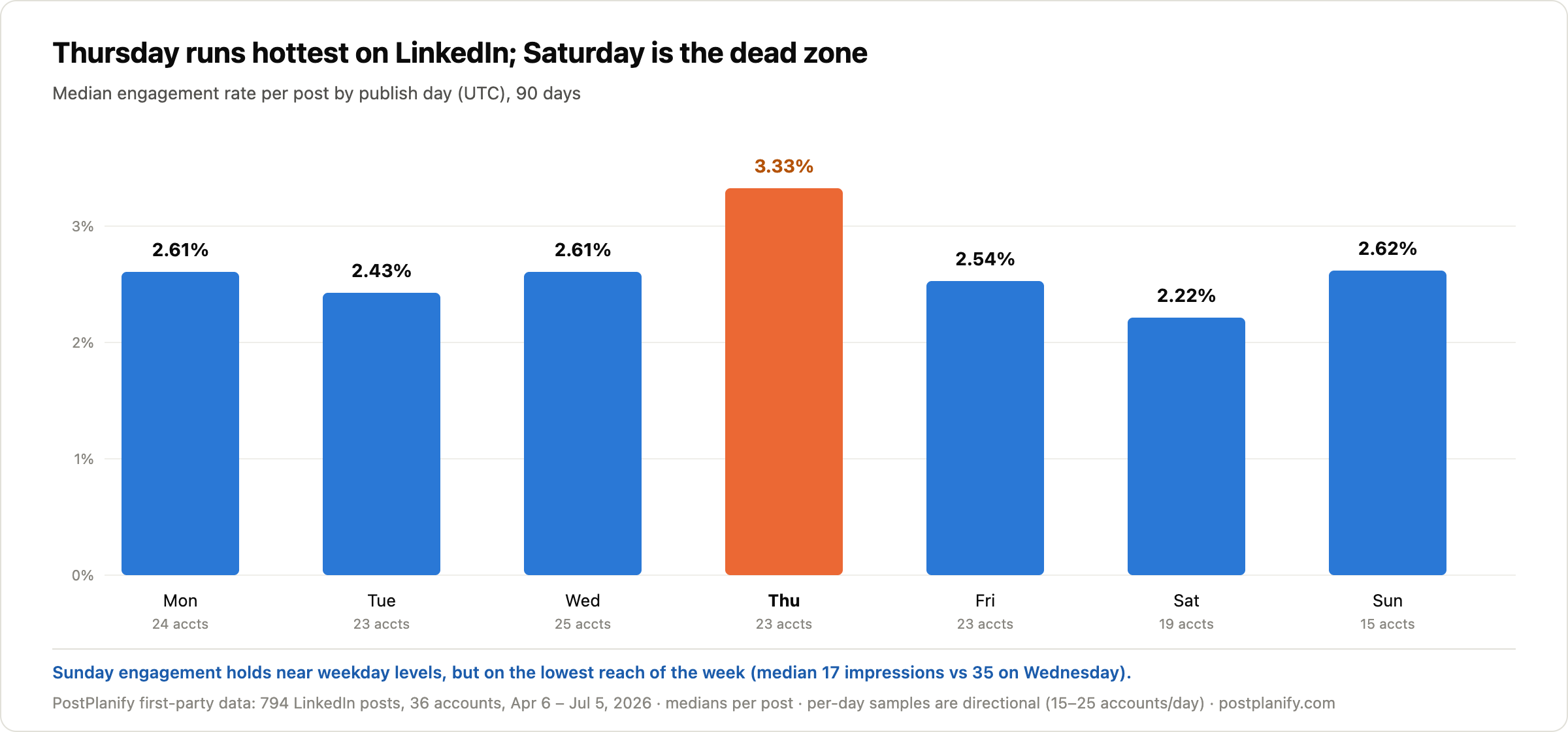
The per-day details are where it gets useful:
- Thursday ran hottest at a 3.33% median, well clear of the 2.2 to 2.6% everything else produced.
- Saturday is the real dead zone (2.22%, the week's lowest).
- Sunday is the sleeper: engagement held at 2.62%, essentially weekday level, but on the week's smallest reach (median 17 impressions vs 35 on Wednesday). Fewer people scrolling; the ones there still engage. If you post seven days a week, Sunday isn't the day to cut. Saturday is.
Per-day samples run 15 to 25 accounts, so treat the day-level ranking as directional and the weekday-versus-weekend split (33 and 22 accounts) as the firmer finding.
Best Time of Day: The Mid-Morning Trap
Here's the finding that surprised us. Everyone knows the standard advice: post mid-morning on a weekday. Our data says that's exactly when you get the least back, partly because that's when everyone posts.
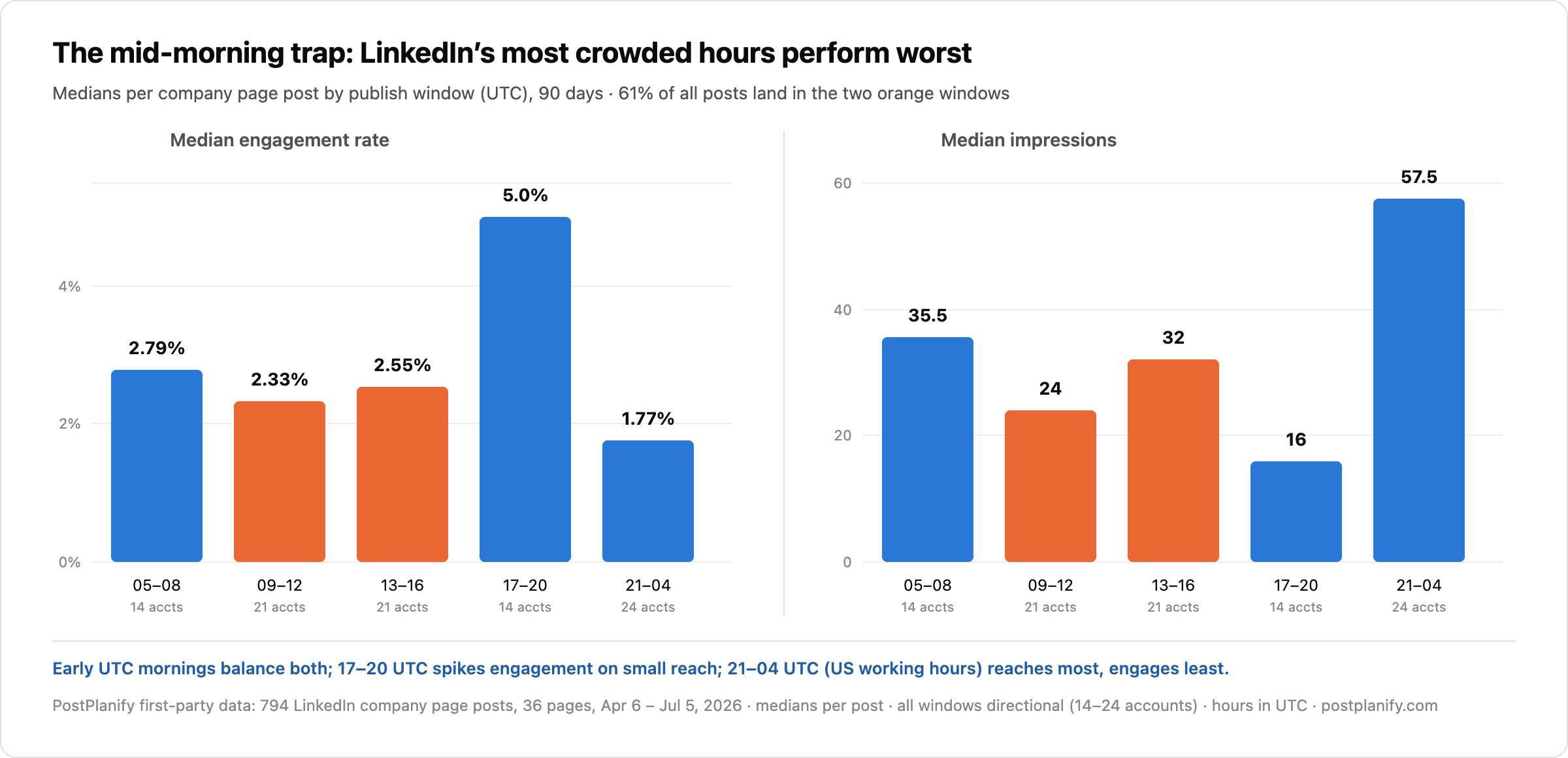
| Window (UTC) | Roughly (ET / CET) | Median ER | Median impressions | Share of all posts |
|---|---|---|---|---|
| 05:00–08:00 | 1–4am ET / 7–10am CET | 2.79% | 35.5 | 13% |
| 09:00–12:00 | 5–8am ET / 11am–2pm CET | 2.33% | 24 | 26% |
| 13:00–16:00 | 9am–12pm ET / 3–6pm CET | 2.55% | 32 | 36% |
| 17:00–20:00 | 1–4pm ET / 7–10pm CET | 5.0% | 16 | 10% |
| 21:00–04:00 | 5pm–12am ET / evening–night CET | 1.77% | 57.5 | 14% |
Three things worth reading out of that table:
- The crowded middle underperforms. The 09:00 to 16:00 UTC stretch holds 61% of all posts and produces the working day's weakest engagement rates. When everyone's post lands at once, everyone's post competes at once.
- The early-morning window is the balanced winner. 05:00 to 08:00 UTC (European morning) delivered above-average engagement on the second-best reach, with about a fifth of the mid-day crowd competing.
- The two extremes tell a timezone story. The 17:00 to 20:00 UTC spike (5.0% engagement on just 16 median impressions) and the 21:00 to 04:00 flood of impressions at low engagement (57.5 and 1.77%) are mirror images: the late-UTC hours are prime US working time for a global sample, big audiences scrolling fast; the early-evening UTC slot is a quieter room where the people present actually engage.
Every time window here runs 14 to 24 accounts, so this whole layer is directional. It's also, as far as we know, the only published time-of-day data for small-to-mid-sized company pages specifically, so directional beats recycled.
A Practical LinkedIn Posting Schedule
Putting the day and time layers together, here's what our data supports as a starting schedule for a company page posting 2 to 3 times a week (the median LinkedIn cadence in our dataset is 2 posts per week):
- Thursday, early morning in your audience's main timezone. The strongest day, in the balanced window.
- One more weekday (Monday or Wednesday), same early slot. Both carried solid 2.6% medians.
- Optional third post: experiment with late afternoon local time. Both the big 2026 industry studies and our own 17:00 to 20:00 UTC spike point at underused later hours. Small crowd, engaged room.
And skip Saturday. If weekend posting matters to you, our data says Sunday is the better half by a wide margin.
Then replace all of this with your own numbers as fast as you can. A benchmark tells you where to start; your audience tells you where to stay. PostPlanify's analytics calculates best times to post from your own audience's activity, and the LinkedIn scheduler puts posts there automatically. For what to actually publish in those slots, our what to post on LinkedIn guide covers formats, and the LinkedIn analytics tools comparison covers how to measure the results properly.
Frequently Asked Questions
What is the best day to post on LinkedIn?
Thursday, in PostPlanify's analysis of 794 company page posts (April to July 2026): a 3.33% median engagement rate versus 2.2 to 2.6% on other days. Weekdays overall beat weekends 2.63% to 2.27%. Saturday was the weakest day at 2.22%, while Sunday held near-weekday engagement on the week's smallest reach. Per-day samples are directional (15 to 25 accounts per day), so validate against your own audience.
What is the best time of day to post on LinkedIn?
The early morning window (05:00 to 08:00 UTC) was the most balanced in PostPlanify's data: a 2.79% median engagement rate on strong reach, with far less competition than the 09:00 to 16:00 UTC stretch where 61% of posts land and engagement drops to 2.33 to 2.55%. The 17:00 to 20:00 UTC window spiked to a 5.0% median on small reach, which matches the 2026 shift toward later posting that Buffer's and Sprout Social's studies also found.
Should I post on LinkedIn on weekends?
Saturday, mostly no: it was the weakest day in our data at a 2.22% median engagement rate. Sunday is the surprise: engagement held at 2.62%, essentially weekday level, but reach was the week's lowest (median 17 impressions vs 35 on Wednesday). If you publish daily, keep Sunday and sacrifice Saturday.
Does posting time actually matter on LinkedIn?
It matters, but less than consistency and content. The gap between our best and worst regular windows was about 1 percentage point of median engagement, while the gap between posting consistently and not posting dwarfs any timing effect. Treat timing as free optimization on top of a steady cadence, not a substitute for one. The same dataset puts LinkedIn's overall median engagement rate at 2.55% per view, so anything above that is beating typical.
How is this different from other best-time studies?
Most studies measure large accounts and report total engagements by local time; ours measures small-to-mid-sized company pages with per-post medians in UTC. That's why the numbers differ and always will. Where they agree is worth noting: both Buffer's 4.8M-post study and Sprout Social's 2026 data moved their recommendations toward late afternoon and evening, and our 17:00 to 20:00 UTC engagement spike points the same direction independently.
Methodology: 794 LinkedIn company page posts from 36 pages connected to PostPlanify, published April 6 to July 5, 2026, each at least 7 days old at measurement. Engagement rate = interactions / impressions per post; medians throughout. Days and hours in UTC. Weekday/weekend split covers 33/22 accounts; per-day and per-window cuts are directional (14 to 25 accounts). Correlation, not causation.
Bottom line: post Thursdays, favor the quiet early window over the crowded mid-morning, give Sunday a chance before Saturday, and then let your own data overrule ours. PostPlanify finds your audience's best times automatically and schedules to them: free for 7 days, with a 14-day money-back guarantee.
 PostPlanify
All your social media in one simple dashboard
Schedule posts, track analytics, and reply to comments/DMs without switching tabs.

Engagement
+18%
Views
52.8k
About the Author

Hasan Cagli
Founder of PostPlanify, a content and social media scheduling platform. He focuses on building systems that help businesses, agencies, and teams plan, publish, and manage content and social media more efficiently across platforms.


