


Everyone wants one number. The honest answer is a number per platform, per capacity — and the difference between those two framings is why most posting-frequency advice fails. A solo founder following "post 3–4 times a day on X" burns out in two weeks. An agency treating "quality over quantity" as permission to post twice a month watches every client account stall.
This guide gives you exact ranges for all 10 major platforms, the studies behind each number (with sample sizes, so you can judge them), first-party data from 55,000+ posts synced through PostPlanify, and a three-tier system — minimum viable, sweet spot, growth push — so you can pick the cadence that matches your team instead of someone else's.
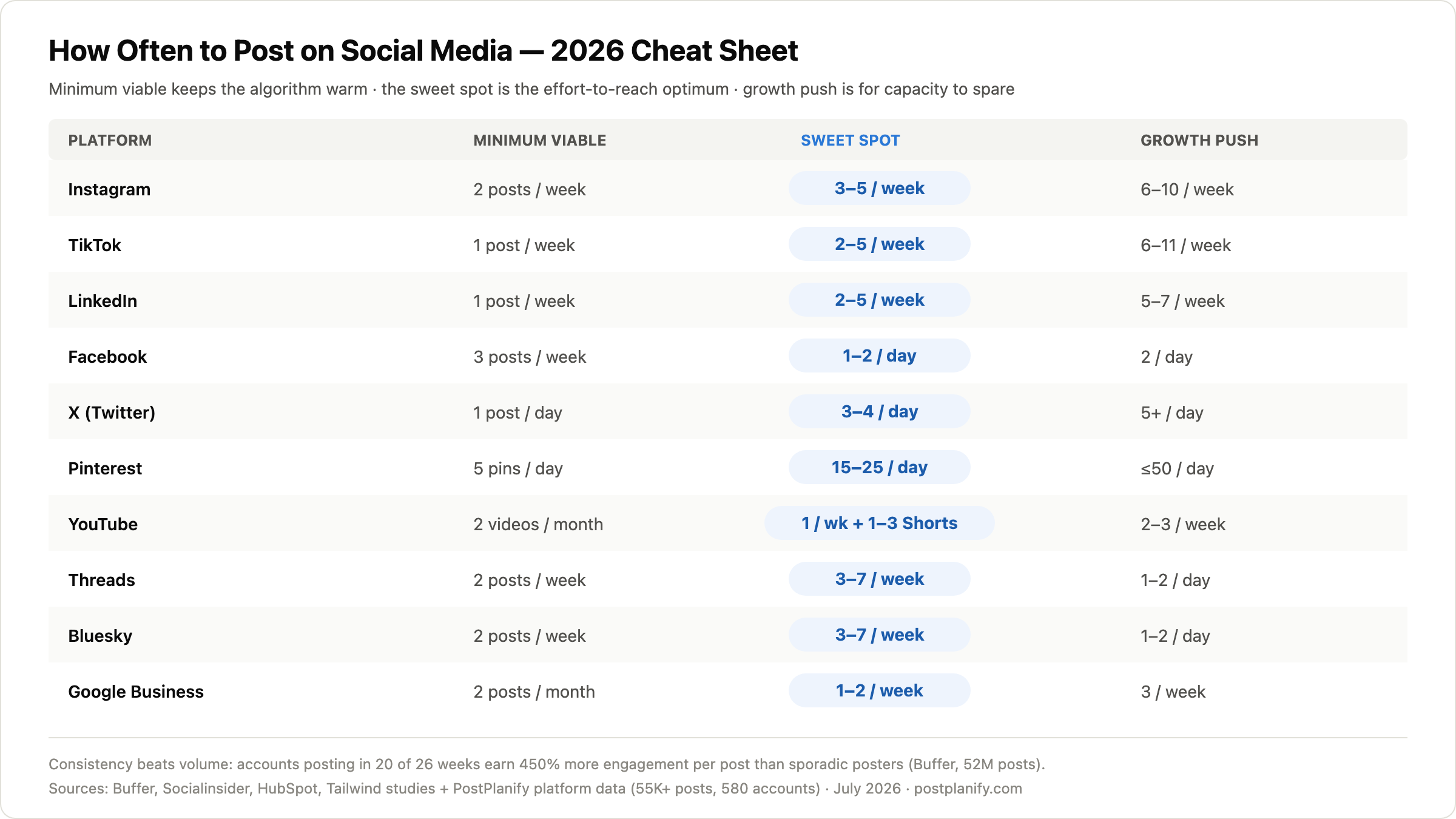
The 2026 posting frequency cheat sheet
| Platform | Minimum viable | Sweet spot | Growth push |
|---|---|---|---|
| 2 posts/week | 3–5/week | 6–10/week | |
| TikTok | 1 post/week | 2–5/week | 6–11/week |
| 1 post/week | 2–5/week | 5–7/week | |
| 3 posts/week | 1–2/day | 2/day | |
| X (Twitter) | 1 post/day | 3–4/day | 5+/day |
| 5 pins/day | 15–25/day | up to 50/day | |
| YouTube | 2 videos/month | 1/week + 1–3 Shorts | 2–3/week |
| Threads | 2 posts/week | 3–7/week | 1–2/day |
| Bluesky | 2 posts/week | 3–7/week | 1–2/day |
| Google Business | 2 posts/month | 1–2/week | 3/week |
We call this three-tier system the cadence ladder — you climb it, you don't jump to the top rung. How to read the tiers:
- Minimum viable — the floor that keeps the algorithm treating you as an active account. Below this, you trigger what the data calls the no-post penalty (more on that below).
- Sweet spot — the best return per unit of effort, and where the large-scale studies cluster. If you can only hit one tier, hit this one on your two most important platforms.
- Growth push — for teams with capacity to spare. The data shows gains continue at this volume, but each additional post buys less than the one before — and quality risk rises.
Three rules that matter more than any number
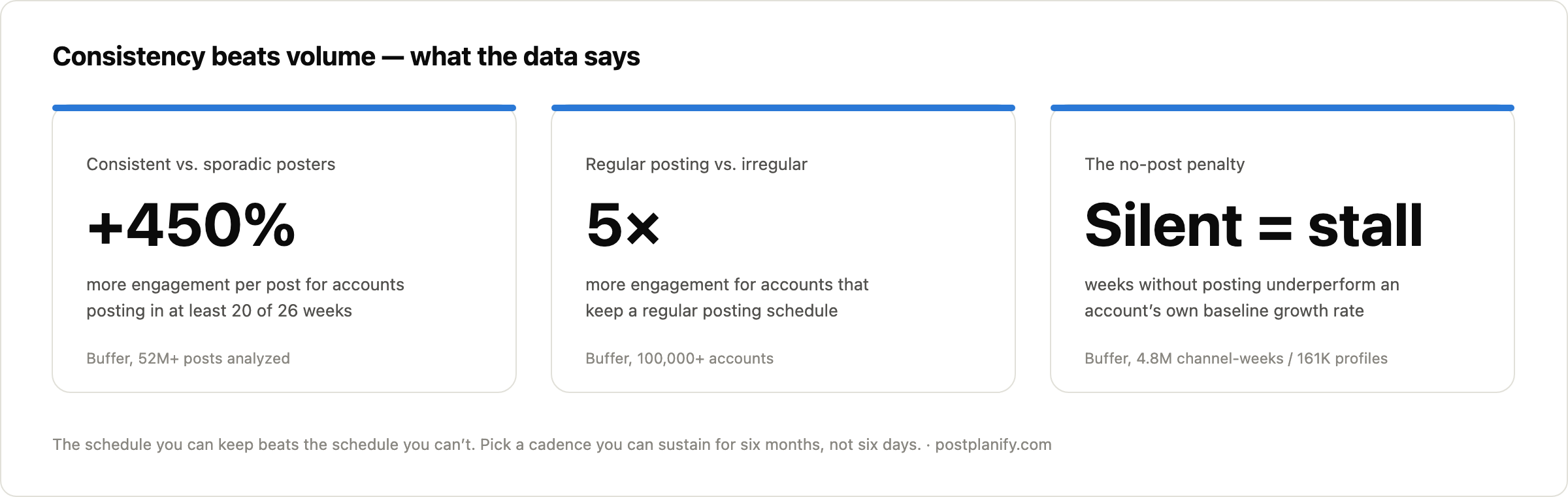
1. Consistency beats volume — by a lot. In Buffer's analysis of 52+ million posts, accounts that posted in at least 20 of 26 weeks earned 450% more engagement per post than sporadic posters. A separate analysis of 100,000+ accounts found regular posting correlates with 5× more engagement. Three posts a week for six months beats fifteen posts one week and silence the next — it isn't close.
2. Silence has a price. Across 4.8 million channel-weeks from roughly 161,000 profiles, accounts that didn't post in a given week consistently underperformed their own baseline growth. You don't hold your position when you skip a week — you lose ground.
3. The right frequency is the highest one where quality holds. Every platform's algorithm now rewards saves, shares, and meaningful comments over raw volume. The moment extra posts start being filler, they dilute your average — and your distribution. Scale cadence up only when the last increase didn't cost you quality.
A note on conflicting data: you'll see engagement benchmarks that seem to disagree wildly — Socialinsider reports Instagram at ~0.48% while Buffer reports ~5.5%. Neither is wrong; one measures engagement against followers, the other against reach. We cite each study by what it actually measured.
What PostPlanify's own data shows
Before the platform-by-platform numbers, we ran the same questions against our own database — every post synced from accounts connected to PostPlanify through the official platform APIs. That covers all account activity, not just posts published through our scheduler: 55,000+ posts across 580 connected accounts.
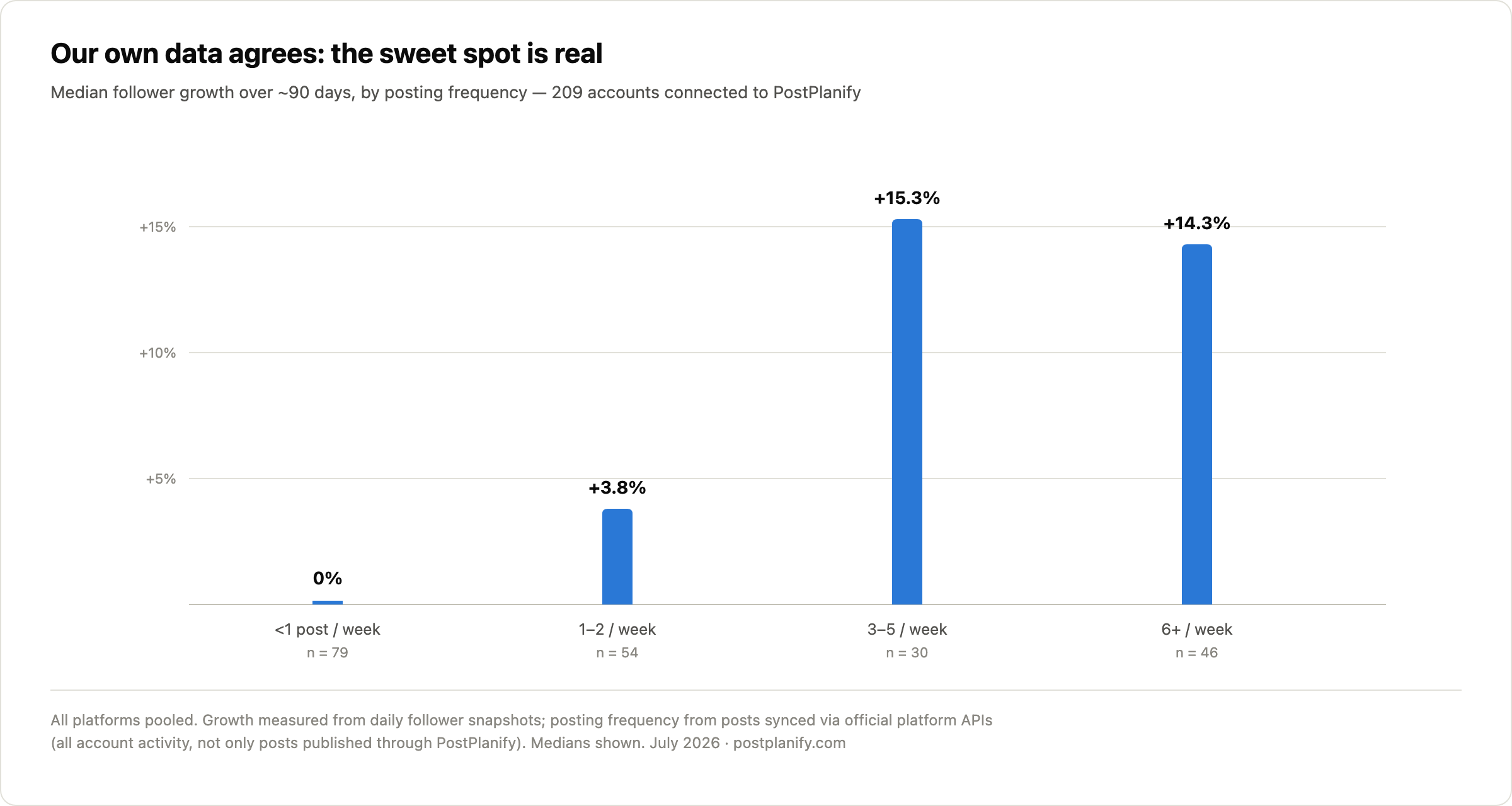
Three findings worth adding to the record:
- The sweet spot reproduced. In PostPlanify's analysis of 55,000+ synced posts (July 2026), accounts posting 3–5 times a week grew followers at a median of +15.3% over ~90 days — four times the +3.8% of 1–2×/week posters. Accounts posting less than weekly didn't grow at all (median 0%). And 6+ posts a week didn't beat 3–5 (+14.3%): diminishing returns, visible in our data too.
- Consistency really is rare. Only 39.7% of accounts in PostPlanify's dataset with six months of history cleared the "20 of 26 active weeks" bar that Buffer's research rewards so heavily. The 450% consistency edge exists precisely because most accounts can't hold a cadence.
- On Instagram, volume bought reach without costing engagement. Accounts posting 3–5×/week earned a median reach of 471 per post vs. 232 for 1–2×/week posters — roughly double — while engagement rate held steady (4.2% vs. 4.1%).
The median active account in our data also lands almost exactly on the cheat sheet: Instagram 3 posts/week (top quartile: 5), Facebook 3, LinkedIn 2, TikTok 6.
Methodology: medians throughout; follower growth measured between first and last daily snapshot across a ~90-day window (minimum 60 days of history per account); frequency buckets with fewer than 30 accounts excluded; X excluded from cadence stats because its API returns limited post history. This is correlation, not causation — but the direction independently matches the 52M-post studies above.
How often to post on Instagram in 2026
Sweet spot: 3–5 feed posts per week. Buffer's account-level data shows the payoff clearly: compared to posting 1–2 times a week, accounts posting 3–5 times earned about 12% more reach per post, 6–9 times earned ~18%, and 10+ earned ~24%. Follower growth follows the same curve — from +0.12% weekly at 1–2 posts to +0.66% at 10+.
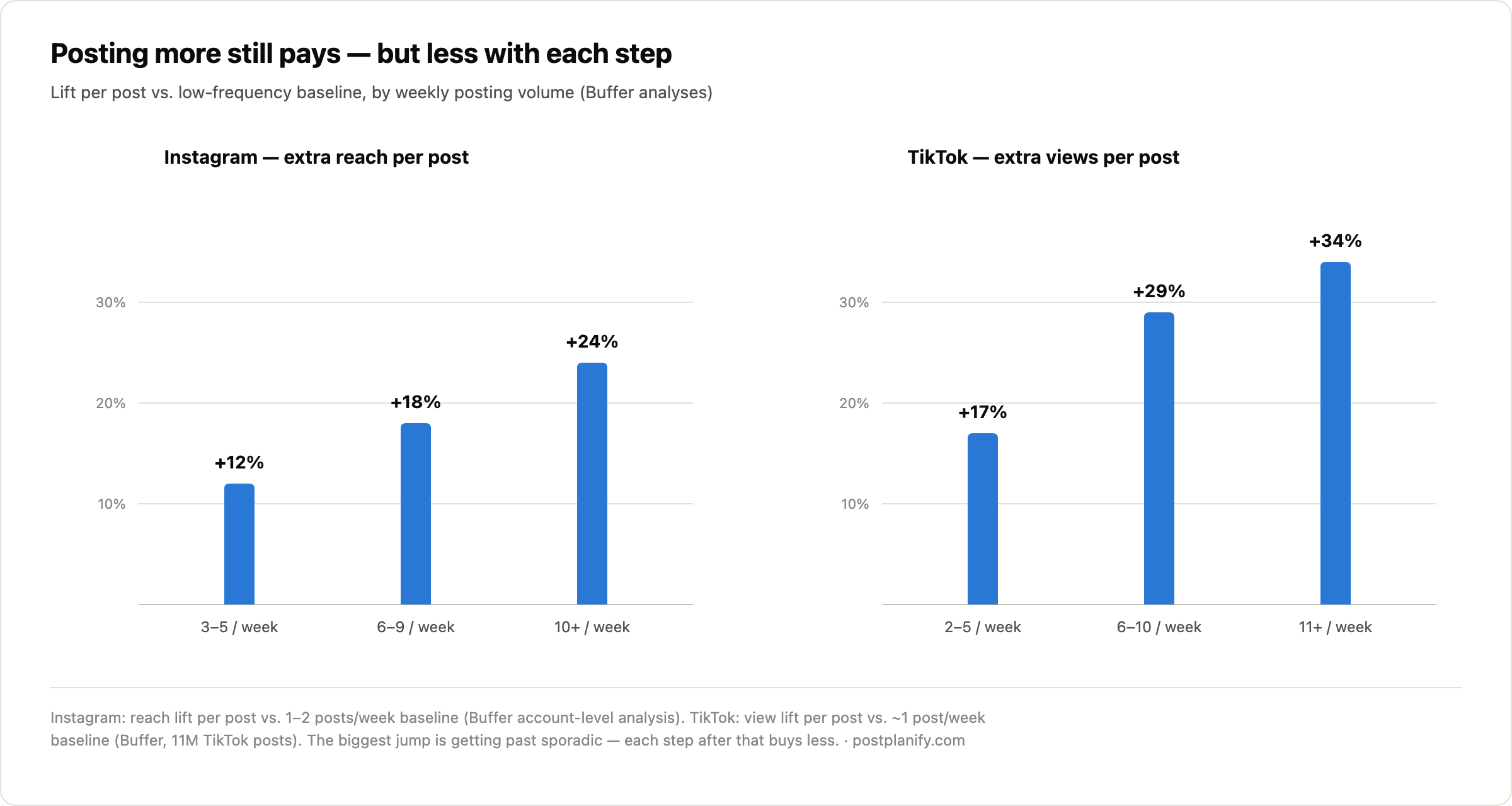
Notice the shape of that curve: the biggest jump is getting past sporadic. Going from 1–2 posts to 3–5 buys more than going from 3–5 to 10+ — which is why the sweet spot is where it is. Our own platform data lands in the same place: the median active Instagram account on PostPlanify posts 3 times a week, and the 3–5/week group doubled the median reach per post of slower posters without losing engagement rate.
Format matters as much as frequency here: carousels earn about +109% more engagement per person reached than Reels, but Reels deliver ~36% more reach. A healthy week mixes both. Stories sit outside the feed-frequency math — near-daily Stories are fine and don't fatigue the algorithm.
Pair your cadence with timing: the best time to post on Instagram shifts by audience, and a dedicated Instagram scheduler makes both variables controllable.
How often to post on TikTok in 2026
Sweet spot: 2–5 posts per week. TikTok famously recommended 1–4 posts per day for years — the data says you don't need anywhere near that. Buffer's analysis of 11 million TikTok posts found moving from ~1 post a week to 2–5 lifted views per post by ~17%; 6–10 posts lifted them ~29%, and 11+ about 34%.
TikTok is also the platform where extra volume keeps paying longest — the returns curve flattens later than Instagram's. It's the heaviest-cadence platform in our own data too: the median active TikTok account posts 6 times a week, and the top quartile is above 20. If you have raw video capacity, this is where to spend it. Just respect rule 3: TikTok's algorithm gives every video a fresh audition, and low-effort filler auditions badly.
Worth knowing: TikTok's engagement rate (~3.7% by followers, up 49% year over year) is roughly 8× Instagram's — underposting here leaves more on the table than anywhere else. See the best time to post on TikTok and our TikTok scheduler.
How often to post on LinkedIn in 2026
Sweet spot: 2–5 posts per week. Buffer's data identifies 2–5 weekly posts as the distribution turning point, surveys of social media managers cluster at 2–3, and the median active LinkedIn account in our own data posts exactly 2 times a week. LinkedIn posts also have the longest shelf life of any feed — a strong post keeps collecting impressions for days — so volume matters less than hit rate.
The format signal is dramatic: LinkedIn carousels post a median engagement rate around 21.8%, roughly triple video (7.4%) and images (6.5%). Two carousels a week beat five link posts. And replying to comments lifts engagement ~30% — cadence includes conversations, not just publishing. Manage it from a LinkedIn scheduler that treats documents as first-class posts.
How often to post on Facebook in 2026
Sweet spot: 1–2 posts per day. A HubSpot survey of 13,500+ users (cited in Buffer's frequency guide) lands at 1–2 daily posts, and one strong daily post is usually enough to stay visible. Facebook is the platform where format matters least — images (5.2%), video (4.8%), and text (4.8%) perform within a point of each other — so consistency is nearly the whole game.
If daily is beyond your capacity, 3 posts a week keeps the page visibly alive (an abandoned-looking page actively hurts trust for local businesses). Timing guide: best time to post on Facebook, and a Facebook scheduler to hold the cadence.
How often to post on X (Twitter) in 2026
Sweet spot: 3–4 posts per day. X is the highest-velocity feed — individual post half-life is measured in hours, so frequency substitutes for shelf life. Studies of top accounts show wide variation (some post 2×/day, some 20×), but the floor is clear: one post a day minimum to stay in the conversation, 3–4 for growth.
Threads (reply chains) count: a thread is one idea but several posts of presence. If 3–4 originals a day sounds impossible, mix originals, replies, and reposts — the cadence is about showing up in feeds, not manufacturing four masterpieces daily. Our X scheduler supports scheduling full threads.
How often to post on Pinterest in 2026
Sweet spot: 15–25 pins per day — yes, per day. Pinterest behaves like a search engine, not a feed: pins surface for months, and volume compounds like a content library. Tailwind's research (via Buffer) found the most successful accounts pin 15–25 times daily — and that pinning 50+ times a day actually hurts distribution.
Before you close the tab: repins and fresh pins of existing content count. A business with 30 products and 5 blog posts can sustain this through variations and seasonal refreshes. See the best times to post on Pinterest and our Pinterest scheduler.
How often to post on YouTube in 2026
Sweet spot: 1 long-form video per week, plus 1–3 Shorts. YouTube rewards depth over frequency more than any other platform — a creator experiment cited by Buffer found weekly uploads performed nearly as well as daily, and 3×/week didn't meaningfully beat 1×/week. Subscribers build habits around a reliable weekly slot.
Shorts run on separate rails: 1–3 a week feeds the discovery engine without cannibalizing long-form. If you're choosing, one excellent weekly video beats three rushed ones — production quality is visible here in a way feed posts forgive. Timing: best time to upload a YouTube video, scheduling: YouTube scheduler.
How often to post on Threads in 2026
Sweet spot: 3–7 posts per week. Honest caveat: nobody has published a large-scale Threads frequency study yet, so this range is derived from what we do know. Threads is text-first and conversational, which makes posts cheap to produce and rewards presence over polish. The format data that does exist says video outperforms (5.55% engagement vs. 2.79% for text), and Threads shows the largest reply-lift of any platform: +42% engagement when creators respond to comments.
Translation: a daily-ish rhythm of low-production posts plus active replies is the play — not a weekly produced masterpiece. Cross-posting from X with light rewrites makes the cadence nearly free via a Threads scheduler.
How often to post on Bluesky in 2026
Sweet spot: 3–7 posts per week. Same caveat — no large-scale study exists. Bluesky is smaller and feed algorithms are user-chosen, which changes the math: chronological and community feeds mean each post's visibility depends less on an engagement algorithm and more on when your audience is online. Frequency behaves closer to old Twitter — more posts, more chances.
The audience skews early-adopter and conversational; the +5% reply lift measured there is modest, but community norms reward participation heavily. Start at 3–4 posts a week cross-posted from your X/Threads content, and scale toward daily if your niche is active there. (Our Bluesky scheduler handles it alongside the other nine platforms.)
How often to post on Google Business Profile in 2026
Sweet spot: 1–2 posts per week. The forgotten platform — and for local businesses, arguably the highest-intent one, since posts show up next to your listing in Search and Maps. Google Business posts have a limited shelf life in the profile display, and an active profile is a freshness signal for local visibility. Weekly updates, offers, or event posts keep the profile visibly maintained; twice a month is the floor before a profile starts looking dormant.
No engagement algorithm to feed here — the audience is people actively searching for your business or category. A Google Business scheduler makes this the easiest cadence on the list to sustain.
What cadence fits your team size
The cadence ladder describes platforms. Your constraint is capacity. Map it honestly:
- Solo (creator, founder, one-person marketing team): run the minimum viable column on 2–3 platforms you've deliberately chosen — not the sweet spot on five. That's roughly 5–8 posts a week, which one batching session can produce. Consistency at the floor beats burnout at the optimum.
- Small team (2–5 people): sweet spot on 2–3 priority platforms, minimum viable on the rest. Roughly 15–25 posts a week — achievable with one content pillar repurposed per platform rather than five original ideas a day.
- Agency: sweet spot per client is the service standard clients are implicitly buying. The math gets real fast: sweet-spot cadence across 6 platforms is roughly 20–40 posts per client per week. At five clients, that's 100–200 posts a week — which is why agencies live or die on batching, approval workflow, and scheduling infrastructure rather than heroics.
Adjustments by account type
Team size sets your total volume; your business model decides where to spend it:
| Account type | Start with | Skew toward |
|---|---|---|
| B2B / SaaS | LinkedIn 2–5/wk + X 1/day | LinkedIn documents, long shelf-life posts |
| Local business | Facebook 3–5/wk + Google Business 1–2/wk + Instagram 2–3/wk | Geo-tagged posts, offers, reviews |
| Ecommerce | Instagram 3–5/wk + Pinterest 15–25 pins/day + TikTok 2–5/wk | Product carousels, seasonal pins |
| Creator / personal brand | TikTok 3–5/wk + Instagram Reels + YouTube 1/wk | Video-first, one pillar repurposed |
So if you're asking "how often should a restaurant post on social media" — that's the local business row: a few Facebook and Instagram posts a week plus a weekly Google Business update beats daily posting on a platform your customers don't check.
How to actually sustain your cadence
Every study above rewards the same underlying behavior: showing up on schedule for months. Nobody sustains that by remembering to post. The mechanics that make the sweet spot achievable:
- Batch on one day. Produce a week's content in one sitting; bulk-schedule the lot. Twenty posts scheduled in an hour beats twenty daily scrambles.
- One idea, many formats. A single content pillar becomes an Instagram carousel, a TikTok, a LinkedIn document, an X thread, and a Threads post. Customize the caption per platform — don't create from scratch per platform.
- Use a queue for the steady drumbeat. Set recurring time slots per platform; drop content into the queue and let it fill the calendar. Your cadence survives busy weeks because it doesn't depend on them.
- See every platform in one calendar. Gaps are the enemy (rule 2), and you can't spot a silent week on Bluesky if checking it means a tenth login. A shared content calendar makes the no-post penalty visible before it happens.
- Keep an ideas backlog. The cadence killer isn't scheduling — it's staring at a blank composer. Keep a running list (here are 100+ starters) and the batching session starts at step two.
PostPlanify was built around exactly this loop — one calendar, all 10 platforms above, bulk scheduling up to 20 posts, per-platform caption customization, and queues — from $129/mo flat. The cheat sheet is the strategy; this is the infrastructure that survives contact with a busy month.
 PostPlanify
All your social media in one simple dashboard
Schedule posts, track analytics, and reply to comments/DMs without switching tabs.

Engagement
+18%
Views
52.8k
FAQ
How often should you post on social media?
As a 2026 baseline across studies: Instagram 3–5 posts/week, TikTok 2–5/week, LinkedIn 2–5/week, Facebook 1–2/day, X 3–4/day, Pinterest 15–25 pins/day, YouTube 1 video/week plus 1–3 Shorts, Threads and Bluesky 3–7/week, Google Business 1–2/week. The stronger rule: pick the highest cadence you can sustain for six months without quality dropping — in PostPlanify's platform data, accounts posting 3–5 times a week grew followers roughly 4× faster than those posting 1–2 times.
Is it bad to post every day on social media?
No — daily posting helps on most platforms if quality holds. Buffer's data shows Instagram accounts posting 10+ times weekly earn ~24% more reach per post, and TikTok accounts posting 11+ times earn ~34% more views. The risk isn't the algorithm punishing volume; it's your content quality diluting. If daily posts start becoming filler, drop back to the sweet spot.
What happens if I stop posting for a week?
Your growth stalls below its own baseline. Across 4.8 million channel-weeks analyzed by Buffer, accounts that skipped a week consistently underperformed their normal growth rate — the "no-post penalty." Silence isn't neutral; scheduling content ahead for vacation weeks is genuinely worth it.
Is it better to post more often or post better content?
Consistency first, then quality, then volume. Consistent posters (20 of 26 weeks) earn 450% more engagement per post than sporadic ones — a bigger effect than any volume increase measured. PostPlanify's own platform data shows the same shape: accounts posting 3–5 times a week grew followers at a median of +15.3% over ~90 days versus +3.8% for 1–2 posts a week, while 6+ posts a week added nothing further. Once you're consistent, quality decides how far each post travels, and only then does extra volume compound.
How often should a small business post on social media?
Two to three platforms at the minimum-viable tier: for example, 2 Instagram posts, 3 Facebook posts, and 1–2 Google Business posts per week — about 6–8 posts total, producible in one batching session. That keeps every profile visibly active without a dedicated social hire.
How often should you post on Instagram Stories?
Stories sit outside feed-frequency math — near-daily is fine and doesn't fatigue your audience the way feed over-posting can. Treat Stories as presence (behind-the-scenes, polls, reshares) and feed posts as your measured cadence.
Does posting frequency affect the algorithm?
Yes, in both directions. Active accounts earn more distribution per post (the Instagram and TikTok curves above), and inactive weeks underperform baseline growth. But every 2026 algorithm weighs engagement quality — saves, shares, watch time — more than raw volume, so frequency only helps while quality holds.
How many times a day should you post on X (Twitter)?
Three to four posts a day is the working sweet spot for growth; one a day is the floor for staying visible. Post half-life on X is measured in hours, so frequency substitutes for shelf life. Replies and reposts count toward presence — it doesn't have to be four original takes daily.
Should I post the same content on every platform?
Same idea, adapted per platform — a pillar becomes a carousel on Instagram, a document post on LinkedIn, a thread on X. Identical unedited cross-posts underperform because formats and caption norms differ; full per-platform originals don't scale. The middle path is what makes the cheat-sheet cadences sustainable.
What's the best day and time to post?
It varies by platform and audience — frequency and timing are separate levers. Once your cadence is set, see our data guides on the best times to post on social media for the per-platform windows.
The bottom line
Save the cheat sheet for your next content-planning session:
The number everyone asks for exists — it's the sweet-spot column above. But the number that changes your results is the one you can still be hitting in month six. Pick your platforms deliberately, start on the cadence ladder's bottom rung, earn your way up to the sweet spot, and let the 450% consistency edge do what extra volume never will.
Set the cadence once, schedule it weekly, and stop renegotiating with yourself every morning.
PostPlanifyAll your social media in one simple dashboard
Schedule posts, track analytics, and reply to comments/DMs without switching tabs.
Engagement
+18%
Views
52.8k
About the Author

Hasan Cagli
Founder of PostPlanify, a content and social media scheduling platform. He focuses on building systems that help businesses, agencies, and teams plan, publish, and manage content and social media more efficiently across platforms.


