


Ask any guide how long an Instagram caption should be and you'll get the same answer: keep it short, front-load the first 125 characters so nothing hides behind "...more". It sounds sensible. It's also, according to our data, the single worst-performing caption length on Instagram.
We analyzed 6,126 Instagram feed posts and Reels from 168 accounts connected to PostPlanify (published July 6 to October 4, 2026, refreshing our April to July study), grouped by caption length, and measured median engagement rate and reach per post. The pattern held for a second quarter, and it's a valley: ultra-short captions hold up on big reach, the "recommended" 51 to 125 character zone craters, and captions that run past the fold outperform it at every length up to about 800 characters. Nobody's recycled advice predicted that shape, which is exactly why we measure instead of repeat.
The Short Answer
- The sweet spot for engagement is 126 to 800 characters. Posts in the 301 to 800 range earned a 4.57% median engagement rate, and 126 to 300 earned 3.6%, both well above the valley.
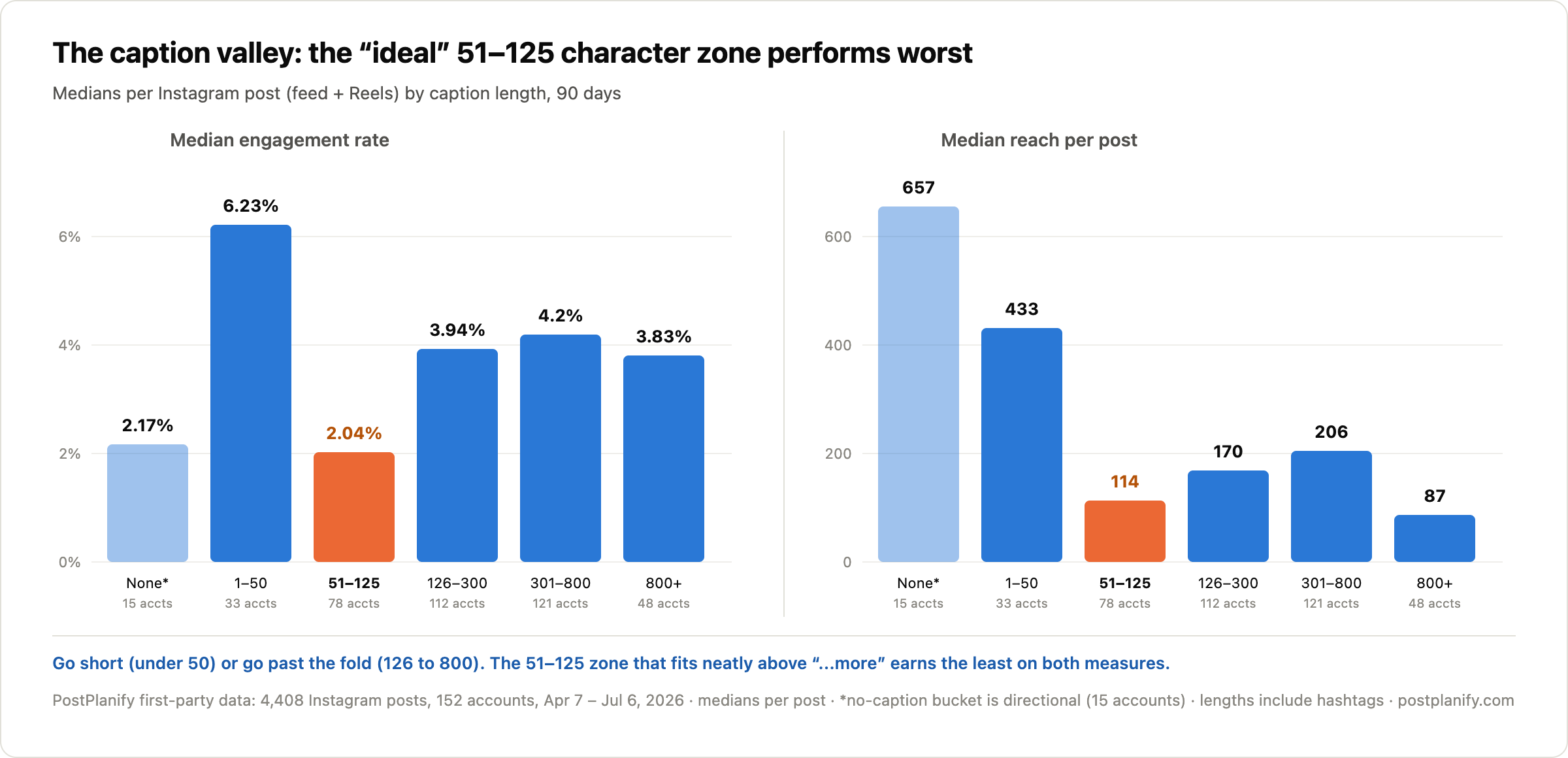
- The "fits above the fold" zone (51 to 125 characters) performed worst: 1.38% (2.04% in the April to July data). We call it the caption valley. It's long enough to say nothing and short enough to add nothing.
- Ultra-short captions (1 to 50 characters) earned 2.96% on the biggest reach of any group (932 median, 50 accounts). Last quarter they spiked to 6.23% on a smaller sample, so the short-caption edge is about reach more than engagement.
- Past 800 characters, returns fade: essay captions held a decent 3.49% engagement rate but reach dropped to the lowest of any caption-bearing group (101 median).
- On Reels, caption length barely matters for engagement. On feed posts, it matters a lot. Details below.
The Known Limits First
The mechanical facts, so we're arguing about strategy rather than specs: Instagram captions allow up to 2,200 characters. In the feed, roughly the first 125 characters show before the caption truncates behind "...more". Those two numbers are where the standard advice comes from: since only ~125 characters are guaranteed visible, write to fit them. Our data says that logic optimizes for the wrong thing.
The Caption Valley: What 6,126 Posts Show
| Caption length | Posts | Median engagement rate | Median reach |
|---|---|---|---|
| No caption* | 29 | n/a | n/a |
| 1–50 characters | 183 | 2.96% | 932 |
| 51–125 characters | 1,291 | 1.38% | 228 |
| 126–300 characters | 2,248 | 3.6% | 190 |
| 301–800 characters | 2,047 | 4.57% | 434 |
| 800+ characters | 328 | 3.49% | 101 |
Too few to report (9 accounts). Lengths include hashtags within the caption. October 2026 data; the April to July 2026 study showed the same valley.
Three things worth sitting with:
- The valley is real and it's exactly where the advice points. Captions of 51 to 125 characters, the zone written specifically to fit above the fold, earned roughly a third of the engagement of captions in the 126 to 800 range (about half in the April to July data), and it was the weakest group in both quarters we measured.
- Substance pays through the fold. Engagement climbs steadily from the valley through 800 characters, and reach peaks again at 301 to 800. Whatever the mechanism (more dwell time, more saves, or simply that thoughtful captions ride on thoughtful content), the fold is not a wall worth writing scared of.
- There are two winning strategies, not one. Say almost nothing (under 50 characters, punchy, meme-style) or say something real (126 to 800). The losing move is the middle: a sentence and a half that neither hooks nor delivers.
Reels vs Feed: Caption Length Matters Differently
The format split changes the advice meaningfully:
On Reels, the caption matters more than we thought. In the October 2026 data, Reels with captions of 125 characters or less earned a 1.69% median engagement rate, against 3.95% for 126 to 500 characters and 4.32% for 500+. Short captions did buy reach (711 median vs 552 and 241), so the trade is the same as on the rest of Instagram: short for reach, longer for engagement. Last quarter Reels engagement barely moved with length, so treat this as a shift worth testing on your own account.
On feed posts, the caption is half the post. Engagement climbed hard with length: the median feed post with a caption of 125 characters or less earned 0.9% on a median reach of just 4, while 126 to 500 characters earned 4.22% and 500+ earned 4.66% (October 2026). Feed posts don't get algorithmic discovery the way Reels do, so the caption is what earns the save, the comment, and the share. A feed post with a throwaway caption is, statistically, a post nobody engages with.
Why Would Longer Captions Win?
Honest answer: our data shows correlation, not mechanism, and part of the effect is surely that people who write real captions also make better content. But two mechanical explanations fit the pattern. Longer captions extend dwell time (readers who tap "...more" spend more seconds on the post, which the algorithm reads as interest), and longer captions give people something to respond to: a question, a story, an opinion. A 90-character caption rarely contains a reason to comment.
The essay drop-off past 800 characters fits too: reach falls by more than half while engagement holds, which looks like the algorithm distributing them less, not like readers disliking them. Save the 1,500-character stories for the posts that earn them.
What to Actually Do
- Default to 126 to 800 characters with the hook in the first line (the part above the fold should earn the tap, not contain everything).
- Going minimal? Go genuinely minimal. Under 50 characters outperformed everything in our sample. One sharp line beats a bland sentence and a half.
- Never park in the valley. If your draft lands at 60 to 120 characters, either cut it to a punchline or add the sentence that gives people something to engage with.
- For Reels, spend your effort on the video and use the caption for context and searchability rather than length for its own sake.
- Watch your own numbers by format. Our Instagram analytics tools guide covers how to split performance by format and post; your account's pattern beats any benchmark, including this one.
The workflow side is the easy part: PostPlanify's AI caption generator drafts captions from your actual media (and the built-in assistant does it in the composer with your brand voice), the character counter keeps you out of the valley, and the Instagram scheduler publishes everything on schedule. For how many hashtags belong in that caption, our hashtag count guide covers that question separately.
Frequently Asked Questions
How long should an Instagram caption be?
Based on PostPlanify's analysis of 6,126 Instagram posts from 168 accounts (October 2026), the strongest range is 126 to 800 characters: those posts earned median engagement rates of 3.6 to 4.57%, versus 1.38% for the commonly recommended 51 to 125 character length. Ultra-short captions under 50 characters earned 2.96% but drew the biggest reach (932 median). The weakest choice is the middle: 51 to 125 characters, long enough to say nothing and short enough to add nothing.
What is the Instagram caption character limit?
Instagram captions can be up to 2,200 characters long. In the feed, only roughly the first 125 characters display before the caption truncates behind "...more", which is why the first line matters most regardless of total length.
Do captions matter for Reels?
More than it used to. In PostPlanify's October 2026 data, Reels with captions of 125 characters or less earned a 1.69% median engagement rate, versus 3.95% for 126 to 500 characters and 4.32% for 500+, while feed post engagement climbed even more sharply with longer captions. The trade-off: short Reels captions reached more people (711 median vs 241 for 500+), so pick short for reach and longer for engagement.
Do posts without captions perform badly?
Not necessarily, but the sample is small. In our April to July 2026 data, no-caption posts earned a 2.17% median engagement rate on unusually high reach (657 median, mostly Reels where the video carries everything), from only 15 accounts; in October 2026 just 9 accounts posted without captions, too few to report. Treat it as directional: skipping the caption doesn't kill a Reel, but on feed posts the caption is where engagement comes from.
Does caption length include hashtags?
In Instagram's 2,200-character limit, yes, hashtags inside the caption count toward it. Our study measured total caption length including hashtags. If you want hashtags without consuming caption space visually, the common approach is placing them in the first comment, which PostPlanify can schedule automatically.
Methodology: 6,126 Instagram feed posts and Reels from 168 accounts connected to PostPlanify, published July 6 to October 4, 2026, each at least 7 days old at measurement (the original study covered 4,408 posts from 152 accounts, April 7 to July 6, 2026). Stories excluded. Engagement rate is interactions per reach (per view when reach is missing); medians throughout; caption lengths include hashtags. Buckets under 30 accounts are marked directional. Correlation, not causation: accounts that write better captions likely also make better content.
Bottom line: the fold is not a wall, and writing to fit above it is the one strategy our data can't defend. Go short or go real, then let your own analytics have the final word. PostPlanify drafts the captions, counts the characters, and shows you which lengths actually work for your audience. Free for 7 days, with a 14-day money-back guarantee.
 PostPlanify
All your social media in one simple dashboard
Schedule posts, track analytics, and reply to comments/DMs without switching tabs.

Engagement
+18%
Views
52.8k
About the Author

Hasan Cagli
Founder of PostPlanify, a content and social media scheduling platform. He focuses on building systems that help businesses, agencies, and teams plan, publish, and manage content and social media more efficiently across platforms.


