


Asking which social media platform for business is "best" is the wrong question, and it's the question every guide on this topic answers anyway. The right question is: which two or three platforms can you do well, at a cost you can sustain? A focused presence on the right platforms beats a thin presence on six, every time, and every serious study agrees.
This guide answers the better question. Of the social media platforms 2026 offers a business, we cover the 10 that support a repeatable posting calendar, and for each you get the audience data, an honest note on organic reach, and something no other comparison includes, the effort price: what "doing it well" actually costs in posts per week, based on studies of 60M+ posts and first-party data from the 55,000+ posts synced through PostPlanify.
Quick answer: the best platforms by business type
- Social media for B2B and SaaS: LinkedIn + X: LinkedIn converts visitors to leads at 2.74%, the highest of any platform.
- Best social media platform for small business and local trade (restaurants, salons, clinics, shops): Facebook + Google Business Profile + Instagram.
- Best platform for ecommerce and DTC: Instagram + TikTok + Pinterest.
- Creator / personal brand: TikTok + Instagram + YouTube.
The rest of this guide is the reasoning, so you can adjust the recipe to your audience instead of taking it on faith.
The 3 questions that decide your platforms
1. Where is your audience, actually? Not "where is everyone", but where is your customer. The social media demographics 2026 gives us settle most debates in one look, generation by generation:
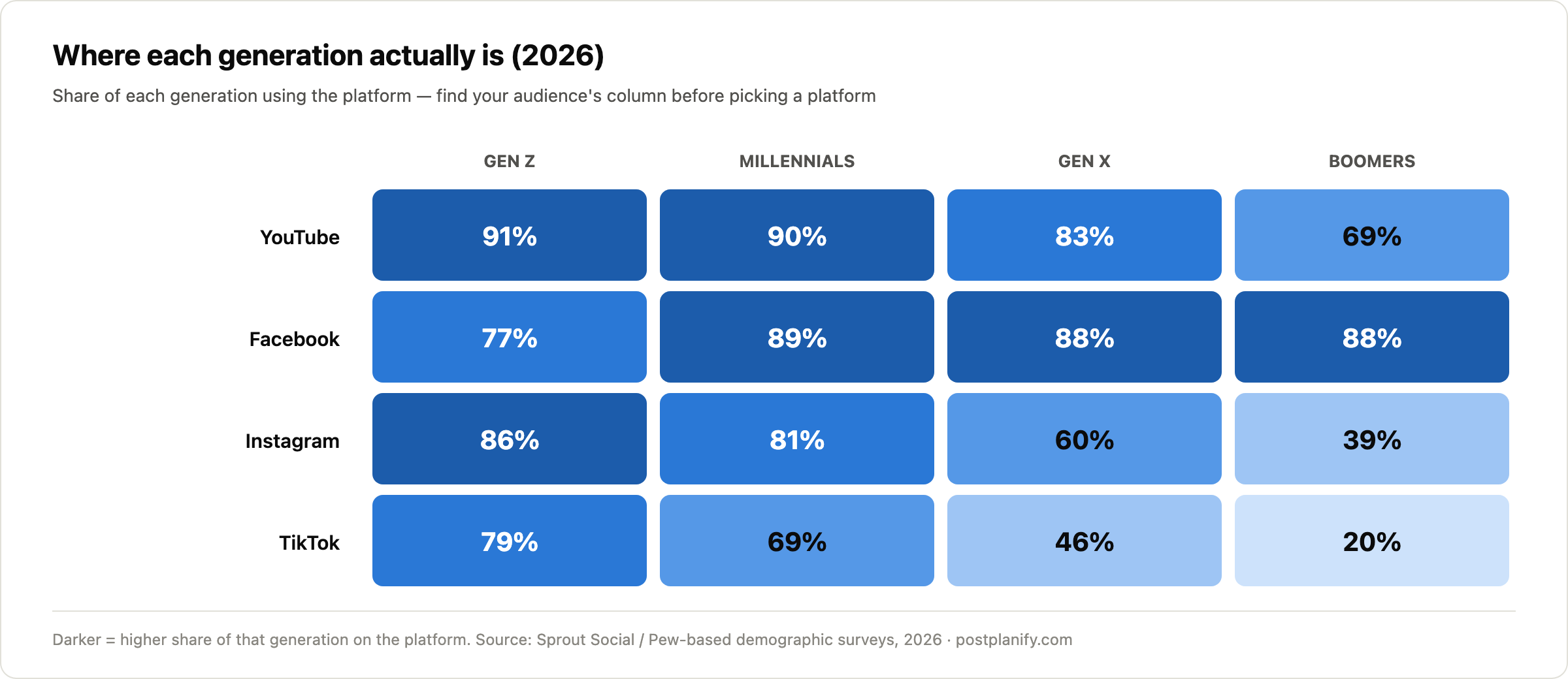
Selling to retirees on TikTok means fishing where 20% of your fish are. Selling to Gen Z without Instagram or TikTok means missing 80%+ of them. (Sprout Social's demographic roundup has the full breakdowns.)
2. What content can you sustainably produce? Video-heavy platforms (TikTok, YouTube, Reels) reward teams that can ship video weekly. If you can't, text-and-image platforms (LinkedIn, Facebook, X, Pinterest) are honest choices, because a mediocre TikTok presence loses to a strong LinkedIn one.
3. What's the effort price? Every platform charges admission in content volume. This is the column other guides skip:
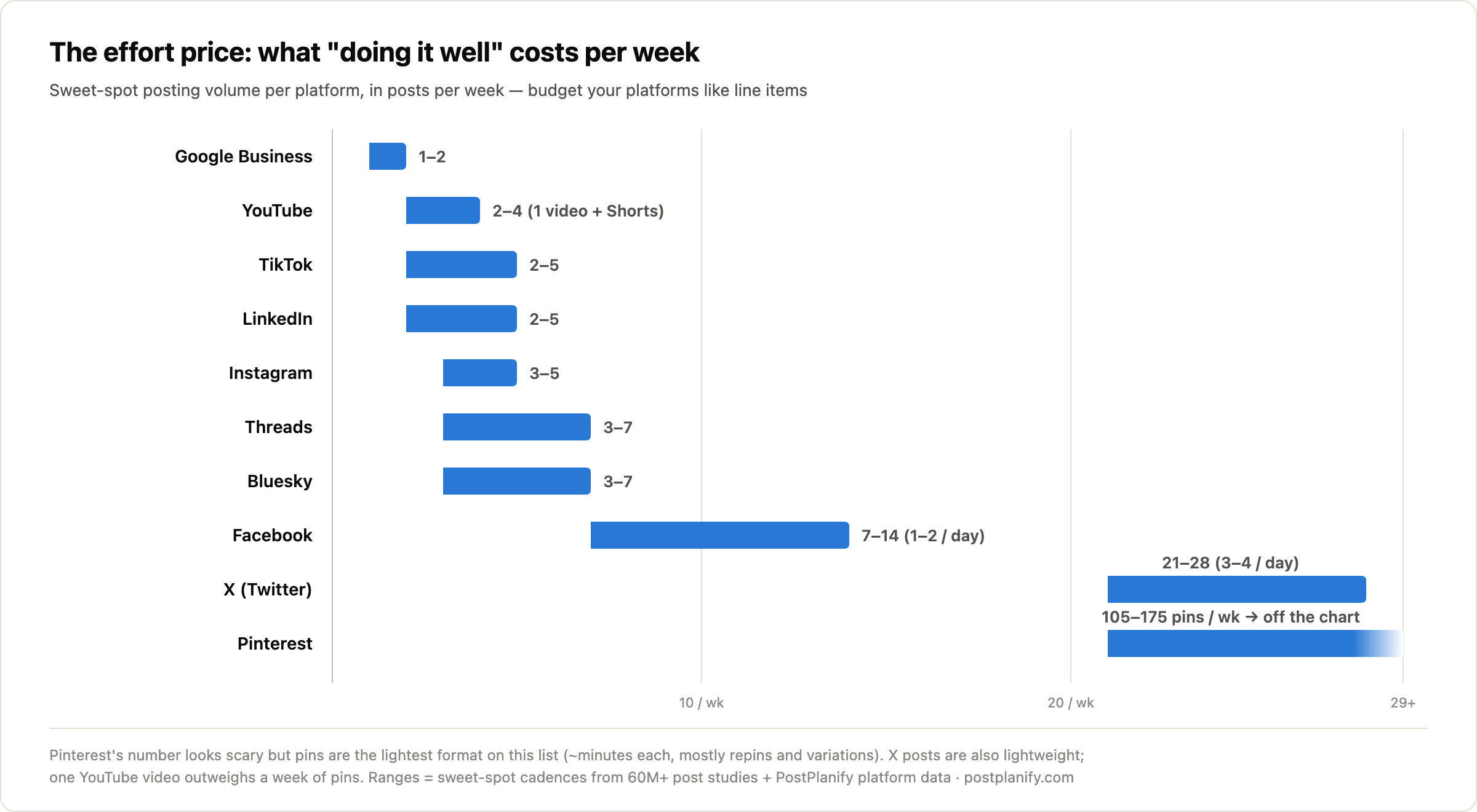
Those ranges come from our data-backed posting frequency guide: the sweet-spot cadences where reach-per-post and growth peak. Notice the trap: X and Pinterest look affordable until you see their weekly bill. Format weight matters too: a pin takes minutes, a YouTube video takes days.
The decision table
| Platform | Users | Strongest audience | Effort price | Best for |
|---|---|---|---|---|
| 3.07B | Millennials–Boomers (88%+) | 7–14 posts/wk | Local, community, ads | |
| ~3B | Gen Z (86%) & Millennials | 3–5 posts/wk | Ecommerce, visual brands | |
| YouTube | 2.6B | All ages (90% of adults <50) | 2–4 videos/wk | Search visibility, authority |
| TikTok | ~2B | Gen Z (79%), 25–34 rising | 2–5 posts/wk | Discovery, B2C |
| 1B+ members | Professionals, B2B buyers | 2–5 posts/wk | B2B leads | |
| 500M+ | Women 25–54, planners | 15–25 pins/day | Ecommerce, DIY, evergreen | |
| X (Twitter) | ~600M | News, tech, finance | 3–4 posts/day | Real-time, B2B tech |
| Threads | 300M+ | Instagram spillover | 3–7 posts/wk | Conversational brand voice |
| Bluesky | ~35M | Early adopters, tech/media | 3–7 posts/wk | Niche communities, early edge |
| Google Business | Search traffic | People searching you locally | 1–2 posts/wk | Free local visibility |
User figures compiled from DataReportal and Backlinko's usage statistics; X and Bluesky figures are company-reported estimates.
Engagement benchmarks from real accounts
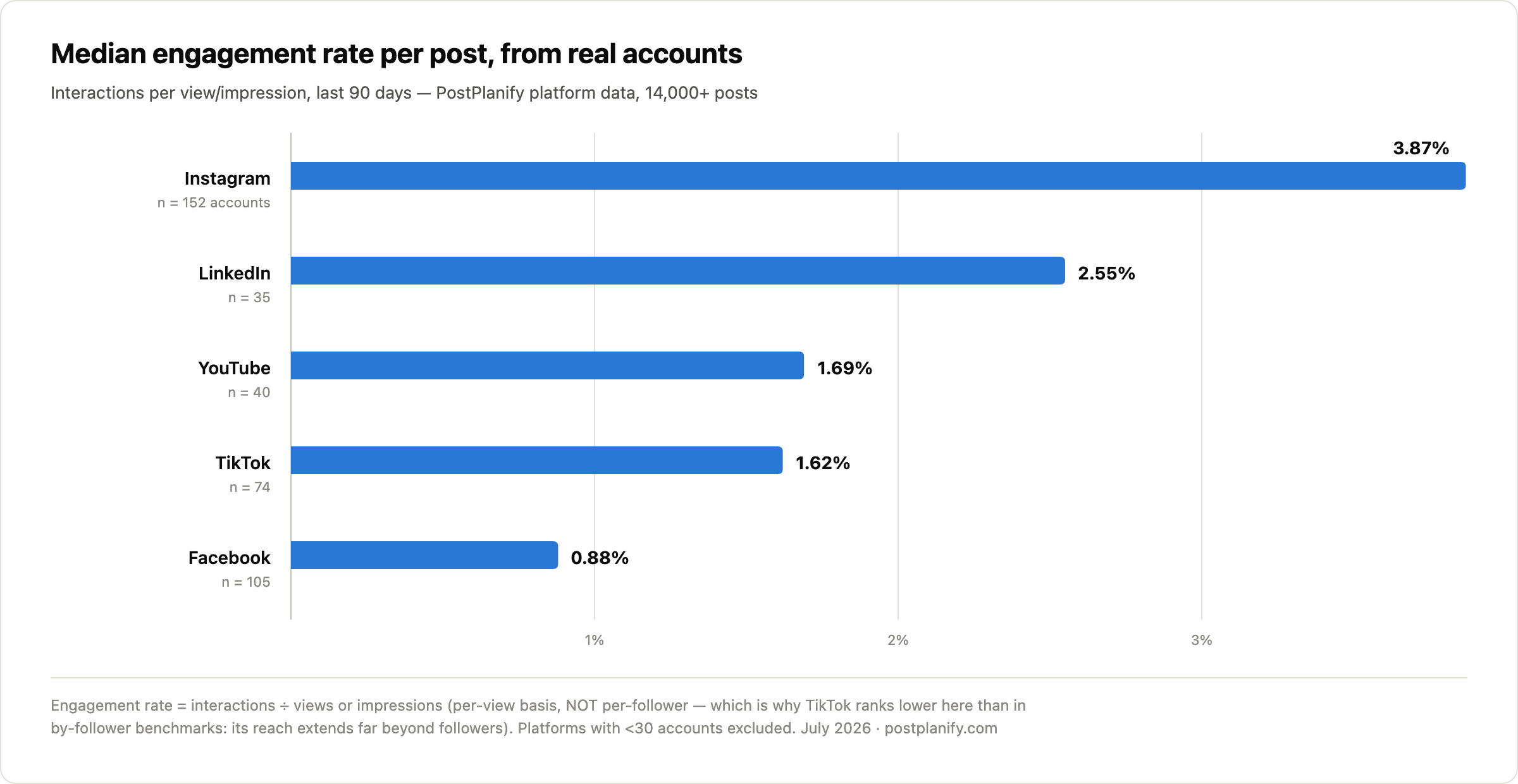
Before the profiles, one dataset you won't find elsewhere. In PostPlanify's analysis of 14,000+ posts from accounts connected to our platform (the 90-day window ending July 2026, drawn from the wider 55,000+ post corpus), the median engagement rate per post, meaning interactions divided by views or impressions, ranked like this:
| Platform | Median ER per post | Top quartile | Accounts |
|---|---|---|---|
| 3.87% | 7.29% | 152 | |
| 2.55% | 5.71% | 35 | |
| YouTube | 1.69% | 4.32% | 40 |
| TikTok | 1.62% | 3.86% | 74 |
| 0.88% | 2.08% | 105 |
Method: medians rather than means, per-view engagement rate (interactions divided by views or impressions), 90-day window ending July 2026. Only platforms with at least 30 qualifying accounts are shown; X, Pinterest, Threads and Bluesky fell below that threshold and are excluded. These are correlations across connected accounts, not controlled experiments.
Notice something? This reverses the famous by-follower rankings, where TikTok's ~3.7% dwarfs Instagram's ~0.48%. Both are true, because they measure different things. By-follower rates flatter TikTok because its algorithm shows videos far beyond your followers (huge denominator of strangers, counted against a small follower base). Per view, the ranking flips: when an Instagram post reaches someone, they're 2.4× more likely to interact with it than a TikTok viewer. Practical translation: TikTok is the discovery platform, Instagram is the connection platform, which is exactly how the stacks below use them.
Platforms with fewer than 30 measured accounts (X, Pinterest, Threads, Bluesky) are excluded rather than reported on thin data.
Is Facebook worth it for business in 2026?
Yes for local and community businesses; with eyes open for everyone else. Facebook is still the largest platform on earth (3.07B monthly users) and the only one that reaches 88%+ of Millennials, Gen X, and Boomers simultaneously. Groups and Marketplace keep it a utility, not just a feed.
The honest part: organic reach sits around 1–2% (WordStream): post to 1,000 followers, reach 10–20 of them. Our own data agrees on the depressed baseline: Facebook's median engagement rate per post (0.88%) is the lowest of the five platforms we can measure at scale, and a quarter of page posts get zero interactions at all. Facebook works as a local trust signal (an active page = an open business), a community engine, and an ad platform with the deepest targeting available. It no longer works as a free megaphone.
Effort price: 7–14 posts/week, the highest of the mainstream feeds, softened by the fact that Facebook posts are the easiest to produce and formats barely matter (image, video, and text perform within a point of each other). A Facebook scheduler makes daily presence a batching job.
Is Instagram worth it for business in 2026?
Yes: it's the default platform for any visual product. Roughly 3 billion users, 86% of Gen Z and 81% of Millennials, and the strongest purchase behavior of any feed: about 7 in 10 users report Instagram influences their buying decisions, per industry research.
The nuance is format strategy: carousels earn about double the engagement per person reached, Reels earn ~36% more raw reach, so a healthy account runs both. In PostPlanify's own platform data, Instagram is the engagement leader outright, with a 3.87% median engagement rate per post, the highest of any platform we measure, and accounts posting 3–5 times a week earned roughly double the median reach per post of 1–2×/week posters with engagement rate unchanged. The sweet spot pays here more visibly than anywhere.
The conversion catch is structural: Instagram gives you one clickable link on the profile, so a link-in-bio page is doing the work every caption cannot.
Effort price: 3–5 feed posts/week (Stories are extra but cheap). See the best time to post on Instagram, and use an Instagram scheduler to hold the cadence.
Is YouTube worth it for business in 2026?
Yes, if you can commit to video: it's the compounding asset. YouTube reaches over 90% of adults under 50, the widest cross-generational net of any platform, and it's the only one where content is a library, not a feed: a good video keeps pulling search traffic for years, and YouTube videos rank in Google itself.
That makes YouTube the authority play: tutorials, comparisons, and how-tos in your niche compound the way blog SEO does. The barrier is real, since video production is the heaviest format on this list, which is exactly why the competition is thinner. Our YouTube analytics data shows the same trade as Instagram Reels: Shorts buy reach, longer videos earn engagement.
Effort price: 1 long-form video + 1–3 Shorts per week. Quality beats volume here more than anywhere; our frequency data shows weekly uploads perform nearly as well as daily. Schedule both formats with a YouTube scheduler.
Is TikTok worth it for business in 2026?
Yes for B2C: it's the last big organic-reach machine. TikTok's algorithm auditions every video on its merits, which means a brand-new account can reach thousands without a single follower, genuinely rare in 2026. Engagement backs it up, and our own TikTok analysis found consistency compounds there rather than virality striking at random. TikTok's rate by followers (~3.7%, up 49% year over year) is roughly 8× Instagram's, and Gen Z increasingly searches TikTok instead of Google.
The demographic story is shifting in business's favor: 25–34 is now the fastest-growing segment. The catch is content culture: polished ads die here, while native, person-on-camera content wins. If your brand can't be human on camera, spend the hours elsewhere.
Effort price: 2–5 posts/week (the heaviest posters in PostPlanify's data are on TikTok, at a median of 6/week, because volume keeps paying here longer than on any other platform). Pair with the best time to post on TikTok and a TikTok scheduler.
Is LinkedIn worth it for business in 2026?
For B2B: it's not optional. LinkedIn converts visitors to leads at 2.74%: nearly triple X and Facebook (HubSpot research), because the audience arrives in a professional mindset with a company card on file. B2B marketers rank it their #1 platform, and posts here have the longest shelf life of any feed.
The format edge is dramatic and underused: document/carousel posts earn roughly triple the engagement of video or images, and weekday posting outperforms weekends in our LinkedIn data. Two strong carousels a week outperform daily link-dumps. Personal profiles also out-reach company pages, so the winning setup is founder and team profiles doing the talking with the company page as home base.
Effort price: 2–5 posts/week (the median LinkedIn account in our own data posts exactly 2). A LinkedIn scheduler that treats documents as first-class posts covers the whole play.
Is Pinterest worth it for business in 2026?
Yes for ecommerce, DIY, food, home, and weddings: as a search engine, not a social network. Pinterest's 500M+ users arrive planning purchases and projects; pins surface for months or years like search results. For visual products, it's closer to free evergreen SEO than to social media.
The volume economics are unique: successful accounts pin 15–25 times a day, but pins are the lightest format on this list (minutes each, mostly variations and repins of existing assets, which is why a shared media library does most of the work here). Fifty products and ten blog posts can feed a Pinterest presence for a year.
Effort price: 15–25 pins/day, which in practice is a ~2-hour weekly batching session with a Pinterest scheduler. Timing guide: best times to post on Pinterest.
Is X (Twitter) worth it for business in 2026?
Yes for tech, finance, media, and founder-led B2B; skip it for most local and visual businesses. X remains where news breaks and where tech and business conversation compounds, and a strong founder account can drive real B2B pipeline. Company accounts without a human voice mostly shout into the void.
The honest math: post half-life is measured in hours, so presence costs 3–4 posts a day. Replies and reposts count toward that, which is how real accounts sustain it, but it's still the second-highest effort price on this list for the reach delivered.
Effort price: 21–28 posts/week (threads and replies included). An X scheduler that handles full threads takes the edge off.
Is Threads worth it for business in 2026?
Worth a low-cost experiment if you're already on Instagram. Threads (300M+ users) inherits your Instagram audience at one tap, posts are text-first and cheap to produce, and engagement patterns reward conversation: replying to comments lifts engagement more on Threads (+42%) than on any other platform we've seen measured.
Treat it as a secondary channel: cross-post your X content with light rewrites, reply actively, and let it compound quietly. No large-scale frequency studies exist yet, and we say so plainly in our frequency guide, but 3–7 posts/week of low-production presence is the sensible play via a Threads scheduler.
Is Bluesky worth it for business in 2026?
Only if your niche is actually there: and if it is, being early is the whole point. Bluesky (~35M users) is small, but it concentrates tech, media, academic, and developer communities that have partially left X. For those niches, the organic conversation is genuinely good and competition from brands is nearly zero.
The feeds are user-chosen and often chronological, so visibility works like old Twitter: show up regularly, engage like a person. For everyone outside those niches: revisit in a year.
Effort price: 3–7 posts/week, mostly cross-posted. A Bluesky scheduler makes it near-free alongside your main channels.
Is Google Business Profile worth it in 2026?
For any business with a location or service area: it's the highest-ROI "social platform" nobody treats as one. Your Google Business Profile appears at the exact moment someone searches for what you sell, locally, with intent. Posts, offers, and updates show up beside your listing in Search and Maps, and an actively maintained profile is a freshness signal for local ranking.
There's no algorithm to feed and no audience to build; the audience is Google's search volume. One or two posts a week keeps the profile visibly alive, the cheapest effort price on this list for the most purchase-ready audience on it. (A Google Business scheduler makes it a five-minute weekly habit.)

LinkedIn is the obvious choice for B2B, but it works best as a system, not a single channel: personal profiles building organic reach, Thought Leader Ads extending it with paid, and a funnel logic tying both together. Meta shouldn't be an afterthought: retargeting through the Meta Pixel reaches people who already found you through organic search, AI search, Google Ads, or LinkedIn Ads, closing the loop rather than opening a new one. And in a search landscape increasingly shaped by AI answers, a well-maintained Google Business Profile is one of the cheapest ways to stay visible, something many businesses neglect.
Platform stacks that work (with the weekly math)
The point of the effort-price column: you can now budget platforms like line items.
- Local business stack: Facebook (7/wk) + Instagram (3/wk) + Google Business (1–2/wk) ≈ 11–12 posts/week. One batching session; most content works on both Meta platforms. Restaurants, salons, and clinics live here (see our restaurant tools guide).
- B2B stack: LinkedIn (3/wk, carousel-heavy) + X (3/day, founder-voiced) ≈ 24 posts/week, or drop X to replies-only and run ~5. The SaaS tools guide covers this segment.
- Ecommerce stack: Instagram (4/wk) + TikTok (3/wk) + Pinterest (15/day, batched) ≈ 7 produced posts + a pinning session ≈ 3–4 hours/week (see ecommerce tools).
- Creator stack: TikTok (4/wk) + Instagram Reels (3/wk, repurposed) + YouTube (1/wk) ≈ 8 posts/week, one pillar video feeding everything.
Every stack shares one operational truth: nobody sustains 8–24 posts a week by logging into three apps daily. Batch once, customize per platform, and schedule the week. That's the entire workflow PostPlanify exists for: all 10 platforms above in one content calendar, bulk scheduling, per-platform captions from a brand-aware AI assistant, analytics across every platform above, and a social inbox so replies don't need a second tool. From $39/mo per client workspace with unlimited team members, which matters once more than one person touches the calendar (team collaboration and approval workflows are included from the entry plan).
 PostPlanify
All your social media in one simple dashboard
Schedule posts, track analytics, and reply to comments/DMs without switching tabs.

Engagement
+18%
Views
52.8k
What about WhatsApp, Snapchat, and Reddit?
Honest exclusions. WhatsApp (3B users) is a messaging channel, not a posting platform: powerful for customer service and broadcast lists, but it's CRM territory, not content strategy. Snapchat still owns a young audience but offers businesses little organic surface beyond ads. Reddit can be gold for niche research and community presence, but it punishes anything that smells like marketing, so participate as a human or not at all. None of them fit a posting-calendar strategy, which is why they're not ranked above.
FAQ
What is the best social media platform for business?
There's no single best, only a best stack for your situation. As 2026 defaults: LinkedIn for B2B (2.74% visitor-to-lead conversion, the highest measured), Instagram + TikTok for ecommerce and visual B2C, Facebook + Google Business Profile for local businesses, and YouTube for anyone playing the long game on search visibility. In PostPlanify's platform data, Instagram also leads outright on engagement per view (3.87% median vs. TikTok's 1.62% and Facebook's 0.88%). Pick two or three and hit their sweet-spot cadence rather than spreading across six.
What is the best social media platform for a small business?
For most local small businesses: Facebook + Google Business Profile + Instagram, about 11–12 posts a week total, manageable in one weekly batching session. Agencies running this stack for several local clients usually want one workspace per client rather than one shared calendar, plus client reports they can send under their own branding. Facebook reaches 88%+ of Gen X and Boomers, Google Business Profile catches purchase-intent local searches for free, and Instagram covers customers under 45.
Which social media platform is best for B2B?
LinkedIn, and it isn't close: 2.74% visitor-to-lead conversion per HubSpot research, roughly triple X and Facebook. Document/carousel posts triple the engagement of other formats there. X is the strong second for tech and founder-led brands.
Which platform is best for ecommerce?
Instagram + TikTok + Pinterest. Instagram carries the strongest purchase influence of any feed, TikTok is the last big organic-discovery engine (~3.7% engagement, 8× Instagram's), and Pinterest behaves like evergreen product SEO, since pins convert for months.
How many social media platforms should a business use?
Two or three, done at their sweet-spot cadence. The data is consistent: focused presence beats thin omnipresence, and consistent accounts earn 450% more engagement per post than sporadic ones. Add a fourth platform only when the first three are running on schedule without heroics. Here's what each platform's cadence costs.
Is TikTok worth it for B2B?
Usually not as a primary channel, because the buying committee isn't scrolling TikTok for vendors. Exceptions: B2B brands with genuinely entertaining education (the 9%+ engagement niche) and products bought by individual professionals. For most B2B budgets, the same hours on LinkedIn return more pipeline.
Do businesses still need Facebook in 2026?
If your customers are over 35 or local: yes. Facebook reaches 88%+ of Millennials, Gen X, and Boomers, and an active page functions as a trust signal the way a maintained storefront does. Just budget for the reality that organic reach is 1–2%: Facebook rewards consistency and ads, not viral hopes.
What's the fastest-growing platform for business in 2026?
TikTok among the big platforms (engagement up 49% year over year, with 25–34 its fastest-growing segment), and Bluesky among the small ones (~35M users, near-zero brand competition in tech/media niches). Threads is the cheapest bet: 300M+ users one tap from your existing Instagram audience.
The bottom line
Save the decision table for your planning session:
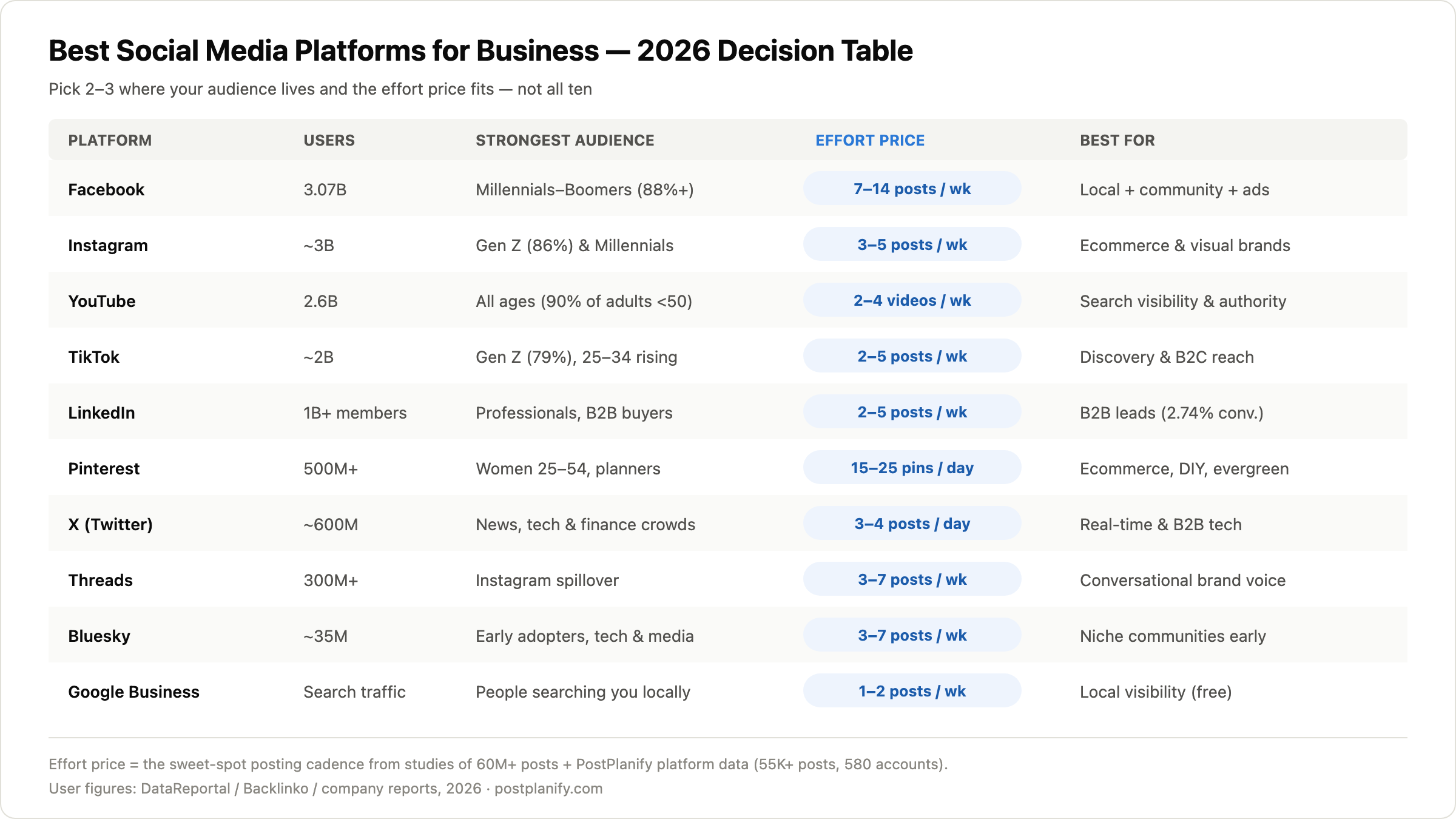
Choose by audience first (the generation grid), capacity second (what you can produce weekly without quality collapsing), and effort price third (what the platform charges in posts per week). Two or three platforms at their sweet spot, scheduled a week at a time. That's the whole strategy. The businesses that win on social in 2026 aren't everywhere; they're reliably somewhere.
Related Reading
- How Often to Post on Social Media: the cadence data behind every effort price above
- Best Social Media Management Platform: tools to run whichever stack you pick
- 14 Best Social Media Automation Tools: batching a multi-platform week
- Best Social Media Management Tools for Teams: what it costs once more than one person posts
- 14 Best LinkedIn Scheduling Tools and how to post on LinkedIn
- Best Instagram Analytics Tools, Facebook, TikTok, YouTube and LinkedIn
- Best Time to Post on LinkedIn and Instagram caption length
- Social Media Management for Small Businesses and for Agencies
- Browse by industry and by use case
PostPlanifyAll your social media in one simple dashboard
Schedule posts, track analytics, and reply to comments/DMs without switching tabs.
Engagement
+18%
Views
52.8k
About the Author

Hasan Cagli
Founder of PostPlanify, a content and social media scheduling platform. He focuses on building systems that help businesses, agencies, and teams plan, publish, and manage content and social media more efficiently across platforms.


