


Your posts are going out, but the response isn't. Few comments, weak shares, low saves, and long gaps between meaningful conversations usually point to the same issue. The content system behind your social presence isn't aligned with how people use each platform.
That matters more than ever. In 2025, there were an estimated 5.24 billion social media users worldwide, equal to about 64% of the global population, and the average person used 6.83 different platforms per month while spending 2 hours and 21 minutes per day on social media, according to Dreamgrow's social media marketing statistics roundup. Your audience isn't sitting in one app waiting for your next post. They're splitting attention, switching contexts, and reacting differently on LinkedIn, Instagram, TikTok, Facebook, and X.
So low engagement usually isn't a creativity problem. It's a systems problem. Teams post inconsistently, reuse the same creative everywhere, respond too slowly, track the wrong metrics, or chase visible reactions instead of meaningful interaction.
This guide fixes that. You'll get ten practical social media engagement strategies that work as repeatable operating systems, not random tips. Each one focuses on why engagement drops, what usually causes it in real teams, and how to improve it with concrete workflow changes.
If you want a broader companion read, ReachLabs.ai's social media guide is also useful.
Quick Answer: The 10 Engagement Strategies That Actually Work in 2026
The highest-leverage social media engagement strategies in 2026 are:
- Content calendar planning with planned + responsive lanes
- Responsive community management routed by intent, not channel
- UGC campaigns built around one specific prompt
- Influencer partnerships chosen by audience fit, not follower count
- Interactive formats (polls, Q&As, Lives) on a recurring cadence
- Data-driven A/B testing — one variable at a time
- Narrative storytelling with stakes and specificity
- Omnichannel consistency — adapt one campaign, don't duplicate it
- Community building through focused membership programs
- Conversion-focused campaigns tied to one business goal
Don't deploy all ten at once. Pick two or three based on your actual bottleneck — inconsistency, silence, weak business results, or operational sprawl. Each strategy below explains why engagement drops, what causes it in real teams, and the workflow change that fixes it.
For benchmarks on what counts as "good" engagement, jump to the platform engagement rate table. For ready-to-use answers to common questions, see the FAQ.
1. Content Calendar Planning and Strategic Scheduling
Most engagement problems start before the post is published. Teams scramble, publish whatever is ready, and end up with uneven quality, repeated topics, and awkward timing across platforms.
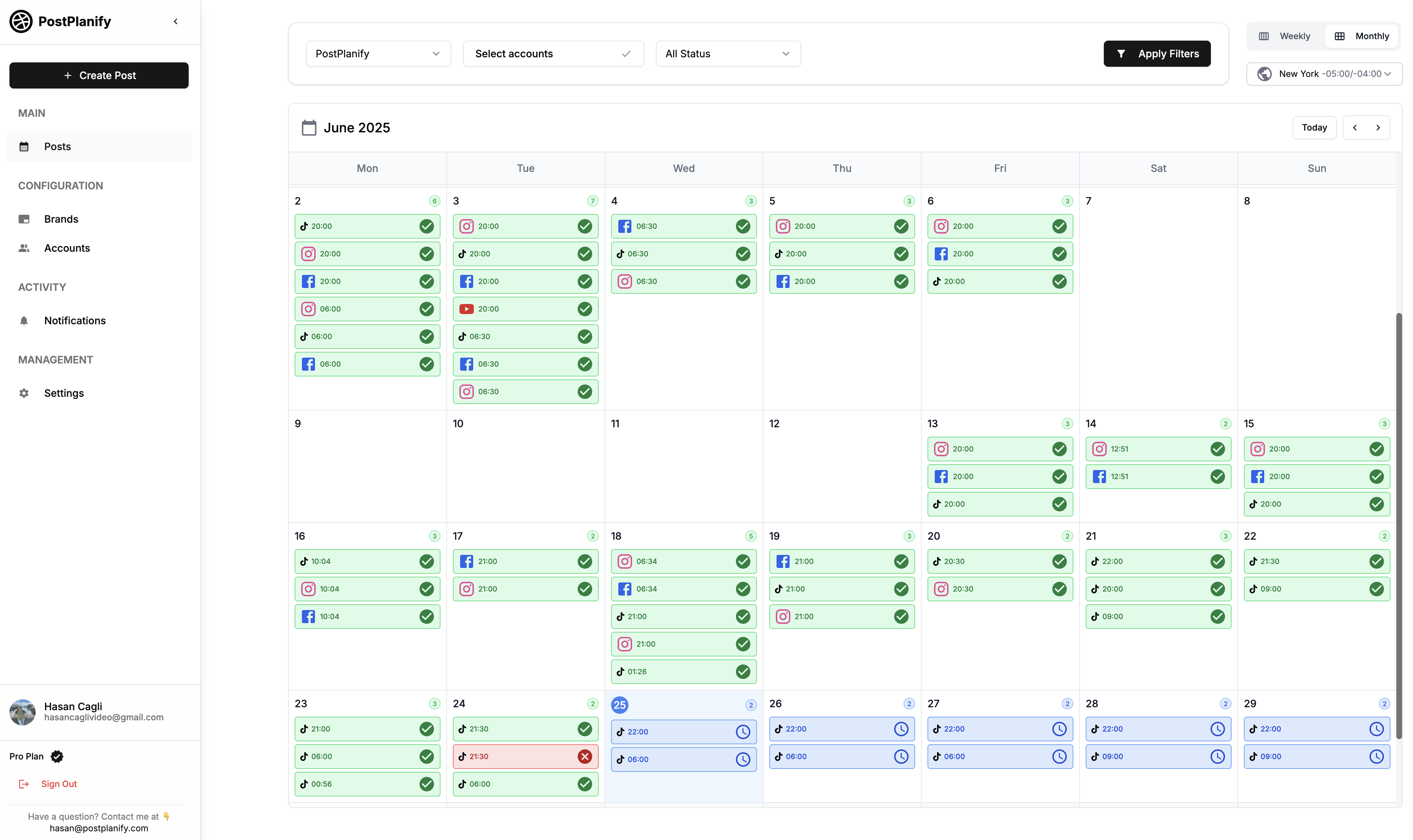
A calendar fixes that because it forces decisions earlier. You can see content gaps, balance promotional posts with educational or community content, and avoid stacking similar messages on the same day. That's especially important when one team manages several brands, product lines, or regions.

How to plan without becoming rigid
Plan the next four to six weeks, but don't lock every slot. Leave space for reactions, trend-based posts, launch changes, and customer moments worth amplifying. If your calendar is full with no slack, your team will either miss opportunities or break the plan every week.
Use separate tracks for planned content and responsive content. For example, LinkedIn might carry thought leadership and customer proof, Instagram might carry carousels, Stories, and UGC, while TikTok gets native short-form video. X is better used for commentary, fast updates, and replies than for recycled promo copy.
A simple structure works well:
- Theme lane: Educational, promotional, community, customer story, product update
- Format lane: Reel, carousel, Story, text post, video clip, poll
- Owner lane: Writer, designer, approver, publisher, responder
- Platform lane: Instagram, Facebook, TikTok, LinkedIn, X
Practical rule: If a team member can't tell what goes live next week, who owns it, and what asset is missing, the calendar isn't finished.
What to do each week
Review performance weekly, but don't rebuild the entire schedule from one strong or weak post. One post can spike because of timing, news, or an external mention. Look for patterns across several posts.
For agencies and in-house teams, a shared calendar also reduces duplicated effort. If product marketing is planning a launch post, community and paid teams should see it early enough to prepare replies, support assets, and campaign variants. If you need a framework for that setup, PostPlanify has a practical guide to building a content calendar for social media, and a dedicated content calendar feature that handles theme tracking, owner assignments, and approvals in one view.
2. Community Management and Responsive Engagement
A post starts picking up traction at 8:30 p.m. Comments split in three directions. New prospects are asking how pricing works, existing customers are reporting a bug, and a creator tags your brand in a Story that could turn into useful UGC by morning. If those messages land in different inboxes with no owner, response quality drops fast.
Community management is an operating system, not a side task under publishing, and the tool you pick for the inbox decides how much of it is manual. Teams need clear ownership for comments, DMs, mentions, and private replies because engagement now happens across public posts, Stories, group conversations, and direct messages. Feed performance still matters, but relationship signals often show up in places the content calendar does not control.
Where teams usually break
The failure point is usually routing. Marketing watches comments, support checks the help desk, sales jumps into high-intent questions, and no one has a shared rule for what gets answered first or who takes over when a thread changes from praise to problem-solving.
Platform behavior adds friction:
- Instagram: Story replies disappear into fast-moving inboxes, and account permissions can limit who can moderate or reply.
- Facebook: Older posts can resurface and attract new comments long after the publishing team has moved on.
- TikTok: A post can sit, then spike days later and flood the team with repetitive questions.
- LinkedIn: Short reactive replies rarely add much. Useful follow-up comments tend to perform better.
- X: People talk about brands without tagging them, so mention monitoring matters if reputation risk is part of the workflow.
One rule helps here. Separate engagement by intent, not by channel.
A product complaint on Instagram and a product complaint on LinkedIn should follow the same service path. A casual compliment on TikTok and a casual compliment on X can use the same lightweight reply standard. This keeps the team from building five different systems for the same underlying job.
A response system that holds up under volume
Use a three-step workflow:
- Triage: Tag messages by urgency, sentiment, and intent.
- Assign: Route each item to the person or team that can answer it.
- Respond: Apply channel-specific tone rules, then document handoff if the conversation moves to DM, email, or support.
That structure sounds simple because it is. The hard part is defining the rules early enough that people do not improvise under pressure.
For example, support-owned issues need a handoff path and a response window. Sales questions need a rule for when social replies stay public versus when they move private. Creator tags and customer shout-outs need a lightweight approval path so the team can acknowledge them quickly and decide whether to request reuse rights. If you need a repeatable process for sourcing and organizing creator submissions, this guide to a UGC content creator workflow is a useful reference.
A fast generic reply often creates more work than a slightly slower useful one.
That trade-off matters. Teams can answer everything in under an hour if they rely on templates for every message, but that approach tends to flatten tone and frustrate people with real questions. On the other hand, fully custom replies do not scale once volume rises. The practical middle ground is to standardize classification, routing, saved replies, and escalation notes, then leave room for human judgment in sensitive or high-value conversations.
Shared tooling helps because responsive engagement is partly a coordination problem. A shared inbox with labels, assignments, and approvals reduces missed messages and duplicate replies, and our comparison of the best social media engagement tools ranks 13 of them on inbox, listening, and AI reply quality. PostPlanify's guide on social media community management covers the workflow side well, and the unified social inbox pulls comments, DMs, and mentions across Instagram, Facebook, LinkedIn, Google Business, YouTube, Threads, and Bluesky into one queue. The tool matters less than the operating rules behind it: who owns first response, who approves exceptions, what gets escalated, and how the team records outcomes.
Measure more than response time. Track resolution rate, handoff volume, repeat question themes, and how often community conversations produce useful inputs for content, support docs, or product feedback. Those metrics show whether engagement is helping the business or just keeping the inbox busy.
3. User-Generated Content Campaigns and Hashtag Strategies
If your brand does all the talking, engagement eventually plateaus. UGC changes the dynamic because customers, members, or followers become contributors instead of passive viewers.
This works best when the ask is simple. People won't create content just because a brand wants “more community.” They respond to a clear prompt, an easy format, and a reason to participate. That could be a transformation story, a product setup, a workspace photo, a tutorial remix, or a short review.

What makes UGC fail
Most weak UGC campaigns ask for too much. “Share your story” is broad. “Post your favorite home office setup with our desk lamp and tag us” is easier to act on. Another common problem is that brands collect UGC but don't respond to it, feature it, or credit creators properly.
Hashtags also get misused. A branded hashtag can help organize submissions, but it won't create engagement by itself. It needs promotion, examples, moderation, and follow-through. On Instagram and TikTok, hashtags can support discovery, but creative quality and relevance still do the heavy lifting. On LinkedIn, hashtags usually play a smaller role than the actual insight in the post.
A practical UGC workflow
Run UGC like a program, not a one-off campaign.
- Define the prompt: Give people one action and one content angle.
- Set permissions early: Decide how you'll request reuse rights and how you'll credit creators.
- Track submissions: Save posts, usernames, captions, and usage status in one place.
- Feature consistently: Reshare, comment, and thank contributors publicly.
This is also where segmentation matters. Social Insider recommends using analytics, surveys, and social listening to segment audiences into smaller groups and tailor content accordingly, as covered in Social Insider's target audience guide. The best UGC prompts for a fitness audience won't look like the best prompts for a B2B SaaS audience.
If your team needs repeatable sourcing and approval, a central workflow helps. PostPlanify's article on working with a UGC content creator is a useful starting point, and the media library keeps approved UGC tagged by campaign and creator so it's easy to schedule and credit later.
 PostPlanify
All your social media in one simple dashboard
Schedule posts, track analytics, and reply to comments/DMs without switching tabs.

Engagement
+18%
Views
52.8k
4. Influencer Partnerships and Co-Marketing Collaborations
A lot of influencer campaigns underperform for one reason. The partnership looks rented, not real.
Good collaborations work because the audience already trusts the creator, partner brand, or subject-matter expert. Bad collaborations feel bolted on. The content is too scripted, too polished, or too disconnected from what the partner normally publishes.
Choose fit before reach
Audience overlap matters more than broad visibility. If you're a B2B software company, a niche LinkedIn consultant or operations creator can be more useful than a large general business account. If you're a consumer brand, a creator who already uses similar products will usually produce better content than someone reading a brief cold.
Many teams still make the wrong call regarding engagement. Sheer audience size matters less than active interaction, and platform engagement varies significantly. Dreamgrow's 2025 roundup reports average engagement rates of 6.50% on LinkedIn, 5.07% on Facebook, and 4.86% on TikTok in its cited data, which is one reason smart partnerships stay platform-specific instead of copying the same campaign everywhere.
Build a collaboration system
The strongest partner programs have a lightweight process:
- Identify creators or brands with audience and tone fit
- Review recent content quality and comment patterns
- Agree on message boundaries, deliverables, and usage rights
- Leave creative room for native execution
- Measure results by the objective that mattered
What you measure depends on the campaign. A co-hosted LinkedIn Live should be judged differently from a TikTok product demo or an Instagram Story series. Comments, saves, shares, clicks, replies, and direct inquiries can all matter, but not every campaign needs all of them.
Watch for this trap: Teams often approve collaborators based on follower count, then judge success by likes. That misses the entire business case.
There are edge cases too. Some creators resist approval workflows because they slow down posting and reduce authenticity. Some platforms also limit what can be tracked cleanly unless promo codes, tagged links, or platform-native partnership tools are set up in advance. Plan that before content goes live, not after.
5. Interactive Content and Real-Time Engagement
Static posting asks people to consume. Interactive posting asks them to act.
That distinction matters because the easiest way to increase engagement is often to lower the effort required for participation. Polls, Q&As, quizzes, surveys, Lives, and question stickers give people a clear next step. Instead of hoping someone thinks of a comment, you hand them a response path.
Coursera's engagement guidance highlights polls, questions, and competitions as practical ways to trigger comments, votes, and shares, while MarketBetter similarly frames polls, quizzes, Q&As, and surveys as formats that turn one-way posting into two-way dialogue in MarketBetter's guide to social media engagement strategies.
A short example is worth watching here:
You can also pair this with lightweight audience growth tactics like free twitter likes, but only if you're careful not to confuse initial traction with actual engagement quality.
Best uses by platform
Interactive formats aren't equal across networks.
- Instagram: Story polls, sliders, quizzes, and question boxes work well for fast feedback.
- Facebook: Groups, Lives, and event-driven posts can support longer discussion.
- TikTok: Replying to comments with a video creates a feedback loop and gives you content ideas.
- LinkedIn: Polls and AMA-style comment threads work if the topic is specific enough.
- X: Quick prompts, live commentary, and reply chains fit the pace of the platform.
What to operationalize
Schedule recurring interactive formats instead of inventing them from scratch every time. Weekly Q&As, monthly office hours, “pick one” polls, and launch-day Lives train your audience to participate.
The trade-off is moderation overhead. Live sessions need someone to host, someone to watch comments, and sometimes someone to capture clips for reuse. If you don't assign those roles ahead of time, live content often becomes chaotic and hard to learn from afterward.
6. Data-Driven Content Optimization and A/B Testing
A familiar failure pattern looks like this. The team ships a strong week of content, one post takes off, and the retro ends with guesses instead of decisions. Someone credits the topic. Someone else points to the format. The social lead suspects timing. If nobody isolated variables, the next round repeats the same uncertainty.
Treat engagement as a system with inputs, outputs, and feedback loops. Inputs are the controllable choices your team makes, such as hook, format, CTA, post timing, and audience segment. Outputs are the behaviors you care about, including comments, saves, shares, clicks, replies, and direct inquiries. A second layer matters too. Sprinklr's guide to measuring social media engagement also tracks share of voice, which helps teams compare brand visibility against competitors instead of judging posts in isolation, as summarized in Sprinklr's guide to measuring social media engagement.
The testing rule is simple. Change one variable at a time.
Useful variables to test include:
- Hook style: Question, contrarian point, list opener, customer pain point
- Format: Carousel versus short video, text-only versus graphic, native video versus edited clip
- CTA type: Comment prompt, save prompt, click prompt, DM prompt
- Publishing context: Time, day, and sequence relative to launches, newsletters, or paid campaigns
This sounds slower. It is slower per test, but faster for learning.
The trade-off is volume. If your team publishes three posts a week, you cannot run five meaningful tests at once and expect clean conclusions. Pick one hypothesis per platform for a set period, document it, and decide in advance what outcome would count as a win. Otherwise, teams drift toward cherry-picking results after the fact.
Reporting should answer operational questions, not decorate a slide deck. Which topics start conversations? Which formats get saves? Which posts create direct inquiries? Which channels generate low-value reactions but little downstream action? For a closer look at this process, review actionable social media analytics.
Mailchimp advises teams to measure beyond vanity metrics and connect reporting to business outcomes. WSI makes a similar point in its discussion of the social customer journey, where metrics such as link clicks, follower growth, and engagement rate are more useful than treating engagement as a single number, as discussed in WSI's social customer journey article.
For multi-account teams, the bottleneck is rarely access to metrics. It is workflow. If content, community management, and reporting live in separate tools, insights arrive too late to shape the next batch of creative. PostPlanify's guide to social media analytics and reporting workflows is useful if you need one reporting process across accounts and campaigns — and our cross-platform analytics covers all 10 connected networks including best-time-to-post suggestions, while white-label PDF reporting (Premium+) ships client-ready exports without manual dashboard rebuilds.
A practical review cadence works well here. Run a weekly performance review for post-level findings and a monthly review for pattern-level decisions. Weekly, tag winners and losers by topic, format, CTA, and objective. Monthly, decide what to repeat, what to pause, and what needs another controlled test. That structure keeps optimization tied to publishing decisions instead of turning analytics into a separate reporting function.
What Counts as "Good" Engagement? 2026 Benchmarks by Platform
Before testing changes, know what "normal" looks like on each platform. Engagement rates vary widely — what's great on X would be weak on LinkedIn. Use these as a directional baseline, not a target.
| Platform | Average engagement rate | What's considered good | Best engagement signals to watch |
|---|---|---|---|
| ~6.50% | >3.5% | Comments, reshares, document opens | |
| ~5.07% | >1% | Reactions, comments, link clicks | |
| TikTok | ~4.86% | >5% | Watch time, completion rate, shares |
| Instagram (Reels) | ~1.9% | >1.5% | Saves, sends, shares |
| Instagram (Feed) | ~0.6% | >1% | Saves, comments |
| YouTube Shorts | ~3.0% | >2% | Watch time, subscriber conversions |
| X (formerly Twitter) | ~0.45% | >0.5% | Replies, quote posts, bookmarks |
| ~0.2% | >0.3% | Saves, outbound clicks | |
| Threads | ~0.7% | >1% | Replies, reposts |
Sources: Dreamgrow 2025 platform engagement averages, Hootsuite 2026 benchmark report, and PostPlanify aggregated client data across 10,000+ accounts. Industry vertical can shift these numbers ±50%.
For the full methodology and how to calculate your own rate, see our social media engagement rate benchmarks guide and the step-by-step engagement rate calculator.
PostPlanifyAll your social media in one simple dashboard
Schedule posts, track analytics, and reply to comments/DMs without switching tabs.
Engagement
+18%
Views
52.8k
7. Storytelling and Narrative-Driven Content Strategy
Some posts get reactions. Stories get remembered.
Narrative content works because it gives people a reason to care beyond the immediate tip, product feature, or promotion. A customer problem, an internal challenge, a founder decision, a behind-the-scenes mistake, or a before-and-after sequence can all create emotional context that plain announcements can't.

The difference between story and fluff
Storytelling doesn't mean vague inspiration. It needs stakes, sequence, and specificity. What was the problem? What changed? What did the team or customer learn? Without that, “brand story” turns into padded copy that nobody discusses.
This is especially effective on LinkedIn, Instagram carousels, and short-form video. LinkedIn favors experience-based lessons. Instagram handles visual progression well. TikTok rewards process stories, reaction stories, and firsthand commentary. Facebook groups can support longer contextual posts if the topic matters to the community.
Story frameworks teams can actually use
You don't need a creative writing workshop. You need repeatable patterns:
- Problem to solution: A customer pain point, the process, and the outcome
- Behind the scenes: What the team changed, tested, fixed, or learned
- Origin moment: Why a product, feature, or campaign exists
- Community spotlight: A user story told with permission and context
People rarely share product features. They do share stories that make the feature feel relevant to their own situation.
One warning. Storytelling can drift away from business goals if nobody defines the role of the content. Some stories are for trust. Some are for education. Some support conversion later. If every story tries to sell immediately, it usually becomes less believable and less useful.
8. Omnichannel Consistency and Cross-Platform Amplification
Teams often confuse consistency with duplication. They're not the same.
Consistency means the brand sounds like itself everywhere. Duplication means posting the exact same asset and caption across every platform and hoping behavior stays the same. It won't. Mailchimp recommends platform-specific content and using unique features such as polls and live video rather than cross-posting identical material everywhere, as reflected in the audience guidance noted earlier.
What consistent actually looks like
A consistent system keeps the core message stable while adapting the format.
A product launch can become:
- an Instagram Reel focused on visuals and reactions
- a LinkedIn post focused on the problem it solves
- a TikTok clip showing the use case in action
- a Facebook post that invites community questions
- an X thread with short updates and follow-up replies
- a YouTube Short repurposed from the TikTok cut
- a Pinterest idea pin if the visual is strong enough
The campaign is one campaign. The executions are different. That gives you both recognition and relevance.
Team workflow that prevents brand drift
The problem usually isn't strategy. It's asset management and approval. Designers create one version. Social adapts it manually. Regional teams tweak copy. Then a last-minute stakeholder changes the positioning on one platform but not the others.
A better system has shared assets, message pillars, approval rules, and platform notes in one place. That matters even more when your audience is fragmented. In the U.S., about 96% of small businesses used social media in 2025, according to the Dreamgrow roundup cited earlier, which means the fight for attention is intense and operational discipline matters.
For teams handling many channels, a central calendar, shared media library, and approval workflow reduce inconsistencies. That's one place where a tool like PostPlanify can help without changing your content strategy itself — the content calendar, media library, and team collaboration features (with multi-step approval flows) keep the moving parts visible. A vision-powered AI assistant can also rewrite a single caption into platform-native variants without losing the core message.
9. Community Building and Exclusive Membership Programs
A brand can post every day, reply quickly, and still stall out on engagement. The usual failure point is not volume. It is the lack of a place where customers can talk to each other, build shared context, and come back for a reason beyond the next post.
That place might be a Facebook Group, Discord server, Slack community, customer forum, broadcast channel, or a gated email-plus-social program. The container matters less than the operating model. Communities hold attention when the purpose is clear, moderation is active, and members get a repeatable benefit from showing up.
Why community works differently from feed engagement
Public social is built for reach. Community spaces are built for retention, feedback, and trust.
That difference changes the job of the social team. A community manager is not only publishing content. They are onboarding new members, prompting useful discussion, routing product feedback, spotting advocates, and stepping in before a support thread turns into a pile-on. According to Hootsuite's social media engagement guidance, stronger engagement increasingly comes from higher-intent interactions like replies and direct messages. Private and semi-private communities fit that pattern because the conversation has more context and less noise.
There is a trade-off. Communities usually produce fewer visible vanity metrics than public posts, but they often produce better signals. You can track repeat participation, question resolution time, referral activity, beta interest, and themes in member feedback. If the team needs help tying those signals back to business outcomes, use a simple social media ROI measurement framework before launch so community work does not get judged only by likes or follower growth.
How to launch a community without creating dead space
Start with a narrow promise and a small group. Early members should already care enough to contribute. That usually means power users, active customers, creators, beta testers, or people who regularly reply, comment, and attend events.
Then build the operating system before you invite scale:
- Define the use case: Peer support, product feedback, education, networking, or member perks. Pick one primary job first.
- Set participation rules: Write clear guidelines on promotion, support requests, off-topic posts, and response expectations.
- Assign ownership: Name a moderator, an escalation path for support issues, and a person who turns recurring feedback into product or content actions.
- Create repeatable programming: Weekly prompts, office hours, teardown sessions, product previews, or member spotlights give people a reason to return.
- Close the loop: If members suggest an idea, tell them what happened next. That is how a forum becomes a feedback system instead of a suggestion box.
I have seen teams skip that setup and launch anyway. The result is usually predictable. A few posts go up, nobody knows who should respond, customer complaints sit too long, and the space starts to look abandoned.
Membership programs need real value, not a badge
Exclusivity by itself wears off fast. People stay for access, status, utility, or connection.
A strong membership layer usually includes one or two concrete benefits: early product access, direct Q&A with the team, templates, job leads, local meetups, private workshops, or a faster path to support. Keep the offer specific. "Join our exclusive community" is weak because it asks people to imagine the value themselves.
The limitation is workload. Community programs create content needs, moderation needs, and support expectations. For small teams, one well-run member space is better than three half-managed ones. If you use a planning tool like PostPlanify, keep the calendar, moderator assignments, recurring prompts, and escalation notes in one place so the community does not depend on one person remembering everything — team collaboration with role-based permissions makes that handoff predictable instead of tribal.
Done well, a membership program is not a side channel. It becomes a system for retention, insight, advocacy, and better content decisions across the rest of your social operation.
PostPlanifyAll your social media in one simple dashboard
Schedule posts, track analytics, and reply to comments/DMs without switching tabs.
Engagement
+18%
Views
52.8k
10. Performance Marketing and Conversion-Focused Content Campaigns
More engagement doesn't always mean better outcomes. A post can collect likes and still produce little traffic, few leads, and no sales.
That gap matters because broader benchmark guidance shows that a good social media engagement rate typically falls between 1.3% and 3.5%, depending on the platform, while one 2025 benchmark also found overall engagement declined by 28% year over year even though conversion rates still typically ranged from 2% to 5% and click-through rates averaged around 0.90%, according to Hootsuite's engagement benchmarks and guidance. The takeaway is simple. Strong social performance needs to connect attention to action.
Build campaigns around one business goal
Don't ask one campaign to do everything. Pick one objective first. Sales, sign-ups, demo requests, app installs, event registrations, or lead generation all need different content and different follow-up.
Then connect organic and paid efforts. Organic content helps surface winning angles, objections, and creative hooks. Paid distribution helps scale the messages that already show intent signals. To maximize this, social teams and performance teams need to work together, especially on retargeting, landing page alignment, and creative iteration.
What to measure when business results matter
Track the interactions that sit closest to the goal. Saves and shares can matter for education. Replies and DMs can matter for consultative sales. Clicks matter for traffic. Completed actions matter most when the campaign is conversion-led.
A practical process looks like this:
- Define one campaign goal
- Match content formats to that goal by platform
- Add tracking before launch
- Review both engagement quality and downstream conversion signals
- Shift budget and effort toward the creatives that drive action
For reporting, connect social activity to ROI as cleanly as your stack allows. UTM tags, platform pixels, CRM tagging, and campaign naming discipline all help. PostPlanify's article on how to measure social media ROI is useful if you're trying to tie organic and paid efforts back to business outcomes, and the cross-platform analytics layer surfaces which formats and posting times are pulling weight per channel so budget shifts faster.
Top 10 Social Media Engagement Strategies Comparison
| Strategy | Implementation Complexity 🔄 | Resource Requirements ⚡ | Expected Outcomes ⭐📊 | Ideal Use Cases 💡 | Key Advantages ⭐ |
|---|---|---|---|---|---|
| Content Calendar Planning & Strategic Scheduling | Medium 🔄 (2–4 weeks setup) | Moderate ⚡, calendar tools, planners, designers | ⭐⭐⭐ 📊 Improved consistency, fewer last‑minute posts | Agencies, e‑commerce launches, influencers batching | ⭐ Ensures consistent posting; streamlines workflows |
| Community Management & Responsive Engagement | Low–Medium 🔄 (processes & SLAs) | High ⚡, dedicated moderators, unified inbox, monitoring | ⭐⭐⭐⭐ 📊 Stronger loyalty, faster CSAT, higher visibility | Brands needing customer support, reputation management | ⭐ Builds community trust; improves real‑time feedback |
| User-Generated Content (UGC) Campaigns & Hashtag Strategies | Medium 🔄 (campaign setup & moderation) | Moderate ⚡, community managers, curation, legal checks | ⭐⭐⭐⭐ 📊 High authenticity, lower content cost, higher engagement | Consumer brands, seasonal contests, community growth | ⭐ Authentic, cost‑efficient content; boosts discoverability |
| Influencer Partnerships & Co-Marketing Collaborations | High 🔄 (vetting, contracts, coordination) | High ⚡, budgets, outreach, tracking tools | ⭐⭐⭐⭐📊 Large reach & credibility; ROI varies by partner | Product launches, awareness campaigns, niche audience access | ⭐ Access to engaged audiences; credible endorsements |
| Interactive Content & Real-Time Engagement (Polls, Q&As, Lives) | Medium 🔄 (planning + live moderation) | Moderate ⚡, hosts, moderators, streaming tools | ⭐⭐⭐⭐ 📊 Very high immediate engagement; first‑party data | Tutorials, product tests, live launches, Q&As | ⭐ Drives engagement and real‑time insights |
| Data-Driven Content Optimization & A/B Testing | High 🔄 (analytics & testing frameworks) | High ⚡, analytics tools, data analysts, time (4–8 wks) | ⭐⭐⭐⭐⭐ 📊 Measurable performance gains; reduced wasted spend | Performance-focused brands, agencies optimizing ROI | ⭐ Eliminates guesswork; continuous measurable improvement |
| Storytelling & Narrative-Driven Content Strategy | Medium 🔄 (creative development & continuity) | Moderate ⚡, writers, producers, ongoing content | ⭐⭐⭐⭐ 📊 Stronger emotional connection; higher shareability | Mission‑driven brands, long‑term loyalty building | ⭐ Creates memorable brand differentiation |
| Omnichannel Consistency & Cross-Platform Amplification | High 🔄 (guidelines + cross‑platform workflows) | High ⚡, centralized tools, asset libraries, coordination | ⭐⭐⭐⭐ 📊 Increased recognition; efficient repurposing | Large brands, agencies, multi‑market operations | ⭐ Consistent brand presence; scalable distribution |
| Community Building & Exclusive Membership Programs | Medium–High 🔄 (launch + governance) | High ⚡, moderators, events, rewards, platform fees | ⭐⭐⭐⭐⭐ 📊 Deep loyalty, higher LTV, potential recurring revenue | Creators, subscription products, product feedback loops | ⭐ Cultivates advocates; direct feedback & monetization |
| Performance Marketing & Conversion-Focused Content Campaigns | High 🔄 (tracking, funnels, attribution) | High ⚡, ad spend, specialists, landing pages, tracking | ⭐⭐⭐⭐⭐ 📊 Direct measurable ROI; fast scaling when optimized | E‑commerce, SaaS acquisition, product launches | ⭐ Measurable conversions; scalable ROAS and attribution |
Your Social Engagement Strategy Checklist
An engagement problem often isn't due to insufficient effort in captions or incorrect hashtag selection. Instead, it arises because the system around the content is weak. Planning is inconsistent. Platform adaptation is shallow. Replies are delayed. Reporting is vague. Ownership is fuzzy. By the time someone notices a drop, nobody can tell whether the issue came from content quality, timing, audience mismatch, or response workflow.
That's why the best social media engagement strategies work together. A content calendar creates consistency. Community management turns passive audiences into active conversations. UGC and collaborations add outside voices. Interactive formats reduce the friction of participation. Analytics and testing tell you what to keep, what to drop, and what to adjust. Community spaces deepen the relationship after the public post is gone. Conversion-focused campaigns make sure engagement supports real business goals instead of just looking busy in a dashboard.
If you need a starting point, don't deploy all ten at once. Pick two or three based on your actual bottleneck.
If your problem is inconsistency, start with calendar planning and cross-platform workflow. If your issue is silent posts with little discussion, focus on interactive content and community management. If your numbers look fine but business results are weak, fix your measurement model and campaign structure. If you're managing many accounts, tighten approvals, routing, and reporting before adding more content volume.
A simple rollout often works better than a big reset:
- Week one: Audit recent posts by format, platform, and engagement quality
- Week two: Set clear ownership for publishing, response handling, and reporting
- Week three: Introduce one recurring interactive format and one repeatable UGC or story format
- Week four: Review results and cut whatever isn't producing useful signals
Keep your metrics honest. Likes can indicate interest, but they don't tell the whole story. Replies, saves, shares, clicks, direct messages, and conversions usually say more about whether the content is helping the audience and moving them closer to action. The right KPI depends on the job of the post.
Also expect trade-offs. Faster posting often lowers quality control. More platforms increase reach but add operational complexity. More personalization in replies improves trust but takes staff time. Communities create stronger engagement but need moderation. There isn't a perfect setup. There is only a setup that's clear enough for your team to run consistently.
For agencies, in-house teams, and creators juggling multiple channels, tooling matters because it reduces friction in the daily workflow. A platform like PostPlanify can help centralize scheduling, approvals, analytics, and inbox management, which makes it easier to run these strategies as systems instead of isolated tasks. That's useful when your challenge isn't "what should we post?" but "how do we keep this working every week across multiple accounts and platforms?"
The goal isn't to chase every trend or maximize every visible reaction. The goal is to build a durable engagement engine. Publish with intent. Reply with structure. Measure what matters. Adjust based on evidence. Do that consistently, and your social channels become more than a content feed. They become a place where attention turns into trust, and trust turns into results.
Key Takeaways
- Engagement problems are systems problems, not creativity problems. Most teams aren't blocked by ideas — they're blocked by inconsistent calendars, slow response routing, and metrics that don't connect to business outcomes.
- Pick 2–3 strategies based on your actual bottleneck. If posts are inconsistent, start with calendar planning. If they're silent, focus on interactive content + community management. If results are weak, fix measurement and campaign structure first.
- Replies, saves, shares, and DMs say more than likes. Engagement quality predicts business impact better than vanity metrics — track what sits closest to the action you actually want.
- Engagement benchmarks vary 10x by platform. A 0.5% rate is weak on LinkedIn but excellent on X. See the platform benchmarks table before judging your numbers.
- Don't duplicate content across platforms — adapt it. One launch should become a Reel, a LinkedIn post, a TikTok, an X thread — same message, native format. Duplication kills engagement faster than under-posting.
- Communities outperform feeds for retention and feedback. Public posts drive reach; gated spaces drive trust, repeat conversation, and product insight.
- Test one variable at a time, or learn nothing. Hook, format, CTA, timing — change one, define the win condition before publishing, then decide what to scale.
Social Media Engagement Strategy FAQ
What is the most effective social media engagement strategy in 2026?
There isn't a single winner — the highest-leverage strategy depends on your bottleneck. For teams with weak consistency, calendar planning + cross-platform workflow wins fastest. For brands with silent posts, interactive formats (polls, Q&As, Lives) plus responsive community management deliver the steepest lift. For organizations whose engagement looks fine but business results are weak, conversion-focused campaigns tied to one goal — with proper tracking — produce the clearest ROI improvement.
What is a good social media engagement rate in 2026?
A good engagement rate depends entirely on the platform. As a directional baseline: LinkedIn >3.5%, Facebook >1%, TikTok >5%, Instagram Reels >1.5%, Instagram Feed >1%, YouTube Shorts >2%, X >0.5%, Pinterest >0.3%, Threads >1%. Your industry vertical can shift these numbers by ±50%. See the full platform benchmarks table for averages and recommended targets.
How do you measure social media engagement?
Engagement rate is most commonly calculated as (total interactions ÷ total followers or reach) × 100. Total interactions usually include likes, comments, shares, saves, and clicks — though high-performing teams weight saves, shares, replies, and DMs more heavily because they signal stronger intent. For a step-by-step walkthrough by platform, see our engagement rate calculator guide.
How often should you post for maximum engagement?
There's no universal answer, but most platforms favor consistency over volume. Common starting cadences in 2026: Instagram 3–5x per week, LinkedIn 3–4x per week, TikTok 1x per day, X 2–5x per day, Facebook 3–5x per week, Pinterest 5–10 pins per week. The trap is over-posting at the expense of quality. If your team can sustainably produce 3 strong posts per week, that beats 7 mediocre ones — algorithmic momentum is built on engagement quality, not raw post count.
What types of content get the most engagement?
In 2026, the highest-engagement formats are: short-form vertical video (Reels, TikTok, Shorts), carousels on Instagram and LinkedIn, interactive Stories (polls, quizzes, sliders), behind-the-scenes content, customer success stories, and live sessions. Static single-image promotional posts continue to under-perform. Formats that ask for participation (questions, polls, fill-in-the-blanks) consistently out-engage one-way announcements.
Why is my social media engagement dropping?
Common causes: posting frequency dropped or became inconsistent, content shifted toward promotion-heavy formats, algorithm changes downranked your post type, your audience moved to other platforms, or you're posting at suboptimal times. Audit the last 90 days by format, topic, and CTA — patterns will usually point to one or two root causes. External factors (Meta/TikTok algorithm shifts, audience saturation) also play a role; check whether competitors in your niche are seeing the same trend before assuming the problem is yours alone.
How long does it take to see results from an engagement strategy?
Expect 4–8 weeks for clear directional signals if you're applying changes consistently and reviewing data weekly. Engagement strategies are compounding — the first two weeks rarely show much because algorithms are still re-learning your account's signals. By week 4 you should see emerging patterns; by week 8 you should have enough data to keep, kill, or retest specific tactics with confidence.
Do hashtags still boost engagement in 2026?
Hashtags are useful for discovery on TikTok and Pinterest, somewhat useful on Instagram, and largely cosmetic on LinkedIn and X. Branded hashtags help organize UGC campaigns but won't drive engagement by themselves — they need promotion, examples, and consistent moderation to work. The era of stuffing 30 hashtags on every Instagram post is over; 3–8 highly relevant tags now outperform broad keyword lists.
Should you reply to every comment?
Reply to substantive comments (questions, feedback, sentiment) within 24 hours, and acknowledge the rest with reactions or short replies when capacity allows. Replying to every comment isn't sustainable for high-volume accounts, but ignoring them entirely teaches your audience their comments don't matter — which suppresses future engagement. The middle ground: prioritize first replies on each post within the first hour (which signals to the algorithm), then triage the long tail by intent.
What's the difference between reach and engagement?
Reach is the number of unique people who saw your content. Engagement is the number of people who took an action on it (like, comment, share, save, click). Reach is an input metric — it tells you how big your audience could be. Engagement is an outcome metric — it tells you whether the audience cared. A post can have huge reach with low engagement (the algorithm pushed it but it didn't resonate) or modest reach with very high engagement (a small audience that's deeply invested). Both matter, but engagement is the better leading indicator of business results.
What tools help with social media engagement?
The most useful categories are: a scheduling and content calendar tool, a unified social inbox for comments/DMs/mentions, an analytics layer that surfaces post-level performance trends, and an approval workflow for teams. PostPlanify combines all four — see the content calendar, social inbox, analytics, and team collaboration features. For broader comparisons, our best social media scheduling tools guide covers the full landscape.
Quick Engagement Strategy Checklist
Use this before deploying any new engagement plan:
- ✅ Have you identified your actual bottleneck (consistency, silence, weak conversion, or sprawl)?
- ✅ Are you running a content calendar with clear ownership lanes?
- ✅ Is your community management routed by intent — not by channel?
- ✅ Do you have one recurring interactive format on the calendar?
- ✅ Are you testing one variable at a time, with a defined win condition?
- ✅ Are your engagement benchmarks set against the right platform baseline?
- ✅ Do organic and paid efforts share creative learnings, or do they operate in silos?
- ✅ Is at least one campaign per quarter tied to a specific business goal with tracking in place?
Related Reading
- Social Media Community Management: A Complete Guide
- Content Calendar for Social Media
- Social Media Analytics and Reporting Workflows
- How to Measure Social Media ROI
- Social Media Engagement Rate Benchmarks 2026
- Engagement Rate Calculator Guide
- How to Improve Social Media Engagement
- UGC Content Creator Workflow
- Best Time to Post on Social Media
- Best Social Media Scheduling Tools
- Best Content Calendar Tools
- 14 Best LinkedIn Scheduling Tools
- Best Social Media Management Tools for Teams
Ready to run these strategies as a system instead of a stack of tabs? PostPlanify combines the content calendar, unified social inbox, cross-platform analytics, AI assistant, approval workflows, and white-label reporting agencies and in-house teams need — across Instagram, TikTok, X, LinkedIn, Facebook, YouTube, Pinterest, Threads, Bluesky, and Google Business.
Try PostPlanify free for 7 days and replace five tools with one.
PostPlanifyAll your social media in one simple dashboard
Schedule posts, track analytics, and reply to comments/DMs without switching tabs.
Engagement
+18%
Views
52.8k
About the Author

Hasan Cagli
Founder of PostPlanify, a content and social media scheduling platform. He focuses on building systems that help businesses, agencies, and teams plan, publish, and manage content and social media more efficiently across platforms.


