


The bond between people and their pets keeps deepening — Americans spent a record $158 billion on their pets in 2025, and roughly two-thirds of U.S. households own one (APPA). When those owners look for a vet, they do what everyone does with a high-trust local decision: they search Google, read reviews, and look you up on Facebook. 98% of consumers search online to find a local business, and 91% say reviews shape how they see one (BrightLocal) — and for something as emotional as their pet's health, your star rating and the way you reply to reviews carry real weight. Tellingly, 88% of consumers say they'd use a business that responds to all its reviews, versus just 47% for one that doesn't.
But running a clinic doesn't leave much time for any of this. Veterinary teams are stretched thin — about half of veterinarians report burnout, and roughly one in three have considered leaving the profession (AVMA) — so social media becomes the thing you'll get to "later." Vets also face a kind of review most businesses never do: the emotional one. With 52% of pet owners skipping or declining recommended care in the past year — 71% of them because of cost (Gallup) — price is a constant friction, and a grieving owner after a euthanasia or a client shocked by an emergency bill can turn that into a public one-star review. How you handle those shapes how the next family sees you. And with corporate groups now owning close to half of U.S. clinics (up from under 10% in 2011), keeping the brand consistent across locations is its own growing headache.
A good social media management tool takes the friction out of both jobs: it lets a busy team batch — or recycle — a month of content in one sitting, and it centralizes Google Business, reviews, and client messages so nothing slips. This guide compares the 10 best social media management tools for veterinary clinics in 2026, scored on what a practice actually uses: Google Business and review management, a unified inbox for engagement, easy pet-photo and video scheduling, evergreen and seasonal content tools, AI help for client education, and pricing that fits a clinic — not an agency.
Quick Answer: The Best Social Media Tool for Veterinary Clinics
For most veterinary practices, the best tool is PostPlanify — flat pricing from $99/month (no per-seat fees), publishing and analytics for all 10 platforms including Google Business, Google review replies from a unified inbox, AI captions and images for client-education content, a link-in-bio for booking, and approval workflows for sensitive posts. For large corporate veterinary networks that need enterprise listening and reporting, Sprout Social is the premium pick; for review and reputation management across Google, Yelp, and Facebook, Vista Social is the highest-rated option; for recycling evergreen seasonal education on autopilot, SocialBee leads; and solo clinics can start free with Buffer.
Quick Picks: Best Social Media Tools for Veterinary Clinics
| Tool | Best for | Starting price | Standout for vets |
|---|---|---|---|
| PostPlanify | Best overall for veterinary practices | $99/mo (flat) | Google Business + reviews, AI education content, approvals |
| Sprout Social | Large groups & corporate networks | $199/seat/mo | Enterprise analytics + social listening |
| Agorapulse | Client engagement & comment moderation | $99/user/mo | Strongest unified inbox + moderation |
| Vista Social | Review & reputation management | $79/mo | Google, Yelp & Facebook reviews in one place |
| SocialBee | Recycling evergreen pet-care content | $29/mo | Category-based content recycling |
| Later | Pet photos & Instagram content | $25/mo | Grid planning + UGC collection |
| Metricool | Analytics on a budget | Free / $25/mo | Deep analytics + ad management |
| Sendible | Agencies serving vet clinics | $29/mo | White-label client dashboards |
| SocialPilot | Budget multi-location management | $30/mo | Bulk scheduling + white-label at low cost |
| Buffer | Solo & small clinics getting started | Free / $6/channel | Simplest free start |
What Matters in a Social Media Management Tool for a Veterinary Clinic
Not every social media tool is built for a clinic. These are the criteria that actually matter when you're running a practice, not a marketing agency:
- Google Business Profile + review/reputation management. New clients find you on Google Business and choose by star rating. The right tool lets you post to Google Business and reply to reviews in one place — critical when a single emotional review can sway a nervous pet owner.
- A unified inbox for comments, DMs, and reviews. Pet content draws heavy engagement, and questions arrive at all hours. One inbox to triage and assign — and to catch a difficult review the moment it lands — keeps you responsive.
- Evergreen and seasonal content scheduling. Much veterinary content recurs every year (flea season, dental month, holiday hazards). Tools that recycle content on a schedule save a short-staffed team hours.
- Easy pet-photo and video scheduling. "Pet of the week," Reels, and TikToks are your highest-engagement content, so you want a visual calendar, previews, and simple video scheduling.
- AI help for client education. Turning "we offer dental cleanings" into an engaging educational post is where most clinics stall; AI captions and images remove the blank-page problem.
- Multi-location support. Groups need location-specific calendars, unified analytics, role-based access, and a shared media library that keeps branding consistent across clinics.
- Pricing that fits a clinic. Most tools charge per user or per channel, which punishes small teams. Flat-rate plans that bundle users and accounts are far more predictable for a practice.
I evaluated the 10 tools below against these criteria — cross-referencing current pricing from each vendor's page and verified user reviews on G2, Capterra, and Trustpilot — and weighted what a clinic actually uses (Google Business, reviews, engagement, seasonal recycling) over the enterprise depth most practices never touch.
1. PostPlanify — Best Overall for Veterinary Practices
PostPlanify is built for the reality of running a clinic: a team stretched thin, a community of pet owners who want to hear from you, and a reputation that lives on Google. It bundles scheduling, analytics, a unified inbox, and AI content tools on one flat monthly plan — no per-seat fees as you add reception staff, a practice manager, or a second location.
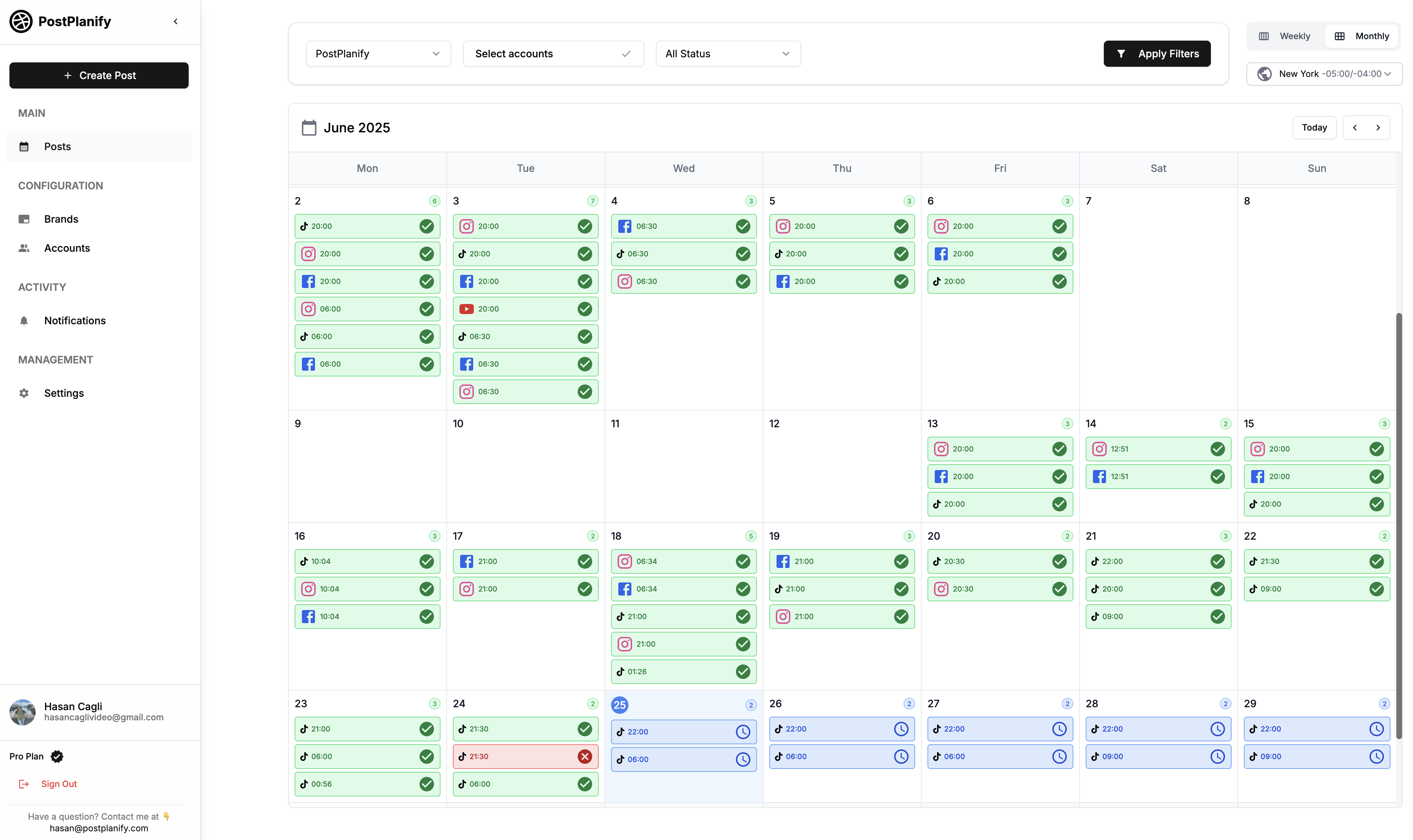
For a veterinary practice, three things stand out. It publishes to Google Business alongside Facebook, Instagram, and TikTok, and lets you reply to Google reviews from the social inbox — which matters enormously when pet owners choose a vet by star rating. Its AI assistant writes captions and generates images, so client-education posts about heartworm, dental month, or holiday hazards go from blank page to a scheduled week in one sitting. And approval workflows let a designated team member sign off before anything sensitive publishes — useful when a post touches a patient's story or a difficult case.
At a glance
- Pricing: Growth $99/mo (or $79/mo billed yearly) for 15 accounts and 3 users → Premium $199/mo → Scale $299/mo; custom Enterprise
- Platforms: 10, including Google Business, Facebook, Instagram, TikTok, YouTube, and LinkedIn
- Free trial: 7 days (14-day money-back guarantee)
- Best for vets: Single-location clinics through multi-location groups that want Google Business, reviews, AI education content, and approvals in one flat-priced tool
Key features for a veterinary clinic
- Publish to Google Business + reply to Google reviews from the social inbox (Instagram, Facebook, LinkedIn, Google Business, YouTube)
- AI-powered captions and image generation for client education and seasonal health posts
- Approval workflows so sensitive posts get signed off before publishing
- Visual content calendar with platform previews and bulk scheduling for pet photos and Reels
- Analytics and reporting across all 10 platforms, including Google Business search impressions and customer actions
- A shared media library for approved clinic photos and patient features
- Link-in-bio to send followers to online booking or new-client forms
How it fits a veterinary clinic: It runs a single clinic's entire local presence — posts, Google reviews, client DMs, and reporting — from one $99/mo plan, and because pricing is flat it scales to a multi-location group without per-seat costs piling up as you add hospitals and staff. The trade-off: a very large corporate network that needs deep social listening and cross-market benchmarking may want a dedicated suite for that specific layer alongside it.
Verdict: The best all-round fit for most clinics — strong on the things practices actually need (Google Business, reviews, AI education content, approvals) without enterprise pricing.
Learn more: See the full PostPlanify pricing breakdown, the scheduler for veterinarians, or start a free trial.
 PostPlanify
All your social media in one simple dashboard
Schedule posts, track analytics, and reply to comments/DMs without switching tabs.

Engagement
+18%
Views
52.8k
2. Sprout Social — Best for Large Veterinary Groups & Corporate Networks
Sprout Social is the enterprise choice, and veterinary medicine increasingly has enterprises — corporate groups like VCA, Banfield, and NVA now own thousands of clinics. Sprout's analytics, social listening, and reporting are the deepest here, a fit for a group running marketing across dozens or hundreds of hospitals that needs to prove ROI.

The wall is price. Sprout starts at $199 per seat per month, listening is a paid add-on, and every user pays the full seat cost — so a single practice putting one coordinator on it is overpaying badly. Review management is included across plans, which is valuable for a multi-location group tracking reputation at scale, but this is enterprise software priced for enterprises.
At a glance
- Pricing: $199/$299/$399 per seat/mo; 30-day trial, no free plan
- Best for vets: Large corporate networks needing enterprise reporting and listening
- Ratings: 4.4/5 on G2 (5,731 reviews), 2.2/5 on Trustpilot (75)
How it fits: Ideal for a corporate group's in-house marketing team; overkill and costly for an independent clinic that mainly needs to post and manage reviews.
Verdict: Best-in-class analytics for large veterinary groups — but the per-seat cost is hard to justify below the corporate level.
Learn more: Sprout Social pricing, Sprout Social reviews, and the best Sprout Social alternatives.
3. Agorapulse — Best for Client Engagement & Comment Moderation
Agorapulse is built around engagement, which fits vet clinics unusually well — pet content draws heavy comments, questions, and the occasional heated thread. Its unified inbox is the strongest on this list, pulling comments, DMs, and reviews into one queue your team can triage and assign, with automated moderation rules that can hide spam or flag sensitive messages.

For a clinic fielding "is chocolate really toxic?" comments and emotional review replies at all hours, that inbox — plus a built-in social CRM that remembers each client's history — is the reason to choose it. Agorapulse publishes to Google Business too, so posting and client care share one workspace. The catch is the meter: at $99–$199 per user, a few team members cost several times a flat plan, and profiles cap at 10 below the custom tier.
At a glance
- Pricing: $99/$149/$199 per user/mo ($79/user annual); 30-day trial, no free plan
- Best for vets: Clinics where responding to clients and reviews is a priority
- Ratings: 4.5/5 on G2 (967 reviews), 4.0/5 on Trustpilot
How it fits: Excellent if engagement is your focus; per-user pricing adds up for larger teams.
Verdict: The engagement pick — the best unified inbox and moderation for a clinic that lives on client interaction.
Learn more: Agorapulse pricing, Agorapulse reviews, and the best Agorapulse alternatives.
4. Vista Social — Best for Review & Reputation Management
Vista Social is the most complete all-in-one here for a clinic whose reputation is everything. It natively manages six review sites — including Google, Yelp, and Facebook — so you can monitor and respond to the reviews that decide whether a nervous new pet owner picks up the phone, all from one dashboard. It's rated 4.8/5 on G2 across 1,000+ reviews, the highest score in this guide.

For vets, the appeal is reputation tools plus breadth at a mid-market price: review management, a Vista Page link-in-bio, DM automations, and social listening in one place, from $79/month for 15 profiles. Two things to know: X/Twitter is a paid add-on, and the sheer number of modules can feel like a lot if all you want is scheduling and reviews. AI image generation also runs through a connected Canva account rather than being native.
At a glance
- Pricing: $79 Professional (15 profiles) / $149 Advanced / $379 Scale per mo; 14-day trial, no free plan
- Best for vets: Reputation-focused practices that want reviews, scheduling, and inbox in one affordable all-in-one
- Ratings: 4.8/5 on G2 (1,071 reviews), 4.1/5 on Trustpilot (62), 4.9/5 on Capterra (scheduling)
How it fits: Excellent for a clinic or small group that wants native review-site management without enterprise pricing; the feature breadth is more than a scheduling-only practice needs, and X costs extra.
Verdict: The all-in-one reputation pick — the best-rated tool here, and the strongest at managing Google, Yelp, and Facebook reviews from one place.
Learn more: Vista Social pricing, Vista Social reviews, and the best Vista Social alternatives.
5. SocialBee — Best for Recycling Evergreen Pet-Care Content
SocialBee solves a problem specific to veterinary marketing: most of your best content is evergreen and seasonal. Flea and tick reminders, heartworm prevention, holiday-hazard warnings, and dental-month tips come around every year — and SocialBee's category-based content recycling is built exactly for that. You sort posts into categories, and it automatically cycles through them on a schedule, so a library you build once keeps working for years.

That set-it-and-forget-it engine, at $29–$99/month, makes it a genuine time-saver for a short-staffed clinic — and it's well-liked, with a 4.8/5 on G2 across 472 reviews. The trade-offs are real, though: analytics are surface-level, there's no true social inbox for handling comments and reviews, and users report the posting queue can occasionally stall if a single post errors out. Think of SocialBee as your evergreen-education workhorse, paired with something that handles engagement and reviews.
At a glance
- Pricing: $29 Bootstrap (5 profiles) / $49 Accelerate / $99 Pro per mo; 14-day trial, 30-day money-back
- Best for vets: Clinics that want to recycle seasonal client education on autopilot
- Ratings: 4.8/5 on G2 (472 reviews), 4.0/5 on Trustpilot (43)
How it fits: Perfect as a low-cost evergreen-content engine; you'll want a separate tool for reviews and real-time engagement.
Verdict: The recycling pick — the most efficient way to keep seasonal pet-care education running all year with minimal effort.
Learn more: SocialBee pricing, SocialBee reviews, and the best SocialBee alternatives.
6. Later — Best for Pet Photos & Instagram Content
Later is the visual specialist, and few businesses are as photogenic as a vet clinic — puppies, kittens, and "pet of the week" features are engagement gold. Later's drag-and-drop grid preview lets you compose an Instagram feed before it publishes, its media library organizes clinic photos, and its UGC tools help you gather and reshare the client pet photos owners love to see featured.

The catch for a clinic is important: Later does not support Google Business Profile — where your reviews and local discovery live — so you'd manage that elsewhere, and it dropped X/Twitter in 2025. Its Linkin.bio page (on all plans) is handy for routing followers to booking or new-client forms, but the gap between its G2 rating (4.5) and Trustpilot score (1.3/5 across 329 reviews) is worth noting. Later is a visual front-end, not an all-in-one.
At a glance
- Pricing: $25 Starter / $50 Growth / $110 Scale per mo; limited free plan, 14-day trial
- Best for vets: Visually active clinics that lean on Instagram pet content
- Ratings: 4.5/5 on G2 (347 reviews), 1.3/5 on Trustpilot (329)
How it fits: Excellent for visual planning and UGC; the missing Google Business support means most clinics will run it alongside a review tool.
Verdict: The Instagram and pet-photo pick — beautiful visual planning, but not a complete clinic solution on its own.
Learn more: Later pricing, Later reviews, and the best Later alternatives.
7. Metricool — Best for Analytics on a Budget
Metricool is the pick for a clinic that wants to know what's actually working. Analytics are its whole identity — competitor benchmarking, unlimited history, and clean reports — and it folds in paid-ad management for Facebook, Instagram, and Google, so a practice running a new-client or lost-pet-alert boost can plan organic and paid together.

It's also affordable, with a free plan to start and paid plans from $25/month, plus SmartLinks (its link-in-bio) for routing followers to booking. The trade-offs: it leans analytical over creative — AI captions, image generation, and previews are thin — and its inbox lacks the moderation and review-site depth an engagement-heavy clinic wants. X/Twitter is a $5/month add-on, and the free plan excludes LinkedIn and X.
At a glance
- Pricing: Free (1 brand) / Starter from $25/mo / Advanced from $54/mo; free plan, no trial needed
- Best for vets: Clinics and groups that want deep analytics and ad management on a budget
- Ratings: 4.5/5 on G2 (83 reviews), 4.2/5 on Trustpilot (519), 4.8/5 on Capterra (ease of use)
How it fits: Ideal if reporting and ROI tracking drive your decisions; less suited to a clinic that wants an all-in-one for content and engagement.
Verdict: The analytics-and-ads pick — the most affordable way to measure what your social is doing, if you can live with lighter content tools.
Learn more: Metricool pricing, Metricool reviews, and the best Metricool alternatives.
8. Sendible — Best for Agencies Serving Vet Clinics
Sendible is built for agencies running social for multiple clients — including the marketing firms that specialize in veterinary practices. Its calling card is white-label client dashboards and branded reports, so an agency can give each clinic a portal under its own brand, with a Priority Inbox and client approval links.

The strength is the agency workflow: run a dozen clinics from one dashboard, group profiles by client, and route posts through approval links so a practice signs off without ever logging in — and it supports Google Business. For a single clinic doing its own marketing, though, it's more than you need, and it lacks AI image generation, a built-in link-in-bio, and Pinterest.
At a glance
- Pricing: $29 Creator → $89 Traction → $199 Scale → $299 Advanced → $750 Enterprise; 14-day trial
- Best for vets: Agencies managing social for several veterinary clients
- Ratings: 4.5/5 on G2 (899 reviews)
How it fits: If you're a single clinic, this is more than you need; if you're the agency serving practices, the white-label workflow is the draw.
Verdict: The agency pick — white-label dashboards and client approvals make it strong for firms managing multiple veterinary accounts.
Learn more: Sendible pricing, Sendible reviews, and the best Sendible alternatives.
9. SocialPilot — Best Budget Multi-Location Management
SocialPilot brings agency-style features — bulk scheduling, multi-account management, white-label reports — at a fraction of enterprise prices, a practical fit for a small veterinary group managing a few hospitals on a budget. It supports Google Business alongside the major networks.

Cost-per-location is the draw. A group can bulk-upload a month of posts for every clinic in one CSV, then send each a white-labeled report from the Premium tier up — for $30–$100 a month. You trade polish for that value: the dashboard is busy, analytics are basic, and small per-account and per-user fees stack on lower tiers. But little else offers this much multi-location reach this cheaply.
At a glance
- Pricing: $30 Essentials / $50 Standard / $100 Premium / $200 Ultimate per mo; 14-day trial
- Best for vets: Budget-conscious multi-location groups and small agencies
- Ratings: 4.5/5 on G2 (841 reviews), 4.4/5 on Capterra
How it fits: Great value for managing multiple clinics; the interface is functional rather than polished.
Verdict: The best value for multi-location veterinary management — white-label reports on Premium and bulk scheduling at a low price.
Learn more: SocialPilot pricing, SocialPilot reviews, and the best SocialPilot alternatives.
10. Buffer — Best for Solo & Small Clinics Getting Started
Buffer is the easiest on-ramp for a single-location or newly-opened clinic. Its interface is the cleanest in the category, its free plan covers three channels, and paid plans are just $6 per channel per month — so you can get organized before there's a marketing budget to speak of.
The simplicity has limits. Buffer publishes to Google Business and includes a Start Page link-in-bio, but analytics are basic, its community inbox only covers Instagram, Facebook, and LinkedIn (not TikTok or X), and there's no review management or content recycling. For a small clinic that mostly wants consistent, friendly posts, that's a fair trade; once reviews and engagement matter, you'll outgrow it.
At a glance
- Pricing: Free (3 channels) / $6 per channel (Essentials) / $12 per channel (Team) per mo; 14-day trial on paid
- Best for vets: Solo and newly-opened clinics getting started
- Ratings: 4.3/5 on G2 (1,023 reviews), 2.1/5 on Trustpilot (93)
How it fits: Perfect for a small clinic that wants simple, consistent posting; light on engagement and analytics.
Verdict: The simplest, cheapest start — great for a single clinic, limited once reviews and engagement matter.
Learn more: Buffer pricing, Buffer reviews, and the best Buffer alternatives.
Side-by-Side Comparison: All 10 Tools
| Tool | Starting price | Google Business | Review replies | Content recycling | AI content | Free plan/trial |
|---|---|---|---|---|---|---|
| PostPlanify | $99/mo (flat) | ✅ | ✅ (via inbox) | Limited | ✅ | 7-day trial |
| Sprout Social | $199/seat/mo | ✅ | ✅ | ❌ | ❌ | 30-day trial |
| Agorapulse | $99/user/mo | ✅ | ✅ (via inbox) | ❌ | ❌ | 30-day trial |
| Vista Social | $79/mo | ✅ | ✅ (6 sites) | ❌ | Via Canva | 14-day trial |
| SocialBee | $29/mo | ✅ | ❌ | ✅ (categories) | ✅ | 14-day trial |
| Later | $25/mo | ❌ | ❌ | ❌ | ❌ | Limited free |
| Metricool | Free / $25/mo | ✅ | ❌ | Limited | ❌ | Free plan |
| Sendible | $29/mo | ✅ | Limited | ✅ (queues) | ❌ | 14-day trial |
| SocialPilot | $30/mo | ✅ | Limited | ❌ | ❌ | 14-day trial |
| Buffer | Free / $6/channel | ✅ | ❌ | ❌ | ❌ | Free plan |
How to Handle Emotional and Grief-Driven Negative Reviews
Veterinary reviews carry an emotional weight most industries never face. A grieving owner may leave a one-star review hours after a euthanasia; another may lash out over the cost of emergency care; a third may blame the clinic for an outcome no one could have changed. How you respond is read by every prospective client who scrolls your Google profile — and the numbers back this up: 88% of consumers say they'd use a business that replies to all its reviews, versus 47% for one that doesn't. A calm, human reply protects your reputation as much as the care itself. The AVMA's own reputation guidance lays out principles that hold up:
- Lead with empathy, never defensiveness. Acknowledge the person's experience and loss before anything else. "We're so sorry for the loss of [pet]" does more for onlookers than a point-by-point rebuttal.
- You often can't set the record straight — legally. HIPAA doesn't apply to pets, but roughly half of U.S. states impose veterinary-client-patient confidentiality, and the AVMA's ethics rules treat patient records as confidential. In practice that means you frequently can't even confirm the person was a client in a public reply, let alone discuss the case. Keep it general and move specifics to a private channel.
- Take it offline fast. Offer a direct line — a name, a phone number, an email — and continue the conversation where emotions can settle and details stay private.
- Know when to stop. The AVMA suggests a "rule of three" — never post a third public reply, because by then you're arguing, not resolving. Say your empathetic piece, offer to talk offline, and let it rest.
- Respond quickly, and to the good reviews too. A steady stream of thoughtful replies to positive reviews softens the impact of the occasional bad one.
This is where the right tool earns its place. A unified inbox that surfaces new reviews the moment they land means nothing festers unseen; team assignment routes a sensitive review to the practice manager rather than a stressed front-desk hire; and saved-reply templates give staff a calm, on-brand starting point for the hardest messages. When you compare the tools above, weigh review monitoring and inbox features as heavily as scheduling — for a clinic, reputation is marketing.
Veterinary Social Media Strategy: Platforms, Content, and a Seasonal Calendar
Which social media platform is best for a veterinary clinic?
- Facebook — still the center of gravity for most clinics: local community groups, an older pet-owner demographic, event promotion, and reviews all live here.
- Google Business Profile — how new clients find you and the reviews that decide whether they call; arguably tied with Facebook for importance.
- Instagram — the home of pet photos, Reels, and "pet of the week" features; great for showing personality.
- TikTok — where pet content goes viral and younger owners discover clinics; authentic, funny, and educational clips outperform polished ones.
- YouTube — longer client-education videos (post-op care, nail trims) with lasting search value.
Master Facebook and Google first, add Instagram for visuals, and treat TikTok as high-upside if someone on the team enjoys it.
What should a vet clinic post?
- "Pet of the week" and patient features (with the owner's permission) — your highest-engagement content
- Client education — preventive care, parasite prevention, toxic foods, post-op instructions
- Team and behind-the-scenes — introduce the DVMs and techs; trust comes from familiarity
- Adoptable pets and shelter partnerships — community goodwill and reach
- Pet memorials and tributes (with permission) — deeply resonant with your audience
- Seasonal health reminders — the backbone of a low-effort calendar (below)
A seasonal pet-health content calendar
Most veterinary content recurs every year, which is why recycling it (see SocialBee above) saves so much time. A simple annual rhythm:
- February — National Pet Dental Health Month
- Spring — flea, tick, and heartworm prevention as the weather warms
- Summer — heat and car safety, travel tips, water safety
- Fall — back-to-school pet anxiety, wildlife and allergy season
- Holidays — toxic foods (chocolate, xylitol, grapes), decoration and travel hazards
- Winter — cold-weather and paw care
Build each of these once, sort them into content categories, and let a scheduler cycle them annually — you'll never start a seasonal post from scratch again.
How to Choose the Right Tool for Your Clinic
- Solo or single-location clinic: PostPlanify (Google Business + reviews + AI content + a booking link, flat $99/mo) or Buffer for a free start.
- Time-starved team that wants to automate education: SocialBee for evergreen seasonal recycling, paired with a review tool.
- Reputation-focused practice: Vista Social for Google/Yelp/Facebook review management, or Agorapulse for the strongest engagement inbox.
- Multi-location veterinary group: PostPlanify for bundled locations and Google Business in one plan, or SocialPilot for budget multi-account scheduling.
- Large corporate network: Sprout Social for enterprise analytics, listening, and governance.
- Data-driven marketer: Metricool for analytics and paid campaigns on a budget.
- Agency serving vet clinics: Sendible for white-label client dashboards.
Frequently Asked Questions
What is the best social media management platform for veterinary clinics?
For most veterinary practices, PostPlanify is the best all-around choice — it bundles Google Business publishing and review replies, AI captions and images for client education, approval workflows for sensitive posts, a link-in-bio for booking, and analytics across all 10 platforms, on one flat plan from $99/mo (no per-seat fees). The best fit still depends on your needs: Sprout Social for large corporate networks that need enterprise analytics, Vista Social for review and reputation management across Google, Yelp, and Facebook, Agorapulse for engagement-heavy clinics, SocialBee for recycling evergreen seasonal education, Metricool for analytics on a budget, Sendible for agencies, SocialPilot for budget multi-location groups, and Buffer for a solo clinic starting out.
Which social media platform is best for a veterinary clinic?
Facebook and Google Business Profile are the two most important — Facebook for local community and an older pet-owner base, and Google Business for how new clients find you and the reviews that decide whether they call. Instagram is the best home for pet photos and Reels, and TikTok has the highest upside for viral, younger reach. Most clinics should master Facebook and Google first.
How often should a veterinary clinic post on social media?
Three to five times per week is a realistic, effective cadence for most clinics — enough to stay visible without overwhelming a busy team. Consistency matters more than volume, and batching or recycling evergreen educational content is the practical way to keep it up when the clinic gets busy.
How should a vet clinic respond to a negative review about euthanasia or cost?
Lead with empathy and acknowledge the person's loss or frustration before anything else, keep the public reply general to protect confidentiality, and move the specifics to a private channel by offering a name and direct number. Never argue the medical details or the bill in public — prospective clients read how you handle criticism, and a calm, compassionate response protects your reputation far better than a rebuttal. The AVMA also suggests a "rule of three": don't post a third public reply, since by then it reads as arguing rather than resolving.
Can a veterinary clinic mention a patient's details when replying to a review?
Generally no. HIPAA doesn't apply to animals, but roughly half of U.S. states impose veterinary-client-patient confidentiality, and the AVMA's ethics rules treat patient records as confidential — so in a public reply you typically can't disclose medical details, or even confirm the person was a client, without their consent. That's exactly why the standard advice is to keep public replies empathetic and general and take any specifics to a private channel.
How do veterinary clinics get more Google reviews?
Ask at the right moment — right after a positive visit or a good outcome — and make it frictionless with a direct review link in follow-up texts, emails, discharge paperwork, and your link-in-bio. Train the team to mention it, respond to every review you receive (which encourages more), and never incentivize reviews, which violates Google's policy. Consistent, genuine asks compound quickly.
What should a veterinary clinic post on social media?
The highest-performing mix is "pet of the week" and patient features (with permission), client education (preventive care, toxic foods, post-op tips), team and behind-the-scenes content, adoptable pets, and seasonal health reminders. Pet photos and short video consistently outperform text or generic graphics — your audience is there for exactly that.
Do veterinary clinics need to be on TikTok?
It's optional but high-upside. Pet content is some of the most viral on TikTok, and clinics that post authentic, funny, or educational clips can reach far beyond their local area — which helps with recruiting staff as well as clients. If no one on the team enjoys making short video, prioritize Facebook, Google, and Instagram first rather than forcing it.
Is PostPlanify a good tool for a veterinary clinic?
Yes — it's our top pick for most clinics. It covers Google Business publishing and review replies, AI captions and images for client education and seasonal posts, approval workflows for sensitive content, a link-in-bio for booking, and analytics across all 10 platforms, on flat pricing from $99/mo with no per-seat fees. Because that pricing is flat, it scales from a single clinic to a multi-location group without per-seat costs piling up; very large corporate networks that need deep social listening may want a dedicated enterprise suite for that layer alongside it.
If PostPlanify fits your clinic, you can start a free trial here.
Related Reading
-
13 Best Google My Business Tools: The listings and review-management layer behind a clinic's local discovery
-
Best Social Media Tools for Franchises and Multi-Location Brands
PostPlanifyAll your social media in one simple dashboard
Schedule posts, track analytics, and reply to comments/DMs without switching tabs.
Engagement
+18%
Views
52.8k
About the Author

Hasan Cagli
Founder of PostPlanify, a content and social media scheduling platform. He focuses on building systems that help businesses, agencies, and teams plan, publish, and manage content and social media more efficiently across platforms.


