


Instagram Story views seem simple: they tell you how many unique accounts have watched your Story. But that’s where the simplicity ends. Unlike feed video views, replays don't inflate this number. It’s a pure metric of how many individual people you've reached. Understanding this metric is the first step to figuring out what your audience actually wants to see.
What Actually Counts as a View on Instagram Stories?
When you check your Story analytics, the "view count" represents something different from a video on your main feed. A feed video might count multiple plays from the same person, but a Story view is about unique reach.
Think of it like hosting a workshop. Your view count is the number of individual attendees who walked through the door. If one person leaves to take a call and comes back in, you still only count them once. Instagram applies the exact same logic: one account equals one view, no matter how many times they tap back and forth or rewatch your Story slides.
This makes your view count a direct, undiluted measure of your audience size for that specific piece of content.

Why Views Are Different from Impressions
It’s easy to mix up Story views with another key metric: impressions. They sound similar, but they tell two very different stories about your content.
While views tell you how many unique accounts saw your Story, impressions tell you the total number of times your Story was seen, including replays. If your impression count is higher than your view count, it means some people came back for a second look. For a deeper dive, check out our guide on what impressions are on Instagram.
This difference isn't just a technicality; it reveals how your content is performing.
- High Views: Your content is successfully reaching a wide audience. You’re getting in front of more people.
- High Impressions (relative to views): Your content was so engaging that people rewatched it. This signals it was particularly interesting, funny, or informative.
Decoding Story Metrics: A Quick Reference
This table breaks down the key metrics and what they mean for your content strategy.
| Metric | What It Really Means | Why It Matters To You |
|---|---|---|
| Story Views | The number of unique accounts that watched any part of your Story. | This is your true reach. It shows how many individual people your content connected with. |
| Impressions | The total number of times your Story slides were seen, including replays. | This measures engagement and stickiness. High impressions suggest your content was compelling enough for repeat viewings. |
| Reach | This is the same as Story Views—the number of unique accounts. | Use this to gauge overall audience growth and the effectiveness of your content distribution. |
Understanding these distinctions helps you move from just tracking numbers to actually interpreting what your audience is telling you through their behavior.
 PostPlanify
All your social media in one simple dashboard
Schedule posts, track analytics, and reply to comments/DMs without switching tabs.

Engagement
+18%
Views
52.8k
How Instagram Ranks Your Story Viewers
Have you ever noticed that the list of people who viewed your Story isn't chronological? That's because Instagram’s algorithm organizes your viewers based on who you interact with the most.
The accounts you see at the top of the list are usually the people you engage with through DMs, comments, and profile visits. It's not random.
This algorithmic sorting is Instagram's way of showing you the people who are most engaged with your profile. It’s a powerful, often overlooked indicator of your strongest connections and most loyal followers.
This turns your viewer list from a basic record into a relationship map. With over 500 million people using Instagram Stories daily, understanding these details is critical. Make sure your Story visuals fill the screen correctly — use 1080×1920 pixels (9:16) and check the Story safe zones to keep text visible above the reply bar. A third of the most-viewed Stories come from businesses, and 62% of viewers say they become more interested in a brand after seeing it in a Story. These numbers show why digging into the details—like who sees your content first—can make a big difference.
How to Find and Understand Your Story Analytics
Your Instagram Insights are more than just numbers—they’re a direct line of communication from your audience. To truly understand the views on your Instagram Stories, you need to look at the user behavior driving that count. This data tells you exactly what’s working, what’s falling flat, and what keeps people coming back.
If you have a Professional (Business or Creator) account, accessing these analytics is simple.
- Open your active Story.
- Swipe up on the screen.
- Tap the bar chart icon (Insights).
This is your performance dashboard, where you can see how people interacted with each slide.
Key Metrics Beyond the View Count
Learning to read these interaction metrics reveals the "why" behind your view count, turning raw numbers into an actionable story about your content.
Here are the essential data points to track:
- Reach: This is your total view count—the number of unique accounts that saw your Story. Think of it as the total number of people who showed up to your event.
- Impressions: This is the total number of times your Story was viewed, including replays. If Impressions are higher than Reach, it’s a great sign that your content was compelling enough for a second look.
- Taps Forward: This shows how many times users tapped to skip to your next slide or the next person's Story. A few taps are normal, but a high number on one slide indicates it didn’t hold their attention.
- Taps Back: This is often a golden metric. It shows how many times people tapped to re-watch the previous slide. A high number here means your content was valuable or interesting enough for them to see it again.
- Exits: This metric counts how many times a viewer swiped away from your Story completely. A spike in exits on a particular slide is a red flag, signaling that the content might have been confusing, boring, or off-putting.
By analyzing these behaviors on a slide-by-slide basis, you can diagnose your content’s real strengths and weaknesses. It’s the difference between knowing how many people came to your event versus knowing why some stayed and others left early.
Putting Your Story Analytics Into Action
Let's look at two real-world scenarios to see how you can use this data to make better content decisions.
Scenario 1: You See High "Taps Back" on a How-To Slide
You post a five-slide Story walking through a quick recipe. You notice that the third slide, which lists all the ingredients, has significantly more Taps Back than any other.
- Why it happened: Your audience found that information valuable, but they probably didn't have enough time to read or screenshot it on the first pass.
- Actionable fix: Next time, you can either leave text-heavy slides on screen for a bit longer or break the information into two separate, more digestible slides.
Scenario 2: You See a Spike in "Exits" on a Sales Pitch
You're sharing a Story about a new product. The first few slides show it in action and get good engagement, but the final slide with a direct "Buy Now" call-to-action has a massive number of Exits.
- Why it happened: The shift into a hard sell might have felt too jarring for your audience, especially if they’re used to non-promotional content from you.
- Actionable fix: Warm them up first. Before a direct CTA, try using a question sticker like, "Want to see how it works?" to gauge interest. This makes the pitch feel less like an ad and more like a helpful conversation.
Getting comfortable with these analytics is a cornerstone of a solid social media strategy. To zoom out and explore performance tracking, our guide on social media analytics and reporting is a great next step.
PostPlanifyAll your social media in one simple dashboard
Schedule posts, track analytics, and reply to comments/DMs without switching tabs.
Engagement
+18%
Views
52.8k
Troubleshooting: Why Your Instagram Story Views Are Dropping
It’s frustrating to put time into a great Story, hit publish, and then watch the view count stall. If you’ve noticed a drop in your views on Instagram Stories, you’re not alone. It’s almost never random—it’s a signal that something in your strategy needs an adjustment. Figuring out the "why" is the first step to fixing it. If your Reels and feed posts are also underperforming, our full guide on how to get Instagram views covers the broader picture.
Common Cause #1: Algorithm Shifts and Low Engagement
Why it happens: The Instagram algorithm’s job is to keep users engaged by showing them content it thinks they'll love. It watches how users interact with your Stories—how many people tap through, reply, or share—to decide where to rank your content in their feed. If your engagement slips, the algorithm shows your Stories to fewer people. It’s not personal; it's the platform prioritizing what's resonating right now. When followers start tapping past your content quickly or exiting your Story, Instagram sees that as a sign your content isn’t connecting.
A drop in views is often a symptom. The root cause is usually a disconnect between what you're posting and what your audience finds engaging at that moment.
Actionable Fix:
- Start with an interactive sticker: Place a poll, quiz, or question box on your very first Story slide to capture immediate engagement.
- Encourage DMs: Ask questions that prompt a direct reply, as DMs are a strong signal of engagement to the algorithm.
- Analyze your exits: Check which slides have the highest drop-off rate and avoid that type of content or format in the future.
Boosting interaction is about sending a direct signal to the algorithm that your content is valuable. We cover more tactics in our guide on how to improve social media engagement.
Common Cause #2: Content Fatigue
Why it happens: Posting the same type of Story every day leads to content fatigue. If your audience knows exactly what to expect, they start to tune it out. A fitness coach posting the same "what I eat in a day" Story every Tuesday will eventually see views drop because the novelty is gone.
Actionable Fix:
- Mix up your formats: Alternate between video, static images, text-based slides, and user-generated content. If you have longer video content, consider breaking it into Story-sized clips or posting it as a Reel instead — our guide on how to post a long video on Instagram explains the best approach for each format.
- Vary your content pillars: Don't just sell. Rotate between behind-the-scenes content, educational tips, and interactive Q&As.
- Surprise your audience: Post something unexpected, like a funny outtake, a personal story, or a limited-time offer.
This concept map shows the key analytics to watch to catch these problems early, zeroing in on metrics like Reach, Taps Back, and Exits.
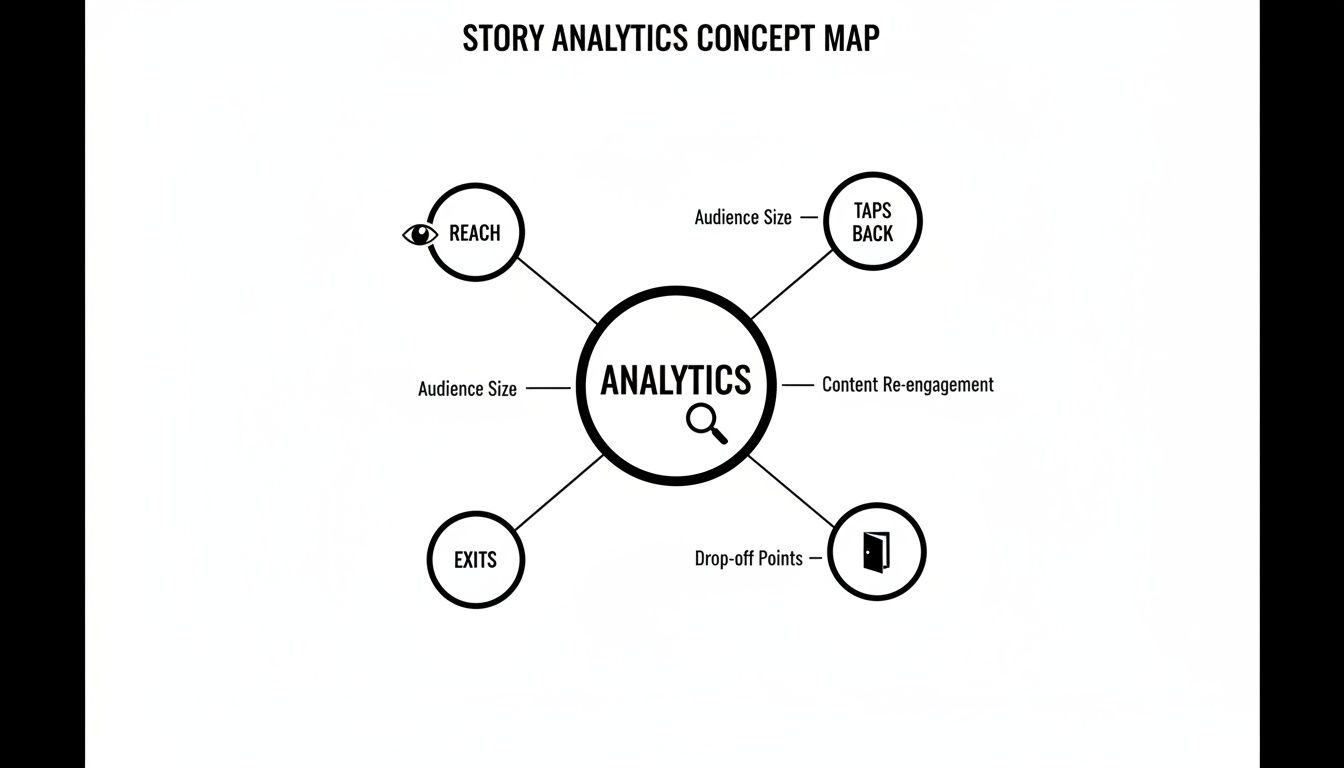
As the visual shows, a high number of Exits and a low Reach are red flags that often mean your audience is losing interest.
Common Cause #3: Inconsistent Posting Schedule
Why it happens: Consistency signals reliability to both your audience and the algorithm. If you post Stories daily for a week and then disappear for five days, you break your audience's viewing habit. They stop looking for your icon at the top of their feed, and the algorithm may deprioritize your account for being inactive. Think of it like a TV show—if the schedule becomes random, people stop tuning in.
Actionable Fix:
- Set a minimum posting frequency: Aim to post on your Story at least once every business day to stay active.
- Use a scheduler: A tool like PostPlanify helps you plan and schedule Stories in advance, ensuring you maintain a consistent presence even on busy days. Content batching makes this even easier — create a week's worth of Stories in one session.
- Find your peak times: Post when your audience is most active. Check your Instagram Insights to find your followers' peak hours.
Common Cause #4: Platform Limitations or Restrictions
Why it happens: Though less common, a sudden, massive drop in views could point to an account restriction, often called a shadowban. This can happen if you violate community guidelines, use banned hashtags, or engage in behavior that looks spammy (like using bots). When you’re shadowbanned, your content won’t appear on Explore pages or in hashtag searches, which kills your reach to non-followers. This happens on TikTok too — if you’re seeing the same issue there, check out our TikTok shadowban recovery guide.
Actionable Fix:
- Review Instagram's Community Guidelines: Ensure your content doesn't accidentally violate any rules.
- Check your hashtags: Search for the hashtags you regularly use to see if any have been flagged or banned by Instagram.
- Take a short break: Pausing all activity on your account for 48-72 hours can sometimes help reset its standing with the algorithm.
Actionable Strategies to Increase Your Story Views
Watching your Story views dip is frustrating, but it's an entirely fixable problem. Boosting your views on Instagram Stories isn't about a secret hack; it's about consistently applying a handful of proven strategies that signal value to both your followers and the algorithm.
When someone interacts with your Story—by tapping a sticker, re-reading text, or sending a reply—they’re telling Instagram, "This is good content." The algorithm sees these signals and shows your Story to more people. That's the entire game.

1. Use Interactive Stickers on Your First Slide
Interactive stickers are your best tool for driving engagement. They turn passive viewers into active participants, and that participation is gold for the algorithm.
The key is to place an interactive sticker on your very first Story slide. Viewership naturally drops with each tap forward, so you need to hook them immediately. Getting an early interaction tells Instagram that your content is engaging and deserves a bigger audience.
Here are the stickers to use regularly:
- Polls: Keep it simple. "This or That?" questions are perfect. A home decor account could ask, "Which rug works better here?" with two options. It's an effortless tap for your viewer.
- Quizzes: Test your audience's knowledge. A coffee brand could quiz followers on the ideal water temperature for a pour-over.
- Question Boxes: This is your direct line to your audience. Ask them for feedback, ideas, or questions to spark real conversations and get valuable insights.
- Emoji Sliders: Perfect for a quick sentiment check. A food blogger can share a recipe video and ask, "How badly do you want to try this?" with a drooling-face emoji slider.
Every tap on a sticker is a vote of confidence. It tells Instagram your Story is compelling enough to stop the scroll, which directly influences your reach and future views.
2. Make Your Stories Discoverable with Tags
If interactive stickers engage your current audience, then location and hashtag stickers help you find new people. These tags make your Stories searchable and can land them on the Explore page or a city's public Story.
How to Use Tags for Maximum Reach:
- Use the Location Sticker: Always tag your city, a specific neighborhood, or the business you're at. This is essential for local businesses and a huge opportunity for travel creators.
- Use Relevant Hashtags: You can add up to 10 hashtags per Story. Use the main hashtag sticker for your most important one, then type out the rest as text. You can shrink them down or hide them behind a GIF to keep your design clean.
- Tag Other Accounts: Mentioning brands, collaborators, or followers you're featuring is a no-brainer. If they reshare your Story, you get exposed to their entire audience instantly.
3. Create "Can't-Miss" Content
The ultimate goal is to become an account whose Stories people actively seek out. This only happens when you consistently provide value, whether through entertainment, education, or exclusive behind-the-scenes access.
When your followers know your Stories are always packed with useful tips or updates they can't get elsewhere, they'll make a habit of tapping on your icon first. This creates a powerful feedback loop: higher initial views signal the algorithm to show it to more people, leading to even more views.
For example, a financial advisor could build a following by posting one "money myth" debunk in her Stories every single day. Her audience would show up consistently for that daily nugget of value.
4. Post Consistently and at the Right Times
Consistency is key on Instagram. If you post a dozen Stories one day and then go silent for three, you confuse both your audience and the algorithm. People stop looking for your content, and the algorithm may deprioritize you.
A steady, predictable schedule keeps you top-of-mind. To make this easier, a scheduling tool like PostPlanify is a game-changer. You can batch-create and schedule Stories ahead of time, ensuring you never lose momentum. Posting when your audience is actually online also matters—finding the best time to post on Instagram ensures your content gets immediate traction.
If you're looking to level up your entire workflow, exploring the best social media management tools can give you a major advantage. A solid toolkit makes managing a consistent, high-quality social media presence much more achievable.
Instagram Story View Rate Benchmarks by Follower Count
The FAQ below covers the general formula for calculating your Story view rate, but what's "good" varies dramatically by account size. Smaller accounts typically have higher view rates because their followers are more engaged and personally connected. As accounts grow, the percentage naturally drops — but the absolute number of views increases.
Here are realistic 2026 benchmarks based on data from social media managers across industries:
| Follower Count | Excellent View Rate | Good View Rate | Average View Rate | Below Average |
|---|---|---|---|---|
| Under 1K | 30%+ | 20-30% | 10-20% | Below 10% |
| 1K-5K | 20-25% | 12-20% | 6-12% | Below 6% |
| 5K-10K | 15-20% | 8-15% | 4-8% | Below 4% |
| 10K-50K | 10-15% | 5-10% | 3-5% | Below 3% |
| 50K-100K | 7-10% | 4-7% | 2-4% | Below 2% |
| 100K-500K | 4-7% | 2-4% | 1-2% | Below 1% |
| 500K+ | 3-5% | 1.5-3% | 0.5-1.5% | Below 0.5% |
How to calculate your view rate: (Average Story Views ÷ Total Followers) × 100
Example: If you have 25,000 followers and your Stories average 1,500 views, your view rate is 6% (1,500 ÷ 25,000 = 0.06). According to the table, that's in the "Good" range for a 10K-50K account.
What These Numbers Actually Mean
- If you're above the "Excellent" threshold: Your audience is highly engaged. Focus on converting that engagement into followers on other platforms, email subscribers, or customers.
- If you're in the "Good" range: You're performing well. Test interactive stickers and timing optimizations to push toward "Excellent."
- If you're "Average" or below: Something is off — likely content fatigue, inconsistent posting, or mismatched content-to-audience. Use the troubleshooting section above to diagnose the issue.
Why View Rates Drop as You Grow
This is normal and not a sign of failure. Three things happen as accounts scale:
- Follower quality dilutes. Early followers are your most engaged fans. Later followers include casual discoverers, follow-for-follow accounts, and people who followed from a viral post but aren't deeply interested in your niche.
- Instagram's algorithm becomes more selective. With more followers, Instagram can't show your Story to everyone — it prioritizes the followers most likely to engage based on past behavior.
- Competition for attention increases. As your audience grows, they follow more accounts. Your Story competes with more creators for that limited top-of-feed real estate.
The fix isn't to chase a higher percentage — it's to focus on the quality of engagement (replies, sticker taps, shares) rather than raw view count. An account with 50K followers and a 5% view rate generating 100 DM replies per Story is outperforming one with a 10% view rate and zero replies.
Instagram Stories vs. Reels: How Views Compare
One of the most common questions creators have is whether to focus on Stories or Reels for maximum reach. The two formats serve fundamentally different purposes, and understanding how their view metrics compare helps you allocate your effort more effectively.
| Factor | Stories | Reels |
|---|---|---|
| View definition | Unique account opened your Story | Account watched for at least 3 seconds (or the full video if shorter) |
| Typical reach | 5-15% of followers | Can reach far beyond followers via Explore and Reels tab |
| Lifespan | 24 hours (unless saved to Highlights) | Permanent (stays on your profile grid) |
| Best for | Engagement with existing audience, real-time updates | Discovery and attracting new followers |
| Algorithm priority (2026) | Shown primarily to followers who engage with you | Distributed broadly based on content signals |
The key takeaway: Stories deepen relationships with your current audience. Reels expand your audience. The strongest Instagram strategies use both---Stories to nurture, Reels to grow. For a deeper breakdown, check our guide on Instagram posts vs. Stories vs. Reels.
How Story Views Feed the Reels Algorithm
Here’s something most creators miss: your Story engagement directly influences how Instagram distributes your other content. When followers regularly interact with your Stories (replies, sticker taps, shares), Instagram categorizes them as "high-interest" connections. This means those same followers are more likely to see your Reels and feed posts in their home feed.
In other words, strong Story views create a compounding effect across your entire account. They’re not just a standalone metric---they’re fuel for your overall Instagram reach.
Optimal Posting Frequency and Timing for Stories
How often should you post Stories, and when? There’s no universal answer, but data from social media managers in 2026 points to clear patterns.
How Many Stories Per Day?
| Story Slides Per Day | Typical Completion Rate | Best For |
|---|---|---|
| 1-3 slides | 85-95% | Maintaining visibility without overwhelming |
| 4-7 slides | 70-85% | Telling a narrative or sharing a tutorial |
| 8-12 slides | 50-70% | Launch days, events, Q&As |
| 13+ slides | Below 50% | Generally too many---high exit rates |
The sweet spot for most accounts is 3-7 slides per day. Posting fewer than 3 means you’re likely not showing up consistently enough in followers’ Story trays. Posting more than 10-12 regularly leads to fatigue and higher exit rates.
When to Post Stories
Unlike feed posts and Reels, Stories don’t need to be posted at a single "perfect" time. Because they last 24 hours and appear at the top of the feed, spacing them throughout the day keeps your profile icon active and at the front of the Story tray.
A practical schedule:
- Morning (7-9 AM): Post your first Story to catch early scrollers
- Midday (12-2 PM): Add a second round during lunch breaks
- Evening (6-9 PM): Post your most engaging content when usage peaks
For data-driven timing specific to your audience, check your Instagram Insights under "Most Active Times" or read our guide on the best time to post on Instagram. Scheduling Stories in advance with PostPlanify ensures you hit these windows consistently without being glued to your phone.
How Story Highlights Extend Your Views
Stories disappear after 24 hours, but Highlights give them a permanent home on your profile. Highlights are the circular icons that sit between your bio and your feed grid, and they’re one of the most underused features on Instagram.
Why Highlights Matter for Views
When someone visits your profile for the first time---whether from a Reel, a hashtag, or a tag---they often check your Highlights before deciding to follow. Well-organized Highlights act as a mini-website, showcasing your best content, FAQs, testimonials, or product info.
Every tap on a Highlight counts as a Story view in your analytics. This means a single well-curated Highlight can accumulate thousands of views over weeks and months, far exceeding what the original 24-hour Story generated.
How to Organize Highlights for Maximum Impact
- Use clear, branded cover icons so visitors can instantly identify each category. For design tips, see our Instagram grid layout guide
- Lead with your strongest content in each Highlight---the first slide determines whether people keep watching
- Keep Highlights updated by removing outdated slides and adding fresh ones
- Limit to 5-7 Highlights visible on your profile to avoid overwhelming visitors
- Name them with short, scannable labels like "Tips," "Reviews," "FAQ," "BTS," or "New"
How to Control Who Sees Your Instagram Stories

Managing your Story’s privacy is just as important as the content itself. Deciding who gets to see your Stories is a strategic choice that can help you build a more engaged community. Instagram offers several layers of control, from broadcasting to the world to sharing with a curated inner circle.
Your first layer of control is your account type. A public account allows anyone, follower or not, to watch your Stories, which is ideal for maximizing reach. A private account restricts Story views to only your approved followers, which is better for personal sharing.
How to Use the Close Friends List
For more precise control, Instagram’s Close Friends feature lets you create a hand-picked list of followers who can see exclusive Stories hidden from everyone else. A Story shared with this list is indicated by a green circle around your profile picture instead of the usual pink.
This feature is excellent for building deeper connections. Brands use it to share behind-the-scenes content, special discount codes, or early access to new products, making those on the list feel like insiders.
How to set up your Close Friends list:
- Go to your profile and tap the three horizontal lines (hamburger menu) in the top-right corner.
- Select Close Friends.
- Search for the accounts you want to add and tap Add next to their name.
- You can remove people from this list at any time from the same screen.
A key limitation to note is that Instagram does not notify users when they are added to or removed from a Close Friends list. This gives you complete freedom to manage your list without creating social awkwardness.
Who Can See Your Viewer List and For How Long?
A common question is who can see the list of people who viewed your Story. The answer is simple: only you. Your followers cannot see who else watched your Story.
As mentioned earlier, this list is sorted algorithmically to place the people you interact with most at the top.
There is also a time limit. Your Story and its viewer list are only available for 48 hours.
- First 24 hours (Live Story): You can see the viewer list by swiping up on your Story.
- Next 24 hours (In Archive): After your Story expires, it moves to your private Archive. You can still access the viewer list for another 24 hours.
After that 48-hour window closes, the list of specific viewers is gone for good. Combining this knowledge with other features can be very effective; for example, our guide on how to pin on Instagram Story shows you how to keep key content visible for that entire duration.
Can You View Instagram Stories Anonymously?
This is one of the most-searched questions related to Instagram Stories — and the answer matters whether you're a viewer wondering about privacy or a creator wondering who's watching.
The Short Answer
No — Instagram does not offer a native way to view someone's Story without appearing in their viewer list. If you watch a Story while logged into your Instagram account, the poster can see your username in their viewer list for 48 hours.
Methods People Claim Work (and Why They're Risky)
You'll find dozens of articles and apps claiming to let you view Stories anonymously. Here's the reality:
| Method | Does It Work? | Risk Level |
|---|---|---|
| Third-party "Story viewer" websites | Sometimes, for public accounts only | High — many are phishing scams that steal login credentials or inject malware |
| Third-party apps | Sometimes, briefly | Very High — violates Instagram's ToS, can get YOUR account banned, often requires your login |
| Airplane mode trick | Partially — lets you view cached Stories without sending a "view" signal | Low risk but unreliable — only works for Stories already loaded in your feed, and Instagram may still register the view when you reconnect |
| Creating a burner account | Yes, if it follows/views from a separate account | Medium — against ToS if used for harassment; fine for casual use but the poster still sees the burner account |
| Viewing via web browser (logged out) | Only for public accounts, and only the first few slides | Low — limited functionality, no guarantee of anonymity |
What This Means for Creators
If you're posting Stories, know that:
- Every viewer is logged. There's no way for a regular Instagram user to view your Story without appearing in your list.
- Your viewer list is private. Only you can see who watched — your followers cannot see each other on the list.
- Screenshots are undetectable. Instagram does NOT notify you when someone screenshots a regular Story (only disappearing DM photos/videos trigger notifications).
- 48-hour window applies. After 48 hours, the specific viewer list disappears — but aggregate metrics (views, reach, impressions) remain in your Insights permanently.
The Bottom Line on Anonymous Viewing
If someone tells you they have a reliable, safe way to view Instagram Stories anonymously at scale — they're either selling you something dangerous or it'll stop working when Instagram patches it. The platform is designed to show creators who's watching, and Meta actively blocks third-party tools that try to circumvent this.
For creators, this is actually good news: your viewer list is one of the most honest metrics on Instagram. Every name represents a real person who chose to watch your content.
PostPlanifyAll your social media in one simple dashboard
Schedule posts, track analytics, and reply to comments/DMs without switching tabs.
Engagement
+18%
Views
52.8k
Frequently Asked Questions About Instagram Story Views
As you refine your Instagram strategy, specific questions about how Story views work are bound to come up. Here are straight answers to the most common ones.
Why are my Story views stuck or not increasing?
If your Story views have plateaued, it’s usually a sign that your content strategy needs a refresh. Here are the most common causes:
- Low Engagement: The algorithm prioritizes interactive content. If your recent Stories haven’t received many replies, sticker taps, or shares, they will be shown to fewer people.
- Content Fatigue: Posting the same format or topic repeatedly can cause your audience to become bored and skip your Stories.
- Inconsistent Posting: Long breaks between posts can break your audience’s viewing habit and cause the algorithm to deprioritize your content.
- Weak First Slide: Viewership drops with every tap. If your first slide doesn’t immediately grab attention, you lose a large portion of your potential audience from the start.
The Fix: Start your next Story with an interactive sticker like a poll or quiz. This immediate engagement can signal to the algorithm that your content is valuable and help break you out of a view slump.
Does watching my own Story affect the view count?
No, watching your own Story does not increase your view count.
Instagram is designed to measure how many unique accounts have seen your content. The system automatically excludes your own views from the public-facing metric to ensure the data accurately reflects your audience reach. You can tap through your own Stories as many times as you need to check for typos or review the flow without worrying about inflating your numbers.
Can I see who viewed my Story after 48 hours?
No, the list of specific people who watched your Story disappears permanently after 48 hours.
While a Story is live for the first 24 hours, you can see the viewer list by swiping up. Once it expires and moves to your private Archive, you have an additional 24-hour grace period to check that same list. After 48 hours, the names are gone.
However, you can always access the performance metrics (Reach, impressions, interactions) for old Stories in your Insights by navigating to your Archive. You just won’t be able to see the individual usernames who made up that view count.
What is a good Story view rate?
A "good" view rate depends on your follower count, niche, and community engagement. The best way to benchmark your performance is to calculate your view rate percentage.
Formula: (Average Story Views / Total Followers) x 100
Here is a general framework used by social media managers:
- Excellent: 15-25%+
- Good: 8-15%
- Average: 3-8%
- Below Average: 1-3%
For example, if you have 10,000 followers and your Stories average 1,000 views, your view rate is 10% (1,000 / 10,000 = 0.10). This indicates a healthy, engaged audience. If that number is closer to 300 views (a 3% rate), it’s a clear signal that you need to adjust your content strategy to recapture your audience’s attention.
Do screenshots count as views on Instagram Stories?
Yes, taking a screenshot of a Story counts as a view. The person is watching your Story when they screenshot it, so they’re already included in your view count. However, Instagram does not notify you when someone takes a screenshot of your regular Story. Screenshots of disappearing photos or videos sent via DM do trigger notifications, but standard Stories do not.
Can you see who screenshots your Instagram Story?
No. As of 2026, Instagram does not notify Story posters when someone takes a screenshot of their Story. This was briefly tested in 2018 but never rolled out permanently. The only screenshot notifications on Instagram apply to disappearing photos and videos sent in direct messages---not to public or Close Friends Stories.
Do Story views affect the Instagram algorithm?
Yes, significantly. The Instagram algorithm tracks how users interact with your Stories---taps forward, taps back, replies, sticker interactions, shares, and exits. Accounts that consistently generate high Story engagement get prioritized in the Story tray (appearing first/leftmost) and also receive a boost in feed and Reels distribution. Think of Story views as a trust signal: the more people watch and interact, the more Instagram shows your content across all formats.
How many Stories should I post per day?
The optimal range for most accounts is 3-7 Story slides per day. Posting fewer than 3 may not generate enough visibility to stay at the front of followers’ Story trays. Posting more than 12 regularly leads to content fatigue and higher exit rates. On special occasions like launches, events, or Q&As, posting 8-12 slides is fine---just don’t make it a daily habit.
Summary & Checklist
- Understand Your Metrics: Views equal unique accounts. Impressions equal total views. Don’t confuse them.
- Diagnose Drops in Views: Low engagement, content fatigue, and inconsistent posting are the usual suspects.
- Prioritize Interaction: Use polls, quizzes, and question stickers on your first slide to boost engagement immediately.
- Increase Discoverability: Use relevant location, hashtag, and account tags in every Story.
- Stay Consistent: Post 3-7 slides daily at spaced intervals and at peak times to keep your audience engaged.
- Use Highlights: Turn your best Stories into permanent profile content that keeps generating views.
- Control Your Privacy: Use the Close Friends list for exclusive content and to build a stronger community.
Ready to turn these insights into a consistent, high-impact content strategy? PostPlanify helps you schedule your Stories, posts, and Reels in advance, so you can maintain momentum and post at the perfect times without the daily grind. Stop letting inconsistency hurt your views. Start your 7-day free trial with PostPlanify.
Related Reading
- Instagram Posts vs. Stories vs. Reels: When to Use Each - Choose the right format for every piece of content
- How to Schedule Instagram Stories - Plan and automate your Story posting schedule
- Best Time to Post on Instagram - Data-backed timing for maximum reach
- What Are Impressions on Instagram? - Understand the difference between views, impressions, and reach
- How to Go Viral on Instagram - Strategies to dramatically increase your reach
- How to Grow Instagram Followers Organically - Build your audience without paid ads
- Instagram Reels Algorithm Explained - How the algorithm decides what content to show
- How to Pin on Instagram Story - Keep key content visible for your full Story duration
- Changing Background Color of Instagram Story - Boost dwell time with on-brand Story backgrounds
- How to Improve Social Media Engagement - Cross-platform engagement strategies
- How to Post a Long Video on Instagram - Best practices for sharing extended video content
- Instagram Image Size Guide - Story, Reel, and feed dimensions
- Social Media Safe Zones Guide - Keep text visible in Stories and Reels
- Content Batching - Create a week of Stories in one session
PostPlanifyAll your social media in one simple dashboard
Schedule posts, track analytics, and reply to comments/DMs without switching tabs.
Engagement
+18%
Views
52.8k
About the Author

Hasan Cagli
Founder of PostPlanify, a social media management platform for agencies and teams. He focuses on building systems that help businesses, agencies, and teams plan, publish, and manage content and social media more efficiently across platforms.


