


You're probably here because your social accounts feel busy but not clear. Posts are going out. Some get traction, some disappear, and reporting turns into a scramble of screenshots, exported CSVs, and guesses about what matters. That's exactly when a social media audit template stops being a nice-to-have and becomes the operating document that tells you what to fix first.
A proper audit doesn't just list metrics. It helps you decide whether your profiles are aligned, whether your content is attracting the right audience, whether engagement is meaningful, and whether any of it connects to leads, sales, or retention. HubSpot research found that businesses conducting regular social media audits achieve 47% higher engagement rates compared to those posting without strategic analysis, as cited by Sugar Punch Marketing's breakdown of audit frameworks. That result makes sense in practice. Teams that review patterns regularly stop repeating weak content and start making deliberate choices.
This guide gives you a copy-paste template you can drop into Google Sheets, Notion, or Airtable in under five minutes — then shows you how to use it section by section. For the full walkthrough of running an audit end-to-end, pair this with our guide on how to do a social media audit.
Quick Answer: What a Social Media Audit Template Includes
A social media audit template is a structured document that captures six areas in one place:
- Goals and success measures — the business outcomes you're reviewing against
- Account inventory — every profile you own, active or dormant
- Profile optimization checklist — brand consistency across platforms
- KPI scorecard — awareness, engagement, conversion, and audience metrics per platform
- Pattern analysis / SWOT — what the data means and why
- Action plan — prioritized tasks with owners, deadlines, and success measures
Use it quarterly for a full review and monthly for a pulse check. The template block below is copy-paste ready.
The Template (Copy This Into Your Sheet)
Drop each block below into its own tab in Google Sheets or page in Notion. Fill it in top-to-bottom, one platform at a time. Don't skip sections even if a row doesn't apply — mark it "N/A" so you know you checked.
Section 1: Goals and Success Measures
| Audit field | What to enter |
|---|---|
| Primary objective | The business outcome you want social to support |
| Platform focus | Instagram, Facebook, TikTok, X, LinkedIn, or multi-platform |
| Success signal | The single metric or action that best reflects progress |
| Review window | 7 days, 30 days, or 90 days (recommend 90 for quarterly) |
| Owner | The person responsible for acting on findings |
| Review date | When this audit will be revisited |
Section 2: Account Inventory
One row per profile. Include dormant and rogue accounts.
| Platform | Handle | Profile URL | Status | Access confirmed | Last post date | Issues |
|---|---|---|---|---|---|---|
| @yourbrand | Active / Inactive / Rogue / Duplicate | Y / N | ||||
| TikTok | ||||||
| X | ||||||
| YouTube | ||||||
| Threads | ||||||
| Bluesky | ||||||
| Google Business |
Section 3: Profile Optimization Checklist
Mark each row ✅ or ❌ per active platform.
| Check | TikTok | X | |||
|---|---|---|---|---|---|
| Profile image on-brand and current | |||||
| Cover / banner on-brand | |||||
| Bio clearly states what you do and for whom | |||||
| Link in bio / profile link points to current landing page | |||||
| Primary CTA is clear | |||||
| Contact info is current | |||||
| Pinned post or highlight is recent | |||||
| Category / positioning set correctly | |||||
| No outdated campaign references |
Section 4: KPI Scorecard
Duplicate this block per platform. Use the same review window for every platform.
| KPI bucket | Metric | This period | Previous period | % change | Notes |
|---|---|---|---|---|---|
| Awareness | Reach | ||||
| Impressions | |||||
| Profile views | |||||
| Follower growth | |||||
| Engagement | Engagement rate | ||||
| Comments per post | |||||
| Shares per post | |||||
| Saves per post | |||||
| Conversation rate | |||||
| Conversion | Link clicks | ||||
| Click-through rate | |||||
| Lead form submits | |||||
| Tracked purchases or signups | |||||
| Audience | Top age band | ||||
| Top location | |||||
| Top active time | |||||
| % match to ICP |
Section 5: Pattern Analysis and SWOT
| Field | Entry |
|---|---|
| Top 3 posts (by primary goal metric) | Link + brief description |
| Bottom 3 posts | Link + brief description |
| Common traits of top posts (format, theme, CTA, timing) | |
| Common traits of bottom posts | |
| Audience fit verdict | Strong / Mixed / Weak — with one-line reason |
| Strengths | Patterns to protect or scale |
| Weaknesses | Friction points lowering performance |
| Opportunities | Changes with visible upside based on evidence |
| Threats | Risks that distort results or waste time |
Section 6: Action Plan
Every row needs all five fields filled.
| Task | Category (Keep / Improve / Stop) | Owner | Deadline | Success measure | Status |
|---|---|---|---|---|---|
| Not started / In progress / Shipped |
That's the full template. Duplicate it quarterly rather than overwriting — you'll want the previous version as a baseline for comparison.
 PostPlanify
All your social media in one simple dashboard
Schedule posts, track analytics, and reply to comments/DMs without switching tabs.

Engagement
+18%
Views
52.8k
Which Section to Focus On First: Quick Diagnosis
Not every audit needs equal depth on every section. If you're under time pressure, match your primary problem to the section and KPI bucket that matters most:
| Business problem | Template section to prioritize | KPI bucket that matters most |
|---|---|---|
| Low engagement | Section 5 (patterns + audience fit) | Engagement — saves, shares, conversation rate |
| No leads or sales from social | Section 6 (action plan) + conversion rows in Section 4 | Conversion — clicks, form submits, CTR |
| Inconsistent branding across platforms | Section 3 (profile checklist) | N/A — checklist only |
| Can't prove ROI to leadership | Sections 1 + 4 + conversion path in Section 6 | All four, tied to one primary metric |
| Slow follower growth | Section 2 + audience rows in Section 4 | Awareness + audience |
| Team workflow chaos | Notes column across all sections | N/A — workflow review |
| Fragmented presence across multiple accounts | Section 2 (account inventory) | N/A — inventory only |
This is the shortcut. The rest of this guide explains why each section matters and how to interpret results.
Stop Guessing and Start Auditing Your Social Media
Most stalled social strategies have the same root problem. The team is publishing consistently, but nobody has stopped to separate signal from noise. A few posts perform well, but there's no clear reason why. Profile details drift. Old campaign links stay live. One platform sounds polished, another sounds improvised. Over time, that creates inconsistency and wasted effort.
A social media audit fixes that because it forces a structured review of the whole system, not just the content calendar.
What an audit actually reveals
A useful social media audit template should help you answer questions like these:
- Profile clarity: Does each account clearly explain what the brand does, who it serves, and what someone should do next?
- Content fit: Are you publishing formats that match the platform, or just cross-posting the same asset everywhere?
- Audience quality: Are the people engaging with your posts likely buyers, clients, recruits, partners, or just passive browsers?
- Conversion path: When someone clicks from social, is there a trackable path to a meaningful action?
- Operational gaps: Are there access issues, abandoned accounts, inconsistent naming, or reporting blind spots?
That's why a checklist alone isn't enough. The template needs to support decisions.
Practical rule: If an audit ends with "post more" or "engage more" and nothing more specific, it wasn't deep enough.
What works and what doesn't
What works is reviewing your last meaningful window of activity, organizing findings by platform, and tying every observation back to a business objective. What doesn't work is pulling vanity numbers in bulk and hoping patterns appear on their own.
A strong audit has three outputs:
- A current-state snapshot of every active and inactive account.
- A pattern analysis of content, audience, and results.
- An action plan with priorities, owners, and dates.
That structure matters because organizations don't need more data. They need fewer, better decisions. The right social media audit template gives you that filter.
If your current reporting lives across native analytics tabs, spreadsheets, and message threads, it helps to centralize what you're measuring first. A social media management dashboard makes the audit process easier because it gives you one place to compare trends instead of rebuilding context every time.
Define Your Goals and Create a Full Account Inventory
If you skip goal-setting, the audit turns into a spreadsheet graveyard. You collect a lot of information and still can't tell whether the account is healthy. Start with goals first, because goals determine what counts as success.

Set goals that are tied to the business
"Grow engagement" is too vague. It doesn't tell you what kind of engagement matters, which platform matters most, or what action should follow.
Better goals usually fall into one of these categories:
- Lead generation: Increase qualified inquiries from LinkedIn or Instagram.
- Traffic quality: Improve website visits from social that reach key pages or complete intent-based actions.
- Community health: Raise comment quality, reply speed, or save/share behavior.
- Brand consistency: Clean up fragmented profiles, outdated messaging, and broken links.
- Content efficiency: Identify which formats deserve more production time and which should be reduced.
A practical way to set goals is to limit the audit to one to three business priorities. More than that, and the review gets muddy. If you manage multiple brands or clients, each account needs its own primary objective. An ecommerce brand on Instagram doesn't need the same audit lens as a B2B SaaS company on LinkedIn.
Why Section 2 catches the most avoidable problems
After goals, map every account the brand owns, uses, or has forgotten about. This is where cross-platform consistency breaks down fastest. A major gap in current social media audit templates is the lack of guidance on cross-platform consistency auditing, and Gartner data shows 55% of teams report a "fragmented presence" as a top challenge, as summarized by Backlinko's template review. In real terms, that means different logos, mismatched offers, stale bios, and conflicting calls to action across platforms.
If you're juggling brand pages, creator profiles, regional accounts, or multiple client brands, this gets messy fast. That's why teams managing several profiles usually need a documented process for managing multiple social media accounts instead of relying on memory.
A quick inventory often exposes avoidable issues. Instagram may have the right brand photo while LinkedIn still shows an old logo. Facebook may link to a retired landing page. X may use an older product description that no longer matches your homepage.
One more check matters here. Find rogue accounts. Former campaigns, old product lines, employee-created pages, and duplicate listings all create confusion if they still rank in search or receive messages.
A walkthrough can help if you want a visual example of how to structure this stage:
A profile inventory isn't clerical work. It's often the fastest way to find broken trust points before you spend another week creating content.
Common edge cases at this stage
Some issues don't show up until you try to document ownership and access:
- Personal account dependency: A former employee connected a business asset through their personal login.
- Permission mismatches: You can publish but not view analytics, or reply to comments but not edit profile details.
- Platform limitations: Some analytics are only available on business or creator account types.
- Delayed updates: Profile edits may take time to propagate across apps and desktop views.
- Merged or duplicate assets: Facebook and Instagram account connections can create confusion about which login controls what.
Don't move on until the inventory is done. If the inventory is incomplete, every KPI review after it will be less reliable.
What to Track: A Platform-by-Platform KPI Guide
Once the account inventory is clean, you can start collecting performance data. Most audits tend to go off course at this point. Teams pull whatever each platform surfaces first, usually impressions, likes, and follower counts, then assume they have enough. They don't.

A better social media audit template groups metrics into four buckets:
- Awareness
- Engagement
- Conversion
- Audience
That structure gives you a balanced view. Reach without engagement can mean weak creative. Engagement without conversion can mean the content is attracting the wrong people. Conversion without audience growth can still be fine if the account targets a narrow, high-intent market.
The four buckets — what to collect and what each one tells you
| Bucket | What it measures | Example metrics | Watch out for |
|---|---|---|---|
| Awareness | Whether people had the chance to see your content | Reach, impressions, video views, profile views, follower growth | A spike in reach without clicks usually means broad distribution, not intent |
| Engagement | Whether content earns meaningful attention | Engagement rate, comments, shares, saves, conversation rate, amplification rate | Likes alone don't prove intent — prioritize saves and shares |
| Conversion | Whether social leads anywhere useful | Link clicks, CTR, lead form submits, booked calls, tracked purchases | Last-click reporting usually undercounts social's real contribution |
| Audience | Whether you're reaching the right people | Follower trend, age bands, geography, active times, job roles | A growing but irrelevant audience will not drive sales |
Effective audits move beyond simple likes. They focus on metrics that measure true engagement, such as conversation rate (comments per post) and amplification rate (shares per post), to establish actionable baselines for improvement, based on Supermetrics' audit template guidance.
Audit filter: If a post has average reach but unusually strong saves, shares, or comments, it often deserves more attention than a post with high reach and weak follow-through.
Platform differences matter — don't use one KPI set blindly
You should not use one KPI set blindly across every platform. Here's the quick version:
| Platform | Awareness KPIs | Engagement KPIs | Conversion KPIs | Biggest audit pitfall |
|---|---|---|---|---|
| Reach, impressions, page views | Engagement rate, comments, shares | Link clicks, CTR, lead actions | Ignoring messages and response quality | |
| Impressions, profile visits, story views | Saves, shares, comments, replies | Website taps, story link clicks | Overvaluing Reels reach without profile visits | |
| TikTok | Video views, reach, profile views | Shares, comments, watch behavior | Bio link clicks, product clicks | Cross-posting Instagram creative unchanged |
| X | Impressions, profile visits, mentions | Replies, reposts, engagement rate | Link clicks, CTR | Judging it on clicks when strength is conversation |
| Page views, impressions, follower visibility | Comments, reposts, engagement rate | Website clicks, lead gen form actions | Measuring volume instead of lead quality |
Platform-specific callouts
Instagram — split performance by format. Feed posts, Reels, Stories, and profile-level behavior shouldn't be averaged together. Reels track reach, shares, and saves. Stories track views, taps forward/back, replies, and link taps. Carousels track saves, shares, and interaction patterns. A common mistake is overvaluing Reels that spike reach but don't create profile visits or meaningful engagement.
Facebook — audit response quality, not just posts. If the page gets comments and messages, your audit should include response time and follow-up workflow, not just post metrics. Facebook still matters for local businesses, community-led brands, events, and customer service.
TikTok — note the conversion visibility limitation. You may not have perfect conversion visibility without additional tracking. Mark that as a limitation directly in the audit rather than pretending the data is complete.
X — audit the content mix. If the account posts frequently but gets little conversation, review the balance of commentary, original insights, links, and reactive posts. Judging X by direct click output alone usually misses its real value.
LinkedIn — quality of engagement beats raw volume. For B2B teams, follower demographics and lead quality signals from social-driven traffic matter more than reach. Audit document posts separately — they often drive stronger click behavior than text posts.
For a more practical reporting setup, a tool that centralizes social media analytics and reporting can reduce the time spent exporting metrics platform by platform.
A few collection rules that save time
Use the same review window across all platforms. Keep metric definitions consistent in your spreadsheet. Record where data came from. If a metric isn't available because of account type, permissions, or API limits, mark it clearly instead of leaving blanks that look like missed work. That discipline matters more than adding dozens of low-value fields.
PostPlanifyAll your social media in one simple dashboard
Schedule posts, track analytics, and reply to comments/DMs without switching tabs.
Engagement
+18%
Views
52.8k
From Data Points to Strategic Insights
Collecting numbers is the mechanical part. The strategic part is deciding what those numbers mean and what they justify changing. Many audits stall at this point.

The biggest failure pattern is familiar. Teams report engagement, follower growth, and reach, but they never connect those figures to business outcomes. Many audits fail because they focus on vanity metrics without connecting them to business outcomes, and a Hootsuite report found that 68% of marketers struggle to prove social media's impact on revenue, as cited by Rival IQ's audit template discussion. That's why interpretation matters more than metric collection.
Identify patterns, not isolated wins
Start by sorting your content by performance. Don't stop at "top 10 posts." Look for patterns across:
| Dimension | What to check |
|---|---|
| Format | Video, carousel, static image, text post, document |
| Theme | Product education, founder perspective, community story, offer, trend response |
| Intent | Awareness, trust-building, conversion, support |
| Timing | Day, hour, campaign period |
| Call to action | Comment prompt, save prompt, site click, DM prompt |
You're trying to answer practical questions. Do educational carousels consistently drive saves on Instagram? Do LinkedIn document posts generate stronger click behavior than text posts? Does Facebook event content produce meaningful comments while regular link posts underperform?
One standout post can be luck. Repeated patterns are strategy.
Check audience alignment
A post can perform well and still attract the wrong audience. This is one of the most expensive mistakes in content planning because high engagement can mask poor market fit.
Review whether your actual audience matches who you want to reach:
- Are the right geographies represented?
- Are job roles or business types aligned on LinkedIn?
- Are content themes pulling in peers instead of buyers?
- Are viral posts distorting follower growth without improving conversions?
If audience fit is weak, the recommendation usually isn't "post more." It's "change the content mix, the hooks, the examples, or the offer."
A social account doesn't need broader reach if broader reach keeps bringing in people who will never buy.
Compare against competitors carefully
Competitor benchmarking helps when you use it for context, not mimicry. Pull a small comparison set and look at:
- Posting cadence
- Dominant formats
- Engagement style
- Offer presentation
- Response patterns
- Content categories they repeat successfully
This doesn't mean copying what they do. It helps you spot gaps. If every competitor uses customer proof on LinkedIn and your brand posts only generic updates, that's a signal. If they all chase trend formats and your audience responds better to practical breakdowns, that's also a signal.
Use SWOT to organize findings
A simple SWOT analysis keeps the audit from turning into a long list of disconnected notes.
| Quadrant | Purpose | Examples |
|---|---|---|
| Strengths | Patterns to protect or expand | Instagram carousels consistently generate saves and shares; LinkedIn posts from SMEs attract relevant comments; Facebook community content produces strong replies and messages |
| Weaknesses | Friction points that lower performance | X drives impressions but weak click activity; profile messaging differs by platform; Stories get posted but generate little follow-through |
| Opportunities | Changes with visible upside based on evidence | Repurpose high-performing LinkedIn themes into Instagram carousels; refresh old profile links and featured content; turn repeated customer questions into short-form educational video |
| Threats | Risks that distort results or waste time | Overreliance on one format; reporting gaps from broken UTMs; publishing bottlenecks from approval delays or permissions |
Tie social performance to on-site behavior
If you want stronger audit conclusions, combine platform insights with website behavior. Social platforms tell you what happened before the click. Your analytics setup tells you what happened after.
That's where a tool or workflow around Google Analytics mcp can be useful for connecting social traffic to on-site actions in a more structured way. Even a simple review of landing page behavior, assisted paths, and campaign-tagged sessions will improve your audit quality.
If your team struggles to connect social traffic to revenue, it helps to review how Modern Marketing Attribution works in practice. It's a useful primer for understanding why last-click reporting often undercounts what social contributes.
Turn analysis into a narrative
A good audit tells a coherent story:
- What the brand is trying to achieve
- Which platforms are helping or hurting
- Which content types are carrying the load
- Where audience fit is strong or weak
- Which operational problems are blocking better results
That narrative makes reporting easier too. If you need to package findings for leadership or clients, a clear framework for how to create a social media report helps translate raw findings into decisions.
Create an Actionable Social Media Improvement Plan
The audit only becomes valuable when it changes behavior. Otherwise it's an archive.
At this stage, teams either sharpen the strategy or lose momentum. They spend hours reviewing content and analytics, then finish with recommendations that are too broad to assign. "Improve engagement." "Be more consistent." "Try more video." Those are observations disguised as actions.
A real action plan is specific enough that someone can own it next week.
Use an if-this-then-that structure
The easiest way to turn findings into action is to write each item as a direct response to the audit.
- If LinkedIn document posts outperform standard updates, then add them to the monthly content mix and reduce lower-performing post types.
- If profile bios are inconsistent across platforms, then update every active account using one approved positioning statement.
- If Instagram Stories get views but few taps or replies, then test stronger calls to action and tighter story sequencing.
- If X drives visibility but weak site traffic, then shift the platform's role toward commentary, support, or awareness instead of direct conversion.
This structure forces prioritization. It also keeps your plan tied to evidence instead of opinion.
Every action item needs five fields
Your social media audit template should end with a planning tab or section that includes:
| Action field | Why it matters |
|---|---|
| Task | States exactly what will change |
| Category (Keep / Improve / Stop) | Forces a decision about the finding |
| Owner | Prevents "someone should do this" drift |
| Deadline | Forces prioritization |
| Success measure | Defines how you'll judge whether the change worked |
That's the minimum. If you work in an agency or larger team, add status and dependencies too.
Prioritize by impact and effort
Not every issue deserves immediate attention. Start with actions that are both important and feasible.
A practical order usually looks like this:
- Fix profile and tracking issues first. Broken links, inconsistent bios, outdated pinned content, missing access, and weak attribution setups distort everything that comes after.
- Double down on proven content formats. If one format already shows reliable audience response, scale it before experimenting elsewhere.
- Address weak conversion paths. Strong content with unclear next steps wastes demand.
- Then test new ideas. Experiments work better after the foundation is clean.
Decision test: If a recommendation can't be assigned to one person with one due date, it's still too vague.
Why structure matters
There's a direct credibility benefit here. A thorough audit culminates in an action plan with clear timelines and assigned owners for each task. Agencies using this structured approach report a 40% increase in client retention because it demonstrates clear, strategic value, according to Brandwatch's ROI audit guidance. That tracks with real-world experience. Clients and internal stakeholders rarely object to bad performance data alone. They object to unclear next steps.
A practical example
Say the audit found these issues:
- Instagram profile has an outdated offer link.
- LinkedIn gets meaningful comments on expert-led posts.
- Facebook content is active but visually inconsistent.
- X drives discussion but not site action.
A useful plan would look like this:
| Task | Category | Owner | Deadline | Success measure |
|---|---|---|---|---|
| Update Instagram bio link and highlight structure | Improve | Social lead | This week | Bio link CTR matches or beats previous offer |
| Create a recurring LinkedIn expert-post series | Keep + scale | Content manager | Next 30 days | Weekly cadence; average engagement rate holds ≥ current baseline |
| Replace Facebook templates and cover assets | Improve | Designer | 2 weeks | 100% of active pages updated with current brand files |
| Redefine X as a conversation channel | Stop (as click channel) | Social lead | This week | New KPI: replies and mentions; stop reporting clicks as primary |
None of those actions are abstract. They tell the team what to do and how to measure whether the change improved the account.
Automate Your Audits and Report on Progress with PostPlanify
Manual audits are useful because they force close attention. They're also slow. If you have to rebuild the same exports, charts, and comparisons every month, the process won't stick.
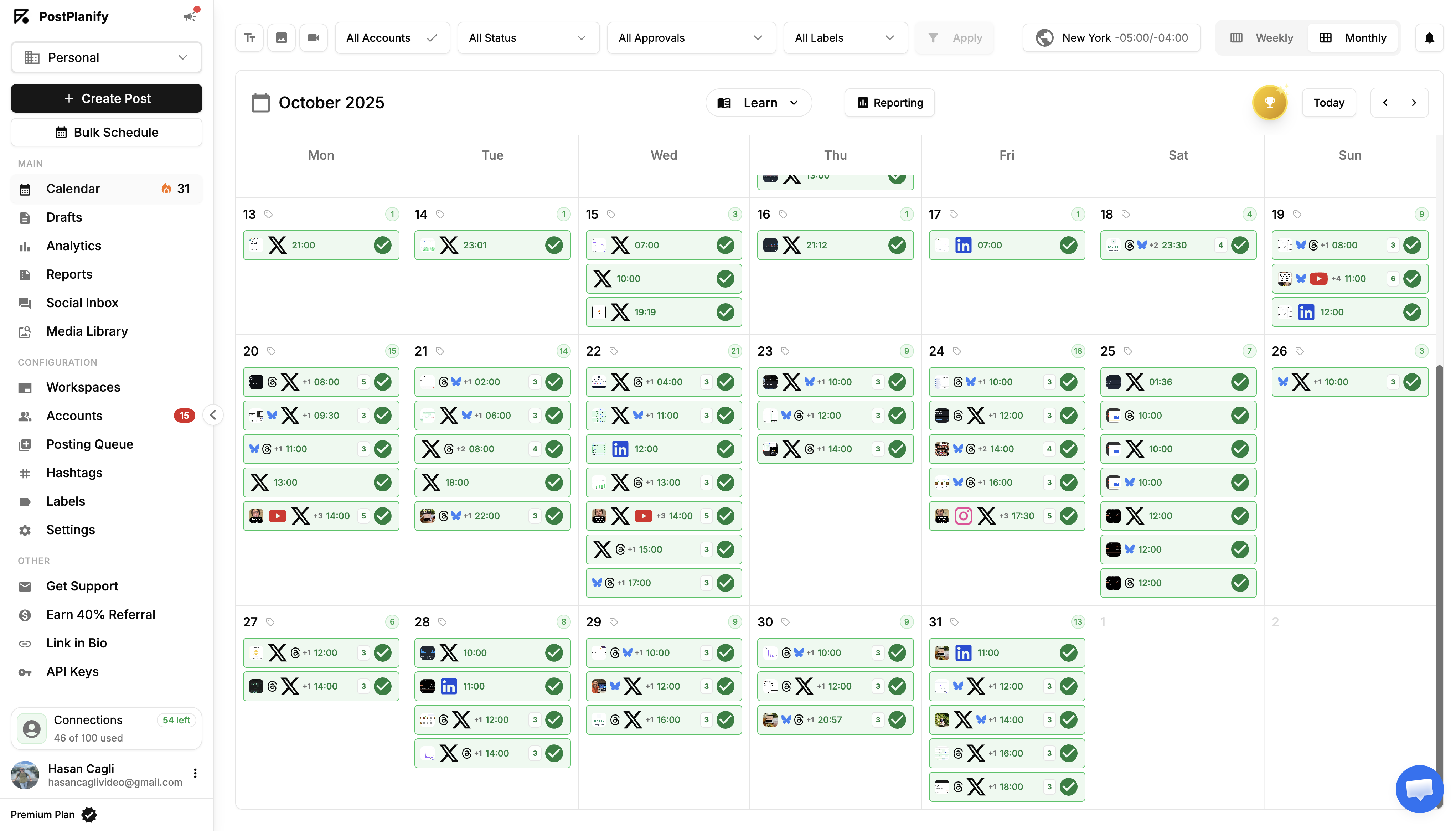

The practical fix is to separate deep audits from ongoing monitoring. Do the full manual review on a regular cadence, then automate as much of the recurring reporting as possible in between.
What to automate
The most useful parts to automate are the parts you repeat:
- Pulling performance data across platforms
- Tracking key KPI trends over time
- Sending weekly or monthly reports
- Monitoring response activity and engagement shifts
- Comparing current periods against your baseline
One centralized tool can reduce the operational drag. PostPlanify's analytics cover all 10 supported platforms with best-time-to-post suggestions, and PostPlanify reporting can generate white-label PDF reports, monitor progress, and surface engagement shifts without manually rebuilding the same reporting package each cycle. The AI assistant (vision-powered), social inbox across Instagram, Facebook, and LinkedIn, and team collaboration with approval workflows round out the workflow so audit findings become changes your team can ship.
What not to automate blindly
Automation helps with collection and presentation. It doesn't replace judgment.
You still need a human review for:
- Context around campaign launches or seasonal shifts
- Platform-specific anomalies
- Account access changes
- Data delays from native analytics
- Broken tracking links or missing UTMs
- Content quality issues that dashboards can't interpret
A report can tell you reach dropped. It can't always tell you that the team changed creative direction, lost a key approver, or accidentally published repurposed content in the wrong format.
A simple ongoing cadence
Keep it manageable:
- Monthly benchmark review — check KPIs against your current baseline and action plan.
- Quarterly deep audit — revisit profiles, content patterns, audience fit, competitor context, and conversion quality.
- Task review after each audit — confirm what changed, what shipped, and what stalled.
For agencies, automation also reduces client-reporting overhead. For in-house teams, it gives leadership a clearer view of progress without forcing the social team into constant manual exports.
PostPlanifyAll your social media in one simple dashboard
Schedule posts, track analytics, and reply to comments/DMs without switching tabs.
Engagement
+18%
Views
52.8k
FAQ: Social Media Audit Templates
What should a social media audit template include?
Six core sections: (1) goals and success measures, (2) a full account inventory with ownership and access status, (3) a profile optimization checklist covering every active platform, (4) a KPI scorecard split into awareness, engagement, conversion, and audience, (5) a pattern analysis or SWOT block for interpreting findings, and (6) an action plan with owners and deadlines. If a template skips any of these, the output tends to be data without decisions.
How often should I use a social media audit template?
Run a full deep audit quarterly, and a lightweight monthly review against the same KPIs. Social platforms change features and algorithms fast enough that strategies drift in 60–90 days. Monthly pulse checks catch drift early without requiring a full rebuild each time.
Can I use one template across every platform?
Partially. The goals, inventory, profile checklist, and action plan sections work identically across platforms. The KPI scorecard should not — Instagram Reels, LinkedIn documents, and TikTok videos all have different meaningful signals. Keep the structure shared but allow platform-specific KPI rows per account.
What's the difference between a social media audit and a content audit?
A social media audit reviews your overall presence: profiles, audience fit, KPIs across platforms, conversion paths, and operational gaps. A content audit is narrower — it evaluates performance of individual assets (posts, videos, carousels) to inform future creation. The content audit is usually one section inside the broader social media audit.
How long does running a social media audit take?
First time: 4–8 hours for a multi-platform brand, spread across profile checks, data collection, analysis, and action planning. Repeat quarterly audits: 1–3 hours once the template and data pipeline are established. Teams that automate KPI collection drop this to under an hour.
Do I need a separate template per brand or client?
Yes. Each brand has its own goals, audience, and benchmarks, so the KPI scorecard and action plan must be separate. For agencies, duplicate the same master template per client — keeping structure shared makes cross-client comparisons and internal training easier.
What KPIs belong in a social media audit template?
Group them into four buckets: awareness (reach, impressions, profile views, follower trend), engagement (saves, shares, comments, conversation rate, amplification rate), conversion (link clicks, CTR, lead form submits, tracked purchases), and audience (demographics, active times, ICP fit). Likes alone don't earn a spot.
Is there a free social media audit template?
The template block earlier in this guide is free to copy into Google Sheets, Notion, or Airtable. For teams that want automated KPI pulls rather than manual exports, a tool with a unified analytics dashboard speeds up the "collect" step considerably and lets you reuse the same template across quarters without rebuilding from scratch.
How do I present audit findings to leadership?
Lead with one-sentence conclusions per platform, followed by the single most important chart per finding. Use the action plan table as the closing slide so reviewers see owners and deadlines, not just metrics. Don't hand over the raw spreadsheet — package it into a narrative using the framework in our guide on how to create a social media report.
What's the difference between an audit and an analytics report?
A report shows what happened. An audit decides what to change. Reports are recurring and descriptive. Audits are periodic and prescriptive. Both can use the same underlying metrics, but the audit adds interpretation and a ranked action list.
Should I audit paid and organic social together?
Keep them separate. Mixing paid reach with organic reach distorts both numbers. Run the organic audit first, then a separate paid review covering ROAS, CPA, creative fatigue, and audience overlap. Combine only in the conversion section, where assisted paths matter.
Can I automate a social media audit?
Collection yes, interpretation no. Dashboards can pull KPIs across all connected platforms on a schedule. Pattern analysis, audience fit, and action prioritization still need human judgment — especially for catching context like campaign launches or creative direction changes.
What's the ideal review window — 7, 30, or 90 days?
Use 90 days for the quarterly deep audit. Shorter windows are too noisy for pattern detection. For monthly pulse checks, use the trailing 30 days. Use 7-day windows only when isolating the impact of a specific launch or campaign.
What do I do if I'm brand new with no data yet?
Focus the audit on external opportunity rather than internal performance. Run competitor benchmarks, lock in profile optimization using Section 3 of the template, and spend the first 30–60 days establishing a data baseline. Your first real performance audit becomes possible once you have 60+ days of activity.
Summary and Quick-Start Audit Checklist
A social media audit template works best when it's treated like an operating system, not a one-off report. The point isn't to collect every metric available. The point is to identify what's misaligned, what's working, and what deserves action first.
Use this checklist to run your first pass:
- Define goals — choose one to three business objectives for the audit.
- Inventory all accounts — list every profile, confirm ownership, and check for branding or link inconsistencies.
- Collect the right KPIs — pull awareness, engagement, conversion, and audience data for each active platform.
- Review by platform context — don't judge Instagram, Facebook, TikTok, X, and LinkedIn by the same signals.
- Find patterns — look at themes, formats, timing, and audience fit instead of isolated top posts.
- Run a SWOT analysis — group findings into strengths, weaknesses, opportunities, and threats.
- Build an action plan — assign owners, deadlines, and success measures.
- Automate the recurring reporting — keep the deep thinking manual. Automate the repetitive tracking.
Key Takeaways
- A social media audit template needs six sections: goals, account inventory, profile checklist, KPI scorecard, pattern analysis, and action plan — skip any and you'll end up with data but no decisions
- Goals go first. Exporting data before setting an objective guarantees a spreadsheet graveyard
- Group KPIs into four buckets — awareness, engagement, conversion, and audience — and don't use one KPI set blindly across platforms
- Patterns over isolated wins. One great post is luck; repeated traits across your top posts are strategy
- Every action item needs five fields: task, category (Keep/Improve/Stop), owner, deadline, success measure
- Run deep audits quarterly and pulse checks monthly. Platforms drift too fast for annual reviews
- Automate collection, not interpretation. Dashboards pull numbers; humans still judge audience fit and prioritize action
- Pair this template with the full how-to walkthrough for the process context behind each section
Related Reading
- 10 Best Social Media Management Tools for Nonprofits
- How to Do a Social Media Audit: A Step-by-Step Guide — the companion how-to walkthrough
- Social Media Management Dashboard — centralize your audit data in one view
- Social Media Analytics and Reporting — deeper look at the KPIs this template uses
- How to Create a Social Media Report — how to package audit findings for stakeholders
- How to Plan Social Media Content — turn your audit's action plan into a calendar
- How to Improve Social Media Engagement — tactics for the "Improve" column of your action plan
- Best Social Media Analytics Tools — tools to automate KPI collection
- Social Media Scheduling Tools — publishing tools that pair well with a quarterly audit cadence
- Managing Multiple Social Media Accounts — for agencies and multi-brand teams running audits at scale
- 14 Best LinkedIn Scheduling Tools
- Best Social Media Platforms for Business
If your current audit process still lives in scattered spreadsheets and native dashboards, PostPlanify gives teams a simpler way to centralize analytics, generate white-label reports, and keep reporting consistent across all 10 supported platforms without rebuilding the workflow each time.
PostPlanifyAll your social media in one simple dashboard
Schedule posts, track analytics, and reply to comments/DMs without switching tabs.
Engagement
+18%
Views
52.8k
About the Author

Hasan Cagli
Founder of PostPlanify, a content and social media scheduling platform. He focuses on building systems that help businesses, agencies, and teams plan, publish, and manage content and social media more efficiently across platforms.


