


Your social media agency pricing structure shapes everything else about your business: cash flow predictability, scalability, margin protection, the kind of clients you attract, and how hard it is to raise rates later. Yet most agencies pick a pricing model by accident. The first client paid hourly. The second asked for a retainer. The third wanted a project. Six months in, the agency is running four different models across twelve clients, each with its own contract and its own renegotiation cycle.
This social media agency pricing guide compares the five pricing models agencies use (monthly retainer, project-based, hourly, performance-based, and hybrid retainer + performance) with 2026 benchmarks, real agency profiles by revenue stage, a pricing decision framework for picking the right model, and a playbook for switching models when you outgrow the one you started with. Every pricing range is sourced from Clutch, Influencer Marketing Hub, SoDA & Productive surveys, Sprout Social, Sculpt, Dollarpocket's 1,200-agency study, and Foxwell Digital.
Related but separate: our guide on how much to charge for social media management covers the tactical side: dollar-figure benchmarks by agency size, how to package services, and how to write a proposal. This article covers how social media agencies charge one level above that, the strategic question of which model to use before you worry about the number.
Quick Answer: Which Pricing Model Should Your Social Media Agency Use?
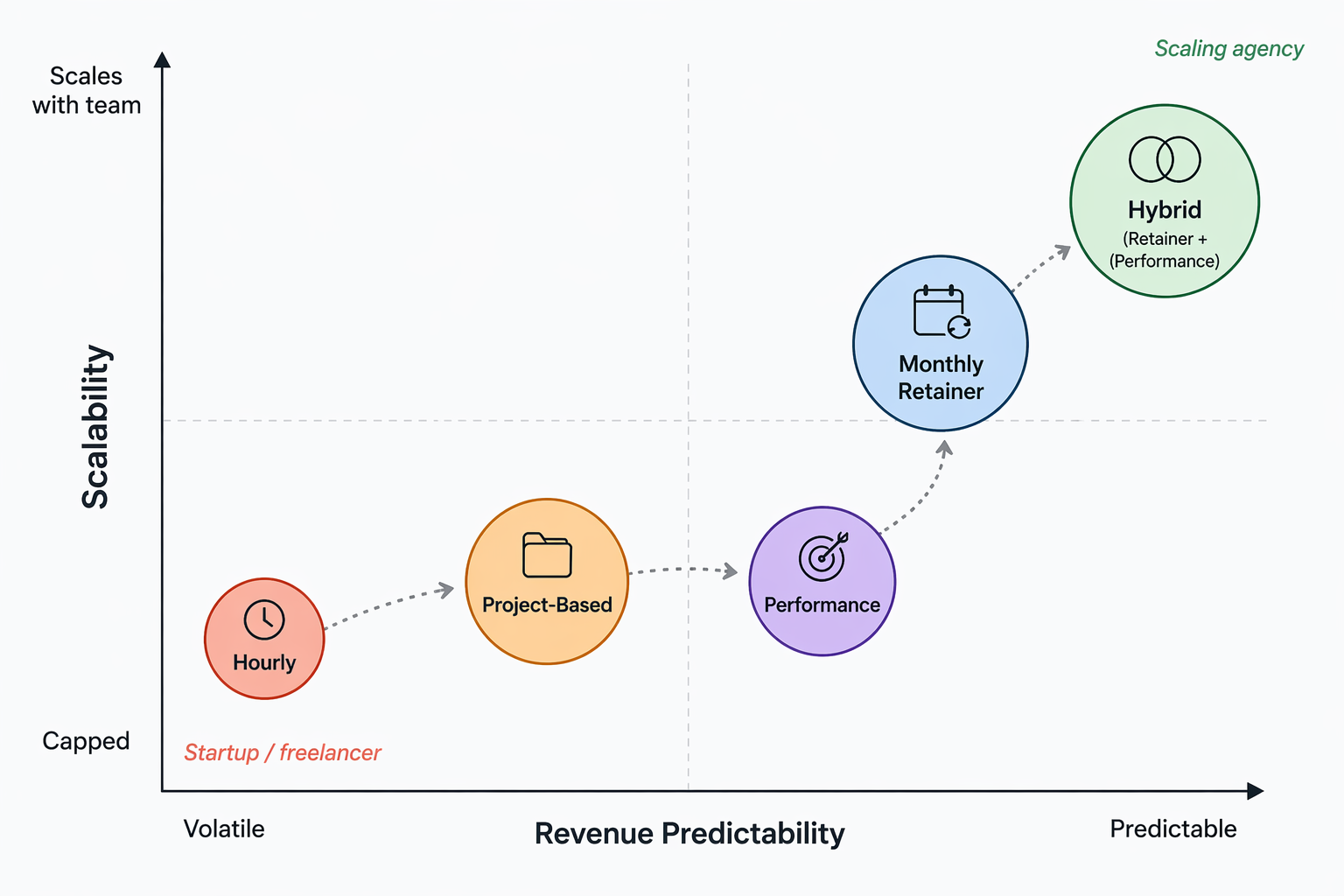
The short answer: monthly retainer for most agencies at $50K–$1M in annual revenue. Hybrid (retainer + performance bonus) for agencies at $1M+ serving performance-focused clients. Hourly and project for solo freelancers, specialty one-off work, or agencies under $50K/year still finding product-market fit.
The longer answer: 78% of digital agencies now use retainer-based pricing as their primary model, up from 64% in 2023 per Influencer Marketing Hub's 2026 agency survey. But primary model isn't the only model. Most agencies running retainers also layer in:
- Project add-ons: audits, strategy documents, campaign launches ($500–$45,000 per project)
- Performance bonuses: hybrid arrangements with base retainer plus performance triggers
- Commission on ad spend: 10–20% for agencies running paid media alongside organic
The strategic discipline isn't picking one model forever. It's picking a base model that fits your current stage, layering variations for specific client types, and being honest about when you've outgrown your starting model.
At a Glance: The 5 Pricing Models Compared
Here is retainer vs project vs performance pricing side by side, along with hourly and hybrid:
| Model | Typical Monthly Range | Cash Flow | Scalability | Best For | Who Bears Risk |
|---|---|---|---|---|---|
| Monthly Retainer | $500–$40,000+/client | Predictable | Medium-High | Agencies at $50K–$1M/yr, SMB clients | Agency bears scope risk |
| Project-Based | $2,500–$150,000/project | Lumpy, seasonal | Low-Medium | Freelancers, specialty shops, campaign work | Client bears delivery risk |
| Hourly | $25–$350/hour | Variable | Low | Solo practitioners, consulting, audits | Client bears time risk |
| Performance-Based | Base $1K–$15K + % of results | Highly variable | Medium | Lead gen, e-commerce, established attribution | Agency bears market risk |
| Hybrid (Retainer + Performance) | $3K–$15K base + bonus | Predictable base + upside | High | Scaling agencies at $1M+/yr, performance clients | Risk split by design |
Why Most Agencies Pick the Wrong Pricing Model
Pricing model failures look the same across hundreds of agencies. The patterns:
Staying on hourly past the ceiling. Hourly caps your income at hours available × rate. Once you're booked, the only lever is raising rates, which clients push back on harder at hourly than they do at retainer. Most agencies should transition off hourly before $10K/month.
Setting retainers too low because of fear. New agencies often price at 40–60% of what similar services cost in their market because they're afraid of losing the first few clients. The price becomes the ceiling for all future clients in that channel. Anchoring low early is hard to undo.
Running too many models concurrently. One client on retainer, one on project, one on hourly, one on commission-on-ad-spend. Each has a different contract, different invoicing cycle, different approval chain. Internal operations collapse under the administrative weight.
Performance-based pricing without attribution infrastructure. Agreeing to a $500-per-lead bonus without a clean UTM + CRM setup is how attribution disputes kill relationships. If the client can't see and agree on the number, the agency won't get paid.
Ignoring tool costs in retainer pricing. Per-seat social tools (Hootsuite at $99 to $399/user, Sprout Social at $199/seat on Standard) reshape agency margin calculations. A 6-person agency paying $1,194/month for Hootsuite Professional seats to manage 12 retainer clients has a very different profit structure than the same agency on tooling priced per client.
Raising rates too rarely. Agencies that haven't raised rates in 2+ years have effectively lost 10–20% of margin to inflation and their own skill growth. Annual rate reviews (ideally at renewal, not mid-contract) are industry standard.
Mixing base and variable without a formula. "Sometimes we do retainer, sometimes project, sometimes both for the same client, sometimes with a bonus." Without a documented rule, it becomes impossible to price new work or explain the bill.
The 5 models below are the framework that prevents most of these mistakes.
What to Look for When Choosing a Pricing Model
Before committing to a model, evaluate against six criteria:
- Revenue predictability. How smooth is cash flow across the year? Retainer is smoothest; project and performance are lumpiest.
- Scalability. Does the model still work at 3× your current client count? Hourly caps at individual time; retainer scales to team capacity; hybrid scales with client results.
- Margin preservation. What's your take-home after tool costs, labor, and overhead? Per-seat tools compound quickly; flat-rate tools preserve margin as you grow.
- Client acquisition friction. How quickly can you close a deal in this model? Project closes fast (defined scope). Retainers close slower (longer commitment). Performance closes slowest (attribution negotiation).
- Operational repeatability. Can you deliver the same quality as you grow? Retainer delivery is the most repeatable. Project and performance delivery varies.
- Model-switching cost. If this model stops fitting, how hard is the transition? Mid-contract switches are hard; renewal-moment switches are clean.
Now the five models in detail.
The 5 Pricing Models in Detail
1. Monthly Retainer
Monthly retainer is a fixed monthly fee for ongoing social media management: publishing, community management, analytics reporting, and strategic consulting. Typically a 3-, 6-, or 12-month commitment.
How it works. The client pays a flat monthly fee. The agency delivers a defined scope of work every month, usually some combination of posts, stories, community management hours, monthly reports, and strategic review calls. Scope is documented in a Statement of Work (SOW). Overages (more content than scoped, rush requests, new platforms) are billed separately at a pre-agreed rate.
2026 benchmarks for social media agency retainer pricing. Per Sprout Social's 2025 pricing guide and Dollarpocket's 2025 Marketing Agency Pricing Study (1,247 agencies):
- Small business / basic package: $500–$2,500/mo (often starting near $1,000/mo for solo operators)
- Small-to-mid market: $1,000–$7,500/mo
- Mid-market: $5,000–$10,000/mo, scaling to $10,000–$20,000/mo for complex programs
- Enterprise: $20,000–$40,000/mo
- Large enterprise (serving $250M+ revenue clients): $40,000–$100,000/mo
Per Clutch's April 2026 pricing guide, the average social media agency project monthly cost is $5,107.28. Common commitment length is 3–12 months; Clutch reports an average social media project timeline of 12 months.
Adoption is dominant: 78% of digital agencies use retainer as their primary pricing model per Influencer Marketing Hub 2026. Retainer generates 44% of total agency revenue per SoDA & Productive's agency operations survey.
When to use retainer:
- Your agency has 3+ months of delivery experience and can reliably scope monthly work
- Clients want predictable monthly costs (SMBs, established mid-market)
- You want stable cash flow and forecastable revenue
- Your team can handle 5–15+ clients at once without collapsing on quality
- The work is ongoing (publishing, community management) rather than project-defined
When to avoid retainer:
- You're pre-product-market-fit and don't know what monthly scope should include
- The client has a specific one-off need (audit, campaign, website launch)
- You're nervous about committing to monthly delivery without testing first
- The client can't commit to at least 3 months
Pros for the agency:
- Predictable monthly revenue, the single biggest operational advantage
- Long-term client relationships: retainer clients have ~56-month average lifespan vs. ~24 months for project clients (industry benchmark, directional)
- Repeatable operations: you learn the client deeply; content gets faster to produce
- Lower sales overhead: retaining a client is 5–10x cheaper than winning a new one
- Margin compounds over time as efficiency improves
- Tool and team costs amortize across 12+ months of consistent work
Cons for the agency:
- Hard to raise prices mid-contract without relationship friction
- Scope creep pressure: clients ask for "just one more post" and never pay overage fees if you don't enforce them
- Capped margin: you can't earn more on a great month unless overages are structured in
- Higher churn risk than project work if performance doesn't meet expectations (though annual churn is ~18% for retainer vs. 42% for project, so retainer wins long-term retention)
- Front-loaded operational setup (onboarding, approvals, reporting infrastructure)
Pros for the client:
- Predictable monthly cost for budgeting
- Consistent brand voice across months
- Established relationship with a team that knows their business
- No need to renegotiate scope every month
Cons for the client:
- Longer commitment (3–12 months minimum)
- Perceived lack of flexibility if needs change
- Pay for "slow months" when agency work naturally dips (summer, December holidays)
- Harder to cancel than project work
Real-world example. A mid-market D2C e-commerce brand signs a 12-month retainer at $8,000/month with a social media agency. Scope: 20 posts/month across Instagram + TikTok, weekly Stories, community management up to 2 hours/day, monthly reporting, quarterly strategy review. Overages at $75/post for extra content, $150/hour for additional strategy work. Total annual agency revenue from this one client: $96,000. Overage revenue typically adds 5–15%, taking total to $100K–$110K/year.
Risk allocation. Agency bears scope risk (if work grows beyond the SOW without overage structure). Client bears performance risk (if social doesn't drive expected outcomes, they're still paying monthly). The clean contract prevents either side from bearing disproportionate risk.
For the full framework on how to set retainer dollar amounts and build tiered packages, see how much to charge for social media management. This article covers the strategic question of when retainer is the right model; that one covers how much retainer should cost.
 PostPlanify
All your social media in one simple dashboard
Schedule posts, track analytics, and reply to comments/DMs without switching tabs.

Engagement
+18%
Views
52.8k
2. Project-Based / Fixed Scope
Project-based pricing charges a fixed fee for a defined deliverable with a clear start and end. No ongoing commitment.
How it works. The agency scopes a specific project (an audit, a strategy document, a 3-month campaign, a website social integration) with exact deliverables, milestones, and payment terms. Typical payment structure: 50% deposit upfront, 25% at midpoint, 25% on completion. Out-of-scope requests are priced as change orders.
2026 benchmarks. Per Sculpt's 2025 pricing guide, Cloud Campaign, and Dollarpocket 2025:
- Social media audit (one-time): $500–$5,000 (sometimes waived with 12-month retainer commitment)
- Strategy + content pillar development: $15,000–$25,000
- Campaign launch (3-month engagement): $25,000–$45,000 plus ad spend
- Short-term project (build + execute + report): starts at $20,000
- Training / team enablement project: starts at $15,000
- Content batch (30 days / 20–30 posts): $3,000–$20,000/mo standalone (though most often bundled into retainers rather than priced separately)
- Full project engagement range: $5,000–$150,000 per engagement depending on scope
Adoption: project-based fees generate ~50% of total agency revenue per SoDA & Productive's agency operations survey, the single largest revenue bucket despite not being most agencies' primary model. This means most retainer-led agencies earn significant project revenue on top of retainers.
When to use project pricing:
- Client has a defined one-off need (audit, campaign, launch, rebrand)
- You want to test the client relationship before committing to retainer
- The scope is genuinely finite and dated
- You have specialty offerings that stand alone (ex: LinkedIn thought-leadership programs, influencer campaign launches)
- The work has inherent seasonality (Q4 retail campaigns, summer tourism launches)
When to avoid project pricing:
- The work is genuinely ongoing (publishing, community), so retainer is the right match
- You can't scope the project precisely, because scope creep is guaranteed
- The client wants "project pricing" because they don't want to commit, but the work is actually ongoing, which signals a misfit
Pros for the agency:
- Clean scope boundaries with no ongoing commitment drag
- High-margin potential when well-scoped
- Showcases specialty work that builds portfolio and case studies
- Sometimes a foot-in-door to retainer conversion
- Upfront payment (deposit) improves cash flow
Cons for the agency:
- Lumpy, unpredictable revenue: you're constantly selling
- Shorter client lifespan (~24 months average vs. 56 for retainer)
- Scope creep is the silent margin killer
- Sales cycle starts over with every project
- Higher proposal and sales overhead per dollar earned
Pros for the client:
- Clear budget with no open-ended commitment
- Defined deliverable with defined value
- No long-term contract obligation
- Easy to budget for board approval
Cons for the client:
- Starting over with a new agency costs more than retaining the existing one
- Post-project support gaps (what happens after the campaign ends?)
- Less strategic alignment than a retainer relationship develops over time
Real-world example. A restaurant chain hires an agency for a 6-week summer menu campaign: $3,500 flat fee. Scope: launch strategy, 24 Instagram + Facebook posts across 6 weeks, community management during the campaign, final performance report. Deposit $1,750 upfront, balance at completion. Over-delivery (bonus Reels based on summer menu popularity) was pre-priced at $150/each, with a 3-Reel cap. Total project revenue: $4,100 including two bonus Reels.
Risk allocation. Client bears delivery risk (if the agency over-scopes internally, the client still pays the fixed fee). Agency bears scope-creep risk (if the client asks for more than the SOW, getting paid for it requires relationship management and contract enforcement).
3. Hourly
Hourly pricing bills based on actual time spent. Clear and transparent, but limits agency income to available hours.
How it works. Agency tracks time in a billing tool (Toggl, Clockify, Harvest) and invoices the client based on hours worked at a pre-agreed rate. Rates vary by role: strategist, copywriter, designer, account manager, analyst. Billing cadence is typically weekly, bi-weekly, or monthly.
2026 benchmarks for social media agency hourly rates. Per Clutch's April 2026 pricing guide and Dollarpocket 2025:
By geography:
- USA / Canada / Australia: $100–$149/hour (Clutch bands)
- UK / Poland: $50–$99/hour
- Ukraine / Spain / Mexico: $25–$49/hour
- India / Philippines: <$25/hour
By agency size (US market, 2025):
- Major metro US agencies: $200–$350/hour
- Secondary markets: $100–$175/hour
- Freelancers: $20–$150/hour based on experience
- Beginners (0–1 yr): $25–$50/hour
- Experienced freelancers (3+ yr): $75–$150/hour
By role (US market):
- Social Media Strategist: avg $37/hour employed rate; agency billable rate $60+/hour minimum
- Social Media Copywriter: $27.88–$41.59/hour (ZipRecruiter Dec 2025, avg $36.74)
- Freelance Digital Marketing Strategy Consultant: ~$82/hour (Marketerhire 2025)
Industry baseline (Credo survey, last refreshed 2022): combined average agency + consultant rate of $138/hour. Flag: this is older data, so use it as an industry baseline, not 2026 current.
Adoption: Credo found 49.88% of agencies do not bill by the hour. Hourly generates ~30% of total agency revenue per SoDA & Productive, most often used for scope add-ons, not primary engagements.
When to use hourly:
- Consulting engagements with unpredictable scope (audits, training, workshops, strategy reviews)
- One-off client requests that don't fit a defined project
- Early-stage agencies still learning what monthly scope should include
- Specialty consulting work (crisis communications, executive social training)
When to avoid hourly:
- Ongoing social media management work (retainer is always better)
- Clients who micromanage time tracking
- Your team's time is worth more than hourly reveals (strategy is valued by outcome, not hours)
- You're past $10K/month in revenue (hourly caps your ceiling)
Pros for the agency:
- Transparent billing that's hard to dispute
- Scales with actual complexity
- Good for variable-scope consulting
- Easy to explain to clients new to agency work
- No scope-creep risk if you bill honestly
Cons for the agency:
- Income capped at
hours × rate, so you can't scale without hiring - Invites client micromanagement ("why did the call take 90 minutes?")
- Punishes efficiency: faster delivery earns less
- Harder to build a scalable team business on hourly
- Administrative overhead (time tracking, detailed invoicing)
- Clients perceive hourly as commodity labor, not strategic partnership
Pros for the client:
- Pay only for actual time spent
- Full transparency on what the agency is doing
- Flexibility to scope up or down
- Easy to start and stop
Cons for the client:
- Unpredictable invoice sizes
- Hourly billing can incentivize the agency to stretch time
- Agency may lack strategic investment ("they're only billing for what we ask")
Real-world example. A consultancy hires a social media strategist for a one-time LinkedIn audit: 3 hours × $150/hour = $450. Scope: review of LinkedIn Company Page + 5 senior employee profiles, benchmark against 3 competitors, written recommendations document. Simple, defined, hourly billed.
Risk allocation. Client bears time risk (agency takes longer than expected, client pays). Agency bears efficiency risk (the better you get, the less you earn on each engagement).
4. Performance-Based
Social media performance-based pricing ties the agency fee to outcomes: leads, revenue, ROAS, follower growth. High-risk, high-reward for both sides.
How it works. The agency earns a fee only when pre-defined performance metrics are hit. Variations include:
- Commission on ad spend: 10–20% of media spend managed, most-cited band across sources
- Pay-per-lead / CPL bonus: flat amount per qualified lead generated
- Revenue share: percentage of attributed revenue
- Tiered commission: different % rates at different ad-spend tiers
2026 benchmarks. Per Foxwell Digital's 2024 guide:
- Percentage of ad spend: 15–20% typical for managed paid social ($10,000 ad spend → $1,500–$2,000 management fee)
- Tiered % of spend: 10% on first $100K, 8% above $100K (one agency example); full-service 15% up to $200K declining to 11% at $300–400K
- "Flat + percentage" (whichever is greater): e.g., "$3,000/month or 10% of ad spend, whichever is greater"
- Flat + revenue share: e.g., $15,000/month flat + 2.8% of attributed revenue
- Pay-per-lead / CPL bonus: $2,000/month base + $100 per qualified lead (Stackmatix 2025 example)
- Revenue-share agreements: 10–30% of attributed revenue, typically with additional performance bonuses (Metamktgagency 2025)
Industry ceiling: Most US clients won't pay >10% of ad spend; $20K–$25K/month is the threshold where clients consider in-house hires over agency engagements.
Adoption: Pure performance pricing generates only ~1% of total agency revenue per SoDA & Productive, vanishingly rare as a standalone model. Most "performance" deals are actually hybrid (see Model 5).
When to use performance:
- Paid media management (commission on ad spend is near-standard)
- Lead generation work with clean CRM attribution
- E-commerce with clean revenue-attribution infrastructure
- Mature client relationships where both sides trust the measurement
- Agency has high confidence in its ability to deliver results
When to avoid performance:
- Early in the client relationship, with no baseline data to set targets
- Attribution is noisy (multi-touch journeys, long B2B sales cycles)
- Client will dispute what counts as a "qualified lead"
- Platform algorithm changes, iOS tracking limitations, or ad account issues introduce external volatility
- You can't afford cash flow volatility
Pros for the agency:
- Aligned with client success: when they win, you win
- Potential for above-market earnings on great months
- Differentiated positioning in sales conversations
- Clients respect agencies willing to share risk
Cons for the agency:
- Cash flow volatility: slow months are painful
- Attribution disputes can wreck the relationship
- External factors (seasonality, product issues, tracking loss) crush earnings through no agency fault
- Requires bulletproof measurement infrastructure
- Client can't always afford to pay out when results are great
Pros for the client:
- Only pays when results materialize
- Aligned incentive structure: the agency is motivated to drive outcomes
- Lower upfront financial risk
- Strong agency pitch ("we only win if you win")
Cons for the client:
- Higher ultimate cost when things work (upside goes to agency)
- Attribution setup burden (CRM, pixels, tracking)
- Agency may decline risky or lower-probability engagements
- Harder to budget than retainer
Real-world example. An online course creator hires an agency for Facebook/Instagram ad management with a $10,000/month ad budget. Fee structure: 15% of ad spend ($1,500/month flat management fee) + $50 per course enrollment attributed to ads. If 40 enrollments hit in a given month, agency earns $1,500 + $2,000 = $3,500. If 10 enrollments hit, agency earns $1,500 + $500 = $2,000. Cash flow volatility is real but aligned with client success.
Risk allocation. Agency bears market risk (platform changes, seasonal demand drops, competitor noise). Client bears attribution setup risk (if tracking is sloppy, results can't be measured and neither side gets what they wanted).
Performance pricing only works when the KPIs are rock-solid. For the definitive KPI list and how to present them, see the 15 social media KPIs every agency should report to clients. For the ROI math behind these fees, see ROI on social media.
5. Hybrid: Retainer + Performance
Agency hybrid pricing is the fastest-growing pricing model of 2024–2026. Fixed monthly retainer for operational delivery plus performance bonuses for hitting outcome targets.
How it works. Agency charges a base retainer that covers predictable monthly work (publishing, community management, reporting) plus a performance-triggered bonus when specific KPIs are hit (qualified leads, revenue attribution, ROAS targets). The retainer protects the agency from cash-flow collapse; the performance layer gives both sides upside alignment.
2026 benchmarks. Per Foxwell Digital and InfluenceFlow's 2026 Digital Marketing Agency Pricing Guide:
- Base retainer + per-lead bonus: $3,000–$5,000/mo retainer + $250–$500 per qualified appointment or lead
- Management fee + outcome bonus: 5–8% base management fee + 3–7% performance bonus when targets hit
- Retainer + % of ad spend (floor): "$3K/mo or 10% of ad spend, whichever is greater"
- Retainer + revenue share: $15,000/mo flat + 2.8% of attributed revenue
Adoption: ~28% of top agencies use some combination of base retainer plus performance bonuses (industry aggregation estimate; treat it as an industry estimate, not a primary survey). Described as "the fastest-growing pricing structure in the agency world."
When to use hybrid:
- Agency at $250K+/year with operational maturity to deliver retainer work reliably
- Clients with strong attribution infrastructure (CRM + UTM + pixel setup)
- Performance-focused verticals (D2C e-commerce, B2B SaaS, lead-gen businesses)
- Mature client relationship (6+ months) with documented baseline performance
- Client wants agency to share risk/reward
When to avoid hybrid:
- New client relationship with no baseline data
- Attribution is contested or unreliable
- Cash flow can't absorb variable months
- Client or agency hasn't agreed in writing what "counts" as a win
- The retainer portion alone wouldn't sustain the engagement (hybrid should enhance, not replace, a functional base)
Pros for the agency:
- Predictable cash flow from the retainer base
- Upside alignment with client success
- Differentiated positioning ("we share risk")
- Higher average client value than pure retainer
- Clients perceive it as fair
Cons for the agency:
- More complex contract and payment tracking
- Attribution disputes can still occur on the performance component
- Requires sophisticated reporting infrastructure
- Payment delays on performance bonus can strain cash flow
- More sales-cycle explanation required up front
Pros for the client:
- Predictable base cost (retainer side)
- Upside capped by formula (client isn't paying unlimited commissions)
- Agency has clear incentive to drive outcomes
- Feels like a modern, aligned partnership
Cons for the client:
- Still paying base retainer even if performance targets miss
- Attribution setup burden
- Potential dispute on what counts as "qualified" in bonus formulas
Real-world example. A scaling B2B SaaS company hires an agency for LinkedIn + paid social management. Structure: $6,000/month base retainer (covers organic publishing, community management, monthly reporting, quarterly strategy review) + $250 per qualified demo booked attributed to social sources via HubSpot CRM. Target: 20 demos/month. If the agency hits target, they earn $6,000 + $5,000 = $11,000. If they miss at 10 demos, they earn $6,000 + $2,500 = $8,500. Both sides have a predictable floor and an aligned ceiling.
Risk allocation. Shared risk by design. Agency bears some market risk (performance bonus varies with results they can't fully control). Client bears operational risk (retainer is paid regardless of outcome). The split is what makes hybrid feel fair.
Variations Worth Mentioning
Value-based / outcome-based pricing. The agency takes a percentage of incremental revenue attributed to the engagement (typically 20–30%). Rare in social media agencies; more common in paid media and performance marketing. Works only when attribution is airtight and client trust is extremely high.
Commission on ad spend. A subset of performance pricing. Typically 10–20% of managed paid media spend. Clean and common for paid social agencies; often paired with a minimum monthly floor.
Equity-for-services (startups). The agency takes equity in a startup client in lieu of or alongside cash fees. High risk, high potential upside. Rare; usually reserved for agencies with deep strategic bets on specific founders.
Subscription pricing. Pre-packaged monthly tiers with fixed deliverables (e.g., "Starter: 10 posts/month, $950/mo"). A variant of retainer with less customization, useful for agencies building productized service offerings.
Real-World Agency Profiles by Revenue Stage
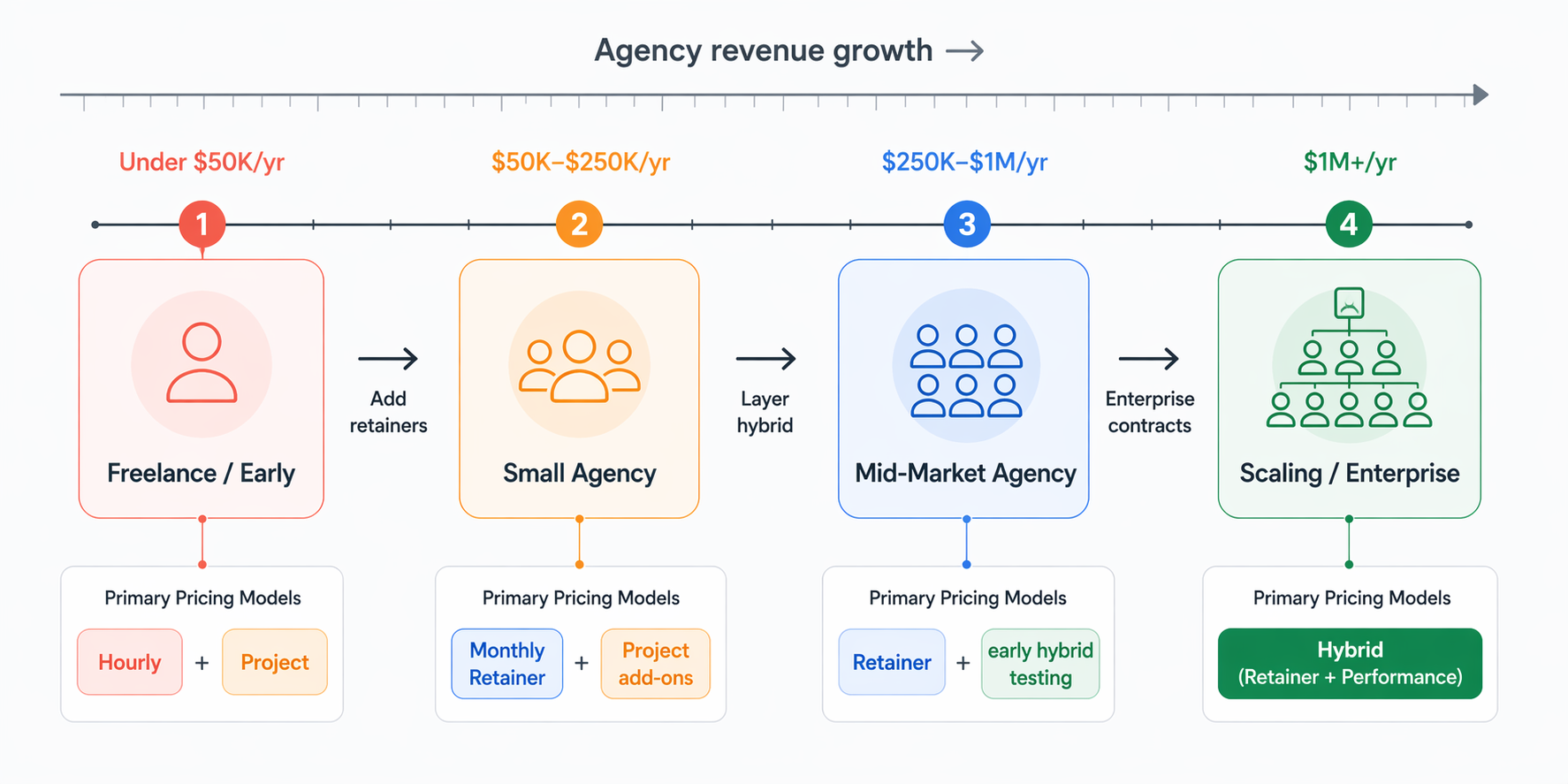
Which model fits best depends on where the agency is in its growth curve. Three profiles.
Scenario 1: Solo Freelancer → Project + Hourly (Under $50K/year)
Profile. A new freelancer with 2–5 clients, mostly finding them through referrals and direct outreach. Revenue is inconsistent month-to-month.
Pricing model fit. Project-based for bounded work (audits, strategy docs, campaigns) + hourly for consulting and variable-scope work. Avoid retainer until you have 3+ stable clients and know what monthly scope looks like.
Why it works. Low commitment lets you test whether you actually want to serve this client long-term. Deposits improve cash flow. No scope-creep exposure from verbal retainer arrangements.
Transition signal. When 80% of your project clients ask for ongoing work after their project ends, you've earned the right to pitch retainers. When your calendar is full and you're turning away hourly consulting, you've outgrown hourly as your primary model.
Example math. 4 project clients at $3,500 average each over 6 months = $14,000/project × 4 = $56,000 in project revenue. Another 3 hourly clients at 10 hours/month × $125/hour = $3,750/month × 12 = $45,000. Total: ~$101,000/year across project + hourly.
Scenario 2: Growing Agency (5–8 people, 8–12 clients) → Pure Retainer ($250K–$1M/year)
Profile. An agency with a small team and enough client volume to forecast revenue 6–12 months out. Marketing strategy, content production, community management, and reporting are all stable operational motions.
Pricing model fit. Monthly retainer as the base model for all ongoing clients. Project add-ons (audits, campaigns) layered on top when opportunities arise. Avoid hourly except for rare consulting engagements.
Why it works. Predictable monthly revenue funds the team. Retainer clients have long lifespans (industry-benchmark ~56 months), which reduces sales overhead. Repeatable operations allow the team to scale across more clients.
Challenge. Margin pressure from clients asking "for more for less." Scope creep kills profitability if overages aren't enforced. Per-seat tool costs (Hootsuite at $99 to $399/user, Sprout Social at $199/seat on Standard) can compound quickly.
Example math. 12 retainer clients at $8,000/month average = $96,000/month × 12 = $1,152,000/year. Split across 6 team members = ~$192K revenue per person. After overhead, tools, and benefits, agency net margin typically 20–35%.
PostPlanifyAll your social media in one simple dashboard
Schedule posts, track analytics, and reply to comments/DMs without switching tabs.
Engagement
+18%
Views
52.8k
Scenario 3: Scaling Agency (12+ people, 20+ clients) → Hybrid Retainer + Performance ($1M+/year)
Profile. Established agency with mature operations, documented processes, and deep attribution infrastructure. Client portfolio includes mature mid-market and enterprise clients with well-defined KPIs.
Pricing model fit. Hybrid as the primary model for performance-focused clients. Pure retainer for low-attribution clients (community management, brand awareness). Project add-ons and specialty consulting round out revenue.
Why it works. The retainer base funds predictable operations. The performance layer unlocks upside from great client months. Shared-risk pricing feels like partnership, which differentiates the agency from pure-fee competitors.
Challenge. Attribution infrastructure is expensive and complex. Performance bonuses require constant reconciliation. Client education on what counts as a "win" is an ongoing conversation.
Example math. 15 hybrid clients at $6,000 retainer + $3,000 avg performance bonus = $9,000/month × 15 = $135,000/month × 12 = $1.62M/year. Plus 5 project-only clients averaging $8,000/project × 4 projects each = $160,000 project revenue. Total: ~$1.78M/year. Split across 14 team members = ~$127K revenue per person.
Decision Framework: Which Model for Which Agency Stage
A practical picker.
By revenue stage:
| Annual Revenue | Recommended Primary Model | Secondary Models |
|---|---|---|
| Under $50K | Project + hourly | N/A |
| $50K–$250K | Monthly retainer | Project add-ons |
| $250K–$1M | Monthly retainer | Project add-ons, early hybrid experimentation |
| $1M–$5M | Hybrid (retainer + performance) | Pure retainer for low-attribution clients |
| $5M+ | Hybrid + outcome-based for strategic clients | Specialized consulting at premium rates |
By client type:
| Client Profile | Recommended Model | Why |
|---|---|---|
| Startups (pre-revenue) | Project or equity | They can't afford ongoing retainers |
| SMBs | Monthly retainer | They want predictability |
| Mid-market DTC / e-commerce | Hybrid (retainer + % of revenue or ROAS bonus) | They obsess over ROI; upside alignment works |
| B2B SaaS | Hybrid (retainer + per-lead or per-demo bonus) | Long sales cycles benefit from shared risk |
| Enterprise | Pure retainer or outcome-based | Procurement prefers predictability; mature trust enables outcome-based |
| Seasonal / campaign-driven | Project-based | Natural scope boundaries |
| Consulting / training | Hourly | Variable scope, expert time |
By geographic market:
| Market | Common Model | Typical Retainer Range |
|---|---|---|
| US / Canada / Australia (major metro) | Retainer standard; hybrid gaining | $5K–$20K/mo mid-market |
| US / Canada (secondary markets) | Retainer + hourly | $2K–$10K/mo mid-market |
| UK / Western Europe | Retainer standard | $3K–$15K/mo mid-market |
| Eastern Europe / LATAM | Project + hourly more common | $500–$5K/mo mid-market |
| India / Philippines / SE Asia | Project + hourly dominant | $250–$2,500/mo small business |
How to Switch Models Mid-Engagement (Without Losing the Client)
Most agencies need to switch pricing models at some point: outgrowing hourly, transitioning project clients to retainer, or layering hybrid onto existing retainers. The switches that work:
Hourly → Retainer. Done at 90-day review or 12-month renewal. Frame as "we've learned your needs; a retainer covers the ongoing scope at a predictable monthly fee and saves you administrative overhead." Pitch the retainer number as 20–30% below what the client was paying in hourly on average. This protects both sides and signals goodwill.
Project → Retainer. Done at the close of the current project. Frame as "based on what we've delivered, here's what the ongoing program would look like as a monthly retainer." Include a 6-month retention discount (5–10%) to reward commitment.
Retainer → Hybrid. Done at annual renewal, not mid-contract. Frame as "we're confident in the work. We're proposing a structure where our base fee is reduced slightly, and we earn an upside bonus when we hit the KPIs we've been driving toward." This works only when 12+ months of baseline data exists.
Any model → Price Increase. Annual renewal only, with 60-day advance notice. Standard increases per industry guidance: 3–5% for cost-of-living, 10–25% for expanded skills/services, 25–50% for market repositioning. Per MixBloom's 2026 agency pricing guide, 10–20% annual increases are "typically accepted without pushback" when results are delivered.
Never: switch models mid-contract unless scope has materially changed. Mid-contract renegotiations damage trust and set a precedent you don't want.
For the full agency renewal conversation, see our guide on how much to charge for social media management, particularly the "When and How to Raise Your Rates Confidently" section.
Common Pricing Model Mistakes
The patterns that recur across hundreds of agency engagements:
1. Staying on hourly too long. Hourly income is capped at hours × rate. Past $10K/month, hourly caps your ceiling. Transition to retainer when your calendar is consistently full.
2. Setting retainers too low because of fear. Anchoring low early sets the ceiling for your whole market. Pricing 20% higher at the outset is less painful than climbing back up later.
3. Running too many models concurrently without rules. Retainer + project + hourly + hybrid for four different clients is an administrative mess. Document when each model applies so the team doesn't make decisions ad hoc.
4. Ignoring tool costs when pricing retainers. Per-seat tools (Hootsuite $99 to $399/user, Sprout $199/seat on Standard) change the margin math significantly. Tools priced per client instead of per seat, like PostPlanify ($49/month for your first client workspace with unlimited team members, less for each one after), let you price retainers confidently without tool costs scaling with team size. See our detailed breakdown in best social media tools for managing multiple brands.
5. Not enforcing overage fees. Retainer scope creeps when "just one more post" or "a quick Story" adds up unbilled. Put overage rates in the SOW and enforce them from month one.
6. Mid-contract price increases. Save rate changes for annual renewal. Mid-contract increases signal desperation and damage trust.
7. Performance pricing without attribution infrastructure. Agreeing to per-lead bonuses without a clean UTM + CRM setup guarantees attribution disputes. Infrastructure first, contract second.
8. Pitching performance pricing too early. New client relationships don't have baseline data. You can't negotiate a performance bonus on metrics that haven't been measured yet.
9. Failing to raise rates annually. Agencies that haven't raised rates in 2+ years have lost 10–20% of margin to inflation and skill growth. Annual rate reviews are industry standard.
10. Accepting scope creep instead of explaining it. When a client asks for something outside scope, the answer isn't silent delivery. It's "we're happy to do that, and here's the overage rate per the SOW."
PostPlanifyAll your social media in one simple dashboard
Schedule posts, track analytics, and reply to comments/DMs without switching tabs.
Engagement
+18%
Views
52.8k
FAQ: Social Media Agency Pricing Models
What's the most common pricing model for social media agencies in 2026?
Monthly retainer. Per Influencer Marketing Hub's 2026 survey, 78% of digital agencies use retainer as their primary pricing model, up from 64% in 2023. However, project-based fees generate ~50% of total agency revenue per SoDA & Productive, meaning most retainer-led agencies layer project add-ons (audits, launches, specialty work) on top of base retainers.
What's a typical social media agency retainer in 2026?
Depends on agency tier and client size. Small business / basic packages run $500–$2,500/month. Small-to-mid market $1,000–$7,500/month. Mid-market $5,000–$20,000/month. Enterprise $20,000–$40,000+/month. The Clutch April 2026 pricing guide reports an average monthly cost of $5,107.28 across their agency dataset.
Should I charge a setup fee on top of a retainer?
Yes, if the onboarding scope is real. Onboarding (audit, strategy, brand voice doc, team setup, first content batch) typically takes 3–4 weeks and warrants a $1,500–$5,000 one-time setup fee. Waive it only when you want to discount strategically (e.g., for signing a 12-month commitment). For the full onboarding breakdown, see our social media agency client onboarding checklist.
How do I move an existing project client to retainer?
At the close of the current project, propose the retainer as "the ongoing version of what we just delivered." Price the first 6 months at a 5–10% discount to reward commitment. Make the transition at a clean handoff point, not mid-project.
What if my client demands hourly billing when I want retainer?
Educate them on retainer math. An hourly client paying $150/hour × 15 hours/week = $2,250/week = $9,750/month. A retainer at $7,500/month covers the same scope predictably with no surprise invoices. Most clients will accept retainer once you frame it as better for their budget planning, not just yours.
Can I offer multiple pricing models to the same client?
Yes. Retainer for ongoing work plus project-based add-ons (audits, campaign launches, new platform onboarding) is the standard agency structure. Pure mixing (hourly on Mondays, project on Fridays, retainer for community) breaks down operationally. One base model + add-ons is the rule.
How often should I raise my rates?
Annually, at contract renewal, with 60-day advance notice. Standard increases: 3–5% for cost-of-living, 10–25% for expanded skills, 25–50% for market repositioning. Industry guidance (via MixBloom 2026) suggests 10–20% annual increases are typically accepted without pushback when results are delivered.
What percentage of ad spend should I charge for managing paid social?
10–20% is the cited range across sources; 15–20% is the most common band. Per Foxwell Digital's 2024 guide, tiered structures work well for larger spend, e.g., 15% up to $200K, declining to 11% at $300–400K, with further reductions at enterprise scale. Most US clients won't pay >10% above $500K in ad spend.
How do I price a performance-based engagement?
Three components: (1) a minimum monthly floor to cover operational costs, (2) a clear KPI that both sides agree can be measured cleanly (leads, revenue, ROAS), (3) a formula that's simple and written down. Example: $3,000/mo minimum + $100 per qualified demo booked. Don't agree to performance-only until you have 3+ months of baseline data with the client.
Should I ever take equity instead of cash?
Rarely. Only for startup clients where you have high conviction in the founders and the business. Equity is a lottery ticket, not a paycheck; most startups fail and most equity is worth zero. If you do take equity, take it alongside reduced cash fees, not instead of them.
How do I avoid scope creep in a retainer?
Document the SOW in writing with specific deliverables per month (X posts, Y hours of community management, Z reports). List out-of-scope items with overage rates. When the client asks for extra work, respond with "happy to do that, and here's the overage rate per the SOW." Enforcing overages from month one is the single biggest margin protection.
What's the difference between hybrid pricing and performance pricing?
Hybrid includes a guaranteed monthly retainer floor. Pure performance pricing pays only when outcomes materialize. Hybrid is the safer model for agencies because it protects cash flow while still aligning incentives. Per industry estimates, ~28% of top agencies now use hybrid, vs. only ~1% of total agency revenue coming from pure performance arrangements.
Do I need different pricing models for different platforms?
No. Pricing models apply to the engagement, not the platform. You can charge a retainer that covers Instagram + LinkedIn + TikTok management together. Platform-specific adjustments live in the SOW (more hours for LinkedIn document posts vs. Instagram Reels), not in different pricing models.
How does tool cost affect my pricing model choice?
Significantly. Per-seat tools (Hootsuite $99 to $399/user, Sprout $199/seat on Standard) scale linearly with team size, eating margin on retainer work. Tools priced per client workspace with unlimited users (PostPlanify starts at $49/month for the first workspace) keep tool costs predictable as your team grows. For a 6-person agency managing 12 retainer clients, the gap between $1,194/month on Hootsuite Professional seats and $388/month on PostPlanify is about $9,700 a year in margin. See best social media tools for managing multiple brands for the full breakdown.
What's the right contract length for a retainer?
3–6 months minimum for new clients, 12 months for established relationships. Month-to-month is fine for smaller retainers under $2,000/mo where churn risk is manageable. Mid-market and enterprise retainers ($5K+/mo) should commit to 6–12 months with auto-renewal unless notified.
Key Takeaways
- The pricing model you pick shapes everything about your agency. Cash flow predictability, scalability, margin protection, client type, and how hard it is to raise rates later.
- Retainer is the dominant model for a reason. 78% of agencies use it as primary. Predictable revenue, long client lifespans (~56 months avg vs. 24 for project), and repeatable operations.
- Project work generates 50% of total agency revenue even though only ~22% of agencies use it as primary, meaning retainer-led agencies should layer project add-ons (audits, campaigns, launches) on top of base retainers.
- Hourly caps your income. Transition off hourly by $10K/month. Good for audits and consulting; bad as a primary revenue model.
- Pure performance pricing is rare (~1% of agency revenue). Hybrid (retainer + performance bonus) is the fastest-growing model at ~28% of top agency adoption.
- Attribution infrastructure is the prerequisite for performance pricing. Without bulletproof UTM + CRM setup, performance-based fees guarantee disputes.
- Switch models at annual renewal, not mid-contract. Mid-contract renegotiation damages trust. Save rate changes and model switches for clean handoff moments.
- Annual rate increases of 10–20% are typically accepted without pushback when results are delivered. Agencies that haven't raised rates in 2+ years are losing margin to inflation.
- Tool costs shape pricing model viability. Per-seat social tools compound fees with team size; flat-rate tools like PostPlanify protect margin as you scale.
- Document the model in writing. Verbal rules don't survive month four. The SOW, overage rates, and bonus formulas all belong on paper.
PostPlanifyAll your social media in one simple dashboard
Schedule posts, track analytics, and reply to comments/DMs without switching tabs.
Engagement
+18%
Views
52.8k
The right pricing model isn't the one a competitor uses or the one a forum suggests. It's the one that fits your revenue stage, your client type, your operational maturity, and your risk tolerance. Revisit this framework every 6–12 months as your agency grows. The model that fit at $100K/year won't fit at $1M/year.
Related Reading
- How to Start a Social Media Marketing Agency
- Social Media Agency Proposal Template
- Social Media Agency Contract Template
- 40 Social Media Agency Statistics to Know in 2026
- How Much to Charge for Social Media Management
- The 15-Step Social Media Agency Client Onboarding Checklist
- The 15 Social Media KPIs Every Agency Should Report to Clients
- Best Social Media Tools for Managing Multiple Brands
- Best Social Media Management Tools for Agencies
- Best Social Media Tools for B2B Companies
- Social Media Tools with No Per-Seat Fees
- Best White Label Social Media Management Tools
- White-Label Social Media Management
- White-Label Social Media Reports for Clients
- ROI on Social Media
- How to Measure Social Media ROI
- Client Engagement Metrics That Matter
- Social Media Analytics and Reporting
- How to Create a Social Media Report
- Social Media Audit Template
- Best Social Media Management Platform
- Save Time on Social Media Management
- Best Social Media Tools with White-Label Reports
PostPlanifyAll your social media in one simple dashboard
Schedule posts, track analytics, and reply to comments/DMs without switching tabs.
Engagement
+18%
Views
52.8k
About the Author

Hasan Cagli
Founder of PostPlanify, a content and social media scheduling platform. He focuses on building systems that help businesses, agencies, and teams plan, publish, and manage content and social media more efficiently across platforms.


