


If you're managing Google Business Profiles for multiple clients, the work usually breaks down in the same places. Access lives in personal Gmail accounts. Clients send hours changes by email after the holiday already passed. Reviews pile up. Q&A gets ignored. Posts happen only when someone remembers. Then the client asks why calls are down.
That isn't a Google problem. It's an operating system problem.
Good google business profile management isn't about tweaking a listing once and moving on. For agencies, it's a repeatable service line with onboarding, permissions, optimization rules, content workflows, review handling, and reporting. If you don't build it that way, every client becomes a custom rescue job.
Quick Answer: How Agencies Manage Google Business Profiles
The agencies that run GBP at scale do five things consistently:
- Centralize access through Business Profile Manager — never share passwords or use personal Gmails.
- Optimize in priority order — categories, phone, website, and address first; then services, hours, and appointment links; then reviews, photos, and posts.
- Treat reviews as operations — defined response templates, escalation paths, and ownership rules per client.
- Run GBP inside the main content calendar, not as a separate workflow with its own approval chain.
- Report on actions (calls, direction requests, website clicks) with UTMs — not raw views.
Jump to: Why GBP management breaks · Foundation & verification · Optimization playbook · Content engine · Reviews · Insights & reporting · Unified workflow · How PostPlanify fits · FAQs
With Google leaning harder on AI Overviews for local results in 2026 and tighter verification standards rolling out across categories, profile maintenance has only become a higher-stakes service line for agencies. The rest of this guide walks through each layer in order.
Why Managing Google Business Profiles Is Chaotic for Agencies
Most agencies inherit a mess.
One client has three duplicate profiles and no one knows which one is verified. Another has a storefront listing tied to a former employee. A third expects your team to “just keep it updated” but never sends service changes, seasonal hours, or new photos on time. When you multiply that across a client roster, chaos becomes the default.

The bigger issue is that agencies often treat GBP as a side task attached to SEO or social. That model fails. Google Business Profile is a high-intent local acquisition channel. People checking a profile are often deciding whether to call, visit, book, or compare you against the competitor down the street.
Google itself says over 15 million edits are made to Google Business Profiles each month by businesses worldwide, which tells you how active profile maintenance really is, not how “set and forget” it should be (Google Business Profile edit activity data).
Why ad hoc management breaks at scale
Agencies usually hit the same failure points:
- Access is unmanaged. Team members use shared passwords, old client logins, or personal accounts.
- Requests arrive everywhere. Clients send updates through Slack, email, texts, and voice notes.
- No one owns response time. Reviews and Q&A sit untouched because they aren't assigned.
- Publishing is inconsistent. GBP posts happen outside the main content calendar, so they get skipped.
- Reporting is weak. Teams show screenshots instead of proving what actions came from the profile.
This is the same operational problem agencies hit when they try to juggle every channel manually. If your team already struggles to manage multiple social media accounts, GBP adds another layer of approval, permissions, and local detail that falls apart without process.
Practical rule: If a client update depends on one account manager remembering to log into Google manually, you don't have a service. You have a recurring risk.
What agencies get wrong about effort
A lot of teams spend time on the wrong work. They debate wording in the business description for too long, but leave categories vague. They ask designers for polished graphics, but never fix service fields or appointment links. They post once, then ignore reviews for weeks.
What works is simpler and less glamorous:
| What wastes time | What actually moves the work forward |
|---|---|
| Shared passwords | Proper user access and ownership |
| Random client requests | Standard update intake form |
| Unscheduled posting | Calendar-based publishing |
| Manual spot checks | Weekly audit rhythm |
| Vanity screenshots | Action-focused reporting |
The opportunity cost of neglect
When GBP management slips, clients lose visibility, trust, and lead intent at the exact point where a searcher is deciding. Agencies feel that later as churn, “strategy doubts,” and awkward retention calls.
The agencies that do this well don't rely on heroic effort. They build a system that treats GBP like an owned operating lane, not a miscellaneous add-on.
 PostPlanify
All your social media in one simple dashboard
Schedule posts, track analytics, and reply to comments/DMs without switching tabs.

Engagement
+18%
Views
52.8k
Building Your Foundation: Client Account Setup and Verification
The fastest way to create long-term GBP headaches is to start with bad access.
I've seen agencies accept owner passwords, share inboxes across freelancers, and log profiles into a generic company Gmail so “everyone can get in.” That feels faster for a week. It becomes a cleanup project for months.

If a client is still fuzzy on the basics, this explainer on understanding GBP for local growth gives useful context before you get into permissions and operational setup.
Use admin invites, not password sharing
The clean agency workflow looks like this:
-
Audit whether the profile already exists Search the business in Google Search and Maps first. Many clients think they need a new profile when they already have one, or several.
-
Identify the true owner Ask who currently controls the listing. Don't settle for “someone on the old team.” Get the exact Google account or person responsible.
-
Request access through Business Profile Manager Your agency should be added through official user roles, not by taking over the client's primary login.
-
Document role levels Keep an internal record of which team members need manager access and which only need reporting or publishing responsibilities.
-
Store everything in your onboarding system Access status, verification status, support tickets, and escalation contacts should live in one place, just like the rest of your agency client onboarding checklist.
A short walkthrough helps when clients are confused about the interface or verification flow:
Organize by client and location group
Once access is granted, structure matters.
For single-location clients, keep ownership simple and document every admin. For multi-location clients, create a naming convention your team can understand immediately. Brand, region, store code, and status should be obvious without opening the profile.
Use a simple internal table like this:
| Field | Example |
|---|---|
| Client name | Northside Dental |
| Location label | Northside Dental Austin South |
| Verification status | Verified |
| Primary contact | Client marketing manager |
| Escalation contact | Regional ops lead |
| Last audit date | Internal tracking field |
Verification problems you should expect
Verification is where timelines slip. Build for that up front.
Common blockers include:
- Video verification confusion. Clients don't know what to show, or they record the wrong proof.
- Mail delays. Postcards can arrive late or go to a front desk that doesn't know what they are.
- Ownership disputes. Former vendors or ex-employees still control access.
- Location mismatch issues. The address on signage, website, and profile doesn't line up.
- Service-area confusion. Clients with no storefront try to verify like a walk-in location.
The agency's job isn't just to submit verification. It's to reduce back-and-forth by telling the client exactly what proof, footage, and business details they'll need before Google asks for them.
What to standardize before going live
Don't move into optimization until these basics are settled:
- Legal business naming that matches real-world branding
- Correct address or service-area configuration
- Primary phone and website destination
- Role ownership map inside your agency
- Client-side escalation contact for urgent verification issues
If you skip this stage, every later task gets slower. Review replies take longer because the wrong person has access. Posting gets delayed because the profile isn't verified. Reporting gets messy because the location structure isn't clean.
Strong google business profile management starts before the first optimization edit. It starts with control.
The Agency Optimization Playbook: From Good to Great
Most GBP advice says the same thing. Fill out every field. Add photos. Respond to reviews.
That's incomplete. Agencies need a priority order, because not every field has equal impact and not every client has time to perfect everything at once.

A better model is a hierarchy. The core fields affect local relevance and consistency. The next layer improves conversion. The final layer improves engagement and maintenance. According to the data quality framework from GMBAPI, from a Local SEO perspective, the critical data points are categories, phone numbers, website links, and address consistency. From a UX perspective, categories, appointment links, and clear unique descriptions drive conversion rates. Advanced management platforms now incorporate account completeness meters that score profiles on a percentage scale (data quality hierarchy for GBP).
Level one focuses on core foundations
I begin every client audit with this.
If these are wrong, nothing else matters much:
-
Primary category This is one of the most important choices in the profile. Pick the most accurate category for what the business is, not every service it offers.
-
Phone number Use the number the client wants to receive lead calls on. Don't swap this casually across campaigns without documenting it.
-
Website link Send users to the most relevant landing page possible. For multi-location brands, that often means a location page, not the homepage.
-
Address consistency The listing address must align with the website and local landing page. If they don't match, you create trust and visibility issues immediately.
Level two improves conversion path clarity
Once the foundation is right, make the profile easier to act on.
A few fields tend to do more work than teams expect:
| Field | Why it matters | Common mistake |
|---|---|---|
| Appointment link | Reduces friction for service businesses | Sending users to a generic homepage |
| Services or products | Clarifies offer fit quickly | Listing vague categories only |
| Description | Helps users understand the business | Keyword stuffing or generic copy |
| Hours | Sets expectation before contact | Forgetting holiday or seasonal changes |
The description should be unique, readable, and useful. A weak description usually sounds like brochure copy. A strong one explains what the business does, where it serves, and what customers can expect.
Level three builds engagement and authority
Most “optimization checklists” begin with this step, even though it should come later.
Engagement fields matter, but only after the profile is structurally sound. That includes reviews, Q&A, photos, and recurring posts. These elements often influence how complete and active the listing feels to both users and your internal team.
If you want a better way to map service terms and neighborhood phrasing into profile copy, this guide on understanding localized keywords in AI is useful for category selection, service naming, and landing page alignment.
A complete profile isn't the goal. A profile that matches search intent and reduces friction is the goal.
Level four supports operational excellence
At scale, optimization becomes a systems problem. You need a way to score, audit, and maintain profiles without opening each one manually and guessing what's missing.
A practical maintenance stack usually includes:
- An audit template for categories, links, hours, descriptions, and media
- A completeness score so account managers can spot gaps fast
- A recurring review cycle for categories and service changes
- A central toolset for agencies comparing locations side by side
For agencies already reviewing tool options, this breakdown of social media management tools for agencies is useful when you're deciding whether your platform can handle approval workflows, scheduling, and multi-client operations alongside GBP.
What doesn't work is chasing every optional field before you've fixed the fundamentals. What does work is ranking fields by impact, then building a repeatable QA process around them.
Creating a GBP Content and Engagement Engine
A client has three locations, two promos running, one holiday-hours change, and a question sitting unanswered on the profile for six days. Instagram is scheduled. Email is approved. GBP is still waiting on someone to open another tab and paste something in manually.
That is how profiles go stale at agencies.
GBP content usually breaks down because it sits outside the main production system. The social team has a calendar. The paid team has launch dates. The account manager has client context. But nobody owns the translation layer that turns campaign activity into Google Posts, Q&A coverage, and profile updates for every location. On a single-location account, that is annoying. Across 20 or 50 profiles, it becomes expensive.

Build a publishing rhythm your team can actually maintain
Agencies do not need a complicated editorial model for GBP. They need a repeatable one.
For most multi-client accounts, three post types cover the majority of useful GBP publishing:
-
Updates Use these for service changes, holiday hours, staffing announcements, new inventory, seasonal reminders, and location-specific news.
-
Offers Use these when there is a real promotion with a clear start and end point. If the client rarely discounts, do not invent fake urgency just to fill the calendar.
-
Events Use these for workshops, open houses, community appearances, in-store activations, and any campaign tied to a date.
The primary work is not choosing the post type. It is adapting the message to local intent.
A Google Post should tell a searcher what changed, why it matters, and what to do next. Captions copied from Instagram usually fail because they rely on brand voice, hashtags, or soft hooks that make sense in-feed but waste space on a profile where the user is already comparing options. Clear beats clever here.
Connect GBP to campaign planning, not leftover content
The fastest way to lose hours is to run GBP in a separate spreadsheet with a separate approval chain.
A better system starts before drafting:
-
Pull from the monthly campaign calendar Use the same launches, offers, seasonal pushes, and service priorities already approved for social and email.
-
Decide the local angle at the brief stage A social post can be broad. A GBP post needs location relevance. That may mean city references, store-specific details, service availability, or a direct CTA such as call, book, or visit.
-
Set the post type before copywriting Writers move faster when they know whether they are drafting an Update, Offer, or Event.
-
Reuse assets selectively Approved visuals save time, but some social graphics perform poorly on GBP because the text is too small or the layout assumes platform context that does not exist on a business profile.
-
Review once, publish across channels Multi-client teams save time when approvals happen inside one content workflow instead of restarting the process for GBP after the rest of the campaign is already live.
If your team is still turning one campaign into five nearly identical captions, this guide on how to create engaging social media content across platforms without sounding repetitive is a useful framework for adapting the same core message by channel.
Q&A needs an owner
Q&A is one of the most ignored parts of GBP management, and it creates preventable messes. Prospects use it to verify details they could not find quickly elsewhere. Competitors, random users, and bots also use it. If your agency is not watching it, bad information can sit in public view long enough to shape buying decisions.
Treat Q&A like a pre-sales queue with public visibility.
A workable agency standard usually includes:
| Q&A task | Agency standard |
|---|---|
| Monitoring | Review on a fixed weekly cadence, with faster checks for high-volume clients |
| Response ownership | Assign one team role to draft and one client-side contact for edge cases |
| FAQ seeding | Add common customer questions drawn from sales calls, front-desk logs, and reviews |
| Escalation | Route legal, medical, pricing, or policy questions to the client before posting |
| Spam handling | Flag quickly, capture screenshots, and track repeat patterns by location |
The FAQ seeding step matters more than many agencies expect. Good seeded questions reduce repetitive support work and tighten conversion paths. If people repeatedly ask about parking, insurance accepted, walk-ins, service areas, or appointment timing, answer those questions before the next prospect has to ask.
What earns attention on GBP
Useful GBP content is usually operational, timely, and close to a decision.
The posts that keep working are simple:
- Service updates customers need right now
- Limited offers with a clear action
- Event posts tied to an actual date
- Location-specific announcements
- Q&A answers written in plain language
- Profile updates that reduce confusion before a call or visit
The posts that waste time are just as predictable:
- Generic awareness copy with no local angle
- Slogans pretending to be updates
- Graphics overloaded with small text
- Filler posts written to satisfy a posting target
- Q&A answers stuffed with keywords instead of actual answers
For agencies, the goal is not constant publishing. The goal is a content and engagement engine that stays current across locations, pulls from the same approved campaign inputs, and gives account managers a system they can run without opening every profile and improvising.
PostPlanifyAll your social media in one simple dashboard
Schedule posts, track analytics, and reply to comments/DMs without switching tabs.
Engagement
+18%
Views
52.8k
Systematizing Review Management and Reputation
If your agency still treats reviews as a courtesy service, you're underpricing the work and underestimating the risk.
Reviews affect how a business looks at the moment of decision. They also shape how prospects judge responsiveness, professionalism, and trust before they ever click through to a website. For local clients, this is part SEO, part sales enablement, part customer service triage.
Build response operations, not one-off replies
Most review programs fail because they rely on whoever notices the alert first.
That doesn't hold up across multiple clients. You need response rules, ownership, and turnaround standards. Without those, a glowing review gets no acknowledgment for days, and a damaging complaint sits in public with no context.
Set up a review workflow with these pieces:
-
Notification routing Decide where new reviews land first. Email can work, but shared team channels or inbox systems are easier to monitor consistently.
-
Brand-approved templates Create reusable responses for common positive reviews, service complaints, no-show claims, and ambiguous feedback. Templates should speed up drafting, not replace judgment.
-
Escalation paths Distinguish between reviews your team can answer directly and reviews that require client approval, especially in regulated industries.
-
Flagging criteria Train the team on when a review should be flagged and what evidence to retain internally.
Use templates carefully
Templates save time, but robotic replies create another problem. Users can tell when every response follows the same script.
A better model is structured flexibility:
| Review type | What the response should do |
|---|---|
| Positive review | Thank the reviewer and reinforce a real service detail |
| Mixed review | Acknowledge the good part, address the issue, invite offline follow-up if needed |
| Negative review | Stay factual, avoid defensiveness, show a resolution path |
| Suspected fake | Keep the public reply brief, avoid accusations, start flagging internally |
The goal of a review reply isn't to win the argument. It's to show the next potential customer that the business handles problems like an adult.
Create a review generation system clients will actually follow
Agencies often give clients vague advice like “ask for more reviews.” That doesn't work unless the request is built into existing operations.
The easier path is to help clients define trigger points:
- After a completed service
- After a successful pickup or delivery
- After a support issue is resolved
- After a repeat customer expresses satisfaction in person or by email
Then standardize the request format. Give staff one approved text message script, one email version, and one QR option if the business works in person. Keep it short. Don't let every location invent its own wording unless there's a reason.
Multi-client review management needs guardrails
The biggest agency mistakes are operational:
- One account manager responds in a warm voice while another sounds legalistic.
- Negative reviews wait because no one wants to touch them.
- Teams overpromise publicly without checking facts.
- Clients jump in and reply from their own phones, creating contradictory messages.
To avoid that, define who owns what:
| Task | Agency | Client |
|---|---|---|
| Daily monitoring | Yes | Optional visibility |
| First-draft response | Yes | Sometimes approval needed |
| Policy clarification | No | Yes |
| Sensitive escalation | Coordinate | Yes |
| In-store review requests | No | Yes |
What to stop doing
Stop chasing every single review with a long, polished response. That wastes time and often sounds forced.
Stop arguing in public. Stop blaming customers. Stop using review responses as a place to stuff service keywords. And stop letting review generation become a once-a-quarter push that disappears when the client gets busy.
What works is a steady cadence, realistic escalation rules, and response language that sounds human. Agencies that systemize this work protect client reputation and reduce a lot of future firefighting.
Decoding Insights and Reporting: Client ROI
Clients don't care that you updated categories, posted twice, and answered five reviews. They care whether the profile produced real business activity.
That means your reports need to move past screenshots and “visibility improved” language. Google Business Profile analytics are useful, but only if you translate them into business terms the client understands.
According to Google's documentation, Google Business Profile analytics provide three distinct measurement layers: views, searches, and actions. Advanced teams implement UTM parameter tracking to segment and measure traffic from GBP sources (GBP performance metrics and attribution).
Focus on the metrics that signal intent
The three layers matter differently:
- Views tell you the profile appeared.
- Searches tell you what kind of queries triggered visibility.
- Actions tell you someone did something meaningful, such as clicking, calling, or requesting directions.
For client reporting, actions usually deserve the most attention. They're closer to commercial intent. Views matter, but without context they can become a vanity metric fast.
A monthly reporting snapshot can be simple:
| Reporting block | What to show |
|---|---|
| Visibility | Basic trend in views and searches |
| Intent | Calls, website clicks, direction requests, bookings if relevant |
| Operational work | Posts published, reviews handled, profile updates completed |
| Takeaways | What changed and what you'll adjust next |
Use UTMs everywhere you can
Without UTMs, agencies end up guessing how much website traffic came from GBP versus other channels.
A cleaner process is to tag profile website links, appointment links, and post URLs consistently. Then check website analytics for what those users did after landing. That closes the loop between profile activity and downstream results.
Use a standard naming pattern across all clients. The exact format matters less than consistency. If every account manager invents their own tags, reporting becomes unreliable.
Explain the story, not just the dashboard
Good reporting answers questions clients are already asking:
- Are more people contacting this location?
- Are branded searches dominating, or is discovery improving?
- Did the service page link attract better traffic than the homepage?
- Did review response consistency line up with stronger action trends?
- Did a change in hours, categories, or offers affect user behavior?
Agencies add value in this capacity. The dashboard provides signals. Your team interprets the likely cause and recommends the next action.
A useful GBP report doesn't dump metrics. It explains what changed, why it likely changed, and what your team will do next.
Keep monthly reports client-friendly
Don't overload the deck.
A strong client report usually includes:
- A one-paragraph executive summary
- A small action-focused KPI section
- A short list of work completed
- Two or three findings tied to business outcomes
- Next month's priorities
The more accounts you manage, the more important report standardization becomes. You don't need every report to be unique. You need every report to be clear, defensible, and tied to business intent.
PostPlanifyAll your social media in one simple dashboard
Schedule posts, track analytics, and reply to comments/DMs without switching tabs.
Engagement
+18%
Views
52.8k
The Unified Workflow: Automation and Integrations
GBP becomes expensive to manage when it's isolated from the rest of your marketing operations.
That isolation causes duplicate work. Designers export one image set for social and another for GBP. Account managers track reviews in one tool, comments in another, and approvals in email. Writers create campaign calendars for Instagram, Facebook, TikTok, X, and LinkedIn, then remember too late that GBP also needs a version.
The gap is real. Verified background data notes that agencies need more guidance on integrating GBP with multi-platform workflows, and that they see 3x higher engagement drops from inconsistent posting while unified systems can save 1-2 hours daily (agency workflow gap in GBP management).
What a unified workflow should include
A practical agency setup usually needs these pieces in one operational layer:
- Shared content calendar for campaign planning
- Role-based approvals so clients or account leads can review before publish
- Asset library for location-safe logos, photos, and recurring creatives
- Inbox or monitoring layer for reviews and engagement
- Client reporting system that doesn't require manual copying across tools
When those pieces live in separate systems, you don't just lose time. You create inconsistency.
Where automation helps and where it doesn't
Automation is useful for publishing, reminders, routing, and template-driven first drafts. It doesn't replace judgment for reputation issues, policy-sensitive Q&A, or verification problems.
Use automation for:
| Good use of automation | Keep human review |
|---|---|
| Scheduling routine posts | Negative review replies |
| Assigning tasks by client | Verification disputes |
| Asset reuse across campaigns | Compliance-sensitive wording |
| Approval reminders | Edge-case Q&A responses |
For teams trying to centralize GBP posting with other channels, PostPlanify's Google Business scheduler fits this workflow by letting agencies schedule Google Business Profile posts alongside social content from one dashboard. That's useful when the main problem is operational sprawl, not lack of ideas.
The real benefit is consistency
Most agency margin gets lost in context switching.
A unified workflow cuts down on logins, message chasing, duplicate drafts, and approval confusion. It also makes it easier to keep GBP aligned with the rest of the client's marketing calendar instead of treating it like a side channel someone updates “when there's time.”
That's the shift. Better google business profile management doesn't come from doing more isolated tasks. It comes from running GBP through the same disciplined system you already use for multi-platform content and client operations.
How PostPlanify Helps Agencies Manage Google Business Profiles at Scale
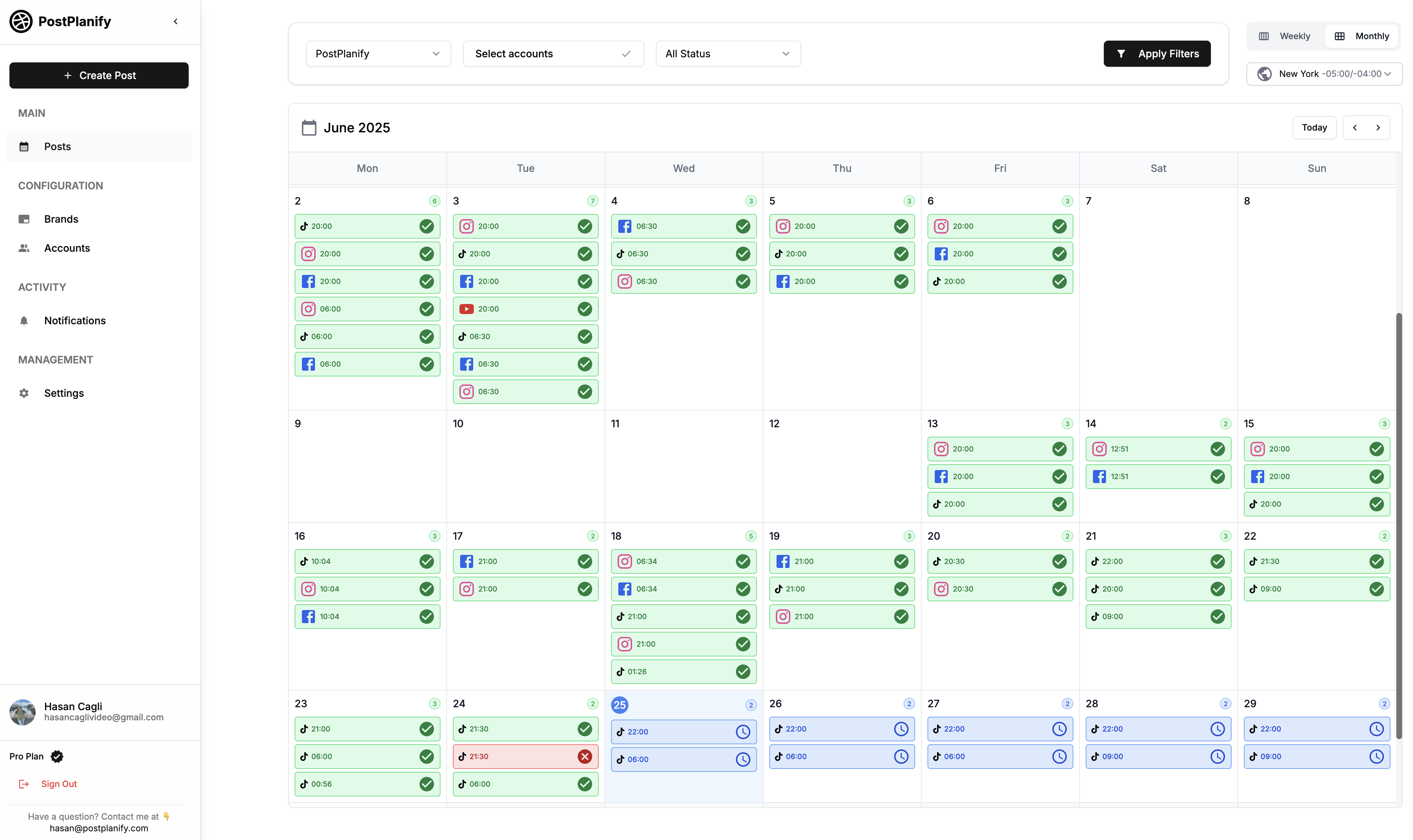
Most of the breakage above shows up because GBP lives outside the system the rest of an agency's content already runs through. Bringing it back into one operational layer is where PostPlanify's Google Business scheduler fits.
PostPlanify is a multi-platform social media management tool built for agencies and teams. It supports 10 platforms — Google Business, Instagram, Facebook, X, LinkedIn, TikTok, YouTube, Threads, Pinterest, and Bluesky — so the same calendar your team already uses for social can carry GBP Updates, Offers, and Events without a separate workflow.
What's actually useful for the GBP work this guide covers:
- Analytics across all 10 platforms with best-time-to-post recommendations, so GBP performance gets reported alongside the rest of the channel mix instead of in isolation.
- Social inbox unifying reviews, comments, mentions, and DMs across Instagram, Facebook, LinkedIn, Google Business, YouTube, Threads, and Bluesky — instead of opening every dashboard one by one.
- Vision-powered AI assistant for drafting GBP posts from approved campaign briefs, reusing assets without rewriting from scratch.
- Team collaboration with approval workflows — Growth includes 3 team members, Premium 6, Scale 12, Enterprise unlimited. Useful when client sign-off is required before a profile post goes live.
- White-label PDF reports so action-focused GBP performance ships under the agency's brand instead of as a Google screenshot.
- Bulk scheduling and a unified content calendar for agencies running 20–50 profiles who need to plan months ahead without per-location busywork.
Pricing starts at $79/mo billed yearly ($99/mo monthly) for the Growth plan. Premium adds reports and a larger team; Scale unlocks white-label reports along with 100 social accounts and 50 workspaces for multi-brand operations. Enterprise is custom for agencies that need unlimited workspaces and 1:1 onboarding.
GBP Management FAQs
How do you manage GBP for service-area businesses without a storefront
Be strict about the business model.
If the client serves customers at their location, use the storefront setup that matches reality. If they travel to customers and don't serve people at a public address, set them up as a service-area business and avoid presenting the profile like a walk-in location. Agencies get clients in trouble when they try to force a storefront format for ranking reasons.
Keep service areas aligned with actual operations. Don't invent coverage just because the client wants wider reach.
What should an agency do first if a profile gets suspended
Start by slowing down and checking what changed recently.
Look at the business name, category edits, address changes, user access changes, and anything else your team or the client updated before the suspension. Gather documentation that proves the business is legitimate and operating as listed. Don't keep making random edits while the issue is unresolved. That usually makes the review path messier.
Can you remove fake negative reviews
Sometimes, but not on demand.
Flag reviews that clearly violate platform rules and keep internal notes on why they were flagged. If the review looks suspicious but not obviously removable, publish a calm public reply and document the issue for the client. Agencies waste time when they promise removals they can't control.
Is keyword stuffing the business name still worth trying
No, not if you're managing accounts for the long term.
It may look tempting in competitive local markets, but it's a brittle tactic. It creates compliance risk, makes reinstatement harder if problems happen, and often leads to messy profile cleanups later. Use the business name. Put optimization effort into categories, services, descriptions, landing pages, content, and review systems instead.
How often should an agency audit a client profile
Run three overlapping cadences:
- Weekly: review check, Q&A sweep, post performance, and unresolved customer messages.
- Monthly: full audit of categories, services, photos, hours, descriptions, completeness score, and link destinations.
- Quarterly: access and ownership audit — confirm admin list, verification status, and escalation contacts haven't drifted.
Anytime the business changes something meaningful — service changes, phone updates, moved locations, seasonal hours, new booking links, ownership changes, or major campaign periods — run an off-cycle audit immediately. High-change businesses (multi-location retail, restaurants, healthcare) need tighter monitoring than stable single-location locations.
Should agencies add FAQ content to client websites too
Yes, when the questions are real and recurring.
GBP Q&A should handle profile-level questions users ask before contacting. Website FAQs can go deeper and support service pages, support content, and conversion pages. If you also want those FAQs to be easier for search engines to interpret, this FAQ schema markup guide is a solid reference for implementing structured FAQ content correctly.
What's the biggest mistake agencies make with GBP
They treat it like a set of isolated tasks instead of a managed channel.
Once you centralize access, define ownership, schedule content, systemize reviews, and report on actions instead of busywork, the service becomes much easier to run and much easier to retain.
Key Takeaways
- GBP is a service line, not a side task. Build it like one — onboarding, permissions, optimization rules, content workflows, review handling, and reporting all need owners and cadences.
- Access first, optimization second. Always join via Business Profile Manager invites; never share passwords or use a shared Gmail. Most multi-month cleanup projects trace back to access shortcuts taken on day one.
- Optimize in priority order. Categories, phone, website, and address consistency outweigh any cosmetic field. Conversion fields (services, hours, appointment links, descriptions) come next. Engagement (reviews, photos, posts) only pays off once the structure is sound.
- GBP content belongs in the main calendar. Adapting approved campaign messages to local intent is faster and more consistent than running a parallel approval chain.
- Review management is operations, not courtesy. Notification routing, response templates, escalation paths, and flagging criteria — defined per client — protect reputation and prevent firefighting.
- Report on actions, not views. Calls, direction requests, website clicks, and bookings are the metrics clients care about. Tag every link with consistent UTMs.
- Audit on three cadences. Weekly review/Q&A check, monthly full-profile audit, quarterly access and ownership audit.
Related Reading
- Best Social Media Management Tools for Agencies
- Best Social Media Tools for Franchises and Multi-Location Brands
- Best Social Media Tools for Managing Multiple Brands
- Social Media Agency Client Onboarding Checklist
- Social Media Management Workflow
- White-Label Social Media Reports for Clients
- Social Media Analytics and Reporting
- Best Social Media Tools with Approval Workflows
- How Much to Charge for Social Media Management
- How to Manage Multiple Social Media Accounts
- How Social Media Agencies Use AI Workflows
- Best Social Media Tools with White-Label Reports
- White-Label Social Media Management
If your team needs one place to plan GBP posts alongside the rest of your client content, PostPlanify is worth a look. It helps agencies schedule and organize publishing across channels, which is often the missing piece when Google Business Profile management keeps slipping through the cracks.
PostPlanifyAll your social media in one simple dashboard
Schedule posts, track analytics, and reply to comments/DMs without switching tabs.
Engagement
+18%
Views
52.8k
About the Author

Hasan Cagli
Founder of PostPlanify, a content and social media scheduling platform. He focuses on building systems that help businesses, agencies, and teams plan, publish, and manage content and social media more efficiently across platforms.


