


Most agency owners don't have a client problem — they have a channel problem. They picked one acquisition method (usually cold outreach, because it's the most-marketed approach), worked it for 3 months, didn't see the volume the YouTube content promised, and concluded "client acquisition is hard." The reality is harder and simpler: the agencies that grow consistently use 3–4 channels in parallel, and the right mix depends on the niche, stage, and operator strengths.
This guide is the operational playbook. It covers seven client acquisition channels with verified 2026 conversion data, the math behind each one, the order to layer them in, the 90-day client acquisition plan that actually works for new agencies, and the tooling stack that makes it efficient. Every channel includes the honest assessment — what works, what doesn't, and where the YouTube-content version diverges from reality.
The first 1–3 clients almost always come from warm network and referrals. The next 5–15 come from content + partnerships. Cold outreach and paid acquisition come later — and only as the marginal channel, not the primary one.
This is the third article in our agency-services trilogy. For the broader operational picture, see how to start a social media marketing agency; for the proposal that closes the deal, see the social media agency proposal template; for the legal protection that follows, see the social media agency contract template.
Quick Answer: How to Find Social Media Marketing Agency Clients
The 2026 reality, ranked by ROI: (1) Warm network and referrals — lowest CAC ($150 average per B2B referral data), highest LTV (16% higher than non-referred clients), source of nearly every agency's first 3–5 clients. (2) Content marketing — particularly LinkedIn, where 80% of B2B social leads originate and personal profiles get 8× the engagement of company pages. (3) Strategic partnerships with complementary service providers — 3× conversion rate of cold leads. (4) SEO and organic search — highest pure-channel ROI at 748% but slowest to compound. (5) Niche-community presence — high-trust, slow-scale, niche-specific. (6) Cold outreach — 3.43% average reply rate; works only at low volume with hyper-personalization. (7) Paid acquisition — last channel to layer in; meaningful only when warm channels are saturated.
The mistake most new agencies make: starting with #6 (cold outreach) instead of #1–#3. Reverse the order. The full playbook below covers each channel with verified data, sample tactics, and how to structure the layering across the first 12 months.
The Data: Which Channels Actually Work in 2026
Before tactics, the verified benchmarks. These shape every recommendation in this guide.
Channel-level ROI
Per recent marketing ROI benchmark data:
- SEO: 748% ROI (highest of any channel, slowest to compound)
- Email marketing: 261% ROI
- Webinars: 213% ROI
- Referrals: ~3,000% ROI (different methodology — includes higher LTV of referred customers)
- Paid social: ~26% ROI on average (highly variable by niche)
Customer acquisition cost (CAC) by channel
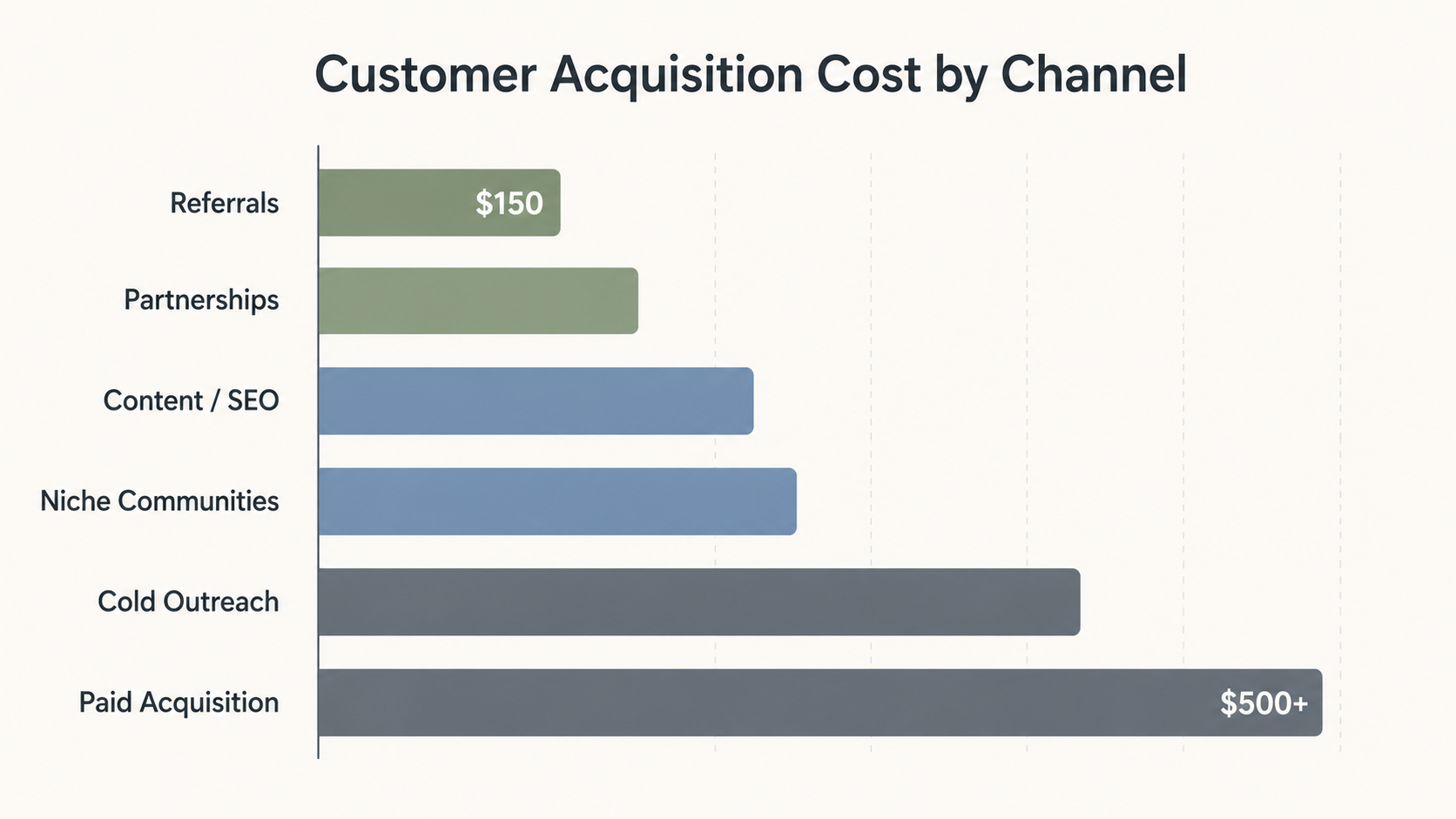
- Referrals: $150 average CAC for B2B SaaS — the most cost-efficient channel by a wide margin
- B2B average cost per lead: ~$198
- Companies with referral programs: 24% lower overall CAC
Cold outreach benchmarks (2026)
- Cold email average reply rate: 3.43% (median across datasets)
- Top quartile cold email: 5.5%+ reply rate
- Excellent cold email: 10%+ reply rate
- By industry: Legal services 10% (highest), IT services 3.5% (lowest)
- LinkedIn cold outreach acceptance: 30–35% (down from 50%+ in 2022)
- LinkedIn cold reply rates: single digits after acceptance
- 79% of B2B decision-makers actively ignore cold DMs (LinkedIn outreach data)
- Low-volume outreach (<25/week) performs 2× better than high-volume
LinkedIn organic performance (2026)
- 80% of all B2B social leads originate from LinkedIn
- 95.7% of B2B marketers use LinkedIn for lead gen
- Personal profile posts get 8× the engagement of identical content from company pages
- LinkedIn lead gen forms convert at 13% on average
- LinkedIn cost-per-qualified-lead is 28% lower than Google Ads
- Native video 60–90 seconds is heavily favored by the 2026 algorithm
Referral program benchmarks
Per referral marketing data and agency-specific research:
- 24% of agencies name referrals as their preferred acquisition channel
- 86% more revenue growth over 2 years for companies with active referral programs
- Referred customers: 16% higher LTV, 18% lower churn rate
- Referrals from trusted partners convert 3× higher than cold leads
- Typical agency referral fee: 5–20% of project value
Conversion benchmarks
- Professional services average conversion: 3–8%
- B2B median conversion: 2.9% (range 2.0–5.0%)
- Lead-to-customer conversion: 10–30% across B2B
- SQL-to-close average: 20–25% in B2B; top performers exceed 30%
Sales cycle length
- Sub-$20K ACV deals: ~75 days from first contact to close
- $20–60K deals: ~115 days
- $60K+ deals: ~180 days
- SMB deals: 30–45 days (faster cycle)
- Enterprise deals: 120+ days (committee buying)
What this means for new agencies
If you're charging $5,000/mo retainers ($60K annual ACV), expect a ~115-day sales cycle from first contact to signed contract. This means:
- A consistent pipeline requires generating leads 3–4 months before you need revenue
- Channel investments take 3–4 months to show results — not 30 days
- "Cold outreach for 3 months and got nothing" is the expected outcome at high volume; the math only works at low volume with hyper-personalization or warm-followup overlay
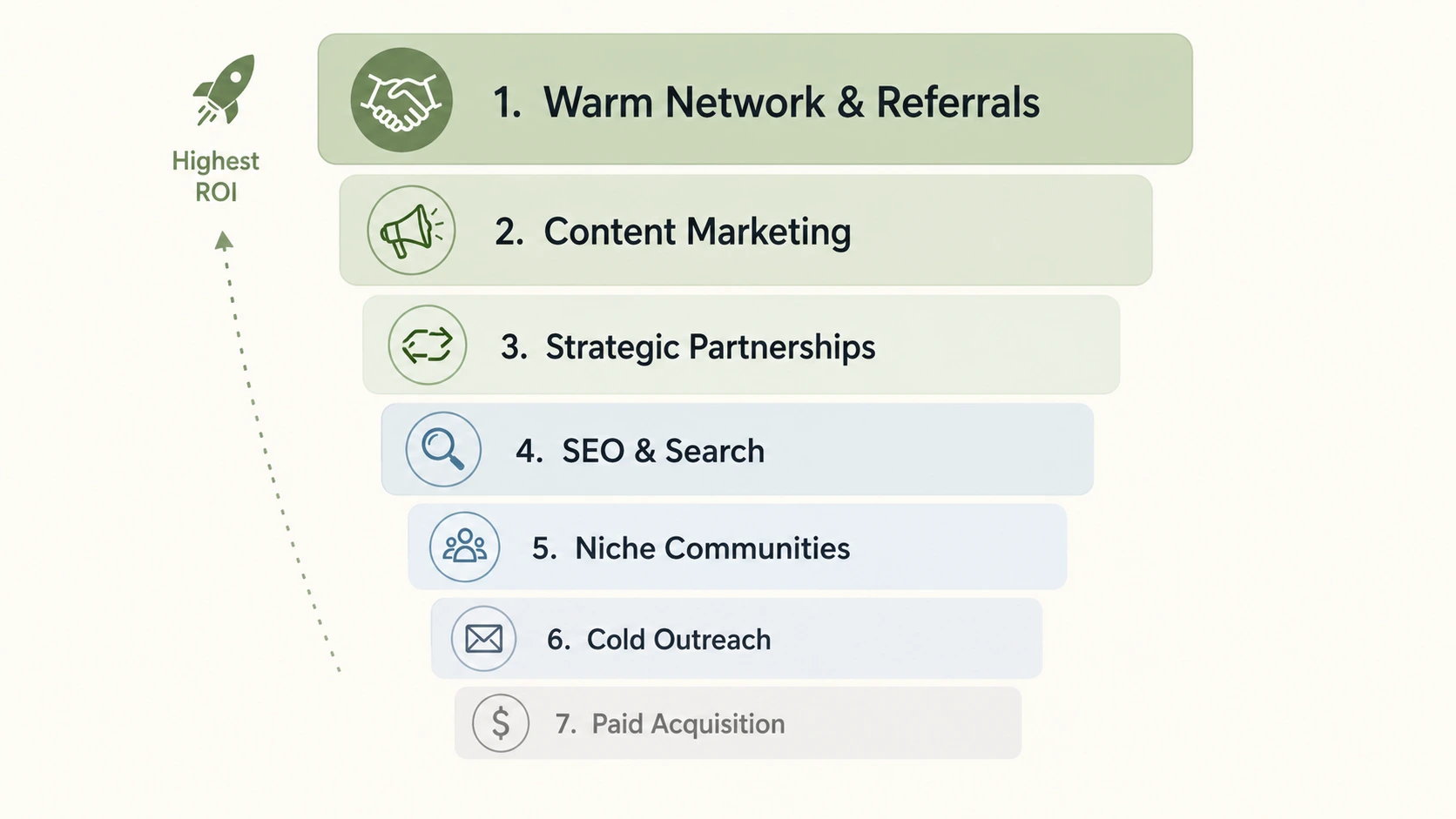
The 7 Channels Ranked: From Highest ROI to Last Resort
The order of channel layering matters as much as the channels themselves. Build outward from highest-trust, lowest-cost to lower-trust, higher-cost.
Channel 1: Warm Network and Referrals (Highest ROI, Slowest Scale)
Why it ranks first: Lowest CAC, highest LTV, source of nearly every agency's first 3–5 clients.
The data is unambiguous. Per agency benchmarks, 24% of agencies name referrals as their preferred channel. CAC drops 24% for companies with referral programs. Referred customers have 16% higher LTV and 18% lower churn. Referrals from partners convert at 3× the rate of cold leads.
The two phases of warm network:
Phase 1: Existing relationships (Month 1–3 of new agency). List 30 people who already know you and work in or adjacent to your niche. Email each personally. Don't pitch — ask for introductions:
"I'm starting a [niche] social media agency, focused on [specific outcome]. I'm not pitching you — but if you know any [niche-specific role] who's frustrated with their current social media work, I'd love an intro. I'll do a free strategy review for them either way."
Conversion math: 30 emails → ~5–8 introductions → ~2–3 conversations → ~1 paying client. The ratios get better as you refine the message and your network gets sharper.
Phase 2: Systematic referral program (Month 4+, after first 3 clients). Once you have happy clients, the referral channel scales through them. Best-practice components:
- Make the ask explicit. Don't wait for organic referrals. After 90 days of strong work, ask the client directly: "Who else in your network would benefit from what we've been doing?"
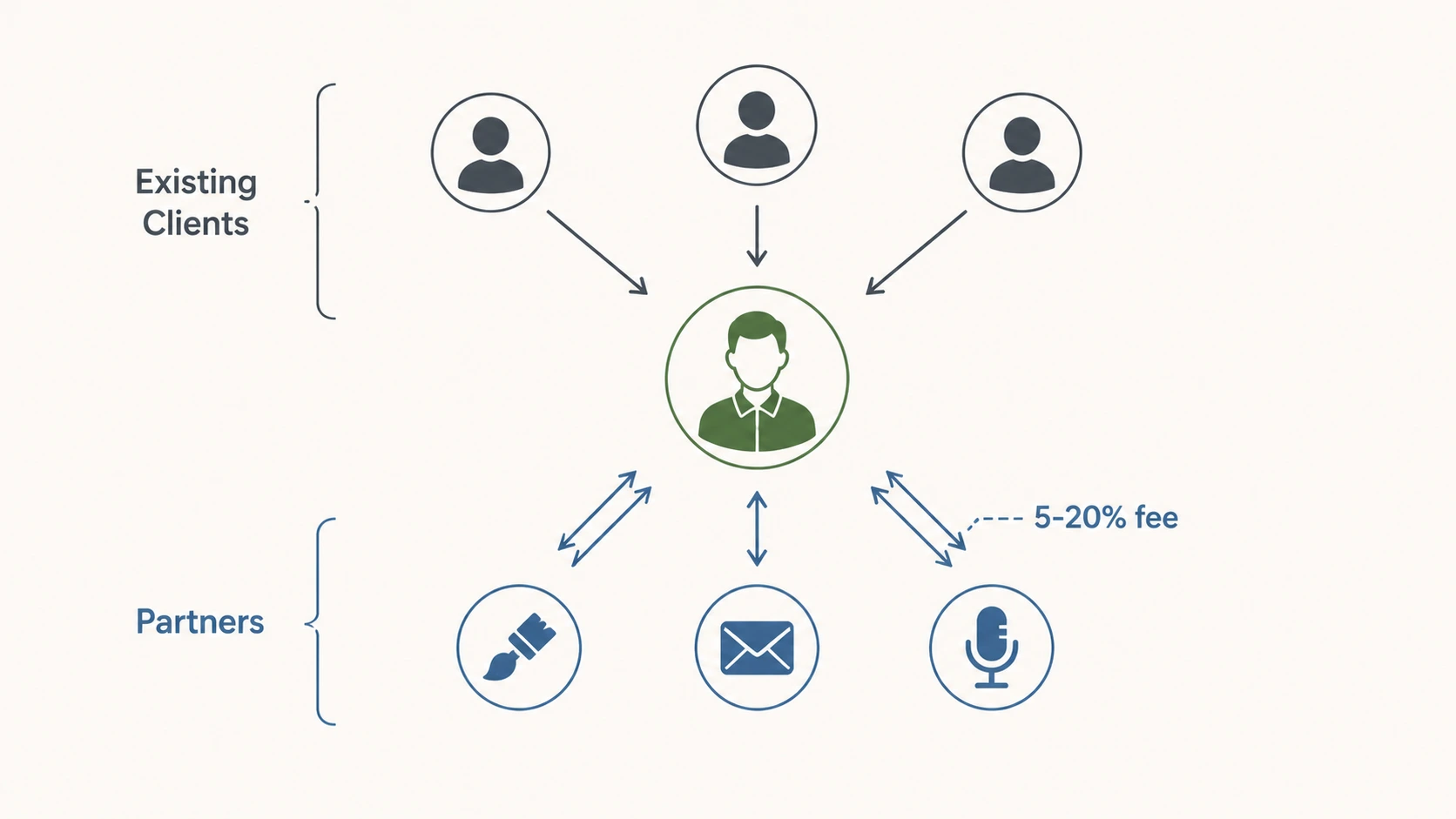
- Pay referral fees. Standard agency rate: 5–20% of first-year project value. Lower end for casual referrers; higher end for active partner referrers (other agencies, consultants, business advisors).
- Acknowledge referrals fast. Thank-you within 24 hours. Status update on the referred deal. Notify them when the deal closes (with permission to share).
- Reciprocate value. Send referrers leads back. Send them industry articles. The relationship has to feel two-way or it stops generating.
Tactics that increase referral velocity:
- Quarterly check-ins with past clients even after engagement ends. They forget you exist if you don't stay in touch.
- Year-end "thank you" outreach to everyone who referred you in the prior 12 months — a small gift, a hand-written note, or a meaningful charitable donation in their name.
- Partner referral programs with non-competing service providers (covered in Channel 3 below).
What this looks like in practice: A B2B SaaS-focused social media agency at $25K MRR typically reports 40–60% of new clients coming from referrals (existing client + partner). A generalist agency typically reports 15–25%. The gap is mostly explained by niche tightness — niche networks refer more.
Channel 2: Content Marketing (LinkedIn for B2B, Other Platforms for B2C Niches)
Why it ranks second: Slowest to compound, but the most defensible long-term channel. Compounds for years; the agencies that win in year 3 are the ones who invested in content in year 1.
The 2026 reality on LinkedIn for B2B agencies:
- 80% of all B2B social leads originate from LinkedIn
- 95.7% of B2B marketers use LinkedIn for lead gen
- Personal profile posts get 8× the engagement of company page posts — your founder profile beats your agency page every time
- Native video 60–90 seconds is heavily favored by the algorithm
- LinkedIn lead gen forms convert at 13% on average
The content thesis that works:
Document, don't promote. The principle that has emerged across hundreds of successful B2B agency-owner LinkedIn presences:
- Document specific client wins (with permission and anonymization where needed)
- Educate your ideal client about what good social media management looks like
- Share frameworks, templates, and behind-the-scenes operational content
- Be specific about who you help — don't say "businesses," say "early-stage B2B SaaS marketing leads"
- Post consistently — 3–5x/week is standard for serious agency-owner accounts
- Engage with prospects' content before pitching — comment thoughtfully on the LinkedIn posts of 5–10 ideal-client-profile prospects daily
Content types that drive inbound for agencies:
- Case study breakdowns ("How we grew @client from 800 to 12,000 LinkedIn followers in 6 months — here's the framework")
- Behind-the-scenes operational content ("The 5-step approval workflow we use with every client")
- Industry takes ("Why most B2B SaaS LinkedIn strategies fail — and what I learned working with 8 SaaS clients in 2 years")
- Frameworks ("The 7-section anatomy of a winning agency proposal")
- Client wins (anonymized) ("A client just hit a record month — here's what we changed")
For B2C niche agencies, the platform shifts:
- Hospitality, lifestyle, e-commerce: Instagram + TikTok (you publish on the platform you're selling expertise about)
- Local services, multi-location: Facebook + Google Business Profile
- Creator economy: YouTube + X (founder presence)
- Ad-heavy niches (paid social agencies): X + LinkedIn
Compounding timeline:
- Month 1–3: Build foundation. Almost no inbound. Audience is small.
- Month 4–6: First inbound leads start arriving. Usually 1–2 per month.
- Month 7–12: Compounding kicks in. Inbound becomes 30–50% of new leads.
- Year 2: Content channel can drive 50–70% of new business.
Why most agencies abandon content too early: The first 90 days produce minimal results, and the impulse is to switch to "faster" channels. The agencies that win played the long game in their first year.
Channel 3: Strategic Partnerships (Highest Multiplier)
Why it ranks third: Per partnership marketing data, referrals from trusted partners convert at 3× the rate of cold leads. The volume per partner is moderate; the quality is exceptional.
The principle: Identify adjacent service providers who share your client base but don't compete. Build mutual referral relationships.
For social media agencies, the natural partner categories:
- Web designers and developers — they ship sites for clients who then need social presence built
- PR agencies — they do earned media; clients often need owned-channel work as well
- Email marketing freelancers and agencies — same audience, complementary services
- SEO agencies — same audience, often non-overlapping scope
- Brand strategy and identity consultants — they design brand systems; clients then need them executed on social
- Photographers and videographers — they produce assets; clients need someone to publish them strategically
- Marketing automation consultants (HubSpot, Marketo, Pardot, ActiveCampaign) — operational complement
- Niche-specific consultants — vertical-aligned business advisors who serve the same client base
- Niche associations and industry orgs — partnerships with associations whose members are your ICP
- Existing agencies in adjacent service categories — paid media agencies often refer organic-only social work, and vice versa
How to structure partnerships:
Step 1: Map your top 20 ideal partners. Same niche or adjacent niche. Same target client size. Active and reputable.
Step 2: Outreach to start the conversation. Direct, value-first. Sample:
"I run a [niche] social media agency, and we're consistently sending business to [their service category] when our clients need [adjacent need]. I'd love to formalize a referral relationship. What does that look like for you when it's working well?"
Step 3: Define the referral structure.
- Referral fee: 10–20% of first-year project value (most common). Some partnerships are reciprocal-only with no fee.
- Hand-off process: Email intro, dedicated channel (Slack), or formal CRM integration.
- Timing: Both directions, ongoing, with quarterly review.
Step 4: Maintain the relationship.
- Quarterly partner reviews — what's flowing both directions, what could be better
- Send qualified leads to your partners
- Occasionally co-author content (joint case studies, joint webinars)
- Celebrate partner wins
Concrete benchmark: A mature agency with 5–8 strong partnerships typically generates 25–40% of new business through partner referrals. That's substantial enough to materially reduce dependence on cold channels.
Channel 4: SEO and Organic Search (Highest Pure ROI, Slowest to Compound)
Why it ranks fourth: SEO has the highest documented ROI of any marketing channel — 748% per verified channel benchmarks. The trade-off: it takes 6–12 months to start producing meaningful traffic, and 18–24 months to compound to dominant channel status.
For agencies, the SEO targets that work:
Local/niche service searches:
- "[Niche] social media marketing agency [city]"
- "B2B SaaS social media management"
- "Healthcare social media marketing agency"
- "Real estate social media agency"
Educational long-tail searches:
- "How much does social media management cost"
- "Social media agency proposal template"
- "Social media management for [niche]"
- "Best [platform] strategy for [vertical]"
The content infrastructure that earns rankings:
- A focused service-page architecture — separate landing pages for each niche/vertical you serve
- A pillar-and-cluster blog content structure — 1 long-form pillar per topic, 5–10 supporting pieces linking back to it
- Genuine expertise content — Google's E-E-A-T (Experience, Expertise, Authoritativeness, Trustworthiness) signals heavily favor content with operational specificity
- Backlinks from reputable industry sources — guest posts on industry publications, partner cross-linking, earned PR mentions
- Technical SEO basics — Core Web Vitals, structured data, site architecture
A high-performing website is just as important as strong SEO. VictorFlow helps agencies build fast, conversion-focused Webflow websites with optimized site architecture, Core Web Vitals, and SEO best practices to turn organic traffic into qualified leads.
Realistic results trajectory:
- Month 1–3: No traffic. Building the foundation.
- Month 4–6: First long-tail keywords ranking. 50–200 monthly visitors.
- Month 7–12: Mid-tail keywords ranking. 500–2,000 monthly visitors. First inbound leads from search.
- Month 13–24: Compounds significantly. 5,000–15,000 monthly visitors. Search becomes a primary channel.
You can also borrow directory authority while your own SEO compounds — vetted B2B directories like Clutch and AppsInsight rank for "top agencies" queries that a newer domain can't yet touch, putting you in front of buyers already in vendor-selection mode.
The investment most agencies don't make: Most agencies under-invest in their own SEO because the payoff is slow. The agencies with the strongest year 3+ pipelines are the ones who started SEO in year 1.
Channel 5: Niche-Community Presence (High Trust, Slow Scale)
Why it ranks fifth: Where your ideal clients spend time when they're not searching. High trust, moderate scale, niche-specific.
Where to show up depends on your niche:
- B2B SaaS: SaaS Founders Mastermind, RevGenius, Pavilion, Demand Curve, MicroConf
- Real estate: Local realtor associations, BiggerPockets, Inman, Tom Ferry community
- Healthcare: Healthcare Marketing Network, AMA marketing chapters, MedPB
- Coaches and course creators: Niche coaching masterminds, ConvertKit Creator community
- Local services: Chamber of Commerce, BNI, Rotary Club, Local Business Network
- Ecommerce: Shopify Plus communities, DTC subreddits, niche Slack communities
The principle: show up and contribute for 60+ days before you ever pitch.
The mistake new agency owners make: joining a community, introducing themselves with a pitch, getting ignored, concluding "this community doesn't work." Communities don't reward pitches. They reward consistent contribution.
What contribution looks like:
- Answer questions thoughtfully without pitching
- Share insights from your client work (without promoting)
- Comment on others' posts substantively
- Show up at events, dinners, and meetups (in-person presence is heavily under-indexed)
- Run small workshops or AMAs on topics relevant to the community
- Offer free strategic reviews or audits to community members
Conversion math: 60 days of consistent contribution → 5–10 conversations → 1–2 clients. The ratio is lower volume but higher trust and faster close than cold outreach.
Channel 6: Cold Outreach (Reality Check)
Why it ranks sixth: Cold outreach still works, but the YouTube-content version of cold outreach is broken. The 2026 reality:
- Cold email average reply rate: 3.43% (median)
- LinkedIn cold outreach acceptance: 30–35%
- 79% of B2B decision-makers ignore cold DMs
- Low-volume outreach (<25/week) performs 2× better than high-volume
The math is clear: high-volume cold outreach (200+ messages/day with automated tools) produces single-digit-percent reply rates and even lower meeting rates. Low-volume, hyper-personalized outreach (10–25 messages/week, custom-written each time) produces materially better results.
What still works in 2026:
Low-volume hyper-personalized email:
- 10–20 emails/week, each individually researched and written
- Reference something specific to the prospect (their LinkedIn post, their recent product launch, their podcast appearance)
- Focus on a single specific outcome you can offer
- Send from a verified, warmed-up domain
- Follow up exactly twice (Day 5 and Day 14), then stop
LinkedIn engagement-first outreach:
- Comment thoughtfully on a prospect's posts for 2–4 weeks before sending a connection request
- Send connection request without a sales pitch
- After connection, exchange messages for 1–2 weeks before any pitch
- Pitch only when there's a clear "warm enough" signal (they've engaged with your content, replied to a message, etc.)
Niche-specific cold outreach:
- Cold outreach works much better when you're niche-specific
- "Hi [Name], I run a B2B SaaS-focused social media agency that's worked with [specific similar SaaS clients]. I noticed [specific observation about their company]. Would you be open to a 15-min conversation about [specific outcome]?"
- This converts 2–3× better than generic "I help businesses with social media" outreach
What doesn't work:
- High-volume automated outreach (200+/day) — single-digit replies, generates spam-flag risk on your domain
- Generic templates ("I help businesses grow through social media")
- Mass LinkedIn connection requests with pitches in the connection note
- Voice notes and "personalized" video pitches in cold contexts (the personalization signals get noticed but the lack of warm context still kills the close)
Honest take: Don't make cold outreach your primary channel. Use it as supplementary volume on top of warm channels. The agencies that brag about "filling pipeline through cold email" are usually either (a) burning their domain reputation on volume, (b) over-counting low-quality leads, or (c) selling courses about cold outreach.
Channel 7: Paid Acquisition (Last Resort, Specific Cases)
Why it ranks last: Most expensive CAC, lowest trust signal, only works when warm channels are saturated.
For agencies, the paid channels that work in specific cases:
- LinkedIn ads: $50–$200/lead for B2B niches. Expensive but quality. Works when you have a clear lead magnet (free audit, free strategy doc) and tight targeting. LinkedIn cost-per-qualified-lead is 28% lower than Google Ads for B2B.
- Google Ads (search intent): Targeting "[niche] social media agency [city]" type queries. Works when SEO hasn't compounded yet.
- Meta ads (B2C niches): Lower-cost but less qualified. Works for ecommerce, lifestyle, hospitality niche agencies.
- Retargeting your existing site visitors: Better economics — these prospects already engaged with your brand. Run retargeting at modest spend ($300–$1,000/mo) once you have site traffic.
When paid makes sense:
- You've maxed out warm channels and need additional volume
- You have a strong lead magnet that converts (audit, ebook, webinar)
- You're entering a new niche where warm network doesn't yet exist
- Your sales process is operationally tight enough to handle cold-leads conversion
When paid doesn't make sense:
- You're a brand-new agency with no proof points
- You don't have a lead magnet or clear conversion mechanism
- Your sales process is still rough
- Your warm channels haven't been worked yet
Math reality: B2B paid lead acquisition costs in the $150–$500 range per qualified lead. Your closing rate on paid leads will be 30–50% lower than warm leads. Run the math before spending.
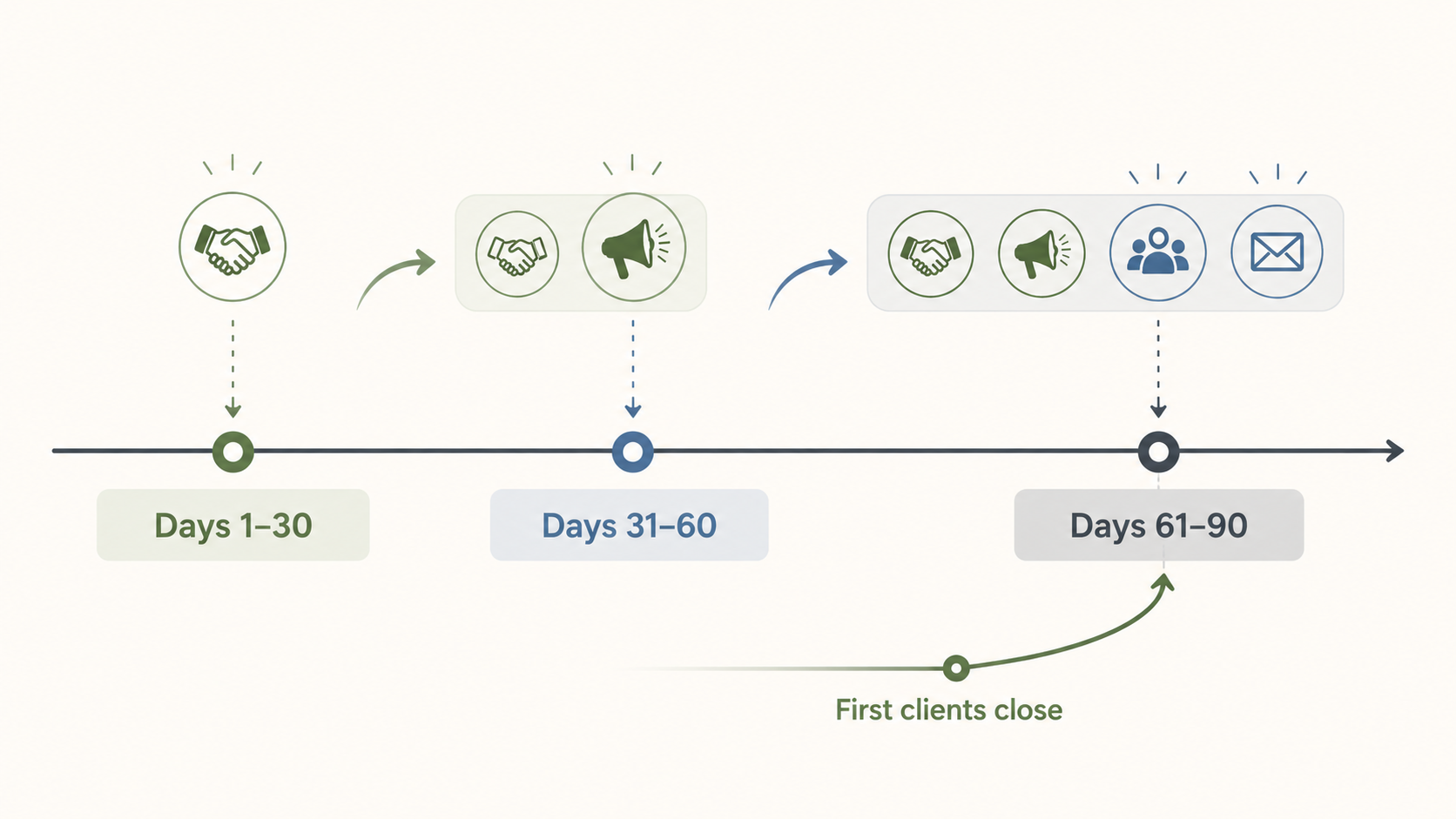
The 90-Day Client Acquisition Plan for New Agencies
The agencies that get from $0 to $10K MRR in 6–9 months don't run all 7 channels at once. They run a phased plan that compounds early channels into later ones.
Days 1–30: Warm Network Sprint
Goal: Generate first 3–5 conversations from existing relationships.
- List 30 people who know you and work in or adjacent to your niche
- Email each individually with the warm-network ask (template above)
- Set up Cal.com / Calendly for booking discovery calls
- Build a one-page website with niche, offer, and booking link
- Set up basic social proof (LinkedIn profile updated, brief case studies if available)
Expected outcome: 5–10 introductions, 2–3 discovery calls, 0–1 closed clients.
Days 31–60: Content Foundation + Partnership Outreach
Goal: Start the long-term channels that compound for years.
- LinkedIn content: Post 3–5x/week. Focus on niche-specific thought leadership. Engage with 5–10 ideal-client posts daily.
- Partnership outreach: Identify 20 ideal partner-category service providers. Reach out to 10. Set up 3–5 partner conversations.
- First case study: If you've closed a client in days 1–30, document the engagement structure and early wins for future content.
- Service page setup: Build a focused service page on your site for your niche.
Expected outcome: Continuing warm-network conversations + early LinkedIn engagement + 1–2 partner relationships forming.
Days 61–90: Layer in Niche Communities + Targeted Cold Outreach
Goal: Add two more channels at low intensity to broaden the funnel.
- Niche community presence: Pick 2 communities. Show up 2–3x/week. Contribute, don't pitch.
- Cold outreach: Send 10–20 hyper-personalized cold emails per week to ideal-client-profile prospects (see Channel 6 specifics above).
- Content amplification: Repurpose your strongest LinkedIn posts to other platforms (X, niche Slack communities, your newsletter if you have one).
- Existing-client referral asks: If you've closed 1–2 clients in days 1–60, ask for 1 introduction each.
Expected outcome: First 2–3 paying clients closed by end of Day 90. Pipeline of 5–8 active conversations.
Day 90 onward: Optimize and Scale
By Day 90, you have signal on which channels are producing best for your specific niche and operator strengths. Double down on the top 2–3, maintain the others at lower intensity, and start planning the layered investments (SEO infrastructure, paid as supplement) for months 4–12.
Key principle: Don't add more channels until your first 2–3 are producing consistently. Most new agencies fail because they spread thin across 7 channels at low intensity, instead of running 3 at high intensity.
Building a Referral Program That Scales
Once you have 3–5 happy clients, the referral channel becomes your highest-leverage lever. Most agencies leave referrals to chance; the ones that grow consistently formalize it.
The 5 components of a working referral program
1. Make the ask explicit. Don't wait. After 90 days of strong engagement with a client, ask:
"I've really enjoyed working on [project]. We're growing the agency and most of our best clients have come from introductions. Who in your network might benefit from what we've been doing? I'd be happy to do a free strategy review for them."
Most clients respond positively. Some don't. Either way, the explicit ask is what generates the referral; expecting them to do it spontaneously rarely works.
2. Structure the incentive.
For client-to-client referrals (where the existing client refers another business they don't work with):
- 5–10% of first-year project value as a thank-you to the referrer
- Or a flat thank-you (gift card, donation in their name, agency swag)
- Or pure goodwill (no monetary incentive — works for many client relationships)
For partner-to-client referrals (other service providers referring clients to you):
- 10–20% of first-year project value
- Or reciprocal: you send them leads in exchange
- Document the structure explicitly to avoid friction later
3. Build the operational machinery.
- Track referrals in a CRM (HubSpot Free, Pipedrive, Notion).
- Set up a quarterly referral review — who has referred you, what closed, what's still pending, who hasn't been thanked.
- Send thank-you messages within 24 hours of every referral, even before you know if it converts.
- Send referral updates monthly — "the lead you sent me last month signed; here's the impact, thank you."
4. Reciprocate value.
The strongest referral relationships are two-way. Send your partners qualified leads. Share industry insights. Co-create content. Refer them inside your own network.
5. Year-end appreciation.
Once a year, formal recognition: hand-written notes, small gifts ($50–$150 range), or charitable donations in their name. Cost is minimal; relationship strengthening is significant.
What a mature referral program produces
A well-run referral program at a mid-sized agency (around $50K MRR) typically generates:
- 40–60% of new clients from existing-client referrals + partner referrals combined
- CAC of $150–$500 per referred client (vs $1,000+ for cold-channel CAC)
- LTV of referred clients 16% higher than non-referred (per referral marketing data)
- Churn 18% lower for referred clients
- Sales cycle 30–40% shorter because trust is pre-established
This is the channel that compounds most reliably and produces the strongest unit economics. Underinvesting in it is the most common acquisition mistake.
Common Client Acquisition Mistakes That Kill New Agencies
Patterns that show up repeatedly in agencies that struggle:
1. Starting with cold outreach. The opposite of the right order. Cold outreach is high-volume, low-conversion, and burns operator energy that should go into warm channels first.
2. Spreading across 7 channels at low intensity. Worst possible allocation. 3 channels at high intensity beats 7 at low intensity every time.
3. Treating LinkedIn as a posting channel rather than an engagement channel. Posting alone doesn't work; engaging with prospects' content for 2–4 weeks before pitching is what converts.
4. Posting from the agency company page instead of the founder's profile. Personal profiles get 8× the engagement in 2026. Build the founder brand; the agency brand follows.
5. Promoting instead of documenting. Promotional content underperforms documentary content (case studies, frameworks, behind-the-scenes) by ~5–10× in engagement.
6. Abandoning content after 60–90 days. Content takes 4–6 months to start compounding. The agencies that quit at month 3 leave the entire channel on the table.
7. Treating warm network as "tapped out" too early. Most agency owners email their existing network once and conclude "no leads there." Reality: warm network is a channel that benefits from quarterly check-ins and consistent presence, not a one-shot email blast.
8. Failing to ask for referrals explicitly. Spontaneous referrals are rare. Asked referrals are common. Most agencies leave 2–3× the referral volume on the table by not asking.
9. Not tracking source attribution. Without knowing which channels produce, you can't optimize. Even basic CRM tagging (where did this lead come from) creates real lift over 12 months.
10. Selling everything to everyone. Niche specialization is the single biggest leverage in agency client acquisition. Generalists struggle to convert; specialists close 2–3× faster.
11. Pricing too low to land first clients. Pricing is sticky — first clients anchor your pricing for years. Charge correctly from day one. See how much to charge for social media management.
12. Conflating volume with success. 100 cold emails sent is not the same as 5 genuinely strong conversations. Track conversations and pipeline value, not activity volume.
Tooling Stack for Agency Client Acquisition
The minimum viable tooling stack to run the 7 channels efficiently:
CRM and pipeline tracking — $0–$15/user/mo
- HubSpot Free — best free CRM for agencies; manages pipeline, contacts, tasks
- Pipedrive ($14.90/user/mo) — when you outgrow HubSpot Free
- Notion (free tier) — for solo operators; combine with HubSpot Free for full stack
Email outreach — $0–$60/mo
- Gmail / Google Workspace — for low-volume warm + partnership outreach (free with workspace)
- Instantly ($37/mo Starter) — when cold email volume justifies a dedicated tool with deliverability infrastructure
- Lemlist ($59/mo) — when personalization at scale matters
LinkedIn engagement — $0–$30/mo
- LinkedIn Sales Navigator ($79.99/mo) — when you're consistently using LinkedIn outreach (not required for first 6 months)
- Native LinkedIn (free) — for content posting and warm-network engagement
- Taplio or Shield Analytics ($30–60/mo) — when LinkedIn analytics become operationally important
Calendar booking — $0–$15/mo
- Cal.com Free — best free option, fully featured
- Calendly ($10–$15/user/mo) — most established alternative
Lead magnet hosting — $0–$30/mo
- Convertkit / Beehiiv (free under 1,000 subscribers) — for newsletter-driven inbound
- Ghost ($9/mo) — alternative for content-heavy lead magnets
Content + scheduling — $79+/mo
- PostPlanify ($79/mo billed yearly on Growth) — schedule your own agency social content + run client work in the same workspace; multi-workspace structure supports both
- Native LinkedIn / X for ad-hoc posting if scheduling tool is too much initially
Analytics — $0–$15/mo
- Google Analytics 4 (free) — for site traffic
- Plausible ($9/mo) — privacy-focused alternative
Total monthly cost
For a new agency in months 1–6, the lean stack runs $0–$200/mo depending on which channels you're prioritizing. By month 12, with all channels active, expect $250–$500/mo across the stack.
FAQ: Finding Social Media Marketing Agency Clients
How long does it take to land my first client?
For most new agencies, 30–90 days from launch. Agencies with strong existing networks (former in-house experience in their niche, freelancing background, established LinkedIn presence) often land their first client within 30 days. Agencies starting cold typically need 60–90 days to generate the first conversations and close the first deal. Per B2B sales cycle data, sub-$20K ACV deals close in approximately 75 days from first contact.
What's the cheapest way to acquire agency clients?
Referrals, by a wide margin. Average CAC is $150 for B2B SaaS-related referrals, versus $1,000+ for cold-channel acquisition. Referred clients also have 16% higher LTV and 18% lower churn rates per referral marketing benchmarks. The catch: you can't run referrals as your primary channel until you have happy clients to refer you. So the path is: warm network → first 3 clients → referral program → referrals become primary channel.
Should I do cold outreach or focus on inbound?
Both, but in the right proportion. Inbound (content + partnerships + SEO + warm network) should be 70–80% of your acquisition effort. Cold outreach should be 20–30% as supplementary volume. The mistake most new agencies make is reversing this — running cold outreach as primary and treating inbound as nice-to-have. Per 2026 cold email benchmark data, average reply rates are 3.43% — meaning a single cold-channel-primary strategy requires high volume to produce, and high volume burns operator energy and email-domain reputation.
How many cold emails should I send per day?
For most new agencies, less than you think — 10–20 per week, hyper-personalized, performs significantly better than 50–200 per day automated. LinkedIn outreach data shows low-volume outreach (<25/week) performs 2× better than high-volume. The math: better personalization → higher reply rate → better meeting rate → better close rate. The volume play (200+/day) burns domain reputation and triggers spam filters.
How do I get agency clients on LinkedIn specifically?
The 2026 playbook: (1) Post from your founder profile, not the agency page — personal profiles get 8× the engagement. (2) Post 3–5x/week with documentary content (case studies, frameworks, behind-the-scenes). (3) Engage with 5–10 ideal-client posts daily for 2–4 weeks before any outreach. (4) Native video 60–90 seconds is heavily favored by the 2026 algorithm. (5) LinkedIn lead gen forms convert at 13% on average if you eventually run paid — but earn the inbound first. The compounding takes 4–6 months to start producing meaningful inbound.
What's a realistic monthly client acquisition target for a new agency?
For a solo founder running 3–4 channels at moderate intensity: 1–3 new clients/month is realistic in months 1–6, scaling to 3–5/month in months 7–12. The variance is mostly explained by niche choice, network quality, and content/partnership compounding. Agencies serving B2B SaaS or high-LTV niches close fewer-but-larger; agencies serving local services or SMBs close more-but-smaller.
Should I run paid ads to find agency clients?
Not as a primary channel until warm channels are saturated. Paid acquisition has the lowest trust signal and the highest CAC of any channel. Agencies that run paid effectively typically (a) have a strong lead magnet (free audit, ebook, webinar), (b) have a tight sales process that handles cold leads, (c) have already maxed warm channels. For most new agencies in the first 6 months, the answer is no. By month 12+, paid retargeting of site visitors at modest spend ($300–$1,000/mo) starts producing meaningful results. LinkedIn ads work for B2B niches; Meta ads for B2C niches; Google Ads for niche-and-location queries.
How do I structure a referral fee for partners and clients?
Standard agency referral fees:
- Client-to-client referrals (existing client refers another business): 5–10% of first-year project value, or non-monetary thank-you (gift card, charitable donation in their name)
- Partner-to-client referrals (other service providers refer clients): 10–20% of first-year project value
- Reciprocal partnerships: No fee; both parties send leads to each other
- Active "agency partner" referrer: 15–25% of first-year project value, paid quarterly
Document the structure explicitly. Per agency referral fee research, the typical range is 5–20% of project value, with the upper end reserved for active partners who consistently send qualified leads.
How do I find ideal-client-profile prospects on LinkedIn?
Use LinkedIn Sales Navigator (or LinkedIn's free search) to filter by:
- Job titles (CMO, VP Marketing, Marketing Director, Head of Demand Gen for B2B; Owner, Founder, Head of Marketing for SMB)
- Company size (employee count range matching your ICP)
- Industry (filter to your niche)
- Geographic region (where applicable)
- Recent job changes (newly-promoted decision makers often need to make tooling/agency decisions in the first 90 days)
Then layer engagement before outreach: comment on 5–10 of their posts over 2–4 weeks before sending a connection request or message.
What's a good content cadence for agency LinkedIn?
3–5 posts per week is the standard for serious agency-owner accounts. Less than 2/week underperforms; more than 7/week dilutes quality. Mix of:
- 1–2 educational frameworks per week (lists, how-tos, breakdowns)
- 1–2 case studies or wins per week (anonymized client results, behind-the-scenes operational content)
- 1 thought-leadership take per week (industry observations, contrarian positions)
- 1–2 engagement-driven posts per week (questions, polls, shareable observations)
Consistency matters more than perfection. Posting 4× a week for 12 months beats posting 7× a week for 3 months.
How do I track which acquisition channel produces the best clients?
Set up basic source attribution in your CRM:
- Source field for every new lead (warm intro / partner referral / LinkedIn inbound / cold email / niche community / etc.)
- Tag at first contact, not at close — capture the first-touch source
- Quarterly review of close rate and LTV by source
- Attribution adjustments: if your data shows partnerships convert at 35% close rate and cold email at 4%, the right move is more partnerships, not "more cold email to make up volume"
After 6–9 months, your source data shows clearly which channels deserve more investment and which to deprioritize.
How long should I wait before asking a client for a referral?
90 days. Long enough that the engagement has produced meaningful results; short enough that the win is fresh in their mind. Some agencies wait 6 months — by then the relationship is stable but the wow-factor of early wins has faded. Some ask in month 1 — too early; the client hasn't seen results yet. The 90-day mark is the sweet spot.
What's the difference between a referral program and a partnership?
Referral program typically refers to an existing-client referral structure — your current clients refer their network to you, often with a referral fee or thank-you incentive. It's bilateral but client-centric.
Partnership typically refers to mutual referral relationships with non-competing service providers — web designers, PR agencies, email marketing firms. It's bilateral and peer-to-peer, with referrals flowing both directions over time.
Both are referral mechanisms; partnerships scale further because each partner refers multiple clients over time, while individual clients typically refer 0–3 leads ever.
Should I have a niche before I start client acquisition?
Yes — not optional. Generalist agencies struggle to convert because they have no differentiated reason for prospects to pick them. Niche specialists close 2–3× faster, command higher pricing, and earn referrals from tighter networks. The first decision in agency-building is niche; client acquisition flows from there. For deep niche selection guidance, see how to start a social media marketing agency.
Do free audits or strategy reviews actually drive deals?
Yes, when scoped correctly. A 30-minute strategy review or a focused audit (specific scope, time-boxed) is one of the strongest top-of-funnel offers in agency sales. Two formats that work:
- 30-min strategy review — qualifying conversation that doubles as discovery; converts roughly 25–40% of recipients to paid engagements within 60 days
- Free audit (5–7 specific findings, sent as written deliverable) — converts roughly 15–25% to paid engagements; works as both a sales tool and a content asset
Avoid open-ended "free consulting" — this trains the prospect to expect free advice indefinitely.
How long until referrals start producing meaningful volume?
For most agencies, months 6–12 after launch. The math: you need 3–5 happy clients to start generating consistent referrals. Each happy client generates 0–3 referrals over the engagement lifetime. With 5 clients, you have 5–15 lifetime referrals to potentially activate. Once you have 10+ happy clients with quarterly check-in cadence, referrals can become 30–50% of new business. The key is asking explicitly and tracking; spontaneous referrals are rare.
Key Takeaways
- Run 3 channels at high intensity, not 7 at low intensity. Most new agencies fail because they spread thin. Pick warm network + one of (content, partnerships) + one of (niche communities, low-volume cold) as the starting trio.
- Reverse the typical YouTube-content order. Start with warm network and referrals (highest ROI, lowest CAC). Layer in content marketing and partnerships in months 2–3. Add niche communities and supplementary cold outreach in months 3–6. Paid acquisition is months 9–12+, if at all.
- Referrals are the single most underleveraged channel. Average CAC of $150 vs $1,000+ for cold; 16% higher LTV; 18% lower churn. Most agencies leave 2–3× the referral volume on the table by not asking explicitly.
- Content marketing on LinkedIn compounds — but takes 4–6 months to start producing. Personal founder profiles get 8× the engagement of company pages. Document, don't promote. Post 3–5x/week from your founder profile. The agencies winning in year 3 invested in content in year 1.
- Cold outreach in 2026 works at low volume, not high volume. 10–20 hyper-personalized emails per week outperforms 200+ per day automated. The volume game burns domain reputation and operator energy.
- Partnerships drive 3× the conversion rate of cold leads. Five strong partner relationships generate 25–40% of new business. The investment is relationship-building, not lead-generation tactics.
- Track source attribution from day one. Without knowing which channel produces best clients, you can't optimize. Even basic CRM tagging creates real lift over 12 months.
- Niche before channel. Generalist agencies struggle to convert in any channel. Specialists close 2–3× faster across all channels. Pick the niche before optimizing the funnel.
 PostPlanify
All your social media in one simple dashboard
Schedule posts, track analytics, and reply to comments/DMs without switching tabs.

Engagement
+18%
Views
52.8k
The agencies that win consistently aren't running a single brilliant tactic. They're running 3–4 channels at moderate-to-high intensity, layering in additional channels as the early ones compound, and tracking source attribution to keep doubling down on what works. The first 90 days are warm-network heavy. Months 4–9 are content-and-partnership compounding. Year 2 is when SEO starts producing and the referral channel becomes self-sustaining.
For the operational platform that runs your client work once you've landed the deals — content calendar, multi-approver workflows, client-specific workspaces, white-label PDF reports — see best social media management tools for agencies. PostPlanify starts at $79/mo billed yearly on the Growth plan and scales to $239/mo on Scale for 100 social accounts and 50 workspaces — purpose-built for agency operations.
This article completes the agency-services trilogy on this site. Together: how to start a social media marketing agency covers the foundation; the social media agency proposal template covers closing deals; the social media agency contract template covers legal protection; this guide covers finding the prospects in the first place.
Related Reading
- How to Start a Social Media Marketing Agency
- Social Media Agency Proposal Template
- Social Media Agency Contract Template
- Social Media Agency Pricing Models Compared
- How Much to Charge for Social Media Management
- Social Media Agency Client Onboarding Checklist
- Best Social Media Management Tools for Agencies
- White-Label Social Media Reports for Clients
- Social Media KPIs for Agencies to Report to Clients
- How Social Media Agencies Use AI Workflows
- Social Media Agency Statistics
- Best Social Media Tools with Approval Workflows
- Social Media Tools With No Per-Seat Fees
- 14 Best LinkedIn Scheduling Tools
Sources
- First Page Sage Marketing ROI by Channel 2026 — channel ROI benchmarks
- Cold email benchmark data 2026 — reply rate medians and percentiles
- Referral marketing statistics 2026 — referral CAC, LTV, conversion rates
- Agency referral fee research — referral fee benchmarks
- LinkedIn outreach strategy 2026 — cold outreach acceptance and reply rates
- LinkedIn lead generation 2026 — LinkedIn organic and paid performance
- Partnership marketing guide 2026 — partnership conversion data
- B2B sales cycle benchmarks 2026 — sales cycle length by ACV
- B2B conversion rate benchmarks — professional services conversion
- Demandsage referral marketing 2026 — agency referral preference data
- Best Social Media Tools with White-Label Reports
PostPlanifyAll your social media in one simple dashboard
Schedule posts, track analytics, and reply to comments/DMs without switching tabs.
Engagement
+18%
Views
52.8k
About the Author

Hasan Cagli
Founder of PostPlanify, a social media management platform for agencies and teams. He focuses on building systems that help businesses, agencies, and teams plan, publish, and manage content and social media more efficiently across platforms.


