


A contract is the difference between an agency that gets paid late, scope-creeped, and stuck without IP rights — and one that operates predictably for years. Most new agencies use a generic template pulled from a Google search, never have it reviewed, and discover the gaps only when something goes wrong: a client refuses to pay, a former client poaches your contractor, or a published post triggers a third-party copyright claim with no clear ownership chain.
This guide is the operational fix. It walks through every clause a social media agency contract needs in 2026, with sample language you can adapt, the legal-landscape shifts that actually matter (the 2026–2027 non-compete restrictions are a real change), and a complete copy-paste template at the end. Every claim about industry standard practice is sourced; every clause is drafted to be agency-protective rather than aspirationally neutral.
Important note before you start. This article is not legal advice. The sample language below is a starting point — every contract should be reviewed by an attorney licensed in the state(s) where your agency operates and your clients are located. Costs for an initial attorney review of a contract template are typically $500–$2,000 (one-time) and dramatically less than the cost of a single contract dispute. If your agency is operational, an attorney review is the highest-leverage legal investment you can make.
Quick Answer: What a Social Media Agency Contract Needs
The minimum viable contract is a single Service Agreement covering: (1) parties and term, (2) scope of services with explicit deliverables, (3) payment terms with late fees, (4) IP and content ownership using both work-for-hire and present-tense assignment language, (5) confidentiality, (6) termination with 30-day notice for convenience, (7) liability cap at 6–12 months of fees with indemnification and confidentiality as uncapped carve-outs, (8) mutual indemnification, (9) non-solicitation (NOT non-compete — increasingly unenforceable in 2026), (10) data privacy compliance (GDPR/CCPA where applicable), (11) force majeure, (12) dispute resolution and governing law.
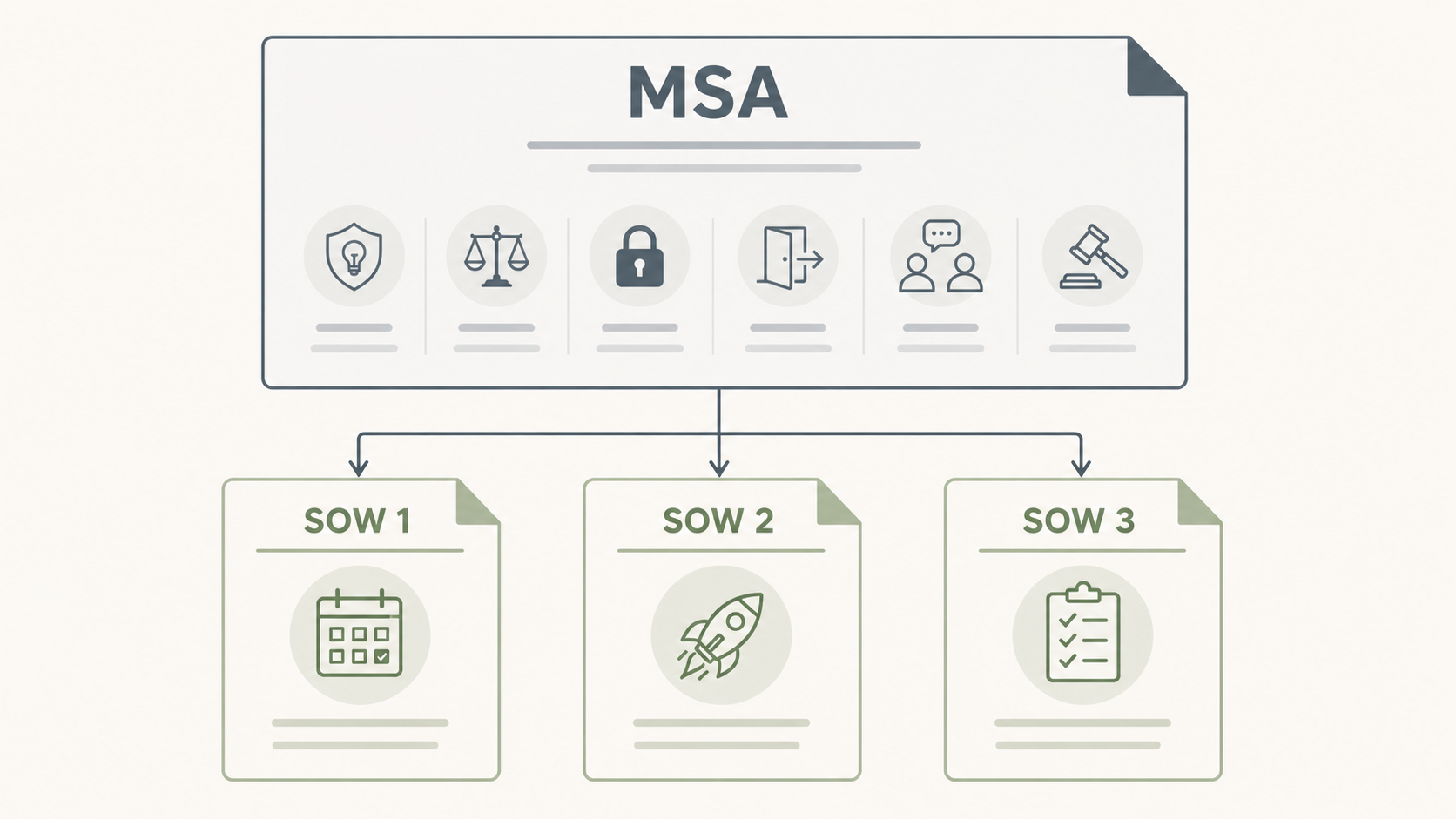
For agencies with multiple recurring clients, structure as MSA (Master Services Agreement) + SOW (Statement of Work) — the MSA covers terms once, individual SOWs handle scope and pricing per engagement. 78% of B2B companies with recurring vendor relationships use this pattern in 2026.
Always have a licensed attorney review your template before using it. A $500–$2,000 one-time review is the highest-leverage legal spend you can make.
The full guide below covers each clause with sample language, common pitfalls, the 2026 legal-landscape changes, and a complete copy-paste contract template.
Single Service Agreement vs MSA + SOW: Which Structure to Use
The first decision is structural. Two approaches work; the right one depends on how your agency operates.
Single Service Agreement
One document covering everything — parties, scope, terms, IP, liability, termination, all in one place.
Use this if:
- You're a new agency with 1–5 clients, mostly retainer engagements
- Your scope rarely changes mid-engagement
- Each client engagement is a discrete relationship with no expectation of multiple projects
- You want simpler operations (one document per client)
Master Services Agreement (MSA) + Statement of Work (SOW)
Two-document structure: the MSA covers the legal framework that applies to all engagements, and individual SOWs cover the specific scope, pricing, and deliverables of each project or retainer.
Use this if:
- You have or expect multiple ongoing engagements with the same client (retainer + project work + ad campaigns)
- You're working with mid-market or enterprise clients (their procurement teams expect MSAs)
- Your scope changes frequently and you want to amend SOWs without renegotiating the legal framework
- Your agency expects to scale past 10–15 clients with diverse engagement structures
Per recent contract industry data, 78% of B2B companies with recurring vendor relationships use MSAs to streamline negotiations and reduce legal risk. The pattern: sign MSA once, then issue SOWs for each new project (e.g., one MSA with the client, separate SOWs for "Q3 Social Campaign," "LinkedIn Thought Leadership Retainer," "Black Friday Paid Ads").
Hierarchy rule: if there's a conflict between the MSA and a SOW, the MSA almost always wins unless the SOW explicitly states an exception. So you can use SOW-level exceptions for one-off needs (e.g., "this SOW supersedes Section 4.2 of the MSA regarding payment terms").
What this guide covers
The clauses below work in either structure — they appear in a Single Service Agreement or in the MSA half of an MSA+SOW pair. The actual scope and pricing details (which would be the SOW in the two-document model) are covered in our companion piece on the social media agency proposal template, since the proposal becomes the basis for the SOW.
The 12 Essential Clauses Every Social Media Agency Contract Needs
Each clause below is explained with: what it does, why it matters, sample language you can adapt, and common pitfalls that hurt agencies.
Clause 1: Parties, Term, and Recitals
The opening section. Identifies who's signing, what they're agreeing to in general terms, and how long the agreement lasts.
What to include:
- Legal names of both parties (LLC, Inc., individual)
- Effective date
- Term (initial term + renewal terms)
- Brief recitals explaining the purpose of the agreement
Sample language:
THIS SOCIAL MEDIA MARKETING SERVICES AGREEMENT (this "Agreement") is entered into as of [Date] (the "Effective Date") by and between [Your Agency Name, LLC], a [State] limited liability company ("Agency"), and [Client Name, Inc.], a [State] [corporation/limited liability company/sole proprietorship] ("Client").
RECITALS
WHEREAS, Agency provides professional social media marketing and management services; and
WHEREAS, Client desires to engage Agency to perform such services on the terms set forth in this Agreement.
NOW, THEREFORE, in consideration of the mutual covenants contained herein, the parties agree as follows:
Term clause:
Term. The initial term of this Agreement shall commence on the Effective Date and continue for a period of three (3) months (the "Initial Term"), after which it shall automatically renew on a month-to-month basis unless terminated as provided in Section [Termination].
Common pitfall: Auto-renewal language without notice requirement. Always include "unless terminated with [N] days notice." Without it, you can be locked into renewals you didn't intend.
Clause 2: Scope of Services
The most operational clause and the most common source of dispute. Specifics protect both parties.
What to include:
- Specific deliverables (what you'll produce)
- Quantities (number of posts, frequency, platforms)
- Inclusions and explicit exclusions
- Reference to attached SOW or Schedule for engagements that will evolve
Sample language:
Services. Agency agrees to provide the social media marketing services described in Schedule A attached hereto and incorporated by reference (the "Services"). Services include, without limitation:
(a) Content production, scheduling, and publishing across the platforms identified in Schedule A; (b) Community management, including responding to comments and direct messages within Agency's stated response time; (c) Monthly performance reporting; (d) Strategy planning and recommendations as detailed in Schedule A.
Any services not expressly included in Schedule A are outside the scope of this Agreement and shall be quoted separately as add-on services.
Then attach Schedule A with detailed specs (e.g., "24 posts/month across LinkedIn, Instagram, TikTok; community management within 4 business hours; monthly PDF report by the 5th of each month; monthly 60-min strategy call").
Common pitfall: Vague scope ("manage social media presence") creates infinite scope creep. Always quantify deliverables.
Clause 3: Compensation and Payment Terms
Money. The clause clients read first and where late-payment friction most often shows up.
What to include:
- Monthly fee
- Payment schedule (due date, billing cadence)
- Accepted payment methods
- Late fees
- Out-of-scope billing rate
- Suspension rights for non-payment
- Tax responsibility
Sample language:
Compensation. Client shall pay Agency a monthly retainer fee of $[Amount] (the "Retainer Fee") in accordance with the schedule below.
Payment Terms.
(a) Invoicing. Agency shall invoice Client on the first business day of each month, with payment due within fifteen (15) days of the invoice date ("Net-15").
(b) Method. Payments shall be made via ACH transfer or credit card through Agency's invoicing platform. Wire transfer or check payments may be arranged with Agency's prior written consent.
(c) Late Fees. Any payment not received within fifteen (15) days of the invoice date shall accrue interest at the rate of one and one-half percent (1.5%) per month, or the maximum rate permitted by applicable law, whichever is lower.
(d) Suspension for Non-Payment. If Client's payment is more than ten (10) days past due, Agency may, in its sole discretion, suspend performance of the Services until all outstanding amounts (including late fees) are paid in full. Such suspension shall not constitute a breach of this Agreement by Agency.
(e) Out-of-Scope Work. Any services performed outside the scope defined in Schedule A shall be billed separately at Agency's then-current hourly rate of $[Rate]/hour, with prior written approval from Client before such work commences.
(f) Taxes. Client shall be responsible for all sales, use, value-added, or similar taxes arising from this Agreement, excluding taxes based on Agency's net income.
Common pitfall: Net-30 invites lateness. Net-15 closes faster on average and maps better to most agencies' cash flow needs.
Clause 4: Intellectual Property and Content Ownership
The clause where most agency contracts have hidden weakness. Get this wrong and you can deliver content that the client doesn't actually own — or end up unable to reuse your own templates and frameworks.
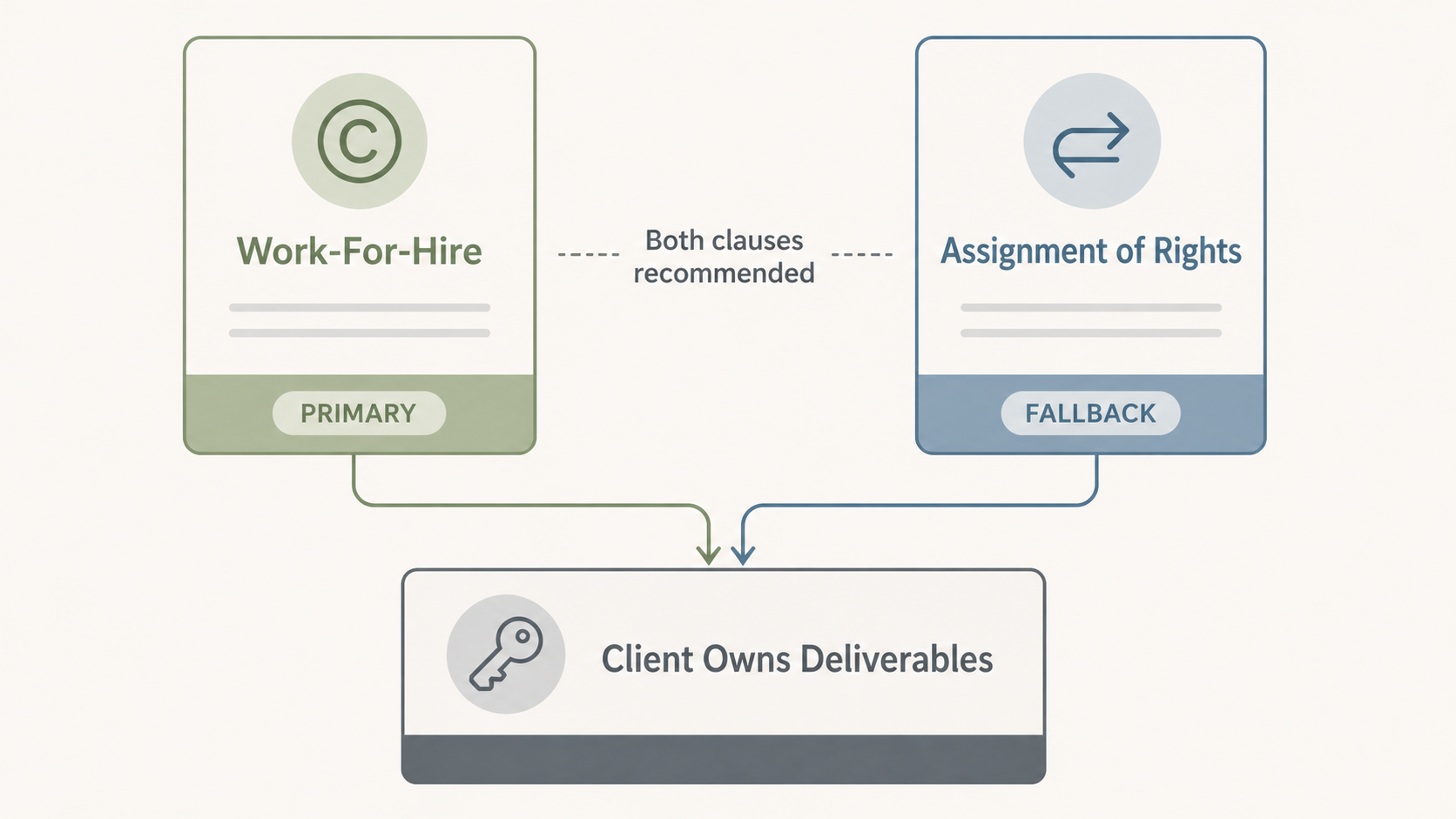
The best-practice pattern combines two mechanisms:
- Work-for-hire designation (covers most categories)
- Present-tense assignment of rights (catches anything work-for-hire fails to capture)
Per marketing IP guidance, work-for-hire alone can fail because not every type of marketing deliverable falls within the specific categories the U.S. Copyright Act recognizes for work-made-for-hire treatment. The combo (work-for-hire + assignment) is the safer drafting pattern.
What to include:
- Definition of deliverables vs Agency's pre-existing IP
- Work-for-hire designation
- Present-tense assignment language
- Agency's retained rights to templates, methods, and tools
- Limited license back to Agency for portfolio use
Sample language:
Intellectual Property.
(a) Deliverables. All content, materials, and other deliverables specifically created by Agency for Client under this Agreement (the "Deliverables") shall be considered "work made for hire" as defined in 17 U.S.C. § 101 to the maximum extent permitted by law.
(b) Assignment. To the extent any Deliverable does not qualify as work made for hire, Agency hereby irrevocably assigns, transfers, and conveys to Client all right, title, and interest in and to such Deliverable, including all copyrights, trademarks, and other intellectual property rights, effective upon Client's payment in full for the applicable Services.
(c) Agency Retained Rights. Notwithstanding the foregoing, Agency shall retain all right, title, and interest in and to: (i) Agency's proprietary methodologies, processes, frameworks, and templates used in providing the Services; (ii) any pre-existing intellectual property of Agency; and (iii) any tools, software, or systems developed by Agency. Agency grants Client a non-exclusive, perpetual, royalty-free license to use such retained materials solely as embodied in the Deliverables.
(d) Portfolio License. Client grants Agency a perpetual, non-exclusive, royalty-free license to display the Deliverables and reference Client's name and logo in Agency's portfolio, case studies, and marketing materials, subject to Client's right to request reasonable redactions.
Common pitfall: Forgetting the "upon payment in full" condition on the assignment. Without it, the client owns the IP regardless of whether they pay you. With it, non-payment leaves IP with the agency — which is a meaningful enforcement tool.
Clause 5: Confidentiality
Standard but important. Protects both parties' sensitive information.
What to include:
- Definition of "Confidential Information"
- Mutual obligations
- Exclusions (publicly available info, prior knowledge)
- Term of confidentiality (typically 2–3 years post-termination, indefinite for trade secrets)
Sample language:
Confidentiality.
(a) Definition. "Confidential Information" means any non-public information disclosed by either party to the other in connection with this Agreement, including business plans, strategies, customer lists, financial information, technical data, and trade secrets.
(b) Obligations. Each party shall: (i) use the other party's Confidential Information solely for the purpose of performing this Agreement; (ii) not disclose Confidential Information to any third party without the other party's prior written consent; and (iii) protect Confidential Information using at least the same degree of care it uses to protect its own confidential information of similar nature, but in no event less than reasonable care.
(c) Exclusions. Confidential Information does not include information that: (i) is or becomes publicly available through no fault of the receiving party; (ii) was known to the receiving party prior to disclosure; (iii) is rightfully received from a third party without obligation of confidentiality; or (iv) is independently developed without use of the disclosing party's Confidential Information.
(d) Term. The obligations in this Section shall survive termination of this Agreement for a period of three (3) years, except that obligations regarding trade secrets shall continue for as long as such information qualifies as a trade secret under applicable law.
Clause 6: Performance Metrics and Reporting
Aligns expectations on what success looks like and what reporting cadence the client receives.
What to include:
- KPIs the engagement will track
- Reporting cadence and format
- Acknowledgment that platform-side variables affect outcomes
- No guaranteed-outcome language (avoid hard performance guarantees)
Sample language:
Reporting and Performance.
(a) Reporting. Agency shall provide Client with monthly performance reports covering the metrics defined in Schedule A, delivered no later than the fifth (5th) business day of each month following the reporting period.
(b) No Guaranteed Outcomes. Client acknowledges that social media performance depends on factors outside Agency's control, including but not limited to platform algorithm changes, audience behavior, market conditions, and Client's product or business changes. Agency makes no representations or warranties regarding specific outcomes, follower counts, engagement rates, or conversions.
(c) Process Commitments. Agency commits to deliver the Services described in Schedule A on the schedule described therein. Process-based commitments (e.g., delivery of N posts per month, response within N business hours) shall be measured against Agency's stated deliverables.
Common pitfall: Performance guarantees ("we'll grow followers 50% in 90 days"). Algorithm changes, platform shifts, and client-side changes make outcome guarantees genuinely uncontrollable. Process commitments are honest and enforceable; outcome guarantees aren't.
Clause 7: Termination
How the agreement ends. Most-negotiated clause after pricing.
What to include:
- Termination for convenience (any reason, with notice)
- Termination for cause (immediate, for breach)
- Notice period (30 days standard for convenience)
- Effects of termination (final invoices, IP, ongoing obligations)
- Survival of certain clauses post-termination
Sample language:
Termination.
(a) For Convenience. Either party may terminate this Agreement for any reason upon thirty (30) days' prior written notice to the other party, provided that the Initial Term has been completed.
(b) For Cause. Either party may terminate this Agreement immediately upon written notice if the other party: (i) materially breaches this Agreement and fails to cure such breach within fifteen (15) days of receiving written notice describing the breach; (ii) becomes insolvent, files for bankruptcy, or makes a general assignment for the benefit of creditors; or (iii) ceases to do business.
(c) Effects of Termination. Upon termination: (i) Agency shall complete any work in progress through the effective date of termination and deliver any completed work to Client upon payment of all outstanding amounts; (ii) Client shall pay Agency for all Services performed through the effective date of termination, plus any out-of-scope work approved before termination; (iii) Each party shall return or destroy the other party's Confidential Information at the disclosing party's option; (iv) Sections covering Intellectual Property, Confidentiality, Indemnification, Limitation of Liability, and Dispute Resolution shall survive termination.
Common pitfall: Allowing termination during the Initial Term. The 3-month minimum exists for a reason — social media work compounds, and one-month engagements don't show enough data. Make convenience-termination available after the Initial Term, not during it.
Clause 8: Limitation of Liability
The clause that determines what happens if something goes wrong. Per industry guidance on liability caps, almost all marketing contracts include some form of liability cap.
Standard cap structure:
- Total liability capped at 6–12 months of fees paid (or to be paid)
- Carve-outs (uncapped exposures): indemnification obligations, breach of confidentiality, gross negligence, willful misconduct, IP infringement claims
Sample language:
Limitation of Liability.
(a) Cap on Liability. Except as provided in subsection (b), each party's total cumulative liability arising out of or related to this Agreement, regardless of the form of action, shall not exceed the total fees paid by Client to Agency under this Agreement during the twelve (12) months preceding the event giving rise to the claim.
(b) Exclusions from Cap. The limitation in subsection (a) shall not apply to: (i) either party's indemnification obligations under this Agreement; (ii) breach of the Confidentiality section; (iii) breach of the Intellectual Property section; (iv) any party's gross negligence or willful misconduct; or (v) Client's payment obligations.
(c) Exclusion of Indirect Damages. In no event shall either party be liable for any indirect, incidental, consequential, special, or punitive damages, including lost profits or business interruption, even if advised of the possibility of such damages.
Common pitfall: Uncapped liability for indirect damages. A client-favoring contract may try to make the agency liable for "lost profits" — which can be unbounded. Always cap or exclude indirect damages.
Clause 9: Indemnification
Who covers what when third-party claims arise. Best practice: mutual indemnification, not one-sided.
Sample language:
Indemnification.
(a) Agency Indemnifies Client. Agency shall indemnify, defend, and hold harmless Client and its officers, directors, employees, and affiliates from and against any third-party claims, damages, liabilities, costs, and expenses (including reasonable attorneys' fees) arising out of or related to: (i) Agency's gross negligence or willful misconduct in performing the Services; (ii) Agency's breach of any representation, warranty, or covenant in this Agreement; or (iii) any claim that Agency-created content infringes the intellectual property rights of a third party (excluding Client-Provided Materials).
(b) Client Indemnifies Agency. Client shall indemnify, defend, and hold harmless Agency and its officers, directors, employees, and affiliates from and against any third-party claims, damages, liabilities, costs, and expenses (including reasonable attorneys' fees) arising out of or related to: (i) Client's products, services, or business activities; (ii) Client-Provided Materials, including any claim that such materials infringe third-party rights; (iii) Client's compliance with applicable advertising, marketing, privacy, and consumer protection laws; (iv) Client's instructions or approvals that result in legal liability; or (v) Client's breach of any representation, warranty, or covenant in this Agreement.
(c) Procedure. The party seeking indemnification ("Indemnitee") shall: (i) promptly notify the indemnifying party ("Indemnitor") in writing of any claim; (ii) give the Indemnitor sole control over the defense and settlement of the claim; and (iii) reasonably cooperate at Indemnitor's expense.
Common pitfall: One-sided indemnification (where only the agency indemnifies the client). Mutual is fairer and standard in well-negotiated agreements. The client often makes the claims, sets the constraints, and is responsible for product accuracy — they should bear the risk that flows from those actions.
Clause 10: Non-Solicitation (NOT Non-Compete) — A 2026 Note
This is where 2026 is very different from 2023. Non-compete clauses are increasingly unenforceable across multiple US states; non-solicitation clauses generally remain enforceable when narrowly drafted.
The 2026 legal landscape:
- Washington (effective June 30, 2027): banning nearly all non-compete agreements for employees and independent contractors
- Virginia (Senate Bill 170, effective July 1, 2026): non-competes unenforceable if employer discharges without cause and provides no severance
- Minnesota (already in effect): non-competes broadly banned
- California, Oklahoma, North Dakota (long-standing): non-competes broadly unenforceable
- FTC federal non-compete ban: enforcement status remains uncertain following 2024 court decisions; states have continued passing their own restrictions
Non-solicitation clauses (preventing former clients/contractors from poaching each other's people or clients) remain generally enforceable when:
- Scope is precise and narrow (specific named clients or employees, not industry-wide)
- Duration is reasonable (typically 12–24 months post-termination)
- Geographic scope is reasonable
- The restriction protects a legitimate interest (client relationships, trade secrets)
Sample language (non-solicitation, no non-compete):
Non-Solicitation.
(a) Of Employees and Contractors. During the Term and for a period of twelve (12) months following termination, Client shall not, directly or indirectly, solicit, hire, or engage any employee, independent contractor, or subcontractor of Agency who performed services for Client under this Agreement, without Agency's prior written consent.
(b) Reciprocal. During the Term and for a period of twelve (12) months following termination, Agency shall not, directly or indirectly, solicit any employee of Client with whom Agency had material contact during the engagement, without Client's prior written consent.
(c) Liquidated Damages. The parties acknowledge that damages for breach of this Section are difficult to calculate and agree that liquidated damages equal to one hundred fifty percent (150%) of the affected individual's annualized compensation shall be a reasonable estimate. The parties agree this provision is not a penalty.
Common pitfall (avoid): Including a traditional non-compete clause ("Client will not work with another social media agency for 12 months"). These are increasingly unenforceable, can void the entire restrictive covenant section in some jurisdictions, and signal an outdated contract approach to sophisticated buyers.
Clause 11: Data Privacy and Compliance
Increasingly important for agencies handling cross-border or regulated industry work.
What to include:
- Acknowledgment of applicable privacy laws (GDPR, CCPA, DPDP, etc.)
- Data processing roles (controller vs processor)
- Industry-specific compliance (HIPAA for healthcare, FINRA for finance)
- Breach notification requirements
Sample language:
Data Privacy and Compliance.
(a) Compliance with Laws. Each party shall comply with all applicable laws, regulations, and industry standards in performing its obligations under this Agreement, including but not limited to: (i) the General Data Protection Regulation (GDPR) for personal data of EU residents; (ii) the California Consumer Privacy Act (CCPA) for personal data of California residents; (iii) the Digital Personal Data Protection Act (DPDP) for personal data of India residents; and (iv) any other applicable data privacy laws.
(b) Data Processing Roles. For purposes of GDPR and similar privacy laws, Client is the controller of personal data of its customers and audience, and Agency acts as a processor solely for the limited purpose of performing the Services described in Schedule A.
(c) Industry-Specific Compliance. [Include if applicable: For Services involving healthcare-related content, both parties shall comply with the Health Insurance Portability and Accountability Act (HIPAA) and execute a separate Business Associate Agreement.]
(d) Breach Notification. Each party shall notify the other within seventy-two (72) hours of becoming aware of any data breach involving the other party's data or Confidential Information.
Clause 12: Force Majeure, Dispute Resolution, and Miscellaneous
The closing operational clauses.
Force Majeure:
Force Majeure. Neither party shall be liable for any failure or delay in performance due to causes beyond its reasonable control, including but not limited to acts of God, natural disasters, pandemics, government actions, war, terrorism, or failure of major social media platforms or third-party services. The affected party shall provide prompt notice and use commercially reasonable efforts to resume performance.
Dispute Resolution:
Dispute Resolution.
(a) Informal Resolution. The parties shall first attempt to resolve any dispute through good-faith discussions between senior representatives of each party for a period of thirty (30) days.
(b) Mediation. If informal resolution fails, the parties shall submit the dispute to non-binding mediation conducted by a mutually agreed mediator under the rules of the American Arbitration Association.
(c) Arbitration. Any dispute not resolved through mediation shall be finally settled by binding arbitration administered by JAMS under its Comprehensive Arbitration Rules. The arbitration shall be conducted in [Your Agency's State], and judgment on the award may be entered in any court having jurisdiction.
(d) Governing Law. This Agreement shall be governed by the laws of the State of [Your Agency's State], without regard to its conflict-of-laws principles.
Miscellaneous:
Miscellaneous.
(a) Entire Agreement. This Agreement, together with any Schedules, constitutes the entire agreement between the parties and supersedes all prior agreements regarding its subject matter.
(b) Amendments. Any amendment must be in writing and signed by both parties.
(c) Assignment. Neither party may assign this Agreement without the other party's prior written consent, except that either party may assign to a successor in connection with a merger, acquisition, or sale of substantially all assets.
(d) Independent Contractor. Agency is an independent contractor. Nothing in this Agreement creates an employer-employee relationship, partnership, or joint venture.
(e) Notices. All notices shall be in writing and delivered to the addresses listed in the signature block.
(f) Severability. If any provision is held unenforceable, the remaining provisions shall continue in full force.
(g) Counterparts and Electronic Signature. This Agreement may be executed in counterparts, including by electronic signature, each of which shall be deemed an original.
The Complete Copy-Paste Contract Template
Below is the full Service Agreement assembled in one block. Copy it into your contract tool of choice (PandaDoc, DocuSign, Bonsai, Better Proposals, or Google Docs), replace the bracketed placeholders, attach Schedule A with your scope-of-work details, and always have it reviewed by a licensed attorney before sending to clients.
SOCIAL MEDIA MARKETING SERVICES AGREEMENT
This Social Media Marketing Services Agreement (this "Agreement") is entered into as of [Effective Date] (the "Effective Date") by and between [Your Agency Name, LLC], a [State] limited liability company with its principal place of business at [Address] ("Agency"), and [Client Name], a [State] [entity type] with its principal place of business at [Address] ("Client").
RECITALS
WHEREAS, Agency provides professional social media marketing and management services; and
WHEREAS, Client desires to engage Agency to perform such services on the terms set forth in this Agreement.
NOW, THEREFORE, in consideration of the mutual covenants contained herein, the parties agree as follows:
1. SERVICES
1.1 Agency shall provide the social media marketing services described in Schedule A attached hereto and incorporated by reference (the "Services").
1.2 Any services not expressly included in Schedule A are outside the scope of this Agreement and shall be quoted separately as add-on services, with prior written approval from Client before such work commences. Out-of-scope work shall be billed at Agency's then-current hourly rate of $[Rate]/hour.
2. TERM
2.1 The initial term of this Agreement shall commence on the Effective Date and continue for a period of three (3) months (the "Initial Term"), after which it shall automatically renew on a month-to-month basis unless terminated as provided in Section 8.
3. COMPENSATION
3.1 Client shall pay Agency a monthly retainer fee of $[Amount] (the "Retainer Fee").
3.2 Agency shall invoice Client on the first business day of each month, with payment due within fifteen (15) days of the invoice date ("Net-15").
3.3 Payments shall be made via ACH transfer or credit card through Agency's invoicing platform. Other methods may be arranged with Agency's prior written consent.
3.4 Any payment not received within fifteen (15) days of the invoice date shall accrue interest at one and one-half percent (1.5%) per month, or the maximum rate permitted by applicable law, whichever is lower.
3.5 If Client's payment is more than ten (10) days past due, Agency may suspend performance of the Services until all outstanding amounts are paid in full. Such suspension shall not constitute a breach by Agency.
3.6 Client shall be responsible for all sales, use, value-added, or similar taxes arising from this Agreement, excluding taxes based on Agency's net income.
4. INTELLECTUAL PROPERTY
4.1 All content, materials, and other deliverables specifically created by Agency for Client under this Agreement (the "Deliverables") shall be considered "work made for hire" as defined in 17 U.S.C. § 101 to the maximum extent permitted by law.
4.2 To the extent any Deliverable does not qualify as work made for hire, Agency hereby irrevocably assigns, transfers, and conveys to Client all right, title, and interest in and to such Deliverable, including all copyrights, trademarks, and other intellectual property rights, effective upon Client's payment in full for the applicable Services.
4.3 Notwithstanding the foregoing, Agency shall retain all right, title, and interest in and to: (a) Agency's proprietary methodologies, processes, frameworks, and templates used in providing the Services; (b) any pre-existing intellectual property of Agency; and (c) any tools, software, or systems developed by Agency. Agency grants Client a non-exclusive, perpetual, royalty-free license to use such retained materials solely as embodied in the Deliverables.
4.4 Client grants Agency a perpetual, non-exclusive, royalty-free license to display the Deliverables and reference Client's name and logo in Agency's portfolio, case studies, and marketing materials, subject to Client's right to request reasonable redactions.
5. CONFIDENTIALITY
5.1 "Confidential Information" means any non-public information disclosed by either party to the other in connection with this Agreement, including business plans, strategies, customer lists, financial information, technical data, and trade secrets.
5.2 Each party shall: (a) use the other party's Confidential Information solely for the purpose of performing this Agreement; (b) not disclose Confidential Information to any third party without the other party's prior written consent; and (c) protect Confidential Information using at least the same degree of care it uses to protect its own confidential information of similar nature, but in no event less than reasonable care.
5.3 Confidential Information does not include information that: (a) is or becomes publicly available through no fault of the receiving party; (b) was known to the receiving party prior to disclosure; (c) is rightfully received from a third party without obligation of confidentiality; or (d) is independently developed without use of the disclosing party's Confidential Information.
5.4 The obligations in this Section shall survive termination of this Agreement for a period of three (3) years, except that obligations regarding trade secrets shall continue for as long as such information qualifies as a trade secret under applicable law.
6. REPORTING AND PERFORMANCE
6.1 Agency shall provide Client with monthly performance reports covering the metrics defined in Schedule A, delivered no later than the fifth (5th) business day of each month following the reporting period.
6.2 Client acknowledges that social media performance depends on factors outside Agency's control, including platform algorithm changes, audience behavior, market conditions, and Client's product or business changes. Agency makes no representations or warranties regarding specific outcomes, follower counts, engagement rates, or conversions.
6.3 Agency commits to deliver the Services described in Schedule A on the schedule described therein. Process-based commitments shall be measured against Agency's stated deliverables.
7. CLIENT OBLIGATIONS
7.1 Client shall: (a) provide Agency with timely access to its social media accounts via secure API connections; (b) provide brand assets, product information, and other materials reasonably required for Agency to perform the Services ("Client-Provided Materials"); (c) review and approve content within the timeframe specified in Schedule A; (d) provide a designated point of contact for the engagement; and (e) comply with all applicable laws, regulations, and platform terms of service.
7.2 Client represents and warrants that all Client-Provided Materials are accurate, do not infringe third-party rights, and comply with applicable laws.
8. TERMINATION
8.1 Either party may terminate this Agreement for any reason upon thirty (30) days' prior written notice to the other party, provided that the Initial Term has been completed.
8.2 Either party may terminate this Agreement immediately upon written notice if the other party: (a) materially breaches this Agreement and fails to cure such breach within fifteen (15) days of receiving written notice describing the breach; (b) becomes insolvent, files for bankruptcy, or makes a general assignment for the benefit of creditors; or (c) ceases to do business.
8.3 Upon termination: (a) Agency shall complete any work in progress through the effective date of termination and deliver any completed work to Client upon payment of all outstanding amounts; (b) Client shall pay Agency for all Services performed through the effective date of termination, plus any out-of-scope work approved before termination; (c) Each party shall return or destroy the other party's Confidential Information at the disclosing party's option; (d) Sections 4 (Intellectual Property), 5 (Confidentiality), 9 (Limitation of Liability), 10 (Indemnification), 12 (Non-Solicitation), and 14 (Dispute Resolution) shall survive termination.
9. LIMITATION OF LIABILITY
9.1 Except as provided in Section 9.2, each party's total cumulative liability arising out of or related to this Agreement, regardless of the form of action, shall not exceed the total fees paid by Client to Agency under this Agreement during the twelve (12) months preceding the event giving rise to the claim.
9.2 The limitation in Section 9.1 shall not apply to: (a) either party's indemnification obligations under this Agreement; (b) breach of Section 5 (Confidentiality); (c) breach of Section 4 (Intellectual Property); (d) any party's gross negligence or willful misconduct; or (e) Client's payment obligations.
9.3 In no event shall either party be liable for any indirect, incidental, consequential, special, or punitive damages, including lost profits or business interruption, even if advised of the possibility of such damages.
10. INDEMNIFICATION
10.1 Agency shall indemnify, defend, and hold harmless Client and its officers, directors, employees, and affiliates from and against any third-party claims, damages, liabilities, costs, and expenses (including reasonable attorneys' fees) arising out of or related to: (a) Agency's gross negligence or willful misconduct in performing the Services; (b) Agency's breach of any representation, warranty, or covenant in this Agreement; or (c) any claim that Agency-created content (excluding Client-Provided Materials) infringes the intellectual property rights of a third party.
10.2 Client shall indemnify, defend, and hold harmless Agency and its officers, directors, employees, and affiliates from and against any third-party claims, damages, liabilities, costs, and expenses (including reasonable attorneys' fees) arising out of or related to: (a) Client's products, services, or business activities; (b) Client-Provided Materials, including any claim that such materials infringe third-party rights; (c) Client's compliance with applicable advertising, marketing, privacy, and consumer protection laws; (d) Client's instructions or approvals that result in legal liability; or (e) Client's breach of any representation, warranty, or covenant in this Agreement.
10.3 The party seeking indemnification ("Indemnitee") shall: (a) promptly notify the indemnifying party ("Indemnitor") in writing of any claim; (b) give the Indemnitor sole control over the defense and settlement of the claim; and (c) reasonably cooperate at Indemnitor's expense.
11. DATA PRIVACY AND COMPLIANCE
11.1 Each party shall comply with all applicable laws, regulations, and industry standards in performing its obligations under this Agreement, including the General Data Protection Regulation (GDPR), California Consumer Privacy Act (CCPA), and Digital Personal Data Protection Act (DPDP) where applicable.
11.2 For purposes of GDPR and similar privacy laws, Client is the controller of personal data of its customers and audience, and Agency acts as a processor solely for the limited purpose of performing the Services.
11.3 Each party shall notify the other within seventy-two (72) hours of becoming aware of any data breach involving the other party's data or Confidential Information.
12. NON-SOLICITATION
12.1 During the Term and for a period of twelve (12) months following termination, Client shall not, directly or indirectly, solicit, hire, or engage any employee, independent contractor, or subcontractor of Agency who performed services for Client under this Agreement, without Agency's prior written consent.
12.2 During the Term and for a period of twelve (12) months following termination, Agency shall not, directly or indirectly, solicit any employee of Client with whom Agency had material contact during the engagement, without Client's prior written consent.
12.3 The parties acknowledge that damages for breach of this Section are difficult to calculate and agree that liquidated damages equal to one hundred fifty percent (150%) of the affected individual's annualized compensation shall be a reasonable estimate. The parties agree this provision is not a penalty.
13. FORCE MAJEURE
13.1 Neither party shall be liable for any failure or delay in performance due to causes beyond its reasonable control, including acts of God, natural disasters, pandemics, government actions, war, terrorism, or failure of major social media platforms or third-party services. The affected party shall provide prompt notice and use commercially reasonable efforts to resume performance.
14. DISPUTE RESOLUTION
14.1 The parties shall first attempt to resolve any dispute through good-faith discussions between senior representatives of each party for a period of thirty (30) days.
14.2 If informal resolution fails, the parties shall submit the dispute to non-binding mediation conducted by a mutually agreed mediator under the rules of the American Arbitration Association.
14.3 Any dispute not resolved through mediation shall be finally settled by binding arbitration administered by JAMS under its Comprehensive Arbitration Rules. The arbitration shall be conducted in [Your Agency's State], and judgment on the award may be entered in any court having jurisdiction.
14.4 This Agreement shall be governed by the laws of the State of [Your Agency's State], without regard to its conflict-of-laws principles.
15. MISCELLANEOUS
15.1 Entire Agreement. This Agreement, together with any Schedules, constitutes the entire agreement between the parties and supersedes all prior agreements regarding its subject matter.
15.2 Amendments. Any amendment must be in writing and signed by both parties.
15.3 Assignment. Neither party may assign this Agreement without the other party's prior written consent, except that either party may assign to a successor in connection with a merger, acquisition, or sale of substantially all assets.
15.4 Independent Contractor. Agency is an independent contractor. Nothing in this Agreement creates an employer-employee relationship, partnership, or joint venture.
15.5 Notices. All notices shall be in writing and delivered to the addresses listed in the signature block.
15.6 Severability. If any provision is held unenforceable, the remaining provisions shall continue in full force.
15.7 Counterparts and Electronic Signature. This Agreement may be executed in counterparts, including by electronic signature, each of which shall be deemed an original.
SIGNATURE PAGE
IN WITNESS WHEREOF, the parties have executed this Agreement as of the Effective Date.
AGENCY:
[Your Agency Name, LLC]
By: ____________________________
Name: [Your Name]
Title: [Your Title]
Date: ____________________________CLIENT:
[Client Name]
By: ____________________________
Name: [Authorized Signatory]
Title: [Title]
Date: ____________________________
SCHEDULE A — SCOPE OF SERVICES
[Attach detailed scope of work — platforms, content quantities, community management hours, reporting cadence, KPIs, and any client-specific requirements. The proposal you sent before this contract becomes the basis for Schedule A.]
How to use this template
- Have it reviewed by an attorney before first use. A one-time review costs $500–$2,000 and is the highest-leverage legal investment your agency can make. Specifically ask the attorney to review state-specific concerns (governing law, non-solicitation enforceability, choice of forum).
- Customize the bracketed placeholders for each client engagement.
- Attach Schedule A with the scope of work — pull this directly from the proposal you sent.
- Send via an e-signature tool (PandaDoc, DocuSign, Bonsai, Better Proposals). E-signed contracts close 28% faster than print-sign-scan workflows per Proposify 2025 data.
- Update annually. Legal landscape changes (the 2026 non-compete shifts are an example). Re-review the template at least once a year with your attorney.
For the scope-of-work content that fills Schedule A, use the social media agency proposal template — proposals and contracts are designed to work as a pair.
 PostPlanify
All your social media in one simple dashboard
Schedule posts, track analytics, and reply to comments/DMs without switching tabs.

Engagement
+18%
Views
52.8k
Common Contract Mistakes That Hurt Agencies
The patterns that cost agencies money or expose them to risk:
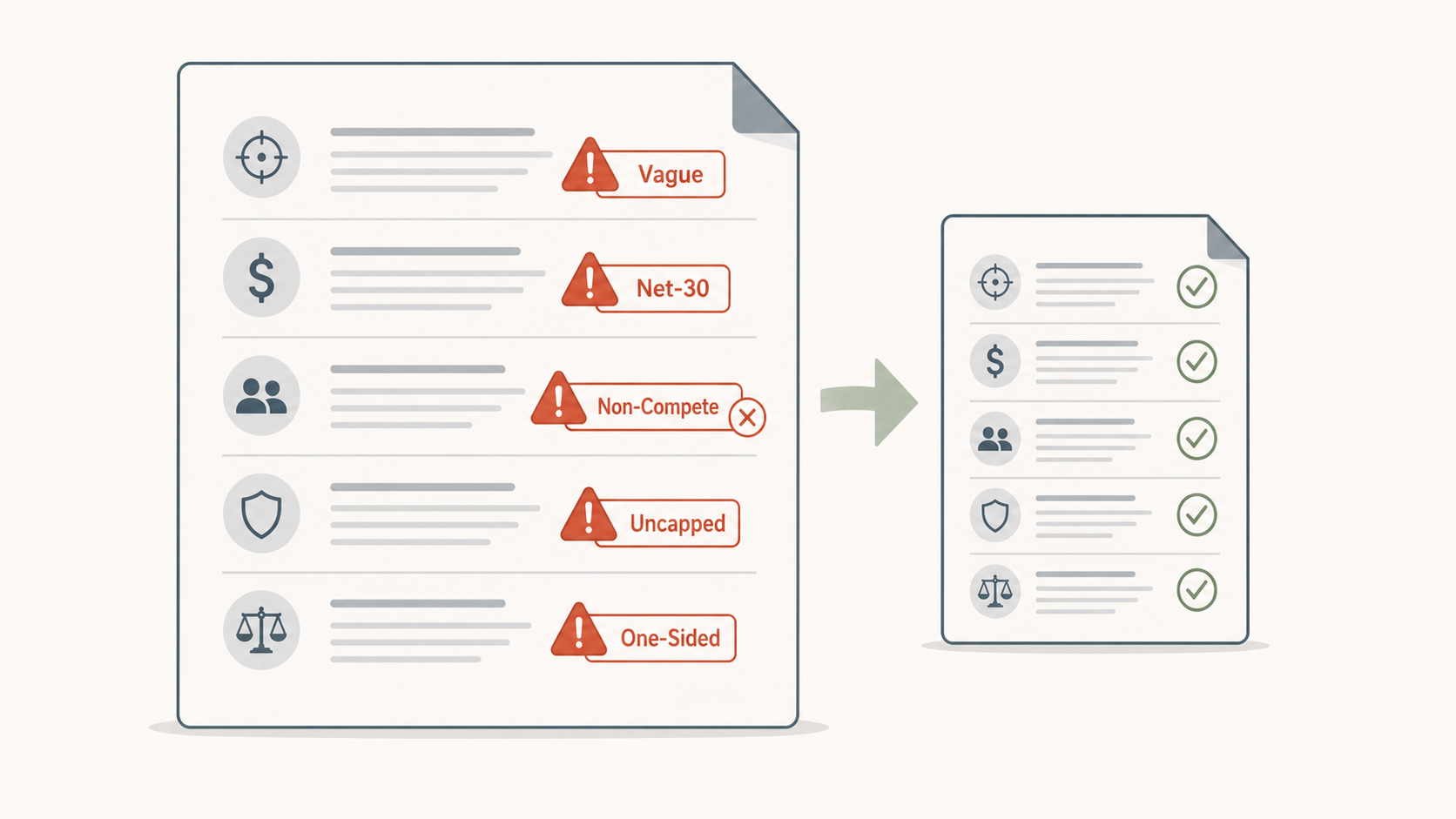
1. Generic "found-on-Google" template without attorney review. Templates designed for any service business miss social-media-specific concerns (platform compliance, content IP, community management liability). A $500–$2,000 attorney review pays for itself in the first dispute avoided.
2. Vague scope of work. "Manage social media" creates infinite scope creep. Always quantify deliverables (24 posts/month, 4 hours/business day community management, monthly PDF report by the 5th).
3. Missing the IP assignment + work-for-hire combo. Work-for-hire alone can fail because not all marketing deliverables qualify under the U.S. Copyright Act. Always combine: work-for-hire designation + present-tense assignment of rights as a fallback.
4. Net-30 payment terms. Net-15 closes faster on average and matches most agencies' cash flow needs better.
5. No suspension-for-non-payment clause. Without it, you're obligated to perform even when the client is late paying. With it, you have leverage.
6. One-sided indemnification. A contract that makes only the agency liable to the client is unbalanced. Mutual indemnification is fairer and standard.
7. Including a non-compete clause. Increasingly unenforceable in 2026 (Washington banning, Virginia restricting, FTC enforcement uncertain). Use non-solicitation instead, narrowly drafted.
8. No liability cap or unlimited indirect damages. Always cap total liability at 6–12 months of fees. Always exclude indirect damages.
9. Auto-renewal without notice requirement. Lock-in is the wrong default. Auto-renew month-to-month with 30-day notice is the right pattern.
10. Ignoring data privacy compliance. GDPR, CCPA, and DPDP are not optional. International or California-based clients require explicit acknowledgment.
11. No "no guaranteed outcomes" language. Algorithm changes, platform shifts, and client-side variables make outcome guarantees unenforceable. Process commitments are the right framing.
12. Forgetting survival clauses. Confidentiality, IP, indemnification, and liability limits should survive termination — otherwise you lose protection the moment the engagement ends.
Contract Tooling: PandaDoc, DocuSign, Bonsai, Better Proposals, Notion
Where to actually create, send, and track your contracts. The right choice depends on volume and integration needs.
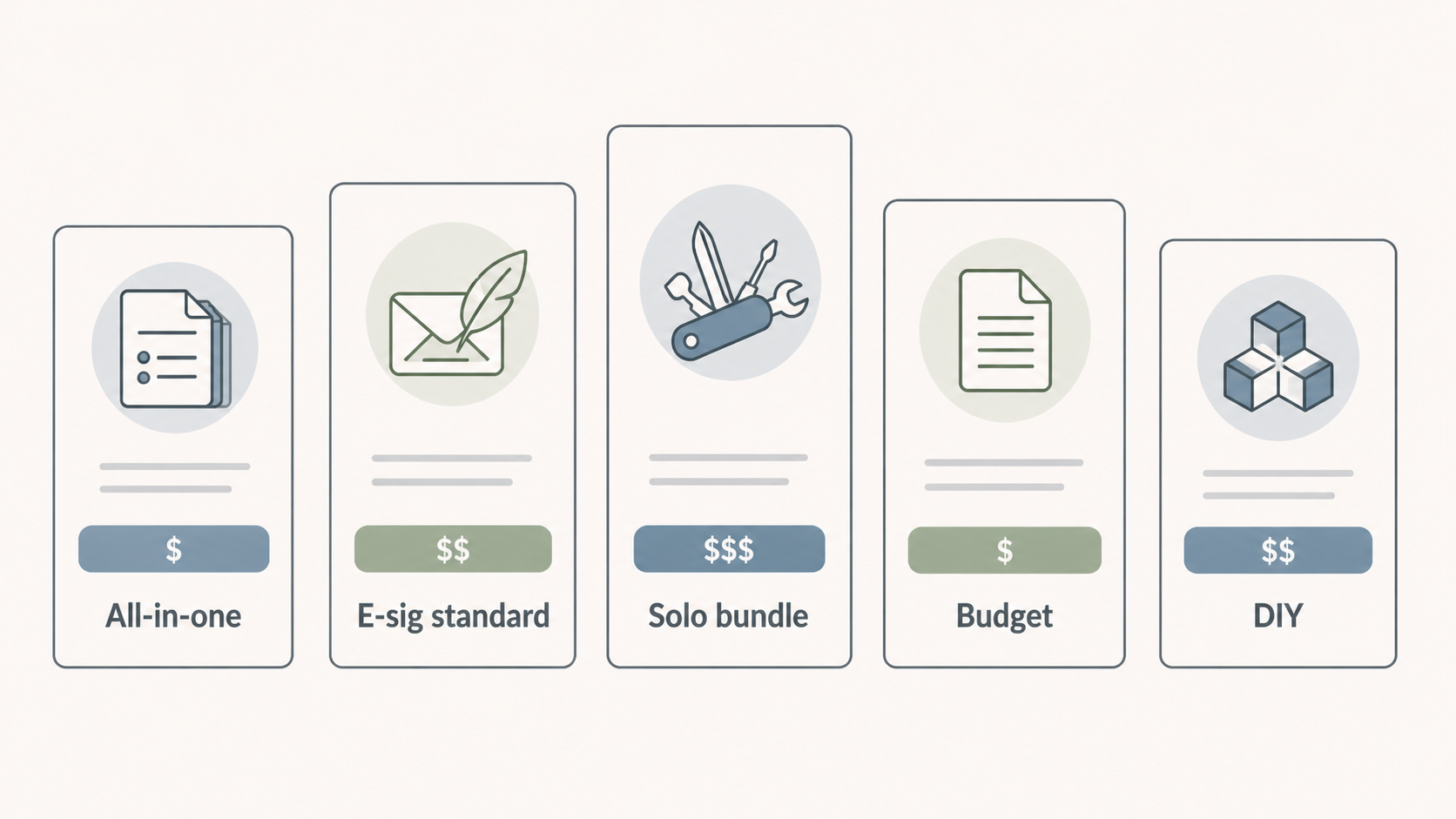
PandaDoc — Best all-around for agencies
- Pricing: Starts ~$35/user/mo (Essentials), up to $100+/user/mo (Enterprise)
- Strengths: Beyond contracts — proposals, invoicing, payment collection in one tool. Strong e-signature workflow with audit trails. Document analytics show when contracts are opened and which sections get the most attention. Native CPQ (configure-price-quote) on Enterprise.
- Weaknesses: Learning curve for advanced workflows; designs feel less polished than Proposify for sales-led agencies.
- Best for: Agencies that want one tool covering proposals + contracts + invoicing.
DocuSign — Best e-signature standard
- Pricing: Starts ~$10/user/mo (Personal — basic e-signature), up to $40+/user/mo (Business Pro)
- Strengths: Industry-standard e-signature; strongest audit trail and legal admissibility record. Works for agencies in legal-adjacent or compliance-heavy verticals (healthcare, finance) where signature provenance matters. Wide third-party integration ecosystem.
- Weaknesses: Not a contract-creation tool — you draft elsewhere and use DocuSign to send for signature. Higher tiers required for templates and advanced workflows.
- Best for: Agencies whose clients require DocuSign specifically (common with enterprise/regulated clients), or agencies that have heavy contract-volume and need the strongest legal-admissibility track record.
Bonsai — Best all-in-one for solo and small agencies
- Pricing: Starts ~$21/user/mo (Starter), up to ~$66/user/mo (Business)
- Strengths: Combines contracts, proposals, invoicing, payments, time tracking, and CRM in one tool. Solid pre-built contract templates including freelance/agency-specific ones. Tax tracking and 1099 reporting bundled.
- Weaknesses: Less depth on each individual function compared to dedicated tools (PandaDoc for proposals, DocuSign for e-sig, QuickBooks for accounting).
- Best for: Solo founders and 1–3 person agencies who want one tool for the whole back-office.
Better Proposals — Best budget option
- Pricing: Starts ~$20/user/mo
- Strengths: Cheapest of the dedicated proposal/contract tools. Clean templates including contract-style options. Fast deployment; good for new agencies.
- Weaknesses: Less depth on contract-specific workflows; better as a proposal tool than a contract tool.
- Best for: Brand-new agencies in months 1–6 sending contracts alongside proposals on a tight tooling budget.
Notion — DIY option
- Pricing: Free or $10/user/mo
- Strengths: Highly customizable; embed templates, use database-style tracking. Free tier is genuinely usable.
- Weaknesses: No native e-signature (requires HelloSign, DocuSign, or similar add-on). No native contract analytics. Manual setup for every contract.
- Best for: Technical founders who already live in Notion and want to keep the operational stack simple, paired with a separate e-signature tool.
Recommendation by agency stage
- First 1–3 clients: Bonsai ($21/mo) — single tool covers contract + invoicing + proposals
- Months 6–18 / under $25K MRR: PandaDoc ($35/mo) for proposals + contracts + analytics
- $25K+ MRR with enterprise clients: PandaDoc + DocuSign for high-stakes contracts where audit trails matter
Whatever you pick, the meaningful uplift over Word docs is engagement tracking + e-signature integration. Per Proposify's 2025 data, proposals and contracts with integrated e-signatures close 28% faster than those requiring print-sign-scan or separate e-signature workflows.
When to Involve an Attorney (and When You Don't Have To)
Legal review costs money but prevents bigger costs. Here's the honest framework:
When attorney involvement is non-negotiable
- Initial template review. $500–$2,000 one-time. Have an attorney review your contract template before you send it to the first client. Cheapest legal investment with the highest ROI.
- Annual template refresh. Legal landscape changes. The 2026 non-compete shifts are a good example. Re-review with your attorney annually — typically $300–$800 for an update review.
- Client-requested redlines you don't fully understand. When a client (or their attorney) sends back a redlined version with material changes, don't accept changes you don't understand. Get an hour of attorney review ($300–$600) before signing.
- High-value engagements. Any engagement above $50K/year or $250K total contract value. The legal review cost is small relative to dispute risk.
- Regulated industry clients. Healthcare (HIPAA), finance (FINRA, SEC), legal (ABA), pharmaceutical, government contractors — industry-specific compliance often requires custom contract language.
- International clients. Cross-border data privacy (GDPR), tax treatment, and choice-of-law issues benefit from attorney input.
When you don't have to involve an attorney
- Standard, well-reviewed template + standard client. Once your template is attorney-reviewed and you're sending to standard SMB or mid-market US clients with no redlines, you can send without per-contract review.
- Minor scope updates within an MSA. SOW updates that don't change the underlying legal terms don't typically require new review.
- Clarifying language requests from clients. If a client asks "can you confirm that X is included," answer in writing. That's communication, not contract negotiation.
Finding an attorney
For US-based agencies, look for:
- Solo or small-firm attorneys with marketing/agency client experience
- Hourly rates in the $250–$500/hour range (significantly cheaper than BigLaw and equally capable for contract work)
- Sources: state bar association referrals, recommendations from other agency owners, LegalShield for budget-conscious access to attorney networks, or platforms like Priori Legal
Edge Cases: When the Standard Template Doesn't Fit
Regulated industry clients (healthcare, finance, legal)
Standard template needs additional clauses:
- HIPAA Business Associate Agreement (BAA) for healthcare clients handling Protected Health Information
- FINRA / SEC compliance language for financial services clients
- ABA Model Rules compliance for law firm clients
- Stronger audit trail and version control — required for compliance reviews
- Insurance requirements — clients in regulated industries often require specific E&O coverage minimums
Get attorney review specific to the industry; generic templates won't pass legal review for these clients.
International clients
Cross-border engagements introduce:
- Currency provisions (which currency, which exchange rate, who bears FX risk)
- Choice of law (which jurisdiction's law governs)
- Choice of forum (where disputes are heard)
- Tax treatment (VAT, GST, withholding)
- Data privacy (GDPR for EU clients, DPDP for India, etc.)
For first international engagement, hire an attorney with cross-border experience for ~$1,500–$3,500 to set up a template you can reuse.
Mid-cycle scope changes
When scope changes after the contract is signed, two approaches:
1. Amendment to the existing contract. A short written amendment signed by both parties, updating Schedule A and any pricing changes. Works for small-to-medium changes.
2. New SOW (under MSA structure). If you're using MSA + SOW, issue a new SOW for the additional scope. Cleaner for large additions or distinct projects.
In both cases, get the change in writing and signed before performing the new work. Verbal scope changes are the leading cause of agency-client friction.
When the client uses their own template
Mid-market and enterprise clients sometimes provide their own MSA. When this happens:
- Don't sign without review. Even if the client says "it's our standard template," every paragraph affects you.
- Common red flags to flag with your attorney:
- One-sided indemnification (only agency indemnifies client)
- Uncapped liability for indirect damages
- IP ownership transferring before payment is received
- Long auto-renewal terms with short notice windows
- Non-compete clauses
- Restrictive change-of-control clauses (limiting your ability to sell your agency)
- Negotiation moves: request mutual indemnification, request a 12-month liability cap, request "upon payment in full" as a condition of IP transfer, request 30-day notice for termination, replace non-compete with narrow non-solicitation.
If the client's template is unworkable for your business, walking away is a legitimate option. Bad contract terms are sometimes a signal of bad client behavior to come.
How to Negotiate When the Client Redlines Your Contract
Mid-market and enterprise clients almost always send back redlines. Most new agency owners fold because they don't know which changes are negotiable, which to push back on, and what counter-language to suggest. Here are the 10 most common client redlines and how to handle each — the negotiation playbook that distinguishes agencies that hold their position from those that erode their template every engagement.
Redline #1: "Remove the 'upon payment in full' condition on IP transfer"
What they want: Ownership of deliverables transferred upon delivery, not upon payment.
Why they want it: They're worried about non-delivery; they want to own work even if a payment dispute arises.
Response: Push back firmly. Don't accept.
The "upon payment in full" condition is your strongest leverage in non-payment disputes. Without it, a client can stop paying mid-engagement and still own everything you've delivered. Counter-language:
"We can revise the timing language so IP transfers within 5 business days of payment receipt, but we cannot transfer IP independent of payment. This is the standard structure for service-based agreements and protects both parties — you receive ownership immediately upon paying, and we have the leverage that prevents non-payment from becoming a delivery dispute."
If they continue to push, this is a walk-away signal. A client who insists on owning IP without paying is signaling they may not pay reliably.
Redline #2: "Make indemnification one-sided (only agency indemnifies client)"
What they want: Agency assumes all third-party-claim liability; client assumes none.
Why they want it: Their procurement template defaults to one-sided indemnification favoring the larger party.
Response: Push back. Request mutual.
Counter-language:
"We require mutual indemnification. The agency indemnifies you for our gross negligence and IP infringement; you indemnify the agency for client-provided materials, your business activities, and your compliance with marketing and consumer-protection laws. Both directions of risk are real — content infringement risk flows from the agency, but product-claim and regulatory risk flows from the client side."
About 80–90% of clients accept mutual indemnification when explained this way. The remaining 10–20% either revise to mutual or signal a misalignment that's worth surfacing before signing.
Redline #3: "Remove the liability cap (or raise it)"
What they want: Unlimited liability, or a cap higher than 12 months of fees.
Why they want it: Their procurement template treats vendors as financially responsible for downstream business impact.
Response: Hold the cap. Allow specific carve-outs only.
Counter-language:
"The 12-month liability cap is industry standard for service-based marketing engagements. We're comfortable keeping uncapped liability for indemnification, breach of confidentiality, breach of IP, and gross negligence — the carve-outs already cover the risks where uncapped exposure makes sense. A blanket uncapped liability creates exposure disproportionate to the engagement value and would require us to materially increase pricing to absorb the risk."
If the client absolutely insists on a higher cap, consider 18 or 24 months as a middle position — but get attorney input before agreeing to any uncapped general liability.
Redline #4: "Add a non-compete clause" (preventing agency from working with their competitors)
What they want: Exclusivity in their industry vertical for the term + N months after.
Why they want it: Competitive paranoia — they don't want the agency's frameworks helping a direct competitor.
Response: Decline. Offer narrow alternative.
Non-compete clauses are increasingly unenforceable in 2026 (Washington banning, Virginia restricting, FTC enforcement uncertain). They also create operational risk for agencies whose niche is the client's vertical — losing the right to work with similar businesses gives up your specialization advantage.
Counter-language:
"We don't include vertical exclusivity clauses because they're (1) increasingly unenforceable under recent state law (Washington and Virginia have both restricted non-competes in 2026), (2) inconsistent with the niche-specialization model we operate under, and (3) typically not necessary if confidentiality is well-defined. We're already bound by Section 5 (Confidentiality) not to share your strategies, customer data, or proprietary information with anyone — including competitors. We'd suggest strengthening that section if you want stronger competitive protection, rather than adding a non-compete that may not be enforceable."
About 70% of clients accept this when the legal landscape is explained. The remaining 30% are either large enterprises with rigid procurement (where you may need to walk) or smaller clients you can educate.
Redline #5: "Net-30 payment terms instead of Net-15"
What they want: 30-day payment terms (or sometimes Net-45 or Net-60).
Why they want it: Their AP department defaults to Net-30; some larger clients have rigid Net-30+ policies.
Response: Push back to Net-15 if possible. Compromise to Net-30 with safeguards.
Counter-language for first push:
"Our standard is Net-15. Net-30 creates working-capital strain for service businesses our size. If your AP system requires Net-30, we can accommodate with two adjustments: (1) the late-fee provision activates 30 days after invoice date instead of 15, and (2) the suspension-for-non-payment provision activates 10 days past due (so 40 days after invoice date)."
Many enterprise clients can't move off Net-30. The compromise is acceptable as long as the suspension and late-fee teeth are preserved. Don't accept Net-45 or Net-60 without significant pricing increase.
Redline #6: "Remove the suspension-for-non-payment clause"
What they want: Agency must continue performing even if client is late paying.
Why they want it: Worried about service interruption.
Response: Push back. Hold the clause.
Counter-language:
"Section 3.5 is structured to give you 10 days of grace past the due date before any suspension. The clause exists because, without it, payment becomes optional and we have no recourse. We're happy to make the cure window longer (15 days instead of 10) but we can't remove the right to suspend altogether."
If the client absolutely insists, you can move suspension out of the contract and into operational practice (i.e., still suspend, but rely on breach-of-payment-obligation as the legal hook). But this is materially weaker. Hold the suspension clause unless the client is high-trust and high-strategic-value.
Redline #7: "Extend termination notice from 30 to 60 or 90 days"
What they want: Longer notice period before either party can exit.
Why they want it: Continuity for them; transition planning.
Response: 30 days standard; willing to compromise to 60 if reciprocal.
Counter-language:
"Standard is 30-day notice for either party. We can move to 60-day notice for both sides — that gives you time to find a successor agency and gives us time to plan capacity. We can't accept 60-day notice from us to you while keeping 30-day notice from you to us; the obligation needs to be reciprocal."
Reciprocity is the key principle. Asymmetric notice periods (e.g., client can leave with 30 days but agency can't leave for 90) are unfair and signal a controlling counterparty.
Redline #8: "Remove portfolio license" (agency can't reference client in marketing)
What they want: Confidentiality covers everything; agency can't mention them publicly.
Why they want it: Brand-control concern; sometimes specific industry concern (financial services, healthcare).
Response: Hold a narrow portfolio right. Compromise on specifics.
Counter-language:
"We use case studies and portfolio references for our own marketing, but we're happy to limit the scope. We can revise to: (1) you have approval rights over any case study before publication, (2) we can mention you as a client (logo + name) without specific work attribution unless approved, (3) we will redact specific results, strategy, or proprietary information at your request."
Total removal of portfolio rights is a meaningful concession. If they insist, consider increasing your fee to account for the lost marketing value (case studies are worth real revenue to agencies).
Redline #9: "Add an outcome guarantee" (agency must guarantee specific results)
What they want: "Agency guarantees 50% follower growth in 90 days" or similar.
Why they want it: Risk-shifting; they want certainty about ROI.
Response: Decline outcome guarantees. Offer process commitments.
Counter-language:
"We can't commit to outcome guarantees because social media performance depends on factors outside any agency's control: platform algorithm changes, audience behavior, competitor activity, your product changes, and macro market conditions. What we can commit to is a defined process — N posts/month, N hours of community management, monthly strategic reviews — and we hold ourselves accountable to delivering that process every month, on time. If you're looking for performance-based pricing, we can structure a separate engagement around that with mutually agreed metrics, but the standard retainer is process-based."
About 60% of clients accept this. The 40% who insist on outcome guarantees may be a poor fit — they're often the same clients who later dispute work quality when results don't match unrealistic expectations.
Redline #10: "Demand ownership of agency's pre-existing IP/templates"
What they want: Ownership of agency's frameworks, templates, methodologies — not just deliverables.
Why they want it: Often a procurement-template default; sometimes deliberate to lock in agency methods.
Response: Decline firmly.
Counter-language:
"Section 4.3 (Agency Retained Rights) is non-negotiable. The deliverables we create specifically for you transfer to you upon payment; the underlying methodologies, templates, frameworks, and tools we use to create those deliverables remain ours. This is consistent with how every service-based business operates — when you hire a CPA, you own the tax return, but the CPA retains their accounting methodology. Same principle applies here."
If the client continues to push, this is usually a deal-breaker signal. A client who insists on owning your methods is asking for something no agency would reasonably grant.
When to walk away
Most negotiations resolve at one of three levels: full acceptance, mutual compromise, or walk-away. Watch for these walk-away signals:
- Client refuses mutual indemnification AND insists on uncapped liability
- Client refuses the "upon payment in full" IP condition
- Client refuses any liability cap or limitation
- Client demands non-compete that's broader than narrow non-solicitation
- Client demands ownership of agency's underlying methodologies
- Client refuses suspension rights AND late fees AND any payment-enforcement teeth
- Client demands aggressive performance guarantees with financial penalties
Any one of these alone may be negotiable. Two or more together signals a counterparty whose risk-allocation expectations are fundamentally misaligned with a service-business engagement. Walk away rather than absorb terms that turn the engagement unprofitable or unsafe.
Real-World Scenarios: How the Contract Protects You
The clauses above feel abstract until you see them activate. Here are three realistic scenarios that show the contract working as designed.
Scenario 1: Client refuses to pay invoice 4
Setup: A B2B SaaS client on a $5,500/mo Growth retainer pays Months 1–3 on time. Month 4 invoice goes unpaid. After 10 days, you reach out — no response. After 15 days, late fees activate per Section 3.4 (1.5%/month interest). After 25 days, the client emails saying they're "reviewing the engagement quality" and "withholding payment pending discussion."
What the contract does:
- Day 25 — Activate Section 3.5 (suspension rights). Send written notice that Services are suspended effective immediately until all outstanding amounts are paid. Stop work. Document clearly that suspension is per Section 3.5.
- Day 30 — Issue formal breach notice. Per Section 8.2(a), client has materially breached payment terms. You give 15 days to cure (pay outstanding amounts + late fees).
- Day 45 (cure period passes) — Terminate for cause. Per Section 8.3, payment obligation survives termination. The client owes Month 4 fees + late fees + Month 5 prorated through the termination date.
- Day 50 — Activate Section 14 (dispute resolution). Send 30-day informal-resolution notice. If unresolved, you proceed to mediation, then binding arbitration.
- At arbitration: Section 9 (Limitation of Liability) caps the client's potential damages at 12 months of fees. Your unpaid fees are not capped — they're a payment obligation, not a damages claim. The arbitrator awards you the unpaid amounts, late fees, and (often) attorney's fees.
What happens without these clauses: Without suspension rights, you'd keep performing while not getting paid. Without late fees, no incentive for the client to pay. Without termination-for-cause, you'd be locked into the engagement. Without arbitration provision, you'd face years of court litigation. The contract turns a 6-month potential dispute into a 60–90 day arbitration-resolved one.
Scenario 2: Former client poaches your contractor
Setup: Six months after termination, you learn that the client has offered your senior content designer (an independent contractor who worked on their account) a full-time in-house role at a 30% salary increase. Your contractor mentions it to you, asking whether to accept.
What the contract does:
- Reference Section 12.1 (Non-Solicitation). During the term and for 12 months after, the client may not solicit, hire, or engage your contractors who performed services on their account.
- Send polite written notice citing Section 12.1. Explain that the offer breaches the agreement and request the offer be withdrawn within 7 days.
- If client refuses: Activate Section 12.3 (Liquidated Damages). The client owes 150% of the contractor's annualized compensation — typically a meaningful enough number that the client either withdraws the offer or negotiates a buyout.
- Resolution paths: (a) Client withdraws offer. (b) Client pays the liquidated damages and hires the contractor. (c) You release the contractor in exchange for a negotiated payment less than the full liquidated amount. Any of the three is acceptable.
What happens without this clause: The client hires your contractor, you lose your senior designer, and you have no contractual remedy. Non-solicitation clauses, narrowly drafted, are still enforceable in most US states (unlike non-competes), making this one of the most valuable agency-side protections.
Scenario 3: Client demands ownership of agency's templates after termination
Setup: After 14 months on Growth retainer, the client gives 30-day termination notice. During the wind-down, they request access to "all of the templates, frameworks, and methodologies you've used during our engagement — we want to migrate the methods to our internal team."
What the contract does:
- Reference Section 4.3 (Agency Retained Rights). Methodologies, processes, frameworks, templates, and tools are explicitly retained by Agency. Client owns the deliverables (the specific posts, captions, designs created for them) but not the underlying methods.
- Provide a clean deliverable handoff. Per Section 8.3, you deliver the completed work and any scheduled-but-unpublished content upon final payment. You do not transfer agency-internal templates, content frameworks, or methodologies.
- Document the boundary. Send a written summary of what was transferred (deliverables) and what was retained (methods), with reference to Section 4.3.
What happens without this clause: Without the retained-rights clause, the client could argue that everything created during the engagement — including underlying templates and methods — was within scope. You'd lose your operational IP at the end of every engagement, eroding the leverage that makes specialization valuable.
What the scenarios share
In all three, the contract didn't prevent the dispute — it gave you a structured response and a clear resolution path. That's what a well-drafted contract does. It doesn't eliminate friction; it channels friction into predictable outcomes that protect both parties.
The agencies that survive year over year aren't the ones who avoid client disputes. They're the ones whose contract turns disputes into 60–90 day resolutions instead of 6–12 month nightmares.
FAQ: Social Media Agency Contracts
Do I really need a contract for every client?
Yes. Even friend clients, referral clients, and short engagements. The clients who later refuse to pay, scope-creep, or dispute IP ownership are exactly the ones who said "we don't need a contract." A signed contract is the difference between "we have a disagreement" and "we have a documented agreement we can enforce." Templates make this fast — once your template is reviewed by an attorney, sending a contract takes 10 minutes.
What's the difference between a contract and a proposal?
The proposal is the sales document — strategic, design-led, structured to close. The contract (or Statement of Work + Master Services Agreement) is the legal document — terms, liability, IP, termination, governing law. Many agencies combine them via proposal software (PandaDoc handles both well); others keep them separate and use the proposal for sales, then send the contract once the prospect commits. Both approaches work. For the proposal companion to this article, see social media agency proposal template.
How long should a social media agency contract be?
Most well-drafted contracts run 8–15 pages. Single Service Agreements covering a typical mid-market retainer are usually 10–12 pages. Master Services Agreements (without the SOW attached) are often 12–18 pages. Anything under 6 pages typically skips important clauses; anything over 25 pages signals an enterprise-style contract that's overengineered for a typical small-business engagement.
Should I use a Service Agreement or Master Services Agreement + Statement of Work?
If you're a new agency with a small number of clients and each engagement is a single retainer, a Single Service Agreement is simpler. As you scale to multiple recurring engagements per client (retainer + project work + paid ads + consulting), the MSA + SOW structure becomes operationally cleaner — you negotiate the legal framework once per client, then issue SOWs for each project. Per recent contract industry data, 78% of B2B companies with recurring vendor relationships use MSAs in 2026. The transition typically happens once you have 5+ clients with diverse engagement structures.
Who owns the content I create for my client?
Standard practice: the client owns the deliverables (the actual content) upon payment in full for the applicable Services. The agency retains ownership of underlying methodologies, templates, frameworks, and proprietary tools. Best-practice contract language combines: (1) work-for-hire designation, and (2) present-tense assignment of rights as a fallback if the work-for-hire designation fails. Without explicit assignment language, the agency may retain copyright in U.S. law even after the client pays — which is a problem for both sides. The IP clause in this template handles this correctly.
Can I keep the right to use client work in my portfolio?
Yes — but it has to be in the contract. Standard practice: Client grants Agency a perpetual, non-exclusive, royalty-free license to display deliverables in Agency's portfolio, case studies, and marketing materials, subject to Client's right to request reasonable redactions. This portfolio license is in the IP section of the template above.
What's a reasonable liability cap?
For social media agencies, 6–12 months of fees paid is standard. The cap should have carve-outs (uncapped exposures) for: indemnification obligations, breach of confidentiality, breach of IP, gross negligence/willful misconduct, and the client's payment obligations. Indirect damages (lost profits, business interruption) should be excluded entirely. The Limitation of Liability clause in this template uses this structure.
Should I include a non-compete clause for clients?
No — non-compete clauses (preventing the client from working with another social media agency) are increasingly unenforceable and signal an outdated contract approach. Use a non-solicitation clause instead — narrowly drafted, preventing the client from poaching your specific employees and contractors who worked on their account, for 12–24 months post-termination. The 2026 legal landscape has shifted significantly: Washington is banning nearly all non-competes (effective June 30, 2027); Virginia SB 170 (effective July 1, 2026) restricts enforcement; Minnesota and California already broadly prohibit them. Non-solicitation, narrowly drafted, remains generally enforceable.
What about a non-compete for my contractors and employees?
Different question, same answer trajectory. Non-competes for your own staff are increasingly hard to enforce; non-solicitation, NDAs, and trade-secret protections are more enforceable. Consult your attorney about your specific state's law and what's enforceable for your team — this is outside the client-contract scope of this article.
Do I need different contracts for different US states?
The contract template above is designed to work across US states with the governing-law clause set to your agency's home state. However, state-specific concerns worth attorney review include: (1) non-compete and non-solicitation enforceability (varies dramatically by state); (2) liquidated damages enforceability; (3) consumer protection statutes that may apply. For agencies with clients in multiple states (most), keep one template with attorney-reviewed governing-law and forum-selection clauses pointing to your agency's home state.
Can I send the contract as a PDF, or do I need a real e-signature?
Use a real e-signature tool (DocuSign, PandaDoc, Bonsai, HelloSign, etc.). E-signed contracts close 28% faster than print-sign-scan per Proposify 2025 data, and the audit trail is far stronger for legal admissibility. Sending a PDF and asking the client to print, sign, scan, and email back is a friction point that delays close — and creates a weaker enforcement record if the contract is disputed. The Electronic Signatures in Global and National Commerce Act (E-SIGN Act) and most state laws give e-signatures the same legal validity as wet signatures.
What payment terms should I use?
Net-15 is the agency-friendly standard. Net-30 invites lateness — clients pay when the deadline approaches, which means you receive payment 30 days after invoicing in the best case and 45+ days in the typical case. Net-15 closes faster on average. Always include late fees (1.5%/month is standard), suspension rights for late payment (10–15 days past due), and clear payment-method requirements (ACH or card).
Should I require a deposit or upfront payment?
For project-based work (audits, strategy docs, campaign launches): yes — typical structure is 50% upfront, 50% on delivery. For retainer engagements: monthly invoicing in advance is standard (Month 1 invoice on Day 1; Month 2 invoice on Day 1 of Month 2). Upfront annual prepayment is increasingly common with an 8–10% discount, though it shifts cash-flow risk to the client. The contract template above defaults to monthly retainer billing with Net-15 terms.
What happens if the client wants to terminate mid-engagement?
The contract specifies the answer. With the template above: (1) After the Initial Term (3 months), either party can terminate with 30-day notice for any reason. (2) During the Initial Term, termination is only available "for cause" (material breach, insolvency, ceasing business). (3) Upon termination, the client pays for all services rendered through the termination date, plus any approved out-of-scope work; the agency completes work in progress and delivers it upon payment. The 30-day notice period gives both sides time to wrap up cleanly.
What if the client doesn't pay an invoice?
The contract template above gives you escalating remedies: (1) Late fees of 1.5%/month begin accruing 15 days past due; (2) After 10 days past due, you can suspend services until paid; (3) After material breach (typically 15 days late after written notice), you can terminate for cause; (4) After termination, you can pursue collections through the dispute-resolution process specified in the contract (mediation, then arbitration). For agencies with collection-prone clients, a personal guarantee from the client's owner can strengthen enforcement — your attorney can advise on when to require this.
Is mediation/arbitration better than going to court?
For most agency disputes, arbitration is faster, cheaper, and more confidential than litigation. Standard pattern in service contracts: 30 days of informal discussion → mediation → binding arbitration. JAMS and the American Arbitration Association are the standard administrators. Litigation in court is generally available only for specific carve-outs (e.g., injunctive relief for IP infringement). The contract template above defaults to mediation + arbitration; this is appropriate for most agency engagements.
Key Takeaways
- Have an attorney review your contract template before first use. $500–$2,000 one-time investment that pays for itself in the first dispute avoided. Update annually as legal landscape shifts.
- Use the work-for-hire + present-tense assignment combo for IP. Work-for-hire alone can fail because not all marketing deliverables qualify under U.S. Copyright Act categories. Belt-and-suspenders drafting prevents the problem.
- Cap liability at 6–12 months of fees with carve-outs for indemnification, confidentiality, IP, gross negligence, and payment obligations. Always exclude indirect damages.
- Use mutual indemnification, not one-sided. A contract where only the agency indemnifies the client is unbalanced. Both sides have liability surface; both sides should bear it where appropriate.
- Skip the non-compete; use narrowly drafted non-solicitation instead. The 2026 legal landscape (Washington ban, Virginia restriction, FTC enforcement uncertainty) makes non-competes increasingly unenforceable. Non-solicitation remains enforceable when narrow.
- Net-15 payment terms with suspension rights close faster and better protect cash flow than Net-30 without enforcement teeth.
- Use MSA + SOW once you scale past 5–10 clients with diverse engagements. 78% of B2B companies with recurring vendor relationships use this pattern in 2026.
- Send via e-signature, not print-sign-scan. E-signed contracts close 28% faster and have stronger legal-admissibility records.
PostPlanifyAll your social media in one simple dashboard
Schedule posts, track analytics, and reply to comments/DMs without switching tabs.
Engagement
+18%
Views
52.8k
The agencies that operate predictably year-over-year aren't the ones with the most clauses in their contracts. They're the ones whose contract is consistent, attorney-reviewed, and used on every engagement. Build the template once with an attorney, send it consistently, update it annually, and the contract becomes operational infrastructure — not a friction point.
For the proposal that becomes the basis for the Schedule A scope of work, see our social media agency proposal template. For the operational platform that delivers on what the contract scope commits to — content calendar, white-label PDF reports, multi-approver workflows, dedicated client workspaces — see best social media management tools for agencies. PostPlanify starts at $79/mo billed yearly on the Growth plan and scales to $239/mo on Scale for 100 social accounts and 50 workspaces — purpose-built for agency operations.
Related Reading
- How to Start a Social Media Marketing Agency
- Social Media Agency Proposal Template
- How to Find Social Media Marketing Agency Clients
- Social Media Agency Pricing Models Compared
- How Much to Charge for Social Media Management
- Social Media Agency Client Onboarding Checklist
- Best Social Media Management Tools for Agencies
- White-Label Social Media Reports for Clients
- Social Media KPIs for Agencies to Report to Clients
- How Social Media Agencies Use AI Workflows
- Social Media Agency Statistics
- Best Social Media Tools with Approval Workflows
- Social Media Tools With No Per-Seat Fees
Sources
- SirionAI MSA vs SOW analysis — 78% B2B MSA usage data
- Matchstick Legal limitation of liability guide — agency liability cap standards
- Gordon Feinblatt LLC marketing IP guidance — work-for-hire vs assignment best practice
- Katz Banks Kumin non-compete update — 2026 non-compete legal landscape
- Jackson Lewis Washington non-compete amendments — Washington state ban
- DLA Piper restrictive covenants 2026 — international non-compete trends
- HyperStart marketing agreement guide — marketing agency contract structure
- Selene the Lawyer social media contract guide — agency-side scope creep prevention
- SBA business structure guide — LLC formation context
- Proposify proposal data — e-signature close-rate impact
- Best Social Media Tools with White-Label Reports
This article is not legal advice. The sample language above is a starting point — every contract should be reviewed by an attorney licensed in the state(s) where your agency operates and your clients are located.
PostPlanifyAll your social media in one simple dashboard
Schedule posts, track analytics, and reply to comments/DMs without switching tabs.
Engagement
+18%
Views
52.8k
About the Author

Hasan Cagli
Founder of PostPlanify, a social media management platform for agencies and teams. He focuses on building systems that help businesses, agencies, and teams plan, publish, and manage content and social media more efficiently across platforms.


