


A proposal is the moment a discovery call turns into a paying client — or doesn't. Most new agency owners spend an hour writing one, send a 4-page Word document, and wonder why deals stall. Agencies that close consistently do something different: they treat the proposal as an operational system, not a creative writing exercise.
The data backs this up. Per Proposify's industry data, the average proposal win rate is 43%, but teams using standardized templates close at 56%. PandaDoc's A/B test across 2.1 million proposals found professionally designed templates close at a 32% higher rate than plain-text proposals. Agencies presenting three pricing tiers (instead of one or two) are 2× more likely to achieve 60%+ conversion rates per recent agency benchmark data.
This guide is the complete operational template. Every section you should include, sample copy you can copy-paste, the 3-tier pricing structure that converts, the tools agencies actually use to send proposals (with verified pricing), the common mistakes that kill deals, and the follow-up sequence that closes. Built for agencies sending their first proposal — and agencies whose current win rate is stuck at the 25% B2B average and need the framework to move it to 50%+.
Quick Answer: How to Write a Winning Social Media Agency Proposal
The structure that closes: 7 sections across approximately 11 pages — Cover & contact, Discovery summary (proves you listened), Strategic approach, Scope of work, 3-tier pricing, Timeline & onboarding, Next steps & signature. Lead with the client's problem (not your agency), present three pricing tiers (Starter / Growth / Premium), include a clear 90-day onboarding plan, and end with a single explicit next step (not "let me know your thoughts"). Send via a tool that tracks engagement (PandaDoc, Proposify, Better Proposals) so you know when to follow up. Follow up 3–5 days after send if there's no response, sooner if engagement signals show high interest.
The full guide below covers each section with verified sample copy, the 3-tier pricing math that works in 2026, tool comparisons, common mistakes that lose deals, and the follow-up sequence that closes.
What Win-Rate Data Actually Shows About Proposals in 2026
Before structure, the data. These benchmarks shape every recommendation in this guide:
- Average proposal win rate: 43% across all industries (Proposify benchmark)
- Teams with standardized templates: 56% win rate — the single biggest lift from any process change
- B2B average: 25% win rate — what unstandardized, custom-each-time proposals typically deliver
- 3-tier pricing: 2× more likely to achieve 60%+ conversion vs single-tier presentations
- Professionally designed templates: 32% higher close rate vs plain-text or minimally formatted proposals (PandaDoc A/B test, 2.1M proposals)
- E-signature integration: 28% faster close vs print-sign-scan or separate e-signature tools (Proposify 2025 data)
- Optimal length: 11 pages across 7 sections — based on Proposify's analysis of millions of proposals
- Pricing-page engagement: prospects spending 45+ seconds on pricing are 2.3× more likely to negotiate rather than reject (PandaDoc analytics) — a strong "follow up now" signal
- Retainer dominance: 78% of digital marketing agencies use monthly retainer as their primary pricing model in 2026, up from 64% in 2023
Translation for your agency: standardize the template, design it professionally, present three tiers, integrate e-signatures, keep it under 12 pages, and use a tool that tracks engagement. Each of these is a measurable lift.
Before You Write the Proposal: 12 Discovery Questions That Make It Land
The proposal is only as good as the discovery call that came before it. Section 2 of a winning proposal (Discovery Summary) restates back to the client what you heard — and you can only do that well if you asked the right questions in the call. Most weak proposals come from weak discovery, not weak writing.
Use these 12 questions, organized into 5 categories. The full call should take 45–60 minutes — long enough to get real answers, short enough to respect the prospect's time. Take notes verbatim where possible; the prospect's actual phrasing makes the proposal land.
Business context (3 questions)
- Tell me about your business — what do you do, and who do you serve? Goal: understand the niche, customer type, and business model in their words.
- What's the most important business goal you're hoping social media supports in the next 12 months? Goal: separate "we want followers" (vanity) from "we want to drive demo bookings from LinkedIn" (operational).
- What does growth look like for your business right now? Where's the bottleneck? Goal: position social media against the actual constraint — leads, brand awareness, hiring, retention, etc.
Current state (3 questions)
- What's your current social media presence look like — which platforms, what's working, what's not? Goal: know what to audit, where to start, and what to avoid recreating.
- Who manages social internally today, and roughly how much of their time goes to it? Goal: understand whether you're replacing a function, augmenting it, or filling a gap.
- What have you tried before? What worked? What didn't? Goal: avoid repeating failed approaches; respect prior agency relationships.
Motivation and timing (2 questions)
- What's prompting you to consider hiring help right now? Why this quarter and not next? Goal: surface the urgency. Strong proposals reflect the actual reason behind the timing.
- If we're working together a year from now and you're thrilled with what we've built, what would have changed? Goal: get the success vision in their language. This becomes the framing for your strategic approach section.
Budget and decision (2 questions)
- What budget range are you working with for social media management? Goal: avoid sending a $5,000/mo proposal to a client with a $1,500/mo budget. If they hesitate, share your typical range ($2,500–$8,000/mo) and ask which feels closer.
- Who else is involved in this decision, and what does their decision timeline look like? Goal: identify committee buyers, surface stakeholders the proposal needs to address, and set realistic close-date expectations.
Operational fit (2 questions)
- Who would be our primary point of contact, and what's your approval process for content — single approver or multiple stakeholders? Goal: design the right approval workflow into the proposal's Scope of Work section. Multi-stakeholder review needs different tooling than single-approver.
- Are there any organizational changes coming in the next 6–12 months that would affect this engagement — leadership change, product launch, fundraising round, rebrand? Goal: surface upcoming complexity so you can scope around it (or price accordingly).
How these questions feed the proposal
Each question maps to a specific proposal section:
- Q1, Q2, Q3, Q7, Q8 → Discovery Summary (Section 2 of the proposal)
- Q2, Q3, Q4, Q8 → Strategic Approach (Section 3)
- Q4, Q11 → Scope of Work (Section 4)
- Q9, Q10 → Pricing tier selection and presentation (Section 5)
- Q11, Q12 → Timeline & Onboarding (Section 6)
Take 5 minutes immediately after the call to fill in your proposal template using your verbatim notes. Speed matters — the proposal should go out within 24–48 hours, before the prospect's enthusiasm and memory of the call fade.
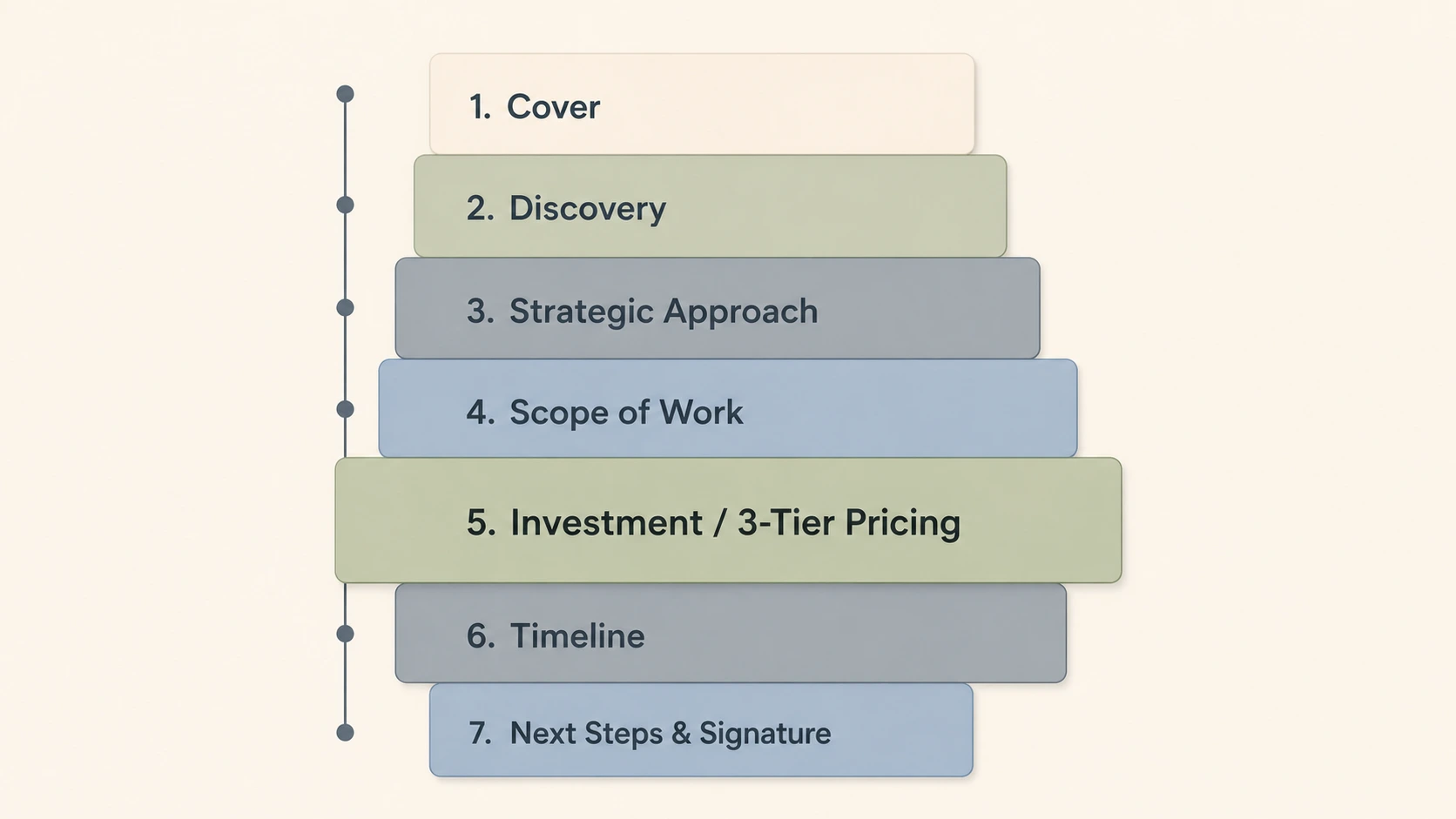
The 7-Section Anatomy of a Winning Social Media Agency Proposal
The structure isn't arbitrary. Each section serves a specific function in the buyer's decision-making process — and skipping any one of them measurably reduces close rate.
Section 1: Cover & Client-Facing Identity
The first thing the prospect sees. Two functions: signal professionalism and establish brand.
What to include:
- Your agency name and logo (top-left, consistent with your website)
- Proposal title — specific to the client, e.g., "Social Media Marketing Strategy & Management for [Client Company Name]"
- Client logo (with permission) — signals personalization, not template
- Date, proposal validity (typical: 30 days)
- Your name, title, contact info
- Client decision-maker's name and title
Sample header copy:
Social Media Marketing Strategy & Management Prepared for: [Client Name], [Client Company] Prepared by: [Your Name], [Your Agency] Date: [Date] Valid through: [Date + 30 days]
Why it matters: Generic Word documents with no branding read as templates the prospect has seen 50 times before. Branded covers signal "this proposal was built for you."
Section 2: Discovery Summary — Prove You Listened
Most agencies skip this and dive into "About Us." That's the single biggest mistake. Per proposal mistake research, proposals that show little understanding of the client's actual situation signal insufficient research and lose deals before pricing is even discussed.
This section restates what you heard during discovery. Your job: prove you understood, not pitch yet.
What to include:
- 2–3 sentences summarizing the client's current state (where they are now)
- Their stated business goals (what they want to achieve)
- The specific challenges they mentioned (in their language, not generic marketing speak)
- Why now — what's prompting this engagement
Sample copy:
Where You Are Now
[Client Company] is a [industry/niche] [stage] business that has built strong [specific strength] but is now ready to invest in social media to support [specific goal — lead generation, brand awareness, hiring, etc.].
During our discovery call on [date], you shared three core priorities for the next 12 months:
- [Specific goal 1 in client's language] — driven by [reason]
- [Specific goal 2] — driven by [reason]
- [Specific goal 3] — driven by [reason]
The current friction: your team has been managing social internally with limited bandwidth, which has resulted in [specific issue — inconsistent posting, low engagement, no measurement framework]. You're considering external partnership now because [the timing reason they mentioned].
Why it matters: When the prospect reads this section and sees their own situation reflected back accurately, the rest of the proposal lands inside a frame of trust. They're already nodding by the time they reach pricing.
Section 3: Strategic Approach
This is where you show how you think — not what you do. The strategic approach is the section that separates "experienced strategic partner" from "vendor who posts content."
What to include:
- Your overall thesis on what will move their numbers (1–2 paragraphs)
- The 3–5 strategic pillars your work will be organized around
- Platform strategy — which platforms, why, what role each plays in the funnel
- Content thesis — what types of content (educational, behind-the-scenes, social proof, etc.)
- Measurement framework — what you'll measure and why
Per Hootsuite's 2024 Social Media Trends Report, 68% of businesses now require platform-specific strategies rather than unified approaches across all channels. Your proposal should reflect this — not "we'll post on all platforms" but "Instagram drives [outcome] for your audience, LinkedIn drives [outcome], here's how we'll allocate effort across both."
Sample copy structure:
How We'll Get You There
Based on your goals and current state, our strategic thesis is: [One-sentence thesis specific to the client].
Strategic Pillars
- [Pillar 1: e.g., Establish thought leadership on LinkedIn] — supports your goal of [X]
- [Pillar 2: e.g., Build community and brand affinity on Instagram] — supports [Y]
- [Pillar 3: e.g., Capture intent-driven traffic from short-form video] — supports [Z]
Platform Strategy
Platform Role in Strategy Content Mix Expected Outcome Thought leadership, B2B leads 60% educational, 30% company culture, 10% case study 2× follower growth, 15% engagement rate Brand affinity, audience building 40% behind-the-scenes, 30% educational, 30% community 50% follower growth, 8% engagement rate [Platform 3] [Role] [Mix] [Outcome]
Why it matters: Clients are paying for strategy, not labor. The Strategic Approach section is where you justify $5,000/month vs $1,500/month.
Section 4: Scope of Work — What You Actually Deliver
The most important operational section. Where most scope creep is decided — by being specific or by being vague.
What to include:
- Monthly content production volume (specific numbers per platform)
- Content type breakdown (static, carousel, reels, stories, etc.)
- Community management (response time, hours per day, escalation)
- Reporting cadence (weekly check-ins, monthly reports)
- Strategy & planning (kickoff, monthly strategy calls, QBRs)
- What's explicitly NOT included (paid ads, video production, influencer outreach if extra)
Sample copy structure:
What's Included
Content Production
- 24 posts/month across LinkedIn (12), Instagram (8), TikTok (4)
- Content mix: educational carousels (40%), short-form video (30%), text-led posts (20%), community engagement posts (10%)
- Custom design in your brand kit using Canva Pro or equivalent
- Caption writing with platform-specific best practices
- Hashtag strategy for Instagram and TikTok, refreshed monthly
Community Management
- Monitor and respond to comments and DMs within 4 business hours during business days
- Escalate to your team for sales-qualified inquiries with [agreed criteria]
- Track engagement quality (sentiment, follower-to-customer signals)
Reporting & Strategy
- Weekly Slack check-in (asynchronous status update)
- Monthly performance report delivered by the 5th of each month
- Monthly 60-min strategy call to review performance and adjust
- Quarterly Business Review every 90 days with strategic recommendations
What's NOT Included (Available as Add-Ons)
- Paid social media ad management — 15% of ad spend or $2,000/mo flat (whichever is greater)
- Video production beyond short-form social cuts — quoted per project
- Influencer outreach campaigns — quoted per project
- Crisis communications outside business hours — billed at $250/hour
- Major campaign launches (Black Friday, product launches) — quoted as project work
Why it matters: Vague scope is the #1 cause of agency-client friction in months 2–6. Specific deliverable counts protect both sides — you from infinite "quick favor" requests, the client from feeling like they got less than expected.
For a deeper breakdown of how to structure scope contractually, see our guide on social media agency client onboarding checklist and how much to charge for social media management.
Section 5: Investment — Three-Tier Pricing
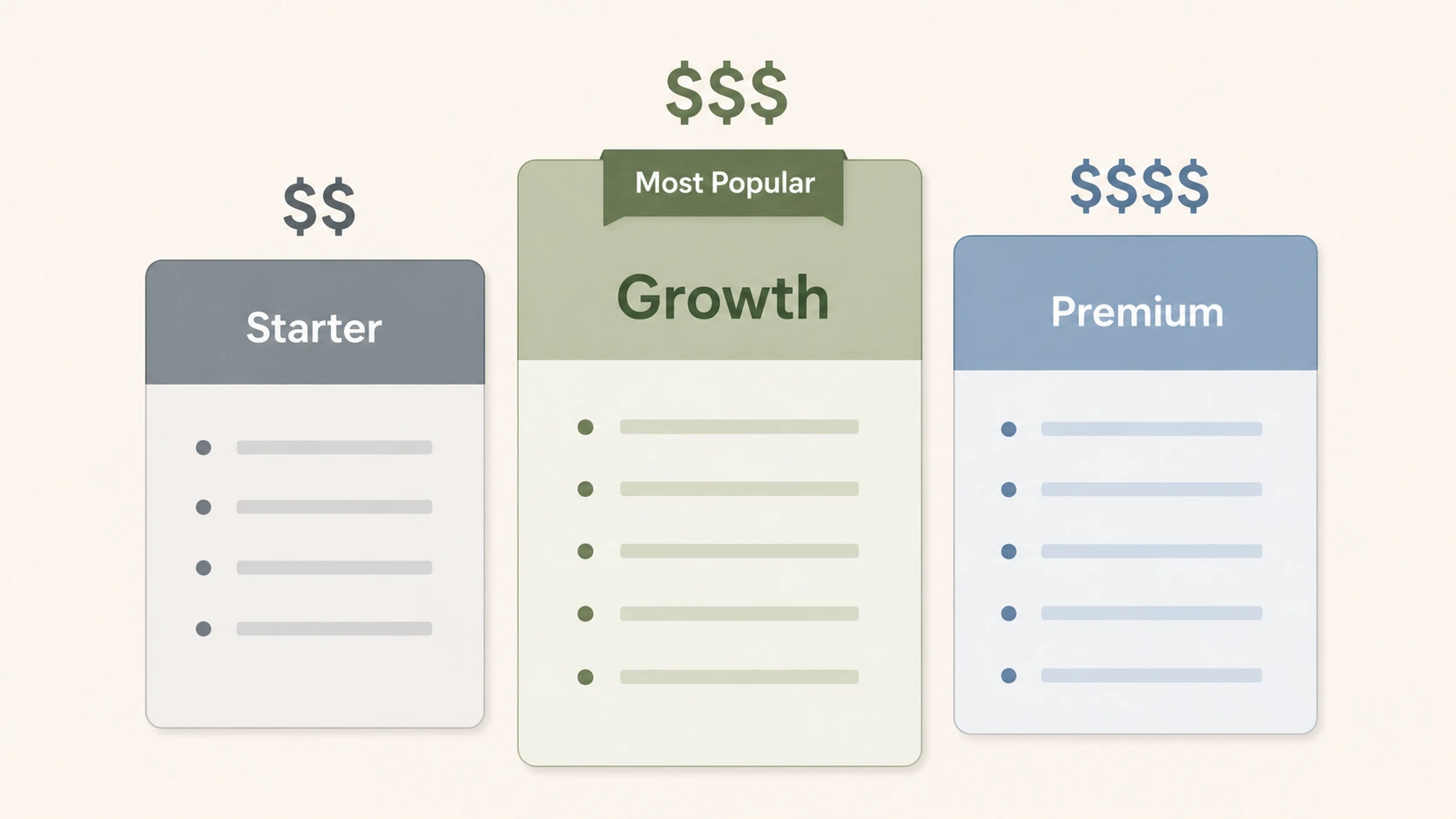
The data is unambiguous: agencies presenting three pricing tiers are 2× more likely to convert at 60%+ rates than agencies showing one number. The reason is psychological — clients given three options feel empowered to choose; clients given one option feel cornered into accept-or-reject.
The standard structure (matched to 2026 industry data):
Starter tier — $2,000–$3,500/mo
- 1–2 platforms, 12–16 posts/month, basic reporting, single-touch approval
Growth tier (Most Popular) — $4,500–$7,500/mo
- 3–4 platforms, 20–28 posts/month, full strategy + reporting + community management, multi-step approval
Premium tier — $10,000–$15,000/mo
- 4+ platforms, 40+ posts/month, paid ad management included, dedicated account manager, weekly strategy calls, quarterly business reviews
Sample pricing presentation:
| Starter | Growth (Most Popular) | Premium | |
|---|---|---|---|
| Monthly investment | $2,500 | $5,500 | $12,000 |
| Platforms | 2 (LinkedIn + Instagram) | 4 (LinkedIn, Instagram, TikTok, X) | 4 + paid ads |
| Posts/month | 16 | 24 | 40 |
| Content formats | Static, carousel | + short-form video, stories | + custom video production cuts |
| Community management | 2 hrs/business day | 4 hrs/business day | 6 hrs/business day, weekend coverage |
| Reporting | Monthly PDF | Monthly + weekly check-ins | Weekly + monthly + QBR |
| Strategy calls | Monthly (30 min) | Monthly (60 min) | Bi-weekly (45 min) |
| Paid ads management | Not included | Add-on at $2,000/mo | Included up to $10K/mo ad spend |
| Account manager | Shared | Dedicated | Dedicated + senior strategist |
Pricing principles that close:
-
Mark Growth as "Most Popular." This is the decoy effect at work — given three options with one explicitly highlighted, most clients pick the highlighted middle option. Industry data confirms this is roughly 60–70% of decisions when three tiers are presented.
-
Include the same outcome promise across tiers; only the depth changes. If your Starter tier promises "growth in followers and engagement" but Premium promises "leads and revenue attribution," you've signaled that Starter doesn't actually work. Promise the same outcome at all tiers; the difference is intensity, speed, and depth.
-
Show what's not included clearly. Premium-tier-only features (QBRs, paid ads, dedicated AM) listed in plain text in Starter row prevents misunderstanding.
-
Always include a 3-month minimum commitment. Social media compounds; one-month engagements don't show enough data to retain. Footer: "All retainers include a 3-month minimum commitment, then continue month-to-month with 30-day notice."
-
Quote the annual investment too. "Growth tier: $5,500/mo or $66,000/year. Save 8% with annual prepayment ($60,720)." Optional but a strong commitment-anchor.
For a deeper guide on retainer pricing benchmarks and how-to-structure-tiers logic, see social media agency pricing models compared.
Section 6: Timeline & Onboarding
The section that turns "interesting" into "let's start." Show that the engagement is operationally real and you've thought through how the first 30–90 days unfold.
What to include:
- Week 1: kickoff, access, brand documentation
- Week 2: audit + content calendar
- Week 3: first content goes live
- Week 4: first reporting cycle, monthly review
- Day 60–90: optimization, QBR if applicable
Sample copy:
Your First 90 Days
Week 1: Kickoff & Foundation
- Strategy kickoff call (90 min) — review goals, audience, voice
- Brand asset transfer (logos, fonts, colors, style guide)
- Social account access via secure API connection (no shared passwords)
- Project workspace setup with shared calendar
- First invoice, payment terms confirmed
Week 2: Audit & Content Calendar
- Complete social media audit (current performance, gaps, opportunities)
- Build month 1 content calendar — drafted for your review
- Submit first content batch for approval
Week 3: Live Publishing Begins
- Approved content scheduled and published
- Community management begins
- Daily Slack check-ins for first two weeks; transition to weekly
Week 4: First Reporting Cycle
- 30-day performance report delivered
- Monthly strategy call to review and adjust
Days 30–90: Optimization
- Content patterns analyzed and refined
- Audience segmentation deepens
- Day 90: Quarterly Business Review (if Growth or Premium tier)
Why it matters: Most clients have been burned by previous agencies that "got started" with no real onboarding. Showing a structured 90-day plan signals operational maturity — and gives you a tool to manage scope creep ("that wasn't in our 90-day plan; let's revisit at the QBR").
Section 7: Next Steps & Signature
The most under-thought section. Per follow-up best-practice research, being too vague about next steps is one of the biggest mistakes in proposal close-out.
What to include:
- Single explicit next step (not "let me know your thoughts")
- E-signature block for selected tier
- Payment terms restated
- Optional: 15-minute follow-up call link
Sample copy:
Next Steps
To move forward:
- Select your tier (Starter / Growth / Premium) below
- Sign electronically — takes about 30 seconds
- Complete the kickoff intake form I'll send within 24 hours of signing
- First invoice issued upon signing; we begin Week 1 work the following Monday
If you have questions before signing, book a 15-minute follow-up call (drop in your scheduling link) or reply to this email.
[E-signature block — selected tier, signature, date]
Looking forward to building something measurable together.
[Your name] [Your title], [Agency name]
Why it matters: Vague endings ("let me know your thoughts") leave the next move on the prospect. Specific endings ("select tier, sign, kickoff next Monday") move the engagement forward. E-signature data shows proposals with embedded signing close 28% faster than ones requiring a separate signing process.
Sample 3-Tier Pricing Structures by Niche
Pricing isn't one-size-fits-all. Different niches support different tier ranges. Here's what works in 2026 across common social media agency verticals:
B2B SaaS
| Tier | Monthly | Scope |
|---|---|---|
| Starter | $3,500 | LinkedIn + 1 supporting platform, 16 posts/mo, monthly reporting |
| Growth | $7,500 | 3 platforms, 24 posts/mo, content + thought leadership, multi-step approval |
| Premium | $15,000+ | Full multi-platform, 32+ posts/mo, paid LinkedIn, ABM-aligned content, weekly strategy |
B2B SaaS supports 28–35% margins per recent niche profitability data, justifying higher tier pricing.
Healthcare (clinics, dental, medspa, behavioral health)
| Tier | Monthly | Scope |
|---|---|---|
| Starter | $2,500 | 1–2 platforms, 12 posts/mo, HIPAA-aware content review |
| Growth | $5,000 | 3 platforms, 20 posts/mo, patient-acquisition-aligned, compliance review |
| Premium | $10,000+ | Multi-location, paid social, reputation management, weekly QBRs |
Healthcare's 25–32% margins reflect compliance complexity premium.
Local services (home services, contractors, multi-location)
| Tier | Monthly | Scope |
|---|---|---|
| Starter | $1,500 | 2 platforms, 12 posts/mo, basic Google Business reviews response |
| Growth | $3,500 | 3 platforms, 20 posts/mo, Google Business + community engagement |
| Premium | $7,500 | Full multi-platform, paid local, lead-attribution reporting |
E-commerce (DTC brands)
| Tier | Monthly | Scope |
|---|---|---|
| Starter | $3,000 | Instagram + TikTok, 16 posts/mo, basic UGC sourcing |
| Growth | $6,500 | + Pinterest + Stories, 24 posts/mo, conversion-aligned content |
| Premium | $12,000+ | Full multi-platform, paid ads up to $10K/mo, performance attribution |
Hospitality (hotels, restaurants, venues)
| Tier | Monthly | Scope |
|---|---|---|
| Starter | $2,000 | Instagram + Facebook, 12 posts/mo, review response |
| Growth | $4,500 | + TikTok + Google Business, 20 posts/mo, booking-CTA content |
| Premium | $9,000+ | Full multi-platform, paid social, partnership content, weekly reporting |
These are starting points. Anchor to your actual cost-to-deliver and your target margin, not just the niche range. For pricing math by team size, see how much to charge for social media management.
Common Proposal Mistakes That Kill Deals
Per industry research on agency proposal failures, these are the patterns that lose deals consistently:
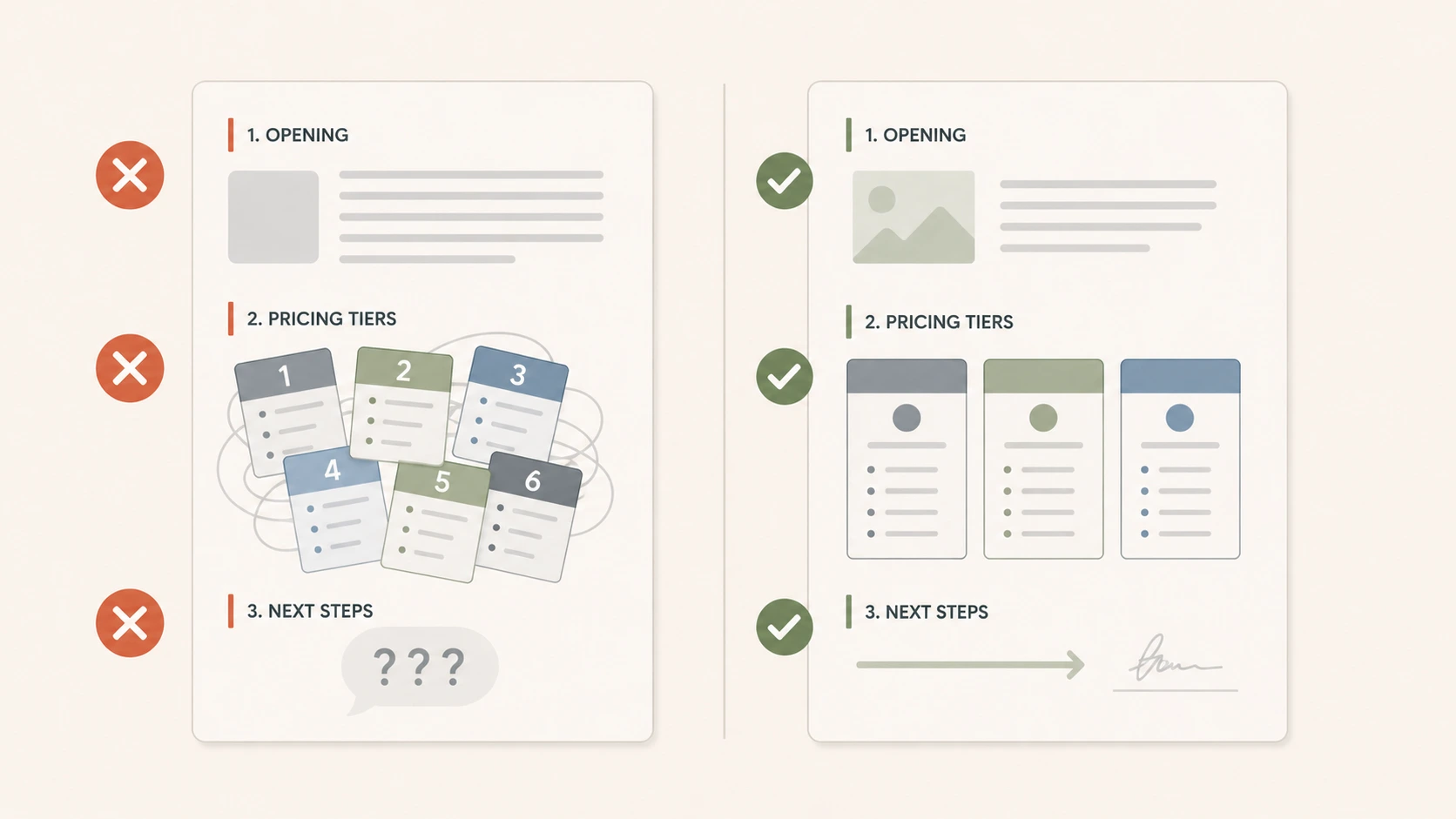
1. Generic "About Us" leading the document. Clients don't care about you yet — they care about whether you understand them. Lead with discovery summary, not company history. About Us belongs at the bottom or in an appendix.
2. Showing too many service packages and add-ons. Per proposal mistake research, offering too many tiers, add-ons, and pricing options causes "analysis paralysis" — clients freeze and ghost you. Three tiers is the sweet spot. Five or more tiers correlates with worse close rates.
3. No discovery summary section. Proposals that show no client research signal "I send the same template to everyone." This is the single most consequential mistake — it telegraphs that the relationship hasn't actually started.
4. Vague pricing. "Starting at $X" or "depends on scope" forces the client to do mental math. Specific tier prices with specific deliverables convert.
5. No next-step CTA. Proposals ending with "let me know your thoughts" don't close. Specific next steps ("select tier, e-sign, kickoff Monday") do.
6. Missing timeline. Without a 30-90 day plan, clients can't visualize starting. Add a timeline section.
7. Plain-text or minimally formatted documents. PandaDoc's 2.1M-proposal A/B test shows professionally designed proposals close 32% higher. Format matters more than length.
8. No social proof or case studies. Even one anonymized case study ("a B2B SaaS client we worked with grew LinkedIn impressions 4× over 6 months") adds credibility. Generic testimonials without context don't.
9. Sending as Word doc or static PDF. No engagement tracking means you don't know when to follow up. Use a proposal tool that tracks opens, time on each section, and signature events.
10. Pricing buried at the bottom. Make pricing easy to find. Clients flip to it first; help them.
11. No commitment minimum. One-month engagements don't show enough data to retain. Always include a 3-month minimum.
12. Long delays between discovery and proposal send. Send within 24–48 hours of the discovery call. Every day of delay correlates with reduced close probability.
13. No follow-up sequence. Sending and waiting silently has the worst close rate. Plan to follow up.
Proposal Tooling: PandaDoc vs Proposify vs Better Proposals vs DocuSign vs Notion
The proposal tool you use materially affects close rate. Engagement tracking, e-signature integration, and design quality all measurably move the needle. Here's the honest comparison:
PandaDoc — Best all-around for most agencies
- Pricing: Starts ~$35/user/mo, up to $100+ for enterprise plans
- Strengths: Beyond proposals — contracts, purchase agreements, invoices in one tool. Strong e-signature workflow. Deal Rooms for collaborative selling. CPQ (configure-price-quote) on Enterprise plans. Claims 18% close-rate boost from analytics-driven follow-up.
- Weaknesses: Design templates feel less polished than Proposify; learning curve on advanced features.
- Best for: Agencies that want one tool covering proposals + contracts + invoicing.
Proposify — Best for design-driven agencies
- Pricing: Starts ~$30/user/mo (single user), team plans up to $100+
- Strengths: Most polished design templates. Agency-specific features — white-labeling, AI template generation from URLs, multi-step approval workflows. Reports 2× industry-average close rates from agencies using it.
- Weaknesses: No native invoicing or contract module — pair with another tool.
- Best for: Agencies whose proposals must look like premium brand work — visual-first niches, high-tier clients.
Better Proposals — Best budget option
- Pricing: Starts ~$20/user/mo
- Strengths: Cheapest of the three. Clean templates. Fast to deploy. Good for new agencies sending under 10 proposals/month.
- Weaknesses: Less depth on advanced workflow, fewer integrations.
- Best for: Brand-new agencies in months 1–6 who want to validate proposal-driven sales without committing to a $35+/mo tool.
DocuSign — E-signature first, proposal-light
- Pricing: Starts ~$10/user/mo (basic e-signature only); proposal features require higher tiers
- Strengths: Industry-standard e-signature. Strong audit trails. Works for legal-adjacent or compliance-heavy clients.
- Weaknesses: Not a proposal-first tool. Templating is weaker than dedicated proposal software.
- Best for: Agencies that already use DocuSign for contracts and want to consolidate.
Notion — DIY option for technical founders
- Pricing: Free or $10/user/mo on Plus plan
- Strengths: Highly customizable. Good for embedding interactive elements. Free tier is genuinely usable.
- Weaknesses: No native e-signature (requires HelloSign or similar add-on). No native proposal analytics. Manual setup of every proposal.
- Best for: Technical founders who already live in Notion and want to keep the operational stack simple.
Recommendation by agency stage
- First 1–3 clients: Better Proposals ($20/mo) or Notion (free) + a HelloSign-style e-signature tool
- Months 6–18 / under $25K MRR: Proposify ($30–60/mo, single user)
- $25K+ MRR: PandaDoc ($35–100/mo) or Proposify Team ($60–150/mo) — whichever fits your needs better
The investment pays back fast. A 32% higher close rate from professional templates, on a $5,500/mo retainer, recovers the tool cost in the first month.
The Follow-Up Sequence That Closes
Sending the proposal is the start, not the end. Per follow-up best-practice research, proposals without follow-up close at half the rate of proposals with structured follow-up sequences.
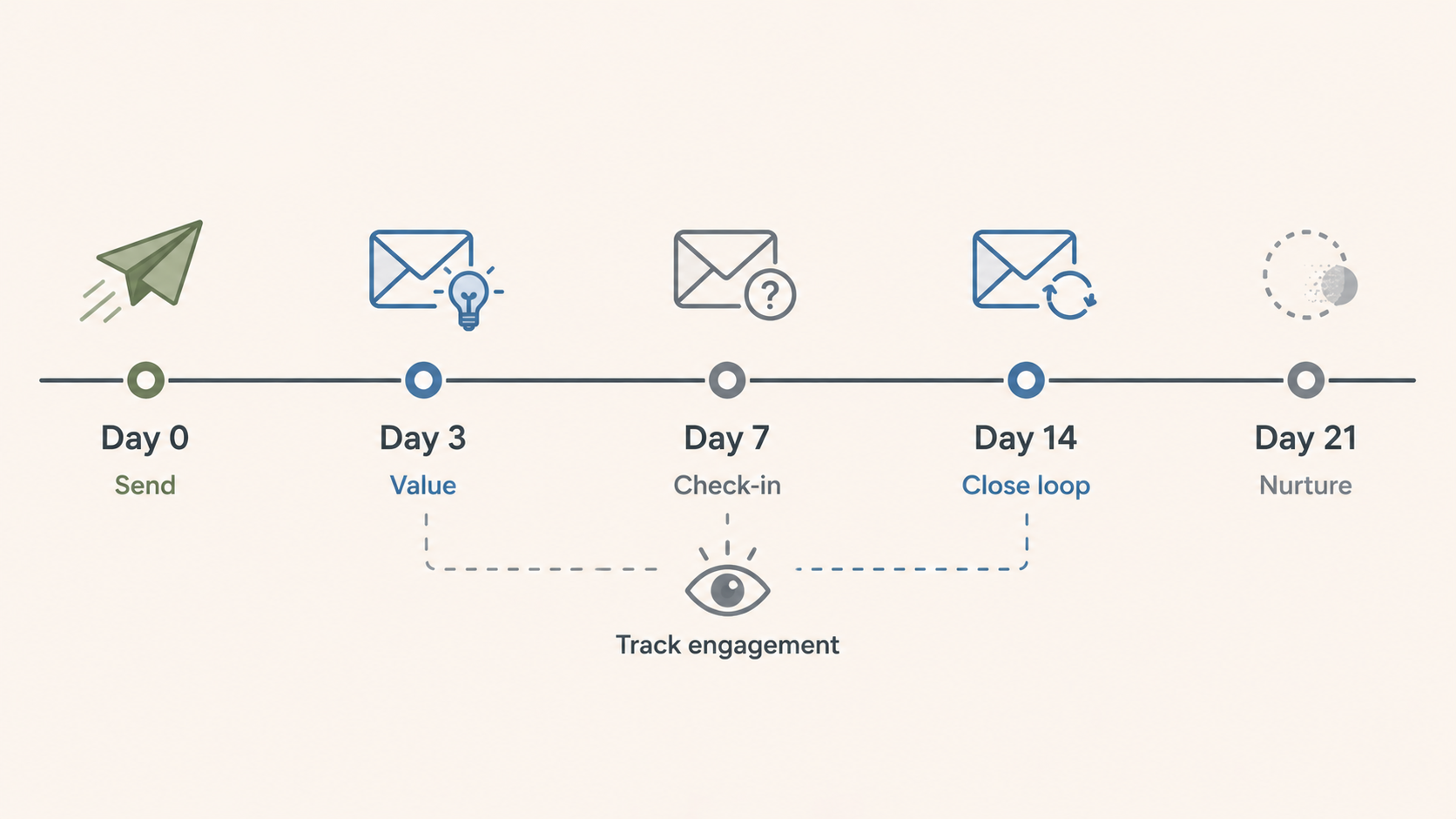
The data-driven sequence for a typical $5K–$15K proposal:
Day 0 (Send day)
- Send the proposal via your tool of choice
- Brief email with one-sentence summary and link to the proposal
- Subject line: "[Client Name] — Social Media Strategy Proposal Inside"
Sample send email:
Hi [Client name],
Following our conversation on [date], here's the proposal we discussed.
Link: [proposal link]
The Discovery section reflects what we covered; the Strategic Approach lays out how we'd get you to your goals; pricing is in three tiers so you have options.
Should take about 8 minutes to read. Happy to jump on a quick call to walk through it if helpful — book here: [Cal link].
Talk soon, [Your name]
Engagement signals (use these to time follow-ups)
If your tool tracks engagement, watch for:
- Multiple views in same day: Reach out within 4 hours — the prospect is actively considering. "Saw you spent some time on the proposal — happy to answer any questions before you decide."
- 45+ seconds on pricing page (PandaDoc data): Strong negotiation signal. They're considering pricing seriously. Consider proactively offering "we can start with a 60-day initial term at the lower tier if that helps."
- Single view, then nothing: Wait 1–2 business days, then check-in.
- Cold for a week: Re-engagement message — different angle, not a repeat ask.
Day 3 (if no response, no engagement)
- Brief email — different angle, not "just following up"
- Add value: link to a relevant case study, article, or framework
- Sample: "Quick note — saw [relevant industry news / their LinkedIn post] and thought of our conversation. Curious if you've had a chance to review the proposal? Happy to discuss."
Day 7 (if still no response)
- Direct check-in
- Sample: "Wanted to follow up on the proposal sent on [date]. Where are you in the decision? Happy to adjust scope or pricing if that helps. If timing is wrong, let me know what would change that."
Day 14 (if still cold)
- Final attempt
- Frame as closure, not pursuit
- Sample: "Hi [name] — wanted to close the loop. If timing's not right or there's something blocking the engagement, let me know and I'll move on. If it's still on the radar, just hit reply with a yes. No hard feelings either way."
Day 21+
If still no response, mark as lost. Re-add to nurture sequence (newsletter, occasional valuable share). Most "lost" deals come back in 6–18 months when timing changes.
The key principle: follow-up emails should add value or move the decision forward — never just "checking in." "Just following up" emails close at the lowest rate of any follow-up category.
Edge Cases: When the Standard Template Doesn't Fit
Responding to an RFP
For formal RFPs (typical with mid-market and enterprise clients), the structure changes:
- Cover and submission compliance (date, contact, RFP reference number)
- Executive summary aligned to RFP-stated objectives
- Detailed responses to each RFP question (one section per question)
- Pricing structured per RFP requirements (often a fixed-format table)
- Case studies in the format requested
- Team bios and qualifications
- References
RFPs typically don't allow the 3-tier creative pricing structure. They want one number that meets RFP scope. Adapt accordingly.
Custom enterprise proposals
For clients above $20K/mo retainer, the proposal often becomes a Statement of Work (SOW) attached to a Master Services Agreement (MSA). Standard format:
- Executive summary (1 page)
- Scope of work (specific, with deliverable counts and SLAs)
- Pricing (often single-tier custom-quoted, with milestone-based payment)
- Timeline with phase definitions
- Acceptance criteria for each milestone
- Termination terms
- Schedules/appendices
Enterprise proposals don't need decoy-effect tier psychology — these are committee decisions where pricing is line-itemed.
Repeat or referral clients
For warm referrals or existing-client expansions, skip discovery summary (you already understand). Tighter format:
- Cover (1 line)
- Strategic recommendation (1 page)
- Scope and pricing (1 page)
- Timeline (1 page)
- Next steps
3-page proposals close faster with referrals than 11-page formal proposals.
Project-based work (audits, strategy docs)
For one-time deliverables, use a project proposal not a retainer proposal:
- Cover
- Project scope and deliverables (specific outputs)
- Timeline (typical 2–6 weeks)
- Investment (single fixed fee, not tiered)
- Payment milestones (typical: 50% upfront, 50% on delivery)
- Acceptance criteria
Many agencies use project work as the foot-in-the-door before retainer.
The Complete Copy-Paste Template (All 7 Sections)
Here's the full proposal template assembled in one block. Copy it into your proposal tool of choice (PandaDoc, Proposify, Better Proposals, Notion, or Google Docs), replace the bracketed placeholders with discovery-call notes, and customize tier pricing to match the niche-specific ranges from earlier in this guide.
This template is structured for an 8–11 page proposal. Each section maps to a page or two in your final output.
[PAGE 1 — COVER]
Social Media Marketing Strategy & Management
Prepared for: [Client Name], [Client Company] Prepared by: [Your Name], [Your Agency] Date: [Send Date] Valid through: [Send Date + 30 days]
[Your agency logo top-left; client logo with permission top-right]
[PAGE 2 — DISCOVERY SUMMARY]
Where You Are Now
[Client Company] is a [industry/niche] [stage — early-stage/growth/established] business serving [target customer]. You've built strong [specific strength they mentioned] and are now investing in social media to support [primary goal from Q2].
During our discovery call on [discovery call date], you shared three core priorities for the next 12 months:
- [Specific goal 1, in their language] — driven by [reason from call]
- [Specific goal 2] — driven by [reason]
- [Specific goal 3] — driven by [reason]
The current friction: [specific issue mentioned in the call — e.g., "your team has been managing social internally with limited bandwidth, which has resulted in inconsistent posting and no measurement framework"]. You're considering external partnership now because [the timing reason from Q7].
[PAGE 3 — STRATEGIC APPROACH]
How We'll Get You There
Based on your goals and current state, our strategic thesis is:
[One-sentence thesis specific to the client — e.g., "Building thought-leadership-driven LinkedIn presence aligned with your demand-gen funnel will compound monthly into a measurable lead source within 6 months."]
Strategic Pillars
- [Pillar 1: e.g., Establish thought leadership on LinkedIn] — supports your goal of [outcome]
- [Pillar 2: e.g., Build community and brand affinity on Instagram] — supports [outcome]
- [Pillar 3: e.g., Capture intent-driven traffic from short-form video] — supports [outcome]
Platform Strategy
Platform Role Content Mix 6-Month Outcome [Platform 1] [Role in funnel] [Content type breakdown %] [Specific outcome] [Platform 2] [Role in funnel] [Content type breakdown %] [Specific outcome] [Platform 3] [Role in funnel] [Content type breakdown %] [Specific outcome]
[PAGE 4–5 — SCOPE OF WORK]
What's Included
Content Production
- [N] posts/month across [platform list — e.g., LinkedIn (12), Instagram (8), TikTok (4)]
- Content mix: [educational carousels (40%), short-form video (30%), text-led posts (20%), community engagement posts (10%) — adjust to client]
- Custom design in your brand kit using Canva Pro
- Caption writing with platform-specific best practices
- Hashtag strategy for Instagram and TikTok, refreshed monthly
Community Management
- Monitor and respond to comments and DMs within [N] business hours during business days
- Escalate to your team for sales-qualified inquiries with [agreed criteria]
- Track engagement quality (sentiment, follower-to-customer signals)
Reporting & Strategy
- Weekly Slack check-in (asynchronous status update)
- Monthly performance report delivered by the 5th of each month
- Monthly 60-min strategy call to review performance and adjust
- Quarterly Business Review every 90 days [if Growth or Premium tier]
What's NOT Included (Available as Add-Ons)
- Paid social ad management — 15% of ad spend or $2,000/mo flat (whichever is greater)
- Video production beyond short-form social cuts — quoted per project
- Influencer outreach campaigns — quoted per project
- Crisis communications outside business hours — billed at $250/hour
- Major campaign launches (Black Friday, product launches) — quoted as project work
[PAGE 6–7 — INVESTMENT]
Investment
Starter Growth (Most Popular) Premium Monthly investment $[Starter price] $[Growth price] $[Premium price] Platforms [N platforms] [N platforms] [N platforms] + paid ads Posts/month [N posts] [N posts] [N posts] Content formats Static, carousel + short-form video, stories + custom video production cuts Community management [N] hrs/business day [N] hrs/business day [N] hrs/business day, weekend coverage Reporting Monthly PDF Monthly + weekly check-ins Weekly + monthly + QBR Strategy calls Monthly (30 min) Monthly (60 min) Bi-weekly (45 min) Paid ads management Not included Add-on at $[X]/mo Included up to $[X] ad spend Account manager Shared Dedicated Dedicated + senior strategist All retainers include a 3-month minimum commitment, then continue month-to-month with 30-day notice. Annual prepayment available for an 8% discount. Setup fee waived for engagements signed by [validity date].
[PAGE 8 — TIMELINE & ONBOARDING]
Your First 90 Days
Week 1: Kickoff & Foundation
- Strategy kickoff call (90 min) — review goals, audience, voice
- Brand asset transfer (logos, fonts, colors, style guide)
- Social account access via secure API connection (no shared passwords)
- Project workspace setup with shared calendar
- First invoice issued; payment terms confirmed
Week 2: Audit & Content Calendar
- Complete social media audit (current performance, gaps, opportunities)
- Build month 1 content calendar — drafted for your review
- Submit first content batch for approval
Week 3: Live Publishing Begins
- Approved content scheduled and published
- Community management begins
- Daily Slack check-ins for first two weeks; transition to weekly
Week 4: First Reporting Cycle
- 30-day performance report delivered
- Monthly strategy call to review and adjust
Days 30–90: Optimization & QBR
- Content patterns analyzed and refined
- Audience segmentation deepens
- Day 90: Quarterly Business Review (Growth and Premium tiers)
[PAGE 9 — NEXT STEPS & SIGNATURE]
Next Steps
To move forward:
- Select your tier (Starter / Growth / Premium) below
- Sign electronically — takes about 30 seconds
- Complete the kickoff intake form I'll send within 24 hours of signing
- First invoice issued upon signing; we begin Week 1 work the following Monday
If you have questions before signing, [book a 15-minute follow-up call here]([Your Cal.com link]) or reply to this email.
Selected Tier: ☐ Starter ☐ Growth ☐ Premium
Authorized Signatory: ____________________________
Date: ____________________________
Looking forward to building something measurable together.
[Your Name] [Your Title], [Your Agency] [Your Email] · [Your Phone] · [Your Website]
How to use this template
- Copy the whole block into your proposal tool of choice. The structure works in PandaDoc, Proposify, Better Proposals, Google Docs, Notion, or any document-creation platform.
- Replace every bracketed placeholder with verbatim notes from your discovery call. The prospect's own language is what makes the proposal feel personalized.
- Adjust tier pricing to match the niche ranges from the 3-tier pricing section above.
- Customize the platform strategy table to reflect what you actually recommended in the discovery call — not generic post counts.
- Send within 24–48 hours of the discovery call. Speed correlates with close probability.
- Track engagement via your proposal tool (PandaDoc, Proposify, Better Proposals all do this natively). Use the engagement signals to time your follow-up sequence.
The template assumes a Growth-tier engagement (the most common). For Starter or Premium scopes, scale section 4 (Scope of Work) up or down accordingly.
For the agency-side workflow that delivers on what you promise in this proposal — content calendar, white-label PDF reports, multi-approver workflows, dedicated client workspaces — see best social media management tools for agencies. For onboarding the client once they sign, see the social media agency client onboarding checklist.
 PostPlanify
All your social media in one simple dashboard
Schedule posts, track analytics, and reply to comments/DMs without switching tabs.

Engagement
+18%
Views
52.8k
FAQ: Social Media Marketing Agency Proposals
How long should a social media marketing proposal be?
The optimal length is 11 pages across 7 sections, per Proposify's data from millions of proposals. Shorter than 8 pages tends to skip critical sections (discovery, timeline, scope detail). Longer than 14 pages tends to dilute the close — clients skim, miss the call to action, and stall. The 7 sections covered above are the right architecture; just don't pad each section beyond what's needed.
Should I include pricing in the proposal or send it separately?
Always include pricing in the proposal. Splitting them is a 2010s-era tactic that no longer works — modern buyers expect transparency, and proposals without pricing get filed for "later" and rarely reopened. If you're worried about price shock, present three tiers (Starter, Growth, Premium) so the client has options. The data is consistent: 3-tier pricing converts at 2× the rate of single-price proposals.
How fast should I send a proposal after the discovery call?
Within 24–48 hours. Every day of delay correlates with reduced close probability — both because the prospect's interest is highest immediately after the call, and because a fast turnaround signals operational professionalism. Block 90 minutes the same day or the next morning to write the discovery summary section while the call is still fresh, then build the rest from your standardized template.
How do I price my first proposal without case studies?
Price at the lower end of your target tier with full scope. Don't reduce scope to discount. For a typical small business client, that means Starter tier at $2,500/mo with full deliverables, not Growth tier at $5,500 with stripped scope. Anchor to industry rates: per recent agency pricing data, the average monthly retainer is ~$3,500. Position yourself at $2,500 for the first 1–2 clients with case-study rights as part of the agreement; you raise to $3,500+ for client #3 once you have proof.
Should I use a Word doc, PDF, or proposal software?
Proposal software, every time. Per PandaDoc's A/B test of 2.1 million proposals, professionally designed templates close at a 32% higher rate than plain-text or minimally formatted documents. Beyond design, proposal software gives you engagement tracking (open events, section dwell time), e-signature integration (28% faster close per Proposify data), and version control. The cost ($20–$60/user/mo) recovers in less than one closed proposal at typical retainer rates.
How many follow-ups should I send if the prospect goes silent?
Three structured follow-ups across 21 days, then mark as lost. Days 3, 7, and 14 — each adding value or moving the decision forward, not just "checking in." More than three follow-ups correlates with damaging the relationship for future opportunities. After Day 21, transition the prospect to a long-term nurture sequence (newsletter, occasional value shares); many "lost" deals return in 6–18 months.
Should I show a discount in the proposal?
Generally no. Discounts in initial proposals signal "my pricing is flexible" and trigger negotiation as the default. Hold pricing firm in the initial proposal; if the prospect counters, you can offer specific concessions tied to commitments — annual prepayment for 8–10% off, longer minimum term for reduced rate, etc. Discounting upfront erodes positioning.
Do I need to include case studies in every proposal?
If you have them, yes — even one. Case studies (anonymized if needed) move close rate measurably. If you're starting and have no case studies, substitute with: (1) your own social presence as proof, (2) reference results from in-house or freelance work with permission, (3) a strong "How We Work" section that demonstrates strategic thinking. New agencies routinely close their first 3–5 clients without case studies; what closes is showing how you think, not what you've already done.
What's the difference between a proposal and a contract?
The proposal is the sales document — strategic, design-led, structured to close. The contract (or Statement of Work + Master Services Agreement) is the legal document — terms, liability, IP, termination, governing law. Many agencies combine them in proposal software (PandaDoc handles both well); others keep them separate and use the proposal for sales, then send the contract once the prospect commits. Either approach works; the key is having both. For contract specifics, see our forthcoming guide on social media agency contract template.
How do I handle a client who wants to negotiate the price down?
Don't reduce price; reduce scope. Saying "yes, we can do $3,500/mo" instead of $5,500/mo without changing scope tells the client your original number was inflated. Instead: "We can do $3,500/mo if we shift to Starter scope (16 posts vs 24, monthly reporting only, no paid ads)." This protects positioning and educates the client on what they're trading. About 30–40% of negotiations resolve at the original price once scope-reduction is offered as an alternative.
Should I include performance guarantees in the proposal?
Generally avoid hard guarantees ("we'll grow your followers 50% in 90 days"). Social media performance has too many variables — algorithm changes, platform shifts, client product changes, market conditions. Instead, commit to process guarantees: "We'll deliver 24 posts/month, monthly strategy review, and quarterly business reviews on time, every month." Clients increasingly accept process guarantees as more honest than outcome guarantees. The exception is performance-based engagements where pricing is structured around outcomes — but those typically use specialized contracts, not standard proposals.
What's the right call to action for the last page?
Three components: (1) a single explicit next step (select tier and e-sign), (2) a 15-minute follow-up call link for questions before signing, (3) a signature block with selected tier pre-filled. Vague CTAs like "let me know your thoughts" close significantly worse than specific CTAs. The proposal should leave no ambiguity about what happens next if the client says yes.
Should I send the proposal video walkthrough or just the document?
A 3–5 minute video walkthrough alongside the proposal increases engagement notably — especially for proposals above $5K/mo. Loom or Vidyard for the recording. Walk through the strategic approach section, the pricing tier you recommend, and the kickoff plan. The video also creates a personal connection that static documents don't. About 15–20% of agencies do this consistently; the close rate lift is well-documented in proposal-tooling case studies.
How do I structure the proposal if there are multiple decision-makers?
For committee decisions (typical above $10K/mo retainer), tailor the proposal to the most senior buyer's frame while including content the operational stakeholders will look for. Add an "Internal Stakeholders" section addressing common concerns from each role — finance (ROI framing), legal (terms summary), marketing leadership (strategic alignment), and the day-to-day operator (workflow detail). This prevents the proposal getting blocked by one stakeholder's concern that wasn't addressed.
Key Takeaways
- Standardize the template. Teams using standardized proposal templates close at 56% vs 43% average. Build the template once, reuse it 100 times.
- Always present three pricing tiers. Agencies with three options are 2× more likely to convert at 60%+ rates than agencies showing one number. Mark the middle tier "Most Popular" — that's the decoy effect at work, and most clients pick it.
- Lead with the client's situation, not your agency. Discovery summary first, About Us last (or in appendix). Generic openings signal templates; client-specific summaries signal partnership.
- Specific scope, specific pricing, specific next steps. Vague proposals close at the lowest rate. Every section should have concrete numbers — content counts, response time SLAs, dollar amounts, dates.
- Use proposal software, not Word docs. 32% higher close rate from professional templates (PandaDoc 2.1M-proposal A/B test). Engagement tracking + e-signatures = 28% faster close. The $20–$60/mo investment pays back in less than one closed deal.
- Send within 24–48 hours of discovery. Speed correlates with close probability. Don't sit on the proposal for a week.
- Follow up structurally, not anxiously. Days 3, 7, 14 — each adding value or moving the decision forward, not "just checking in." Three follow-ups, then mark as lost and transition to nurture.
PostPlanifyAll your social media in one simple dashboard
Schedule posts, track analytics, and reply to comments/DMs without switching tabs.
Engagement
+18%
Views
52.8k
The agencies that close consistently aren't the ones with the most creative proposals. They're the ones with the most repeatable proposals — built once as a system, sent fast, designed professionally, structured around the buyer's decision-making process, and followed up with discipline. Once your template is locked in, every new prospect runs through the same workflow, and your close rate moves from "depends on the client" to "depends on the prospect's actual fit."
If you're running an agency on PostPlanify, the operational artifacts your proposal references — content calendar, white-label PDF reports, multi-approver workflows for client review, dedicated workspaces per client — are all built into the platform. That's the operational foundation behind the deliverables you commit to. Starting from $79/mo billed yearly on the Growth plan, scaling to Scale at $239/mo for 100 social accounts and 50 workspaces.
Related Reading
- How to Start a Social Media Marketing Agency
- Social Media Agency Contract Template
- How to Find Social Media Marketing Agency Clients
- Social Media Agency Pricing Models Compared
- How Much to Charge for Social Media Management
- Social Media Agency Client Onboarding Checklist
- Best Social Media Management Tools for Agencies
- White-Label Social Media Reports for Clients
- Social Media KPIs for Agencies to Report to Clients
- How Social Media Agencies Use AI Workflows
- Social Media Agency Statistics
- Best Social Media Tools with Approval Workflows
- Social Media Tools With No Per-Seat Fees
- How to Create a Social Media Report
- Client Engagement Metrics That Matter
Sources
- Proposify — proposal benchmark data including 56% close rate for standardized templates
- PandaDoc 2.1M-proposal A/B testing data — 32% higher close for professionally designed templates, 18% close-rate boost claim
- Hootsuite Social Media Trends Report — 68% of businesses requiring platform-specific strategies
- Recent agency pricing data — $3,500 average monthly retainer
- Niche profitability analysis — B2B SaaS 28–35% margins, healthcare 25–32%
- Proposal mistake research — analysis paralysis from too many tiers
- Follow-up best practices — engagement-driven follow-up sequencing
- Agency pricing model trends 2026 — 78% retainer dominance, 3-tier conversion data
PostPlanifyAll your social media in one simple dashboard
Schedule posts, track analytics, and reply to comments/DMs without switching tabs.
Engagement
+18%
Views
52.8k
About the Author

Hasan Cagli
Founder of PostPlanify, a content and social media scheduling platform. He focuses on building systems that help businesses, agencies, and teams plan, publish, and manage content and social media more efficiently across platforms.


