


There's a gap between content about "starting a social media marketing agency" and what running one actually looks like. The first lives on YouTube and TikTok — bright thumbnails, screenshots of $100K months, programs that cost $1,997. The second lives in spreadsheets, contracts, recurring tooling bills, and months of cold outreach that converts at 2%.
This guide is the second one. It's written for someone who actually plans to start an agency — a freelancer formalizing the work they already do, a marketer leaving an in-house role, a recent graduate looking for a viable path that doesn't require a six-figure investment. Every cost cited is sourced from verified data in 2026. Every tool recommendation is grounded in current pricing, not 2023 numbers. And every step assumes you'll do it without a course or a coach — just real research and execution.
The market is real but crowded. There are roughly 87,197 digital advertising agencies in the US alone, per industry data referenced in recent agency pricing analysis. Specialized agencies in profitable niches achieve 25–35% profit margins; generalists struggle to hit 15%. The path from $0 to a sustainable $10K–$25K/month is well-documented — but it requires choosing a niche, pricing correctly, building operational discipline, and surviving the first 90 days when the cost of running the agency exceeds revenue.
This is everything you need to know.
Quick Answer: How to Start a Social Media Marketing Agency
The minimum viable path: (1) pick a specific niche where you have either expertise or distribution access, (2) define one focused service offering with retainer pricing in the $1,500–$5,000/mo range, (3) form an LLC and get E&O insurance once you have 3 paying clients, (4) build a lean operational stack ($150–$300/month for tooling), (5) land your first 3 clients via warm-network outreach and content-led LinkedIn presence (cold outreach has a 30–35% acceptance rate and is rarely the first channel that works), (6) systematize onboarding and reporting before scaling, (7) hire your first contractor when you cross $10K/mo in MRR consistently.
The full guide below covers each step with specific numbers, tool choices, contract templates, and the operational pitfalls that kill most new agencies in their first 18 months.
Should You Start a Social Media Marketing Agency in 2026?
The honest answer depends on what you're optimizing for. The agency model has real advantages — recurring revenue, geographic flexibility, scale potential — and real disadvantages that course content tends to underplay.
The market is genuinely competitive. With ~87,197 digital advertising agencies operating in the US, generalist agencies face heavy commoditization pressure. Many compete on price, drive margins down, and burn out within 18–24 months. Surviving means specialization, which most new agency owners resist because specialization initially feels like leaving money on the table.
Specialization is the difference between profitable and not. Industry data consistently shows specialized agencies earning 20–50% higher rates than generalists, with stronger client retention. B2B SaaS specialists hit 28–35% profit margins; healthcare specialists 25–32%. Generalist agencies typically operate at 10–18% margins, which means surviving on volume rather than expertise.
Cold outreach works less than YouTube content suggests. Recent LinkedIn outreach data shows acceptance rates for pure cold messaging have dropped to 30–35%, with response rates to subsequent automated pitches in the single digits. 79% of B2B decision-makers actively ignore cold direct messages. This doesn't mean cold outreach is dead — it means the funnel math is harder than it was three years ago, and content-led inbound or warm-network outreach now outperforms volume-based tactics.
You should consider it if you can answer "yes" to all four:
- You have either domain expertise (worked in a specific industry for 2+ years) OR distribution access (existing audience, network, referral pipeline)
- You have 3–6 months of personal runway to absorb the slow ramp
- You're willing to pick a niche and resist client work outside that niche
- You can tolerate the operational reality — invoicing, contracts, client communication, reporting — not just the creative work
You should hesitate if any of these apply:
- You're starting because you want to escape a job, not because you have a specific market thesis
- You're broke and need revenue within 30 days (the agency model takes 60–120 days to first revenue, longer if you're learning the niche)
- You don't enjoy any part of operations — finding clients, writing contracts, project management — and only want the creative work (in that case, freelancing or in-house roles fit better)
- You're hoping a course will teach you the niche-specific knowledge a client will pay for (clients pay for expertise that takes years to develop)
The rest of this guide assumes you've answered yes to the four "consider it" questions and are ready to do the operational work.

Step 1: Choose Your Niche
The single most consequential decision you'll make. Most new agencies skip this step — pitch "social media marketing for small businesses" — and then spend two years discovering they should have specialized.
Why niching matters in 2026
Niche specialists earn more, retain clients longer, and build referral pipelines faster than generalists. The reasons compound:
- Pricing power. A "B2B SaaS social media agency" can charge $5,000–$15,000/month because the client knows you understand their funnel, their compliance environment, their technical product. A "social media agency for small businesses" gets compared to every other generalist and ends up at $1,000–$2,500/month.
- Faster delivery. Niche knowledge means you don't reinvent strategy for every new client. Templates, content frameworks, and reporting structures transfer.
- Stronger referrals. Niche communities are smaller and tighter than the general market. One satisfied B2B SaaS client tells five other founders. One satisfied "small business" client doesn't refer because their network isn't tightly connected to your other clients.
- Compliance moats. Regulated industries (healthcare, finance, legal) have HIPAA, FDA, FINRA, or state-specific requirements that filter out generalist competition.
How to actually choose a niche
Don't pick the niche from a list of "most profitable niches." Pick from your real expertise and access. The right niche sits at the intersection of three filters:
Filter 1: Domain experience. Where have you worked? What industries have you sold into? What problem space do you understand at the operational level?
Filter 2: Network access. Whose phone calls would you answer if they came in? Whose introductions can you actually get? Founders, mid-market marketing leads, and operators in the niche need to be people you can reach.
Filter 3: Niche economics. Does the niche have enough buyers, with enough budget, who churn enough that there's recurring opportunity?
Niches that meet all three filters in 2026:
- B2B SaaS — high client budgets (typically 9% of revenue on marketing), 12–24+ month engagement cycles, sophisticated buyers, 28–35% margins for specialists
- Healthcare (clinics, dental, medspa, behavioral health) — regulatory complexity creates a barrier to entry; 25–32% margins
- Legal (firm marketing, particularly personal injury and family law) — high client lifetime value; ABA compliance creates a moat
- Real estate (residential teams, commercial brokerages) — recurring listing-driven content needs
- Local services (home services, contractors, multi-location) — high LTV, content patterns are repeatable across clients
- E-commerce (sub-niche by product category) — performance-attributable revenue makes ROI clear
- Fitness studios and gyms — community-led model fits social well; recurring membership economics
- Hospitality and food/beverage — visual content lends itself to social
- Coaches and course creators — high willingness to pay; content needs are specific
Avoid these without strong reason:
- "Small businesses" — too broad; you'll compete with every other generalist
- "Solopreneurs and creators" — most have neither budget nor formal buying processes
- "Startups" — pre-revenue startups churn fast; pre-funded startups want a fractional CMO, not an agency
For deeper niche analysis with specific case studies of nine agency-friendly verticals, see our guide on best social media management tools for agencies.
Step 2: Define Your Services and Pricing Model
Before you talk to a client, decide exactly what you sell, how it's priced, and what's in/out of scope. New agency owners commonly skip this and try to "figure it out" with the first client. The result is scope creep, pricing variance, and unsustainable margins.
Pricing models that actually work
There are four main pricing models for social media agencies. Most new agencies use either retainer or hybrid retainer + ad management.
1. Monthly retainer (recommended for new agencies). Fixed monthly fee for a defined scope. Predictable cash flow, easier to forecast, simpler to manage. The standard model.
- Small business retainer: $1,500–$5,000/mo
- Mid-market retainer: $3,000–$10,000/mo
- Enterprise retainer: $10,000–$25,000+/mo
- Industry average: ~$3,500/mo per recent pricing data
2. Project-based. One-time fee for a defined deliverable (audit, strategy doc, campaign launch). Useful as a foot-in-the-door before retainer, or for clients who aren't ready for ongoing work.
- Audit: $500–$2,500
- Strategy + content calendar: $1,500–$5,000
- Campaign launch: $3,000–$15,000
3. Performance-based. Fee tied to results (revenue generated, leads, CPA). Models include flat retainer + performance bonus, revenue-share (5–25% of attributed revenue), or pure CPA. High variance — works for ecommerce or lead-gen niches; risky for brand-led work where attribution is fuzzy.
4. Hourly. $100–$250/hour depending on seniority. Avoid as your primary model — it caps your earnings and creates billing friction. Useful only for ad-hoc consulting outside retainer scope.
For most new agencies in the first 18 months, retainer pricing is the right call. For a deeper breakdown of all four models with profit-margin math, see our guide on social media agency pricing models compared and the practical guide on how much to charge for social media management.
What to include in a starter retainer package
Don't try to sell "everything." Pick a focused offering. A common starter package for a new agency:
Mid-tier monthly retainer ($2,500–$5,000) — typical scope:
- Strategy: monthly content theme planning aligned with client goals
- Content production: 16–24 posts per month across 3–4 platforms
- Publishing: scheduled via your tool of choice
- Community management: monitor and respond to comments and DMs (usually 1–2 hours per business day)
- Reporting: monthly performance report with insights and recommendations
- Account management: weekly Slack/email check-in + monthly strategy call
What's typically NOT included (charge separately):
- Paid ad management (charge 10–20% of ad spend, or flat $500–$2,000/mo on top of retainer)
- Influencer partnerships (project-based)
- Video production (per-asset or hourly)
- Crisis management or PR work
- Major campaign launches (project-based, separate)
Key pricing principles for new agencies
Charge by value, not by hours. Hour-based pricing punishes efficiency. As you get faster (templates, automation, AI tools), you make less per client. Retainer pricing rewards efficiency.
Don't undercharge to land your first client. Pricing is sticky. Land a client at $1,000/mo and you'll be at $1,000/mo for two years. Pricing your first 3–5 clients correctly sets the floor for everything that follows.
Add a 20–30% complexity premium for regulated industries. Healthcare, finance, legal, and pharmaceutical clients have compliance requirements that justify higher pricing. Don't price these like generalist work.
Geographic premium is real. Tier 1 city clients (NYC, SF, London) accept 40–60% higher rates than Tier 2 city clients for equivalent work. Anchor your pricing to your client base, not your location.
Always require a 3-month minimum commitment on retainers. Social media work compounds; one-month engagements don't show enough impact to justify your effort or to retain the client.
Step 3: Set Up the Legal and Financial Foundation
Most new agency owners over-research this step. The minimum viable legal foundation is straightforward — and you can launch before you complete it.
Business structure: LLC vs sole proprietorship
For most US agencies, LLC is the right structure. The reasons:
- Liability protection. A sole proprietorship lumps your personal and business assets together. If a client sues, your personal assets are exposed. An LLC separates the two, providing critical protection for service-based businesses.
- Tax treatment is identical to sole prop by default. LLCs are pass-through entities — no separate corporate tax return. You file the same way you would as a sole proprietor.
- Filing cost is modest. State filing fees range from $50 to $500 depending on state (Delaware ~$90, California ~$70, New York ~$200, Texas ~$300). The process takes 2–6 weeks in most states.
- It signals professionalism. Larger clients (enterprise, regulated industries) often require vendors to be incorporated.
You can launch as a sole proprietor and convert to LLC once you have 2–3 clients — the conversion is straightforward. Many agency owners skip the LLC for the first 60 days while validating, then file once they're certain the business is real. Consult a tax attorney or CPA in your state for your specific situation; the above is not legal advice.
Insurance: when and what
You need two policies once you cross 3–5 paying clients:
1. Errors & Omissions (E&O) / Professional Liability Insurance. Covers claims that your work caused a client financial harm — missed posts, social media crisis, brand damage from a campaign. Costs roughly $40–$88/month from providers like Hiscox, Next Insurance, or Embroker. Essential for service-based businesses.
2. General Liability Insurance. Covers physical injury and property damage claims (relevant if you ever meet clients in person or work from a coworking space). Often bundled with E&O for ~$50–$120/month combined.
For agencies specifically working in healthcare, finance, or legal verticals, ask your insurer about HIPAA coverage or specific industry endorsements.
Banking and financial setup
Open a separate business bank account immediately. Even before forming the LLC. Mixing personal and business finances is the single most common mistake new agency owners make — it creates tax headaches, weakens liability protection, and makes financial visibility impossible. Most banks (Chase, Mercury, Relay, Bluevine) offer free business checking accounts with sub-15-minute online setup.
Set up bookkeeping from day one. Options:
- DIY: Wave (free) or QuickBooks Self-Employed ($15/mo) for solo operations
- Outsourced: Bench ($299/mo) or a part-time bookkeeper ($150–$400/mo) once you have 5+ clients
Set aside 25–30% of every payment for taxes. Self-employment + income tax is the largest budget surprise for new agency owners. Don't spend money you'll owe to the IRS.
Contracts: don't operate without one
Every client engagement needs a written contract. Even (especially) clients that are friends or referrals. Standard agency contracts cover:
- Scope of work (deliverables, exclusions)
- Payment terms (monthly retainer amount, due date, late fees)
- Term and termination (3-month minimum, 30-day notice for cancellation)
- IP ownership (typically client owns the content; you own the templates and methods)
- Confidentiality
- Liability cap (usually capped at the retainer amount × 1–3 months)
- Dispute resolution
You can start with templates from HubSpot, Bonsai, or Clickup and customize. For clients above $5,000/mo, have an attorney review or draft a custom agreement (one-time cost: $500–$2,000).
Step 4: Build Your Operational Stack
Your tool stack is the operational backbone of your agency. New agencies routinely overspend here — buying enterprise tools they don't need, stacking three different schedulers, paying for features that won't matter until they have 10+ clients.
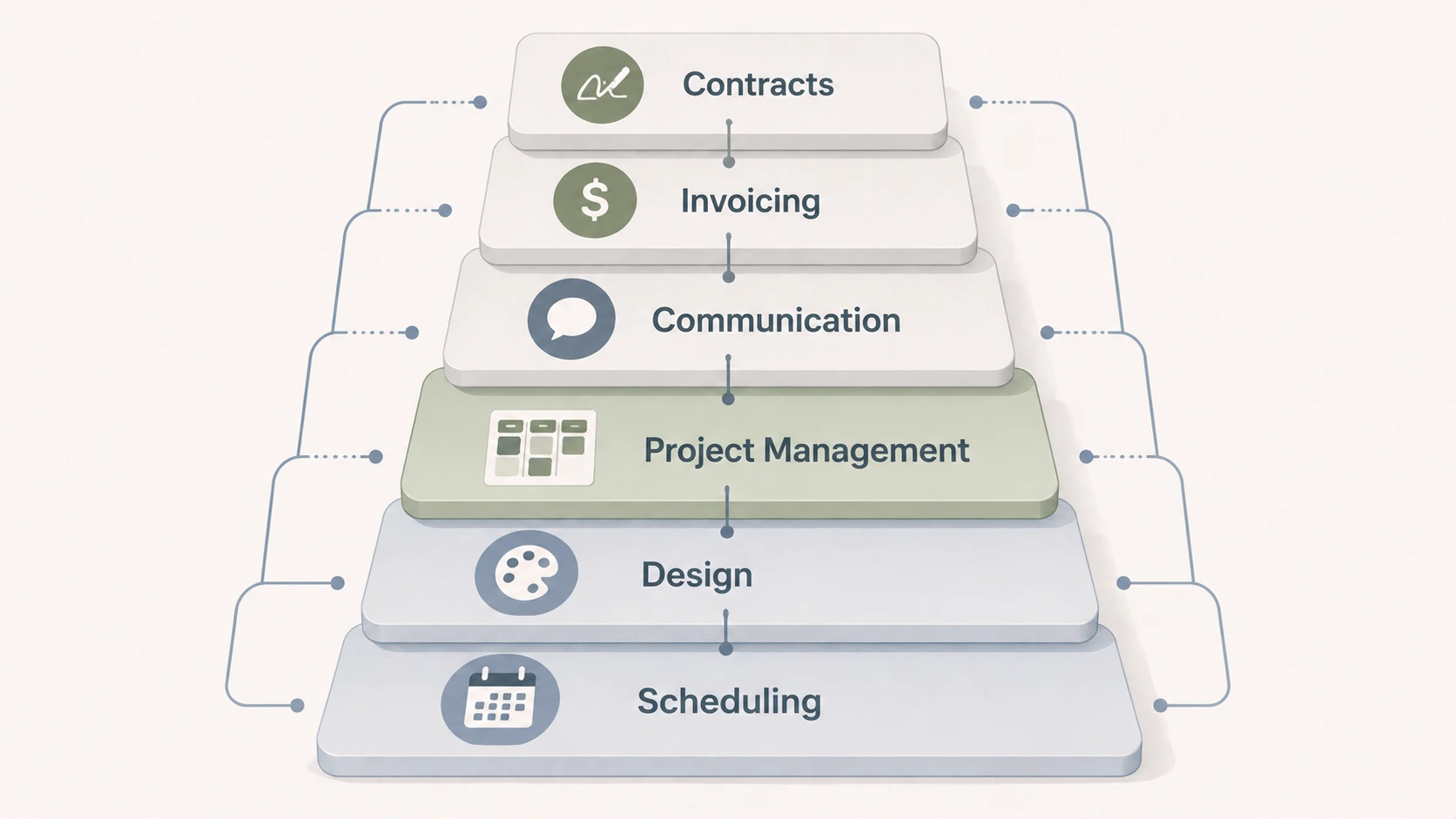
The minimum viable stack for a new agency, with verified 2026 pricing:
Core stack (~$150–$300/month for 3–5 clients)
1. Social media management platform — $79–$159/mo PostPlanify is the strongest fit for new agencies because of the operational shape: flat-rate pricing means you can give clients view-only access without seat fees, multi-workspace structure (5 / 15 / 50 / unlimited workspaces) maps cleanly to one-per-client, white-label PDF reports work for monthly client reporting, and multi-approver workflows fit client review chains.
- Growth plan ($79/mo billed yearly): 15 social accounts, 5 workspaces, 3 team members — fits agencies with 1–3 clients
- Premium plan ($159/mo billed yearly): 30 social accounts, 15 workspaces, 6 team members — fits 4–10 clients
- Scale plan ($239/mo billed yearly): 100 social accounts, 50 workspaces, 12 team members — fits 10–30+ clients
For a deeper review of agency-specific tools and how they compare, see best social media management tools for agencies. For tools with no per-seat fees specifically, see social media tools with no per-seat fees.
2. Design tool — $0–$13/month
- Canva Pro ($13/mo) for most agencies — templates, brand kit, team collaboration, Magic Resize for cross-platform variants
- Free Canva tier works for very early stage; upgrade once you're producing more than 30 designs/month
3. Analytics / native platform tools — Free
- Native Meta Business Suite, LinkedIn Page Analytics, TikTok Analytics, X Analytics, YouTube Studio
- Google Analytics 4 for site-side conversion tracking
- Your scheduling platform handles cross-platform analytics aggregation
4. Project management, $0 to $15/user/month
See our best marketing agency project management software comparison for the options at each agency size.
- ClickUp Free or Notion Free for solo operations
- Asana ($10.99/user/mo) or ClickUp Unlimited ($7/user/mo) once you have a contractor
- One workspace per client, organized by month/quarter
5. Communication — Free
- Slack Free or Microsoft Teams Free for internal + client communication
- One channel per client; one shared channel for agency-wide
6. File storage — $0–$13/user/month
- Google Workspace ($14/user/mo) is the standard — Drive, Docs, Sheets, calendar, professional email
- Or Dropbox Standard ($15/user/mo) for visual-asset-heavy agencies
7. Invoicing and payments — $0–$33/month
- Stripe + Stripe Invoicing for ACH and card payments (no monthly fee, ~2.9% + $0.30 per transaction)
- QuickBooks ($30/mo) or FreshBooks ($21/mo) once accounting becomes complex
- Wave (free) for very early stage
8. Contract / e-signature — $0–$15/month
- DocuSign Personal ($15/mo) for signed contracts
- SignWell Free for low-volume signing (3 docs/month)
- Bonsai ($21/mo) bundles contracts + invoicing + project management
Add later (after $10K MRR)
- CRM: HubSpot Free or Pipedrive ($14.90/user/mo)
- Cold outreach tooling: Lemlist, Instantly, or Apollo (~$50–$120/mo)
- Reporting tooling: Looker Studio (free) or Whatagraph ($249/mo) for advanced BI
- AI image generation: Midjourney ($30/mo) or built-in via PostPlanify Scale (800 AI images/mo)
- Time tracking: Toggl Free or Harvest ($12/mo) once billing complexity grows
What you don't need yet
- A custom-built website (use Webflow Starter at $14/mo, or a polished one-pager from a Cal.com link)
- Salesforce or any enterprise CRM (overkill for under 20 clients)
- Sales enablement tooling (Outreach, Salesloft) — wait until you have a sales hire
- Custom analytics dashboards — your scheduling platform's analytics + Looker Studio handles this for free
Step 5: Land Your First 3 Clients
This is where most new agencies stall. The "build it and they will come" model doesn't work; clients don't materialize because you've launched a website. They come from deliberate outbound work in channels with documented results.
The reality of first-client acquisition in 2026
Recent LinkedIn outreach data is sobering for anyone who learned cold-DM tactics from 2022 YouTube content:
- 79% of B2B decision-makers actively ignore cold direct messages
- LinkedIn cold outreach acceptance rates: 30–35%
- Reply rates to subsequent automated pitches: single digits
- Low-volume outreach (<25/week) performs 2× better than high-volume
Translation: cold outreach still works, but the volume + automation playbook does not. You need warmth, signal, and credibility before the message lands.
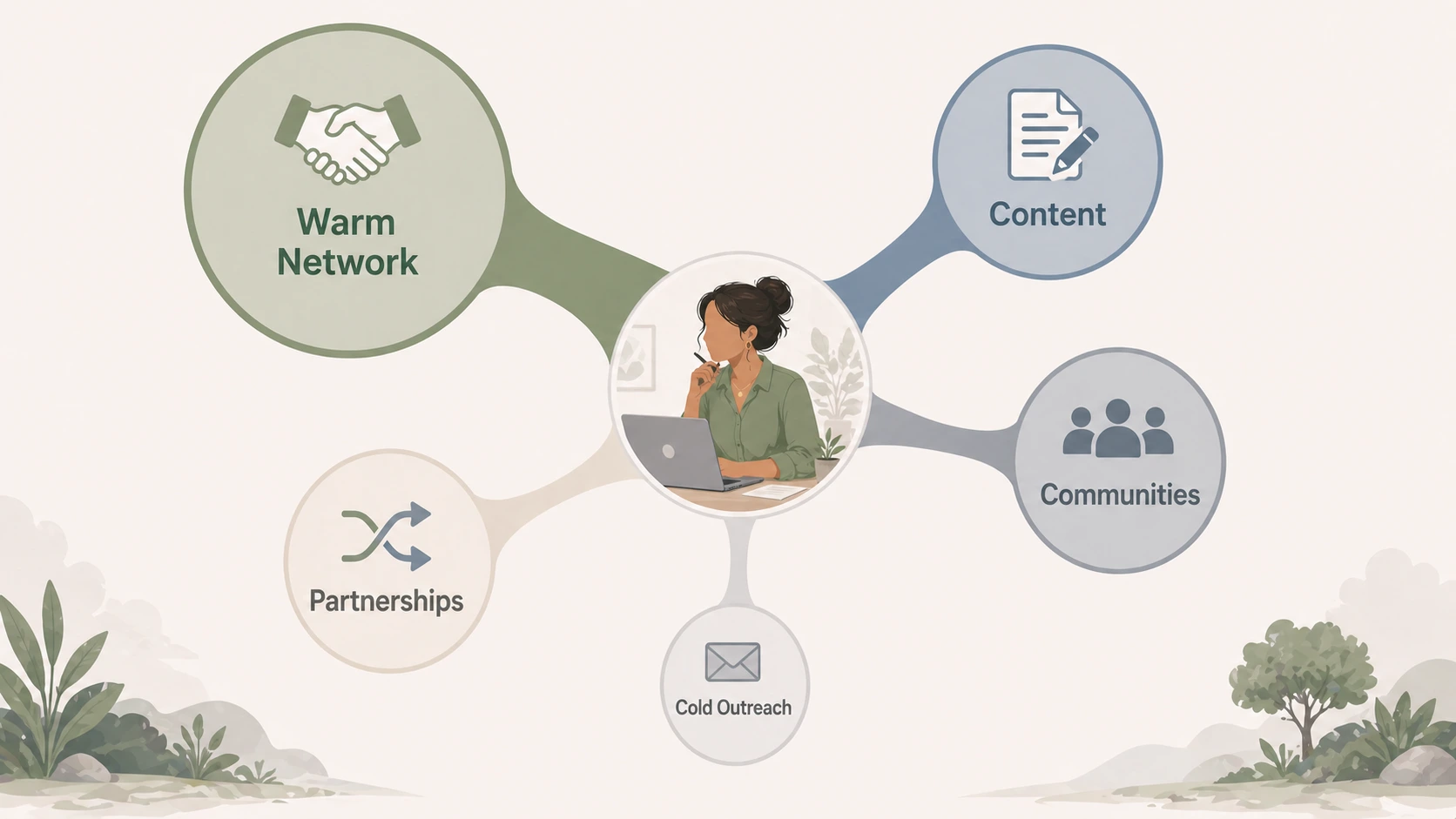
The first-client acquisition channels that actually work
Channel 1: Warm network (highest conversion, slowest scale)
Start here. List 30 people who already know you and work in or adjacent to your niche. Email each personally (no group blast). Ask not for the sale, but for the introduction:
"I'm starting a [niche] social media agency, focused on [specific outcome]. I'm not pitching you — but if you know any [niche-specific role] who's frustrated with their current social media work, I'd love an intro. I'll do a free strategy review for them either way."
Warm network conversion rates run 10–25% to first conversation, and 5–15% from first conversation to retainer. The first 1–3 clients almost always come from warm network.
Channel 2: Content-led inbound (slowest start, fastest compounding)
Build a content presence on LinkedIn (B2B niches), Instagram (B2C, lifestyle, hospitality), or X (founder-led, marketing-led, tech). The principle is document, don't promote:
- Document specific client wins (with permission and anonymization where needed)
- Educate your ideal client about what good social media management looks like
- Share frameworks, templates, and behind-the-scenes operational content
- Be specific about who you help — don't say "businesses," say "early-stage B2B SaaS marketing leads"
Content takes 6–12 months to compound but creates the strongest top-of-funnel. By month 9, you'll have inbound leads from people who've never heard of you reaching out because they've been reading your posts.
Channel 3: Niche-specific community presence
Pick 2–3 communities where your ideal client lives (not where other agency owners hang out — that's the wrong audience). Examples:
- B2B SaaS: SaaS Founders Mastermind, RevGenius, Pavilion
- Real estate: Local realtor associations, Bigger Pockets
- Healthcare: Healthcare Marketing Network, AMA marketing chapters
- Coaches: Niche coaching communities and masterminds
- Local services: Chamber of Commerce, Rotary, BNI
Show up consistently for 60 days before you ever pitch. Answer questions, contribute insight, build reputation. Then pitches happen organically because people know who you are.
Channel 4: Strategic partnerships
Identify adjacent service providers who share your client base but don't compete:
- Web designers who build sites but not social
- PR agencies who want to refer social work
- Email marketing freelancers
- SEO agencies
- Brand strategy and packaging design agencies like SmashBrand, whose CPG clients need the new brand executed on social
- Photo/video producers
Offer mutual referrals. One strong partnership can drive 30–50% of an agency's growth in year one.
Channel 5: Cold outreach (only after warmth and content)
Not a starting channel. Use cold outreach once you have content, case studies, and a recognizable niche. Then volume of <25 messages/week, hyper-personalized, with a specific offer (not "let's hop on a call"), can land 1–2 clients/month.
The first conversation: discovery, not pitch
When a warm intro or inbound lead comes in, the first conversation is discovery, not pitch. Ask:
- What's prompting you to consider hiring help right now?
- What does success look like in 6 months?
- What have you tried before? What worked? What didn't?
- What's the budget range you're working with?
- Who else is involved in this decision?
Most new agency owners pitch on the first call and lose the deal. Discovery calls close at 2–3× the rate of pitch calls.
After discovery, send a follow-up scope document with:
- Restated goals
- Recommended approach (specific to their context)
- Pricing options (3 tiers — they almost always pick the middle one)
- Timeline
- Next step
Step 6: Onboard and Run Your First Client Engagement
Most agency churn happens in the first 90 days. Strong onboarding cuts churn dramatically and sets the engagement up for long-term renewal.
The first-30-days onboarding playbook
Week 1: Strategy and access
- Strategy kickoff call (60–90 min) — review goals, audience, brand voice, content pillars
- Brand documentation transfer (logos, fonts, colors, tone-of-voice guide)
- Social account access via official APIs (PostPlanify, Hootsuite, Sprout etc. handle this — never share passwords)
- Add the client to your project management tool with their own workspace
- Confirm payment terms, send first invoice, confirm payment received before starting work
Week 2: Audit and content calendar
- Conduct a social media audit (existing performance, gaps, opportunities)
- Build month 1 content calendar — draft post copy, identify visuals needed
- Send first content batch for client review (use a tool with approval workflows; PostPlanify Premium+, Loomly, or Vista Social all support this)
Week 3: First content goes live
- Schedule and publish approved content
- Begin community management (responding to comments and DMs)
- Daily Slack check-ins for the first two weeks; transition to weekly after
Week 4: First reporting cycle
- Pull first 30-day performance report (a white-label PDF if your tool supports it)
- Review with client on a call — frame around outcomes, not vanity metrics
- Adjust strategy for month 2 based on data
For a structured checklist of every onboarding step (with templates), see our social media agency client onboarding checklist.
Reporting that retains clients
Monthly reporting is the highest-leverage retention activity. Done well, clients renew without conversation. Done poorly, the renewal call is a renegotiation.
Effective reporting includes:
- One-page executive summary — narrative-style, not metric-dense. What we did, what worked, what we're changing.
- Performance numbers — reach, engagement, follower growth, conversion-attributed traffic
- Specific content callouts — top-performing posts, why they worked
- Next month's plan — what shifts based on this month's data
The reporting framework matters more than the metric depth. For a deeper guide on building reports that actually retain clients, see how to create a social media report and social media KPIs for agencies to report to clients. For the white-label specifics — branded PDFs, shareable links, custom templates — see white-label social media reports for clients.
Step 7: Scale from Solo to Small Team
The transition from solo operator to small team is the second most common failure point (after the first-client struggle). Done too early, you erode margins by hiring before you have stable revenue. Done too late, you burn out and clients churn from quality drops.
When to make your first hire
Make your first contractor hire when all three are true:
- You've crossed $10K MRR consistently for 3+ months (not one big month — sustained)
- You're spending 20+ hours/week on production work that could be delegated (not strategy or client communication)
- You have a documented production playbook (someone else could follow it)
Hire order: contractor before employee
Most agencies grow through contractors before full-time hires. Standard sequence:
1. First contractor: graphic designer or video editor ($500–$2,000/mo per client served)
- Frees you from production grunt work
- Easy to scale up/down with client load
- Often hourly or per-deliverable, not retainer
2. Second contractor: virtual assistant or community manager ($1,500–$3,500/mo)
- Handles inbox replies, scheduling, simple admin
- Frees you for sales, strategy, and account management
3. Third contractor: copywriter or content strategist ($2,000–$5,000/mo)
- Drafts captions and content briefs
- You review and approve, scaling your output significantly
4. Fourth person: account manager (employee or senior contractor) ($60K–$90K/year as employee, or $5,000+/mo as contractor)
- Handles weekly client communication, reporting, strategy calls
- This is the hire that breaks you out of the bottleneck of being on every client call
AI workflows reduce hiring pressure
In 2026, AI tools meaningfully reduce the staffing pyramid. Tasks that previously required a contractor — caption drafting, image generation, post variants, basic analytics summaries — can now be 50–70% AI-assisted. This shifts the optimal team shape:
- Solo + AI tools: can support up to 8–10 clients (was 4–6 pre-2024)
- Solo + 1 contractor + AI: can support up to 15 clients
- Small team (3–4 people) + AI: can support 25–35 clients
For specific AI workflow examples agencies are running, see our guide on how social media agencies use AI workflows.
Pricing the second tier of clients (mid-market)
As you scale past the first 5 small-business clients, your second tier should be mid-market. Mid-market retainers ($5,000–$10,000/mo) come with different expectations:
- Higher production volume (40+ posts/month)
- More platforms
- Paid ad management bundled in
- Dedicated account manager
- Quarterly business reviews
- Custom reporting and BI dashboards
The economics improve significantly: one $7,500/mo mid-market client equals 3–4 small-business clients but takes only 1.5–2× the production time. Most agencies that hit $25K–$50K MRR get there by adding 2–3 mid-market clients, not 15 small-business clients.
Step 8: Build Retention Systems
Acquisition is expensive. Retention is what makes agencies profitable. The math: a client who stays 12 months instead of 6 doubles their lifetime value with no additional acquisition cost. Retention compounds.
Retention tactics that work
1. Quarterly Business Reviews (QBRs). Every 90 days, schedule a 60-min review. Show progress against goals, propose strategic shifts, surface upsell opportunities. QBRs predict renewal — clients who do them renew at 85%+; clients who skip them renew at 50%.
2. Monthly strategy calls — not just status calls. Status reports answer "what did you do?" Strategy calls answer "what should we do next?" Position yourself as a strategic partner, not a content vendor.
3. Document scope creep, but accommodate small asks. Track every "quick favor" the client asks for. After three of them, propose a scope expansion or politely surface them. Agencies that say yes to everything bleed margin; agencies that say no to everything churn clients.
4. Surface ROI continuously. Find the one metric that matters most to the client (lead-source attribution, follower growth in target demographic, donor click-through rate, whatever) and reference it every report.
5. Build a "client success" cadence even if you're solo. Birthday emails, anniversary acknowledgments, sending relevant industry articles. Sounds small; reduces churn meaningfully.
6. Increase prices on time. Annual price increases of 5–10% are standard. Communicate them with 60 days notice, frame around expanded scope or accumulated expertise. Most clients accept; the ones who churn over 8% increases were going to churn anyway.
For a deeper breakdown of agency-side metrics that drive retention, see client engagement metrics that matter.
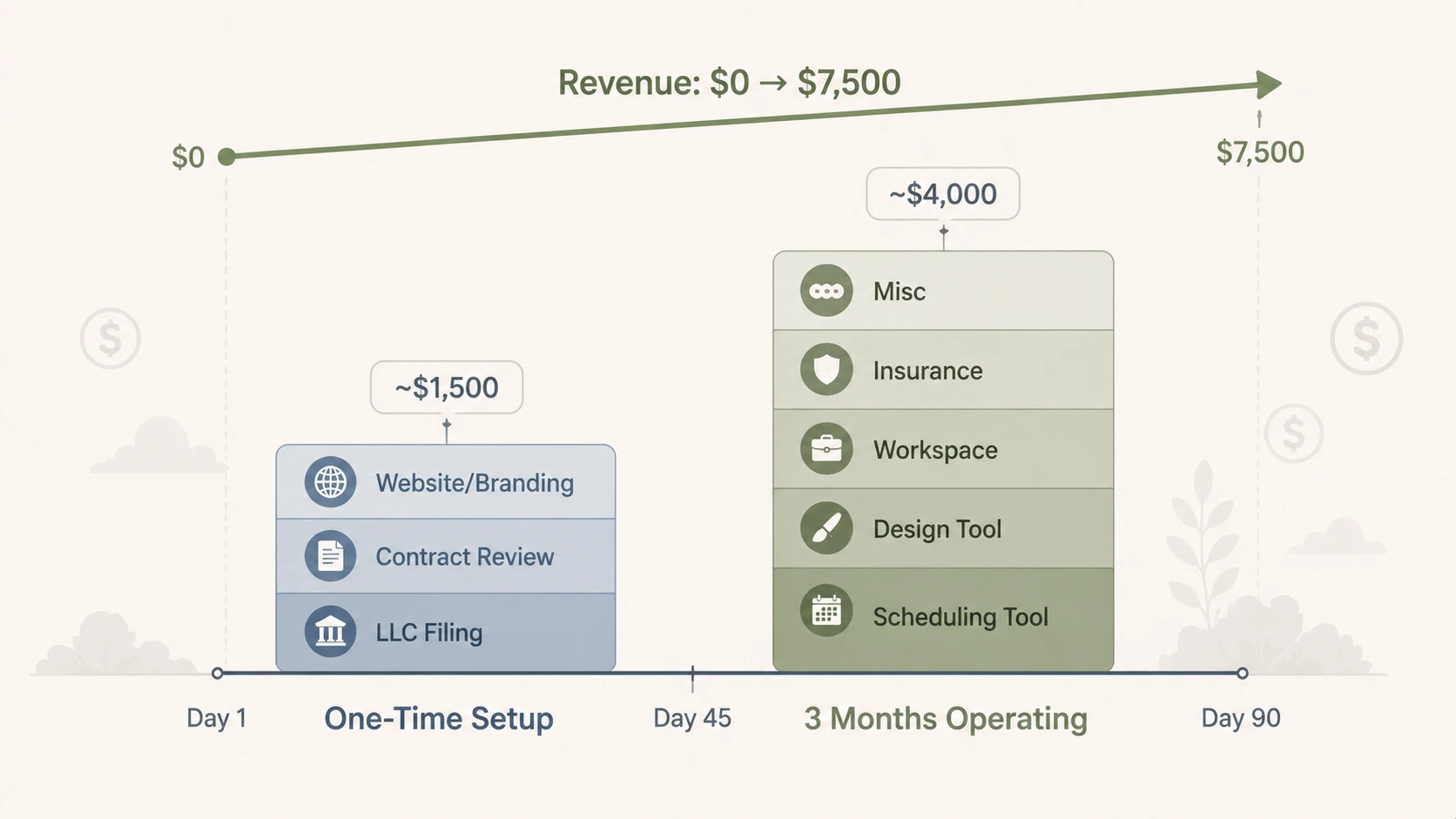
Real Cost: What the First 90 Days Actually Costs
Here's what starting an agency actually costs in 2026, with verified pricing — the budget course content rarely shows.
One-time setup costs
| Item | Cost Range |
|---|---|
| LLC filing (varies by state) | $50–$500 |
| Registered agent (first year) | $100–$300 |
| Domain name | $12–$20/year |
| Logo (Fiverr or DIY in Canva) | $50–$300 |
| One-page website (Webflow, Carrd, Framer) | $0–$200 |
| Initial contract review by attorney | $500–$2,000 (optional but recommended) |
| Bookkeeping setup | $0–$300 |
| Total one-time setup | $700–$3,600 |
Monthly operating costs (first 90 days, 0–3 clients)
| Item | Monthly Cost |
|---|---|
| PostPlanify Growth | $79/mo (yearly) |
| Canva Pro | $13/mo |
| Google Workspace | $14/user/mo |
| Project management (ClickUp Free → Asana) | $0–$11/mo |
| QuickBooks Self-Employed | $15/mo |
| DocuSign Personal | $15/mo |
| E&O + General Liability insurance (start month 2) | $40–$120/mo |
| Banking (Mercury, Relay) | $0/mo |
| Total monthly (months 1–3) | ~$176–$267/mo |
Three-month total
- One-time setup: ~$700–$3,600
- 3 months of operating costs: ~$528–$801
- Three-month total: ~$1,228–$4,401
Realistic revenue trajectory
What revenue actually looks like in those three months:
- Month 1: $0. You're setting up and prospecting. Most agencies have no revenue in month 1.
- Month 2: $0–$2,500. First client may close, often at the lower end of pricing.
- Month 3: $2,500–$7,500. Second and third clients start landing.
- End of month 3 MRR: $2,500–$7,500/mo if you executed well; $0 if you didn't.
This means you need 3–6 months of personal runway minimum. Anyone who tells you the agency model produces revenue faster than that is selling a course.
When you hit $10K MRR
This is the inflection point most successful agencies hit between months 6–12. At $10K MRR, the math is sustainable:
- Revenue: $120K/year
- Tooling and operating costs: ~$300–$500/mo = $3,600–$6,000/year
- Insurance + admin: ~$100–$200/mo = $1,200–$2,400/year
- Tax reserve (25%): $30,000/year
- Effective take-home before any contractors: ~$80,000–$85,000/year
That's the realistic baseline of solo agency operation at $10K MRR. Adding mid-market clients and a contractor or two can push net income past $150K/year by year 2 if execution is strong.
Common Mistakes New Agency Owners Make
The patterns that kill new agencies are well-documented. Avoiding them is half the battle.
1. No niche. Trying to serve "small businesses" or "any client willing to pay" — leads to commoditization, undifferentiated pricing, and unsustainable margins. Pick a niche.
2. Underpricing the first 3 clients. "I'll just get in the door cheap" becomes "I'm stuck at $1,000/mo retainers." Pricing is sticky. Charge correctly from day one.
3. Skipping contracts. The friend client, the referral, the "we trust each other" client — these are the ones who stop paying or scope-creep. Always have a written contract.
4. Mixing personal and business finances. Creates tax problems, weakens liability protection, makes financial visibility impossible. Separate accounts from day one.
5. Saying yes to everything in scope. Scope creep destroys margins faster than anything else. Document scope, surface scope changes, charge for additions.
6. Buying enterprise tools before you need them. Sprout Social and Hootsuite are tempting. Neither makes sense at 0–5 clients. Start lean with PostPlanify or similar; upgrade only when scale justifies it.
7. Hiring before $10K MRR. Premature hiring burns cash and creates management overhead before you have the revenue base to support it. Stay solo (with AI assistance) longer than feels comfortable.
8. No reporting cadence. Clients who don't see results forget they're paying you. Monthly reports — even simple ones — keep the value visible.
9. Confusing volume of activity with strategic value. Posting 30 times a month on every platform is not the same as growing a client's business. Strategy first, volume second.
10. Treating it as a side project. Agencies that grow are run with the discipline of a real business. Side-project agencies stall around $3K–$5K MRR and never break out.
When to Stay Solo vs Build an Agency
Not everyone should build an agency. Solo freelancing with the agency operational model can be more profitable, more flexible, and less stressful than scaling.
Stay solo if:
- You enjoy the craft (writing, strategy, design) more than the operations
- Your goal is $100K–$200K take-home, not $1M+ revenue
- You don't want to manage people
- You can hit your income goal with 3–5 retained clients at $3K–$7K/mo each
- You'd rather spend time on clients than on hiring, training, and process documentation
Build an agency if:
- You enjoy operations, hiring, and process design as much as the work itself
- You want to build something with enterprise value (acquirable, sellable)
- You're comfortable with management overhead
- You have a niche where mid-market and enterprise clients exist
- You're willing to spend year 2 mostly on team and process, not client work
Both paths are legitimate. The mistake is stumbling into the agency path because course content told you that's the goal — when solo at $200K/year is what you actually want.
FAQ: Starting a Social Media Marketing Agency
How much money do I need to start a social media marketing agency?
Realistically, $1,200–$4,500 in setup costs (LLC, basic tools, contracts, modest design) plus 3–6 months of personal living expenses to bridge the revenue ramp. The agency model takes 2–6 months to first revenue, longer if you're learning a new niche. Anyone telling you to start with $50K is overselling; anyone telling you to start with $0 is underselling. The honest range is "low four figures + personal runway."
Do I need a formal business plan?
A 30-page business plan, no. A 1–2 page operating doc, yes. You should be able to articulate: (1) niche, (2) one focused service offering, (3) pricing tiers, (4) target clients, (5) acquisition channels, (6) cost structure, (7) 12-month revenue target. If you can't write that on two pages, you're not ready.
What's the difference between a freelancer and an agency?
Three differences: (1) agencies have multiple service offerings or specialized capacity; freelancers typically don't, (2) agencies have systematized operations (project management, reporting templates, hiring); freelancers ad-hoc each engagement, (3) agencies have legal/financial structure (LLC, contracts, insurance) that signals scale to enterprise clients. The transition from freelancer to agency is mostly about systematization and structure, not headcount. A solo "agency" with great operations is more credible than a 4-person team without them.
Can I start a social media agency with no experience?
Technically yes; realistically, only if you specialize in a niche where you have prior experience. A B2B SaaS marketer who's been in-house for 5 years can credibly start a B2B SaaS agency. A person who's never managed social media at scale starting a "general social media agency" will struggle to charge above $1,500/mo retainers because they have no demonstrable expertise. Specialize in what you know.
How long until I make $10K/month?
For founders with prior in-house or freelance experience in their chosen niche: typically 6–12 months. For founders learning a new niche from scratch: 12–24 months. The variance is mostly explained by (1) niche choice, (2) network access, (3) consistency of acquisition activity, (4) pricing decisions in the first three clients. Speed is heavily front-loaded — your first three clients set the trajectory.
Should I quit my job before starting?
Generally no, until you have 1–2 paying clients. The most efficient path is to start the agency on nights and weekends while employed, land your first 1–2 clients (proving the model works), then go full-time. Quitting first creates time pressure that pushes you to underprice and accept poor-fit clients. Two paying clients at $3K/mo each = $6K/mo MRR, which is enough to bridge the transition for most people.
How do I get my first client without case studies?
Three options: (1) do free or discounted work for 1–2 clients in exchange for case study rights and testimonials, (2) leverage your prior in-house or freelance work as case studies (with permission and anonymization), (3) start with one project-based engagement (audit, strategy doc) which builds a deliverable you can show before retainer pricing. Most successful agencies use a combination — first client at a discount with case study rights, second client at full price, third client at a premium because the first two case studies built credibility.
What's the best legal structure for a US social media agency?
LLC for most agencies. Reasons: liability protection (clients can sue), pass-through tax treatment (same as sole prop), professional appearance for enterprise clients, modest filing cost ($50–$500 depending on state). S-corp election is worth considering once you cross ~$80K/year in net profit (potential payroll tax savings); consult a CPA at that point. Sole proprietorship is fine for the first 60 days while validating, but switch to LLC once you have 2–3 paying clients. This is not legal advice — consult an attorney for your specific situation.
How important is having a website?
Less important than people think in your first year. Most early clients come from warm network, content-led inbound, or partnerships — not from your website. A polished one-page site with your offering, niche, and a Cal.com booking link is sufficient for the first 12 months. Invest in a real website (Webflow, Framer, custom-built) once your inbound traffic justifies the work. Don't spend $5K on a website before you have $10K MRR.
Do I need to incorporate immediately?
No. You can operate as a sole proprietor for the first 30–90 days while validating that the agency is real. File the LLC once you have 2–3 paying clients and revenue clarity. Many agency owners delay LLC formation until end of year for tax-year alignment. Confirm with a CPA — your specific situation may favor earlier filing.
What's the best social media management platform for a new agency?
Depends on client load and feature needs. For most new agencies, the operational fit comes down to flat-rate pricing (so you can give clients view-only access without seat fees), reporting depth, and multi-workspace structure (so each client gets their own organized environment). PostPlanify Premium ($159/mo billed yearly) is a strong entry point for 15 workspaces, 6 team members, approvals, and branded reports; Scale ($239/mo billed yearly) is where true white-label PDF reports start. Sendible Scale ($199/mo) and Sprout Social Standard ($199/seat/mo) are alternatives with different trade-offs. For a full agency-tool comparison, see best social media management tools for agencies.
How do I price my first client without case studies?
Anchor pricing to the value the client receives, not your hours. Even without case studies, you can quote $2,500–$3,500/mo for full-service management of 3–4 platforms with 16–24 posts/month — that's the lower end of the industry standard ($3,500 average per recent pricing data). If the client pushes back, offer a 60-day initial term at the lower end of your range with a clear scope, then renegotiate at month 3 with results in hand.
Should I offer multiple service tiers?
Yes — three tiers usually. Most clients pick the middle tier when given three options (the "decoy effect" in pricing). A common structure: Starter ($2,000/mo, 2 platforms, 8 posts/mo), Growth ($3,500/mo, 4 platforms, 16 posts/mo), Premium ($6,000/mo, 4 platforms, 24 posts/mo + paid ads up to $5K). Three tiers also give you upgrade paths inside the same client engagement.
How do I avoid scope creep?
Three habits: (1) document scope explicitly in the contract — list deliverables, count, frequency; (2) track every "quick favor" in your project management tool; (3) raise scope concerns early, not after months of accumulation. Most scope creep comes from clients adding small asks that compound — a Reel here, a custom graphic there, a "quick" community management ask. Surface them at month 2 with: "I've noticed we've been doing X above scope. Want to add it formally to the retainer at $Y/mo, or should we keep it ad-hoc?"
How do I handle clients who pay late?
Net-15 payment terms (not net-30) for retainer clients, plus 1.5% monthly late fees written into the contract. Stripe and most invoicing tools auto-charge on due date — make this default unless the client explicitly requires manual invoicing. For repeat-late payers, pause work after 5 days late (write this into the contract) and require pre-payment for the next month before resuming. Late payment is the most common cash-flow problem for new agencies; structural defaults solve it.
Can I run a social media agency from any location?
Yes for most niches. Geographic flexibility is one of the agency model's strongest features. Exceptions: highly local niches (boutique real estate teams, regional restaurants) sometimes prefer in-person availability. Tier 1 metro clients (NYC, SF, London) sometimes pay a premium for in-person availability. For B2B SaaS, healthcare, ecommerce, and most other niches, location is largely irrelevant.
Key Takeaways
- Niche first, everything else second. Specialized agencies in 2026 earn 28–35% margins (B2B SaaS, healthcare); generalists struggle at 10–18%. The single biggest decision you make is your niche.
- Pricing is sticky — set the floor correctly. First three clients establish your pricing trajectory. Charge full-tier ($2,500–$5,000/mo retainer) from day one or accept that you'll be at sub-$2K retainers for years.
- The agency model takes 6–12 months to $10K MRR. Have 3–6 months of personal runway. Anyone promising faster is selling a course, not running an agency.
- Operational discipline distinguishes profitable from struggling. Contracts, separate banking, scoped retainers, monthly reporting, QBRs — agencies with these systems retain clients at 85%+; agencies without them churn at 50%+.
- Start with a lean stack ($150–$300/mo). PostPlanify for management, Canva for design, Google Workspace for ops, ClickUp/Notion for projects. Upgrade tools as scale justifies, not before.
- Stay solo + AI longer than feels comfortable. AI workflows extend solo capacity to 8–10 clients. First contractor only after $10K MRR is sustained for 3+ months.
- Retention compounds. A 12-month client at $4,000/mo = $48K LTV; a 6-month client at the same rate = $24K. The difference is mostly operational discipline, not new acquisition activity.
 PostPlanify
All your social media in one simple dashboard
Schedule posts, track analytics, and reply to comments/DMs without switching tabs.

Engagement
+18%
Views
52.8k
If you're building a social media marketing agency in 2026, PostPlanify is worth a serious look as your operational platform. Flat-rate pricing means you can give clients view-only access without seat fees, multi-workspace structure (5 / 15 / 50 / unlimited workspaces) maps cleanly to one-per-client, multi-approver workflows fit client review chains, and white-label PDF reports work cleanly for monthly client reporting and QBR decks. Starting at $79/mo billed yearly on the Growth plan, scaling to Scale at $239/mo for 100 social accounts and 50 workspaces — purpose-built for agency operations.
Related Reading
- Best Social Media Management Tools for Agencies
- Social Media Agency Proposal Template
- Social Media Agency Contract Template
- How to Find Social Media Marketing Agency Clients
- Social Media Agency Client Onboarding Checklist
- Social Media Agency Pricing Models Compared
- How Much to Charge for Social Media Management
- White-Label Social Media Reports for Clients
- White-Label Social Media Management
- Social Media KPIs for Agencies to Report to Clients
- How Social Media Agencies Use AI Workflows
- Social Media Agency Statistics
- Best Social Media Tools with Approval Workflows
- Social Media Tools With No Per-Seat Fees
- How to Create a Social Media Report
- Client Engagement Metrics That Matter
- Manage Multiple Social Media Accounts
- Social Media Management Workflow
Sources
- Social Media Marketing Agency Pricing 2026 — retainer ranges and industry averages
- Social Media Management Pricing Guide for Agencies — pricing by package, platform, and scope
- Most Profitable Niches for Digital Marketing Agencies in 2026 — niche profit margin analysis
- LinkedIn Outreach in 2026 — cold outreach acceptance and reply rates
- How to Start a Social Media Marketing Agency Guide — industry context and US agency count
- SBA Choose a Business Structure — LLC vs sole proprietorship comparison
- Best Social Media Tools with White-Label Reports
PostPlanifyAll your social media in one simple dashboard
Schedule posts, track analytics, and reply to comments/DMs without switching tabs.
Engagement
+18%
Views
52.8k
About the Author

Hasan Cagli
Founder of PostPlanify, a social media management platform for agencies and teams. He focuses on building systems that help businesses, agencies, and teams plan, publish, and manage content and social media more efficiently across platforms.


