


Your team shipped posts all month. Creative went out on time. Nothing looked off in review. Then the report came in and the pattern was familiar. Reach stalled, engagement bounced around, and each platform seemed to reward a different type of post.
That's the point where teams start adding tactics without fixing the system behind them. They post more often, test another hashtag set, chase a trend format, or add another tool to the stack. Activity goes up. Clarity usually does not.
The root issue is rarely effort. It's the lack of an operating model. Without one, content gets published without a clear feedback loop, channel priorities stay fuzzy, and teams mix up content meant for discovery with content meant to build trust or convert existing attention. Results flatten, and nobody can explain what should change first.
Social growth now depends on coordination across platforms, formats, and roles. People discover brands in one place, vet them in another, and come back later through search, DMs, creator mentions, or retargeting. Treating one channel as the whole strategy leaves gaps in that path, especially for teams managing multiple offers, audiences, or client accounts. If you need a practical starting point for planning that work, this guide to creating a social media content calendar is a useful reference.
That's the angle of this guide. It is not another list of ideas to test when numbers dip. It is a working playbook. Each strategy is framed around when to use it, how to implement it step by step, which assets and roles it requires, which metrics matter, and what changes across Instagram, Facebook, TikTok, X, and LinkedIn.
The trade-offs matter too. A strategy that works for a solo creator can break under client approvals. A format that grows reach on TikTok may do little for LinkedIn pipeline. A niche operator building a social media strategy for real estate will need a different workflow, content mix, and review cadence than a B2B SaaS team or ecommerce brand.
Use the strategies below as a system you can run. That means choosing a few that match your audience, team capacity, and business goal, then setting them up so they support each other instead of competing for time and budget.
Quick Answer: What Actually Drives Social Media Growth in 2026
Social media growth in 2026 depends on three things working together:
- A defined job for each platform. Discovery, trust, or conversion — pick one per channel. Running the same strategy on Instagram, LinkedIn, and TikTok is the fastest way to flatten results.
- Engagement-first content. Saves, shares, qualified comments, and DM replies predict business outcomes better than reach. Sprout Social research cited by HubSpot shows response speed now affects whether consumers stay with a brand or switch.
- A weekly review loop. Track outputs (cadence, format mix, response time) separately from outcomes (leads, sales, qualified follows). Adjust one variable at a time.
The 10 strategies below are sequenced by what to fix first. Use the diagnosis table next to skip straight to your bottleneck.
Quick Diagnosis: Match Your Bottleneck to a Strategy
| Symptom | Most Likely Cause | Where to Start |
|---|---|---|
| Posts go out inconsistently, week-by-week scramble | No operating model | Content Calendar |
| Lots of metrics tracked, no clear decisions made | Measuring outputs not outcomes | Analytics |
| Posts reach the wrong people | Weak discoverability signals | Hashtags + Social SEO |
| Comments and DMs go unanswered | No community ownership | Engagement-First Content |
| Reach is flat, polished posts underperform | Wrong format for the platform | Video & Native Formats |
| Need to reach new audiences fast | Limited organic distribution | Collaboration + Ambassadors |
| Traffic doesn't convert | Profile and offer not search-clear | SEO + Link Building |
| Need volume immediately | Organic too slow alone | Paid Advertising |
| Niche brand competing for attention | Too broad a focus | Thought Leadership |
 PostPlanify
All your social media in one simple dashboard
Schedule posts, track analytics, and reply to comments/DMs without switching tabs.

Engagement
+18%
Views
52.8k
1. Content Calendar Planning & Consistency
If your posting rhythm depends on how busy the week feels, you don't have a strategy. You have a recurring scramble.
A content calendar fixes more than scheduling. It forces decisions early. You see platform gaps, campaign overlap, missing assets, and approval bottlenecks before they break publishing. For agencies, it also prevents the classic client problem where everything becomes “urgent” because nothing was mapped in advance.

When this works best
This is the first fix when a brand has inconsistent output, reactive approvals, or uneven platform coverage. It also matters when one team is creating for multiple channels and keeps repurposing the same idea too late.
I've found calendars work best when they're not just date grids. They need to show content pillar, platform, campaign tie-in, owner, status, and whether the post is fixed or flexible. Without that, the calendar looks organized but doesn't reduce decision fatigue.
Implementation workflow
- Set your publishing floor: Pick the minimum output your team can sustain for six weeks without burnout.
- Define content pillars: Use a small set of repeatable themes so ideation doesn't restart from zero every Monday.
- Map fixed dates first: Product launches, events, promos, holidays, and partner posts go in before evergreen content.
- Leave open slots: Reserve room for trends, reactive posts, or platform-native opportunities.
- Batch by format: Record multiple short videos in one session, write several captions together, and prep image sets in one design block.
- Assign owners clearly: Strategy, design, copy, review, and publishing should each have a named person.
Practical rule: If a post needs more than one approval, it should be in the calendar earlier than you think.
For teams that need a working template, this guide on how to create a social media content calendar is a solid place to start.
Platform-specific notes
- Instagram: Plan feed, Stories, and Reels separately. They serve different jobs.
- Facebook: Calendar timing still matters, especially for local businesses and event-driven content.
- TikTok: Don't overfill the month. Trend responsiveness matters more here.
- X: Keep room for live commentary and replies. A rigid calendar can make the account feel asleep.
- LinkedIn: Align posts with business moments, launches, hiring, webinars, and founder commentary.
A lot of real estate teams run into this same consistency issue, which is why examples from a broader social media strategy for real estate often translate well to any service business with recurring campaigns and local timing constraints.
2. Data-Driven Analytics & Performance Tracking
Many marketing departments track too much and learn too little. They watch likes, impressions, follower changes, reach, clicks, and views every day, then still can't answer a simple question: which content should we do more of next month?
The fix is to reduce noise and tighten the review cycle. Social media growth strategies only become useful when the metrics are tied to a decision. If the data doesn't change what gets published, it's just reporting theater.
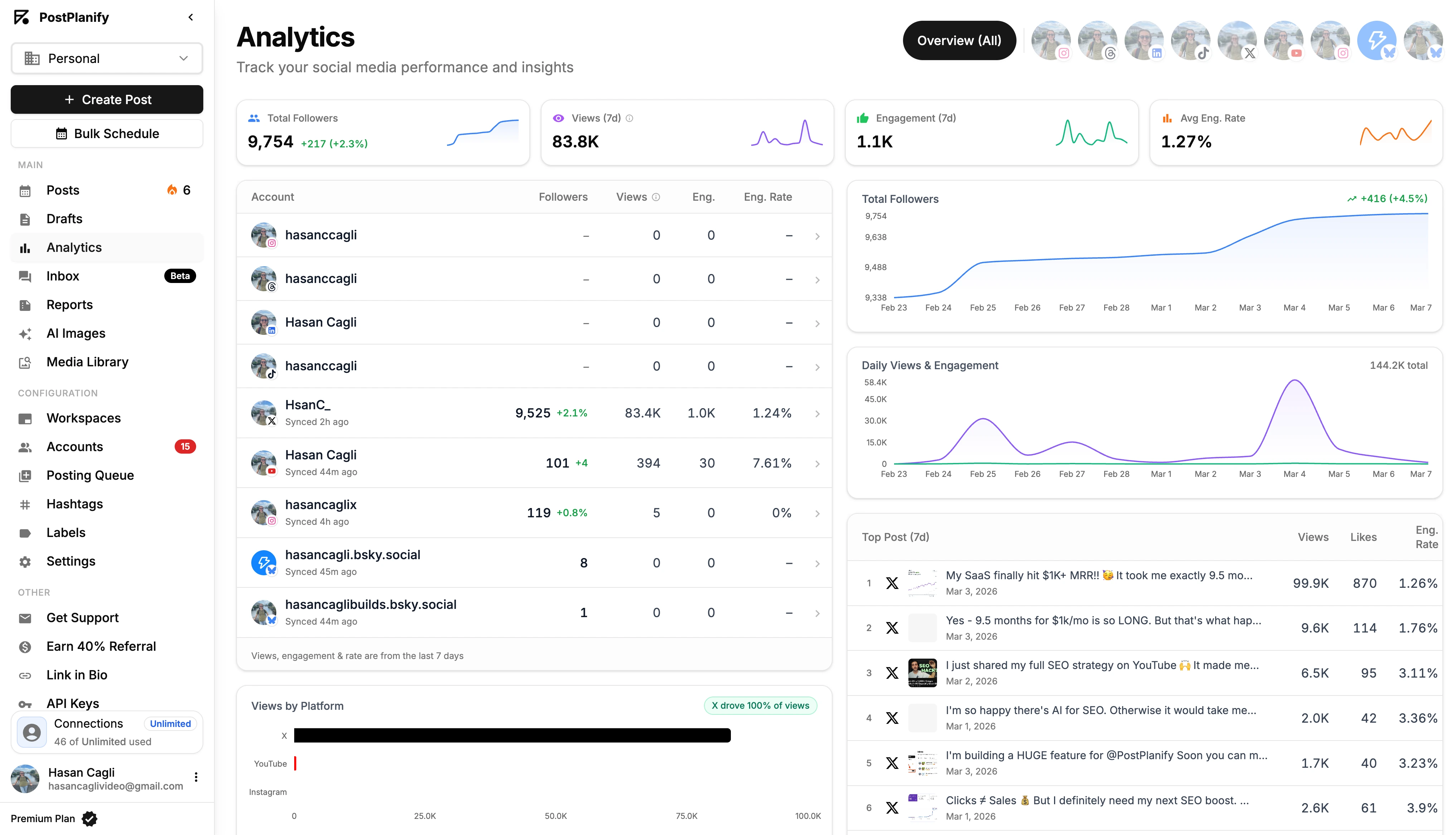
What to track instead
Start with a narrow set of metrics matched to the post's job. A discovery post should be judged differently from a trust-building post or a conversion post.
Use a working structure like this:
| Funnel Stage | What to Track | Why It Matters |
|---|---|---|
| Discovery | Reach, views, profile visits, non-follower engagement | Tells you if new audiences are finding your content |
| Engagement quality | Saves, shares, qualified comments, repeat engagement | Predicts whether reach is converting into trust |
| Traffic | Link clicks, landing page sessions, assisted conversions | Shows whether attention is moving off-platform |
| Service | Response speed, unresolved messages, comment backlog | Affects retention, brand sentiment, and repeat engagement |
| Conversion | Leads, demos, qualified DMs, purchases | The only metrics tied directly to revenue |
That middle layer matters more than many teams admit. Recent coverage has highlighted a shift away from raw follower growth and toward efficient engagement, community quality, and deeper indicators such as saves, shares, qualified comments, and repeat engagement, as discussed in Evergreen Feed's analysis of social media growth strategies.
Implementation workflow
- Review weekly, not hourly: Daily checks encourage overreaction.
- Tag posts by theme and format: You need pattern recognition, not isolated post wins.
- Separate audience types: Existing followers and new viewers often behave very differently.
- Log hypotheses: If you think founder-led videos outperform polished brand content, write that down before testing.
- Turn reports into publishing changes: More of one format, less of another, different hooks, different CTAs.
If you need a reporting setup that's easier to operationalize, this walkthrough on social media analytics and reporting covers the basics cleanly.
What usually goes wrong
The common failure mode is using platform dashboards as if they tell the full story. They don't. Native analytics are useful, but they rarely connect social activity to CRM movement, lead quality, or actual downstream conversion.
Another issue is comparing unlike posts. A meme, a product demo, a founder opinion, and a customer testimonial aren't supposed to perform the same way. Evaluate them by role, not by one universal engagement benchmark.
3. Hashtag Strategy & Research
Hashtags are no longer the growth engine some marketers want them to be, but they still help with classification, context, and discovery, especially on Instagram, TikTok, and X. The mistake is treating them like a magic reach lever instead of a search and relevance tool.
If your team is still pasting the same giant hashtag block into every post, you're probably training the account to look templated instead of discoverable.
A better way to use hashtags
Hashtag strategy works when it reflects the content itself. A behind-the-scenes Reel, a local event post, a niche tutorial, and a product education post should not carry the same tag set.
Build several small libraries based on content intent:
- Niche topic tags: For specific communities and subject areas
- Category tags: For broader industry discoverability
- Branded tags: For UGC, campaigns, and community indexing
- Location tags: Useful for local service brands, retail, hospitality, and events
- Trend tags: Used selectively, only when the content belongs in the conversation
Implementation workflow
- Research directly in-platform: Search on Instagram and TikTok first. Third-party lists get stale fast.
- Check the result pages: If the content under a tag doesn't match your post, skip it.
- Create tag sets by content pillar: Don't organize only by platform.
- Review performance monthly: Remove tags that attract the wrong audience or no meaningful discovery.
- Keep branded hashtags simple: If users can't remember or spell it, it won't spread.
For Instagram-specific decisions, this guide on how many hashtags to use on Instagram is useful because the answer depends on the post type and intent, not one fixed rule.
Hashtags help most when they describe the post clearly enough that the platform knows where to place it and the user knows why it appeared.
Platform trade-offs
Instagram still benefits from thoughtful tagging, but over-optimized captions can feel mechanical. TikTok relies more on the full content package, including hook, watch behavior, and relevance, so hashtags should support the post, not carry it. On LinkedIn, hashtags are a light assist at best. On Facebook, they're often unnecessary unless tied to a campaign or event. On X, they still have value during live topics and industry moments, but overuse makes a post look promotional.
4. Engagement-First Content & Community Building
You publish three times a week, the posts look polished, and impressions still swing wildly. Then you check the comments. Half the questions have no reply, DMs sit unanswered for days, and the only posts that get real traction are the ones that spark a back-and-forth. That pattern usually points to an engagement problem, not a content volume problem.
Community growth comes from two systems working together. The content has to invite a response, and the team has to continue the conversation fast enough that people feel heard. Brands that only schedule posts and move on usually cap out early, even if the creative is solid.
HubSpot's roundup of marketing statistics cites Sprout Social research showing that response speed affects whether consumers stay with a brand or switch, in HubSpot's marketing statistics resource. Slow community management affects more than vanity metrics. It influences retention, trust, and how often people choose to engage again.
What engagement-first content looks like in practice
Start with intent. Every post should do one of four jobs: collect feedback, start discussion, answer a repeated question, or give the audience a reason to contribute their own experience. “What do you think?” is usually too broad. A stronger prompt narrows the ask: “Which of these two options would you choose?” or “What usually blocks this step on your team?”
The format should match the type of response you want. Stories are useful for low-friction interaction, especially if the goal is quick polling or light audience research. If your team needs a clearer workflow for choosing between those placements, this breakdown of the difference between Reels and Stories helps frame the decision by intent, not by habit. Comment-led posts work better when the audience has a point of view to share. Reply videos and public answers work well when the same questions keep showing up.
For creative patterns that pull more interaction, this guide on how to create engaging social media content is worth keeping in your workflow docs.
Implementation workflow
- Audit response coverage: Review comments, DMs, mentions, tags, and story replies for the last 30 days. Look for missed questions, slow handoffs, and platforms where replies stop after publishing day.
- Set channel ownership: Assign who handles community, who handles customer support, and who steps in for sales or partnership inquiries. If an agency runs social, define the escalation path before problems show up.
- Build prompt-based content into the calendar: Mark which posts are designed for saves, which are designed for comments, and which are designed for shares. Engagement-first planning works best when the goal is set before the asset is produced.
- Create a response SLA: Set target reply windows by platform and message type. Public complaints need a faster standard than casual comments.
- Turn recurring interactions into content: Reuse good audience questions in carousels, FAQs, story series, and short videos. This reduces support load and gives the community proof that you listen.
Required assets, roles, and metrics
This strategy breaks down when nobody owns the reply layer. The minimum setup is a content lead, a community manager or account coordinator, a shared response guide, and a simple escalation matrix for legal, PR, support, and sales questions. Smaller teams can combine these roles, but the decision rights still need to be clear.
Track metrics that show relationship quality, not just reach. Useful ones include comment rate, story reply rate, DM response time, percentage of comments answered, repeat commenters, and the share of inbound questions that turn into future content. Agencies should report engagement quality separately from raw engagement volume, because a giveaway comment and a product question are not equal signals.
Platform-specific notes
- Instagram: Stories, comment replies, and UGC reposts help maintain daily contact. Carousels with a clear opinion or teachable mistake often pull better discussion than polished brand graphics.
- TikTok: Reply videos are efficient when one comment represents a common question. Fast creator-style responses usually outperform heavily edited brand responses.
- Facebook: Community still clusters around Groups, local audiences, and interest-based discussions. Page posts can work, but threads matter more than many teams expect.
- X: Speed matters. Timely replies, useful observations, and a clear point of view beat overly designed assets.
- LinkedIn: Smart comments on relevant industry posts can outperform average content on your company page. For B2B teams, employee participation often drives stronger discussion than branded posts alone.
Response standard: If your brand asks for engagement and rarely replies, people learn that the conversation ends with the post.
5. Video Content & Platform-Specific Formats
You publish three videos in a week. One is a polished brand reel that took two days to edit. One is a quick phone-shot answer to a customer question. One is a cropped webinar clip with subtitles added at the end. The quick answer wins, because it fits how people use the platform and gets to the point before they scroll away.
That pattern shows up constantly in client work. Video drives reach, but only when the format matches the platform, the audience intent, and the stage of the funnel. Teams that treat all video as one content type usually waste production time and misread why results are flat.

The practical job of social video usually falls into four buckets: attract new viewers, explain a product or idea, build trust through repeated visibility, or move warm audiences toward action. Each goal needs a different structure. A discovery reel should hook fast and reward completion. A product explainer can slow down slightly, but it still needs a clear opening, a focused middle, and one action for the viewer to take next.
Platform differences matter more than many content calendars account for.
- Instagram Reels: Best for discovery, shares, and repeatable short educational formats. Strong visual pacing helps, but clear framing matters more than polish.
- TikTok: Best for native delivery, creator-style voice, and rapid iteration. Comment-led follow-ups often outperform preplanned campaign concepts.
- YouTube Shorts: Best for broad awareness and searchable short education. Good option when one topic can support both short and long-form content.
- LinkedIn video: Best for expert commentary, sales-adjacent education, hiring brand content, and event takeaways. Tight editing helps because attention drops fast if the setup is too slow.
- Facebook video: Best for community retention, local business updates, and repurposing videos that already proved demand elsewhere.
For a quick reference on which format fits which job:
| Format | Best Platforms | Primary Job | Where the Hook Lives |
|---|---|---|---|
| Vertical short video (9:16) | TikTok, Reels, Shorts | Discovery + algorithmic reach | First 0–3 seconds |
| Carousel (multi-slide) | Instagram, LinkedIn | Education + saves | First slide visual + opening line |
| Live commentary / reaction | TikTok, X | Trust + voice | First sentence |
| Long-form video (8+ min) | YouTube | Authority + search | First 30 seconds |
| Stories / ephemeral | Instagram, Facebook | Frequency + community | Relationship format — no hook needed |
| Talking-head explainer | LinkedIn, YouTube Shorts | Expertise + B2B trust | Opening claim or contrarian take |
Format choice matters inside a platform too. Teams regularly confuse visibility formats with relationship formats. Use Reels for discovery. Use Stories for frequency, response, and lower-friction touchpoints. This breakdown of the difference between Reels and Stories is a useful reference when the same team is trying to force one format to do both jobs.
Implementation workflow
Use a repeatable production system, not one-off brainstorming.
- Choose the job of the video first: Awareness, consideration, retention, or conversion support.
- Pick one recurring format: FAQ answer, product demo, myth correction, customer result, founder opinion, process breakdown, reaction, or teardown.
- Assign roles before production: Strategist sets the angle, creator or subject-matter expert records, editor cuts platform-specific versions, community manager routes comments into future topics.
- Write the first five seconds carefully: Lead with the problem, outcome, mistake, or strong point of view. Weak hooks waste even strong footage.
- Film vertical from the start: Native framing avoids awkward crops and gives editors cleaner options.
- Edit for retention: Cut dead air, add readable captions, vary shots only when it improves clarity, and remove branded intros that delay the point.
- Version by platform: Keep the core idea, but adjust pacing, caption style, CTA, and cover text for each channel.
- Review by the right metrics: Retention, hold rate, shares, saves, profile visits, click-throughs, and qualified comments matter more than raw views alone.
For agencies, this workflow needs an approval rule. If every video requires full client review, volume drops and timeliness disappears. The fix is simple: pre-approve content pillars, hook styles, visual boundaries, and escalation topics. Then let the team ship within that frame.
A quick example helps:
Where teams waste effort
The biggest mistake is overproducing low-value ideas. Expensive editing does not fix a weak concept, a vague hook, or footage that feels imported from another channel.
The second mistake is measuring success too late. If viewers drop in the first seconds, the problem is usually the opening or the mismatch between the cover, caption, and actual content. If retention is decent but clicks and conversions are weak, the issue is often offer clarity or CTA placement.
Keep the bar simple. Build two or three repeatable video series, publish often enough to get signal, and improve the formats that hold attention and start the right conversations. That is how video becomes a growth system instead of a production burden.
PostPlanifyAll your social media in one simple dashboard
Schedule posts, track analytics, and reply to comments/DMs without switching tabs.
Engagement
+18%
Views
52.8k
6. Strategic Collaboration & Cross-Promotion
Collaboration is one of the fastest ways to reach a relevant audience you don't already own. It's also one of the easiest ways to waste time if the fit is wrong.
The best partnerships aren't chosen by follower count alone. They're chosen by audience overlap, trust, content compatibility, and whether both sides can make something that feels native to their own feeds.
Where collaboration actually helps
This works well when your account has solid fundamentals but needs audience expansion. It also works when the brand has expertise but not enough reach, or when a creator has reach but needs stronger subject matter and structure.
Socialinsider's 2026 coverage points to an overlooked advantage here: growth often comes from identifying competitor gaps and using built-in platform features such as Instagram Collab posts, strategic tagging, Story mentions, location tags, product tags, and Reels collaboration more deliberately, as outlined in Socialinsider's guide to social media growth strategies.
Implementation workflow
- List partner types: Creators, customers, adjacent brands, community leaders, employees, and vendors.
- Screen for audience fit: Check comments, not just audience size.
- Propose a format, not a vague partnership: Joint Reel, live session, collab post, guest carousel, newsletter swap, or takeover.
- Define the exchange clearly: Audience access, content asset sharing, usage rights, and timing.
- Review performance after the post: Saves, shares, profile visits, inbound DMs, and collaboration quality.
Platform-specific notes
- Instagram: Collab posts are useful when both accounts have aligned audiences and similar quality standards.
- TikTok: Duets, stitches, and creator-led response chains can open doors quickly.
- LinkedIn: Co-authored webinars, event recap posts, and executive commentary often work better than polished “partnership announcements.”
- X: Cross-promotion works best through conversation, not formal co-branding.
- Facebook: Partnering with local pages, groups, or event organizers can still drive meaningful discovery.
Good collaboration should make both accounts look more useful, not just more visible.
7. SEO-Optimized Content & Link Building
Social search matters more than many teams admit. Users search inside Instagram, TikTok, YouTube, LinkedIn, and Google for creators, products, tutorials, reviews, and category terms. If your profile and content don't describe what you do clearly, you lose discoverability before the content itself has a chance.
This doesn't mean stuffing keywords into every caption. It means making your profiles, posts, and linked assets understandable to both users and search systems.
What to optimize first
Start with the surfaces people search and skim:
- Profile name field
- Bio description
- Video on-screen text
- Caption opening lines
- Alt text where supported
- Link-in-bio destination
- Pinned posts
- YouTube titles and descriptions
- LinkedIn headline and about section
A surprising amount of social underperformance is just messaging friction. The profile is vague, the offer is buried, and the link-in-bio sends people to a generic homepage.
Implementation workflow
- Choose a small keyword set: Brand terms, category terms, problem terms, and use-case terms.
- Update bios with plain language: State who you help and what the account publishes.
- Optimize your evergreen posts: FAQs, tutorials, explainers, product education, and common objections.
- Build better destination pages: Don't send traffic to a dead-end page.
- Use internal site content strategically: Turn strong blog posts into social snippets and link them where relevant.
This is especially important for service businesses, B2B teams, and education-led brands. Their audience often moves between platform search and web search before converting.
Trade-offs to watch
SEO-minded social content can get stiff if you overdo it. Write for real people first. Search optimization should improve clarity, not flatten personality. Also, not every platform behaves the same. TikTok search behavior is different from LinkedIn search behavior, and both differ from Google.
8. Influencer & Brand Ambassador Programs
A creator mentions your brand once, reach jumps for 48 hours, and then nothing sticks. That is the usual result of one-off influencer outreach. Ambassador programs are better suited to brands that need repeated exposure, a bank of credible creator content, and a relationship model they can keep improving quarter after quarter.
This approach works best when the product benefits from demonstration, comparison, education, or social proof. Beauty, apparel, fitness, SaaS, food, and creator tools all fit. The common thread is simple. People need to see the product used by someone they trust, more than once, in a format that feels native to the platform.
What separates a real ambassador program from random influencer outreach
An ambassador program has structure. You define who qualifies, how they are onboarded, what they can say, what they must disclose, how often they post, what support they get, and how performance is reviewed. Without that structure, teams end up managing a pile of one-off deals that are hard to compare and harder to scale.
I usually group partners into four lanes because each one serves a different job:
- Customers with influence: High trust and strong product credibility
- Niche creators: Better audience fit than broad-reach lifestyle accounts
- Subject experts: Useful for B2B, software, education, and technical products
- Power users and community members: Strong for tutorials, use cases, testimonials, and comment-level advocacy
When to use this strategy
Use ambassador programs when your brand already has some product-market fit and you can support repeated creator relationships with budget, product seeding, approvals, and reporting. It is less effective when the offer is still changing every month or the team cannot respond quickly to creator questions and content reviews.
For agencies, this model tends to work well after the content engine is already producing clear audience signals. At that point, creators are not guessing which messages matter. They are extending themes that already work.
Implementation workflow
- Start with proximity to the brand: Existing customers, creators who already mention you, affiliates, event partners, and active community members are usually stronger bets than cold outreach lists.
- Vet for fit, not just follower count: Review comments, posting consistency, brand safety, audience overlap, and whether they can explain a product clearly.
- Assign a partner role: Awareness creator, conversion creator, educator, UGC supplier, or community advocate. This keeps deliverables realistic.
- Build an asset pack: Messaging guardrails, product facts, disclosure requirements, campaign dates, content examples, offer details, tracking links, and points of contact.
- Leave room for creator format: Set the objective and the must-have claims. Let the creator handle tone, framing, and pacing in their native style.
- Track at the partner level: Measure views, saves, profile visits, clicks, use of promo codes, assisted conversions, content reuse value, and comment quality by creator.
The trade-off is control. The tighter the script, the safer the message usually is, but the weaker the content tends to perform. The looser the brief, the more native the post feels, but the more review discipline you need around claims, disclosures, and brand risk.
For agency teams, the workflow matters as much as the creative. One person should own sourcing and negotiation. Another should handle briefs, approvals, and asset delivery. Reporting should separate direct response results from content value, because some ambassadors drive sales while others produce reusable creative that improves paid and organic performance later.
The mistake I see most often is forcing creators into branded copy that sounds like legal reviewed it line by line. Once the post stops sounding like the creator, the audience notices immediately.
9. Paid Advertising & Audience Targeting
You publish for weeks, find two or three posts that clearly pull profile visits, saves, or qualified comments, then put budget behind a different message because it sounded better in the ad brief. That is how teams waste paid social budget.
Paid social works best as an extension of what organic has already validated. Use it to scale proven messages, reach specific audience segments, and retarget people who showed intent. Use it too early, or with weak tracking, and it turns into expensive guesswork.
When paid makes sense
Paid is the right move when you need one of four things: faster reach, launch support, remarketing, or more stable traffic than organic can deliver on its own. It is also useful when sales needs volume now, not after three months of content testing.
The trade-off is speed versus learning cost. Paid can shorten the path to reach and conversions, but it charges you for every bad assumption. If the offer is off, the audience is too broad, or the creative does not match platform behavior, the budget exposes the problem fast.
As noted earlier, ad spend across social keeps rising. Brands use paid social as a real acquisition and remarketing channel now, not just a visibility play.
Implementation workflow
- Start with proven creative: Pull from organic posts that already earned strong watch time, shares, saves, comments, or clicks. Do not ask paid to rescue content that never worked organically.
- Segment audiences by intent: Build separate groups for cold prospects, video viewers, engagers, site visitors, cart abandoners, leads, customers, and exclusions. Budget decisions get clearer when these groups are split.
- Match the campaign objective to the job: Reach and video view campaigns are for message testing and audience building. Traffic and lead campaigns are for mid-funnel actions. Conversion campaigns are for offers with a strong landing page and enough signal volume.
- Set up tracking before launch: Confirm pixel events, UTMs, conversion windows, attribution settings, and landing page load speed. A broken thank-you page or duplicate event can ruin reporting for the whole campaign.
- Refresh on a schedule, not by instinct: Review frequency, thumb-stop rate, click-through rate, cost per result, and conversion rate weekly. Replace fatigued hooks, intros, or visuals before performance slides too far.
For agency teams, the cleanest workflow is split by function. Strategy defines audience and offer. Creative adapts native assets for each platform. Media buying handles structure, budget, exclusions, and testing. Analytics checks event quality and reports results by funnel stage, not just blended ROAS.
Platform-specific notes
- Meta Ads: Best for retargeting, catalog sales, lead generation, and fast creative testing across placements. Strong account structure matters here because overlap and audience saturation can drive costs up.
- TikTok Ads: Strong for discovery and impulse response when the creative feels native to the feed. Polished brand ads often lose to creator-style videos with a clear hook in the first seconds.
- LinkedIn Ads: Useful for narrow B2B targeting, high-ticket offers, and lead generation tied to a sales team. Costs are high enough that weak positioning, vague copy, or soft landing pages show up immediately.
- X Ads: Usually works best around live events, launches, announcements, and conversation-heavy topics. It is less forgiving for evergreen demand generation.
One of the easiest paid social mistakes to spot is a strong ad driving to a weak page. If the landing page changes the message, loads slowly, asks for too much, or looks nothing like the ad, performance drops fast. Paid distribution can scale a working funnel. It cannot fix a broken one.
10. Niche Community Building & Thought Leadership
Not every account should chase broad reach. Some of the strongest growth comes from becoming highly relevant to a smaller, better-fit audience.
This is especially true in B2B, high-consideration services, creator education, local expertise, and technical niches. If you know something useful and can explain it clearly, thought leadership can outperform generic “brand content” by a wide margin in actual business value, even when the audience is smaller.
Why this is growing in importance
The strongest technical lever in 2026 is the move toward AI-enabled social listening and real-time optimization. Hootsuite notes that social platforms are increasingly being used as consent-based first-party data sources, and that AI-powered social listening can surface consumer and market signals in near real time, helping teams adapt messaging quickly, according to Hootsuite's Social Trends research. The same research says the global social media management market was $29.93B in 2025 and is projected to reach $171.62B by 2033.
For thought leadership, that means you no longer need to guess which themes matter. You can watch what your audience asks, what competitors ignore, and which topics create stronger discussion quality.
Implementation workflow
- Choose a narrow lane: Broad expertise is hard to remember. Specific expertise sticks.
- Publish repeatable insight formats: Breakdown posts, hot takes, lessons learned, teardown threads, annotated carousels, short explainers.
- Use listening data to refine angles: Watch recurring pain points, objections, and language patterns.
- Move deeper than the feed: Community spaces, webinars, newsletters, private groups, and comment ecosystems matter.
- Keep the voice human: Thought leadership dies when it starts sounding ghostwritten.
Platform notes and edge cases
LinkedIn is often the cleanest fit for this, but niche thought leadership also works on TikTok, YouTube Shorts, Instagram carousels, and X threads when the creator has a clear perspective. The edge case is volume. You don't need to post everywhere. In fact, newer guidance increasingly emphasizes focus and niche relevance over trying to be on every platform at once, as noted earlier.
That restraint matters. The average person uses many social platforms per month, but that doesn't mean every brand should actively grow on all of them. Smart social media growth strategies require coverage where your audience moves, and focus where your team can win.
PostPlanifyAll your social media in one simple dashboard
Schedule posts, track analytics, and reply to comments/DMs without switching tabs.
Engagement
+18%
Views
52.8k
10 Social Media Growth Strategies Compared
| Strategy | 🔄 Implementation Complexity | ⚡ Resource Requirements & Efficiency | ⭐ Expected Outcomes | 💡 Ideal Use Cases | 📊 Key Advantages |
|---|---|---|---|---|---|
| Content Calendar Planning & Consistency | 🔄🔄 Medium, upfront planning effort | Medium resources (planning tools, team); ⚡ high efficiency after setup | ⭐⭐⭐⭐ Consistent posting, improved algorithmic visibility | Brands/agencies needing regular, coordinated posting | Scales workflows; reduces last-minute work; enables data-driven scheduling |
| Data-Driven Analytics & Performance Tracking | 🔄🔄🔄 High, analytics skill and setup | Medium–High (dashboards, analysts); ⚡ improves decision speed | ⭐⭐⭐⭐⭐ Actionable insights, measurable ROI, optimized content | Performance-driven campaigns; client reporting and optimization | Identifies winners quickly; informs strategy; proves value to stakeholders |
| Hashtag Strategy & Research | 🔄🔄 Low–Medium, ongoing research | Low resources (research tools, time); ⚡ cost‑effective | ⭐⭐⭐ Increased discoverability and niche reach | Organic reach growth; niche community discovery | Boosts reach cheaply; enables UGC and branded tag communities |
| Engagement-First Content & Community Building | 🔄🔄🔄 High, continuous moderation | High resources (community managers, time); ⚡ slower scale but high quality | ⭐⭐⭐⭐⭐ Strong loyalty and retention; better lifetime value | Customer-centric brands; community-driven growth | Builds loyal advocates; improves organic visibility and feedback loops |
| Video Content & Platform-Specific Formats | 🔄🔄🔄 Medium–High, production & format expertise | High resources (production, editing); ⚡ very efficient distribution on platforms | ⭐⭐⭐⭐⭐ High reach and engagement; strong viral potential | Brands aiming for rapid audience growth on Reels/TikTok/Shorts | Superior reach and shareability; higher engagement and retention |
| Strategic Collaboration & Cross-Promotion | 🔄🔄 Medium, partner coordination | Medium resources (outreach, coordination); ⚡ can accelerate reach quickly | ⭐⭐⭐⭐ Immediate audience access; variable outcomes | Audience expansion via creators/brands; campaign amplification | Fast audience access; shared content costs; credibility via partners |
| SEO-Optimized Content & Link Building | 🔄🔄🔄 Medium–High, SEO expertise needed | Medium resources (research, content); ⚡ slow initial return, compounding long-term | ⭐⭐⭐⭐ Long-term organic traffic and authority | Brands seeking sustained search visibility and website conversions | Compounding search benefits; integrates social with owned media |
| Influencer & Brand Ambassador Programs | 🔄🔄🔄 High, vetting and program management | High resources (budget, program ops); ⚡ efficient long-term advocacy if managed | ⭐⭐⭐⭐ Sustained reach and higher conversions | Product launches, ongoing advocacy, niche markets | Authentic promotion; sustained conversions; scalable advocacy |
| Paid Advertising & Audience Targeting | 🔄🔄🔄 Medium–High, ad platform expertise | High resources (budget, creatives, analytics); ⚡ immediate scale and testing speed | ⭐⭐⭐⭐ Rapid follower/acquisition growth when optimized | Rapid growth, conversion-focused campaigns, retargeting | Precise targeting; measurable ROI; instant reach and scale |
| Niche Community Building & Thought Leadership | 🔄🔄🔄 Medium–High, consistency and expertise | Medium resources (content, time); ⚡ slow growth but high value per follower | ⭐⭐⭐⭐ Long-term authority and high-value partnerships | B2B, experts, founders, premium services | Defensible positioning; attracts quality followers and opportunities |
Your Social Growth Action Plan
Monday morning. The team is posting on four platforms, testing short-form video, answering comments late, boosting a few posts, and reporting on reach in a spreadsheet that no one fully trusts. By Friday, activity is up, but no one can say which tactic improved pipeline, sales conversations, or qualified audience growth.
That is the point where social needs an operating plan, not more ideas.
Start by sequencing the work. Trying to run all ten strategies at once usually creates noise, reporting confusion, and channel fatigue. The better approach is to build in stages, with clear owners, assets, review points, and success metrics for each stage.
Stage 1: Stabilize execution.
Set the publishing cadence, content pillars, approval path, and channel scope. Every active platform needs a defined job. One may drive discovery, another may handle community interaction, and another may support conversion. If the team cannot maintain a channel with enough quality and response time, cut it or reduce its role. A smaller channel mix with clear intent outperforms scattered posting.
Stage 2: Fix measurement before adding complexity.
Track outputs and outcomes separately. Outputs are volume, cadence, format mix, and response time. Outcomes are saves, shares, qualified comments, profile visits, clicks, leads, demos, or purchases, depending on the account. At this point, teams usually find a reporting problem: the content getting praise internally is not always the content creating business value. Broad reach can be useful. It is not the same as useful attention.
Stage 3: Add one growth lever based on the bottleneck.
Choose the next move by constraint, not by trend.
- Awareness is weak: Add platform-native video and paid distribution to proven posts.
- Trust is weak: Prioritize founder or expert-led content, stronger comment handling, and community prompts.
- Audience growth is flat: Add collaborations, creator partnerships, or referral-style ambassador programs.
- Conversion is weak: Tighten profile positioning, improve social SEO, and align landing pages with the content promise.
This is the part many teams skip. They choose tactics by preference instead of need.
Each strategy has a real cost. Video increases discovery potential, but it also increases scripting, editing, review cycles, and creative fatigue. Collaborations can expand reach fast, but they require outreach, partner vetting, briefing, and stronger brand judgment. Paid social gives fast feedback, but weak offers and weak creative get exposed immediately. Community building produces durable value, yet it depends on staffing, reply standards, and someone owning the inbox every day.
For agencies and multi-brand teams, standardize the workflow, not the output. Keep the same intake template, approval stages, reporting model, naming conventions, and escalation rules across accounts. Then adapt the actual content by audience maturity, platform behavior, sales cycle, and brand voice. That balance matters. Process should scale. Creative should not look templated.
A practical implementation framework looks like this:
- Month 1: Audit channels, define roles, set cadence, build reporting, assign owners.
- Month 2: Improve the top two underperforming content types and remove low-value recurring work.
- Month 3: Add one accelerator strategy with a fixed test window, budget, and review criteria.
- Monthly review: Keep, cut, or expand based on contribution to the primary goal.
PostPlanify can support that workflow if you want planning, scheduling, analytics, AI assistance, team collaboration, and inbox management in one system rather than across separate tools.
The goal is simple. Publish with intent, review weekly, and make fewer decisions based on vanity metrics. Once the team can explain what each channel is doing, who owns it, how success is measured, and which tactic is being tested next, social stops behaving like a content treadmill and starts working like a growth program.
Key Takeaways
- Social media growth in 2026 is a system, not a tactic — coordinated across platforms, formats, and roles, with each channel given a defined job
- Engagement quality beats raw reach — saves, shares, qualified comments, and response speed predict business outcomes better than follower count
- Sequence beats volume — fix consistency first, then measurement, then add one growth lever based on your specific bottleneck
- Match format to platform behavior — short-form vertical video for discovery, Stories and X for frequency, LinkedIn and YouTube for trust and education
- Don't run all 10 strategies at once — pick the ones that match your bottleneck, team capacity, and business goal
- Paid social scales what organic already validated — never put budget behind creative that didn't work organically first
- Measure outputs and outcomes separately — outputs are cadence and response time, outcomes are leads, sales, and qualified conversations
- Track partner-level performance for collaborations and ambassador programs — partner type matters more than follower count alone
- Pick where your team can win — coverage on two platforms with strong execution will outperform thin presence across five
Social Media Growth FAQ
How long does it take to grow on social media?
Most accounts see meaningful growth in 3–6 months with consistent publishing and a focused content strategy. Short-form video on TikTok, Instagram Reels, and YouTube Shorts can accelerate this — strong creative reaching the right audience can produce visible follower growth within weeks. B2B and high-consideration niches usually take longer because trust builds through repeated exposure, not single viral moments.
What's the best social media platform to grow on in 2026?
The "best" platform depends on your audience and offer. Instagram and TikTok still drive the fastest discovery for consumer brands and creators. LinkedIn is the strongest B2B platform. YouTube Shorts has broad reach potential because content gets indexed by both YouTube and Google. The mistake is trying to grow on all of them at once — pick where your audience already spends time and where your team can produce native-feeling content consistently.
How often should I post on social media to grow?
Quality and consistency beat volume. A realistic floor for most teams is 3–5 feed posts per week on each priority platform, plus Stories or short-form video on the platforms that reward frequency (Instagram, TikTok, X). Posting more without a clear feedback loop usually creates burnout and audience fatigue. Set the cadence your team can sustain for six weeks without quality dropping.
Do hashtags still work for social media growth in 2026?
Yes, but as a discovery and context tool — not a reach hack. Instagram and TikTok still use hashtags to classify content. LinkedIn uses them lightly. Facebook and X have largely de-prioritized them. The best use is small, intent-matched tag sets that describe the content accurately. See our guide on how many hashtags to use on Instagram for platform-specific guidance.
What's a good engagement rate on social media?
For organic content, 1–3% is average across most platforms. Above 3% is strong, and above 5% usually means you have a highly engaged niche audience. Engagement quality matters more than the percentage — 50 saves and shares from your target audience is more valuable than 500 likes from a broad audience that won't convert.
Is organic or paid social media better for growth?
Both, in sequence. Use organic to test what messages, formats, and offers resonate. Use paid to scale the ones that already worked. Putting budget behind unvalidated creative is the single most common paid social mistake — paid distribution amplifies the gap between strong and weak ideas. It does not fix weak ones.
How do I measure social media growth properly?
Track outputs and outcomes separately. Outputs are volume, cadence, format mix, and response time. Outcomes are saves, shares, qualified comments, profile visits, clicks, leads, demos, or purchases. The mistake is reporting on reach alone — broad reach without conversion or trust signals doesn't compound. For a full reporting framework, see our guide on social media analytics and reporting.
Do I need to be on every social media platform to grow?
No. The average person uses multiple platforms, but each brand should be on the channels where its specific audience is active and where the team can produce native-feeling content. Spreading across five platforms with weak execution will underperform two platforms with strong execution every time.
What's the best content format for social media growth in 2026?
Short-form vertical video (9:16) on Instagram Reels, TikTok, and YouTube Shorts produces the most discovery for consumer audiences. Carousels still work well on Instagram and LinkedIn for educational content. Live commentary and threads work on X and LinkedIn. The best format is the one that matches the post's job — see Strategy 5 for the format-to-goal mapping.
How do I grow on social media without ads?
Focus on five things: a consistent publishing cadence, platform-native short-form video, engagement-first content prompts, strategic collaborations with adjacent creators or brands, and clear social SEO on your profile and bio. Organic growth is slower than paid but builds compounding trust and earned distribution that doesn't disappear when budget stops.
Why is my social media growth so slow?
The four most common causes are: posting inconsistent formats that confuse the algorithm, optimizing for the wrong metric (reach instead of saves or shares), spreading effort across too many platforms, and ignoring comments and DMs after publishing. Diagnose which bottleneck you have using the Quick Diagnosis table above.
Are followers or engagement more important in 2026?
Engagement quality matters more than follower count for almost every business goal. A 5,000-follower account with active commenters, savers, and DM conversations will outperform a 50,000-follower account with passive viewers when it comes to leads, sales, and partnership opportunities. Follower count is a vanity metric unless tied to a specific funnel stage.
What tools do I need for social media growth?
At minimum: a scheduler so you can plan ahead and review by cohort, an analytics tool that combines platform data with website conversions, and a community management workflow for comments and DMs. PostPlanify consolidates planning, scheduling, analytics, AI assistant, team collaboration, social inbox, and white-label reporting in one dashboard — useful when switching between tools breaks reporting. See our comparison of social media scheduling tools for a full breakdown.
Should I focus on one platform or multiple?
Start with one or two. Get the operating model, content pillars, and reporting right before adding more channels. Most teams overestimate their bandwidth and end up posting weak content on five platforms instead of strong content on two. Once you have a working playbook on the first platform, adapt — don't copy — it to the next.
How do I grow on social media as a small business?
Pick one platform where your local or niche audience is already active. Publish consistently with two or three content pillars. Reply to every comment and DM for the first six months — that's how you build the engaged base that fuels organic reach. Add collaborations with adjacent local businesses or creators once you have a baseline rhythm.
What's the fastest way to grow on social media in 2026?
Native short-form vertical video, posted consistently, with hooks that match how people actually scroll. TikTok, Instagram Reels, and YouTube Shorts all reward content that holds attention in the first 3 seconds and earns shares. There is no shortcut around quality — but format-to-platform fit can compress 6 months of slow growth into 6 weeks of clear traction.
Related Reading
- How to Create a Social Media Content Calendar
- Social Media Analytics and Reporting
- How to Create Engaging Social Media Content
- How to Plan Social Media Content
- Best Social Media Scheduling Tools
- Difference Between Reels and Stories
- How Many Hashtags to Use on Instagram
- Best Time to Post on Instagram
- Instagram Image Size Guide
- How to Schedule Instagram Posts
- Instagram Post Scheduler Tools
- Automating Instagram Posts Safely
- 14 Best LinkedIn Scheduling Tools
- Best Social Media Management Tools for Teams
- How to See Scheduled Posts on Instagram
PostPlanifyAll your social media in one simple dashboard
Schedule posts, track analytics, and reply to comments/DMs without switching tabs.
Engagement
+18%
Views
52.8k
About the Author

Hasan Cagli
Founder of PostPlanify, a content and social media scheduling platform. He focuses on building systems that help businesses, agencies, and teams plan, publish, and manage content and social media more efficiently across platforms.


