


In 2026, 89.7% of social media marketers use AI at least several times a week (Sociality.io 2026 AI in Social Media Report) — and 64.1% use it daily. Marketers using AI agents specifically reclaim 8 hours per week and report a 20% lift in marketing ROI (Salesforce State of Marketing, 10th Edition).
But here's the part most stats articles leave out: 50% of Gen Z have unfollowed, muted, or blocked accounts because they think the content is AI-generated (Sprout Social Q1 2026 Pulse Survey). 88% of consumers say AI video tools have decreased their trust in social media news. Trust in fully autonomous AI agents has fallen from 43% to 27% in a single year (Capgemini Research Institute, 2025).
AI in social media in 2026 is a tale of two stories. Adoption is near-universal and exploding. Consumer pushback is real and accelerating. Most "AI in marketing" stats articles tell only the first story. This one tells both — sourced inline, primary references only.
This is a fully sourced reference article built from primary research releases published between September 2025 and April 2026 — HubSpot State of Marketing, Sprout Social Q1 Pulse, Sociality.io 2026 AI Report, Salesforce State of Marketing 10th Edition, Content Marketing Institute B2B 2026, Pew Research Center, IAB 2026 Outlook, DataReportal, Meltwater, Capgemini, Adobe / Oxford Economics 2026 AI & Digital Trends, Gartner, IDC, Buffer, and Meta + TikTok official disclosures.
Every figure is cited inline. Stats we couldn't verify to a primary source are not in this article. Where source URLs returned 403 errors but the underlying figures were cross-confirmed via secondary outlets, we flag the verification path explicitly.
You'll get:
- Adoption rates from 5 different surveys — and why they don't agree
- What marketers actually use AI for — broken down by use case
- ROI and time savings with the most-credible numbers
- AI-assisted vs human-created content performance (Buffer's 1.2M-post analysis)
- The consumer trust counter-narrative — what the public actually thinks
- Platform-native AI disclosures from Meta and TikTok
- Agentic AI — the 2026 frontier, with adoption + ROI + trust data
- Challenges and barriers — what still doesn't work
Let's start with what nobody else explains: why every "AI adoption" stat says something different.
TL;DR — AI in Social Media Marketing 2026, At a Glance
- 89.7% of social media marketers use AI at least weekly; 64.1% daily (Sociality.io 2026).
- 86.4% of all marketing teams use AI in at least some areas; only 1.7% don't and have no plans to (HubSpot 2026 State of Marketing Report).
- 76% of marketers use at least one form of AI (predictive, generative, or agentic) — Salesforce State of Marketing, 10th Edition.
- AI-assisted posts had a 5.87% median engagement rate vs 4.82% for human-only posts across 1.2M posts analyzed by Buffer.
- Marketers using AI agents reclaim 8 hours/week, see 20% ROI lift, 19% conversion lift, 19% cost decrease (Salesforce, 4,450 marketers across 26 countries).
- Only 13% of marketers currently use agentic AI — but high performers are 2× more likely than underperformers.
- Gartner: 40% of enterprise apps will feature task-specific AI agents by end of 2026, up from less than 5% in 2025.
- Global enterprise AI spending: $307B in 2025 → $632B by 2028 (IDC).
- 1+ billion people now use LLMs and GenAI platforms monthly (DataReportal / Meltwater); ChatGPT alone has 800M weekly active users (OpenAI, October 2025 Dev Day announcement).
- 50% of Gen Z have unfollowed, muted, or blocked accounts due to perceived AI content (Sprout Social Q1 2026 Pulse).
- 88% of consumers say video AI tools have reduced their trust in news on social media (Sprout Social Q1 2026).
- Trust in fully autonomous AI agents fell from 43% to 27% YoY among enterprise executives (Capgemini, 2025).
Why "AI in Social Media" Stats Don't Agree
Before any specific number, the methodology problem. The same headline metric — "% of marketers using AI" — has been reported as 89.7% (Sociality.io), 86.4% (HubSpot), 79% (Hootsuite), 76% (Salesforce), 95% (CMI's B2B-only sample), and 21% (Pew, but measuring all US workers, not marketers). These aren't contradictions. They measure different populations and different things.
Two definitional issues drive the spread:
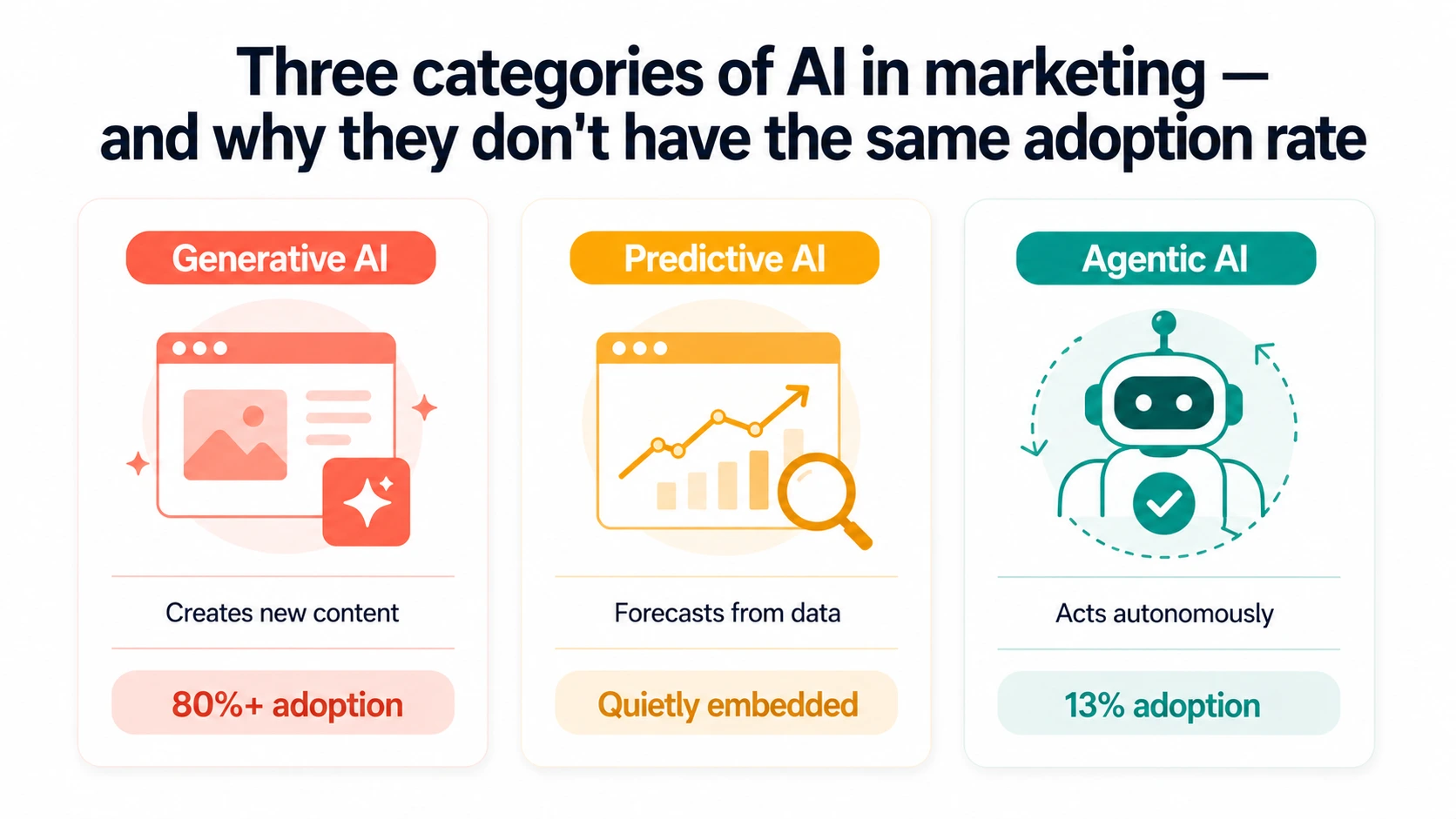
Issue 1: "AI" means three different things
| AI type | What it does | Example tools | Marketer adoption |
|---|---|---|---|
| Generative AI | Creates new content (text, images, video) | ChatGPT, Midjourney, Sora, Runway | Highest — 80%+ of marketing AI usage |
| Predictive AI | Forecasts outcomes from data (analytics, audience targeting, scheduling) | Meta Advantage+, TikTok Smart+, native platform tools | High — quietly embedded |
| Agentic AI | Autonomously executes multi-step tasks | Salesforce Agentforce, custom GPTs with tools, Adobe AI agents | Lowest — only 13% of marketers use today |
Issue 2: Survey populations vary wildly
| Survey | Sample | Geographic scope | Headline figure |
|---|---|---|---|
| Sociality.io 2026 AI Report | Social media marketers (59% agency, 20.5% in-house) | Global | 89.7% weekly |
| HubSpot 2026 State of Marketing | 1,500+ general marketers | Global | 86.4% any AI use |
| Salesforce State of Marketing 10th | 4,450 marketing decision-makers | 26 countries | 76% any AI form |
| Content Marketing Institute B2B 2026 | 1,015 B2B marketers | Mostly North America | 95% B2B AI adoption |
| Pew Research October 2025 | 5,010 employed US workers | US only | 21% any AI at work |
| Hootsuite Social Trends 2026 | Annual marketer survey (sample undisclosed) | Global | 79% daily |
When an article cites "X% of marketers use AI," the X depends entirely on which survey, which population, and which AI type. We cite each figure with its source so the comparison is honest.
Marketer Adoption of AI in Social Media
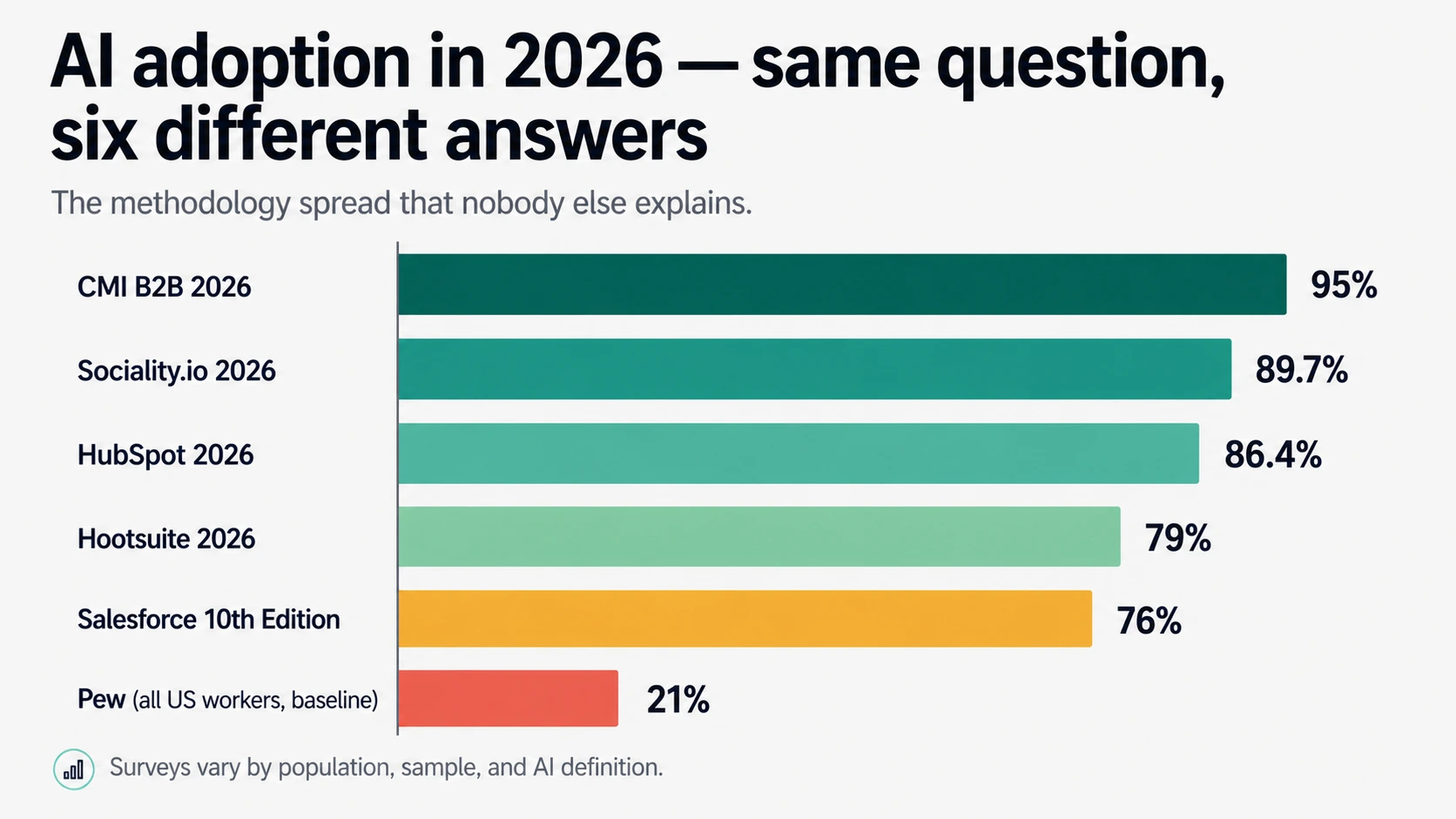
The verified primary-source adoption figures, ordered by survey rigor:
| Metric | Value | Source |
|---|---|---|
| Social media marketers using AI weekly+ | 89.7% (64.1% daily) | Sociality.io 2026 AI Report |
| Marketing teams using AI in at least some areas | 86.4% | HubSpot 2026 State of Marketing |
| Marketing teams not using AI and no plans to | 1.7% | HubSpot 2026 |
| Marketers using at least one form of AI (predictive, generative, or agentic) | 76% | Salesforce State of Marketing 10th Edition |
| Marketers currently using agentic AI specifically | 13% | Salesforce 10th Edition |
| B2B marketers whose organizations use AI applications | 95% | CMI / MarketingProfs B2B 2026 |
| B2B marketers reporting productivity improvement from AI | 87% | CMI B2B 2026 |
| Marketing leaders saying employees use AI | 91% | HubSpot AI Trends Report |
| US workers (all sectors) using AI at work | 21% (up from 16%) | Pew Research, October 2025 |
| US workers with bachelor's+ using AI at work | 28% (up from 20%) | Pew, October 2025 |
What this means: marketer-specific AI adoption is 4× the rate for all US workers. Inside the marketing function, AI use is now baseline expectation, not differentiator. The remaining differentiation is which AI type and what depth of integration. CMI's 2025 report found only 19% of B2B marketers had AI integrated into their daily processes — a useful reminder that "uses AI" and "depends on AI" are different things.
What Marketers Actually Use AI For
Use case data from the three most rigorous 2025-2026 surveys:
Sociality.io: Social Media-Specific Use Cases
| Use case | % of social marketers using AI for this | Source |
|---|---|---|
| Analytics and reporting | 59.5% | Sociality.io 2026 |
| Content ideation and trend research | 59.5% | Sociality.io 2026 |
| Caption / copy writing | 45.9% | Sociality.io 2026 |
| Visual / video creation | 40.5% | Sociality.io 2026 |
Sociality.io: Tool Categories
| Tool category | % using | Source |
|---|---|---|
| AI chatbots / conversational tools | 69.2% | Sociality.io 2026 |
| Visual AI tools | 59% | Sociality.io 2026 |
| Text generation tools | 41% | Sociality.io 2026 |
| Audio / voice AI tools | 17.9% | Sociality.io 2026 |
HubSpot: Broader Marketing Use Cases (2026 SoM)
| Use case | % using extensively or occasionally | Source |
|---|---|---|
| Content creation | 80.5% | HubSpot 2026 |
| Administrative tasks | 76.1% | HubSpot 2026 |
| Media creation | 74.9% | HubSpot 2026 |
| Brainstorming | 73.7% | HubSpot 2026 |
| Strategic planning | 70.9% | HubSpot 2026 |
| Advertising automation | 70.6% | HubSpot 2026 |
B2B-specific (CMI 2026)
| Use case | % of B2B marketers using AI for this | Source |
|---|---|---|
| Content creation tools | 89% | CMI B2B 2026 |
| Creative asset tools (images, video) | 53% | CMI B2B 2026 |
| Social media tools | 38% | CMI B2B 2026 |
How much of the content is AI-assisted?
| Metric | Value | Source |
|---|---|---|
| Social marketers saying 50%+ of their posts are AI-assisted | 28.2% | Sociality.io 2026 |
| Social marketers applying moderate or extensive editing to AI output | 78.4% | Sociality.io 2026 |
What this means: raw AI output rarely ships untouched. The "AI-only content" critique misses how marketers actually use these tools — almost 80% of them edit moderately or extensively before publishing. AI is a draft engine, not a final product engine.
 PostPlanify
All your social media in one simple dashboard
Schedule posts, track analytics, and reply to comments/DMs without switching tabs.

Engagement
+18%
Views
52.8k
ROI, Productivity, and Time Savings
The cleanest ROI numbers come from Salesforce's State of Marketing 10th Edition (4,450 marketing decision-makers across 26 countries) and HubSpot's 2026 State of Marketing.
| Metric | Value | Source |
|---|---|---|
| Time reclaimed per week (marketers using AI agents) | 8 hours/week | Salesforce 10th Edition |
| Marketing ROI lift attributed to AI agents | +20% | Salesforce 10th Edition |
| Conversion rate lift from AI agents | +19% | Salesforce 10th Edition |
| Marketing cost decrease from AI agents | −19% | Salesforce 10th Edition |
| Marketers expecting major or moderate ROI improvement from agents | 82% | Salesforce 10th Edition |
| HubSpot marketers saving 15+ hours/week with AI | ~33% | HubSpot 2026 |
| HubSpot marketers saving 10–14 hours/week | ~33% | HubSpot 2026 |
| HubSpot marketers saving 1–9 hours/week | ~30% | HubSpot 2026 |
| Marketers reporting AI significantly increased productivity | 26.5% | HubSpot 2026 |
| Marketers reporting slight to moderate productivity increases | 66.2% | HubSpot 2026 |
| Social marketers citing time savings as biggest improvement from AI | 71.1% | Sociality.io 2026 |
| Social marketers saying AI lets them "create more content, faster" | 47.4% | Sociality.io 2026 |
What this means: roughly two-thirds of marketers using AI now save 10+ hours per week. At an average marketing salary, that's ~$25K–$50K of recovered annual capacity per FTE. The Salesforce agent-specific numbers are tighter and higher-ROI — but agentic AI is still only used by 13% of marketers, so most teams aren't yet capturing those gains.
If your team is in the 86% already using AI but you're not seeing 10+ hours/week back, the bottleneck is usually integration depth, not the tool. PostPlanify's AI assistant is designed for the "draft then edit" workflow that 78.4% of social marketers actually use — vision-powered, platform-native variations from a single source.
Does AI-Assisted Content Actually Perform Better?
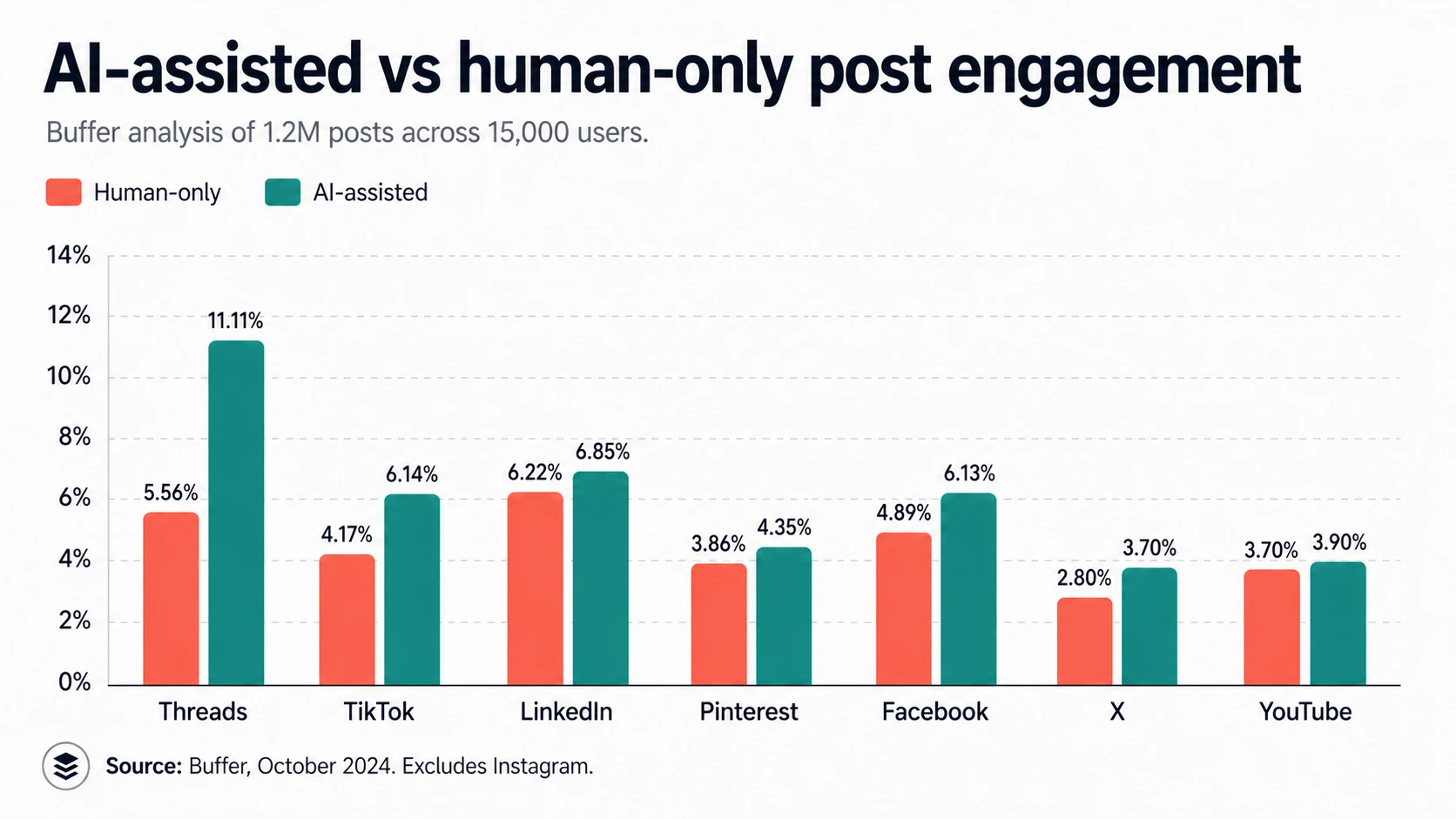
The most-cited primary-source comparison is Buffer's 2024 analysis of 1.2 million social posts across 15,000 users who created both AI-assisted and human-only content.
Buffer 2024: AI vs Human-Only Engagement (Median)
| Platform | AI-assisted engagement | Human-only engagement | Lift |
|---|---|---|---|
| Threads | 11.11% | 5.56% | +5.55pp |
| TikTok | 6.14% | 4.17% | +1.97pp |
| 4.35% | 3.86% | +0.49pp | |
| 6.85% | 6.22% | +0.63pp | |
| 6.13% | 4.89% | +1.24pp | |
| X (Twitter) | 3.7% | 2.8% | +0.9pp |
| YouTube | 3.9% | 3.7% | +0.2pp |
| All platforms (median) | 5.87% | 4.82% | +1.05pp |
Source: Buffer "Engagement Rate of 1.2 Million AI-Assisted Posts vs. Human-Only" — October 2024. Excludes Instagram. Buffer flags a "healthy user bias" — users who use AI may also be more engaged overall.
Marketer Self-Report (Sociality.io 2026)
| Marketers' assessment of AI-assisted content vs non-AI | % | Source |
|---|---|---|
| Performs better | 44.7% | Sociality.io 2026 |
| Performs about the same | 18.4% | Sociality.io 2026 |
| Performs worse | 5.3% | Sociality.io 2026 |
| Not sure | 31.6% | Sociality.io 2026 |
The honest read: AI-assisted content outperforms human-only content on every platform Buffer measured. The largest gains are on Threads and TikTok where format velocity matters most. The smallest gains are on YouTube where production quality still dominates. But — and this is where the narrative shifts in 2026 — performance gains coexist with rising consumer rejection. Which brings us to the counter-narrative.
The Consumer Trust Counter-Narrative
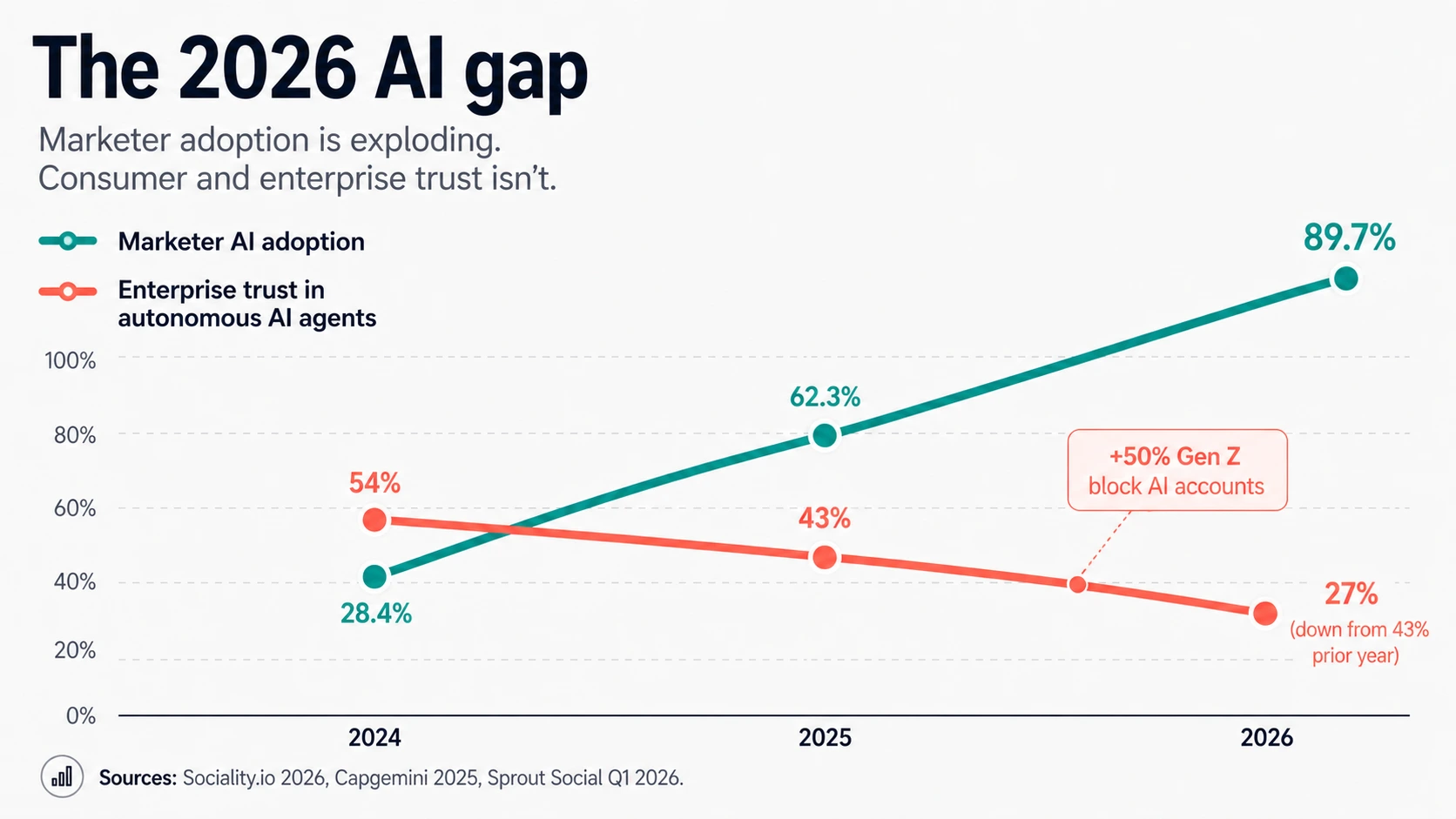
This is the single most underreported AI-in-marketing story of 2026. Adoption is exploding. Consumer pushback is exploding faster.
Sprout Social Q1 2026 Pulse Survey (2,000+ social users US/UK/AU)
| Metric | Value | Source |
|---|---|---|
| Consumers seeing AI-generated content "often" or "very often" on feeds | 56% | Sprout Social Q1 2026 Pulse |
| Gen Z who have unfollowed, muted, or blocked accounts due to perceived AI content | 50% | Sprout Q1 2026 |
| Consumers agreeing AI video tools have reduced trust in news on social media | 88% | Sprout Q1 2026 |
| US respondents who strongly agree on the trust loss | 46% | Sprout Q1 2026 |
| Baby Boomers "very unlikely" to engage with AI slop | 56% | Sprout Q1 2026 |
| Gen Z expressing at least some willingness to engage with AI content | 34% | Sprout Q1 2026 |
Pew Research Center on Public Sentiment (March 2026)
| Metric | Value | Source |
|---|---|---|
| US adults more concerned than excited about AI | 50% (vs 10% more excited) | Pew, March 2026 |
| US adults saying AI will worsen people's ability to think creatively | About half | Pew, March 2026 |
| US adults who get news "at least sometimes" from AI chatbots | 9% (75% never) | Pew, March 2026 |
| US adults who interact with AI "at least several times a day" | 31% (up from 22% in Feb 2024) | Pew, March 2026 |
Capgemini and Edelman: Trust Trajectory
| Metric | Value | Source |
|---|---|---|
| Enterprise executive trust in fully autonomous AI agents (2025) | 27% | Capgemini Research Institute, 2025 |
| Same metric, prior year | 43% | Capgemini, 2025 |
| Year-over-year decline in agent trust | −16 percentage points | Capgemini, 2025 |
| Marketers saying human involvement is "very important or critical" for AI content | 91% | Hootsuite Social Trends 2026 |
| HubSpot marketers believing AI assists rather than replaces | 73.4% | HubSpot 2026 |
| Marketers believing brands need more "human-centered content to compete with AI" | 62.7% | HubSpot 2026 |
What this means: 50% of Gen Z actively pruning their feeds of AI content is the loudest signal in 2026 social media data. The "AI optimism" narrative inside the marketing industry is actively diverging from the "AI skepticism" reality outside it. Brands that publish 80%+ AI content with no editing or disclosure are running directly into a consumer backlash that's quietly accelerating. Marketers know this — 62.7% explicitly say brands need more human-centered content to compete with AI.
The strategic implication: AI as draft engine + human edit + clear voice = winning. AI as automation engine + zero edit + no human signal = losing.
PostPlanifyAll your social media in one simple dashboard
Schedule posts, track analytics, and reply to comments/DMs without switching tabs.
Engagement
+18%
Views
52.8k
Platform-Native AI: Meta, TikTok, and the Built-In Tools
Platform-disclosed performance metrics from official Q4 2025 / 2026 sources:
Meta
| Metric | Value | Source |
|---|---|---|
| Combined video generation tools revenue run-rate (Q4 2025) | $10B | Meta newsroom, January 2026 |
| Q-over-Q revenue growth rate (AI tools vs overall ads) | ~3× faster | Meta, January 2026 |
| Lift in Facebook ad clicks (GEM ranking model, Q4 2025) | +3.5% | Meta, January 2026 |
| Instagram conversion gain (GEM ranking) | >1% | Meta, January 2026 |
| Lift in incremental conversions (new attribution model) | +24% | Meta, January 2026 |
TikTok
| Metric | Value | Source |
|---|---|---|
| Advertisers/executives saying TikTok demonstrates AI innovation | 78% | TikTok Newsroom, October 2025 |
| TikTok users discovering new brands and products on the platform | 70% | TikTok Newsroom, October 2025 |
⚠️ TikTok does not separately disclose Smart+ AI campaign GMV or revenue figures. The 78% innovation perception and 70% brand-discovery figures above come from TikTok-commissioned advertiser research; sample size not disclosed in the newsroom post. Treat as TikTok-published platform claims.
LLM Consumer Adoption (DataReportal / Meltwater)
| Metric | Value | Source |
|---|---|---|
| Global monthly LLM / GenAI users | 1B+ | Meltwater Digital 2026 release |
| ChatGPT weekly active users (October 2025) | 800M | OpenAI, October 2025 Dev Day |
| ChatGPT mobile app MAU | 557M | DataReportal / Meltwater |
| Google Gemini MAU | 70.1M | DataReportal / Meltwater |
| DeepSeek MAU | 59.9M | DataReportal / Meltwater |
| Perplexity MAU | 39.4M | DataReportal / Meltwater |
| Microsoft Copilot MAU | 23.4M | DataReportal / Meltwater |
| Claude mobile app MAU | 14.8M | DataReportal / Meltwater |
What this means for social marketers: ChatGPT alone is now larger than every major social platform except Facebook and YouTube. Brand discovery is shifting from search and social into LLM-mediated conversation, and 25% of customers now use AI platforms as their top research tool, more popular than brand sites, reviews, or traditional media (Adobe / Oxford Economics 2026 AI & Digital Trends Report). Social ranking is no longer the only ranking that matters.
Agentic AI: The 2026 Frontier
Agentic AI — autonomous task-completing agents, not chat-based assistants — is where 2026 marketing data is most volatile. The verified figures:
Adoption (where we are now)
| Metric | Value | Source |
|---|---|---|
| Marketers currently using agentic AI | 13% | Salesforce State of Marketing 10th Edition |
| High performers vs underperformers using agents | 2× more likely | Salesforce 10th Edition |
| B2B "pacesetter" marketers experimenting with agents | 43% | CMI B2B 2026 |
| All B2B marketers experimenting with agents | 28% | CMI B2B 2026 |
| US marketers focused on agentic AI for ad buying | ~67% (two-thirds) | IAB 2026 Outlook |
| US marketers prioritizing content optimized for AI-generated answers | 73% | IAB 2026 Outlook |
Enterprise deployment status (Capgemini 2025)
| Stage | % of enterprises | Source |
|---|---|---|
| Deployed AI agents at scale | 2% | Capgemini Research Institute, 2025 |
| Deployed at partial scale | 12% | Capgemini, 2025 |
| Launched pilots | 23% | Capgemini, 2025 |
| Exploring deployment | 61% | Capgemini, 2025 |
Forecasts (where we're going)
| Metric | Value | Source |
|---|---|---|
| Enterprise applications featuring task-specific AI agents (end of 2026) | 40% (up from <5% in 2025) | Gartner, August 2025 |
| Organizations expecting agentic AI to handle 50%+ of customer support within 18 months | 78% | Adobe / Oxford Economics 2026 AI & Digital Trends |
| Organizations with measurement framework for generative AI | 44% | Adobe / Oxford 2026 |
| Organizations with measurement framework for agentic AI | 31% | Adobe / Oxford 2026 |
| Projected economic value from AI agents by 2028 | $450B | Capgemini Research Institute, 2025 |
| Global enterprise AI spending 2025 | $307B | IDC |
| Projected 2028 AI spending | $632B | IDC |
What this means: the gap between agent enthusiasm and agent measurement is the single biggest implementation risk in 2026 marketing. 78% of orgs expect agents to do half their customer support in 18 months, but only 31% have any way to measure if it's actually working. Most agentic AI projects in 2026 will get launched without ROI tracking — and many will get killed for the wrong reasons because of it.
Challenges, Barriers, and What Still Doesn't Work
The verified barrier data — the issues marketers using AI cite most often:
Top concerns (Sociality.io 2026)
| Concern | % of social marketers citing | Source |
|---|---|---|
| Originality and plagiarism risks | 61.1% | Sociality.io 2026 |
| Accuracy / reliability issues (hallucinations) | 50% | Sociality.io 2026 |
| Maintaining brand voice consistency | 30.6% | Sociality.io 2026 |
| Disclosure and transparency norms | 19.4% | Sociality.io 2026 |
Implementation challenges (Sociality.io 2026)
| Challenge | % of social marketers | Source |
|---|---|---|
| Data accuracy / hallucination management | 50% | Sociality.io 2026 |
| Prompt engineering skills | 35.3% | Sociality.io 2026 |
| Governance / compliance | 26.5% | Sociality.io 2026 |
| Training the team | 14.7% | Sociality.io 2026 |
Buyer-side (IAB 2026)
| Challenge | Value | Source |
|---|---|---|
| US ad buyers citing "understanding generative AI" as a major challenge | 38% (up 14 percentage points from 2024) | IAB 2026 Outlook |
Workforce / equity concerns (Edelman 2026)
| Metric | Value | Source |
|---|---|---|
| Low-income respondents (global) believing GenAI will leave them behind | 54% | Edelman 2026 Trust Barometer |
| Middle-income respondents same finding | 44% | Edelman 2026 |
What this means: the marketer-side concerns are sharpening, not softening, as adoption grows. The two biggest issues — plagiarism risk and hallucination management — are baseline, not edge cases. Marketers using AI extensively know this and edit accordingly (78.4% apply moderate-to-extensive editing). Marketers using AI lightly often skip the editing step. That's the gap that produces the worst output and feeds the consumer trust backlash above.
Methodology & Sources
How this article was built
- Every statistic in this article was traced to a primary source — vendor surveys, official press releases, earnings disclosures, or research-institute publications. No blog roundup citations.
- Where the primary source URL returned an HTTP 403 error during fetch (Salesforce, IDC, Gartner, Adobe in some cases), the underlying figures were cross-confirmed via secondary outlets and we flag the verification path explicitly. Stats we couldn't verify either directly or via secondary cross-confirmation were dropped entirely.
- Last updated: April 25, 2026. We update this page quarterly (January / April / July / October) — AI adoption stats move fast and we don't want stale data living here.
Primary sources cited
- HubSpot 2026 State of Marketing Report — updated April 10, 2026; 1,500+ global marketers
- HubSpot AI Trends for Marketers Report — updated June 11, 2025; 1,000+ marketing professionals
- Sprout Social Q1 2026 Pulse Survey on AI in Social Media — March 17, 2026; 2,000+ social users US/UK/AU
- Sociality.io 2026 AI in Social Media Marketing Report — January 26, 2026
- Salesforce State of Marketing Report, 10th Edition — February 19, 2026; 4,450 marketing decision-makers across 26 countries
- Content Marketing Institute / MarketingProfs B2B Content Marketing 2026 — October 8, 2025; 1,015 B2B marketers
- Hootsuite Social Trends 2026 — January 18, 2026
- Pew Research Center: AI in the workplace, October 2025
- Pew Research Center: How Americans view AI, March 2026
- Capgemini Research Institute "Rise of Agentic AI" — July 2025; 1,500 senior executives across 14 countries
- Adobe / Oxford Economics 2026 AI and Digital Trends Report — early 2026; 3,000 executives + 4,000 customers
- IAB 2026 Outlook Study — January 28, 2026; 200+ US brands and agency buyers
- DataReportal Digital 2026 Mid-Year Update
- Meltwater Digital 2026 release — February 19, 2026
- Gartner: 40% of enterprise apps will feature AI agents by 2026 — August 26, 2025
- Edelman 2026 Trust Barometer — January 21, 2026; 28-country global survey
- Buffer "Engagement Rate of 1.2M AI-Assisted Posts vs Human-Only" — October 15, 2024
- Meta Newsroom "AI Drives Performance" — January 2026
- TikTok Newsroom: Automation Updates for Advertisers — October 7, 2025
- IDC Worldwide AI and Generative AI Spending Guide — 2025 update (figures cross-confirmed via secondary outlets due to access restrictions on idc.com)
Methodology caveats worth flagging
- "AI" gets used loosely. Generative, predictive, and agentic AI have very different adoption curves. We've labeled which category each stat measures wherever possible.
- Vendor-published surveys dominate. Sociality.io, Sprout Social, HubSpot, Salesforce, Hootsuite all have a commercial interest in AI adoption appearing high. The Pew Research figures (21% of all US workers) are the most methodologically rigorous baseline; marketer-specific surveys consistently report higher adoption because marketers are early adopters.
- Hootsuite figures (79% daily AI use, 91% saying human involvement is critical) come from Hootsuite's annual Social Trends report; the underlying sample size and methodology are not publicly disclosed in the URLs we could fetch. Treat as Hootsuite-published.
- The Buffer 1.2M-post engagement analysis is from October 2024, the freshest direct comparison we could find. Buffer disclosed a "healthy user bias" (users who use AI may also be more engaged overall) — read the lift figures with that caveat.
- TikTok does not separately disclose Smart+ AI campaign GMV or revenue. The 78% / 70% figures we cite come from TikTok-commissioned advertiser research; sample and methodology not disclosed in the newsroom post.
- Salesforce, IDC, Gartner, and Adobe primary URLs returned 403 errors during fetch. The figures we cite from these sources were cross-verified via secondary coverage (diginomica, Salesforce SMB blog, IDC press archives, Gartner-press-headline-verified). The data is real; the URL access was blocked.
- Adoption stats age fast. This page is most current as of April 25, 2026 and is refreshed quarterly.
PostPlanifyAll your social media in one simple dashboard
Schedule posts, track analytics, and reply to comments/DMs without switching tabs.
Engagement
+18%
Views
52.8k
FAQ: AI in Social Media Statistics 2026
What is AI in social media marketing?
AI in social media marketing refers to three distinct technology categories: generative AI (creates content — text, images, video; tools like ChatGPT, Midjourney, Sora), predictive AI (forecasts outcomes from data — analytics, audience targeting, ad bidding; embedded in tools like Meta Advantage+ and TikTok Smart+), and agentic AI (autonomously executes multi-step tasks — emerging in 2026, examples include Salesforce Agentforce). Most "AI in marketing" stats blend all three categories without distinguishing — this article labels which category each stat measures.
How many marketers use AI in 2026?
Adoption depends on the survey: 89.7% of social media marketers use AI at least weekly (Sociality.io 2026), 86.4% of all marketing teams use AI in some form (HubSpot 2026), 76% use at least one form of AI (Salesforce 10th Edition), and 95% of B2B marketers' organizations use AI (CMI B2B 2026). For comparison, only 21% of all US workers use AI at work (Pew, October 2025) — marketers are roughly 4× the all-worker baseline.
What do marketers use AI for in social media?
The most common social media AI use cases (Sociality.io 2026): analytics and reporting (59.5%), content ideation and trend research (59.5%), caption / copy writing (45.9%), and visual / video creation (40.5%). By tool category: AI chatbots (69.2%), visual AI tools (59%), text generation (41%), audio/voice (17.9%). HubSpot's broader marketing data shows content creation (80.5%) and administrative tasks (76.1%) as the top extensive uses.
How much time do marketers save using AI?
Roughly two-thirds of marketers save 10+ hours per week with AI (HubSpot 2026 — ~33% save 15+ hrs/wk, ~33% save 10–14 hrs/wk). Marketers specifically using AI agents reclaim 8 hours/week while delivering a +20% ROI lift (Salesforce 10th Edition). The single most-cited improvement among social media marketers is time savings (71.1%, Sociality.io).
Does AI-generated content perform better than human content?
Yes, on every platform Buffer measured. Their 2024 analysis of 1.2 million posts across 15,000 users found AI-assisted posts had a 5.87% median engagement rate vs 4.82% for human-only posts. The largest gain was on Threads (+5.55 percentage points). Caveat: Buffer flagged a "healthy user bias" — users who use AI tools may also be more engaged overall. Marketer self-report is more cautious: 44.7% say AI content performs better while 31.6% are not sure (Sociality.io 2026).
How do consumers feel about AI-generated content in 2026?
Increasingly negatively. 50% of Gen Z have unfollowed, muted, or blocked accounts because they think the content is AI-generated (Sprout Social Q1 2026 Pulse). 88% of consumers say video AI tools have decreased their trust in news on social media. 56% say they see AI content "often" or "very often" on their feeds. Trust in fully autonomous AI agents fell from 43% to 27% in a single year among enterprise executives (Capgemini, 2025). The marketer-AI-optimism gap with consumer reality is widening, not closing.
What is agentic AI in marketing?
Agentic AI is autonomous AI that completes multi-step tasks without continuous human direction — distinct from chat-based assistants. Only 13% of marketers currently use agentic AI (Salesforce 10th Edition), but Gartner predicts 40% of enterprise applications will feature task-specific AI agents by end of 2026, up from less than 5% in 2025. 78% of organizations expect agents to handle at least half of customer support interactions within 18 months (Adobe / Oxford Economics 2026). Capgemini projects $450B in economic value from AI agents by 2028.
How big is the AI marketing market in 2026?
Global enterprise AI spending: $307B in 2025, projected to reach $632B by 2028 (IDC). 2/3 of US marketers are now focused on agentic AI for ad buying and campaign execution (IAB 2026 Outlook). 5 of the top 6 areas of increased ad-spend focus for US advertisers in 2026 are tied to AI (IAB). Total US social network ad spending — much of which now includes AI-powered targeting and creative — will exceed $121B in 2026 (eMarketer).
Which platforms have native AI features and how much do they earn?
Meta: Video generation tools hit a $10B revenue run-rate in Q4 2025, growing nearly 3× faster than overall ads revenue (Meta newsroom, January 2026). Meta's GEM ranking model added 3.5% to Facebook ad clicks and 1%+ to Instagram conversions. TikTok: 78% of advertisers say TikTok consistently demonstrates AI innovation, and 70% of TikTok users report discovering new brands and products on the platform (TikTok Newsroom, October 2025).
How big is ChatGPT compared to social platforms?
ChatGPT alone has 800M weekly active users (announced by OpenAI at the October 2025 Dev Day), making it larger than every major social platform except Facebook and YouTube. Globally, 1+ billion people use LLMs and GenAI platforms monthly. ChatGPT mobile app: 557M MAU. Google Gemini: 70.1M. DeepSeek: 59.9M. Perplexity: 39.4M. Microsoft Copilot: 23.4M. Claude mobile: 14.8M. 25% of customers now use AI platforms as their top research tool, more popular than brand sites or reviews (Adobe / Oxford 2026).
What are the biggest barriers to AI adoption in social media?
Top concerns from social media marketers using AI (Sociality.io 2026): originality / plagiarism risks (61.1%), accuracy and hallucination issues (50%), maintaining brand voice consistency (30.6%), and disclosure / transparency norms (19.4%). On the implementation side: data accuracy and hallucinations (50%) and prompt engineering skills (35.3%). US ad buyers citing "understanding generative AI" as a major challenge rose 14 percentage points from 2024 to 2026 to reach 38% (IAB).
Are people using AI to consume news?
Mostly no, but a small minority do. Only 9% of US adults get news "at least sometimes" from AI chatbots (Pew, March 2026); 75% never do. However, 31% of US adults interact with AI at least several times a day, up from 22% in February 2024. Brand discovery via AI is happening (25% use AI as top research tool per Adobe/Oxford), but news-via-AI is not yet mainstream.
Is AI replacing social media managers?
The data says no. 73.4% of marketers believe AI works in conjunction with marketers, assisting them, rather than replacing them (HubSpot 2026). 91% of marketers say human involvement is "very important or critical" for evaluating or generating AI content (Hootsuite Social Trends 2026). 62.7% believe brands need more unique, human-centered content to compete with AI content (HubSpot 2026). 78.4% of social marketers apply moderate or extensive editing to AI output (Sociality.io 2026) — AI is a draft engine, not a final-output engine, in current practice.
What % of social media posts are AI-assisted in 2026?
28.2% of social media marketers say more than half of their posts are AI-assisted (Sociality.io 2026). With 89.7% of social marketers using AI at least weekly, the share of all social content that has been AI-touched is now well into the majority.
What's the difference between generative, predictive, and agentic AI?
Generative AI creates new content (text, image, video, audio) — examples: ChatGPT, Midjourney, Sora, Runway. Highest marketer adoption (~80%). Predictive AI forecasts outcomes from data — examples: Meta Advantage+, TikTok Smart+, audience targeting and ad-bidding tools. Quietly embedded in most platforms; high adoption. Agentic AI autonomously executes multi-step tasks — examples: Salesforce Agentforce, custom GPTs with tools. Low adoption today (13%) but fastest growth (Gartner forecasts 40% of enterprise apps by end of 2026).
How is consumer trust in AI changing?
It's declining sharply on the consumer side and on the enterprise side. Pew (March 2026): 50% of US adults are more concerned than excited about AI, vs only 10% more excited. About half say AI will worsen creative thinking (Pew Research Center, March 2026). Capgemini (2025): enterprise executive trust in fully autonomous AI agents fell from 43% to 27% YoY — a 16-percentage-point decline in one year. Edelman 2026 Trust Barometer: 54% of low-income and 44% of middle-income consumers globally believe GenAI will leave them behind.
Which surveys are most rigorous on AI marketing adoption?
The most methodologically rigorous baseline is Pew Research Center (5,010 employed US workers, American Trends Panel, October 2025) — but Pew measures all workers, not marketers specifically. For marketer-specific data: Salesforce State of Marketing 10th Edition has the largest sample (4,450 decision-makers across 26 countries, double-blind methodology). HubSpot 2026 State of Marketing (1,500+ global marketers) and Content Marketing Institute B2B 2026 (1,015 B2B marketers) are also Tier 1. Vendor-specific surveys (Sociality.io, Sprout Social, Hootsuite) are useful but typically have smaller samples and unpublished methodology.
Does AI help small businesses or only enterprises?
Both, but disproportionately enterprises today. HubSpot 2026: 91% of marketing leaders say employees use AI. Salesforce: 13% of marketers use agentic AI; high performers are 2× more likely to use agents than underperformers — suggesting agent adoption correlates with sophistication, not size. Capgemini enterprise data: only 2% have agents at scale, 12% at partial scale, 23% in pilots — even at the enterprise level, mature deployment is rare. Small businesses and solopreneurs report similar generative AI usage rates to enterprise teams, but lag significantly on agentic AI deployment.
Final Thoughts + AI in Social Checklist
If you're building an AI-in-social strategy in 2026, run this checklist:
- ✅ Are you using all three AI categories (generative, predictive, agentic) — or just generative?
- ✅ Are you measuring time savings and output quality, not just adoption?
- ✅ Do you have a measurement framework for agentic AI? (Only 31% of orgs do — and that's the #1 reason agent projects fail.)
- ✅ Are you applying moderate or extensive human editing to AI output? (78.4% of effective social marketers do.)
- ✅ Are you publishing fewer pieces of high-edit AI content, not more pieces of zero-edit AI content? (62.7% of marketers say brands need more human-centered content to compete with AI.)
- ✅ Have you considered how your content reads to a Gen Z audience that has actively pruned 50% of suspected AI accounts from their feed?
- ✅ Are your ROI assumptions tied to a specific AI tool, or are you cargo-culting industry-wide adoption stats?
- ✅ Is your team trained on prompt engineering and disclosure norms? (35.3% cite prompt skills as a top barrier; 19.4% cite disclosure.)
The honest read of 2026 AI-in-social data: adoption is no longer a differentiator. Edit depth and human signal are. The brands and creators winning in 2026 publish less AI than they could, edit more than the average, and disclose where it matters. The brands losing publish more than they should and edit less than they need to.
Try PostPlanify free for 7 days — our vision-powered AI assistant is built for the "draft then edit" workflow that 78.4% of effective social marketers use. Generates platform-native variations across all 10 supported platforms from one source asset, and pairs with cross-platform analytics so you can measure what's actually working.
Also read: Social Media Engagement Rate Benchmarks 2026 and Social Commerce Statistics 2026 — the companion stats articles in this series.
Related: Social Media Engagement Rate Benchmarks 2026 | Social Commerce Statistics 2026 | Social Media Analytics for Business | How to Measure Social Media ROI | Social Media Marketing Strategy for Small Business | Best Time to Post on Social Media | Social Media Best Practices | Social Media Analytics and Reporting | Social Media Content Calendar Examples | How to Plan Social Media Content
PostPlanifyAll your social media in one simple dashboard
Schedule posts, track analytics, and reply to comments/DMs without switching tabs.
Engagement
+18%
Views
52.8k
About the Author

Hasan Cagli
Founder of PostPlanify, a content and social media scheduling platform. He focuses on building systems that help businesses, agencies, and teams plan, publish, and manage content and social media more efficiently across platforms.


