


Quick Answer: The best AI social media post generator depends on where your workflow breaks. PostPlanify is the best all-in-one pick for agencies and teams — AI drafting, scheduling, social inbox, analytics, and white-label reports in one place (starts at $79/mo billed yearly or $99/mo monthly). Jasper wins for pure writing quality and brand voice control. Buffer is the best free option, Later suits Instagram-first visual planners, Lately AI is the strongest for repurposing long-form content, Sprout Social is best for enterprise governance, and Hootsuite (OwlyWriter AI) makes sense if you're already in the Hootsuite ecosystem.
Best AI Social Media Post Generator by Use Case
| Use Case | Winner | Why |
|---|---|---|
| Best all-in-one (agencies & teams) | PostPlanify | AI + scheduling + inbox + reports across 10 platforms |
| Best for writing quality | Jasper | Strongest brand voice and tone controls |
| Best free option | Buffer | AI Assistant works on the free plan |
| Best for visual planners | Later | Caption Writer built into the visual planner |
| Best for repurposing long-form | Lately AI | Turns one asset into dozens of posts |
| Best for enterprise governance | Sprout Social | Compliance, approvals, social care + AI |
| Best inside an existing suite | Hootsuite | OwlyWriter AI lives in the Hootsuite composer |
PostPlanify is the best all-in-one option for agencies and teams, and Jasper is the best standalone ai social media post generator if you mainly need stronger writing controls. That split matters because AI use is already mainstream in social workflows: 79% of creators say AI helps them produce more content faster, 65% use it for at least half of their posts, and only 3.6% of social media managers avoid AI entirely (adoption data on AI in social media).
If you're staring at a content calendar with too many empty slots, the problem usually isn't just "writing faster." It's that teams often are trying to force a caption tool into a workflow problem. They need idea generation, platform formatting, approvals, scheduling, inbox management, and reporting to work together. When those pieces live in separate tools, AI often creates more cleanup work than it saves.
That's why an ai social media post generator only helps if it fits the way you already publish. A lightweight writer can be enough for a solo creator posting on LinkedIn and X. It usually isn't enough for an agency juggling Instagram approvals, TikTok drafts, Facebook scheduling, and client reporting.
The market has also changed. AI-generated articles surpassed human-written articles on the web in November 2024, and more than half of LinkedIn posts are likely AI as of 2024 (analysis of AI-generated content volume). That means volume is easy now. Distinctiveness is the hard part.
For that reason, this list focuses on practical trade-offs. Which tools reduce workflow friction. Which ones are best if you're scheduling across channels. Which ones are better if you need brand voice control first and publishing second. If you want a broader workflow view, the existing guide to AI tools for social media marketing is worth reading first, and you can browse these social products for a wider category view.
What Is an AI Social Media Post Generator?
An AI social media post generator is a tool that uses large language models (and increasingly vision models) to draft captions, hooks, hashtags, and full social posts from a short input — a topic, a campaign brief, a URL, an image, or an existing asset. The strongest ones go further: they adapt the same idea to the format conventions of each network (a tighter hook on X, a structured opener on LinkedIn, a cleaner caption lead on Instagram), generate multiple variants for A/B testing, and plug into your scheduler so the draft doesn't die in a separate document. For visual campaigns, teams may also pair these tools with an AI poster maker to create matching promotional graphics that support the captions and keep the campaign consistent across channels.
There are three loose categories on the market in 2026:
- All-in-one platforms with AI baked into the composer (PostPlanify, Hootsuite, Buffer, Later, Sprout Social). You draft, edit, schedule, approve, and report inside one tool.
- Writing-first tools that focus on output quality and brand voice (Jasper, Copy.ai, Writer). You still need a separate scheduler.
- Repurposing engines that atomize long-form content into many short posts (Lately AI, Repurpose.io). Best when you already produce podcasts, webinars, or long blogs.
The right category depends less on which AI sounds smartest in a demo, and more on which step of your workflow is actually slow.
How We Tested
This list isn't pulled from a marketing roundup — it's built from hands-on use of each tool inside real publishing workflows. We evaluated each one against five criteria that matter once you move from a free trial to daily use:
- AI output quality — Does the first draft sound generic or usable? How well does it adapt by channel?
- Brand voice control — Can you train it on existing copy, set tone rules, or store reusable guidelines?
- Workflow integration — Does the AI live where you actually publish, or does it create another copy-paste step?
- Channel coverage — How many networks does the tool support, and which post types (Reels, carousels, Stories, threads) does the AI handle?
- Pricing and team scale — Is the cost reasonable for the number of accounts, teammates, and approvers involved?
We also tested edge cases — long-form repurposing, multi-account agency setups, approval flows with non-marketer reviewers, and AI replies for community management — because that's where many tools quietly break.
Quick Comparison: All 7 at a Glance
If you don't have time to read the whole list, here's the short version:
- PostPlanify — Best all-in-one for agencies and teams. AI drafting, scheduling, social inbox, analytics, and white-label reports in one tool. From $79/mo billed yearly.
- Hootsuite (OwlyWriter AI) — Best if you're already on Hootsuite and want AI inside enterprise governance.
- Buffer (AI Assistant) — Easiest free entry point for solo creators and small teams.
- Sprout Social (AI Assist) — Strongest for enterprise-grade social care, listening, and compliance.
- Later (Caption Writer) — Best when your workflow starts with the visual asset.
- Jasper — Wins on pure writing quality and brand voice control for agencies juggling multiple client tones.
- Lately AI — Standout for repurposing podcasts, webinars, or long-form blogs into hundreds of platform-native posts.
 PostPlanify
All your social media in one simple dashboard
Schedule posts, track analytics, and reply to comments/DMs without switching tabs.

Engagement
+18%
Views
52.8k
1. PostPlanify

At a glance
- Best for: Agencies, in-house teams, and creators managing 2+ networks
- Starting price: $79/mo billed yearly ($99/mo monthly) — Growth plan
- Free trial: Yes, 7 days
- Channels: Instagram, X, Facebook, LinkedIn, YouTube, TikTok, Threads, Pinterest, Bluesky, Google Business Profile (10 total)
- Standout AI feature: Vision-powered AI assistant that drafts captions from your uploaded media
A common team scenario looks like this. The strategist wants faster ideation, the account manager wants approvals in one place, the designer wants assets organized, and the client wants a report at the end of the month. PostPlanify fits that workflow better than a standalone caption generator because AI drafting, scheduling, the social inbox, analytics, and reporting sit in the same system.
That matters in practice. AI writing saves less time than teams expect if every draft still has to be copied into another scheduler, reformatted per network, sent for approval in email, and matched with the right asset manually. PostPlanify cuts that operational drag by keeping the calendar, publishing, inbox, media, and reports connected.
Why it works in a real publishing process
For agencies and in-house teams managing several channels, the useful part of the product is the handoff reduction. A draft can move from idea to scheduled post without leaving the platform. Comments and messages come back into the same workflow via the unified social inbox. Reports are generated from the same activity history instead of stitched together later.
I look for that more than flashy copy quality.
PostPlanify also covers a wide set of publishing destinations, including Instagram, X, Facebook, LinkedIn, YouTube, TikTok, Threads, Pinterest, Bluesky, and Google Business Profile. That broad channel support is helpful if your team repurposes one campaign across several formats and wants AI to assist inside the actual publishing flow instead of in a separate writing tab.
Where it earns its place
The strongest use case is a team that needs AI as one part of a larger social system:
- Analytics across every platform: Built-in analytics for all 10 networks plus best-time-to-post suggestions — see our best time to post on Instagram guide for how to use these signals.
- Unified social inbox: Comments, DMs, and mentions across Instagram, Facebook, LinkedIn, Google Business, YouTube, Threads, and Bluesky in one queue.
- Vision-powered AI assistant: Drafts captions, hooks, and hashtags from an image or video — useful for Instagram captions where the visual is the brief.
- Team collaboration & approval workflows: Role-based permissions, client access, and multi-step approvals keep review cycles inside the tool.
- White-label PDF reports: Recurring client reporting without leaving the platform (available on Scale and above).
- Bulk scheduling & media library: Imports from Canva, Google Drive, and Dropbox reduce asset hunting during scheduling. Plan it all on the content calendar.
Pros & Cons
✅ Pros
- AI sits inside the actual publishing workflow, not a separate tab
- 10-platform coverage including Google Business Profile
- Flat plan pricing — no per-seat fees on Growth and above
- White-label PDF reports for client delivery
- Vision-powered AI assistant that reads your uploaded media
- Unified social inbox across 7 networks
❌ Cons
- Entry plan starts at $79/mo billed yearly — not the cheapest entry point
- Smaller vendor footprint than legacy enterprise suites
- Best for teams that want fewer moving parts — less attractive if you only need a writing tool
How to use the AI well
The platform gets better results when teams treat AI as a draft assistant, not an autopilot. Give it inputs with enough structure to produce channel-ready copy. Include the audience, offer, platform, tone, CTA, and any phrases to avoid. Then save the output as a version one, review it against brand voice, and only schedule after a human edit.
A simple workflow works well:
- Start with one campaign brief.
- Generate platform-specific variants instead of one generic caption.
- Edit for brand voice and claims accuracy.
- Attach assets from the shared library.
- Route for approval.
- Schedule by channel and time slot.
- Review engagement and reporting data to see which prompts and post formats performed.
That last step is where ROI becomes clearer. You are not just measuring whether AI produced a caption faster. You are measuring whether the team published more consistently, spent less time on admin work, and improved output per person.
Trade-offs to know before choosing it
PostPlanify makes more sense when workflow friction is the main problem. If your only requirement is deeper writing control, longer-form content support, or prompt experimentation without much need for scheduling and approvals, a writing-first tool can feel more flexible.
There are also scale considerations. Smaller vendors can have fewer enterprise procurement features than legacy platforms, and some teams will need to check workspace, user, or contract requirements before standardizing on it. The product is strongest for organizations that want fewer moving parts, not for teams buying software primarily for enterprise brand familiarity.
If you want a broader workflow view, the existing guide to AI tools for social media marketing is worth reading. For broader scheduling context, see our roundup of the best social media scheduling tools and the Instagram post scheduler tools comparison.
2. Hootsuite

At a glance
- Best for: Enterprises already inside the Hootsuite ecosystem
- Starting price: $249/user/mo (Standard plan)
- Free trial: Yes, 30 days
- AI feature: OwlyWriter AI inside the composer
- Standout: AI sits inside Hootsuite's existing compliance and approval layers
Hootsuite's OwlyWriter AI makes the most sense if you're already inside Hootsuite and want AI without adding another content tool. That's the core value. It sits inside the composer and works with the rest of Hootsuite's scheduling, approvals, compliance, analytics, and broader social operations stack.
That setup is convenient for teams that don't want a separate writing workflow. You generate ideas, draft or repurpose copy, adjust tone, and move directly into scheduling. For organizations that already rely on Hootsuite, that's cleaner than using a standalone AI writer and then copying everything over manually.
Best fit and where it falls short
OwlyWriter is not the tool I'd choose just for caption generation. Hootsuite as a whole tends to make more sense when the team already needs enterprise-style governance and broader social management.
If you're a solo operator or a small team, the suite can feel heavy. You may end up paying for workflow depth you don't use. But if legal review, approvals, and cross-team publishing controls matter, the built-in AI is a practical extension of an existing system rather than a gimmick.
A strong use case looks like this:
- LinkedIn and X repurposing: Take a high-performing post and create several tone-adjusted variations.
- Campaign drafting inside scheduling: Generate several options directly in the publishing workflow instead of in a separate doc.
- Team review environments: Keep revisions inside one platform where approvers already work.
Pros & Cons
✅ Pros
- AI lives inside Hootsuite's existing scheduling, approval, and analytics layers
- Strong governance and compliance features
- Good for tone-adjusted variations of high-performing posts
- Mature integrations and enterprise procurement story
❌ Cons
- Per-user pricing gets expensive fast ($249+/user/mo)
- Heavy for small teams or solo creators
- Generic prompts produce generic outputs — needs channel-specific direction
- AI features are an add-on rather than a core differentiator
Hootsuite is best when AI is one feature inside a larger social operating system, not when AI is the product you're actually shopping for.
The biggest drawback is cost efficiency for narrower needs. If you only want an ai social media post generator, Hootsuite is often more platform than necessary. Teams comparing alternatives often end up looking at a leaner all-in-one setup like this Hootsuite alternative breakdown.
Practical use notes
For platform-specific work, Hootsuite works best when you prompt with channel intent instead of generic topic prompts. Ask it for "three concise X variants with a sharper hook" or "a more professional LinkedIn version with a stronger CTA." Generic prompts usually produce generic outputs.
It also helps to treat the first draft as raw material, especially on LinkedIn. AI-heavy phrasing is easier for audiences to spot there because the platform is already saturated with polished, formulaic posts. Edit for specificity, cut filler, and add one real observation from your team or campaign.
You can see the product details on Hootsuite OwlyWriter AI.
PostPlanifyAll your social media in one simple dashboard
Schedule posts, track analytics, and reply to comments/DMs without switching tabs.
Engagement
+18%
Views
52.8k
3. Buffer
At a glance
- Best for: Solo creators, freelancers, and small teams
- Starting price: Free (AI Assistant available on free plan with limits)
- Free trial: Yes — free-forever plan
- AI feature: Buffer AI Assistant inside Create + composer
- Standout: Channel-aware rewrites without complexity
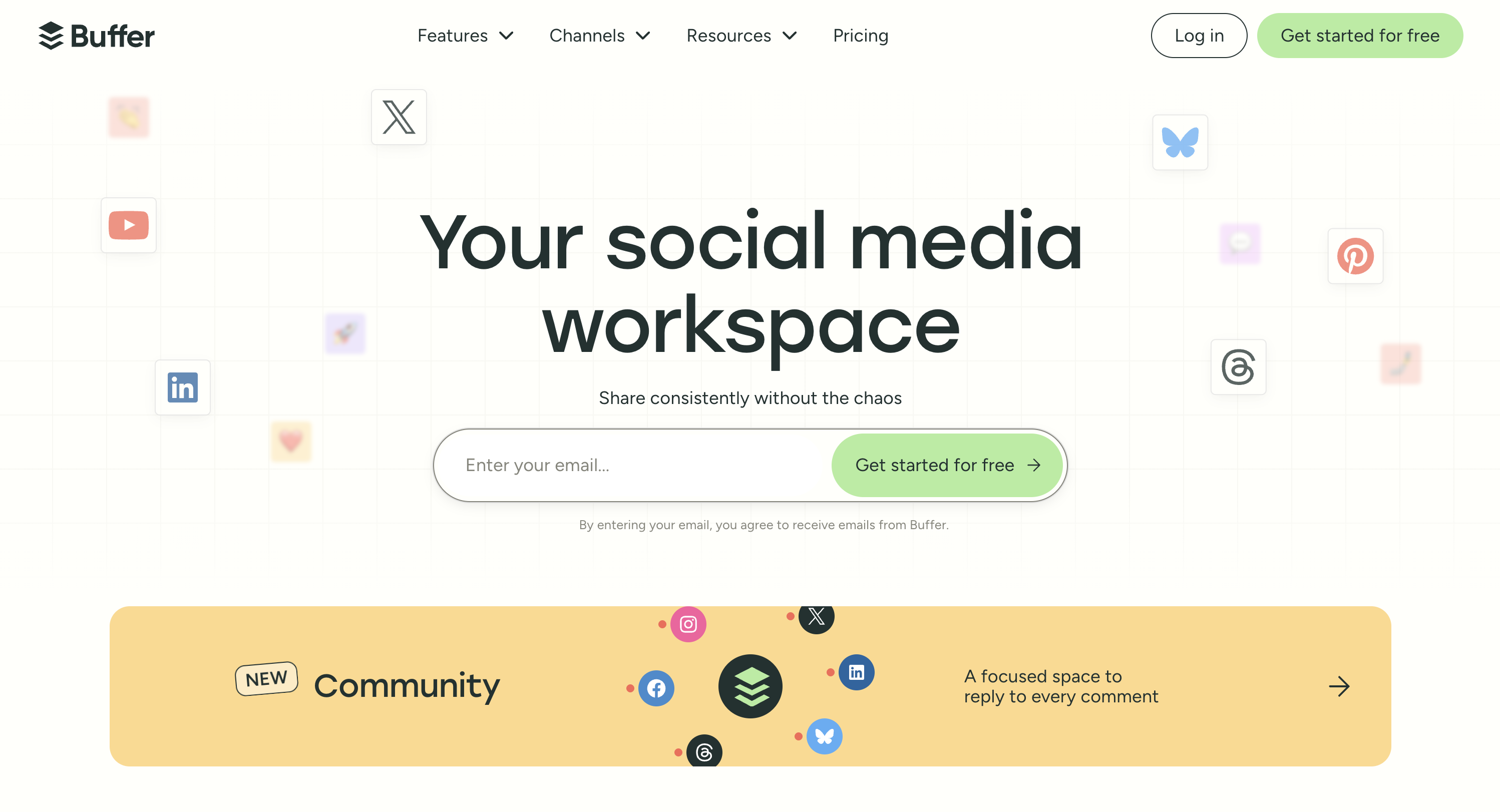
Buffer's AI Assistant is the easiest recommendation for small teams, freelancers, and creators who want help writing posts without committing to a large platform. It lives inside Buffer's Create space and composer, which means the jump from draft to scheduled post is short and intuitive.
This is the tool for people who don't want complexity. Buffer keeps the writing workflow simple, and that's a strength. You can generate, shorten, rephrase, or tailor copy by channel without a steep setup process.
Where Buffer is a smart choice
Buffer is a good fit when your bottleneck is caption writing, not operations. If you post consistently to a handful of channels and don't need advanced governance, it gets out of your way.
Its channel-aware generation is useful because social copy fails when teams reuse the exact same post everywhere. X needs tighter phrasing. LinkedIn needs stronger structure. Instagram often needs a cleaner caption lead and a different CTA. Buffer helps with those rewrites inside the place where you're already scheduling.
A practical setup works like this:
- Draft one core message in plain language.
- Ask Buffer to create one variant each for Instagram, LinkedIn, and X.
- Cut repeated AI phrasing.
- Add platform-specific details like hashtags, line breaks, or a more direct CTA.
- Schedule immediately so the draft doesn't die in another document.
Pros & Cons
✅ Pros
- AI Assistant available on the free plan
- Clean, beginner-friendly interface
- Channel-aware rewrites built into the composer
- Fast setup — no complex onboarding
❌ Cons
- Lighter than full agency suites by design
- No native AI image generation
- Approval workflows are basic (Team plan only at $12/channel/mo)
- Limited deep reporting for agency clients
What usually works: Use Buffer AI to create the first 70% of the post. Write the opening hook and final CTA yourself. That's where brand voice usually gets lost.
Another thing to watch is sameness across channels. Buffer makes adaptation easier, but you still need to give it a reason to differentiate. If you prompt lazily, it will produce safe versions of the same idea.
If you're deciding between a lightweight scheduler and a more agency-oriented tool, this Buffer alternative comparison is a useful next read. Product details for the assistant are on the Buffer AI Assistant page.
4. Sprout Social
At a glance
- Best for: Enterprise brands with serious social care workloads
- Starting price: $249/seat/mo (Standard plan)
- Free trial: Yes, 30 days
- AI feature: AI Assist inside Compose, replies, alt text, video subtitles
- Standout: AI for both publishing AND community management
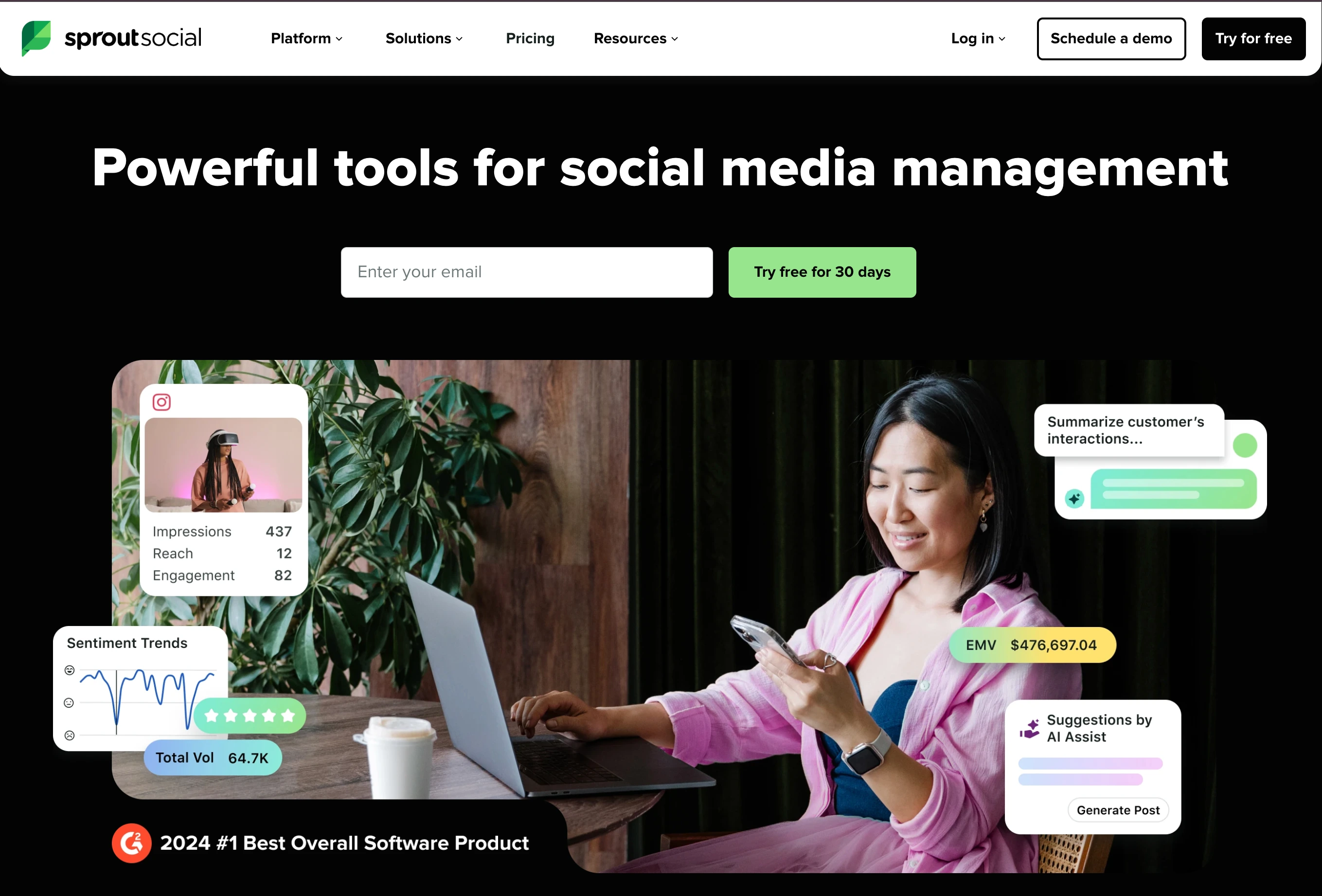
Sprout Social is for teams that care as much about response workflows and analytics as they do about post creation. Its AI Assist is built into Compose and extends into replies, alt text, and video subtitle support on relevant plans, which makes it more operational than many "AI writer" tools.
This matters for brands with a real customer care layer. If social is part publishing and part support, AI that helps both sides of the workflow is more valuable than a standalone caption generator.
What makes Sprout different
Sprout's AI isn't trying to be flashy. It fits into an enterprise-ready system that already handles approvals, analytics, listening, and social care. That's why larger teams often prefer it. The platform context is the primary feature.
The strongest use case is a cross-functional team that needs content and response quality to stay consistent. Marketing drafts posts. Community managers refine replies. Teams generate alt text and subtitles without opening another app. The result is less fragmentation.
Jasper's research on social media content generation notes that AI tools now support platform-specific optimization around length, tone, CTA patterns, and channel-specific formatting, while also enabling dynamic content adaptation by audience and platform in multi-channel workflows (platform-specific AI content optimization overview). Sprout fits that broader trend well because it places AI inside an established publishing and engagement environment.
The trade-off most teams feel fast
Sprout gets expensive when many collaborators need access. Per-seat pricing can become a key decision-maker, especially for agencies managing multiple brands with account managers, editors, approvers, and community staff.
For smaller teams, it can also be overkill. If all you need is "help me write better captions and schedule them," there are cheaper ways to solve that.
Pros & Cons
✅ Pros
- AI helps both publishing and community management
- Strong analytics and social listening foundation
- Enterprise governance and approval chains
- Alt text and subtitle generation for accessibility
❌ Cons
- Per-seat pricing scales painfully for agencies
- Overkill if you only need a caption generator
- Premium add-ons gate some AI features
- Steeper learning curve than lighter tools
Still, if your workflow includes:
- Approval chains across departments
- A meaningful social inbox workload
- Brand safety and governance needs
- Detailed analytics tied to publishing decisions
then Sprout is one of the better integrated options.
Practical caution
Sprout's AI should still be treated as assistive, not autonomous. That's especially true for replies. AI-generated response drafts can save time, but they shouldn't be posted without review in sensitive support or reputation scenarios.
The product details and plan-specific feature availability are on Sprout Social pricing and AI feature information.
5. Later

At a glance
- Best for: Instagram-first visual planners and influencer teams
- Starting price: $25/mo (Starter plan)
- Free trial: Yes, 14 days
- AI feature: Caption Writer inside the visual planner
- Standout: Caption generation tied to the asset you're scheduling
Later's Caption Writer is a focused tool for teams that already live inside a visual planner and mainly want faster caption iterations. It doesn't try to be everything. That's why it works well for creators, influencer teams, and brands that plan visually first and write around the asset.
The biggest practical advantage is convenience. You can generate or rewrite captions inside the same environment where you're arranging posts on the calendar. If your workflow starts with the image, carousel, or short-form video asset, that feels natural.
Best use cases
Later works best when content starts from the creative asset and not from a messaging brief. Instagram-heavy teams often operate this way. They already know the visual direction and need help turning it into on-brand caption options quickly.
The tone controls are useful for this. Casual, professional, or custom rewrites help teams create variations without rewriting from scratch. Mobile support also helps when someone is approving or editing from a phone instead of waiting to get back to desktop.
A realistic workflow is:
- Pick the asset first.
- Write a rough caption seed with the actual offer, point, or story angle.
- Use Caption Writer for two to four variations.
- Choose one, then manually rewrite the first line.
- Finalize platform-specific extras like hashtags, mentions, or line spacing.
Pros & Cons
✅ Pros
- Caption Writer lives inside the visual planner
- Strong mobile experience for on-the-go edits
- Good tone controls (casual/professional/custom)
- Excellent for Instagram-first workflows
❌ Cons
- Credit-based usage burns fast with vague prompts
- Narrower AI feature set than all-in-one tools
- No X/Twitter support (8 platforms total, no Google Business)
- Limited reporting for agency-style client delivery
If your team says, "We have the visuals, we just need better captions fast," Later is a strong fit. If your team says, "We need one place to run social," it probably isn't.
For Instagram-first teams, it can still be a solid choice because the visual planning experience remains the center of the product. If caption quality for that channel is your immediate problem, this guide to an AI Instagram caption generator is directly relevant, and our walkthrough of how to schedule Instagram posts covers the rest of the workflow. Product specifics for the feature are on Later's Caption Writer documentation.
6. Jasper

At a glance
- Best for: Agencies and brands prioritizing writing quality and brand voice
- Starting price: $39/seat/mo (Creator plan)
- Free trial: Yes, 7 days
- AI feature: Jasper Canvas, brand voice management, social templates
- Standout: Strongest brand voice controls on this list
Jasper is the best standalone option on this list. If your main problem is writing quality, brand consistency, and generating multiple variations across channels, Jasper is usually stronger than the AI assistants embedded in scheduling platforms.
That's because Jasper is writing-first. It gives you more control over brand voice, reusable knowledge, and structured content creation than most built-in social AI features do. For agencies managing several brands, that control often matters more than convenience.
Why Jasper stands out
The key difference is voice management. Most built-in post generators are fine at producing workable drafts. Jasper is better when you need those drafts to stay aligned with a client's tone, messaging boundaries, and recurring language patterns.
That makes it useful for:
- Agency teams with multiple client voices
- In-house brands with strict messaging standards
- Campaigns that need many post variations from one core message
- Teams that draft outside the scheduler, then move approved copy into publishing tools
Jasper's Canvas and social templates are particularly useful when you're turning one campaign concept into platform-specific outputs. You can create a more concise X version, a more narrative LinkedIn version, and an Instagram caption with a different opening structure without feeling like each version came from the same generic machine.
The downside is operational
Jasper isn't a scheduler. That's the whole trade-off. You still need somewhere else to publish, review, and report.
That means Jasper fits best when content creation is the bigger pain than publishing logistics. If your team already has a scheduler they like, Jasper can improve the writing layer. If your team wants a single place to create and publish, it adds another handoff.
Pros & Cons
✅ Pros
- Best-in-class brand voice management
- Strong templates for social and multi-channel campaigns
- Multi-brand workspaces work well for agencies
- Reusable knowledge bases keep tone consistent
❌ Cons
- Not a scheduler — adds a handoff step
- Per-seat pricing climbs with bigger teams
- No native social analytics or inbox
- Requires more setup than embedded AI tools
Teams tend to make mistakes with standalone AI tools. They buy the strongest writer, then realize the actual bottleneck was approvals, scheduling delays, or fragmented reporting. So choose Jasper if those operational pieces are already handled. Pair it with a scheduler from our social media scheduling tools roundup if you go this route.
How to use it well
Jasper performs best when you give it structured inputs. Don't just ask for "an Instagram caption about our product launch." Give it:
- The audience.
- The platform.
- The offer or key point.
- The brand tone constraints.
- What the post should get the reader to do.
Then ask for three variants with different hook styles. One direct. One curiosity-driven. One educational. That usually produces much better raw material than a single generic prompt.
You can review pricing and plan details on Jasper's pricing page.
7. Lately AI

At a glance
- Best for: Teams repurposing podcasts, webinars, and long-form content
- Starting price: Custom (sales-led)
- Free trial: Demo-based
- AI feature: Long-form-to-many-posts repurposing engine
- Standout: Turns one asset into dozens of platform-native posts
Lately AI solves a different problem from the other tools on this list. It isn't primarily for writing one caption at a time. It's for atomizing long-form content into many social posts while trying to preserve brand voice.
If your team produces webinars, podcasts, blog posts, videos, or thought leadership content, Lately is one of the more interesting options. It turns those source assets into a stream of shorter social outputs, which is much more efficient than manually slicing everything into posts.
Where Lately makes the most sense
Lately is strongest when one content asset needs to feed many channels over time. Agencies and content marketing teams often struggle here. They create strong long-form material, then under-distribute it because repurposing takes too long.
That's where Lately's model is useful. Instead of asking, "What should we post today?" it asks, "What can we extract from what we've already made?"
The better use cases look like this:
- Turn a podcast episode into multiple LinkedIn, X, and Facebook posts
- Break a webinar into short thematic post series
- Repurpose blog posts into caption-ready snippets
- Support employee advocacy with prebuilt post options
Pros & Cons
✅ Pros
- Genuinely strong at long-form-to-short-form repurposing
- Brand voice training preserves tone across atomized posts
- Saves hours of manual extraction work
- Supports employee advocacy workflows
❌ Cons
- Heavier learning curve than caption generators
- Sales-led pricing — no transparent self-serve tier
- Doesn't fix weak source material
- Less useful if you don't produce long-form content regularly
The real trade-offs
Lately has a heavier learning curve than a simple caption generator. You need source content, editorial judgment, and some process around what gets reused where. If you're a solo creator just trying to fill tomorrow's calendar, it may feel like too much.
The pricing is also sales-led rather than simple self-serve. For some buyers that's fine. For others, it's friction.
Repurposing tools work best when your long-form content is already strong. They don't fix weak source material. They scale it.
There's also a broader trust issue to keep in mind. As AI content volume rises and platforms get flooded with repetitive phrasing, teams are pushing back against content that feels too polished or too obviously synthetic. Lately can help preserve brand patterns, but it still needs a human editor to decide what sounds lived-in versus machine-smoothed.
You can explore the product on Lately AI's social media content writing platform.
Comparison Table: All 7 AI Post Generators Side-by-Side
The right choice depends less on "which AI writes better" and more on where your workflow breaks. Some teams need faster first drafts. Others need approvals, scheduling, reporting, and inbox work in one place. This comparison is useful only if you read it through that operational lens.
A practical test helps. If the tool can generate a decent post but still forces your team to copy content into a scheduler, reformat it by channel, chase approvals in Slack, and build reports manually, the writing gain may not turn into time saved.
| Product | 🔄 Implementation complexity | ⚡ Resource requirements | ⭐ Expected outcomes | 📊 Ideal use cases | 💡 Key advantages |
|---|---|---|---|---|---|
| PostPlanify | Moderate. Set up drag and drop calendar plus optional API integrations | Cost efficient flat pricing, no per seat fees, tiered limits on lower plans | High. Efficient multi platform publishing and reporting, with clear operational time savings ⭐⭐⭐⭐ | Agencies, in house teams, creators needing multi account publishing | All in one workflow, unlimited teammates on flat plans, built in AI and white label reports |
| Hootsuite (OwlyWriter AI) | Moderate if already on Hootsuite, higher if onboarding the full suite | Higher overall spend because AI sits inside paid plans | Strong end to end workflow with governance and analytics ⭐⭐⭐ | Enterprises or teams already using Hootsuite and adding AI to an existing process | AI built into approvals, compliance, analytics, and broader social operations |
| Buffer (AI Assistant) | Low. Embedded composer and simple UX | Very low cost of entry, free tier supports testing | Good for basic captioning and quick drafts ⭐⭐ | Creators and SMBs testing AI inside an existing publishing routine | Channel aware generation on free plan, approachable interface, fast setup |
| Sprout Social (AI Assist) | Higher. Enterprise rollout with governance and add ons | Higher per seat cost, with feature access tied to plan level | Very strong for analytics, social care, and enterprise workflows ⭐⭐⭐⭐ | Brands needing social care, advanced analytics, and compliance | Enterprise controls, AI for posts and replies, clear plan structure |
| Later (Caption Writer) | Low. Caption tool built into the visual planner | Paid plans plus credit based generation model | Focused caption quality inside the planner, but credits can limit heavier use ⭐⭐ | Visual planners and social teams prioritizing mobile scheduling | Mobile friendly captioning, tone controls, direct planner integration |
| Jasper | Moderate. Stand alone authoring tool that usually requires export or integration into your stack | Separate subscription, higher cost for advanced brand controls | High for brand consistent copy at scale ⭐⭐⭐⭐ | Agencies and teams needing consistent brand voice across clients | Brand voice controls, templates, collaboration features, API access |
| Lately AI | Higher. Brand training and onboarding for repurposing workflows | Sales led pricing, heavier onboarding and training | Excellent at turning long form assets into many platform specific posts ⭐⭐⭐⭐ | Teams repurposing blogs, podcasts, and videos into social content at scale | Automated long form to multi post conversion, voice consistency after training |
One caution from implementation work. The tools near the top of the market often look similar in a feature table, but they create value in different places. Hootsuite and Sprout Social make more sense when social is tied to governance, approvals, and customer care. Jasper is stronger when copy quality and brand control matter more than native scheduling. Buffer and Later are easier to adopt, but they solve a narrower part of the workflow.
That difference shows up fast once a team moves from testing to daily use. A solo creator can tolerate a few manual steps. A multi stakeholder team usually cannot.
Checklist: Choosing Your AI Post Generator
A bad tool choice usually shows up after week two. Drafts are coming out faster, but approvals still live in Slack, assets still sit in scattered folders, and reporting still gets rebuilt by hand at the end of the month. The right ai social media post generator fixes the step that is slowing the team down.
Start there. Identify the bottleneck before you compare features.
If the team writes solid social copy already, adding stronger generation alone will not change much. The bigger gain usually comes from reducing handoffs between drafting, scheduling, approvals, inbox work, and reporting. If copy quality and brand consistency are the actual problem, a writing-first tool is the better fit. If execution is the problem, an all-in-one platform will usually return more value.
Content tends to stall in a few predictable places:
- Idea to draft: The team knows the message but loses time getting a usable first version.
- Channel adaptation: One post needs to become five versions without sounding pasted across platforms.
- Approvals: Feedback gets split across docs, chat threads, and email.
- Publishing and engagement: Scheduling is separate from comment and reply management.
- Reporting: Results are available, but assembling them for clients or stakeholders takes too long.
That distinction matters because the implementation is different. A lightweight generator can solve drafting and variation. It will not fix approval bottlenecks or reporting overhead unless the rest of the workflow is already clean.
AI is useful for first drafts, rewrites, formatting, and repurposing. It is weaker at judgment. Teams still need a human pass for claims, nuance, hooks, and calls to action. Generic AI copy is easy to spot on social, especially on LinkedIn and X, where weak points of view get ignored fast.
A practical setup looks like this:
- Write one brand voice brief for each account.
- Build prompt templates by platform and content type.
- Use AI to generate options, not final posts.
- Assign a human review step before scheduling.
- Measure time saved in the actual workflow, such as draft speed, revision count, and reporting effort.
Channel differences matter more than product demos suggest. Instagram usually needs a stronger opening line and cleaner formatting. LinkedIn needs a clearer opinion and less polished filler. X needs compression. TikTok captions work better when they support the visual instead of repeating it. Good tools help teams adapt the draft, but they do not replace channel judgment. For a deeper view on planning around AI, see our guide to how to plan social media content and our walkthrough on automating Instagram posts safely.
Two checks save a lot of frustration. Confirm publishing permissions and account-type requirements before rollout, especially for Instagram, Facebook Pages, TikTok business publishing, and Google Business Profile. Then test the approval flow with the people who will use it every day, including clients and non-technical teammates. Admin views often hide friction that shows up immediately in real use.
PostPlanifyAll your social media in one simple dashboard
Schedule posts, track analytics, and reply to comments/DMs without switching tabs.
Engagement
+18%
Views
52.8k
Frequently Asked Questions
What is an AI social media post generator?
An AI social media post generator is a software tool that uses large language models (and increasingly vision models) to draft captions, hooks, hashtags, and full social posts from a short input — a topic, a campaign brief, a URL, or an uploaded image. The strongest tools adapt the same idea to each network's format, generate multiple variants for testing, and plug directly into a scheduler so the draft doesn't get stuck in a separate document.
Is there a free AI social media post generator?
Yes. Buffer's AI Assistant is available on its free plan, and ChatGPT's free tier can produce serviceable drafts if you give it strong prompts. ChatGPT can also schedule the posts it drafts once it is connected to a scheduler. However, free tools typically lack scheduling, brand voice training, and team collaboration — fine for one-person operations, limiting for any team publishing across multiple accounts.
Can AI write social media posts that don't sound generic?
Yes, but only if you give it specifics. Generic prompts produce generic posts. The fix is structured input: audience, platform, offer or key point, tone constraints, and the action you want the reader to take. Ask for three variants with different hook styles (direct, curiosity-driven, educational) and edit the opening line yourself — that's where brand voice usually lives.
Does Instagram or LinkedIn penalize AI-generated posts?
No. Neither platform penalizes posts based on how they were written. What gets penalized is low-quality, repetitive, or formulaic content — which AI produces by default if you don't edit it. LinkedIn in particular is saturated with polished AI phrasing, so distinct voice and real observations win there. Treat AI as a first-draft tool, not a publish-and-forget machine.
Can ChatGPT replace a dedicated AI social media post generator?
Partially. ChatGPT can draft strong copy, but it doesn't schedule posts, manage brand voice across multiple clients, sit inside an approval workflow, or report on what published. For a solo creator with three accounts, ChatGPT plus a basic scheduler can work. For agencies or teams, a dedicated tool like PostPlanify eliminates the copy-paste tax between writing and publishing.
What's the best AI tool for Instagram captions specifically?
For Instagram-only workflows, Later's Caption Writer is purpose-built and lives inside the visual planner. For multi-platform teams that include Instagram, PostPlanify's vision-powered AI assistant drafts captions directly from your uploaded media — useful when the visual is the brief. See our deeper breakdown in our AI Instagram caption generator guide.
Can an AI social media post generator create images too?
Some can. PostPlanify includes AI image generation with monthly allowances that scale by plan, Jasper has Jasper Art, and standalone tools like Midjourney, DALL·E, and Adobe Firefly handle images separately. If your bottleneck is mixing visuals with copy in the same flow, an all-in-one platform with both built in saves the most time.
How do I keep AI-generated posts on-brand across multiple clients?
Use tools with brand voice training and reusable knowledge bases. Jasper is the strongest here for pure writing, with workspaces per brand. PostPlanify uses brand-level settings and team workspaces so AI suggestions stay scoped to each client. For either approach, document a one-page brand voice brief per account (tone, banned phrases, preferred CTAs) and feed it into the prompt every time.
How much does an AI social media post generator cost?
Pricing ranges from free (Buffer's free plan, ChatGPT free tier) to enterprise per-seat pricing ($249+/user/mo for Hootsuite or Sprout Social). The sweet spot for most teams sits between $30–$100/mo for an all-in-one tool with AI included — for example, PostPlanify starts at $79/mo billed yearly with multi-account support and built-in AI drafts on Growth and above.
Can AI schedule posts automatically?
The AI itself drafts; the scheduler publishes. Inside all-in-one platforms (PostPlanify, Hootsuite, Buffer, Later, Sprout Social), drafting and scheduling happen in the same tool, so the workflow feels automatic. Standalone AI writers like Jasper require exporting the copy into a separate scheduler. See our guide on how to see scheduled posts on Instagram for managing your queue, and our Instagram post scheduler tools comparison for scheduler picks.
Are AI-generated social media posts safe from copyright issues?
Copy generated from scratch is generally safe, but be cautious with two things: AI-generated images can occasionally reproduce trademarked logos or characters, so review before publishing; and Reels or videos using copyrighted music must be added manually inside Instagram, since Meta's API can't legally include licensed music in auto-published posts. See our Instagram scheduled posts troubleshooting guide for the full list of API limitations.
How do I measure whether the AI tool is actually saving time?
Track three numbers before and after rollout: average drafting time per post, number of revision cycles per post, and total team hours spent on monthly reporting. If the AI saves drafting time but revisions and reporting overhead stay the same, the tool is fixing the wrong problem — you likely need an all-in-one workflow, not a better writer.
Final Thoughts
For teams that need AI writing inside a broader social workflow, PostPlanify is a practical starting point. It makes the most sense for agencies, in-house teams, and creators who want one system for drafting, scheduling, asset organization, engagement, and reporting, instead of stitching those steps together across separate tools. Plans start at $79/mo billed yearly (Growth) with multi-platform support and built-in AI drafts, with reports unlocked from Premium and white-label reports from Scale.
If your bottleneck is genuinely writing quality and brand consistency, pair Jasper with your existing scheduler. If you only need a free starting point, Buffer's AI Assistant is the cleanest entry. And if you're repurposing podcasts or webinars at scale, Lately AI deserves a demo.
Try PostPlanify free for 7 days and see whether moving drafting, scheduling, and reporting into one tool changes how much your team actually ships.
Related Reading
- Best AI Tools for Social Media Marketing
- AI Caption Generator for Instagram
- Instagram Post Scheduler Tools (2026)
- Best Social Media Scheduling Tools
- How to Schedule Instagram Posts: Full Guide
- How to See Scheduled Posts on Instagram
- Instagram Scheduled Posts Not Working? 10 Quick Fixes
- How to Plan Social Media Content
- Automating Instagram Posts Safely
- Best Time to Post on Instagram
- Hootsuite Alternative: PostPlanify
- Buffer Alternative: PostPlanify
- Best Social Media Management Tools for Teams
PostPlanifyAll your social media in one simple dashboard
Schedule posts, track analytics, and reply to comments/DMs without switching tabs.
Engagement
+18%
Views
52.8k
About the Author

Hasan Cagli
Founder of PostPlanify, a content and social media scheduling platform. He focuses on building systems that help businesses, agencies, and teams plan, publish, and manage content and social media more efficiently across platforms.


