


If you're trying to figure out how to post a Story on Facebook, you're usually in one of three situations. You need to publish something quickly from your phone, you're sitting at a desktop and can't find the right option, or you're managing a Page and want a cleaner workflow than tapping around in the app.
Facebook doesn't make those paths equally obvious. The mobile app is still the simplest place to publish, but desktop options exist, and the feature set changes depending on whether you're posting to a personal profile or a business Page. That's where many users get stuck.
Quick Answer: How to Post a Story on Facebook
To post a Story on Facebook, use the method that matches your device and account:
- Phone (iOS/Android) — Open the Facebook app → tap Create Story → upload or capture a photo/video → add text, stickers, or music → tap Share to Story. This is the fastest route and unlocks every creative tool.
- Desktop (personal profile) — Go to Facebook.com → find the Story option near the main posting area → upload your photo/video → publish. Fewer creative tools than mobile.
- Business Page (desktop) — Open Meta Business Suite → select the Page → start a post → choose Story as the placement → publish or schedule.
A Facebook Story is a vertical photo or video (1080 × 1920 px, 9:16) that stays visible for 24 hours, then disappears. Page Stories can be scheduled ahead in Meta Business Suite or a tool like PostPlanify; personal-profile Stories cannot.
What Are Facebook Stories and Why Post Them in 2026
A Facebook Story is a temporary photo or video post that stays visible for 24 hours, then disappears. That short lifespan is the whole point. Stories work best for updates that are useful now, not for content you need to live on your timeline long term.

That changes how you should think about them. A feed post needs to stand on its own and often needs broader context. A Story can be lighter, faster, and more immediate. Flash promos, behind-the-scenes clips, restock alerts, event reminders, quick polls, and informal check-ins all fit better here than in the main feed.
One reason people still care about learning how to post a Story on Facebook is simple visibility. One independent industry guide reports that over 500 million people view Stories across Facebook every day, and that Stories account for 31.7% of all time spent on Facebook. The same guide also recommends publishing in vertical format and aiming for 3 to 5 Stories per day to stay visible near the top of followers' feeds, which tells you how often brands now treat Stories as an active publishing channel rather than an occasional extra in this Facebook Stories guide from MeetEdgar.
Facebook Story specs at a glance
Before you create anything, match your asset to these specs so it doesn't get cropped, compressed, or rejected.
| Spec | Recommendation |
|---|---|
| Aspect ratio | 9:16 (full vertical) |
| Resolution | 1080 × 1920 px |
| Lifespan | 24 hours, then auto-expires (saved to your Archive) |
| Photo display time | ~5 seconds per frame |
| Video length | Up to ~60 seconds per segment (longer clips split into multiple frames) |
| Image formats | JPG, PNG |
| Video formats | MP4, MOV |
| Safe zone | Keep text and CTAs centered, away from the top/bottom ~14% where the UI sits |
What makes Stories different from feed posts
The main difference isn't just that Stories disappear. It's also placement and user intent.
| Format | Best use | What usually works |
|---|---|---|
| Story | Fast updates, promos, short sequences | Vertical visuals, urgency, quick interaction |
| Feed post | Durable content, announcements, community updates | Strong caption, standalone message |
| Reel | Discovery, entertainment, broader reach potential | Edited short-form video with stronger creative hook |
If you're comparing formats for campaign planning, this guide on Reels vs Stories is useful because the trade-offs are real. Stories are stronger for repeat touchpoints and short-lived offers. Reels are usually the better bet when you want content to keep working after the first day.
Practical rule: Post Stories when timing matters. Post to the feed when permanence matters.
Why teams still use Stories
For brands, Stories fill the gap between polished content and everyday presence. They let you stay visible without overloading the main feed.
What doesn't work is treating Stories like recycled feed posts with no adaptation. A square graphic with tiny text, dropped into a vertical Story frame, usually looks lazy and gets skipped. Stories reward content that feels native to the format. Shorter, clearer, more visual.
Posting a Story from Your Phone (iOS and Android)
The phone app is still the fastest way to post. If you're using a personal profile, it's the default route. If you're posting for a Facebook Page, it's also the workflow many teams fall back on when desktop options are missing features.

Facebook Stories use a 24-hour format, and on Pages the usual mobile flow starts with Create Story, then choosing a photo or video, then tapping Share. Buffer also notes that Stories don't appear in the News Feed or timeline by default unless you choose to share them there too, which is why they work well for time-sensitive content that doesn't need a permanent home in Buffer's Facebook Stories walkthrough.
Basic steps in the Facebook app
The exact button placement can shift a little between iPhone and Android, but the process is largely the same.
- Open the Facebook app and make sure you're using the correct profile or Page.
- From the home area, look for Create Story.
- Tap it, then choose whether to:
- upload a photo from your camera roll
- upload a video
- capture something in the app
- create a text-based Story
- Add simple edits if needed. Text, stickers, drawings, or music are usually available here.
- Check the audience setting if Facebook shows one.
- Tap Share to Story or Share.
If you're posting for a business that also runs Instagram, it helps to sort out account connections before you start. Broken or partial connections create a lot of weird publishing issues later, especially when cross-post options appear inconsistently. This guide on linking Facebook and Instagram properly is worth checking if your accounts don't seem to talk to each other.
What to watch before you tap Share
A Story can go live in seconds, which is useful, but it also means small mistakes go public fast.
Use this quick check first:
- Check framing: Vertical content fits the format better than horizontal clips with empty space.
- Read your text once: Story text gets cropped or covered more often than people expect.
- Keep it short: One clear message per frame usually beats trying to say everything at once.
- Confirm the account: Agencies and in-house teams switch identities often. Posting from the wrong Page is more common than anyone likes to admit.
If the Story matters commercially, preview it as if you're a distracted user, not the person who made it.
If you want a visual walkthrough
Sometimes it helps to see the taps rather than read them. This walkthrough gives a practical visual reference for the in-app flow:
Common mobile differences between iPhone and Android
You usually won't see major feature gaps, but there are small differences.
- Menu layout: Android and iPhone may place stickers or editing tools in slightly different spots.
- Permissions prompts: Camera, microphone, and photo library access often behave differently on first use.
- Media picker behavior: Some Android devices show album folders differently, which can make users think their files are missing.
If the Story option isn't visible at all, log out and back in, update the Facebook app, and confirm you're not in a restricted account mode or outdated Page experience. Most of the time it's a version issue, permissions issue, or the wrong identity selected inside the app.
 PostPlanify
All your social media in one simple dashboard
Schedule posts, track analytics, and reply to comments/DMs without switching tabs.

Engagement
+18%
Views
52.8k
How to Post a Story from Your Desktop Computer
Desktop posting is where Facebook gets inconsistent. You can post in more than one way, but the right workflow depends on what kind of account you're managing.
For a personal profile, you're usually working directly inside Facebook on the web. For a business Page, the more reliable route is typically Meta Business Suite. Those aren't interchangeable, and the available tools won't match perfectly.
Personal profile on Facebook.com
If you're logged into your own Facebook account on desktop, look for the Story entry point near the main posting area. Facebook sometimes labels it clearly and sometimes hides it behind changing interface elements, which is why users often think the feature disappeared.
The usual process is simple:
- Log in to Facebook.com.
- Find the Story option from the main home view or profile-related posting area.
- Upload a photo or short video.
- Add any available text or basic adjustments.
- Publish.
This method is fine for quick personal updates, but it's usually the least flexible route for managed publishing. Desktop profile posting tends to offer fewer creative tools than the mobile app, and Facebook changes the interface often enough that training documents get outdated fast.
Business Page in Meta Business Suite
If you're managing a Page, use Meta Business Suite when possible. It gives you more control and usually makes the account context clearer, which matters when multiple team members share responsibilities.
A typical workflow looks like this:
- Open Meta Business Suite and select the correct Page.
- Start a new post or Story from the publishing area.
- Choose Story as the placement if Facebook presents multiple placement options.
- Upload your creative.
- Review how it will appear.
- Publish now or, if available in your workflow, schedule it.
For teams that need a calendar view instead of working natively in Meta every time, a dedicated Facebook scheduler can make story planning easier, especially when you're coordinating Stories with feed posts and Instagram content. For the full method-by-method breakdown, see our guide on how to schedule Facebook posts, which covers Story scheduling limits in detail.
Which desktop method should you use
Here's the practical comparison.
| Use case | Better option | Why |
|---|---|---|
| Personal account posting | Facebook.com | Direct, simple, no extra tool needed |
| Business Page management | Meta Business Suite | Clearer Page context and better workflow control |
| Fast creative editing | Mobile app | More native Story tools |
| Batch planning | Business Suite or scheduler | Easier to organize future content |
Desktop is best for organization. Mobile is still better for last-minute creative edits.
Real limitations on desktop
This is the part basic guides skip. Desktop isn't always a full replacement for the phone.
You may run into these constraints:
- Missing stickers or music options: Some Story features appear in mobile first or stay mobile-only.
- Different preview behavior: A design that looks fine on desktop can still crop awkwardly on mobile.
- Role and permission issues: In Page environments, not every team member can publish the same way.
- Account confusion: If Business Suite is linked to multiple assets, it's easy to draft under the wrong brand.
When a desktop Story won't publish cleanly, the fallback is often the app. That's annoying, but it's still normal in day-to-day social work.
Making Your Stories Engaging with Creative Tools
Knowing how to post a Story on Facebook is only half the job. The other half is making sure people don't tap past it instantly.
Facebook's built-in Story tools matter because they create small actions. A tap on a poll, a pause to read text, a reaction to music, or a click on a link all signal that the frame did its job. Hibu notes that stronger Stories often use native tools like polls, emoji polls, GIFs, music, text, and link CTAs, and it also points out that you can check the viewer list from the Story interface itself. That matters because you can spot where interest holds and where viewers start dropping off in Hibu's guide to Facebook Stories.

Tools worth using regularly
Not every sticker or effect is worth your time. These usually are.
- Polls and emoji polls: Good for low-friction interaction. Ask one simple question, not three.
- Music: Useful when the clip feels flat without audio context.
- Text overlays: Best for clarifying the point fast, especially if viewers watch with sound off.
- GIFs and effects: Fine in moderation. Too many makes a Story look cluttered.
- Link CTAs: Useful when the Story needs to move someone to a site, product page, or signup step.
How to use each tool well
A poll works when the choices are obvious and fast to answer. "Which launch color?" works. A long, nuanced market research question doesn't.
Music helps when it supports the mood of the frame. It hurts when it competes with your message. If text is the main point, don't bury it under a loud soundtrack.
Text should be readable in a second or two. Keep it large, high-contrast, and away from the edges. Facebook's interface can cover parts of the design depending on device and placement.
For visuals, some teams create lightweight concept shots instead of waiting for a full photo shoot. If you need quick assets for a mockup or campaign filler, a tool like this realistic AI photo generator can help you build Story-ready imagery faster. It won't replace original brand photography, but it can be useful for placeholders, tests, or simple visual variations.
Use one interaction per frame. When a Story asks viewers to read, vote, listen, and click at the same time, most people do none of it.
Creative choices that usually underperform
Some patterns look busy but don't help.
| Usually works | Usually gets skipped |
|---|---|
| One message per frame | Text-heavy frames with multiple ideas |
| Clear CTA | Vague "check this out" language |
| Simple sticker use | Overdecorated frames |
| Readable contrast | Tiny text on bright backgrounds |
A lot of teams also repurpose Instagram Story ideas on Facebook. That's fine, but don't assume the exact same design will land the same way. If you need starting points, these Instagram Story templates are useful for adapting layouts quickly instead of designing every frame from scratch.
Privacy and audience control
Before posting, check who can see the Story. This matters more on personal accounts, but it's still worth confirming whenever Facebook shows audience settings.
Review these items:
- Make sure the Story isn't limited to a smaller audience than intended.
- Confirm whether cross-posting or connected account sharing is turned on or off.
- If you're tagging another account or location, preview how that changes the frame.
- If the Story contains a link or offer, test whether the CTA is easy to notice.
Creative tools help, but restraint matters more. The best-performing Stories are often the simplest ones in the sequence.
PostPlanifyAll your social media in one simple dashboard
Schedule posts, track analytics, and reply to comments/DMs without switching tabs.
Engagement
+18%
Views
52.8k
Troubleshooting Common Facebook Story Problems
When Facebook Stories fail, the cause is usually boring. App version issues, permissions, upload instability, unsupported features, or account-role confusion. The hard part is that Facebook rarely tells you which one it is.
Why is my Story video blurry
Blurry Story uploads usually come from compression, low-quality source files, or editing a video several times before uploading it.
Try this:
- Upload the original file instead of a clip that's already been exported multiple times.
- Use a vertical version rather than forcing a horizontal video into the Story frame.
- Check your connection before uploading. Weak mobile data can lead to messy results.
- If the result still looks wrong, close the app and try again on stable Wi-Fi.
If your content keeps failing or posting incorrectly across Facebook in general, this guide on why you can't post on Facebook covers the broader causes that also affect Stories.
Why can't I see music, polls, or link options
This usually happens for one of four reasons:
- Feature rollout differences: Facebook doesn't always release Story features evenly across accounts.
- Account type limitations: Personal profiles, professional modes, and Pages don't always get the same options.
- Region or licensing issues: Music availability can vary.
- App version lag: Outdated apps often miss newer Story tools.
Fix it with this sequence:
- Update the Facebook app.
- Log out and back in.
- Confirm you're posting from the intended profile or Page.
- Test from another device if available.
- If the sticker is still missing, assume the feature isn't available on that account right now.
A missing sticker doesn't always mean you've done something wrong. Sometimes the account simply doesn't have that tool yet.
Why does my Story fail to upload
This is one of the most common complaints for Page managers.
Check these causes:
- Large or awkward media files
- Weak internet connection
- Temporary Facebook app bugs
- Expired login session
- Page permission issues in shared business accounts
Do this in order:
- Restart the app.
- Reconnect to a stronger network.
- Try a different photo or a shorter video.
- Re-authenticate the account if you're in a business environment.
- Test the same upload from mobile if desktop keeps failing.
If you scheduled the Story through a tool and it never went live, the cause is often the same family of issues that affect feed posts — our guide on Facebook scheduled posts not working walks through the fixes.
Why are stickers or taps not working properly
If viewers report that polls, links, or interactive elements aren't behaving correctly, the problem may be with placement or preview assumptions.
Check for these mistakes:
- text or stickers placed too close to the edge
- overlapping interactive elements
- cluttered design that makes the CTA hard to notice
- posting too many frames in a row, which leads users to skip before they interact
The fix isn't always technical. Sometimes the Story works fine, but the design makes interaction easy to miss.
Advanced Strategy for Social Media Managers
It is 8:45 a.m., a product launch goes live at 9, and the Story draft is still sitting in someone's camera roll. That is the core Facebook Story problem for social teams. The issue is not how to tap "Share to Story." It is building a process that works across phones, desktop, Meta Business Suite, approvals, and last-minute campaign changes without posting from the wrong Page or missing the window.
That broader workflow question is also why Story strategy still deserves attention in 2026. Meta keeps Stories inside the core Facebook experience, but public reporting rarely breaks out Story performance by Page type, audience mix, or region. Teams often have to judge value from their own results and placement tests, rather than from clean platform-wide benchmarks as discussed in this analysis of whether Facebook Stories still matter.

What a workable Story workflow looks like
Teams that publish Stories consistently do not rebuild the process every day. They standardize a few decisions so mobile posting, desktop publishing, and approvals stay predictable.
-
Plan by campaign job Start with the use case. Event reminder, limited-time offer, creator repost, testimonial, FAQ, or product proof. Story is just the container. The job of the frame decides the creative.
-
Build vertical assets once, then adapt Design for vertical first so the same asset can work across Facebook Stories, Instagram Stories, and paid placements with minor edits. Keep headlines, CTA text, and background layers editable. That saves time when legal changes one line or a store location needs a localized version.
-
Schedule the predictable content Meta Business Suite is useful for planned Story posts on Pages, especially when the campaign date is fixed and the asset is already approved. It does not replace mobile for every creative feature, but it does cut down on missed posts and messy handoffs.
-
Keep a gap for reactive posting Launch-day updates, stock alerts, event footage, and creator mentions usually perform better when they feel current. Leave room in the calendar for those. A full week of pre-scheduled Stories often looks organized internally and stale to the audience.
What to measure without making reporting messy
Story review should answer a few operational questions.
| Question | What to look for |
|---|---|
| Did viewers stay through the sequence? | Frame-to-frame drop-off |
| Did they do the intended action? | Poll taps, replies, link clicks, profile visits |
| Did the format fit the message? | Static frame vs short video vs text-led card |
| Did timing help or hurt? | Whether the Story matched the campaign moment |
The useful pattern is simple. One Story frame should ask for one action. If a frame asks viewers to read, vote, listen, and click at the same time, viewers tend to do none of it. Polls, question stickers, links, and reply prompts are valuable because they create small actions that signal intent without asking for a full commitment. Timing matters too — our guide on the best time to post on Facebook covers the windows when Story trays are busiest.
If you need more creative volume for Story ads or supporting assets, an AI tool such as the ShortGenius Meta ad creator can help generate video variations faster for testing and repurposing. That works best when the campaign angle is already clear and the bottleneck is asset production, not strategy.
When a scheduling tool actually helps
A single Page with light posting can usually run on native Meta tools alone. The strain starts when one team manages several brands, needs stakeholder approvals, or has to coordinate Facebook Stories with Instagram posts and paid launches in the same calendar.
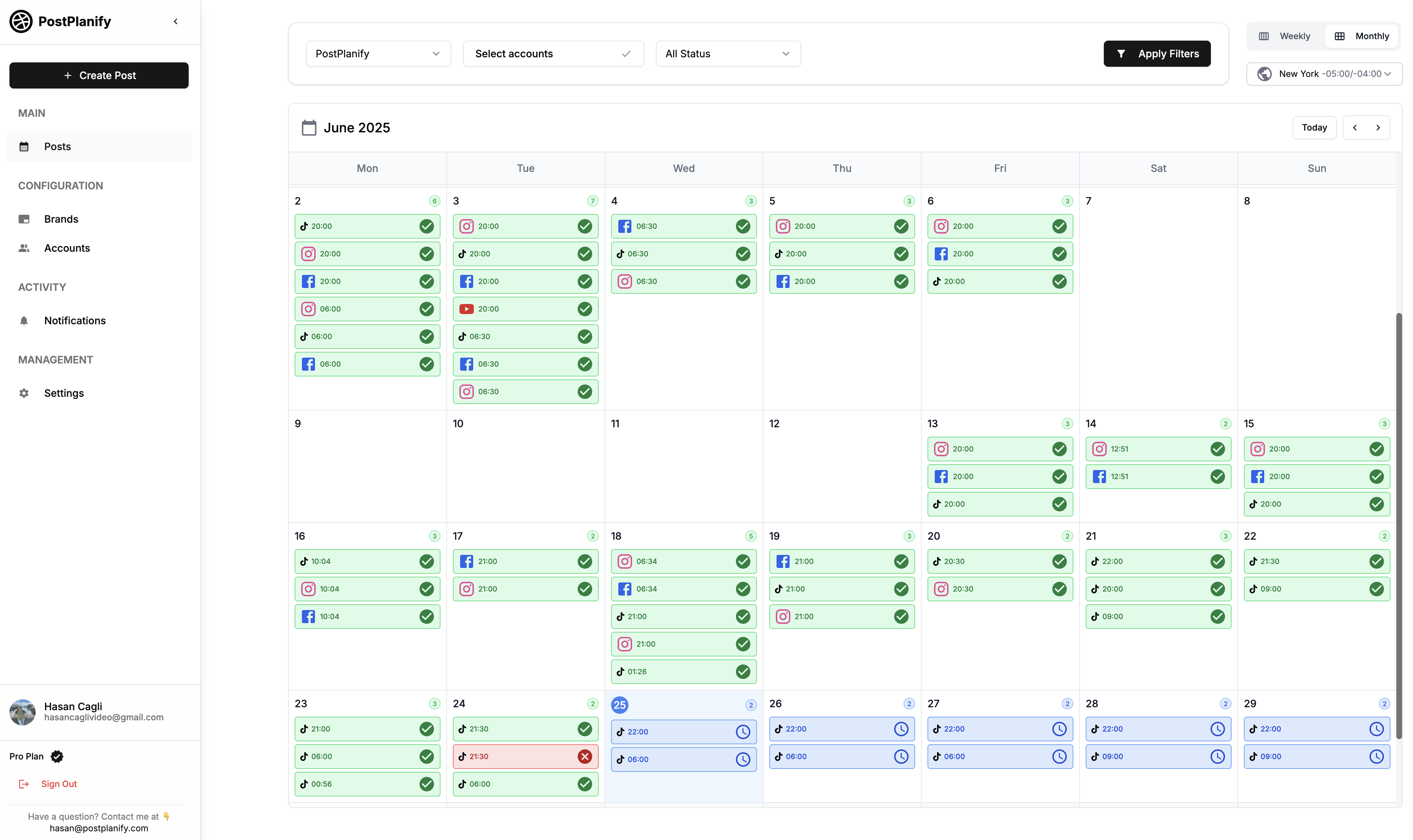
This is where PostPlanify fits. It schedules Facebook Page Stories through Meta's official API, and the value isn't only the queue — it's everything wrapped around it:
- Analytics across every connected platform so you can see which Stories actually drove taps, replies, and profile visits instead of guessing from native screens.
- A unified content calendar that puts Stories, feed posts, Reels, and Instagram content in one view, so you spot gaps and overlaps before they ship.
- Approval workflows so a draft Story gets a second set of eyes before it goes out under the wrong Page.
- A vision-powered AI assistant for caption and copy variations when you need three versions of a frame fast.
- A social inbox so the replies a Story generates don't get lost across accounts.
- White-label PDF reports when a client wants proof the Story program is working.
It is not automatically the right choice for every setup. It is practical when manual Story posting starts causing missed publish times, fragmented calendars, or confusion over who owns the final publish step.
One more operational point gets overlooked. Audience settings are especially important for personal accounts, but teams should still confirm them any time Facebook surfaces audience controls or profile/Page identity choices during publishing. I have seen approved content go out from the wrong identity more than once, and fixing that after the fact is slower than checking it before publish.
The strongest Story workflow is the one your team can repeat under deadline, across devices, without missed posts or identity mistakes.
If you post Stories occasionally, the Facebook mobile app is usually enough. If you manage a Page from a desktop, Meta Business Suite is the better starting point. If you run multiple brands or need approvals, a shared calendar, and cross-platform scheduling in one place, PostPlanify is a practical option for a more structured workflow.
Facebook Story FAQ
Here are direct answers to the most common questions about posting Stories on Facebook.
How do I post a Story on Facebook?
Open the Facebook app, tap Create Story from the home area, then upload a photo or video, capture something live, or make a text-based Story. Add any text, stickers, or music, confirm you're posting from the right profile or Page, and tap Share to Story. The Story stays live for 24 hours, then disappears automatically.
Can I post a Facebook Story from my computer?
Yes. For a personal profile, go to Facebook.com, find the Story option near the main posting area, upload your photo or video, and publish. For a business Page, use Meta Business Suite instead — it gives clearer Page context and lets you schedule. Desktop offers fewer creative tools (some stickers and music are mobile-only), so for last-minute creative edits the phone app is still better.
How long does a Facebook Story last?
A Facebook Story stays visible for 24 hours, then disappears from the Stories tray. It isn't deleted — it's moved to your Story Archive (if archiving is enabled), where you can revisit or reshare it. If you want content that lives permanently, post to the feed instead.
What are the correct dimensions for a Facebook Story?
Facebook Stories are full vertical: 9:16 aspect ratio at 1080 × 1920 pixels. Photos display for about 5 seconds per frame, and longer videos are split into multiple frames of roughly 60 seconds each. Keep important text and CTAs centered and away from the top and bottom edges, where Facebook's interface can cover them.
Can I schedule a Facebook Story in advance?
Yes — for business Pages. You can schedule Page Stories in Meta Business Suite (up to 75 days ahead) or with a third-party tool like PostPlanify, which publishes directly through Meta's official API. Personal-profile Stories cannot be scheduled — they must be posted manually. See our Facebook scheduling guide for the step-by-step.
Why can't I post a Story on Facebook?
The usual causes are an outdated Facebook app, missing camera or photo permissions, being signed in to the wrong profile or Page, a weak connection during upload, or a feature that hasn't rolled out to your account yet. Update the app, log out and back in, confirm your identity, and try a stronger network. If posting fails across Facebook entirely (not just Stories), see why can't I post on Facebook.
Who can see my Facebook Story?
On a personal profile, your Story audience follows your privacy setting — Public, Friends, or a custom list — and you can adjust it in Story settings. On a Page, Stories are public to anyone who can see the Page. Always check the audience control before tapping Share, especially if you manage multiple accounts, so a Story doesn't go out to the wrong group.
What's the difference between a Facebook Story and a Reel?
A Story is a temporary vertical post that disappears after 24 hours and is best for fast, time-sensitive updates to your existing audience. A Reel is a permanent short-form video built for discovery and broader reach that keeps working long after you post it. Use Stories for repeat touchpoints and short-lived offers; use Reels when you want lasting reach. Our Reels vs Stories guide breaks down the trade-offs.
Can I post the same Story to Facebook and Instagram at once?
Yes, if your accounts are properly linked. When you create a Story on a connected Page, Facebook often shows a cross-post toggle to share it to Instagram simultaneously. If that option doesn't appear, the connection is usually incomplete — see how to link Facebook and Instagram. Scheduling tools can also publish the same Story to both platforms from one calendar.
Do Facebook Stories show up in the News Feed?
No, not by default. Stories appear only in the Stories tray at the top of the app, separate from the News Feed and your timeline. You can choose to share a Story to your feed as well, but unless you opt in, it stays in the Stories row — which is exactly why Stories suit content that doesn't need a permanent home.
PostPlanifyAll your social media in one simple dashboard
Schedule posts, track analytics, and reply to comments/DMs without switching tabs.
Engagement
+18%
Views
52.8k
Get Your Facebook Stories Out the Door On Time
If you're posting the occasional personal update, the Facebook app is all you need. But if you're running a Page — or several — and Stories keep slipping through the cracks at launch time, a structured workflow pays for itself fast.
PostPlanify lets you plan, schedule, and review Facebook Page Stories alongside your feed posts, Reels, and Instagram content in one calendar — with analytics, approvals, and a social inbox so nothing gets lost.
Key Takeaways
- A Facebook Story is a vertical (9:16, 1080 × 1920) photo or video that disappears after 24 hours — use it for time-sensitive updates, not permanent content.
- The mobile app is the fastest route and unlocks every creative tool; desktop works but offers fewer stickers and music options.
- For business Pages, post or schedule from Meta Business Suite; for personal profiles, post directly on Facebook.com (no scheduling).
- Page Stories can be scheduled ahead (Meta Business Suite or a tool like PostPlanify); personal-profile Stories cannot.
- Stories don't appear in the News Feed by default — they live in the Stories tray, which is why they suit short-lived content.
- Most "won't post" problems come down to an outdated app, permissions, wrong identity, or a weak connection — and most are fixed in under five minutes.
- One action per frame. Stories that ask viewers to read, vote, listen, and click all at once usually get ignored.
Related Reading
- How to See Scheduled Posts on Facebook
- How to Schedule Facebook Posts: Full Guide
- Facebook Scheduled Posts Not Working? How to Fix It
- How to Post Reels on Facebook
- Reels vs Stories: What's the Difference?
- Best Time to Post on Facebook
- Best Facebook Scheduling Tools
- Why Can't I Post on Facebook? Fixes
- How to Link Facebook and Instagram
- How to Share a Story on Instagram
- Instagram Post vs Story vs Reel
- Instagram Story Templates
- How to Schedule Carousel Posts on Instagram & Facebook
- Posting Facebook to Instagram: Cross-Posting Guide
PostPlanifyAll your social media in one simple dashboard
Schedule posts, track analytics, and reply to comments/DMs without switching tabs.
Engagement
+18%
Views
52.8k
About the Author

Hasan Cagli
Founder of PostPlanify, a content and social media scheduling platform. He focuses on building systems that help businesses, agencies, and teams plan, publish, and manage content and social media more efficiently across platforms.


