


Trying to figure out how to post from Facebook to Instagram can be frustrating. You hit "share" on a Facebook post, expecting to see an Instagram option, but it's just not there. You're right to be confused—it seems like it should be simple. The reality is, Meta's platforms are intentionally designed for content to flow from the visual-first Instagram to Facebook, not the other way around. This guide will explain why and show you the actual workarounds that solve this problem.
Why You Can't Directly Post from Facebook to Instagram
The core of the issue is platform design and user experience. Instagram was built as a highly-curated visual platform, emphasizing high-quality photos and videos. Facebook evolved into a multi-purpose network for text updates, news links, photo albums, and community discussions.
To protect Instagram's visual-first identity, Meta created a one-way street for content sharing. This isn't a bug; it's a deliberate feature. Understanding this limitation is the first step to finding a real solution.
Here are the most common scenarios where this problem surfaces:
- Sharing a Link Post: You share a link to your latest blog post on your Facebook Page. You look for a way to push it to Instagram, but the option doesn't exist. This is because Instagram's main feed doesn't support clickable links in captions, making a direct share technically impossible and against the platform's nature.
- Mismatched Account Types: For any cross-posting to work, your Instagram account must be a Professional Account (Business or Creator) and correctly linked to a Facebook Page, not a personal profile. Trying to connect a personal Instagram account or a personal Facebook profile will cause the connection to fail.
- Cryptic Permission Errors: If you're using Meta Business Suite and see errors like "Permissions Needed" or "Action Not Allowed," it usually means the connection between your accounts needs to be re-authorized. API connections and permissions expire over time for security reasons, and you need to refresh them.
Instead of trying to force a direct share that will never work, the solution is to use tools and workflows designed for simultaneous posting to both platforms. This guide will show you how.
Related: How to Link Facebook and Instagram | Why Can't I Post on Facebook? | Why Can't I Post on Instagram?
How to Set Up Your Accounts for Cross-Posting
Before you can post to both platforms, you must have a correct and active connection between them. Nine times out of ten, when cross-posting fails, it's due to an issue with this foundational setup. A faulty connection will block both Meta's native tools and third-party schedulers.
The entire process hinges on linking your Instagram Professional Account (Business or Creator) to a Facebook Page you manage. The most common mistake is trying to link to a personal Facebook profile, which is not supported for these features.
Why the Connection is a One-Way Street
Meta's ecosystem was intentionally built to prioritize content originating on Instagram. This means you can easily share a new Instagram post to your Facebook Page, but the reverse is blocked.
This diagram clarifies what Meta allows versus what it blocks:

As you can see, pushing content from Instagram to Facebook is a native, supported feature. The opposite is a dead end. This is precisely why you need a workaround like using a unified composer in Meta Business Suite or a third-party scheduling tool.
How to Correctly Link Your Accounts: A Step-by-Step Fix
You can establish the connection from the Instagram app or Meta's Accounts Center. Both methods achieve the same result.
Here is a step-by-step guide to ensure your accounts are linked correctly:
- Switch to a Professional Account: Open your Instagram app, go to
Settings and privacy>Account type and tools>Switch to professional account. Follow the prompts to choose a category and select either a Creator or Business account. This step is mandatory. - Connect from Instagram: In the Instagram app, navigate to
Settings and privacy>Sharing and remixes. Select the option to share to your Facebook Page. If not already linked, Instagram will guide you through connecting to a Facebook Page you manage. - Verify in Meta Accounts Center: Go to
accounts.meta.comto confirm the connection. You should see both your Instagram account and Facebook Page listed under your Accounts Center. This is also where you can manage connected experiences. - Check Admin Permissions: Ensure the person linking the accounts has Admin access to the Facebook Page. An "Editor" or "Moderator" role does not have sufficient permissions to authorize the connection for cross-posting tools.
- Re-authorize if Needed: If you later encounter errors, return to the Accounts Center and look for a "Review Connection" notification. Re-authorizing refreshes the security permissions and often fixes posting issues.
A flawless connection is non-negotiable. For a detailed walkthrough, our complete guide on how to link Facebook and Instagram covers every screen. Once this is done, you're ready to start posting efficiently.
 PostPlanify
All your social media in one simple dashboard
Schedule posts, track analytics, and reply to comments/DMs without switching tabs.

Engagement
+18%
Views
52.8k
Using Meta Business Suite to Post to Both Platforms
Once your accounts are correctly linked, you can use Meta Business Suite to post to Facebook and Instagram simultaneously. This is Meta's free, official tool for managing content across its platforms. Instead of creating a post on Facebook first, you'll use the Business Suite's unified composer.
Inside Business Suite, click "Create Post." In the composer, select both your Facebook Page and your Instagram account as post destinations. Now you can upload your media (image or video) and write your caption in one place.

How to Customize Posts for Each Platform
The most valuable feature in the Business Suite composer is the ability to customize your content for each platform before publishing. After drafting your core message, you can toggle between the Facebook and Instagram previews to make specific edits.
- For Facebook: You can include clickable links directly in the post text. You also have a much higher character limit (over 60,000 characters), allowing for longer, more detailed descriptions.
- For Instagram: Remove any links from the caption and replace them with a "link in bio" call-to-action. This is also the place to add your Instagram-specific hashtags (up to 30) to maximize reach.
This customization is critical for performance. Blasting the exact same unedited content to both feeds ignores user behavior and looks lazy. An unclickable link in an Instagram caption is a clear sign you didn't adapt your content.
Limitations: What You Can and Cannot Post
While useful, Meta Business Suite has limitations. Knowing what they are helps you build a realistic workflow.
What Works Well:
- Single image posts
- Single video posts and Reels (learn more in our guide on how to post Reels on Facebook)
- Basic scheduling for a future date and time
What Is Not Supported:
- Direct sharing of Facebook-native formats: You cannot share a text-only status update or a link post from Facebook to Instagram, as Instagram requires media.
- Advanced Carousel/Album Customization: You can't post a 5-image carousel on Instagram and have it appear as a 10-image album on Facebook in the same workflow. For carousel-specific tips, see our guide on how to schedule carousel posts on Instagram and Facebook.
- Advanced Scheduling: There are no content queues, bulk upload features, or recurring post options.
Meta Business Suite is a solid, free tool for basic cross-posting. However, if you manage multiple clients or a high volume of content, its manual, one-post-at-a-time nature will quickly become a bottleneck.
Related: How to Schedule Facebook Posts | How to Schedule Instagram Posts | Facebook Scheduled Posts Not Working
Adapting Your Content for Better Engagement
Simply posting the same content everywhere is a common mistake that hurts engagement. Each platform has its own culture, format, and user expectations. True efficiency comes from adapting your content, not just duplicating it.
A classic error is posting a clickable URL in an Instagram caption, where it appears as dead text. The correct workflow is to keep the link for Facebook but change the call-to-action to "Link in bio" for Instagram. It's a small tweak that signals you understand the platform.

Optimize Your Media and Captions
The visual language of each platform is distinct. Instagram's grid favors square (1:1) or vertical (4:5) images, while Stories and Reels demand a full-screen vertical (9:16) format. Facebook is more flexible, but landscape (16:9) often performs well in its feed. Mismatched aspect ratios can result in awkward cropping and a less professional look.
To ensure your visuals are always optimized, refer to our complete guide on Instagram image sizes. For a breakdown of when to use each Instagram format, see Instagram Post vs Story vs Reel.
Your captions require the same platform-specific attention.
- Facebook: Use this space for longer storytelling, detailed information, and asking questions to spark conversation. Links can be placed directly in the post.
- Instagram: Captions should be concise and lead with a strong hook. Use emojis to add personality and place hashtags in the first comment or at the end of the caption to keep it clean.
A practical workflow is to write your content for the most restrictive platform first (usually Instagram), then expand and adapt it for the more flexible one (Facebook).
Understand Platform-Specific Engagement Trends
Adapting content also means understanding what makes people engage. For instance, recent social media benchmarks on socialinsider.io show that while Instagram's overall engagement remains high, users are increasingly sharing content via DMs and Stories rather than just liking it. This shift means creating content that is genuinely share-worthy—informative, entertaining, or useful—is more important than ever for reaching new audiences.
Use this checklist to optimize your content before you publish:
Platform Content Optimization Checklist
| Feature | Facebook Best Practice | Instagram Best Practice |
|---|---|---|
| Image/Video | Landscape (16:9) or Square (1:1) is effective. More forgiving on aspect ratio. | Vertical (4:5) for feed posts. Full-screen Vertical (9:16) for Reels/Stories. |
| Caption Length | Longer, detailed storytelling is encouraged. Use the space to provide value. | Shorter and direct. Get to the point quickly. Keep it scannable. |
| Links | Place clickable links directly in the post caption. | Use "Link in bio" or a link sticker in Stories. No clickable links in feed captions. |
| Hashtags | Use 1-3 highly relevant hashtags. Over-tagging can look unprofessional. | Use 5-15 relevant hashtags to improve discoverability. Place in the first comment to avoid clutter. |
| Tagging | Tag other Pages or people in the text or photo to trigger notifications. | Tag accounts in the photo/video and caption. Use Story mentions for easy resharing. |
PostPlanifyAll your social media in one simple dashboard
Schedule posts, track analytics, and reply to comments/DMs without switching tabs.
Engagement
+18%
Views
52.8k
Stagger Your Posts for Maximum Impact
Posting to both platforms at the exact same time isn't always the best strategy. Your Facebook audience might be most active during their lunch break, while your Instagram followers engage more in the evenings.
Use your platform analytics (Insights) to identify the peak activity times for each audience and schedule your posts accordingly. A staggered approach ensures your content appears at the top of the feed when your followers are most likely to see and interact with it. For data-backed timing recommendations, check out our guides on the best time to post on Instagram and the best time to post on Facebook.
Related: How to Create a Social Media Content Calendar | How to Plan Social Media Content
Using a Social Media Scheduler for an Efficient Workflow
For busy marketers and content creators, Meta's free tools are a starting point, but they lack the efficiency needed for managing a serious content strategy. The manual, post-by-post process in Business Suite becomes a major time sink when you're handling multiple accounts or a high volume of content.
This is where a dedicated social media scheduler automates your workflow. Instead of creating and scheduling every post individually, you can plan, create, and queue your entire content calendar in focused sessions.
Save Time with Bulk Scheduling and Content Queues
Imagine scheduling an entire month of content in a single afternoon. Tools like PostPlanify make this possible with features you won't find in Meta's native tools.
- Bulk Scheduling: Use a simple CSV file to upload and schedule hundreds of posts at once. This is a game-changer for content-heavy campaigns or onboarding new clients.
- Content Queues: Create categories for your evergreen content (like tips, tutorials, or testimonials) and let the tool automatically publish them at pre-set intervals. This keeps your feed active without constant manual effort.
- Shared Media Library: A central hub for your entire team to access approved images, videos, and brand assets, eliminating the need to search through disorganized folders.
This level of social media automation transforms your content strategy from a daily chore into a scalable system.
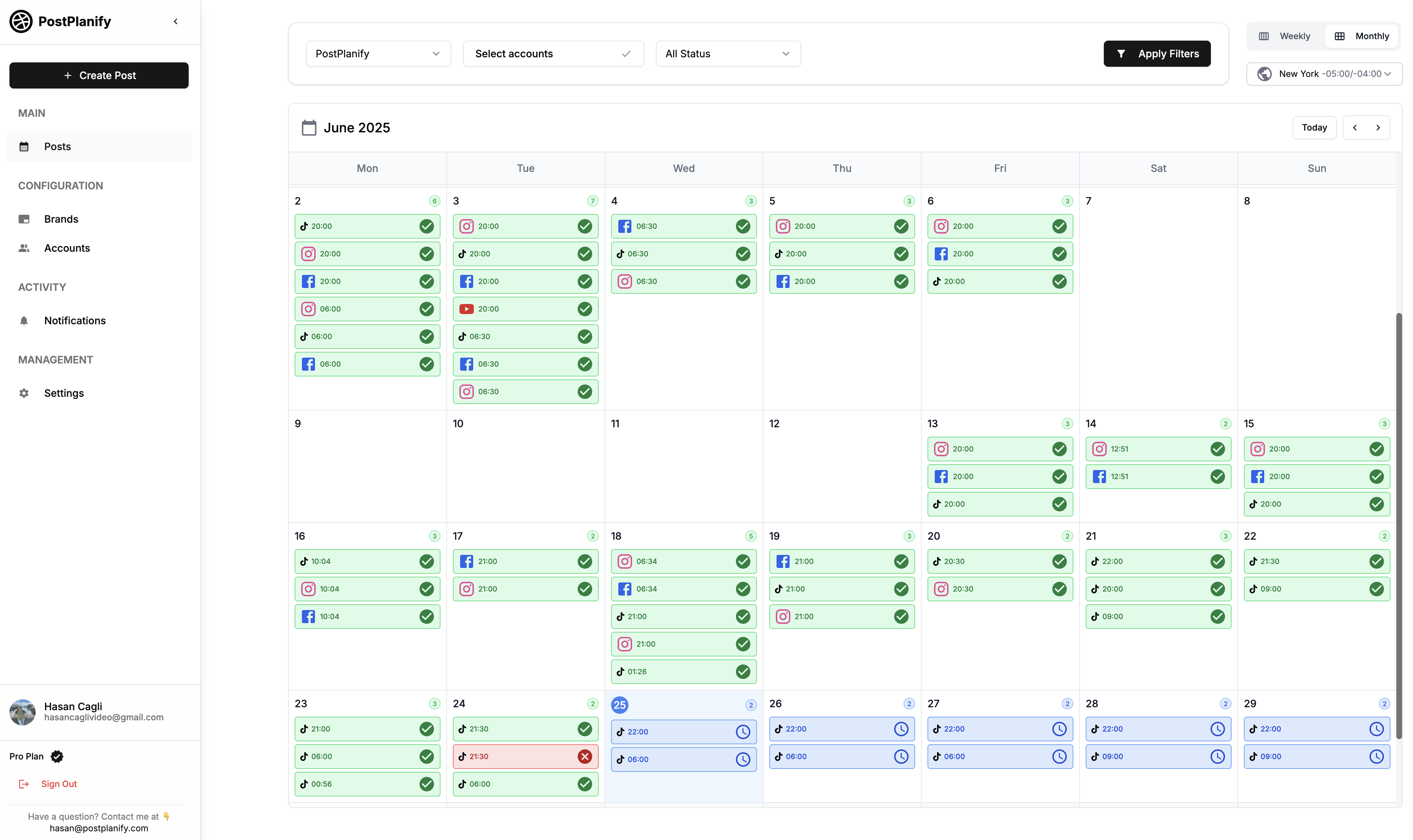
Customize, Schedule, and Analyze in One Place
The true power of a dedicated scheduler is unifying your entire workflow. You can write a post, customize it for Facebook and Instagram in the same composer, and schedule it with advanced options. Save reusable groups of hashtags, get AI-powered caption suggestions, and analyze performance across all platforms from a single dashboard. For a deep dive, see our guide on how to schedule social media posts.
Most importantly, you get data-driven scheduling recommendations. A good scheduler analyzes when your specific audience is most active and suggests the best times to post, taking the guesswork out of maximizing reach. This, combined with unified analytics, gives you a clear picture of what's working so you can make smarter content decisions.
Related: Best Apps to Post to All Social Media at Once | Manage Multiple Social Media Accounts | Best Social Media Management Platform
Facebook to Instagram Cross-Posting FAQ
Can you share a Facebook post directly to Instagram?
No. Meta does not support sharing an existing Facebook post to Instagram. The content flow is one-way: you can share from Instagram to Facebook when creating a new post, but not the reverse. To publish the same content on both platforms, use Meta Business Suite's unified composer or a third-party scheduling tool to create the post for both destinations simultaneously.
Why is there no option to share my Facebook post to Instagram?
Instagram was designed as a visual-first platform that requires every post to include an image or video. Many Facebook post types — text-only updates, link shares, event posts — don't meet this requirement. To protect the Instagram experience, Meta intentionally blocks the Facebook-to-Instagram sharing direction. The workaround is to create your content in a tool that publishes to both platforms at once.
Can you cross-post Facebook Reels to Instagram Reels?
Not directly from Facebook. However, you can use Meta Business Suite to create and schedule the same Reel for both Facebook and Instagram at the same time. Third-party tools like PostPlanify also support scheduling Reels to both platforms. For platform-specific tips, see our guide on how to schedule Instagram Reels.
Do cross-posted posts get less engagement than native posts?
No. Neither Facebook nor Instagram penalizes content based on how it was published. What matters is the quality of the content and how well it's adapted to each platform. A cross-posted image that uses the correct aspect ratio, a platform-appropriate caption, and relevant hashtags will perform just as well as a manually published post. The risk is only when you don't adapt — an unclickable link in an Instagram caption or a landscape image cropped awkwardly on a vertical feed signals low effort.
Can you schedule the same post for Facebook and Instagram at different times?
Yes, but not in all tools. Meta Business Suite publishes to both platforms simultaneously — you cannot set different times. Third-party schedulers like PostPlanify allow you to customize the publish time for each platform independently, which is ideal for staggering posts based on when each audience is most active.
How do I stop Facebook from automatically sharing to Instagram?
If your posts are being shared to Instagram without your intent, you likely have auto-sharing enabled. To turn it off, open the Instagram app and go to Settings and privacy > Sharing and remixes > disable the option to share posts to Facebook. You can also check Meta Accounts Center at accounts.meta.com and review the "Sharing across profiles" settings to disable automatic cross-posting in either direction.
PostPlanifyAll your social media in one simple dashboard
Schedule posts, track analytics, and reply to comments/DMs without switching tabs.
Engagement
+18%
Views
52.8k
Summary: Key Takeaways & Checklist
- You can't post from Facebook to Instagram directly. The content flow is one-way: from Instagram to Facebook.
- The solution is to use a unified composer. Tools like Meta Business Suite or a third-party scheduler let you create one post and publish it to both platforms simultaneously.
- Correct account setup is crucial. Your Instagram must be a Professional (Business or Creator) account linked to a Facebook Page you have admin access to.
- Adapt your content for each platform. Customize captions, hashtags, and media formats to fit each platform's user expectations.
- Use a scheduler for efficiency. For managing significant content volume, a tool like PostPlanify with bulk scheduling and content queues saves hours of manual work.
Ready to stop wrestling with clunky native tools and build a workflow that actually saves you time? PostPlanify lets you plan, schedule, and analyze your content across all your social platforms from a single, unified dashboard. Start your free 7-day trial and see how much time you can save.
Also read: Social Media Cross-Posting Guide | How to Schedule Anything on Instagram | The Ultimate Guide to Scheduling Instagram Posts | How to Post on LinkedIn | Automate Social Media Posts
PostPlanifyAll your social media in one simple dashboard
Schedule posts, track analytics, and reply to comments/DMs without switching tabs.
Engagement
+18%
Views
52.8k
About the Author

Hasan Cagli
Founder of PostPlanify, a content and social media scheduling platform. He focuses on building systems that help businesses, agencies, and teams plan, publish, and manage content and social media more efficiently across platforms.


