


B2B social media is a different job than consumer social media. The audience is smaller, the purchase decisions take longer, and the people making those decisions don't respond to the same content that drives viral moments on TikTok. Most tools built for the broader social media market treat B2B as an afterthought — LinkedIn support is shallow, CRM integrations are missing or unreliable, and the analytics are optimized for engagement metrics that don't map to pipeline.
This guide tested 11 tools specifically for B2B fit. The evaluation criteria were LinkedIn depth (personal profiles + Company Pages), CRM integration reliability (Salesforce, HubSpot, Marketo, Pipedrive), approval workflows for compliance-heavy industries, employee advocacy capability, and pipeline attribution — not just likes and impressions. Every pricing figure is cross-referenced against vendor pricing pages, verified in April 2026.
And since LinkedIn is the primary channel for most B2B teams, pair this guide with our LinkedIn analytics tools breakdown: it covers the measurement side, including first-party data on which posting days actually earn B2B engagement.
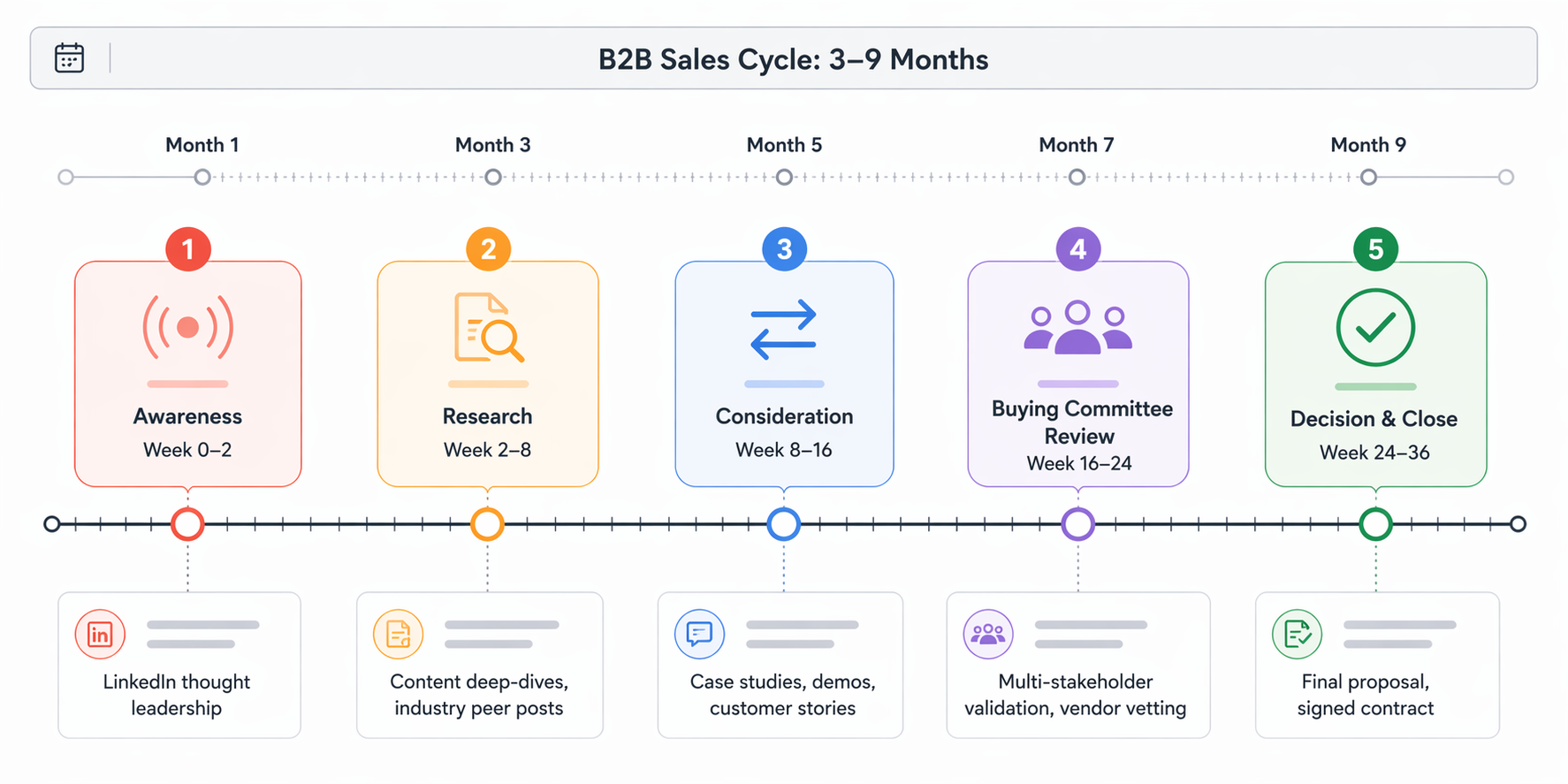
If you're a B2B services firm, a manufacturer, a professional-services agency, a consultancy, an enterprise software company, or any B2B organization where sales cycles run 3 to 9 months and buying committees have grown — this is the shortlist.
Why B2B Social Media Is Different
A few numbers set the frame.
- 75% of B2B buyers use social media to support purchase decisions, and 84% of C-suite and VP-level executives do the same, per IDC's Social Buying study (via LinkedIn Sales Solutions).
- 96% of B2B content marketers use LinkedIn to distribute content, per Content Marketing Institute's B2B Benchmarks. Roughly 80% of B2B leads from social come from LinkedIn.
- B2B sales cycles typically run 3–9 months depending on deal size and have stretched approximately 22% since 2022 as buying committees have grown.
- Employee-shared content earns roughly 8x more engagement than brand-channel content (Social Media Today / Sociabble), and content from employees is 3x more trusted than content from brand channels, per Edelman's Trust Barometer.
These numbers shape what a B2B social tool must actually do. Reach maximization matters less than relationship-building. Engagement rate matters less than whether social engagement ends up attached to a CRM record. A tool that helps a SaaS founder go viral on TikTok doesn't help a financial-services firm earn trust with compliance-approved content across a 15-person employee network.
This guide is organized around that difference.
Quick Answer: What Is the Best Social Media Tool for B2B in 2026?
For most B2B teams, the best social media tool is PostPlanify — flat monthly plans starting at $79/mo billed yearly (or $99/mo monthly), with 5 to 50 workspaces depending on tier, unified analytics across all 10 supported platforms, LinkedIn Company Page + personal profile scheduling, approval workflows for compliance review on Premium+, white-label PDF reports on Scale+, and REST API + MCP support for custom CRM integrations. No per-seat fees inside plan limits.
For B2B-specialist feature depth, Oktopost is the purpose-built enterprise pick — social-to-pipeline attribution, native employee advocacy, deep Salesforce/HubSpot/Marketo/Pardot/Eloqua integrations, and a LinkedIn-first architecture. Pricing is demo-only and starts at mid-market ACV.
For teams already running HubSpot CRM, HubSpot Social Tools (bundled inside Marketing Hub Professional at $800/mo) gives CRM-native social tracking, lead attribution, and pipeline reporting. The social module itself is thinner than dedicated tools but hard to beat if you're already in the HubSpot ecosystem.
For enterprise B2B analytics and social listening, Sprout Social ($199/seat/mo) and Hootsuite ($249/user/mo with Amplify employee advocacy on Enterprise) remain the established picks. For B2B agencies serving clients, Sendible and SocialPilot offer mid-market value. For compliance-heavy approvals, Planable wins. For professional-services firms managing reviews alongside social, Vista Social is the underrated pick. For simpler B2B teams just getting started, Buffer and Agorapulse cover the basics.
How We Tested These B2B Tools
We tested 11 social media tools against seven B2B-specific evaluation categories: LinkedIn feature depth (Company Pages + personal profiles + document posts + first-comment automation), CRM integration breadth, employee advocacy capability, approval workflows for compliance review, pipeline attribution, pricing model economics at B2B team size, and platform coverage beyond LinkedIn.
Scoring methodology. Each tool was scored on a 1–5 scale per category. Final rankings weight LinkedIn depth 20%, CRM integration 20%, approval workflows 15%, pipeline attribution 15%, pricing at B2B team scale 15%, employee advocacy 10%, and other platform coverage 5%.
Live testing. Each tool was connected to a real B2B test setup spanning LinkedIn Company Page + personal profiles, X, YouTube, and Facebook, with at least one CRM integration attempted per tool. We verified publishing reliability, approval chain configuration, attribution-reporting accuracy, and edge cases like LinkedIn document post publishing.
Review analysis. We cross-referenced testing against verified reviews on G2, Capterra, and TrustRadius to surface the most common B2B-specific complaints and praise.
Pricing sources. Every pricing figure is sourced from each vendor's public pricing page (or, for private-priced tools like Oktopost, from credible third-party aggregators with ranges). Verified in April 2026.
At a Glance: Best B2B Social Media Tools Compared
| Tool | Best For | Starting Price | LinkedIn Depth | CRM Integration | Free Trial |
|---|---|---|---|---|---|
| PostPlanify | Flat-price B2B teams + multi-product portfolios | $79/mo (billed yearly) | Strong | REST API + MCP | 7 days |
| Oktopost | B2B-native pipeline attribution | Custom (mid-market $15K–$60K/yr) | Excellent | Salesforce, HubSpot, Marketo, Pardot, Eloqua | Demo only |
| HubSpot Social Tools | Teams already on HubSpot CRM | $800/mo (Marketing Hub Pro) | Good | Native HubSpot CRM | 14 days |
| Sprout Social | Enterprise B2B analytics + listening | $199/seat/mo | Strong | Salesforce, HubSpot, Zendesk | 30 days |
| Hootsuite | Enterprise employee advocacy (Amplify) | $249/user/mo | Strong | Via Enterprise integrations | 30 days |
| Sendible | Agencies serving B2B clients | $29/mo | Good | Via integrations | 14 days |
| Agorapulse | B2B social CRM + relationship tracking | $99/user/mo | Good | Built-in social CRM | 30 days |
| Planable | Multi-step compliance review | $39/workspace/mo | Good | Limited | Free plan |
| SocialPilot | Mid-market B2B agencies | $30/mo | Good | Limited | 14 days |
| Vista Social | Professional services + reviews | $79/mo | Good | Via integrations | 14 days |
| Buffer | Small B2B teams, simple publishing | $6/channel/mo | Moderate | Limited | Free plan |
Why Most Social Media Tools Don't Fit B2B
Tools built for the general social media market break down in B2B contexts in predictable ways. If your current tool has any of these problems, the fix is usually switching — not working around them.
The LinkedIn shallowness trap. Most tools list LinkedIn as supported but handle it poorly. Missing: personal profile scheduling (critical for executive and employee advocacy content), document/carousel PDF support, first-comment automation, company page analytics with historical depth. Tools that "support" LinkedIn but can't schedule to a founder's personal profile are functionally half-missing for B2B.
The CRM disconnection trap. Social engagement that doesn't attach to a contact record in your CRM is engagement without business value. Tools without Salesforce, HubSpot, Marketo, or Pipedrive integrations force manual handoff, which breaks in real usage. After six months, nobody's cross-referencing the social spreadsheet against the opportunity pipeline.
The compliance approval trap. Financial services, healthcare, legal, and enterprise-regulated industries need multi-step approval chains: content creator → compliance review → legal review → executive sign-off → schedule. Tools with single-step approval force compliance review to happen in email threads — which defeats the purpose and adds legal risk.
The per-seat pricing trap. B2B teams aren't small. You have marketers, SDRs, product marketers, executives, compliance officers, and agency partners who all need at least view-only access. Per-seat tools (Hootsuite, Sprout Social, Agorapulse) multiply aggressively. A 10-person B2B team on Sprout Professional pays $2,990/month minimum.
The vanity-metric trap. B2B success metrics are MQLs, SQLs, pipeline influenced, closed-won revenue. Tools whose native reporting stops at likes, reach, and follower counts force your team to rebuild attribution in spreadsheets — or quietly under-report social's actual contribution.
The attribution-window trap. B2B sales cycles run 3–9 months. Tools that only keep 60 or 90 days of historical data can't show that last quarter's LinkedIn content contributed to this quarter's closed deals. Historical data retention matters disproportionately in B2B.
The employee-advocacy trap. Employee content earns 8x the engagement of brand content and is trusted 3x more. Yet most tools treat employee advocacy as an enterprise-only add-on (Hootsuite Amplify, Oktopost's native module) or ignore it entirely. For B2B at scale, this is the biggest missed multiplier.
The 11 tools below are scored against each of these traps. Score the tools against your specific B2B context, not a generic "best social tool" framing.
What to Look for in a B2B Social Media Tool
Before picking a tool, list your must-haves. The common ones for B2B:
- Deep LinkedIn support. Company Pages + personal profiles + document posts + first-comment automation + follower demographic analytics (job title, company size, seniority).
- CRM integration that actually works. Salesforce, HubSpot, Marketo, Pipedrive at minimum. Native integrations beat Zapier bridges.
- Multi-step approval workflows. Compliance review → legal review → executive sign-off chains, configurable per content type.
- Employee advocacy support. Either built-in (Oktopost) or via add-on module (Hootsuite Amplify) — ideally integrated with the same content calendar the marketing team uses.
- Pipeline attribution. UTM automation, campaign tagging, and reporting that ties social engagement to leads in the CRM.
- Historical analytics retention. 12+ months minimum. B2B sales cycles demand it.
- Flat pricing at team scale. If the tool charges per seat, run the math at your real team size (marketing + sales + executives + compliance + agency partners).
- Platform coverage matching your actual buyer journey. LinkedIn primary, plus X/YouTube/Facebook/Threads as secondary. Most B2B doesn't need TikTok, Pinterest, or Snapchat depth.
- Content approval without per-seat fees for reviewers. Legal reviewers and executives shouldn't cost an extra $200/month each.
Test one full B2B workflow in the free trial: schedule a LinkedIn Company Page post, run it through a multi-step approval, publish it, and verify the engagement attaches to a CRM contact. That test surfaces more friction than any demo.
The 11 Best Social Media Tools for B2B Companies in 2026
1. PostPlanify — Best Overall for B2B Teams
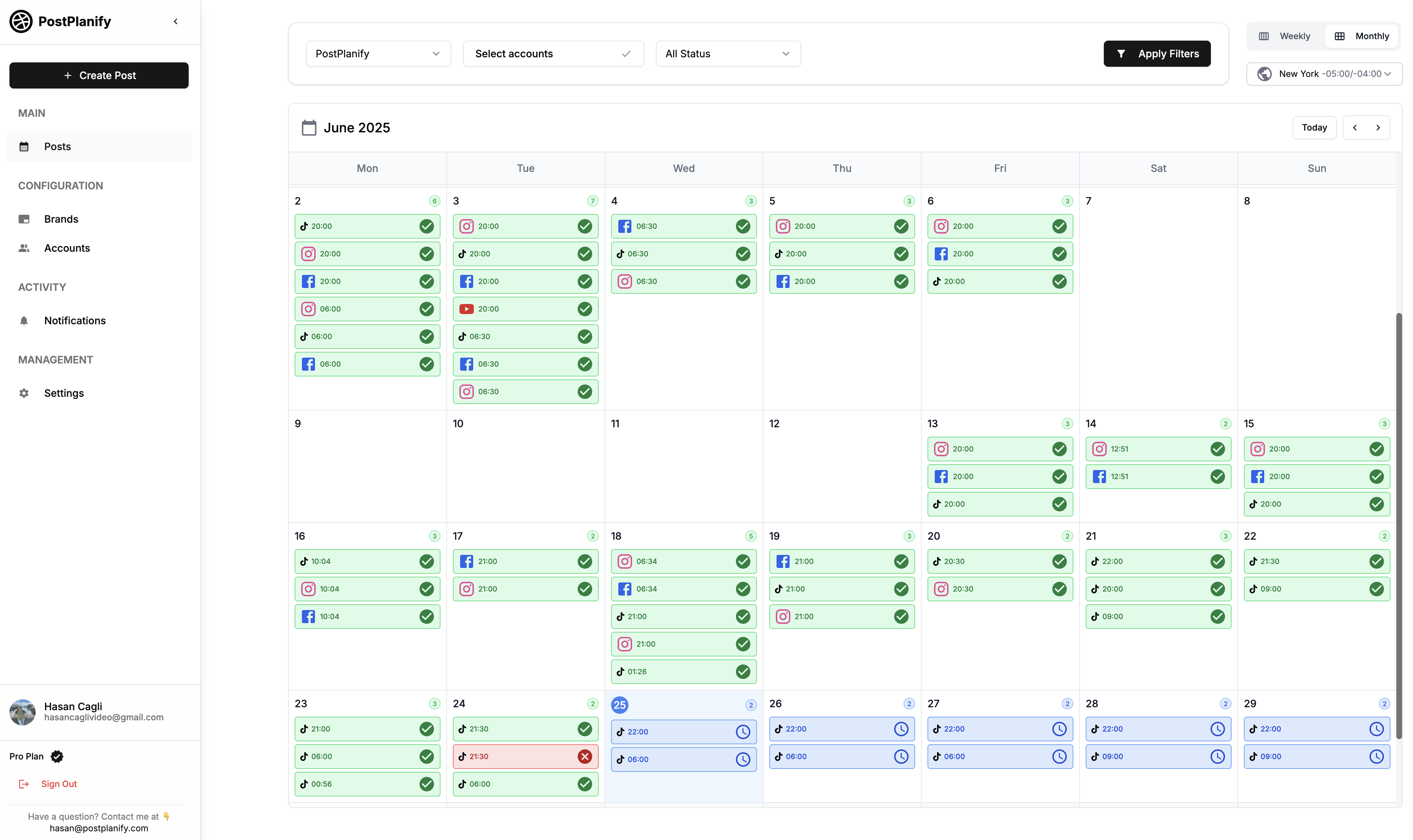
PostPlanify is an all-in-one social media management platform built around flat-per-tier pricing, workspace isolation, and no per-seat fees — which matters disproportionately for B2B teams where stakeholders multiply (marketing, sales, executives, compliance, agency partners). Where most tools treat B2B as a vertical to be addressed with premium tiers, PostPlanify treats the B2B workflow as the default architecture.
For B2B specifically, the workspace ladder handles multi-product-line companies cleanly: Growth (5 workspaces) suits a small services firm; Premium (15) suits mid-market B2B with multiple product divisions or client accounts; Scale (50) suits enterprise B2B with brand portfolios; Enterprise is unlimited. Every workspace has its own LinkedIn accounts, approval chain, analytics, and branded reporting — no cross-contamination between product lines or client accounts.
At a glance — PostPlanify
- Pricing: Growth $99/mo ($79/mo billed yearly) → Premium $199/mo ($159/mo billed yearly, Most Popular) → Scale $299/mo ($239/mo billed yearly); custom Enterprise
- Max workspaces: 5 (Growth) / 15 (Premium) / 50 (Scale) / Unlimited (Enterprise)
- LinkedIn depth: Company Pages + personal profiles, document posts, first-comment automation, bulk scheduling
- Platforms: 10 including LinkedIn, X, YouTube, Facebook, Instagram, TikTok, Threads, Pinterest, Bluesky, and Google Business
- CRM integration: REST API + MCP support for custom Salesforce, HubSpot, Pipedrive, or Marketo pipelines
- Free trial: 7 days
- Best for: B2B marketing teams, professional services firms, manufacturing, consulting practices, B2B agencies, and enterprise B2B teams that want flat pricing, multi-workspace isolation, and LinkedIn-first publishing without per-seat fees
Key features for B2B:
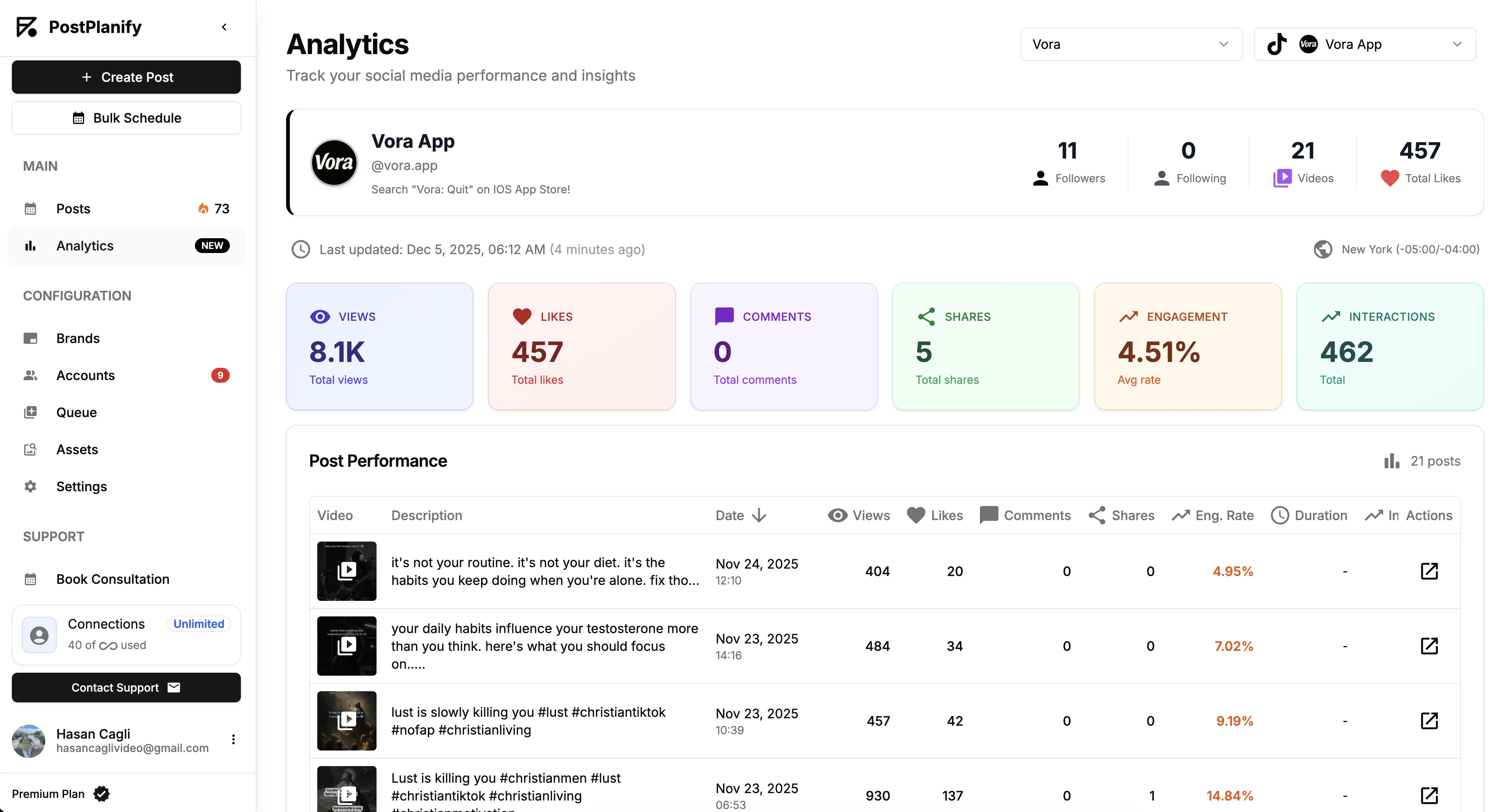
- Advanced analytics across all 10 platforms — historical daily snapshots for 12-month+ trend analysis that match B2B sales cycle length
- LinkedIn scheduler — Company Pages + personal profiles, document/PDF posts, first-comment automation, best-time-to-post by audience engagement patterns
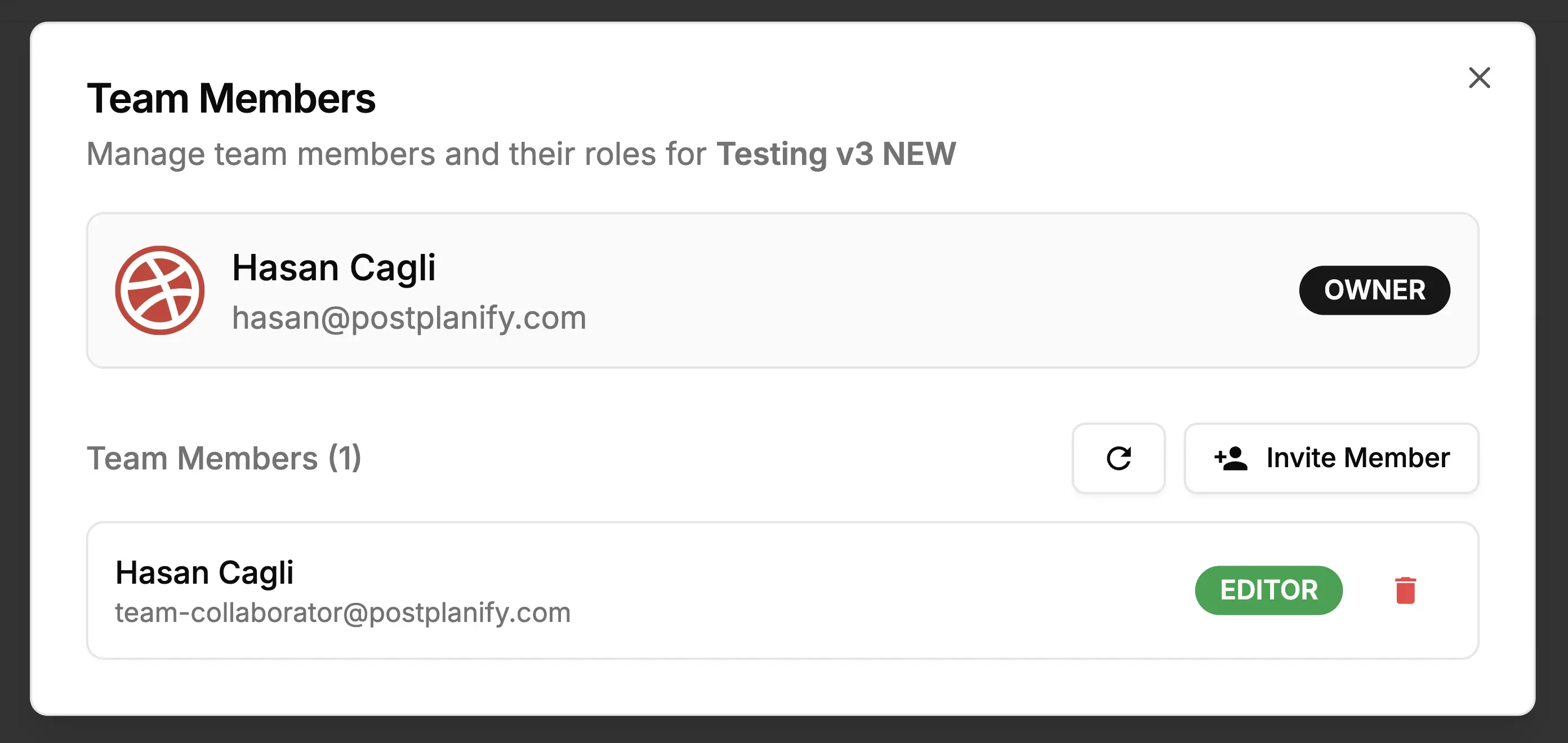
- Team collaboration with no per-seat pricing — invite marketers, executives, SDRs, and compliance reviewers without paying per stakeholder
- Approval workflows (Premium+) — multi-approver chains for compliance review, legal review, and executive sign-off with role-based permissions
- Reports on Premium; white-label PDF reports on Scale+ — branded reporting for B2B consultancies and in-house teams, with vendor branding removed on Scale
- Social inbox for LinkedIn, Instagram, Facebook — reply to comments and DMs from the same surface where the team schedules
- AI assistant (vision-powered) — generates LinkedIn captions in brand voice; understands uploaded images for better suggestions
- Content calendar with drag-and-drop rescheduling per workspace
- Bulk scheduling (up to 20 posts per batch) for thought-leadership campaigns and product launches
- REST API + MCP support for custom pipelines into Salesforce, HubSpot, Pipedrive, Marketo, or in-house data warehouses
Pricing:
| Plan | Monthly | Billed Yearly | Workspaces | Social Accounts | Team Members |
|---|---|---|---|---|---|
| Growth | $99/mo | $79/mo ($948/yr) | 5 | 15 | 3 |
| Premium (Most Popular) | $199/mo | $159/mo ($1,908/yr) | 15 | 30 | 6 |
| Scale | $299/mo | $239/mo ($2,868/yr) | 50 | 100 | 12 |
| Enterprise | Custom | Custom | Unlimited | Custom | Unlimited |
Yearly billing saves 20% (roughly two months free). All plans include a 7-day free trial and a 14-day money-back guarantee.
Pros:
- Flat per-tier pricing — no per-user, per-channel, or per-workspace fees. Matters at B2B team scale where stakeholders multiply
- Deep LinkedIn support (Company Pages + personal profiles + document posts + first-comment)
- Multi-approver workflows (Premium+) fit compliance-heavy B2B review chains
- REST API + MCP support enables custom CRM pipelines without being locked into vendor-provided integrations
- White-label PDF reports (Scale+) work for B2B agencies and internal C-suite reporting
- Workspace isolation prevents cross-brand mistakes in multi-product or multi-client B2B portfolios
- Team members and clients included in flat pricing — no surprise costs when legal or executives need access
- Transparent published pricing — no "contact sales" friction below Enterprise
Cons:
- No native employee advocacy module (unlike Oktopost or Hootsuite Amplify) — teams needing turnkey advocacy should pair with Sociabble or similar
- No built-in CRM integration — REST API/MCP works but requires some engineering setup vs. native connectors
- Social inbox covers LinkedIn, Instagram, Facebook but not X, YouTube, or TikTok
- Newer platform than Sprout Social or Hootsuite with smaller B2B-specific customer base than 10+ year incumbents
- No dedicated social listening engine — not built to replace Brandwatch-level consumer intelligence
Best for: B2B services firms managing thought-leadership content, professional-services practices (law, accounting, consulting) needing compliance-friendly approvals, manufacturers with multiple product lines, B2B agencies managing client accounts, and enterprise B2B teams where LinkedIn is the primary channel and CRM integration needs flexibility.
How it compares to per-seat B2B tools:
Consider a 10-person B2B team (3 marketers, 2 SDRs, 2 executives, 1 compliance officer, 2 agency partners):
- Sprout Social Professional ($299/seat/mo): 10 seats = $2,990/mo. Unlimited profiles per seat, deep analytics, but every additional reviewer is a billable seat.
- Hootsuite Advanced ($499/user/mo): 10 users = $4,990/mo. Unlimited accounts per user. Amplify employee advocacy requires Enterprise upgrade.
- Oktopost (demo-only, mid-market): typically $15K–$60K/year for similar scope. Deepest B2B features but opaque pricing.
- PostPlanify Premium ($159/mo billed yearly): 15 workspaces, 6 team members included (upgrade to Scale at $239/mo for 12 and white-label PDF reports), full LinkedIn support, approval workflows, reports, analytics across all 10 platforms. Flat price.
- The trade-off: Sprout, Hootsuite, and Oktopost go deeper on social listening, employee advocacy, and B2B-specialist integrations. PostPlanify delivers the operational surface most B2B teams live in (publishing, approvals, analytics, reporting) at a fraction of the seat cost — with REST API/MCP for custom CRM pipelines.
Used by 1,740+ users across 30+ countries. Explore the platform at PostPlanify or see the full feature set on the analytics, team collaboration, and reporting pages.
 PostPlanify
All your social media in one simple dashboard
Schedule posts, track analytics, and reply to comments/DMs without switching tabs.

Engagement
+18%
Views
52.8k
2. Oktopost — Best B2B Specialist
Oktopost is the purpose-built enterprise B2B pick. Where every other tool on this list was designed for general social media management and then adapted for B2B, Oktopost was built B2B-first from the ground up. Its positioning: "LinkedIn-first, pipeline-focused, employee advocacy built-in."
For B2B companies where proving social's contribution to revenue is the primary job, Oktopost's funnel-focused analytics — tying social engagement to leads, pipeline, and closed-won revenue via native CRM integration — is genuinely differentiated. Not just scheduling + reporting, but social-to-revenue attribution as the core architecture.
At a glance — Oktopost
- Pricing: Custom quote — no public pricing. Mid-market deployments typically run $15K–$60K/year per third-party aggregators (Vendr, PricingNow); enterprise deployments often exceed $75K/year. Implementation fees range $1,000–$10,000 one-time.
- Platforms: LinkedIn (primary), Facebook, X/Twitter, Instagram, YouTube. No TikTok, Threads, Bluesky, Pinterest, or Google Business Profile.
- Free trial: Demo only (no self-serve)
- User ratings: ~4.5/5 on G2; 4.5/5 on Capterra (~110 reviews); 4.5/5 on SaaSworthy (~347 ratings)
- Best for: Enterprise B2B marketing teams (typically 200+ employee companies) needing pipeline attribution, deep LinkedIn support, and native employee advocacy
Key features for B2B:
- Native employee advocacy module — employees share approved content; admins track engagement and attributable reach
- LinkedIn depth — primary platform focus; company page management, personal profile scheduling, advocacy syncing
- Social-to-pipeline analytics — funnel analytics tying social activity to lead generation, pipeline stages, and revenue
- CRM and marketing automation integrations — Salesforce, HubSpot, Marketo, Pardot, Eloqua, Microsoft Dynamics (native connectors, not Zapier bridges)
- Approval workflows — multi-step content approvals for regulated and enterprise teams
- Social listening — brand, competitor, and industry keyword monitoring (less mature than Brandwatch/Talkwalker)
- Account-based marketing (ABM) support — account-level tracking via CRM integration; engagement scoring against target accounts
- B2B-tuned GenAI content agents (2024–2025 rollout)
Pros:
- Purpose-built for B2B — social-to-pipeline attribution is the standout differentiator in the category
- Native employee advocacy module, consistently praised in reviews
- Deepest LinkedIn support among tools in this list (company pages + advocacy sync)
- Mature Salesforce, HubSpot, Marketo, Pardot, and Eloqua integrations
- Clean UI — minimal onboarding friction for day-to-day scheduling tasks
- Strong customer support reported across review sites
Cons:
- Opaque pricing — demo-only sales process with reported 15–25% negotiation headroom
- Overkill and cost-prohibitive for SMBs and non-B2B companies
- Social listening weaker than dedicated tools (Brandwatch, Talkwalker)
- Reporting can feel rigid; some users want more customization
- LinkedIn PDF embedding described as awkward in reviews
- Steep initial learning curve beyond basic scheduling
- No TikTok, Threads, Bluesky, Pinterest, or Google Business Profile support
Best for: Enterprise B2B marketing teams where pipeline attribution and employee advocacy are non-negotiable, and where LinkedIn drives the majority of social-sourced revenue. Overkill for SMBs and misfit for B2C.
"Its strong focus on B2B social media, especially the ability to tie social activity directly to pipeline and revenue." — Justin S., Director of Sales, Information Technology and Services, via Capterra
3. HubSpot Social Tools — Best for CRM-Integrated B2B
HubSpot Social Tools is bundled inside HubSpot Marketing Hub and is the obvious pick if your B2B team is already on HubSpot CRM. The social module inherits HubSpot's CRM-native posture: every social interaction can attach to a contact record, social engagement can feed lead scoring, and campaign reporting ties social activity to sourced contacts and closed deals.
The catch: HubSpot Social Tools are only available on Marketing Hub Professional and above, which starts at $800/month plus a mandatory $3,000 one-time onboarding fee. That makes it one of the most expensive entry points on this list — but if Marketing Hub is already in the stack, the social module effectively becomes "free" operationally.
At a glance — HubSpot Social Tools
- Pricing: Marketing Hub Professional $800/mo (annual) — 3 seats, 2,000 contacts, $3,000 mandatory onboarding fee. Additional seats $45/mo each. Marketing Hub Enterprise $3,600/mo — 5 seats, 10,000 contacts, $7,000 onboarding fee. No standalone Social Tools pricing.
- Platforms: Facebook, Instagram, LinkedIn, X/Twitter, YouTube, Pinterest, TikTok (expanded early 2026). No Threads, Bluesky, or Google Business Profile.
- Free trial: 14 days
- User ratings: 4.4/5 on G2 (~12,000+ reviews for Marketing Hub aggregate). Social Tools sub-module rated significantly lower independently (~2.8/5 per SocialRails April 2026 review).
- Best for: B2B teams already on HubSpot CRM where CRM-native social tracking and pipeline attribution outweigh the limited social-specific feature depth
Key features for B2B:
- Native HubSpot CRM integration — social interactions (comments, messages) attach to contact records; contacts can be created from social engagement
- Lead attribution from social — campaigns tie social posts to UTM-tracked conversions, sourced contacts, and closed deals inside HubSpot reporting
- Scheduling and publishing — bulk scheduling, content calendar, draft-and-approve workflows
- Social monitoring — keyword streams and brand/competitor monitoring (basic)
- Unified content calendar — social, blog, email, and campaigns in one view
- Reporting dashboards — social performance tied to contacts created, deals influenced, and revenue attribution
- Lead scoring tied to social engagement — via custom properties and workflows (stronger in Enterprise)
- Approval workflows and team collaboration on Pro/Enterprise
- Breeze Social Agent (2026 beta) — AI assistant for social content and scheduling
Pros:
- Unmatched CRM-social integration — social activity ties directly to contact and deal records
- Revenue attribution and pipeline reporting when paired with HubSpot CRM
- Unified dashboard across email, landing pages, blog, ads, and social
- Strong value if Marketing Hub Pro is already in the stack
- Up to 300 social accounts connected — generous for agencies and enterprises
- Approval workflows and team collaboration built in
Cons:
- High cost of entry — $800/mo plus $3,000 onboarding just to access Social Tools
- Limited platform support vs. dedicated tools (no Threads, Bluesky, Google Business Profile)
- Weak social listening — minimal sentiment depth, no competitor tracking
- Basic scheduling — limited first-comment automation, no advanced recurring post logic
- No native video templates or design tools
- AI features (Breeze Social Agent) still in beta as of early 2026
- Not recommended as a standalone social tool — only makes sense as part of a broader Marketing Hub deployment
Best for: B2B teams already running HubSpot Marketing Hub Professional or Enterprise, where CRM-native tracking and pipeline attribution outweigh the limited social-specific feature depth. Misfit if Marketing Hub isn't already in the stack — $800/mo is too much to pay just for social.
4. Sprout Social — Best for Enterprise B2B Analytics
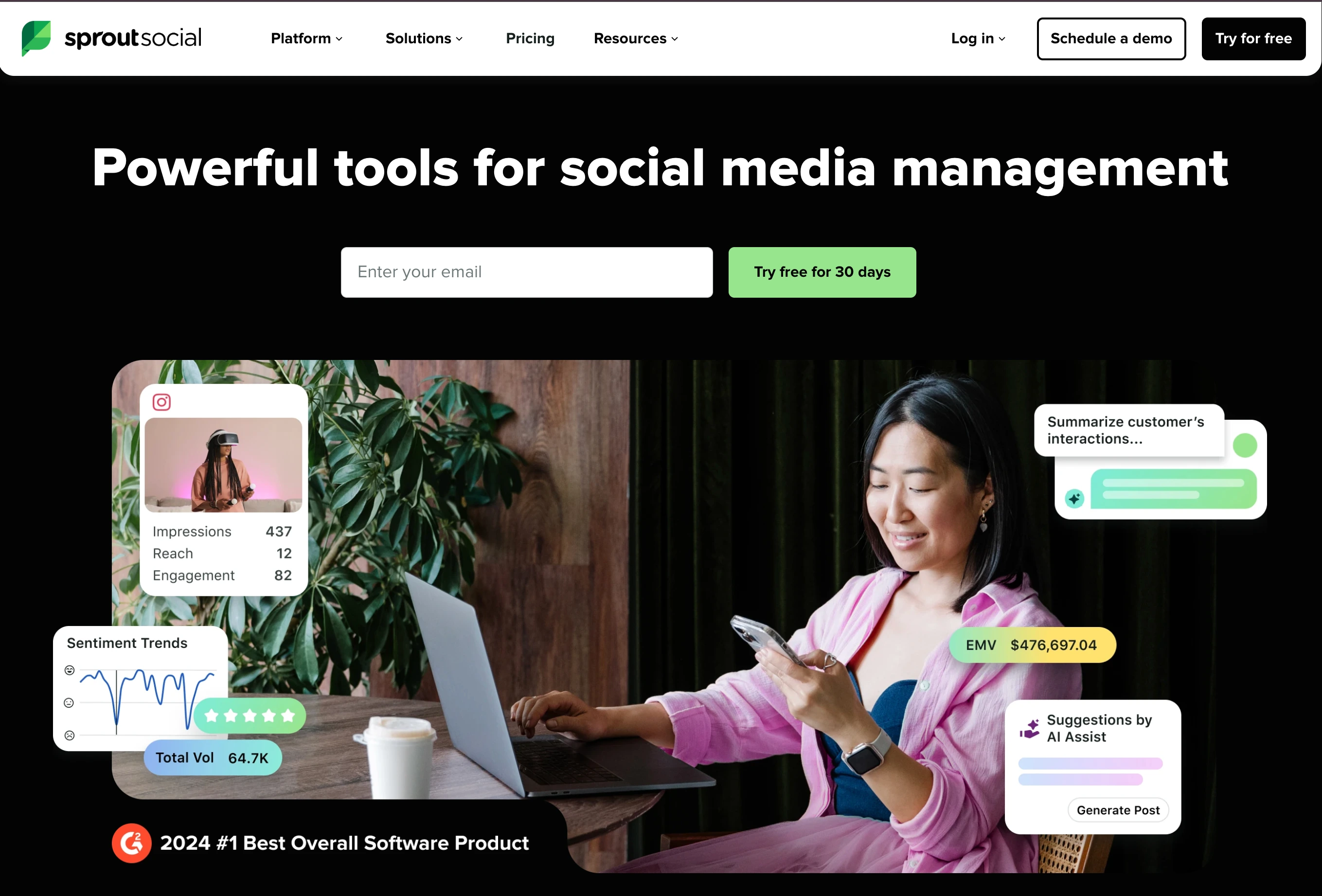
Sprout Social is the analytics-depth pick for enterprise B2B teams. Its Premium Analytics module adds 150+ pre-built reports, Trellis AI drives content-performance pattern detection, and its Groups feature allows multi-brand B2B rollups with separate reporting and access controls. Sprout's CRM integrations (Salesforce, HubSpot, Zendesk) and customer care workflows also fit B2B support teams well.
The trade-off is per-seat pricing. A 10-person B2B team on Sprout Professional pays $2,990/month minimum, and social listening is a separate add-on rather than a core feature.
At a glance — Sprout Social
- Pricing: Standard $199/seat/mo → Professional $299/seat/mo → Advanced $399/seat/mo → Enterprise (custom)
- Max profiles: 5 (Standard) / Unlimited (Professional+)
- Platforms: 10+ including Reddit and WhatsApp
- Free trial: 30 days, no credit card required
- User ratings: 4.4/5 on G2 (5,731 reviews), 2.2/5 on Trustpilot (75 reviews)
- Best for: Mid-to-large enterprise B2B teams where analytics depth justifies seat pricing
Key features for B2B:
- 150+ pre-built reports on Premium tiers
- Trellis AI for content performance and pattern detection
- Customizable dashboards by team, campaign, or KPI
- Social listening (paid add-on) with sentiment analysis — useful for B2B brand-reputation monitoring
- Tag-based campaign reporting
- Groups feature for multi-brand / multi-product-line rollups
- Multi-step approval workflows with audit trails
- CRM integrations: Salesforce, HubSpot, Zendesk, Microsoft Dynamics
- Employee advocacy (Bambu was discontinued but advocacy features remain)
Pricing:
| Plan | Monthly (per seat, annual) | Profiles |
|---|---|---|
| Standard | $199 | 5 |
| Professional | $299 | Unlimited |
| Advanced | $399 | Unlimited |
| Enterprise | Custom | Unlimited |
Pros:
- Deepest pre-built report library in the category — strong for B2B executive reporting
- Clean, modern UI despite enterprise depth
- Trellis AI for pattern recognition and content insights
- Strong customer-care workflows — useful for B2B support functions
- Presentation-ready reports that pass executive review
- Salesforce and HubSpot CRM integrations are mature
Cons:
- Per-seat pricing scales fast — 10 seats = $2,990/mo minimum on Standard
- Social listening and advanced analytics are add-ons, not included
- No flat-rate option for agencies with shifting stakeholders
- Overkill for SMB B2B teams
- Long contracts and reported difficulty canceling on Trustpilot
Best for: Mid-to-large enterprise B2B teams where analytics depth justifies seat pricing, and where marketing, sales enablement, customer care, and executive stakeholders all consume the same reports.
For more details, see our Sprout Social pricing breakdown, Sprout Social reviews, and best Sprout Social alternatives.
PostPlanifyAll your social media in one simple dashboard
Schedule posts, track analytics, and reply to comments/DMs without switching tabs.
Engagement
+18%
Views
52.8k
5. Hootsuite — Best for Enterprise Employee Advocacy
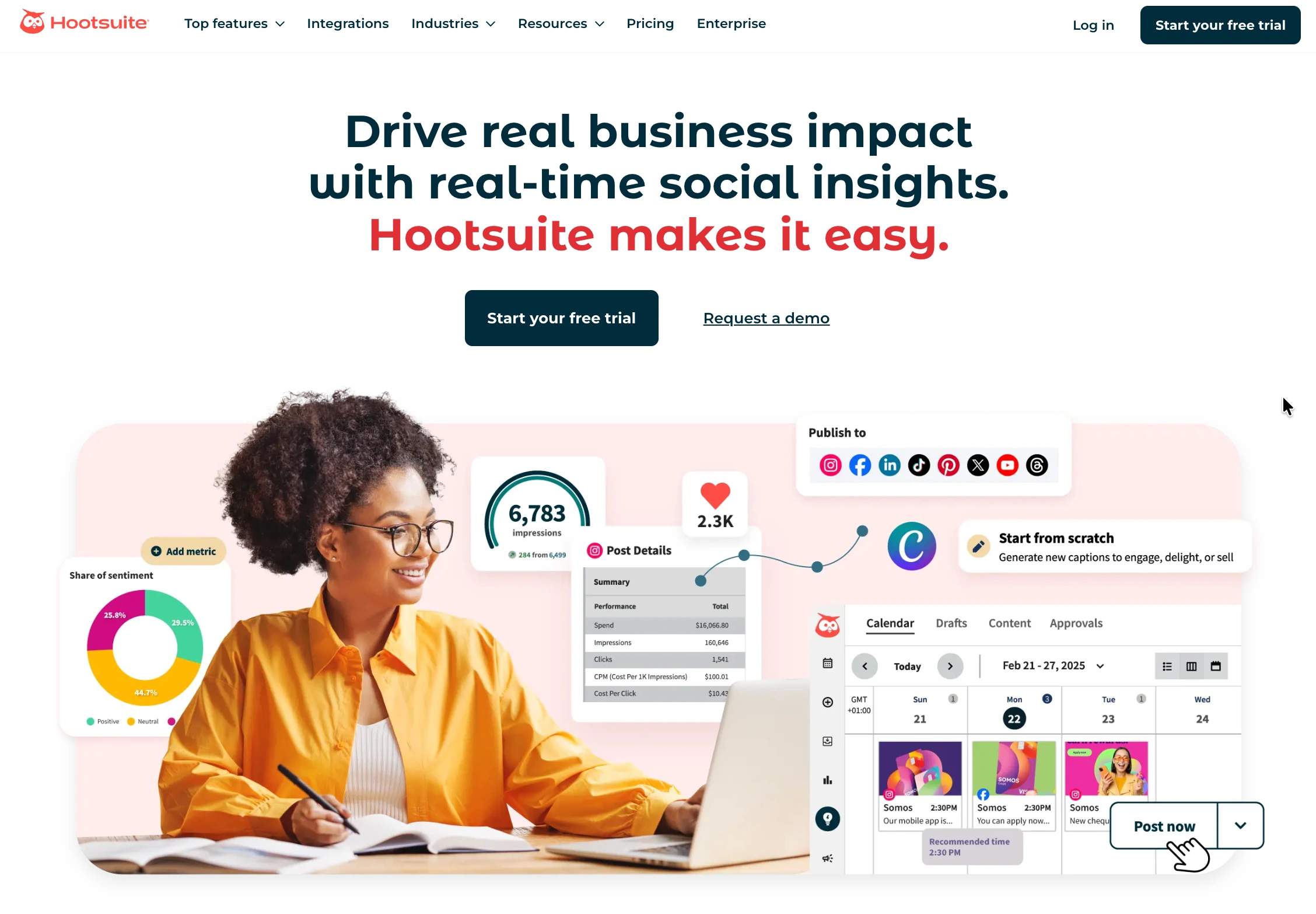
Hootsuite is the 18-year veteran enterprise pick. Its Amplify employee advocacy module (Enterprise tier only) is one of the few mature alternatives to Oktopost's native advocacy, and its integration with Talkwalker provides enterprise-grade social listening. For large B2B organizations where organic + paid ads live in the same dashboard and governance/audit trails matter, Hootsuite is often the incumbent.
The cost is brutal at growing team scale. Per-user pricing starts at $249/month on Standard, and the features B2B teams actually need — Amplify employee advocacy, advanced approvals, bulk scheduling — are locked behind the $499/user/month Advanced plan or Enterprise.
At a glance — Hootsuite
- Pricing: Standard $249/user/mo → Advanced $499/user/mo → Enterprise (custom). No free plan since 2023
- Max accounts: 10 (Standard) / Unlimited (Advanced) / Custom (Enterprise)
- Platforms: 10+ including Google Business Profile
- Free trial: 30 days, no credit card required
- User ratings: 4.3/5 on G2 (6,615 reviews), 1.8/5 on Trustpilot (511 reviews)
- Best for: Enterprise B2B teams needing mature employee advocacy, organic + paid unified workflow, and multi-department governance
Key features for B2B:
- Hootsuite Amplify — native employee advocacy module (Enterprise only)
- OwlyGPT AI assistant for captions and summaries
- Organic and paid advertising in one dashboard — rare at this tier
- Competitor benchmarking (Standard+)
- Social listening via Talkwalker integration (add-on)
- Multi-user approval workflows (Advanced+)
- Ad management for paid social
- Salesforce integration available at Enterprise
Pricing:
| Plan | Monthly | Accounts | Users |
|---|---|---|---|
| Standard | $249/user | 10 | 1 (add per seat) |
| Advanced | $499/user | Unlimited | 1 (add per seat) |
| Enterprise | Custom | Custom | Custom |
Pros:
- Broadest platform maturity — 18 years of iteration
- Amplify employee advocacy module is one of the few mature non-Oktopost options
- Organic + paid ads in one system (rare at this tier)
- OwlyGPT for caption and summary generation
- Competitor benchmarking on Standard+
- Strong integration ecosystem
Cons:
- Per-user pricing is brutal — 10 users on Advanced = $4,990/mo
- Amplify (employee advocacy) requires Enterprise upgrade — locked behind the highest tier
- Complex dashboard that feels heavy for SMB teams
- Free plan removed in 2023
- Social listening requires Talkwalker add-on
- Trustpilot rating (1.8/5, 511 reviews) reflects consistent billing and support complaints
Best for: Enterprise B2B teams that need employee advocacy (Amplify), organic + paid in one system, ad management alongside content, and multi-department governance — and where budget justifies per-seat pricing at scale.
For more details, see our Hootsuite pricing breakdown, Hootsuite reviews, and best Hootsuite alternatives.
6. Sendible — Best for B2B Agencies
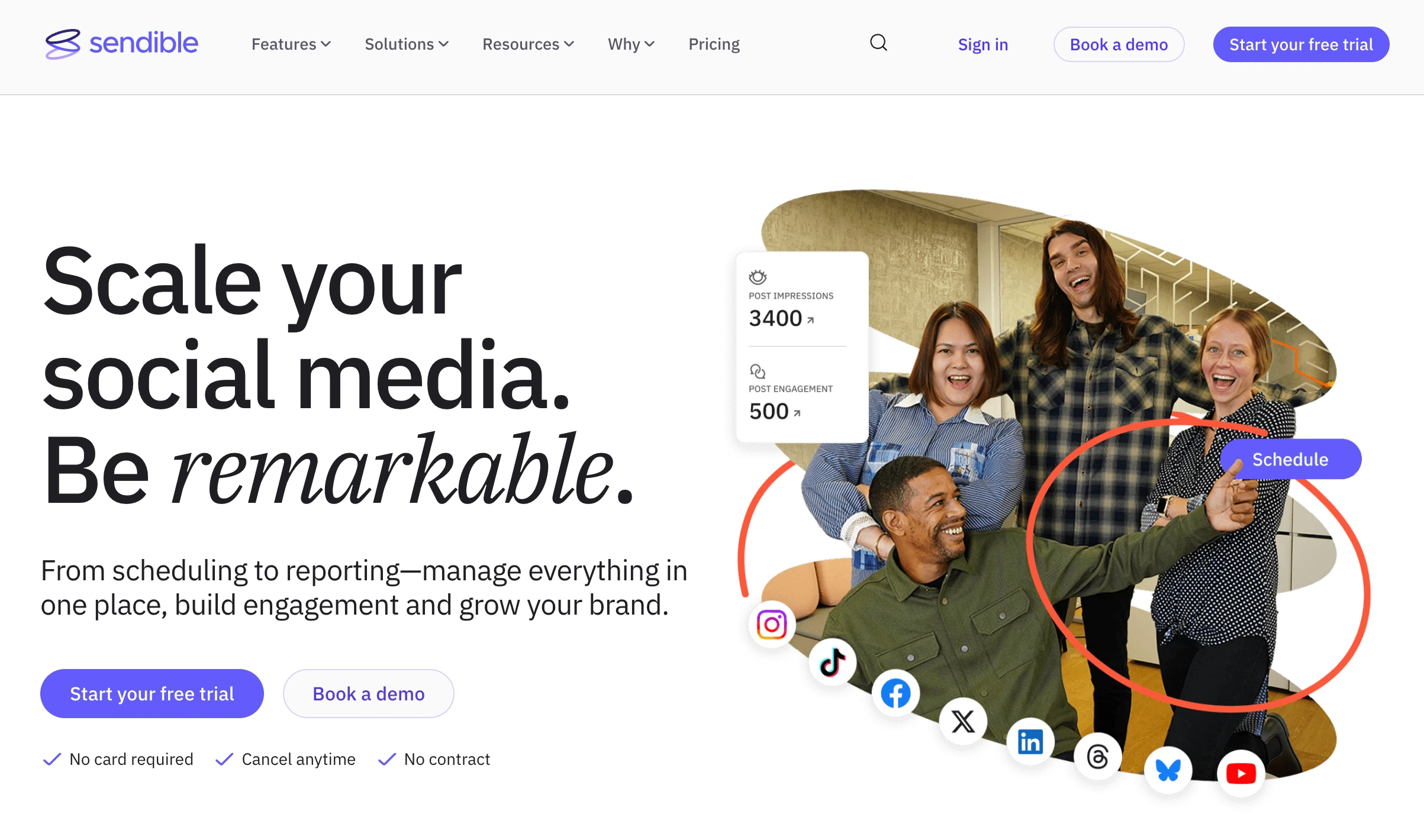
Sendible is agency-grade and fits B2B agencies managing multiple B2B clients especially well. Its Profile Groups feature clusters client accounts under a shared structure while maintaining separate reporting, approval flows, and permission sets. For B2B agencies that have outgrown SMB tools and need 50–400 profiles in one place, Sendible's upper tiers are one of the few places where that's genuinely supported.
The catch is pricing structure. White-label — the feature most B2B agencies actually buy Sendible for — is a $240/month add-on, not included in any plan. That pushes an already-expensive Advanced plan past $500/month total.
At a glance — Sendible
- Pricing: Creator $29/mo → Traction $89/mo → Scale $199/mo → Advanced $299/mo → Enterprise $750/mo
- Max profiles: 6 (Creator) / 24 (Traction) / 49 (Scale) / 100 scalable to 175 (Advanced) / 400 scalable to 475 (Enterprise)
- Platforms: 10 including Facebook, Instagram, TikTok, X, LinkedIn, Google Business, YouTube, WordPress, Threads, Bluesky
- Free trial: 14 days, no credit card required
- User ratings: 4.5/5 on G2 (899 reviews), 2.3/5 on Trustpilot (8 reviews)
- Best for: Established B2B agencies with 25+ clients that need deep profile groupings, client dashboards, and white-label options
Key features for B2B:
- Profile Groups for B2B client organization and permission isolation
- Priority Inbox with sentiment analysis
- Client dashboards (Traction+)
- Approval workflows (Traction+) with custom workflows on Scale+
- White-label as a paid add-on ($240/mo, Advanced+ only)
- Built-in media editor
- Content queue and bulk publishing
- WordPress integration — useful for B2B content teams doing blog + social together
Pros:
- Built for agencies from the ground up — Profile Groups are first-class
- 10-platform coverage including WordPress and Bluesky
- Client dashboards from Traction plan upward
- 14-day free trial without a credit card
- Advanced tier supports up to 175 profiles with 35 users
Cons:
- White-label costs $240/month extra on top of $299+/month plan — total closer to $540/mo
- Creator plan extremely restrictive (1 user, 6 profiles)
- Daily sending limits can cap high-volume B2B campaigns
- AI is caption-only (no native image generation)
- Custom reporting locked behind Scale tier
Best for: Mid-to-large B2B agencies that have already outgrown SMB tools, need 50–400 profiles in one place, and are comfortable with the add-on pricing for white-label.
For more details, see our Sendible pricing breakdown, Sendible reviews, and best Sendible alternatives.
7. Agorapulse — Best for B2B Social CRM
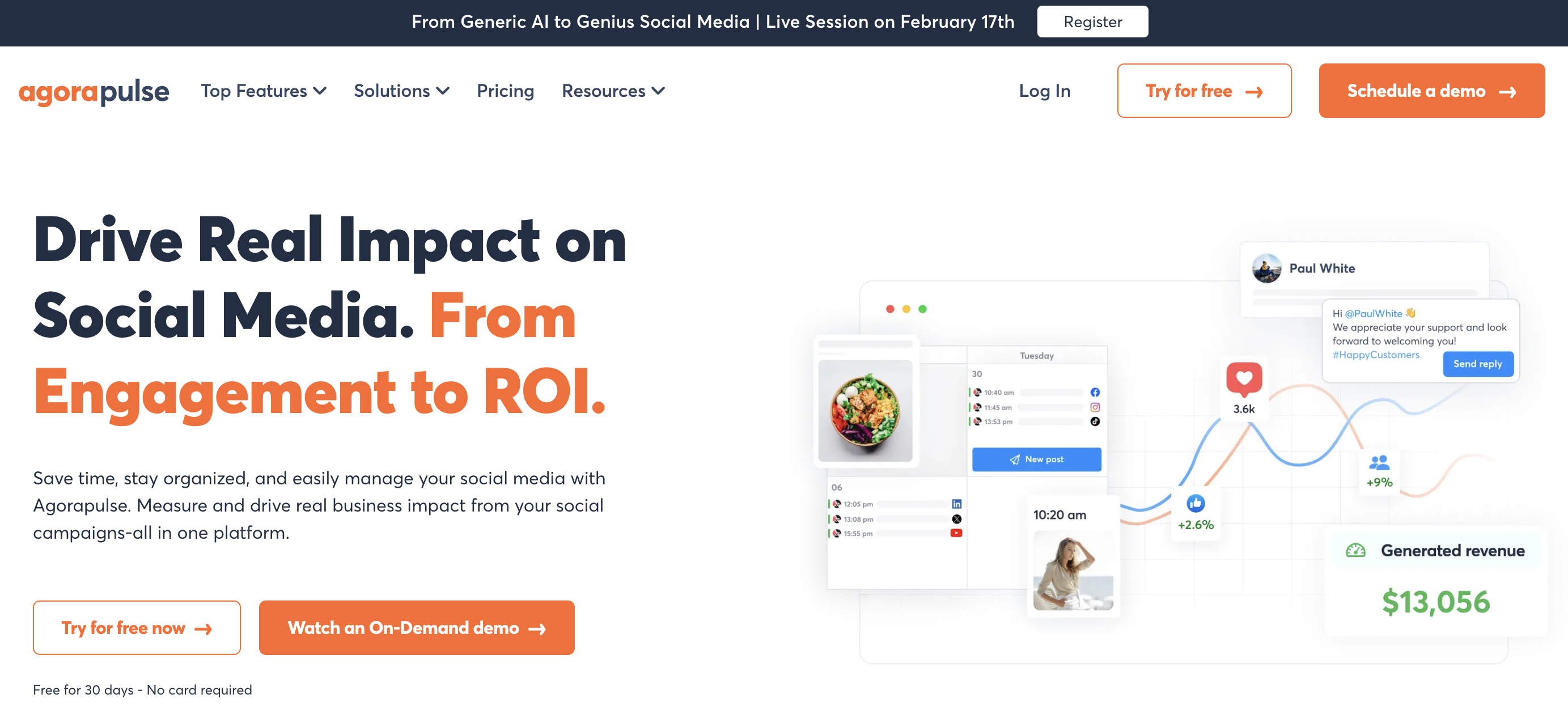
Agorapulse has one of the strongest social CRM layers in this category. For B2B teams where relationship tracking matters — remembering that LinkedIn commenter Jane from Acme Corp asked a question three months ago — Agorapulse's native social CRM attaches interaction history to each contact. Its Advanced tier adds ROI tracking via UTM parameters, tying social activity back to revenue outcomes.
The limitation for B2B scale is per-user pricing and a 10-profile cap across all plans. A 5-person B2B team pays $495/month minimum on Standard, and adding profiles requires pay-per-profile add-ons.
At a glance — Agorapulse
- Pricing: Free → Standard $99/user/mo ($79/user/mo annually) → Professional $149/user/mo → Advanced $199/user/mo → Custom
- Max profiles: 3 (Free) / 10 (paid plans) / Custom (Custom plan)
- Platforms: 11 including Facebook, Instagram, X, LinkedIn, YouTube, Pinterest, TikTok, Google Business, Threads, Bluesky, Reddit
- Free trial: 30 days, no credit card required
- User ratings: 4.5/5 on G2 (967 reviews), 4.0/5 on Trustpilot (57 reviews)
- Best for: B2B community managers and mid-market B2B teams focused on relationship tracking and engagement
Key features for B2B:
- Social CRM — tracks interaction history per contact across platforms
- Unified social inbox with automated moderation rules
- ROI reporting on Advanced tier — tie social activity to revenue via UTM tracking
- Team performance analytics (response time, resolution rate)
- Competitor analysis
- Approval workflows on Professional+ (multi-step on Custom only)
- LinkedIn comment tracking for engagement follow-up
Pricing:
| Plan | Monthly / Annual (per user) | Profiles |
|---|---|---|
| Standard | $99 / $79 | 10 |
| Professional | $149 / $119 | 10 |
| Advanced | $199 / $149 | 10 |
| Custom | Contact sales | Unlimited |
Pros:
- Best-in-class social CRM for B2B relationship tracking
- Clear client-friendly reports
- ROI tracking tied to business outcomes (Advanced+)
- Clean UI and approachable onboarding
- Free plan for 3 profiles, 1 user
Cons:
- Per-user pricing scales fast — 5 users on Standard = $495/mo before add-ons
- Paid plans cap at 10 profiles
- Approval workflows only on Professional+
- Multi-step approvals only on Custom tier
Best for: B2B community managers, mid-market B2B teams focused on engagement SLAs, and support-led B2B functions where inbox performance drives revenue.
For more details, see our Agorapulse pricing breakdown, Agorapulse reviews, and best Agorapulse alternatives.
8. Planable — Best for B2B Compliance Approvals

Planable treats approval and collaboration as the primary job, which makes it the strongest fit for compliance-heavy B2B industries — financial services, healthcare, legal, pharma. Its visual post-preview UX shows the client exactly how content will appear per platform before approval, and its multiple approval flow types (Basic 2 types, Pro 3 types) handle multi-stakeholder review cleanly.
The model is per-workspace. Each B2B brand or client gets its own workspace at $39/month (Basic) or $59/month (Pro), which is clean for small portfolios and expensive at scale.
At a glance — Planable
- Pricing: Free → Basic $39/workspace/mo → Pro $59/workspace/mo → Enterprise (custom)
- Platforms: 9 including Facebook, Instagram, X, LinkedIn, Pinterest, TikTok, YouTube, Snapchat, Google Business. No Threads or Bluesky.
- Free trial: Free plan available
- User ratings: 4.6/5 on G2 (937 reviews), 4.5/5 on Trustpilot (69 reviews — one of the smallest G2/Trustpilot gaps in the category)
- Best for: B2B teams in compliance-heavy industries where visual approvals and sign-off audit trails drive the workflow
Key features for B2B:
- Industry-best visual post previews (see content exactly as it will appear per platform)
- Multiple approval flow types (2 on Basic, 3 on Pro) for compliance, legal, and executive chains
- External approval links — clients/executives can approve without a billable login
- Unlimited users on paid plans
- Visual comment threads per post with audit trail
- Analytics add-on ($9/workspace/mo)
Pricing:
| Plan | Monthly | Posts | Social Pages | Approval Types |
|---|---|---|---|---|
| Free | $0 | 50 lifetime | — | 1 |
| Basic | $39/workspace | 60/month | 4 | 2 |
| Pro | $59/workspace | 150/month | 10 | 3 |
| Enterprise | Custom | Unlimited | Unlimited | Custom |
Pros:
- Cleanest visual approval and preview experience in the category — exceptional for legal/compliance review
- Unlimited users on paid plans (reviewers don't cost extra)
- Very consistent G2 and Trustpilot ratings (4.6 / 4.5) — suggests authentic product quality
- External approval links let compliance/legal review without account creation
- Multiple approval flow types for complex B2B review chains
Cons:
- Posting limits per workspace (60 on Basic, 150 on Pro)
- Analytics is a paid add-on ($9/workspace/mo)
- No social inbox
- No Threads or Bluesky support
- No AI captions
- Billing per-workspace — costs multiply linearly with B2B brand count
Best for: B2B teams in regulated industries (finance, healthcare, legal, pharma) where visual client approvals, sign-off audit trails, and platform-accurate previews are non-negotiable.
For more details, see our Planable pricing breakdown, Planable reviews, and best Planable alternatives.
9. SocialPilot — Best Mid-Market B2B Value
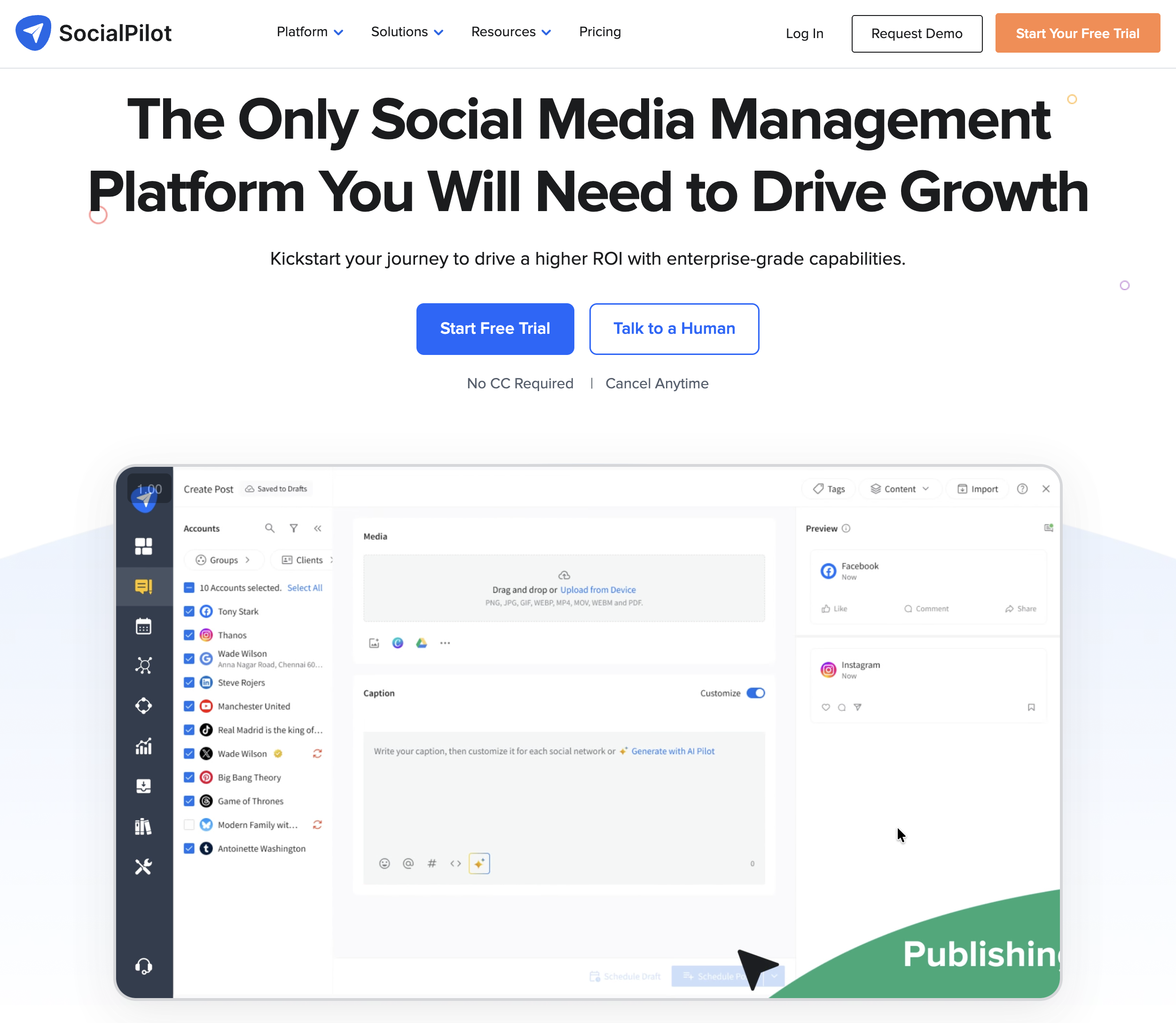
SocialPilot occupies a useful middle ground for B2B: transparent flat pricing, agency-friendly tiers, white-label reporting on Premium+, and a 50-account ceiling on Ultimate. For mid-market B2B agencies managing client accounts without per-seat compounding, it's one of the cleanest options.
At a glance — SocialPilot
- Pricing: Essentials $30/mo → Standard $50/mo → Premium $100/mo → Ultimate $200/mo → Enterprise (custom)
- Max accounts: 7 (Essentials) / 15 (Standard) / 25 (Premium) / 50 (Ultimate)
- Free trial: 14 days on all plans
- User ratings: 4.5/5 on G2 (841 reviews), 2.4/5 on Trustpilot (33 reviews — 73% 1-star)
- Best for: Mid-market B2B agencies wanting flat pricing and white-label without enterprise contracts
Key features for B2B:
- White-label reporting on Premium and above
- Client approvals on Standard+
- Bulk scheduling
- AI content assistant (500–unlimited credits)
- Team collaboration and role permissions
Pricing:
| Plan | Monthly | Accounts | Users | AI Credits |
|---|---|---|---|---|
| Essentials | $30 | 7 | 1 | 500 |
| Standard | $50 | 15 | 3 | 1,000 |
| Premium | $100 | 25 | 6 | 5,000 |
| Ultimate | $200 | 50 | Unlimited | Unlimited |
Pros:
- Flat pricing predictable at scale
- White-label on Premium (not locked to Enterprise)
- Ultimate allows unlimited users — rare at this price
- Better value than Hootsuite or Sprout for B2B agencies with flat budgets
Cons:
- Essentials only allows 1 user
- Trustpilot ratings skew heavily negative (73% 1-star)
- Limited deep CRM integration
- Extra accounts and users add up past tier limits
Best for: Mid-market B2B agencies managing 15–50 client accounts that want flat pricing, white-label reporting included on Premium, and unlimited users on the top tier.
For more details, see our SocialPilot pricing breakdown, SocialPilot reviews, and best SocialPilot alternatives.
10. Vista Social — Best for B2B + Reviews Management
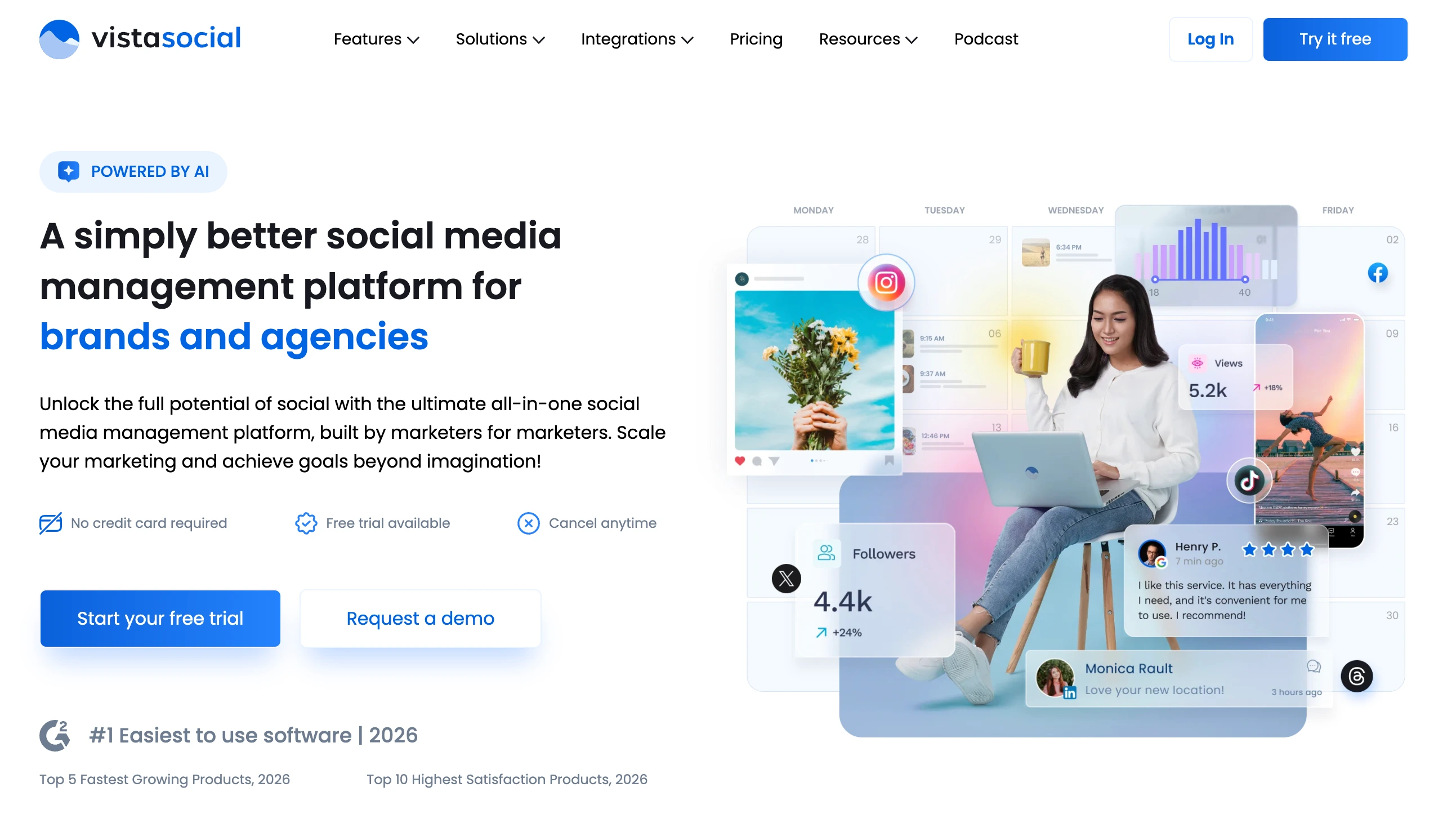
Vista Social is an underrated pick for B2B professional services, consultancies, and service-delivery firms — because it uniquely combines social media management with integrated review-site management across Google, Trustpilot, Yelp, G2, Capterra, and others. For B2B services firms where online reputation across review sites shapes the buying decision alongside social, Vista is one of the few tools that handles both in one dashboard.
At a glance — Vista Social
- Pricing: Professional $79/mo → Advanced $149/mo → Scale $379/mo → Enterprise (custom)
- Max profiles: 15 (Professional) / 30 (Advanced) / 70 (Scale) / Custom (Enterprise)
- Platforms: 12+ social platforms plus 5 review sites (X requires paid add-on)
- Free trial: 14 days, no credit card required
- User ratings: 4.8/5 on G2 (1,071 reviews — ranked #1 Easiest to Use in 2026), 4.1/5 on Trustpilot (62 reviews)
- Best for: B2B professional services and consultancies managing social alongside Google Business, Trustpilot, and G2 reviews
Key features for B2B:
- 12+ social platforms including Reddit, Snapchat, Tumblr
- 5 review-site integrations (Google Business, Trustpilot, Yelp, G2, Capterra)
- Multi-step approval workflows on all tiers
- AI-powered DM automation
- Unified inbox with sentiment analysis
- White-label on Scale tier ($379/mo) and Enterprise
- Employee advocacy add-on ($199/mo for 25 employees)
- Social listening add-on ($75/mo)
Pricing:
| Plan | Monthly | Profiles | Users | AI Credits |
|---|---|---|---|---|
| Professional | $79 | 15 | 3 | 500 |
| Advanced | $149 | 30 | 6 | 1,000 |
| Scale | $379 | 70 | 10 | Unlimited |
| Enterprise | Custom | Custom | Custom | Unlimited |
Pros:
- Review-site management is rare and genuinely valuable for B2B services firms
- Multi-step approvals included on all tiers
- White-label included on Scale (not an add-on)
- 4.8/5 G2 rating from 1,071 reviews
- Employee advocacy available as add-on
Cons:
- X/Twitter requires a paid add-on with undisclosed pricing
- AI credits capped below Scale (500 on Professional, 1,000 on Advanced)
- Scale tier at $379/mo priced above many mid-market budgets
- No native AI image generation
Best for: B2B professional services firms, consultancies, and B2B service-delivery businesses where Google Business, G2, and Trustpilot reviews matter as much as LinkedIn presence.
For more details, see our Vista Social pricing breakdown, Vista Social reviews, and best Vista Social alternatives.
11. Buffer — Honorable Mention for Simpler B2B Starts
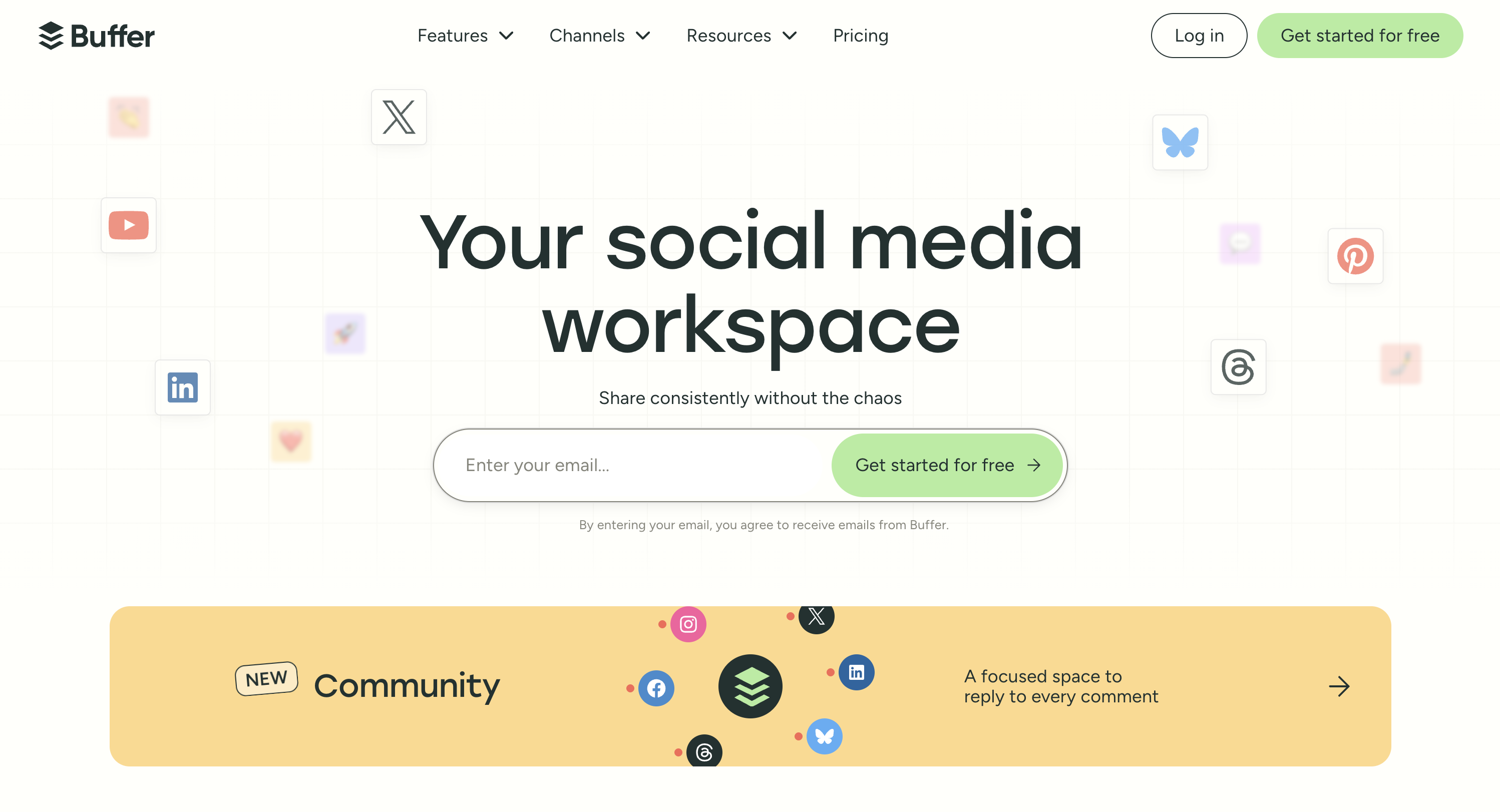
Buffer is the simpler B2B entry point — not B2B-specialized, but genuinely useful for small B2B teams or consultants running a handful of channels without heavy compliance or CRM integration needs. Its per-channel pricing works well at 1–3 channels and gets expensive fast past that.
At a glance — Buffer
- Pricing: Free (3 channels) → Essentials $6/channel/mo → Team $12/channel/mo
- Platforms: 11 including LinkedIn, X, Facebook, Instagram, TikTok, Threads, Mastodon, Bluesky, YouTube, Google Business, Pinterest
- Free trial: Free plan available
- User ratings: 4.3/5 on G2 (1,023 reviews), 2.1/5 on Trustpilot (93 reviews)
- Best for: Solo B2B consultants, small B2B teams, or companies just starting with LinkedIn-focused publishing
Key features for B2B:
- Per-channel pricing starting at $6/channel/mo
- Basic post-level analytics across 11 platforms
- Buffer AI Assistant for caption suggestions
- Start Page (link-in-bio)
- Community inbox (Instagram, Facebook, LinkedIn on paid plans)
- Approval workflows on Team plan
Pros:
- Free plan with 3 channels
- Clean, minimal interface
- LinkedIn support on all tiers
- Unlimited users on Team plan
- Nonprofit discounts available (50% off)
Cons:
- Per-channel pricing multiplies fast for B2B agency teams — 30 channels = $180–$360/mo
- Analytics stays surface-level even on paid plans
- No CRM integration — not built for B2B pipeline attribution
- No workspace isolation — channels aren't grouped by brand by default
- Limited B2B-specific features (no employee advocacy, no compliance workflows)
Best for: Solo B2B consultants starting with LinkedIn + one or two other channels, or small B2B teams whose entire portfolio fits inside the free plan. Not recommended for scaling past 5 brands or for compliance-heavy industries.
For more details, see our Buffer pricing breakdown, Buffer reviews, and best Buffer alternatives.
How B2B Pricing Models Compare
B2B teams scale differently than SMB teams. Your team includes marketing, sales enablement, executives, and compliance reviewers — often 8–15 stakeholders even in mid-market companies. Pricing model choice has outsized impact on total cost.
Flat-rate per-tier (PostPlanify) Pay per plan for a set number of workspaces, accounts, and team members. Predictable and caps scale cleanly at B2B team sizes. Best for growing B2B teams past 3 stakeholders.
Flat-rate account-based (Sendible, SocialPilot, Vista Social) Pay per tier for a set number of profiles. Slightly less clean than workspace-based because profiles don't always group by brand, but still predictable at scale.
Per-user / per-seat (Hootsuite, Sprout Social, Agorapulse) Pay per team member. Brutal at B2B scale. A 10-person B2B team on Sprout Professional pays $2,990/month minimum; on Hootsuite Advanced pays $4,990/month. Client reviewers and executives add more seats.
Per-channel (Buffer) Pay per connected platform. Multiplies fast — a B2B agency with 10 clients × 3 platforms = 30 channels at $360/month on Team.
Per-workspace (Planable) Pay per brand container. Clean for 1–5 brands; expensive past that.
Custom / enterprise (Oktopost, HubSpot Enterprise, Sprinklr) Annual contracts with demo-only pricing. Typically $15K–$100K+/year. Justified by B2B-specialist features (pipeline attribution, employee advocacy, CRM integration depth).
Real-World Cost Comparison: 3 B2B Scenarios
Scenario 1: Small B2B services firm — 3 brands, 2 users, LinkedIn-primary
| Tool | Plan | Monthly Cost |
|---|---|---|
| PostPlanify | Growth (yearly) | $79/mo |
| Buffer | Essentials ($6 × 9) | $54/mo |
| SocialPilot | Essentials | $30/mo (1 user only) / $50 Standard |
| Vista Social | Professional | $79/mo |
| Planable | Basic ($39 × 3) | $117/mo |
| HubSpot Social | Marketing Hub Pro | $800/mo + $3,000 onboarding |
Winner at 3 brands: Buffer for raw price if already LinkedIn-only; SocialPilot Essentials if 1 user is enough; PostPlanify for deeper features at similar price.
Scenario 2: Mid-market B2B SaaS — 10 brands, 5 users, approval workflows required
| Tool | Plan | Monthly Cost |
|---|---|---|
| PostPlanify | Premium (yearly) | $159/mo |
| Sendible | Scale | $199/mo (+ $240 white-label = $439/mo) |
| SocialPilot | Premium | $100/mo (6 users included) |
| Vista Social | Advanced | $149/mo |
| Planable | Pro ($59 × 10) | $590/mo |
| Agorapulse | Standard ($79 annual × 5) | $395/mo |
| Hootsuite | Standard ($249 × 5) | $1,245/mo |
| Sprout Social | Standard ($199 × 5) | $995/mo |
| HubSpot Social | Marketing Hub Pro | $800/mo |
Winner at 10 brands: PostPlanify or SocialPilot. PostPlanify wins on workspace isolation, reporting, and social inbox depth; SocialPilot is slightly cheaper but flatter on features. Choose PostPlanify Scale if true white-label PDF reports are required.
Scenario 3: Enterprise B2B with ABM — 20 brands, 12 users, CRM integration required, employee advocacy
| Tool | Plan | Monthly Cost |
|---|---|---|
| PostPlanify | Scale (yearly) | $239/mo |
| Oktopost | Custom (mid-market) | ~$2,500–$5,000/mo (equivalent monthly) |
| HubSpot Social | Marketing Hub Enterprise | $3,600/mo |
| Hootsuite | Advanced ($499 × 12) | $5,988/mo (Amplify extra) |
| Sprout Social | Professional ($299 × 12) | $3,588/mo |
| Sendible | Advanced + white-label | $539/mo |
| Vista Social | Scale | $379/mo |
Winner at enterprise scale: Depends on feature priority. For pipeline attribution + employee advocacy, Oktopost. For CRM-native, HubSpot. For cost-conscious enterprise, PostPlanify Scale at $239/mo handles most operational needs with REST API/MCP for CRM integration.
Winner by Category for B2B
| Use Case | Winner | Why |
|---|---|---|
| Flat-price growth from 3 to 50 B2B brands | PostPlanify | Workspace ladder, no per-seat fees inside plan limits, reports on Premium, white-label on Scale+ |
| B2B-specialist with pipeline attribution | Oktopost | Native employee advocacy + mature CRM integrations |
| CRM-integrated if already on HubSpot | HubSpot Social Tools | CRM-native social tracking + lead attribution |
| Enterprise analytics + listening | Sprout Social | 150+ pre-built reports, Trellis AI, Groups rollup |
| Enterprise employee advocacy | Hootsuite (Amplify) | Mature advocacy module outside of Oktopost |
| B2B agencies serving multiple clients | Sendible | Profile Groups + white-label add-on |
| B2B social CRM + relationship tracking | Agorapulse | Interaction history per contact |
| Compliance-heavy approvals (finance/healthcare/legal) | Planable | Visual previews + multiple approval flows + external reviewer links |
| Mid-market B2B agencies on flat pricing | SocialPilot | White-label on Premium, 50 accounts on Ultimate |
| B2B services + reviews management | Vista Social | Social + review-site management in one dashboard |
| Solo B2B consultants + small teams | Buffer | Free plan for 3 channels |
B2B KPIs to Track Across These Tools
B2B social reporting should tie back to pipeline and revenue, not likes and follower counts. The 15 KPIs that matter for agency and in-house B2B reporting are broken out in our full social media KPIs every agency should report to clients guide. The B2B-relevant subset:
- LinkedIn engagement rate by followers (industry benchmarks: strong B2B accounts hit 2–5%+ for document posts)
- Follower growth rate (weekly benchmark from Hootsuite 2026: LinkedIn 0.85%)
- Social-driven website sessions (Similarweb 2025: ~7% of total traffic for average sites; typically 2–5% for B2B)
- Lead conversion rate from social (Unbounce 2025: 1.5% baseline for cold social; 3–5% typical for LinkedIn-sourced B2B)
- Response time (Sprout Social Index 2025: 42% of consumers expect response within 60 minutes)
- Employee advocacy reach multiplier (8x engagement vs. brand posts, 10x network reach per Sociabble/Edelman)
- Social-attributed pipeline influenced (custom per CRM; tools like Oktopost and HubSpot handle natively)
PostPlanifyAll your social media in one simple dashboard
Schedule posts, track analytics, and reply to comments/DMs without switching tabs.
Engagement
+18%
Views
52.8k
FAQ: Social Media Tools for B2B Companies
What's the best social media tool for B2B companies in 2026?
For most B2B teams, PostPlanify delivers the best cost-to-value — flat pricing, workspace isolation for multi-product portfolios, LinkedIn Company Page + personal profile support, approval workflows, reports on Premium, white-label reports on Scale, and REST API/MCP for custom CRM integration. For B2B-specialist features (native employee advocacy, social-to-pipeline attribution), Oktopost is the purpose-built enterprise pick. For CRM-integrated workflows on HubSpot, HubSpot Social Tools is the obvious pick.
Do B2B companies need a different social media tool than B2C?
Yes. B2B success depends on LinkedIn depth, CRM integration, multi-stakeholder approvals, pipeline attribution, and employee advocacy — features that general B2C tools treat as afterthoughts or enterprise-only add-ons. The tools on this list all demonstrate B2B-relevant features; B2C-first tools like Later fit poorly.
Is LinkedIn the only platform B2B needs?
No, but it's primary. Per Content Marketing Institute, 96% of B2B content marketers use LinkedIn. Supporting channels vary by vertical: X/Twitter for tech and industry commentary, YouTube for demos and thought-leadership video, Facebook for community-focused B2B niches, Reddit for developer audiences, and industry-specific forums. A tool that handles LinkedIn deeply and supports 2–3 secondary platforms well is enough for most B2B teams.
How important is employee advocacy for B2B?
Significant. Content shared by employees earns roughly 8x more engagement than brand-channel content (Social Media Today / Sociabble) and is 3x more trusted (Edelman Trust Barometer). Employee networks are on average 10x larger than company follower bases. For B2B at scale, employee advocacy is the biggest reach and trust multiplier available. Native support exists in Oktopost (built-in) and Hootsuite Amplify (Enterprise tier). Other tools handle it via separate modules or integration with dedicated platforms like Sociabble.
What CRM integrations should a B2B social tool support?
Salesforce and HubSpot are table-stakes. Marketo, Pardot, and Eloqua matter for marketing-automation-centric B2B stacks. Pipedrive for smaller B2B SaaS. Microsoft Dynamics for enterprise B2B. Tools with native connectors (Oktopost, HubSpot Social, Sprout Social, Hootsuite Enterprise) deliver more reliable attribution than tools that rely on Zapier bridges. PostPlanify's REST API + MCP support enables custom pipelines but requires some engineering setup.
How much should a B2B company budget for a social media tool?
Solo B2B consultant: $0–$80/mo (Buffer free, PostPlanify Growth $79/mo billed yearly). Small B2B team (3–5 users, 5–10 brands): $100–$300/mo (PostPlanify Premium $159/mo, SocialPilot Premium $100/mo, Vista Social Advanced $149/mo). Mid-market B2B (6–15 users, 10–25 brands): $200–$600/mo (PostPlanify Scale $239/mo, Sendible Scale $199/mo, Vista Social Scale $379/mo). Enterprise B2B with ABM + advocacy: $2,500–$10,000/mo (Oktopost custom, HubSpot Enterprise $3,600/mo, Sprout/Hootsuite enterprise contracts).
What's the best tool for B2B compliance approvals?
Planable for the cleanest UX — visual post previews, multiple approval flow types, external reviewer links. PostPlanify for flat pricing with multi-approver chains on Premium+. Sprout Social and Hootsuite for enterprise governance. HubSpot Social for approval workflows tied to CRM audit trails. For highly regulated industries (finance, healthcare, legal), verify the tool supports: audit log export, role-based permissions, and integration with compliance-tool-of-record (Proofpoint, Hearsay, Smarsh).
Can I use general tools like Buffer or Later for B2B?
Buffer works for small B2B teams with simple LinkedIn-primary needs. Later is weaker for B2B — visual-first, Instagram-centric, limited LinkedIn features, no compliance workflows. For B2B scale, tools specifically designed for or adapted to B2B (PostPlanify, Oktopost, Sprout, Hootsuite, Sendible, HubSpot, Planable) outperform consumer-first tools.
Does HubSpot Social replace a dedicated social tool?
For teams already on HubSpot Marketing Hub Professional or Enterprise, it usually covers enough social functionality to skip a dedicated tool — especially if CRM-native attribution is the priority. For teams not on HubSpot, paying $800/mo + $3,000 onboarding just for social access rarely makes sense; pick a flat-priced dedicated tool (PostPlanify, SocialPilot) and integrate to CRM separately.
What's the difference between Oktopost and Sprout Social for B2B?
Oktopost is purpose-built for B2B — pipeline attribution is the default architecture, employee advocacy is native, CRM integrations are mature. Sprout Social is broader enterprise social with strong B2B features bolted on — deeper analytics reports, Trellis AI, Groups rollups, but listening is an add-on and employee advocacy is thinner than Oktopost's. Oktopost fits B2B-native enterprises; Sprout fits enterprises where social spans B2B + B2C + support.
How do I prove social media ROI to a B2B CFO?
Track: social-sourced pipeline (leads with social as first-touch attribution), social-influenced pipeline (opportunities where social was any touch), closed-won revenue attributed to social-sourced deals, and cost per acquisition (CPA) by channel. Tools with CRM integration do this natively (Oktopost, HubSpot, Sprout Professional+). For other tools, wire up UTM parameters religiously and pull reports from GA4 + CRM manually. For the full framework, see our guides on ROI on social media and how to measure social media ROI.
What should a B2B agency look for in a client-facing tool?
Multi-workspace isolation (one workspace per client), white-label PDF reports, approval workflows with external reviewer access (so clients approve without a billable seat), LinkedIn depth (most B2B clients are LinkedIn-primary), and flat pricing that doesn't reshape as clients grow. For the full agency-specific comparison, see best social media tools for managing multiple brands and best social media management tools for agencies.
Are there B2B-specific social media tools for specific verticals?
Several. For manufacturing and industrial B2B: Sprout Social, Hootsuite, Oktopost. For professional services (law, accounting, consulting): Vista Social (reviews management), Planable (compliance approvals), PostPlanify (cost-effective). For SaaS: best social media management tools for SaaS covers the SaaS-specific angle. For B2B agencies: best social media tools for managing multiple brands.
How do I onboard a new B2B client onto a social media tool?
Full 15-step onboarding process in our social media agency client onboarding checklist. Key steps: collect credentials securely through a password manager, create a dedicated workspace per client, configure team roles (Owner/Editor/Client/Guest) with the right permissions, build approval chains for compliance review, document brand voice, set reporting cadence, and train the client on approval UI in the kickoff meeting.
Can I integrate a social media tool with Salesforce or HubSpot directly?
Yes. Native Salesforce integrations: Oktopost, Hootsuite Enterprise, Sprout Social, HubSpot Social (which is native inside HubSpot). Native HubSpot integrations: Oktopost, HubSpot Social, Sprout Social. For other tools (PostPlanify, Sendible, SocialPilot, Planable), use Zapier or the REST API to push data into the CRM. PostPlanify specifically supports REST API + MCP, which enables custom Salesforce/HubSpot/Pipedrive pipelines.
Key Takeaways
- Pick the B2B angle before the tool. Specialist features (pipeline attribution, employee advocacy, CRM integration) cost premium pricing. If you don't need them, don't pay for them — flat-price tools like PostPlanify, SocialPilot, and Sendible cover most B2B operational needs at a fraction of the cost of Oktopost, Hootsuite Enterprise, or Sprout Advanced.
- LinkedIn depth is non-negotiable. Verify Company Pages + personal profiles + document posts + first-comment automation before committing. Most general tools handle LinkedIn poorly.
- CRM integration matters more than social listening. B2B success = pipeline attribution. Tools with native Salesforce/HubSpot/Marketo connectors (Oktopost, HubSpot Social, Sprout Social) or mature API support (PostPlanify) outperform tools that treat CRM as an afterthought.
- Approval workflows must support multi-step chains. Compliance-heavy B2B (finance, healthcare, legal) requires legal review → executive sign-off chains. Single-step approvals break in real usage.
- Per-seat pricing scales badly at B2B team size. Marketing + sales enablement + executives + compliance + agency partners = 10–15 stakeholders. Per-seat tools multiply to $3,000–$5,000/month fast.
- Employee advocacy is the biggest B2B reach multiplier. Native support in Oktopost and Hootsuite Amplify (Enterprise). For other tools, pair with dedicated advocacy platforms (Sociabble, EveryoneSocial) or custom via API.
- For most B2B teams, PostPlanify delivers the best cost-to-value. Workspace ladder (5/15/50/unlimited), flat pricing, LinkedIn depth, approval workflows, reports on Premium, white-label reports on Scale, REST API/MCP for CRM integration — and no per-seat fees inside plan limits.
PostPlanifyAll your social media in one simple dashboard
Schedule posts, track analytics, and reply to comments/DMs without switching tabs.
Engagement
+18%
Views
52.8k
If you're a B2B company where LinkedIn drives pipeline, compliance approvals are required, and per-seat pricing is killing your budget, PostPlanify was built around flat pricing, workspace isolation, and the approval workflows B2B teams actually need.
Related Reading
- Best Social Media Management Tools for SaaS
- Best Social Media Management Tools for Agencies
- Best Social Media Management Tools for Teams
- Best LinkedIn Scheduler
- Best Social Media Tools for Managing Multiple Brands
- Best Social Media Analytics Tools
- Best Social Media Tools with Approval Workflows
- Social Media Tools with No Per-Seat Fees
- White-Label Social Media Reports for Clients
- White-Label Social Media Management
- The 15 Social Media KPIs Every Agency Should Report to Clients
- The 15-Step Social Media Agency Client Onboarding Checklist
- How to Post on LinkedIn
- How to Schedule LinkedIn Posts
- ROI on Social Media
- How to Measure Social Media ROI
- Social Media Analytics and Reporting
- How to Create a Social Media Report
- Best Hootsuite Alternatives
- Best Sprout Social Alternatives
- Best Sendible Alternatives
- Best Agorapulse Alternatives
- Best Planable Alternatives
- Best SocialPilot Alternatives
- Best Vista Social Alternatives
- Best Buffer Alternatives
PostPlanifyAll your social media in one simple dashboard
Schedule posts, track analytics, and reply to comments/DMs without switching tabs.
Engagement
+18%
Views
52.8k
About the Author

Hasan Cagli
Founder of PostPlanify, a content and social media scheduling platform. He focuses on building systems that help businesses, agencies, and teams plan, publish, and manage content and social media more efficiently across platforms.


