


If you're trying to figure out how to add a link on Instagram Story, you probably need one of two things right now. Either you want the exact taps inside Instagram so you can publish fast, or the Link sticker isn't showing up and you're stuck.
Quick answer: Open the Story creator → tap the sticker icon → choose Link → paste your URL → customize the sticker text (e.g., "Shop now" instead of the raw URL) → place it in the central area of the Story → publish. The feature works on all public Instagram accounts as of 2026 — no follower minimum, no Professional account required. If the Link sticker doesn't appear, update the Instagram app first.
Both problems are common. The feature is simple once you know where Instagram hides it, but a lot of the frustration comes from small details like app version, sticker placement, and using the wrong destination page. For businesses, creators, and agencies, those details matter because a Story link isn't just a button. It's one of the cleanest ways to move people from Instagram to a product page, article, signup form, or campaign landing page.
Quick Diagnosis: Match Your Symptom to a Fix
Not sure where the problem is? Use this table to jump straight to the right section:
| Symptom | Most Likely Cause | Where to Fix |
|---|---|---|
| Link sticker doesn't appear in the tray | Outdated Instagram app | Update Instagram first |
| Sticker is there but viewers aren't tapping | Bad placement or weak CTA text | Sticker placement + CTA fixes |
| Tap rate is low overall | Generic CTA, weak landing page match | Best practices |
| Sticker works, but link goes to wrong page | URL pasted with extra characters or shortened incorrectly | Match the Story to the destination |
| Want to schedule Stories with link stickers | Not possible — must publish natively in the IG app | Honest answer on scheduling |
| Link sticker missing on a brand-new account | Account is private or temporarily restricted | Switch to public + check account status |
| Need to track Story link clicks | No native click analytics by URL | Track link performance like a campaign |
Why Adding Links to Instagram Stories Is a Game-Changer
A customer watches your Story, likes the offer, and is ready to act right then. If the only next step is "go to our bio," you lose people. The link sticker removes that extra step and sends the tap straight to the page that matches the Story.
That direct path changed who could use Stories as a traffic channel. In December 2018, Instagram introduced link stickers for Stories exclusively to accounts with 10,000+ followers or verified status, and that restriction lasted until December 2021, when Instagram expanded link stickers to everyone. Before that change, only 15-20% of Instagram's 1.4 billion monthly active users could use the tool. After the rollout, link sticker usage in Stories rose by over 40% across business accounts by mid-2022, alongside a 25% uplift in website clicks from Stories, as Sprout Social's review of the swipe-up to link sticker shift found.
For smaller brands and agencies managing client accounts, that update removed a real bottleneck. Teams no longer had to build every campaign around one bio URL or swap that link every time a promotion changed. Story links made it possible to run several offers, content pushes, and landing pages in parallel without forcing users through extra taps.
Story links vs link in bio vs product tags
Three Instagram linking surfaces, three different jobs. This is where most creators get it wrong — they pick the wrong one for the moment.
| Linking Surface | Best For | Lifespan | Limitations |
|---|---|---|---|
| Story link sticker | Time-bound campaigns, launches, flash sales, article promotion, lead magnets | 24 hours (or until added to Highlights) | One link per sticker; multiple stickers possible per Story |
| Link in bio | Permanent navigation, multiple destinations, evergreen content hubs | Indefinite | Single tap zone — needs a hub tool to fan out |
| Product tags / Shopping | Direct product browsing inside Instagram | Permanent (per post) | Requires approved Instagram Shop and product catalog |
| Reels link sticker | Same as Story links, longer lifespan | Indefinite while Reel is live | Slightly newer feature — placement rules differ |
Practical rule: Use Story links for one clear action tied to one Story. Use your bio link for broader navigation. Use product tags when the destination is the product page itself.
Why this matters more for business workflows
The advantage shows up at scale. A solo creator can add one sticker by hand and move on. A marketing team or agency needs a system for campaign naming, UTM tracking, approvals, scheduling, and reporting across multiple Stories and destinations.
That is where the link sticker becomes more than a publishing feature. It becomes part of a traffic workflow. Teams can assign different Story frames to different landing pages, schedule campaigns around launches, measure which creative drove taps, and keep the bio link focused on evergreen destinations instead of constantly changing it for short-term promotions.
That fits the broader shift toward social platforms acting as direct response channels, not just awareness channels. These social commerce statistics for 2026 provide useful context for why low-friction paths from Story view to site visit matter so much for modern Instagram strategy.
 PostPlanify
All your social media in one simple dashboard
Schedule posts, track analytics, and reply to comments/DMs without switching tabs.

Engagement
+18%
Views
52.8k
How to Add a Link to Your Instagram Story Step-by-Step
The actual setup takes less than a minute once the sticker is available on your account. The process is often overcomplicated because Instagram doesn't label it clearly.

Step 1: Open the Story creator
From the Instagram home screen, tap your profile image in the top-left area, or swipe right to open the Story camera. You can also start from your profile and choose to add a Story from there.
Once you're in the Story creator, either capture a photo or video on the spot, or upload one from your camera roll. If you're using pre-made creative, check it before you continue. A link sticker won't fix a Story that's hard to read or visually overloaded.
Step 2: Add your Story media first
Select the image or video you want to use. Instagram lets you resize and reposition some uploaded media, so take a second to decide where your text, product shot, or focal point should sit.
The link sticker needs room. If your media already fills the center with text, the sticker will compete with it. Give the sticker a clear place to live before you add it.
For exact safe-zone dimensions on Stories (where the link sticker won't overlap with profile info, captions, or reply buttons), use our free Instagram safe zone checker — it previews the actual UI overlay zones so you can place stickers where they're guaranteed visible.
Step 3: Open the sticker tray and choose Link
Tap the sticker icon at the top of the Story editor. It looks like a square smiley sticker. In the tray that opens, choose Link.
If you don't see it immediately, use the search bar in the sticker tray and type "link." If it still doesn't show, skip ahead to the troubleshooting section because that's usually an app-version issue.
Now paste your URL into the field Instagram gives you. This can be a product page, blog post, registration page, lead magnet, booking link, or another destination you control.
Step 4: Customize the sticker text
Instagram lets you change the visible text on the sticker. Don't leave the raw domain there unless the domain itself adds trust and clarity.
Use short CTA text that tells people what happens next:
| CTA Text | Best Use Case | Typical Performance Boost |
|---|---|---|
| Shop now | Product launches, flash sales, e-commerce | +30–40% vs raw URL |
| Read the article | Blog posts, news, long-form content | +25–35% vs raw URL |
| Get the offer | Discounts, coupon codes, promotions | +35–45% vs raw URL |
| Book a demo | SaaS, agencies, B2B services | +20–30% vs raw URL |
| Watch the full video | YouTube, podcasts, longer Reels | +25–35% vs raw URL |
| Apply now | Hiring, course enrollment, applications | +30% vs raw URL |
| Register here | Webinars, events, conferences | +35–40% vs raw URL |
| Get the free guide | Lead magnets, ebooks, checklists | +40%+ vs raw URL |
Clear CTA text usually performs better than a bare URL because users know exactly what they're tapping.
A separate but related workflow matters if you're also republishing content formats across campaigns. This guide on how to share a story on Instagram is useful if you're juggling reposts, mentions, and fresh Story content in the same calendar.
After adding the link, you'll want to see the taps in context. This quick walkthrough shows the editing flow in motion:
Step 5: Place the sticker and publish
Drag the sticker to where it's visible and easy to tap. Avoid covering faces, pricing, subtitles, or product details. Resize it if needed, but don't make it so small that it looks decorative rather than interactive.
Before posting, preview the Story and ask one practical question: if someone watched this for one second, would they know where to tap and why?
If the answer is no, add a short text cue or arrow. Then publish to your Story.
Pro Tip: A Story link works best when the creative answers two questions instantly: what is this, and why should I tap? If your viewer needs to think about it, the tap rate drops sharply.
Troubleshooting Common Instagram Story Link Issues
Most Story link problems come down to one of three things. The sticker is missing, the sticker appears but doesn't work well, or the Story is technically live but people aren't tapping because the setup is poor.

Common Story Link Errors and Fixes
| Problem | Likely Cause | Fix |
|---|---|---|
| Link sticker missing from tray | Outdated Instagram app | Update via App Store / Play Store, force-close app |
| "Link" search shows no results | Cached sticker tray | Log out → log back in, or reinstall the app |
| Sticker visible but tap doesn't register | Sticker too close to top/bottom UI zone | Move sticker into central 60% of Story canvas |
| Link works but opens in-app browser only | This is normal — Instagram opens links in its built-in browser | Make sure your destination renders well on mobile webview |
| Sticker disappears after publishing | Account just switched from private to public — refresh required | Force-close Instagram, reopen, recreate the Story |
| Story link tap count not showing | Personal account or fewer than 100 views | Switch to Professional account for full Insights |
| URL gets cut off or won't paste | Copy contains extra spaces or hidden characters | Re-copy URL from a fresh tab, paste into a notes app first |
| Link sticker text reverts to URL | Custom text exceeded the character limit (~25 chars) | Shorten CTA text |
The Link sticker doesn't appear
The first thing to check is your Instagram app version. The Link sticker is available to most accounts, but its visibility depends on the app version, so if it doesn't appear, you should update Instagram first. The same guidance also notes that sticker placement matters, and the recommended area is the middle 60% of the Story canvas, away from the top and bottom edges where mobile tap zones become unreliable. It also notes that customized sticker text improves click-through rates, based on Hey MarVelous guidance on Instagram Story links.
If you're managing several brand accounts, teams often encounter a common challenge. One person updates the app. Another person on an older device doesn't. Suddenly the workflow looks inconsistent across accounts.
Try this in order:
- Update Instagram from the App Store or Google Play.
- Force close and reopen the app after updating.
- Log out and back in if the sticker still doesn't show.
- Switch to a public account — link stickers don't work on private accounts.
- Try another device if you're working across a team setup.
- Check whether the account has temporary app bugs by testing other sticker features too.
If Instagram is acting strangely beyond the Link sticker, this broader guide on why you can't post on Instagram can help isolate account, permission, or app issues. If your scheduled Stories are also failing, see Instagram scheduled posts not working for the full troubleshooting checklist.
The sticker is visible but hard to tap
This usually isn't a permissions problem. It's a placement problem.
If you put the sticker too close to the top edge, bottom reply area, or on top of cluttered UI elements, taps become unreliable. Users may also miss it entirely if the contrast is weak. A light sticker on a pale background disappears fast.
Use these fixes:
- Move it inward: Keep it in the central working area of the Story, not pressed against the edges.
- Increase contrast: Use a background, overlay, or sticker style that clearly stands out. If your image is too busy or the colors clash with the sticker, changing the background color of the Story with the Draw tool or eyedropper is the fastest fix.
- Leave breathing room: Don't stack polls, mentions, GIFs, and the link sticker on top of each other.
- Use the safe zone tool: Our Instagram safe zone checker shows the exact pixel zones where Instagram's UI overlays your Story. Place stickers outside those zones.
The link works but the Story underperforms
If taps are low, the issue is often strategic rather than technical. Common causes include:
- Generic CTA text: "link" or a domain name doesn't tell people why to click.
- Weak landing page match: the Story promises one thing, but the page opens to something broader.
- Too much visual noise: the sticker blends into the design.
- No directional cue: nothing points the eye toward the action.
Field note: Most low-performing Story links aren't hidden by Instagram. They're hidden by the creative itself.
PostPlanifyAll your social media in one simple dashboard
Schedule posts, track analytics, and reply to comments/DMs without switching tabs.
Engagement
+18%
Views
52.8k
Best Practices for Higher Click-Through Rates on Story Links
Adding the sticker is the easy part. Getting consistent taps takes better creative decisions.
The strongest Story links don't rely on the sticker alone. They combine placement, CTA wording, visual hierarchy, and a landing page that matches the promise of the Story.
Customize the CTA instead of showing the raw URL
The data here is clear. The Link Sticker rollout led to a 35% average increase in Story-driven conversions for e-commerce brands, and link taps rose from 12% to 28% of total Story interactions after the feature change. Engagement increased by 22% when links were customized, with examples like "Shop Now" outperforming raw URLs by 40%. The same source notes that upper placement drove 32% more clicks than center placement, and by 2025, 1 in 3 Stories from verified agencies used links for traffic, according to Mobilocard's breakdown of Instagram Story link behavior.
That means two practical things.
First, don't leave the sticker as a generic domain unless your brand name itself is the message. Second, write CTA text that reflects the user's next action, not your internal campaign label.
Short CTAs that usually work better:
- Read more for content
- Shop now for products
- Get details for launches
- Apply now for hiring
- Register here for events
If your team writes CTAs quickly or rotates offers often, tightening the copy matters as much as the design. These social media copywriting tips are useful when your sticker text and Story framing feel too vague.
Place the sticker where people can see and reach it
The exact position depends on the creative, but placement isn't cosmetic. It's functional.
Upper placement can drive stronger results, but only if the sticker stays visually obvious and doesn't get lost against the top area of the Story. If you're adding subtitles, product tags, or other stickers, test where the link stands out best.
A simple rule helps: the sticker should sit where the eye lands naturally, not where you had space left over.
For exact dimensions and safe zones on Stories (which differ from feed posts), see our Instagram image size guide.
Add visual cues that support the link
Arrows, short captions, hand gestures, and motion graphics still help because they direct attention. Use them lightly. If you add too many prompts, the Story starts to look desperate or messy.
If you're working with video, file quality matters too. Compression, awkward cropping, or the wrong export settings can make text and stickers harder to read. This resource on Reels and Stories video settings is useful if your Stories look soft, cut off, or poorly framed after upload.
Match the Story to the destination page
A Story saying "Shop this drop" shouldn't open your homepage. A Story promoting one article shouldn't land people on a blog index page if you can send them to the exact post.
That mismatch is one of the biggest conversion leaks I see in Story campaigns. The user taps with clear intent, then lands on something broader and loses momentum.
Track link performance like a campaign, not a post
Use Instagram Insights to review link taps, and add UTM parameters if you're measuring traffic in analytics tools. That gives you a cleaner read on which Story, CTA, or campaign drove the visit.
A simple UTM template that works for Story campaigns:
?utm_source=instagram&utm_medium=story&utm_campaign=spring-launch&utm_content=story-link-day1
When you check your scheduled queue and link performance side by side — see how to see scheduled posts on Instagram for the full walkthrough — you can spot which CTAs and Story creative actually drove the taps.
Post Stories at peak engagement times
A perfect link sticker still needs eyes on it. Three major studies found that Tuesday through Thursday between 11 AM and 6 PM consistently drives the highest Instagram engagement. Posting Story content at those windows compounds your link tap rate. For a full breakdown by day and industry, see our best time to post on Instagram guide.
Scheduling Instagram Stories with Link Stickers (The Honest Answer)
This is where most "scheduling tool" articles get it wrong. Instagram's Graph API does not allow any tool — first-party or third-party — to add a Link sticker to a Story. It's a platform-level restriction from Meta. Link stickers can only be added natively, inside the Instagram app, at publish time.
That means there is no real way to "schedule a Story with a Link sticker." Even tools that can auto-publish Stories via the API will strip the sticker because the API doesn't accept it as a parameter. If a Link sticker is essential to the Story, you have to publish that Story by hand, in the app.
The practical workflow most teams settle on:
- Use scheduling tools for everything else — feed posts, Reels, carousels, planning, calendars, analytics, approvals
- Publish Story posts that need Link stickers natively in the app — it takes about 30 seconds per Story once the creative is ready
- Use Highlights to extend the lifespan of Stories with Link stickers beyond 24 hours so you're not republishing the same one constantly
For the complete walkthrough on what is and isn't possible with Story scheduling, see our how to schedule Instagram Stories guide.
Where a Real Scheduling Workflow Helps
Story Link stickers stay manual — that part is fixed. But the rest of your Instagram workflow doesn't have to. 68% of social media managers report spending over 5 hours weekly on manual Story posting, and API-driven tools with drag-and-drop calendars and bulk queues can save teams an average of 1-2 hours daily, based on Bitly's discussion of linked Story workflows and scheduling.
For agencies and in-house teams, the problem isn't just time. It's also inconsistency. Wrong links get pasted. UTM tags get skipped. Posts go live late. Approvals happen in DMs instead of a real workflow.
PostPlanify handles the rest of the Instagram operation — feed posts, Reels, carousels, analytics, inbox, approvals — so the only thing your team has to touch manually is the Link sticker itself when a Story goes live:
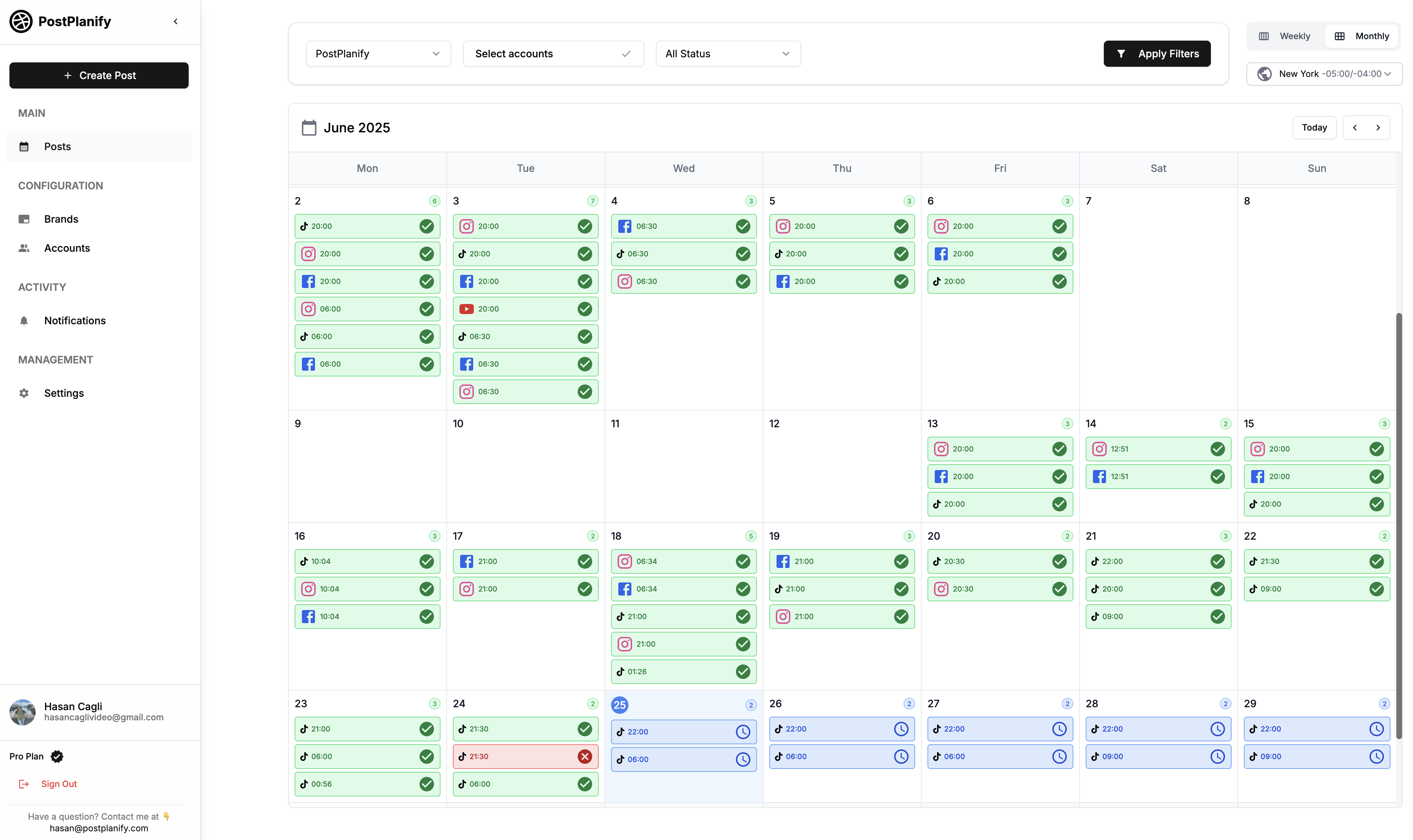
- Multi-platform analytics across all 10 supported platforms (Instagram, TikTok, X, Facebook, LinkedIn, YouTube, Threads, Pinterest, Bluesky, Google Business) including best-time-to-post recommendations
- Social inbox for Instagram, Facebook, LinkedIn, Google Business, and YouTube — reply to Story replies, comments, and DMs in one place
- AI assistant (vision-powered) for caption suggestions, CTA copy, and post variations
- Team collaboration with approval workflows — route drafts to a manager or client before publishing
- White-label PDF reports for agencies presenting Instagram performance to clients
- Bulk scheduling via CSV upload for feed posts, Reels, and carousels
- Content calendar with drag-and-drop rescheduling
- Media library to organize Story creative, brand assets, and reusable content
PostPlanify pricing starts at $79/mo billed yearly (Growth plan, 15 social accounts, 3 team members). The Premium plan ($159/mo billed yearly) adds white-label reports and 6 team seats. Try it free for 7 days.
For the full feature breakdown, see the Instagram scheduler page.
Alternatives and Advanced Linking Strategies for Instagram
The Story link sticker is good for immediate action. It isn't enough on its own if you're running several campaigns, sharing multiple offers, or managing accounts for clients who need more than one active destination.
That's where Instagram linking strategy usually splits into three lanes: Story links, link-in-bio hubs, and commerce features like product tags.

When to use Story links versus link in bio
Story links are temporary and campaign-specific. They work well for launches, flash offers, live events, article promotion, lead magnets, and anything tied to current content.
A link-in-bio page solves a different problem. It gives you a permanent traffic hub for multiple destinations at once. That's useful when your profile needs to support several priorities, like services, blog content, featured products, bookings, and newsletter signups. PostPlanify includes a built-in link-in-bio builder with click analytics, so you can run your bio hub in the same dashboard you use for scheduling and the social inbox.
If you're deciding between tools for that setup, this roundup of link in bio tools is a practical starting point.
Product tags and shopping tools
For e-commerce brands, product tags can shorten the path even further because they support direct product discovery inside Instagram. They don't replace Story links, though. They serve a narrower purpose.
Use product tags when the goal is direct product browsing. Use Story links when the destination needs context, explanation, lead capture, or a page outside Instagram.
Think cross-platform, not platform-by-platform
The cleanest workflows use the same campaign logic across channels. A launch that uses an Instagram Story link might also need a YouTube description link, a TikTok bio route, a LinkedIn post CTA, and an updated bio hub.
If you're building that kind of system, this guide to adding links in YouTube videos is worth reading because it shows the same underlying principle on another platform: reduce friction, match intent, and track the destination.
For full multi-platform automation, see our guides on automating Instagram posts safely and the best social media scheduling tools.
Instagram Story Link FAQ
Can anyone add a link to an Instagram Story now?
Yes. Since December 2021, the Link sticker is available to all Instagram accounts — no follower minimum, no Professional account required. The only restriction is that your account must be public. Private accounts cannot use the Link sticker.
Why can't I find the Link sticker in Stories?
The most common cause is an outdated Instagram app. Update Instagram via the App Store or Google Play, force-close the app, and reopen it. If the sticker still doesn't appear, log out and back in, switch to a public account if you're private, or try a different device. See the troubleshooting checklist above.
Can you add multiple links to one Instagram Story?
Yes. You can add multiple Link stickers to a single Story frame, and you can also have different links across different frames in the same Story sequence. There's no hard cap, but stacking too many stickers makes them harder to tap. Two links per frame is usually the practical maximum.
Do Instagram Story links work after 24 hours?
By default, Stories disappear after 24 hours, and the link sticker disappears with them. To keep a Story link active longer, add the Story to a Highlight on your profile. The link sticker remains tappable as long as the Story is in the Highlight.
Can you track clicks on Instagram Story link stickers?
Yes, partially. Instagram's native Insights show link sticker taps per Story for Professional accounts (Business or Creator). However, Instagram doesn't show which URL was tapped if you used multiple links across Stories — for granular tracking, use UTM parameters on each URL and check your website analytics tool (Google Analytics, Plausible, etc.).
Can you schedule Instagram Stories with link stickers?
No. Instagram's Graph API doesn't allow any tool — including Meta's own Business Suite — to add Link stickers to Stories. It's a platform-level restriction, not a missing feature in any specific app. Link stickers can only be added natively in the Instagram app, by hand, at publish time. If a Link sticker is part of the Story, that Story has to be published manually. For what is possible with Story scheduling (and what isn't), see how to schedule Instagram Stories.
What's the character limit for Story link sticker text?
Approximately 25 characters for the visible CTA text. If you exceed it, Instagram truncates or reverts to the raw URL. Keep CTAs short and action-focused: "Shop now," "Read more," "Get the offer."
Can you add a link to an Instagram Story Highlight?
Indirectly. You can't add a link directly to the Highlight cover, but any Story inside a Highlight that has a link sticker keeps the sticker active. So if you publish a Story with a link sticker and then add it to a Highlight, viewers tapping through the Highlight can tap the link.
Why doesn't my Story link sticker show up on a private account?
The Link sticker is disabled on private accounts because Stories are only visible to approved followers — Instagram restricts the feature to public-facing content. Switch your account to public under Settings → Account privacy if you want to use Story links.
Can you add a link to an Instagram Reel like a Story?
Yes. Instagram added the Link sticker to Reels in 2023, working similarly to Stories. The placement and CTA best practices are the same. Note that Reels stay live indefinitely, so a Reel with a link sticker keeps driving taps long after a Story would have expired.
Do Story link stickers count as ads?
No. The Link sticker is an organic feature available on regular Story posts. If you boost a Story with a link sticker as a paid ad, the link continues to work — but the organic sticker itself is not classified as advertising.
Can you remove the Link sticker after publishing a Story?
No — once a Story is published, you cannot edit individual stickers. To change or remove a Link sticker, you'd need to delete the Story and republish it with the corrected sticker. This is why scheduling tools with preview features are useful: you catch URL errors before they go live.
Why does my Story link open in Instagram's in-app browser instead of Safari/Chrome?
This is intentional. Instagram opens all external links in its in-app browser to keep users inside the app. This means your destination page needs to render correctly in a webview — test it on mobile before linking. Some users can change this in their app settings (Settings → External Links → Default Browser), but most will see your link in the in-app browser.
Can you A/B test different CTAs on Story link stickers?
Not natively. Instagram doesn't have a built-in A/B testing tool for Story stickers. The workaround is to post two versions of the Story to different audiences (or on different days) using different CTA text on the link sticker, then compare the tap rates in Instagram Insights. Add UTM parameters to the destination URLs so you can also see which version drove more downstream conversions in Google Analytics or your preferred analytics tool.
What changed with Instagram Story links in 2026?
Two main updates in 2026: (1) Meta expanded Insights and Trending Audio to all public accounts (March 1, 2026) — meaning Personal accounts now get Story link tap analytics they previously couldn't access without switching to Professional. (2) Reel link stickers gained additional CTA text options to match Story sticker functionality. The core Story link sticker behavior is unchanged from the December 2021 expansion.
PostPlanifyAll your social media in one simple dashboard
Schedule posts, track analytics, and reply to comments/DMs without switching tabs.
Engagement
+18%
Views
52.8k
Your Instagram Story Link Checklist
If you only remember a few things from this guide, remember these. Update the app first. Use CTA text people can understand instantly. Keep the sticker easy to tap. Send people to the exact page they expect.
Quick checklist before you publish
- ✅ Update Instagram: If the Link sticker is missing, app version is the first thing to check.
- ✅ Switch to public: Private accounts can't use Link stickers.
- ✅ Choose one clear destination: Don't send Story traffic to a broad page when a specific one exists.
- ✅ Customize the sticker text: Use a direct CTA instead of a raw URL (~25 character limit).
- ✅ Place it carefully: Keep it away from the very top and bottom edges — use the safe zone checker.
- ✅ Make it visible: Use contrast and avoid clutter around the sticker.
- ✅ Support it visually: Add a short text cue, arrow, or gesture if the CTA needs emphasis.
- ✅ Add UTM parameters: Track which Story drove the traffic in Google Analytics.
- ✅ Match the destination: The landing page should fulfill the Story's promise exactly.
- ✅ Add to a Highlight: Extend the link's lifespan beyond 24 hours.
- ✅ Track the result: Review link taps in Instagram Insights and your scheduling tool's dashboard.
Key Takeaways
- The Link sticker is available to all public Instagram accounts since December 2021 — no follower minimum, no Professional account required, but private accounts are excluded
- Custom CTA text outperforms raw URLs by ~40% — always replace the default URL with action-focused copy like "Shop now" or "Get the offer" (~25 character limit)
- Sticker placement matters — keep it in the central 60% of the Story canvas, away from the top and bottom UI zones where taps become unreliable
- Story links last 24 hours by default — add the Story to a Highlight to keep the link tappable indefinitely
- You can add multiple Link stickers per Story frame, but two is the practical maximum before stickers stack and become hard to tap
- No tool can add Link stickers to Stories via the API — not Hootsuite, Buffer, Later, or even Meta Business Suite. Instagram restricts Link stickers to native publishing only. If a Story needs a Link sticker, it has to be published manually in the Instagram app
- Use UTM parameters to track which Stories, CTAs, and campaigns drive the most taps — Instagram's native Insights only show aggregate sticker taps
- Match Story creative to the destination page — the biggest conversion leak is sending high-intent Story tappers to a broad homepage instead of the exact promised page
Related Reading
- How to Schedule Instagram Stories
- How to Schedule Instagram Posts: Full Guide
- How to Schedule Instagram Reels
- How to See Scheduled Posts on Instagram
- Instagram Scheduled Posts Not Working? 10 Quick Fixes
- Instagram Image Size Guide (Stories, Reels, Feed)
- How to Share a Story on Instagram
- Best Time to Post on Instagram
- Best Instagram Post Scheduler Tools
- Best Link in Bio Tools
- Social Media Copywriting Tips
- Why Can't I Post on Instagram?
- Automating Instagram Posts Safely
- How to Collaborate on Instagram
- Instagram Safe Zone Checker (Free Tool)
A good Instagram Story link setup isn't complicated. It just needs to be intentional. Most missed clicks come from avoidable issues: old app versions, weak CTA text, bad placement, or sending traffic to the wrong page.
If you're managing Instagram across multiple campaigns or client accounts, PostPlanify can centralize planning, feed/Reel/carousel scheduling, approvals, analytics, and the social inbox so the only thing left to do by hand is the Link sticker itself when a Story goes live. Try it free for 7 days.
PostPlanifyAll your social media in one simple dashboard
Schedule posts, track analytics, and reply to comments/DMs without switching tabs.
Engagement
+18%
Views
52.8k
About the Author

Hasan Cagli
Founder of PostPlanify, a social media management platform for agencies and teams. He focuses on building systems that help businesses, agencies, and teams plan, publish, and manage content and social media more efficiently across platforms.


