


Trying to coordinate an Instagram account with a team can quickly turn into chaos. You're juggling multiple contributors, chasing down approvals, and just hoping that every post going live is on-brand and error-free. The problem isn't a lack of effort; it's a broken workflow. To fix it, you need a system that defines who does what, centralizes your content, and builds a safety net to catch mistakes before they happen.
Why Your Instagram Collaboration Workflow Is Broken (And How to Fix It)
 Effective team collaboration on Instagram isn't about the final act of posting—it's about the system you build around it. When teamwork falls apart, it's rarely because people aren't trying. It's because the process itself is inefficient, unclear, or insecure. Without a clear system, even the most creative teams get tangled in a cycle of confusion, missed deadlines, and off-brand content that undermines the very presence you're working so hard to build.
Common Causes of Instagram Collaboration Problems
The first step to fixing a broken workflow is identifying exactly where the friction occurs. Most teams run into the same handful of frustrating—and entirely preventable—issues.
- Communication Chaos: Feedback is scattered across Slack DMs, email threads, and random text messages. Is this the final version of the caption? Did the client approve the creative? Critical details fall through the cracks, leading to mistakes.
- Brand Voice Whiplash: When multiple people are writing captions without solid guidelines or a final review, your account's personality becomes inconsistent. One post is witty and fun, the next is stiff and corporate. This erodes audience trust. Using an AI caption generator for Instagram can help maintain a consistent tone across contributors.
- Rogue Posts and Accidental Edits: Someone posts the wrong creative by mistake. Another person schedules a Reel for 3 AM instead of 3 PM. Or worse, a junior team member edits a post after the client has already approved it. This happens when everyone shares a single password and there's no accountability.
- The Approval Bottleneck: The entire content calendar grinds to a halt because a manager is in meetings and can't give the final sign-off. Chasing that one "looks good!" email becomes a full-time job, causing delays and stress.
A successful collaboration system isn't about finding the perfect team; it's about giving a good team the perfect workflow. By structuring your process, you eliminate guesswork and empower everyone to do their best work without stepping on each other's toes. To solve these exact problems, you need a mix of defined roles, smart use of Instagram's native features, and the right tools—like PostPlanify's team collaboration features—to keep everyone on the same page.
Why Instagram Collaboration Matters More Than Ever
Before diving into the how, it's worth understanding why collaboration is becoming non-negotiable for anyone serious about Instagram growth.
- Organic reach is declining. Overall post reach has dropped roughly 31%, and Reels reach has fallen 35%, according to recent platform data. Collaborative strategies—like Collab posts, influencer partnerships, and cross-promotions—are one of the most effective ways to offset that decline without increasing your ad spend.
- Audiences trust partnerships. Research from Shopify shows that 69% of consumers trust influencer recommendations over direct brand messaging. A collaboration lends credibility that a solo brand post simply can't replicate.
- Brand partnerships boost visibility. According to the Marketing Science Institute, strategic brand partnerships can increase visibility by up to 30%. When two audiences merge on a single piece of content, the algorithm treats that pooled engagement as a strong signal to push it further.
- 90% of Instagram users follow at least one business account. Your audience is already open to brand content—they just need it delivered in a way that feels authentic. Collaboration is how you achieve that.
The bottom line: working together isn't just a nice team-building exercise. It's a growth strategy. The rest of this guide shows you exactly how to set it up.
Step 1: Establish Clear Roles and Permissions for Your Team
If your team's idea of "Instagram collaboration" is just sharing the main password, you're operating with a significant security and operational risk. It's a recipe for chaos—a free-for-all that invites accidental post deletions, off-brand captions, and a total lack of accountability. When something goes wrong, you have no way of knowing who was responsible.
The only way to move past this is to set up a professional workflow with role-based permissions. This is the single most important step for any team managing Instagram securely and efficiently. By clearly defining who can do what, you give every team member the access they need to do their job—and nothing more.
Why Separating Duties Is a Non-Negotiable
When everyone is an admin, no one is accountable. A clear separation of roles is your best defense against the most common and damaging team mistakes.
- Prevents Accidental Edits: A content creator can't accidentally reschedule a post that a manager has already approved and locked in.
- Stops Unauthorized Posts: A junior team member can draft content, but they can't actually hit "Publish" without sign-off from a designated reviewer.
- Reduces Confusion: Team members only see the tasks and posts relevant to their role, which cleans up their dashboard and makes it clear what they need to work on.
This structure empowers your creators to make great content, while managers and clients can review and approve work with confidence, knowing nothing will slip through the cracks. It builds a predictable, secure system from the start.
How to Define Essential Team Roles with a Tool
Most social media teams can be broken down into a few key roles. The job titles might change, but the core responsibilities stay consistent. Using a tool like PostPlanify formalizes this structure. It uses five distinct roles—Owner, Admin, Editor, Client, and Viewer—each with a clear set of permissions so there's zero guesswork.
For example, Editors handle content creation. They can draft, schedule, and edit posts, but they can't approve their own work. Clients (or internal stakeholders) are the ones who review and approve or reject posts, but they can't accidentally edit or reschedule content. The Owner has full control over everything. This separation removes guesswork and prevents people from stepping on each other's toes. If you're juggling several brands or profiles, our guide on how to manage multiple social media accounts explains how to keep everything organized. And if you're running an agency with multiple client accounts, our guide on the best social media management tools for agencies covers how to scale this structure.
Essential Instagram Collaboration Team Roles
Here's a practical breakdown of typical roles and the specific permissions you should assign them in any good management tool.
| Role | Primary Responsibilities | Key Permissions |
|---|---|---|
| Owner | Manages the workspace, connects social accounts, and oversees all team members and billing. Has ultimate authority. | Full access: create, edit, schedule, approve, and delete posts; manage team roles; connect/disconnect accounts. |
| Admin | Helps manage the workspace. A trusted role for team leads who need broader visibility. | Elevated access to workspace settings and team oversight. |
| Editor | Drafts and schedules content. This includes writing captions, preparing media, and setting up all post details. | Create, edit, and schedule posts. Cannot approve their own content or connect new social accounts. |
| Client | Provides feedback and gives the final sign-off on content before it goes live. This is often a brand stakeholder. | View scheduled content, approve posts, and reject posts with feedback. Can add and refresh social accounts. Cannot create or edit content directly. |
| Viewer | Observes the content plan without the ability to make any changes. Useful for stakeholders who need visibility but not input. | View-only access to the content calendar and scheduled posts. Cannot create, edit, approve, or comment. |
By assigning roles, you're not just managing people—you're building a system that enforces your workflow automatically. An editor can't skip the approval step, and a client can't accidentally delete a scheduled campaign. This structure is the foundation for scaling your Instagram efforts. To dive deeper into finding the right platform, explore the best social media management tools for teams and see how their features align with these roles.
Step 2: Leverage Instagram's Native Collaboration Features
Once your internal team roles are set, you can start using Instagram's built-in tools for collaborating with other accounts. These features are often overlooked but are incredibly powerful for co-marketing with creators, influencers, or partner brands.
Types of Instagram Collaborations
"Collaboration" on Instagram means more than just the Collab post feature. There are several ways to work with other accounts, and each serves a different purpose. Understanding the full menu helps you pick the right approach for every situation.
- Collab Posts: Co-authored Feed posts or Reels that appear on both creators' grids with shared engagement. The most powerful native option for reach.
- Branded Content (Paid Partnerships): A disclosure label for sponsored posts. Gives the brand partner access to the post's analytics and the ability to promote it as an ad.
- Story Cross-Promotion: Two accounts promote each other in Stories, often using the mention sticker to link directly to the partner's profile.
- Instagram Live Rooms: Co-host a live session with up to three other accounts. Great for Q&As, interviews, and real-time engagement.
- Account Takeovers: A creator or partner temporarily "takes over" your account's Stories or Feed for a day, bringing their audience along with them.
- Giveaway Partnerships: Two or more accounts run a joint contest, requiring followers to follow all participating accounts for entry. A proven follower growth tactic.
- Shoutouts and Mentions: A simpler, informal approach where accounts mention each other in captions or Stories to drive cross-traffic.
The rest of this section focuses on the two most structured options: Collab posts and Branded Content. For informal collaborations like shoutouts and takeovers, the key is clear communication with your partner about timing, messaging, and expectations—something a shared content calendar (covered in Step 4) makes much easier.
Use Instagram Collab Posts to Expand Your Reach
The Instagram Collab feature lets two accounts co-author a single Feed post or Reel. When published, the post appears on both profile grids and is shown to both audiences simultaneously. You're not just reaching your followers; you're tapping directly into your partner's audience, making it one of the most effective organic reach boosters on the platform.
Here's why it's so effective:
- Shared Engagement: All likes, views, and comments are pooled on the single post instead of being split across two separate ones. This consolidated engagement signals to the algorithm to boost visibility.
- Unified Authorship: Both account names appear in the post's header, making the partnership clear and giving both creators equal credit.
- No Duplicate Content Penalties: Because there's only one post (not two identical ones), the algorithm treats it as original content for both accounts. Posting the same image separately risks being flagged as duplicate.
- Increased Discovery: Your account gets a warm introduction to a new, relevant audience that already trusts your collaborator, making them more likely to follow you. For more strategies on building your audience, see our guide on how to grow Instagram followers organically.
When to Use Collab Posts: This is your go-to for partnerships between two creators, a brand and an influencer, or two non-competing brands with a shared audience. It's perfect for joint announcements, co-hosted giveaways, or campaign launches where you need maximum impact. If you're planning multi-image content with a partner, our Instagram carousel guide walks you through the format options.
Collab Post Rules and Requirements
Before you create your first Collab post, make sure you meet Instagram's requirements. Getting these wrong is the number one reason collaborations fail silently.
- Account type: Both accounts must be Professional (Business or Creator). Personal accounts cannot create or accept Collab invitations.
- Public accounts only: The collaborator you invite must have a public profile. If their account is private, the invitation option won't appear.
- Content types supported: Collab posts work with Feed posts, Reels, and carousels. They do not work with Stories.
- Collaborator limit: You can invite up to one collaborator per post. (Instagram briefly tested multi-collaborator support in some regions, but as of 2026, the standard limit remains one.)
- No follower minimum: There's no minimum follower count required to use the Collab feature. Any Professional account can send or receive invitations.
- Tag settings: The collaborator's tag settings must allow tags from everyone (or at least from accounts they follow). If they've restricted tags, your invitation won't go through.
How to Create an Instagram Collab Post (Step-by-Step)
Inviting a collaborator is built directly into the standard posting workflow.
- Create Your Content: Open the Instagram app and start a new Feed post, Reel, or carousel as you normally would. Add your media, write your caption, include hashtags, and apply any edits.
- Tap "Tag People": On the final screen before publishing, tap the "Tag People" option.
- Select "Invite Collaborator": You'll see two choices: "Add Tag" and "Invite Collaborator." Tap "Invite Collaborator."
- Search for Your Partner: Type your partner's Instagram handle and select their account from the results.
- Review and Share: Double-check the caption, tags, and collaborator name. When everything looks right, tap "Share."
- Wait for Acceptance: Your post goes live on your grid immediately. Your collaborator will receive a notification with the option to Accept or Decline. Once they accept, the post appears on their grid too, and their username is added to the post header.
The entire process takes less than a minute beyond your normal posting flow. The collaborator does not need to upload anything — they simply accept the invitation.
How to Accept or Decline a Collab Invitation
If someone invites you to collaborate on a post, here's what to do:
- Check Your Notifications: You'll receive a notification saying "[username] invited you to collaborate on a post." Tap it to open the post.
- Review the Content: Look at the image or video, read the caption, and check the hashtags. This post will appear on your grid, so make sure it aligns with your brand.
- Accept or Decline: Tap "Review" on the notification, then choose "Accept" or "Decline." If you accept, the post immediately appears on your profile grid. If you decline, nothing happens — the post stays on the original creator's grid only.
Important: Once you accept, you cannot edit the caption, media, or tags. If something needs to change, the original poster must make the edit. Discuss the content before the post goes live to avoid any surprises.
How to Remove Yourself from a Collab Post
Changed your mind after accepting? You can leave a collaboration at any time.
- Open the Collab post on your profile.
- Tap the three dots (⋮) in the top-right corner.
- Select "Stop Sharing."
The post disappears from your grid and your username is removed from the header. All your shared engagement (likes, comments) stays on the original post — it doesn't disappear. If the original poster deletes the post entirely, it's removed from both grids.
Collab Post vs. Tag vs. Mention: What's the Difference?
These three features look similar but work very differently. Here's how to decide which one to use.
- Collab Post: Co-authored content that appears on both profile grids. Both usernames show in the post header. All engagement is shared on a single post. Best for equal partnerships where both accounts deserve credit and reach.
- Tag: A clickable label placed on the image. The post appears in the tagged account's "Tagged" tab, but not on their main grid. Best for crediting someone who appears in the photo or contributed to the content.
- Mention: The partner's @username appears in the caption or comments. Tapping it leads to their profile, but the post doesn't appear anywhere on their account. Best for informal shoutouts and referrals.
Rule of thumb: Use a Collab post when you want shared reach and equal billing. Use a tag when someone is in the content. Use a mention when you're simply referencing another account.
Add Transparency with Branded Content Tools
When a post is sponsored or paid, you must be transparent. Instagram's Branded Content tools let you add a "Paid partnership" label to posts and Stories, fulfilling disclosure requirements.
This label also provides two key benefits for the brand partner:
- Access to Analytics: They can see post-performance metrics like reach, impressions, and engagement directly in their Meta Business Suite.
- Promotion Capability: The brand gains the ability to promote the post as a "Branded Content ad," amplifying its reach far beyond the creator's organic audience.
As your team gets comfortable with these features, you can make your paid promotions even more engaging by learning how to create a social media carousel from video for Instagram.
Troubleshooting: "Invite Collaborator" Not Showing
This is one of the most common frustrations with Instagram collaborations. You follow all the steps, but the "Invite Collaborator" option simply doesn't appear. Here are the most likely causes and their fixes.
- You have a Personal account. The Collab feature is only available for Business and Creator accounts. Go to Settings → Account type and tools → Switch to professional account. It's free and takes 30 seconds.
- Your app is outdated. Instagram rolls out features through app updates. Go to the App Store or Google Play and make sure you're running the latest version.
- The collaborator's account is private. You can only invite public accounts. Ask your partner to temporarily switch to public if needed.
- Tag settings are restricted. If the person you're inviting has limited who can tag them, the invitation won't go through. They need to go to Settings → Privacy → Tags → Allow Tags From → set to "Everyone."
- You're trying to collab on a Story. Collab posts only work with Feed posts, Reels, and carousels. Stories are not supported.
- Instagram is experiencing an outage. Check Downdetector to see if the platform is having issues. If so, wait and try again later.
- Cache or app glitch. On Android, go to Settings → Apps → Instagram → Clear Cache. On iPhone, delete and reinstall the app. Then log back in and try again.
If you've checked all of these and the option still doesn't appear, try creating the post from Instagram's web version on a desktop browser. Some app-specific bugs don't affect the web interface. For more general Instagram troubleshooting, see our guide on why you can't post on Instagram.
 PostPlanify
All your social media in one simple dashboard
Schedule posts, track analytics, and reply to comments/DMs without switching tabs.

Engagement
+18%
Views
52.8k
Step 3: Find and Vet the Right Collaboration Partners
The best collaboration workflow in the world won't help if you're partnering with the wrong people. Before reaching out, you need a system for identifying accounts that align with your brand, audience, and goals.
How to Identify Ideal Collaboration Partners
Not every account with a big following is a good fit. Focus on these criteria:
- Niche alignment: Their content should be relevant to your audience without being a direct competitor. A skincare brand collaborating with a dermatologist creator makes sense. A skincare brand collaborating with a car detailing account does not.
- Engagement rate over follower count: An account with 10,000 followers and a 5% engagement rate will deliver better results than one with 500,000 followers and 0.3% engagement. Look at the ratio of likes and comments to followers on their recent posts.
- Audience overlap (but not identical): You want some overlap so the content feels relevant, but enough difference that you're reaching genuinely new people.
- Content quality and consistency: Scroll through their last 20-30 posts. Is the quality consistent? Is the posting cadence reliable? An inactive or inconsistent partner won't deliver results.
- Authenticity check: Look at the comments. Are they genuine conversations, or are they dominated by bots, spam, and generic emojis? A high ratio of low-effort comments ("Nice!" "🔥🔥🔥" from random accounts) can signal inflated or purchased engagement.
Understanding Influencer Tiers
Different partnership sizes serve different goals. Knowing where a potential collaborator falls helps you set realistic expectations.
- Nano influencers (1K–10K followers): Highest engagement rates (often 5-10%). Best for niche, community-driven campaigns. Affordable and often willing to collaborate in exchange for product.
- Micro influencers (10K–100K followers): Strong engagement with a more defined audience. Best for targeted reach campaigns and product launches.
- Macro influencers (100K–1M followers): Broader reach with moderate engagement. Best for brand awareness campaigns and seasonal pushes.
- Mega influencers (1M+ followers): Maximum reach but lower engagement rates and higher costs. Best for large-scale brand awareness or celebrity partnerships.
For most brands and creators, the sweet spot is nano and micro influencers. They're more accessible, more affordable, and their audiences tend to be more engaged and trusting.
How to Reach Out for a Collaboration
Your outreach message is your first impression. Generic copy-paste DMs get ignored — personalized messages see a 32% response rate compared to just 5-8% for generic ones.
What to include in your outreach:
- Lead with something specific about their content. Show that you've actually looked at their profile. Reference a recent post, a theme in their work, or something you genuinely admire.
- Explain why the collaboration makes sense. What's in it for them? What's in it for their audience? Frame it as a partnership, not a favor.
- Be clear about what you're proposing. A Collab post? A joint giveaway? A Story takeover? Vague asks get vague responses.
- Keep it short. Three to five sentences is plenty for a first message. You can discuss details after they express interest.
Example DM:
"Hey [Name] — I've been following your skincare routine series and loved the recent post on ingredient layering. We're a clean beauty brand with a similar audience, and I think a Collab post comparing our morning vs. evening routines could be really fun for both our followers. Would you be open to exploring something together?"
Follow-up cadence: If you don't hear back, wait 5-7 days and send one polite follow-up. If there's still no response after 14 days, move on. Persistence is fine; pestering is not.
Step 4: Build a Foolproof Content Approval Workflow
An airtight approval process is what separates professional teams from the chaos of last-minute scrambles and off-brand posts. This isn't about adding red tape; it's about building a safety net that guarantees every post is polished, vetted, and aligned with your strategy. The goal is a system where content is created, reviewed, and published without anyone ever having to chase down feedback in scattered DMs again.
The Reject-and-Revise Loop
The core of a strong approval workflow is the reject-and-revise loop. It's a structured process that ensures feedback is clear, actionable, and tied directly to the content it's about.
When an approver rejects a post, they must provide a reason. That feedback is delivered directly to the content creator, who revises the post and resubmits it for another review. This cycle repeats until all approvers give their sign-off. This creates a single source of truth where the entire history of a post—who requested changes, what those changes were, and when the final version was approved—is tracked.
How to Set Up a Mandatory Review Process in 5 Steps
Managing approvals manually is a recipe for disaster. The only way to enforce a workflow is to use a dedicated social media scheduler. A tool like PostPlanify builds the approval process directly into your scheduling steps. For a broader look at how different tools handle this, see our roundup of the best social media tools with approval workflows.
Here's a typical approval flow from start to finish:
- Content Creation: A creator (with an "Editor" role) drafts the post—uploading media from their computer, Canva, or Google Drive, writing the caption, and adding tags. Teams that use content batching can prepare an entire week's worth of posts in one sitting, then route them all for approval at once.
- Requesting Approval: Before scheduling, they enable the "Require Post Approval" setting. This can also be enforced automatically at the workspace level by the owner, so no post ever skips review.
- Selecting Approvers: The creator selects the specific team members who need to sign off. If default approvers are set for the workspace, they're added automatically to save time.
- Submission: The post is scheduled but held in a "pending" state. It will not publish until every designated approver gives their consent. Each approver immediately gets an in-app and email notification with a direct link to the post.
- Approval or Rejection: The approver reviews the content and either Approves it or Rejects it with a specific reason. If rejected by even one person, the post is canceled, and the creator is notified with the feedback so they can revise and resubmit.
This workflow applies to every content format your team schedules — whether it's a feed post, a scheduled Instagram Reel, a scheduled Instagram Story, or a scheduled carousel.

Just like a Collab post requires an invitation and acceptance, your internal workflow needs these clear, sequential steps to function smoothly.
The Approver's Role: Giving Clear, Actionable Feedback
For this system to work, the process has to be painless for approvers. A well-designed system makes giving feedback quick and easy.
- Instant Notification: Approvers get alerts that link directly to the post, so there's no hunting through a calendar.
- Provide Clear Feedback: If a post isn't ready, the approver hits "Reject" and must provide a reason. This is critical. "Needs work" is useless. Good feedback is specific: "Please add the #SummerSale campaign hashtag" or "The logo placement in the second image is off."
This targeted feedback goes straight to the creator, ensuring they know exactly what to fix. The entire point of an approval workflow is predictability: creators know their work will be reviewed, and approvers know nothing goes live by accident.
Handling Multiple Review Rounds Efficiently
Few campaign posts are perfect on the first try. A robust system handles multiple feedback rounds without confusion. Most teams settle into a rhythm of two to three review rounds for a typical Instagram campaign.
- Round 1: Catches big-picture copy, creative, and strategic issues.
- Round 2: Confirms revisions have been made correctly and verifies final assets and timing.
- Round 3: An optional final check for any last-minute typos before the post is locked in.
Because each rejection creates a clear task and every approval moves the post forward, the entire history is documented. This creates an invaluable audit trail and ensures that when the scheduled time arrives, only fully vetted content goes live.
How Instagram Collaboration Features Compare Across Tools
Not all platforms handle team collaboration equally. Here's a side-by-side look at what you get with Instagram's native options versus a dedicated management tool.
| Feature | Instagram App | Meta Business Suite | PostPlanify |
|---|---|---|---|
| Role-based permissions | No (shared password only) | Basic (admin/editor roles) | Full (Owner, Admin, Editor, Client, Viewer) |
| Content approval workflow | No | No | Yes (multi-approver with reject-and-revise) |
| Default approvers | No | No | Yes (auto-assigned per workspace) |
| Shared content calendar | No | Weekly/monthly (Facebook + Instagram) | Daily/weekly/monthly (all platforms) |
| Drag-and-drop rescheduling | No | No | Yes |
| Social inbox | In-app only (no team features) | Basic | Yes (with comment assignment) |
| Team member limits | N/A | Varies by Page roles | 3 on Growth, 6 on Premium, 12 on Scale, custom on Enterprise |
| Email notifications for approvals | No | No | Yes |
| Multi-platform support | Instagram only | Facebook + Instagram | 10 platforms |
| Best for | Solo creators | Small teams on Meta only | Teams, agencies, multi-platform brands |
PostPlanifyAll your social media in one simple dashboard
Schedule posts, track analytics, and reply to comments/DMs without switching tabs.
Engagement
+18%
Views
52.8k
Step 5: Use a Shared Content Calendar to Prevent Chaos
 As your team grows, so does the potential for crossed wires. When multiple people plan content, it's only a matter of time before one person schedules a Reel for a product launch, while another unknowingly plans a Story for the exact same time. The result is a confusing and spammy experience for your followers.
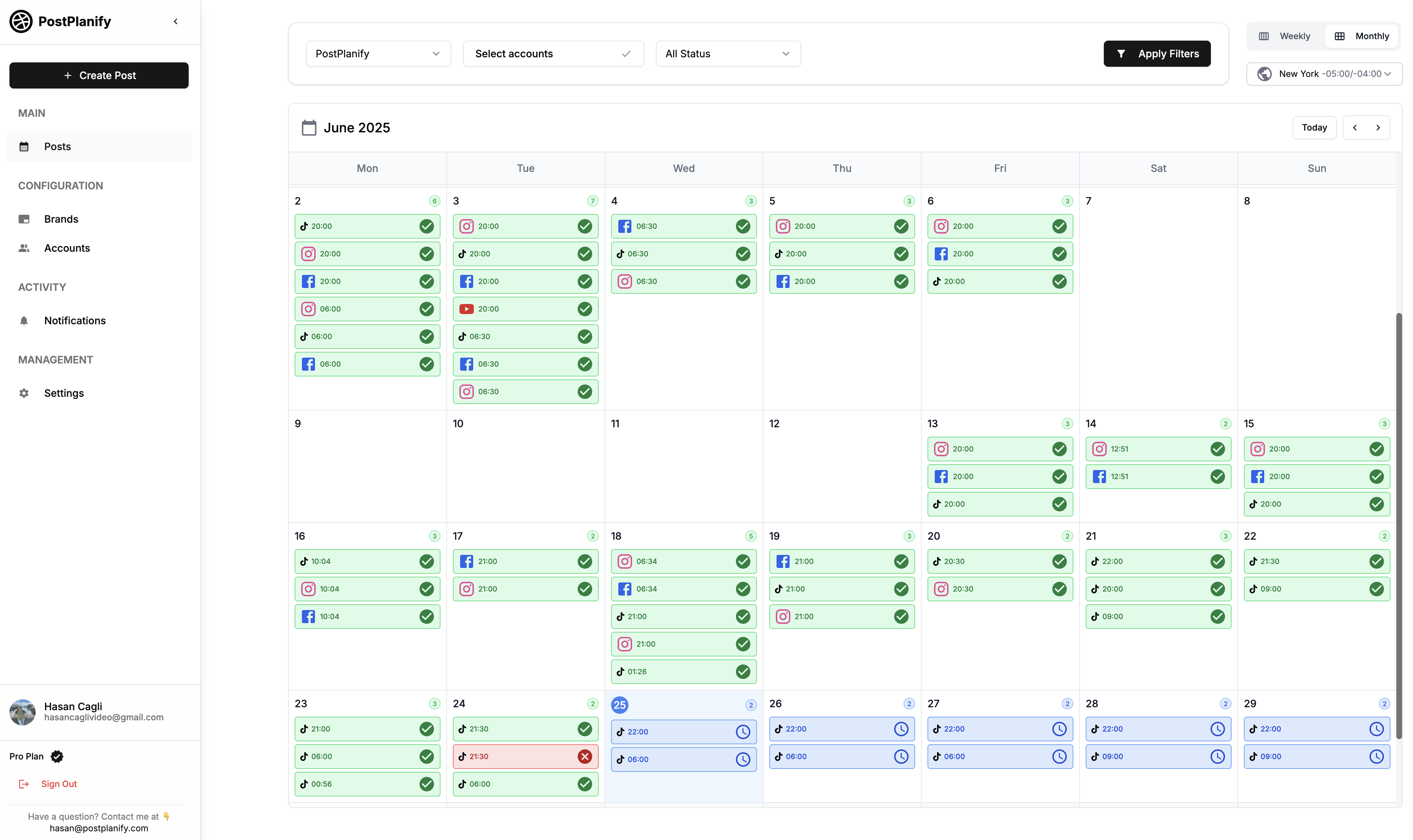
A shared content calendar is your team's single source of truth. It's not a nice-to-have; it's the bedrock of an organized Instagram strategy. When everyone sees the same view of all scheduled, published, and draft posts, you stop conflicts before they happen. If you need help building yours from scratch, our guide on how to create a social media content calendar breaks down the full process.
How a Shared Calendar Prevents Conflicts
The biggest benefit of a unified calendar is instant visibility. It turns scheduling from a guessing game into a clear, visual plan that everyone on the team can understand in real-time.
Here's a real-world scenario: Say two editors are planning an Instagram Story for a product launch on Thursday at 2 PM.
- The first editor schedules their story. It immediately shows up on the shared calendar as a card in that time slot, displaying the Instagram icon, a caption preview, and a media thumbnail.
- When the second editor opens the calendar to schedule their version, they see the first editor's story already sitting right there in the Thursday 2 PM slot—before they even start creating. The conflict is obvious at a glance.
This real-time feedback is what makes team collaboration work. It eliminates duplicate efforts and makes your content cadence feel intentional, not accidental. Some tools also enforce platform-specific limits (e.g., maximum posts per day), preventing your team from accidentally over-posting.
Get a Bird's-Eye View of Your Entire Strategy
A shared calendar does more than prevent double-booking. It gives you a high-level look at your entire content plan, helping you spot opportunities and problems.
- Identify Gaps: A quick glance at the monthly view might show you have nothing planned for an upcoming holiday weekend, allowing you to plan your social media content ahead of time.
- Balance Content Types: You can instantly see if you're over-relying on Reels and forgetting about static images, or vice-versa, helping you maintain a healthy format mix. Not sure which format to use when? Our Instagram post vs. story vs. Reel comparison breaks it down.
- Track Campaign Cadence: Using colored calendar tags to mark specific campaigns lets everyone see how posts for a single launch are spaced out over time, ensuring you're telling a cohesive story.
- Perfect Your Grid Aesthetic: A calendar with a visual preview lets you check how upcoming posts will look on your Instagram grid layout before they go live, so your feed stays cohesive.
A great content calendar isn't just a scheduling tool; it's a strategic dashboard. It shows you what's coming, what's working, and where to focus your team's creative energy.
How to Make Adjustments on the Fly
Plans change. A product launch gets pushed back, or a current event makes a scheduled post feel tone-deaf. A flexible, shared calendar means your team can adapt in minutes.
With drag-and-drop rescheduling, you can simply move a post to a different day or time. If a team member spots a conflict, they can drag the post to a new slot, and the system can check that the new time is valid.
Filtering the calendar by social account is another must-have for organized teams. This lets your Instagram manager isolate just the Instagram content, giving them a clean view of their channel without noise from Facebook or LinkedIn. If your team also needs to schedule posts to all social media at once, a unified calendar becomes even more critical. For ideas on setting yours up, check out these helpful social media content calendar examples.
Step 6: Manage Feedback and Community Engagement as a Team
Publishing a great Instagram post is just the beginning. The real work starts when the comments and DMs begin to roll in. If your team's response to engagement is chaotic, you risk undermining all the effort you put into creating that content. A unified system for managing both internal feedback and external engagement is essential.Centralize Feedback for Continuous Improvement
When a post is sent back for revisions, that feedback can't get lost in a Slack channel. For a team to stay agile, rejection notes need to be direct, specific, and tied directly to the creator. This creates a clear to-do list for edits.
A solid approval workflow, as discussed, supports as many review cycles as needed. If an approver rejects a draft because the caption is missing a hashtag, the creator gets that exact feedback, makes the fix, and resubmits. No confusion, no lost context. Every piece of feedback helps improve not just the current post, but all future content.
Unify Community Management in a Social Inbox
Your comments and DMs are a direct line to your audience. Managing them as a team without a system leads to duplicate replies, missed messages, and an inconsistent brand voice. A unified social inbox solves this problem.
A tool like PostPlanify's social inbox (available for Instagram, Facebook, and LinkedIn) brings all your engagement into one shared dashboard. Instead of everyone logging into the native app, the team works from a single control center. This stops two people from accidentally answering the same question or, worse, leaving a customer's question unanswered.
A unified inbox transforms community management from a chaotic free-for-all into a structured, collaborative effort. It's how you maintain a consistent brand voice, even with multiple people handling engagement.
To make this even smoother, you can assign comments or DMs to specific team members. A technical question can be assigned to a product specialist, while a customer order issue goes to your support lead. This creates clear ownership and ensures the right expert is always on the case. For running contests, specialized free Instagram giveaway picker tools can keep the winner selection process transparent. By systemizing both internal feedback and external engagement, you close the collaborative loop. For a deeper look, check out our guide on effective social media community management. Tracking the impact of your engagement efforts is also important — our social media analytics and reporting guide shows you how to measure what's working.
Step 7: Measure Your Collaboration Results
Setting up collaborations is only half the work. Measuring what's actually working — and what isn't — is how you improve over time and justify the effort to stakeholders.
Key Metrics to Track After a Collaboration
Not every collaboration will be a home run. Tracking the right numbers helps you identify which partnerships to repeat and which to skip next time.
- Reach and impressions: How many unique accounts saw the collaborative content? Compare this to your average post reach to see the lift.
- Engagement rate: Calculate the total engagement (likes + comments + shares + saves) divided by reach. A successful collaboration should outperform your solo posts.
- Follower growth: Did you gain new followers during and immediately after the collaboration? Track the net change over the 48 hours surrounding the post.
- Profile visits: Check your Instagram Insights for a spike in profile visits. This signals that the partner's audience was curious enough to check out your account.
- Saves and shares: These are the highest-value engagement signals. A high save rate means the content was genuinely useful or inspiring. A high share rate means people wanted their friends to see it too.
- Website clicks or link taps: If you're driving to a link in bio or a specific landing page, track the click-through rate during the collaboration window.
Turn Successful Collaborations into Long-Term Partnerships
One-off collaborations are fine, but research shows that 70% of brands see the best ROI from ongoing creator relationships rather than single posts. When you find a partner who delivers strong results, consider:
- A recurring content series — Monthly or quarterly collaborations that your audiences come to expect.
- A long-term ambassador relationship — The creator consistently features your brand, building familiarity and trust with their audience over time.
- Repurposing the best content — Turn high-performing Collab posts into paid ads (using Branded Content tools), pin them to your grid, or adapt them for other platforms.
For a deeper look at tracking performance across all your channels, see our guide on how to create a social media report.
Instagram Collaboration Ideas That Actually Work
Knowing how to collaborate is essential, but knowing what to collaborate on is equally important. Here are proven collaboration formats that consistently drive engagement.
- Joint Giveaways: Partner with a complementary brand to offer a combined prize package. Require participants to follow both accounts and tag friends. This is one of the fastest ways to grow followers, especially when paired with a Collab post so the giveaway reaches both audiences natively.
- Product Launch Teasers: Build anticipation by co-creating a Reel that hints at an upcoming product or collection. The partner's audience gets early access to the excitement, and the shared engagement gives the post a visibility boost right out of the gate.
- Behind-the-Scenes Content: Give followers a look at the process behind a partnership — packing orders together, brainstorming sessions, or a day in each other's workspace. This format feels authentic and builds trust.
- Creator Takeovers: Let a creator take over your Stories for a day. They bring their personality (and their audience), while your account gets fresh, engaging content without your team having to create it.
- Tutorial or How-To Collabs: Partner with someone whose expertise complements yours. A fitness brand could collab with a nutritionist on a "full day of eating + training" Reel. A photographer could collab with an editor on a "before and after edit" carousel.
- Cause-Based Collaborations: Partner with a nonprofit or advocacy account for a cause your brand genuinely supports. These posts tend to generate high save and share rates because followers want to spread the message.
- "Day in the Life" Swaps: Two creators or brands swap accounts for a day, documenting their routines through the other's lens. This format creates curiosity and cross-pollination between audiences.
The best collaboration ideas share two traits: they provide genuine value to both audiences, and they feel natural — not forced. If the partnership feels like an advertisement, it won't perform.
Instagram Collaboration FAQ
How do I add a collaborator to an Instagram post?
Open the Instagram app and create a new Feed post or Reel as usual. On the final screen before publishing, tap "Tag People," then select "Invite Collaborator" instead of "Add Tag." Search for your partner's Instagram handle, select them, and share the post. It goes live on your grid immediately, and once your collaborator accepts the invitation from their notifications, the post appears on their grid too. Both accounts must be Professional (Business or Creator), and the collaborator's account must be public.
Can you have multiple collaborators on an Instagram post?
As of 2026, Instagram limits Collab posts to one collaborator per post. If you need to credit multiple partners, you can tag additional accounts in the post and mention them in the caption. For internal team collaboration (multiple editors, reviewers, and approvers working on the same post), a social media management tool with role-based permissions is a better solution than Instagram's native features.
Can I add a collaborator to an Instagram post after publishing?
No. As of 2026, Instagram does not allow you to add a collaborator to a post that has already been published. You must invite the collaborator before you hit "Share." If you forget, your options are to delete the post and re-create it with the collaborator, or simply tag and mention them instead.
Why is "Invite Collaborator" not showing on my Instagram?
The most common causes are: you're using a Personal account (switch to Business or Creator for free), your app is outdated (update from the App Store or Google Play), the collaborator's account is private, or their tag settings are restricted. You also can't use Collab on Stories — only Feed posts, Reels, and carousels. See the full troubleshooting section above for step-by-step fixes.
How many followers do you need to collab on Instagram?
There is no minimum follower count. Any Professional account (Business or Creator) can send or receive Collab post invitations, regardless of follower count. The feature is available to everyone from brand-new accounts to accounts with millions of followers.
Can I do a Collab post on Instagram Stories?
No. The Collab feature only works with Feed posts, Reels, and carousels. For Story-based collaborations, use the mention sticker to tag your partner's account, or coordinate a simultaneous Story cross-promotion where both accounts post Stories linking to each other's profiles.
What happens if someone declines a Collab request?
If the invited collaborator declines the invitation, your post stays live on your grid as a normal single-author post. Their username is never added to the header, and the post does not appear on their profile. You will not be explicitly notified that they declined — the invitation simply won't be accepted. If the invitation is still pending, you can cancel it by editing the post and removing the collaborator before they respond.
What's the difference between an Instagram Collab post and a tagged post?
A Collab post is co-authored — it appears on both creators' profile grids, and all likes, comments, and views are shared on a single post. A tagged post only appears on the original creator's grid. The tagged account gets a notification and the post shows up in their "Tagged" tab, but they don't get shared engagement metrics or equal billing in the post header. Collab posts are far more powerful for reach because both audiences see the content in their feeds.
Can I approve Instagram posts before they go live?
Not with Instagram's native tools — once you hit "Share" or "Schedule," the post goes live or is queued without any review step. To add an approval layer, you need a third-party tool. PostPlanify's approval workflow holds scheduled posts in a "pending" state until every designated approver signs off. If anyone rejects the post, it's canceled and the creator is notified with specific feedback.
Can you boost or promote an Instagram Collab post?
Yes, but only the original poster can promote a Collab post as a paid ad through Instagram's promotion tools. If the post also uses the Branded Content / Paid Partnership label, the brand partner can promote it as a Branded Content ad through Meta Ads Manager, giving both parties the ability to amplify its reach.
How do I manage an Instagram account with a team without sharing the password?
Use a social media management platform that connects to Instagram through the official API. Tools like PostPlanify let each team member log in with their own account and access the brand's Instagram through assigned roles — Owner, Editor, Client, or Viewer. Nobody needs the actual Instagram password, and every action is tied to a specific person for full accountability.
What permissions do team members need to manage an Instagram account?
It depends on their role. Content creators need the ability to draft, schedule, and edit posts. Reviewers need the ability to approve or reject content with feedback. Managers need access to workspace settings, social account connections, and team member management. A good management tool enforces these boundaries automatically — an editor can't publish without approval, and a reviewer can't accidentally edit scheduled content.
How do I set up an approval workflow for Instagram posts?
In a tool like PostPlanify, go to your workspace settings and enable "Require Post Approval." You can also set default approvers so every new post is automatically routed to the right reviewers. When a creator schedules a post, it enters a "pending" state and won't publish until every designated approver signs off. Approvers get notified by email and in-app, and if they reject, they provide a reason so the creator knows exactly what to fix. For more options, see our roundup of the best social media tools with approval workflows.
How many team members can manage one Instagram account?
With Instagram's native app, there are no formal team features — you'd need to share the password. Meta Business Suite allows you to assign Page roles, but permissions are limited. With a dedicated tool like PostPlanify, Growth supports 3 users, Premium supports 6 users, Scale supports 12 users, and Enterprise is custom. Each member gets their own login and role-based permissions.
PostPlanifyAll your social media in one simple dashboard
Schedule posts, track analytics, and reply to comments/DMs without switching tabs.
Engagement
+18%
Views
52.8k
Instagram Collaboration Checklist
Feeling overwhelmed? Don't be. Here's a simple checklist to get your Instagram collaboration workflow on the right track.
- Stop Sharing Passwords Immediately: Switch to a social media management platform that uses secure API connections and role-based permissions.
- Define Team Roles: Assign roles like Owner, Editor, and Client/Reviewer to create clear responsibilities and prevent accidental mistakes.
- Build an Approval Workflow: Implement a mandatory review process where content must be approved before publishing. Use a tool that supports clear reject-and-revise cycles.
- Use a Shared Content Calendar: Give your entire team a single source of truth for all scheduled content to prevent conflicts and spot gaps in your strategy.
- Leverage Instagram's Native Tools: Use Collab posts to expand your reach with partners and Branded Content tools for transparency in paid campaigns.
- Vet Partners Before Reaching Out: Check engagement rates, content quality, and audience alignment before proposing a collaboration.
- Centralize Community Management: Use a unified social inbox to manage comments and DMs as a team, assign conversations, and maintain a consistent brand voice.
- Measure and Iterate: Track reach, engagement, follower growth, and saves after every collaboration to identify what's working.
Final Thoughts on Instagram Collaboration
Successful Instagram collaboration isn't a matter of luck; it's a result of a well-designed system. By defining roles, building a mandatory approval process, and using a shared calendar, you eliminate the guesswork and chaos that plague so many teams.
Instead of chasing approvals and fixing mistakes, your team can focus on what they do best: creating great content that grows your brand. A streamlined process also means you save time on social media management every single week. Ready to build a better workflow? A platform like PostPlanify can provide the structure you need.
Key Takeaways
- Sharing your Instagram password with a team is the fastest path to chaos — use a management tool with role-based permissions (Owner, Editor, Client, Viewer) so every action is tied to a specific person
- Instagram's native Collab post feature lets two accounts co-author content that appears on both profile grids with shared engagement — both accounts must be Professional and public
- Collab posts work with Feed posts, Reels, and carousels but not Stories — and you can invite up to one collaborator per post
- If "Invite Collaborator" isn't showing, the most common fixes are switching to a Professional account, updating the app, and checking the collaborator's tag settings
- A mandatory approval workflow with a reject-and-revise loop prevents off-brand content from going live — most teams go through two to three review rounds per campaign
- A shared content calendar is your team's single source of truth — it prevents scheduling conflicts, reveals content gaps, and supports drag-and-drop rescheduling for quick adjustments
- Vet collaboration partners by engagement rate, not follower count — nano and micro influencers typically deliver the best ROI
- Centralizing comments and DMs in a unified social inbox with team assignment stops duplicate replies and ensures the right person handles each conversation
- Track reach, engagement rate, follower growth, and saves after every collaboration to identify which partnerships are worth repeating
- Instagram's native tools have no built-in approval workflow — if you need content review before publishing, a third-party tool is required
Related Reading
- How to Schedule Instagram Posts: Full Guide
- How to Schedule Instagram Reels
- How to Schedule Instagram Stories
- Best Social Media Tools with Approval Workflows
- Best Social Media Management Tools for Teams
- Best Social Media Management Tools for Agencies
- How to Create a Social Media Content Calendar
- How to Plan Social Media Content
- How to See Scheduled Posts on Instagram
- Instagram Scheduled Posts Not Working? 10 Quick Fixes
- Best Time to Post on Instagram
- Instagram Image Size Guide
- Social Media Scheduling Tools
- Manage Multiple Social Media Accounts
- Content Batching: How to Create More in Less Time
- Automating Instagram Posts Safely
- How to Create a Social Media Report
- Best Social Media Management Platform
- Instagram Grid Layout Guide
- How to Schedule Carousel Posts on Instagram & Facebook
- Save Time on Social Media Management
- How to Schedule Anything on Instagram
- Best Apps to Post to All Social Media at Once
- How to Grow Instagram Followers Organically
- Why Can't I Post on Instagram?
PostPlanifyAll your social media in one simple dashboard
Schedule posts, track analytics, and reply to comments/DMs without switching tabs.
Engagement
+18%
Views
52.8k
About the Author

Hasan Cagli
Founder of PostPlanify, a content and social media scheduling platform. He focuses on building systems that help businesses, agencies, and teams plan, publish, and manage content and social media more efficiently across platforms.


