


Before a traveler ever books a room, they've already seen your hotel: on a friend's Instagram story, in a TikTok room tour, or three reviews deep on Google. 57% of travelers now say they're comfortable booking travel directly through social media (Skift Research), and 96% read reviews before they book, with 77% more likely to book a hotel when the owner responds to reviews (Tripadvisor). Your feed, your review replies, and the video someone shot by your pool are doing the work of a sales team, whether you're managing them or not.
The problem is scale and leakage. One property juggles Instagram, TikTok, Facebook, and Google alongside a constant demand for fresh visuals; a group multiplies that by every location. Reviews and messages land across Google, TripAdvisor, Booking.com, and Instagram at once, and the demand all of it creates often leaks to an online travel agency that takes a commission on the booking you sourced.
This guide compares the 11 best social media management tools for hotels and hospitality in 2026, scored on what a property actually uses.
Quick Answer: The Best Social Media Tool for Hotels
For most hotels, the best tool is PostPlanify: Google Business publishing and review replies, AI captions and images for room and F&B content, a link-in-bio that routes guests to your direct booking page, and approval workflows that hold brand standards across properties, priced per property from $39/month with unlimited team members.
If something else is your priority:
- Large groups and chains: Sprout Social for enterprise listening and reporting
- Reputation-led properties: Vista Social for Google, Yelp, and Facebook reviews in one place
- Visual, Instagram-first resorts: Later for grid planning and UGC
- Proving ROI on a budget: Metricool for analytics and paid campaigns
- Independent hotels starting out: Buffer for a free, simple start
Quick Picks: Best Social Media Tools for Hotels
| Tool | Best for | Starting price | Standout for hotels |
|---|---|---|---|
| PostPlanify | Best overall for hotels | From $39/mo per property | Google Business + reviews, AI visuals, direct-booking link |
| Sprout Social | Hotel groups & chains | $99/seat/mo | Enterprise analytics + social listening |
| Hootsuite | Enterprise multi-property brands | $99/user/mo | Breadth of integrations + listening |
| Agorapulse | Guest engagement & social CRM | $99/user/mo | Strongest unified inbox + social CRM |
| Vista Social | Multi-site review management | $99/mo | Google, Yelp & Facebook reviews in one place |
| Later | Visual & Instagram-first content | $25/mo | Grid planning + UGC collection |
| Metricool | Analytics & paid campaigns | Free / $25/mo | Deep analytics + ad management + SmartLinks |
| Sendible | Hospitality marketing agencies | $35/mo | White-label client dashboards |
| SocialPilot | Budget multi-property management | $30/mo | Bulk scheduling + white-label at low cost |
| Buffer | Independent & boutique hotels | Free / $6/channel | Simplest free start |
| Loomly | Brand-consistent approvals | $65/mo | Structured multi-step sign-off |
What Matters in a Social Media Management Tool for a Hotel
Not every social media tool is built for hospitality. These are the criteria that actually matter when you're running a property, not a marketing agency:
- Google Business Profile + review management. For a hotel, Google Business and the reviews on it decide bookings: it's where high-intent "hotels near me" searchers land. Our roundup of Google Business Profile tools goes deeper on that surface alone. The right tool lets you post to Google Business and reply to reviews in one place, since travelers are 77% more likely to book when a hotel responds to reviews. Budget for more than one listing, too: Google's guidelines allow departments that operate as distinct entities, with their own entrance and a category different from the main business, to hold their own Business Profile, so an on-site restaurant or spa may be a separate listing to post to and reply on.
- Visual and short-video scheduling. Hotels are judged on imagery. Reels, TikToks, room reveals, and drone shots are your highest-reach content, so you want a visual calendar, an Instagram grid preview, and easy video scheduling with platform-specific previews.
- A unified guest inbox. Reviews, comments, and DMs arrive across Google, TripAdvisor, Instagram, and Facebook at all hours, often in multiple languages. One inbox to triage and assign them, without handing out logins, keeps you responsive. We compare the category in our guide to social media inbox tools.
- Link-in-bio + direct-booking routing. Social creates demand; a link-in-bio that points at your booking engine captures it directly instead of letting it leak to a commission-charging OTA.
- UGC and AI content help. Guest photos are the most trusted content in travel, so tools to collect and reshare them matter, and AI captions and images remove the blank-page problem for room, F&B, and destination posts.
- Multi-property support. Managing several locations means location-specific calendars, unified analytics, role-based access, and a shared media library that keeps brand standards consistent across properties.
- Pricing that fits a property. Most tools charge per user or per channel, which punishes a small team the moment you add a GM, a front-office poster, or an agency. Pricing that scales with properties rather than headcount is far more predictable for a hotel, and we rounded up the tools with no per-seat fees separately.
I evaluated the 11 tools below against these criteria, cross-referencing pricing taken from each vendor's own page in September 2026 and verified user reviews on G2, Capterra, and Trustpilot, and weighted the features a property actually uses (Google Business, reviews, visual scheduling, direct-booking links) over the enterprise depth most hotels never touch.
1. PostPlanify: Best Overall for Hotels
PostPlanify is built for the reality of hotel marketing: a small team, a relentless need for fresh visuals, and guests who discover, review, and book across a dozen surfaces. It bundles scheduling, analytics, a unified inbox, AI content tools, and a booking-focused link-in-bio, and it prices per client workspace rather than per seat, so a workspace maps to a property and front-office staff, an agency, or a GM reviewing posts all cost nothing to add.
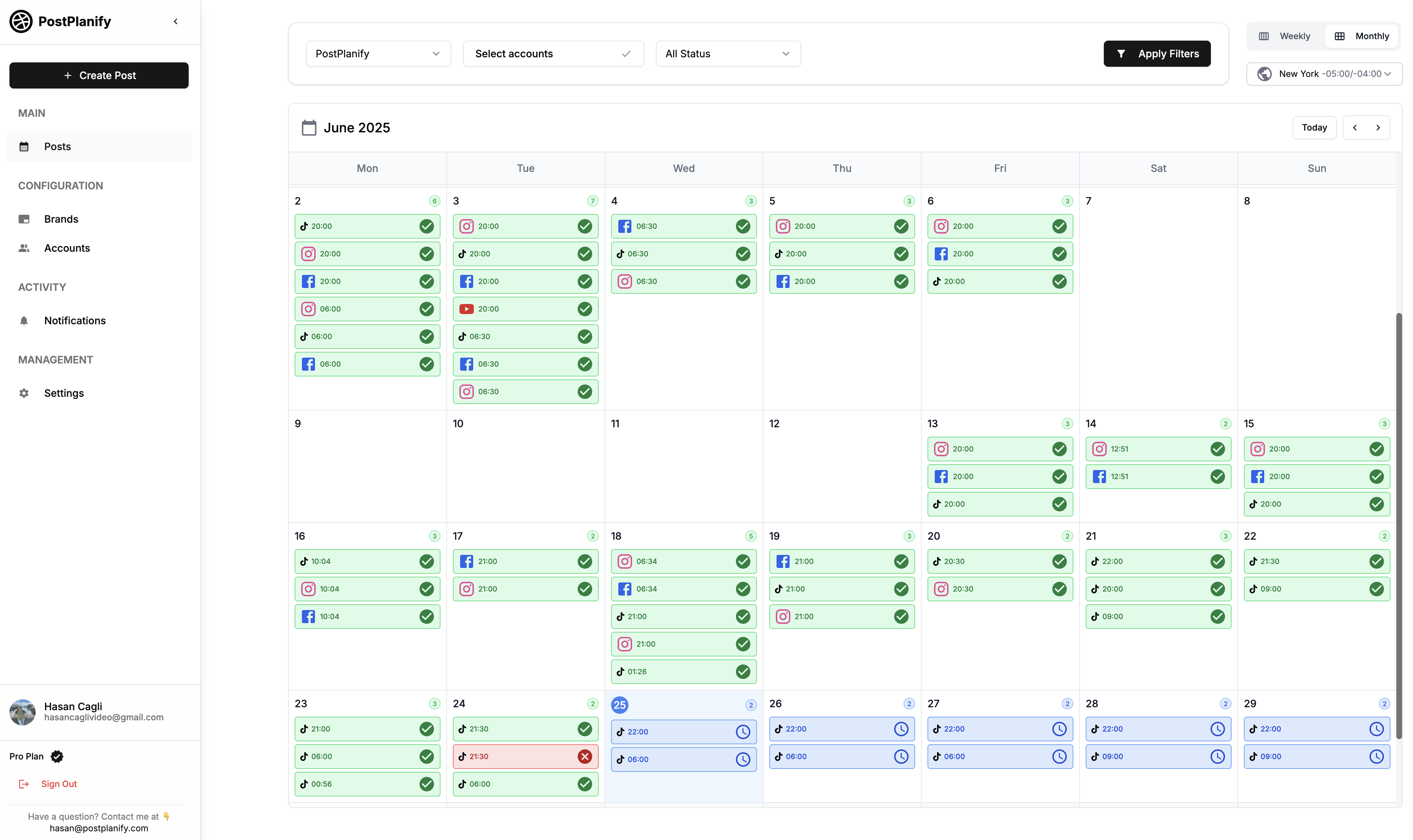
Three things make it fit a hotel specifically. It posts to Google Business and answers Google reviews in the same inbox, so the surface that decides local bookings is where you already work. Its AI assistant turns room reveals and F&B features from a blank page into a batched week of content. And its link-in-bio sends followers to your booking engine rather than an OTA that takes a cut.
At a glance
- Pricing: Per property and graduated: Growth from $39/mo, Premium from $49/mo, Scale from $59/mo, with each extra property billed in a cheaper band
- Team members: Unlimited on every plan, including GMs and agency reviewers
- Platforms: 10, including Google Business, Instagram, Facebook, TikTok, YouTube, and LinkedIn
- Free trial: 7 days (14-day money-back guarantee)
- Best for hotels: Independent properties through multi-property groups that want Google Business, reviews, AI visuals, and a direct-booking link in one tool
Key features for a hotel
- Publish to Google Business + reply to Google reviews from the social inbox (Instagram, Facebook, LinkedIn, Google Business, YouTube)
- AI-powered captions and image generation for rooms, F&B, and destination content
- Link-in-bio that routes followers to your direct booking page
- Approval workflows, single and multi-step, included from the entry plan to keep brand voice consistent across properties
- Visual content calendar with platform-specific previews, plus bulk scheduling to queue a month of property content in one sitting
- Analytics and reporting across all 10 platforms, including Google Business search impressions and customer actions
- A shared media library for approved property photography, guest UGC, and brand assets
- Unlimited team members and client approvers on every plan, so adding a GM or an agency never changes the bill
- White-label reports on Scale for groups reporting to owners or asset managers
Pricing
| Workspaces | Growth | Premium | Scale |
|---|---|---|---|
| 1 workspace | $39/mo | $49/mo | $59/mo |
| 3 workspaces | $97/mo | $127/mo | $157/mo |
| 5 workspaces | $155/mo | $205/mo | $255/mo |
| 10 workspaces | $250/mo | $350/mo | $450/mo |
| Social accounts per workspace | 4 | 6 | 8 |
Unlimited team members on every plan, no per-seat fees. Yearly billing saves 20%. All plans include a 7-day free trial with a 14-day money-back guarantee.
How it fits a hotel: It scales cleanly from a single property to a multi-property group. Each property gets its own workspace with 4 social accounts on Growth, and because the bill follows properties rather than headcount, adding front-office staff, a GM approver, or an agency costs nothing. The trade-off: a large chain that needs deep enterprise social listening and cross-market benchmarking will still want a dedicated suite for that specific layer.
Verdict: The best all-round fit for most hotels: strong on the things properties actually need (Google Business, reviews, visual AI content, a direct-booking link) without enterprise per-seat pricing.
Learn more: See the full PostPlanify pricing breakdown, the hotel & hospitality scheduler, or start a free trial.
 PostPlanify
All your social media in one simple dashboard
Schedule posts, track analytics, and reply to comments/DMs without switching tabs.

Engagement
+18%
Views
52.8k
2. Sprout Social: Best for Hotel Groups & Chains
Sprout Social is the enterprise choice. Its analytics, social listening, and reporting are the deepest in the category, a genuine fit for hotel groups and chains that run marketing as a measured function and need to benchmark performance across brands and markets.
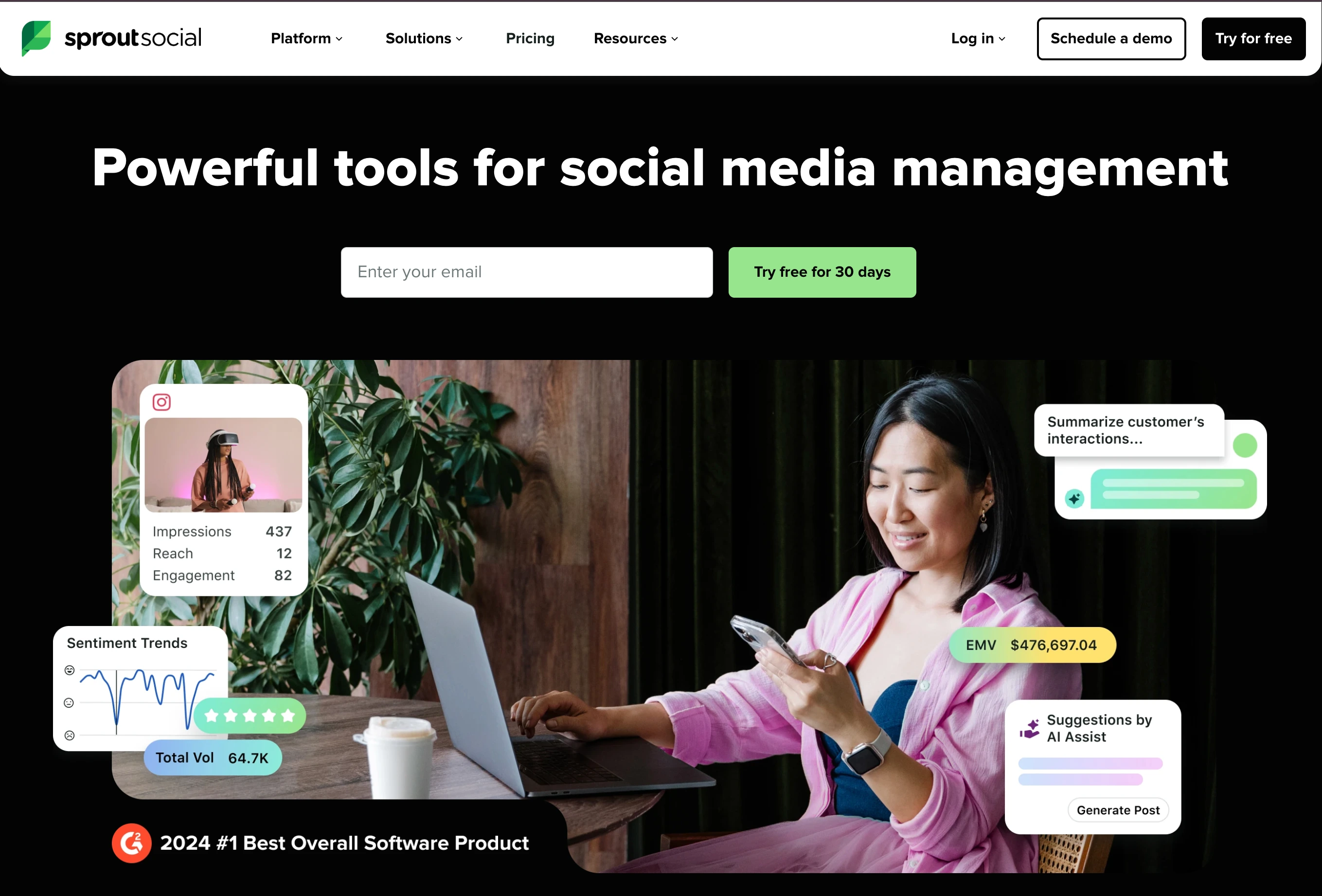
The wall is price. Sprout starts at $99 per seat per month on Essentials and $199 on Standard, listening is a paid add-on, and every additional team member pays the full seat cost, so a property-level marketing coordinator is an expensive way to schedule a Reel. Review management is included across plans, which matters for hotels, but you're buying enterprise governance a single property will never fully use.
At a glance
- Pricing: $99 Essentials ($79 annual) / $199 Standard / $299 Professional / $399 Advanced per seat/mo; 30-day trial, no free plan
- Best for hotels: Multi-brand groups and chains needing enterprise reporting and listening
- Ratings: 4.4/5 on G2 (5,731 reviews), 2.2/5 on Trustpilot (75)
How it fits: Ideal for a hotel group's in-house marketing team; overkill and costly for an independent property that mainly needs to post and manage reviews.
Verdict: Best-in-class analytics for large hotel groups, but the per-seat cost is hard to justify below the chain level.
Learn more: Sprout Social pricing, Sprout Social reviews, and the best Sprout Social alternatives.
3. Hootsuite: Best for Enterprise Multi-Property Brands
Hootsuite plays at the same enterprise tier, competing on breadth: a huge app directory, paid social, employee advocacy, and social listening through a Talkwalker add-on. Large hospitality brands that want one platform standardized across dozens of properties often land here.
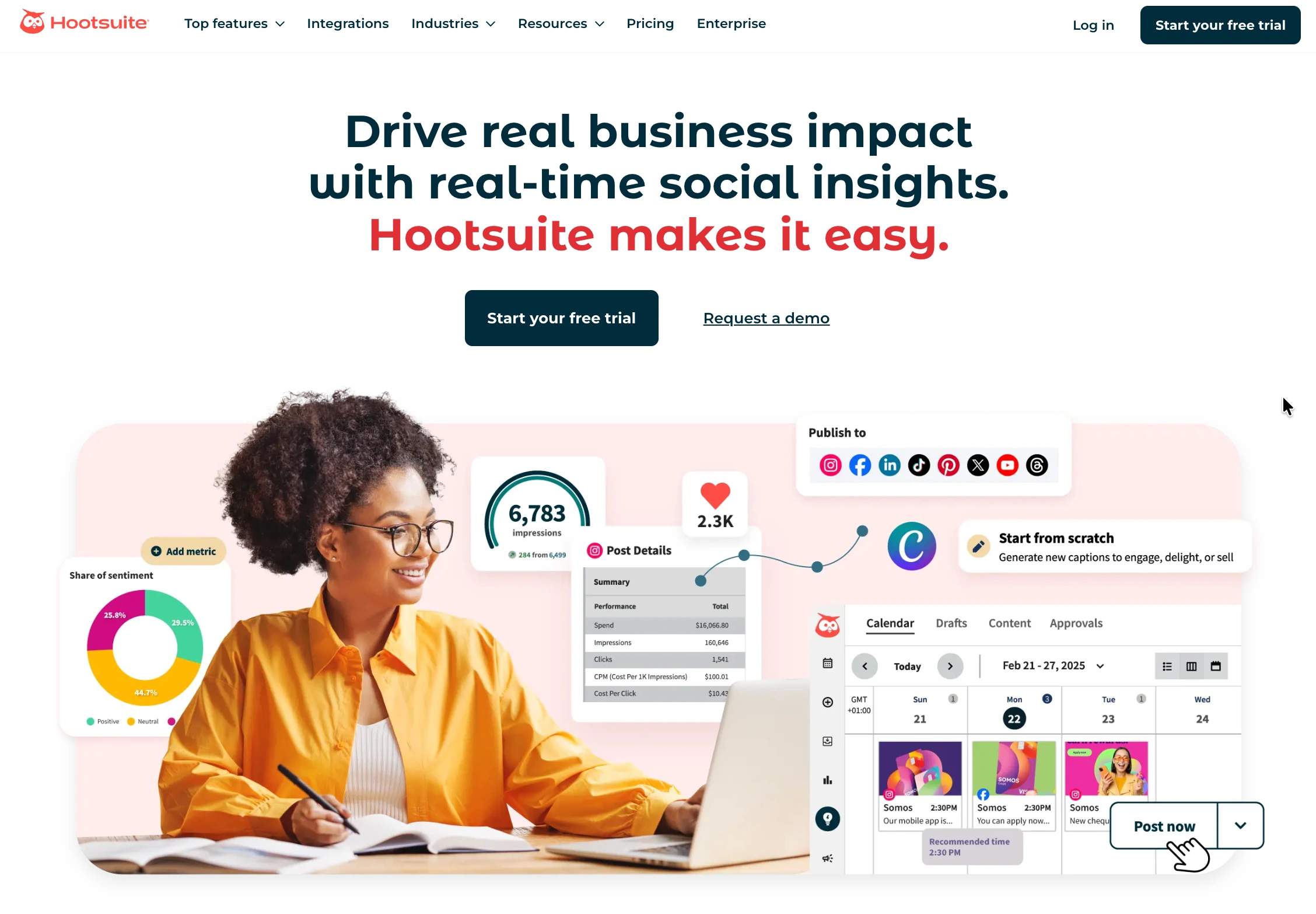
It carries enterprise pricing to match: $99 per user per month on Standard, rising to $399 on Advanced, no free plan since 2023, and review management only as an Enterprise add-on. For a hotel, that's a lot of platform to buy for what is often a review-and-visuals job, and the Trustpilot score (1.8/5 across 511 reviews, mostly billing complaints) is worth reading before you commit annually.
At a glance
- Pricing: $99 (Standard) / $199 (Professional) / $399 (Advanced) per user/mo; 14-day trial, no card required
- Best for hotels: Enterprise brands needing integrations and governance at scale
- Ratings: 4.3/5 on G2 (6,615 reviews), 1.8/5 on Trustpilot (511)
How it fits: A fit for large organizations; independent hotels will feel the complexity and cost.
Verdict: Powerful and broad, but built for enterprises: most properties pay for capability they won't touch.
Learn more: Hootsuite pricing, Hootsuite reviews, and the best Hootsuite alternatives.
4. Agorapulse: Best for Guest Engagement & Social CRM
Agorapulse is built around engagement, and for a hotel that's the whole point. Its unified inbox is the strongest on this list: comments, DMs, and reviews pour into one queue your team can triage and assign, and a built-in social CRM remembers each guest's history so a returning visitor is never answered cold.
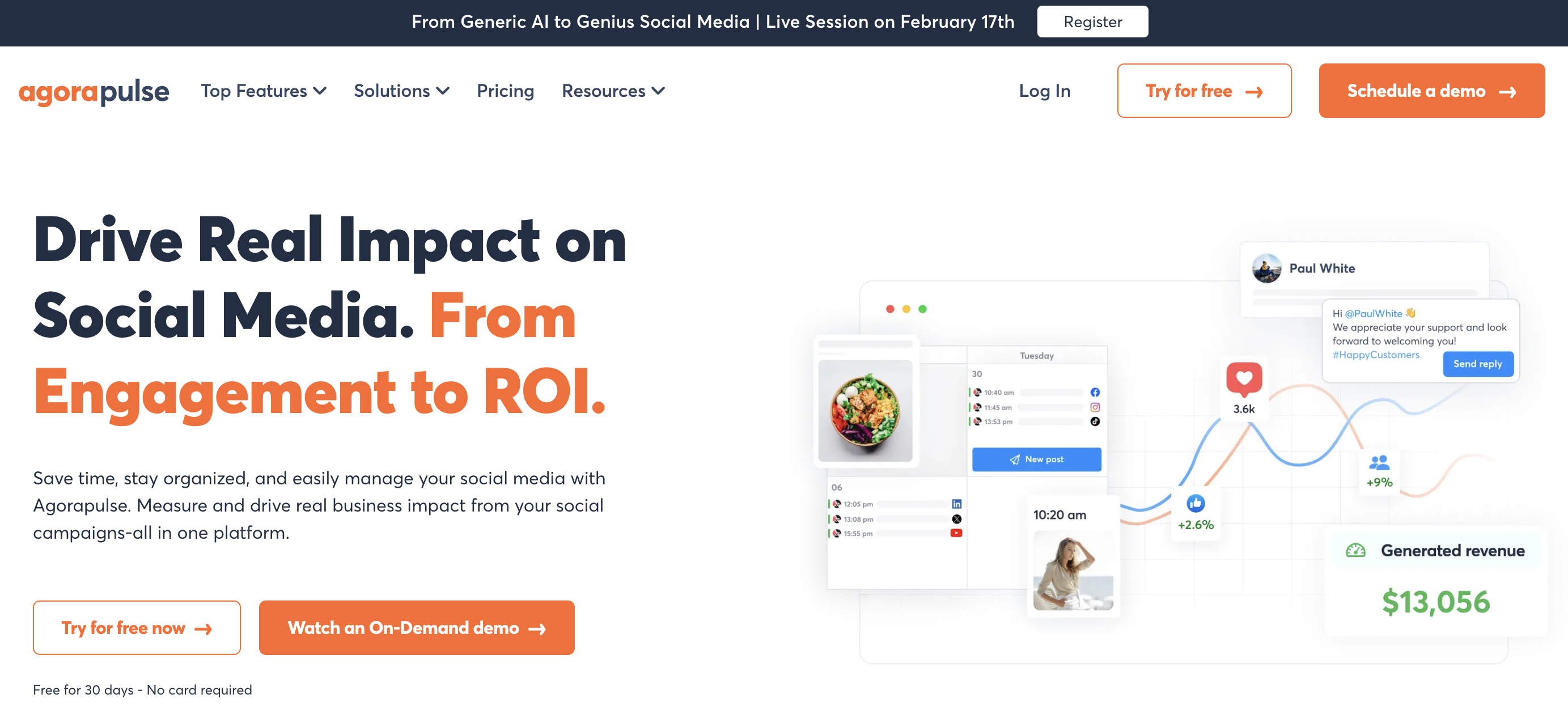
For a property fielding questions and comments across Google, Instagram, and Facebook at all hours, that inbox is the reason to choose it, and because Agorapulse publishes to Google Business and includes its PulseLink link-in-bio, posting and guest care sit in one workspace. The meter is the catch: at $99–$199 per user, a three- or four-person front-of-house team pays several times what a tool with unlimited seats costs, and profiles are capped at 10 unless you move to a custom tier.
At a glance
- Pricing: $99/$149/$199 per user/mo ($79/user annual); 30-day trial, no free plan
- Best for hotels: Properties where responding to guests is the priority
- Ratings: 4.5/5 on G2 (967 reviews), 4.0/5 on Trustpilot
How it fits: Excellent if engagement is your focus; per-user pricing adds up for larger teams.
Verdict: The engagement pick: the best unified inbox and social CRM for a property that lives on guest interaction.
Learn more: Agorapulse pricing, Agorapulse reviews, and the best Agorapulse alternatives.
5. Vista Social: Best All-in-One for Review Sites
Vista Social is the most complete all-in-one on this list for a hotel that lives and dies by its reputation. Alongside scheduling and a unified inbox, it natively manages six review sites: including Google, Yelp, and Facebook, so a property can read and reply to the reviews that decide bookings without juggling separate tabs. It's rated 4.8/5 on G2 across more than 1,000 reviews, the highest score in this comparison.
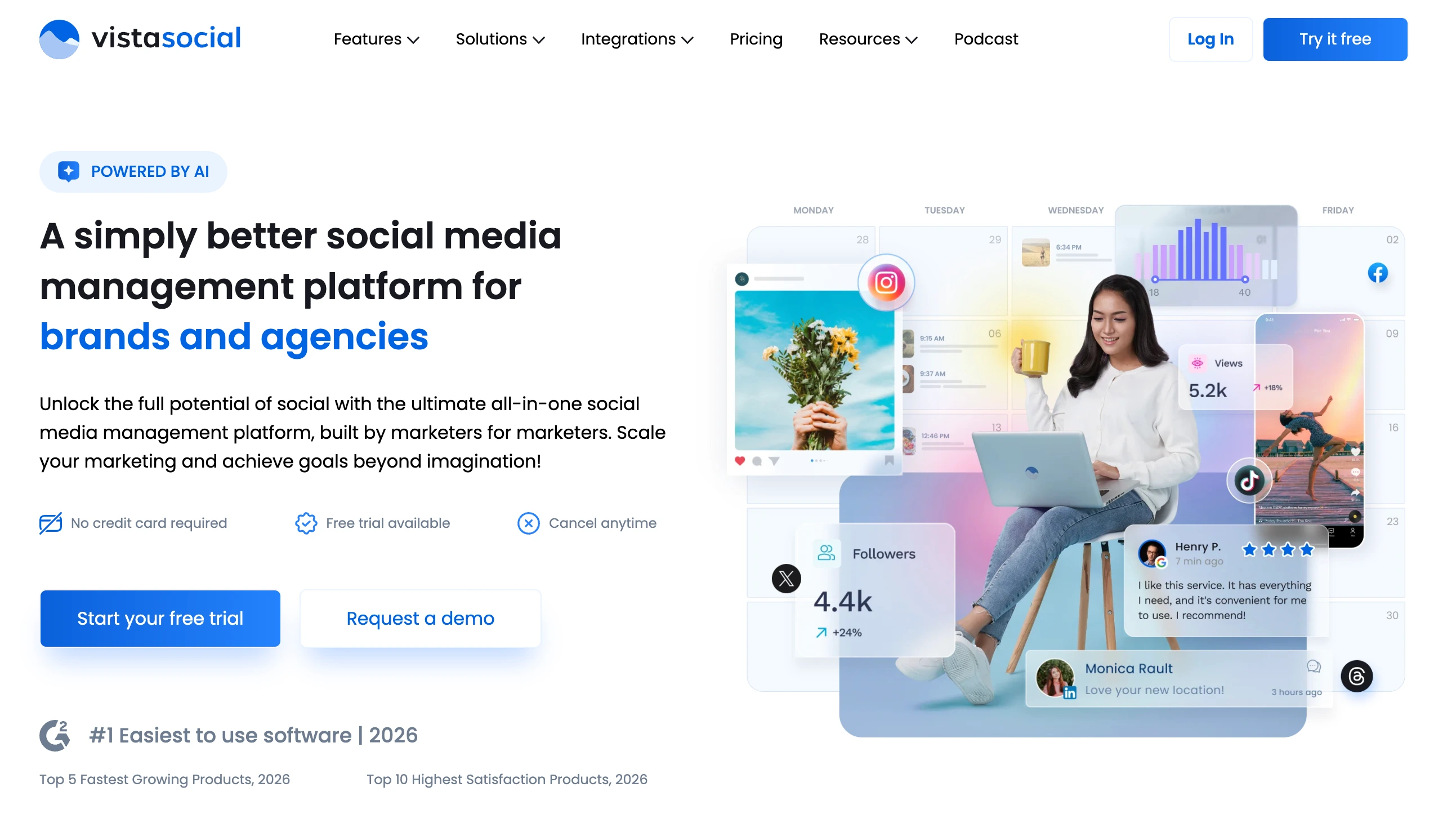
For a hotel, the draw is breadth at a mid-market price: review management, a Vista Page link-in-bio for routing followers to your booking engine, DM automations, and social listening all sit in one dashboard, with plans starting at $99/month for 15 profiles: workable for a single property or a small group. Two caveats worth knowing: X/Twitter is a paid add-on rather than included, and the sheer breadth of modules can feel cluttered if you only need scheduling and reviews. AI image generation also leans on a connected Canva account rather than being built in.
At a glance
- Pricing: $99 Professional (15 profiles, 2 users) / $199 Advanced (30 profiles, 3 users) / $449 Scale (70 profiles, 4 users) per mo; 14-day trial, no free plan
- Best for hotels: Reputation-focused properties that want reviews, scheduling, and inbox in one affordable all-in-one
- Ratings: 4.8/5 on G2 (1,071 reviews), 4.1/5 on Trustpilot (62), 4.9/5 on Capterra (scheduling)
How it fits: Excellent for a property or small group that wants native review-site management without enterprise pricing; the feature breadth is more than a scheduling-only hotel needs, and X costs extra.
Verdict: The all-in-one reputation pick: the best-rated tool here, and the strongest at managing Google, Yelp, and Facebook reviews from one place.
Learn more: Vista Social pricing, Vista Social reviews, and the best Vista Social alternatives.
6. Later: Best for Visual & Instagram-First Content
Later is the visual specialist, and hospitality is exactly the kind of visually-driven business it was made for. Its drag-and-drop grid preview lets you compose an Instagram feed that looks like a magazine spread before anything publishes, its media library keeps property photography organized, and its UGC collection tools help you gather and reshare the guest content travelers trust most.
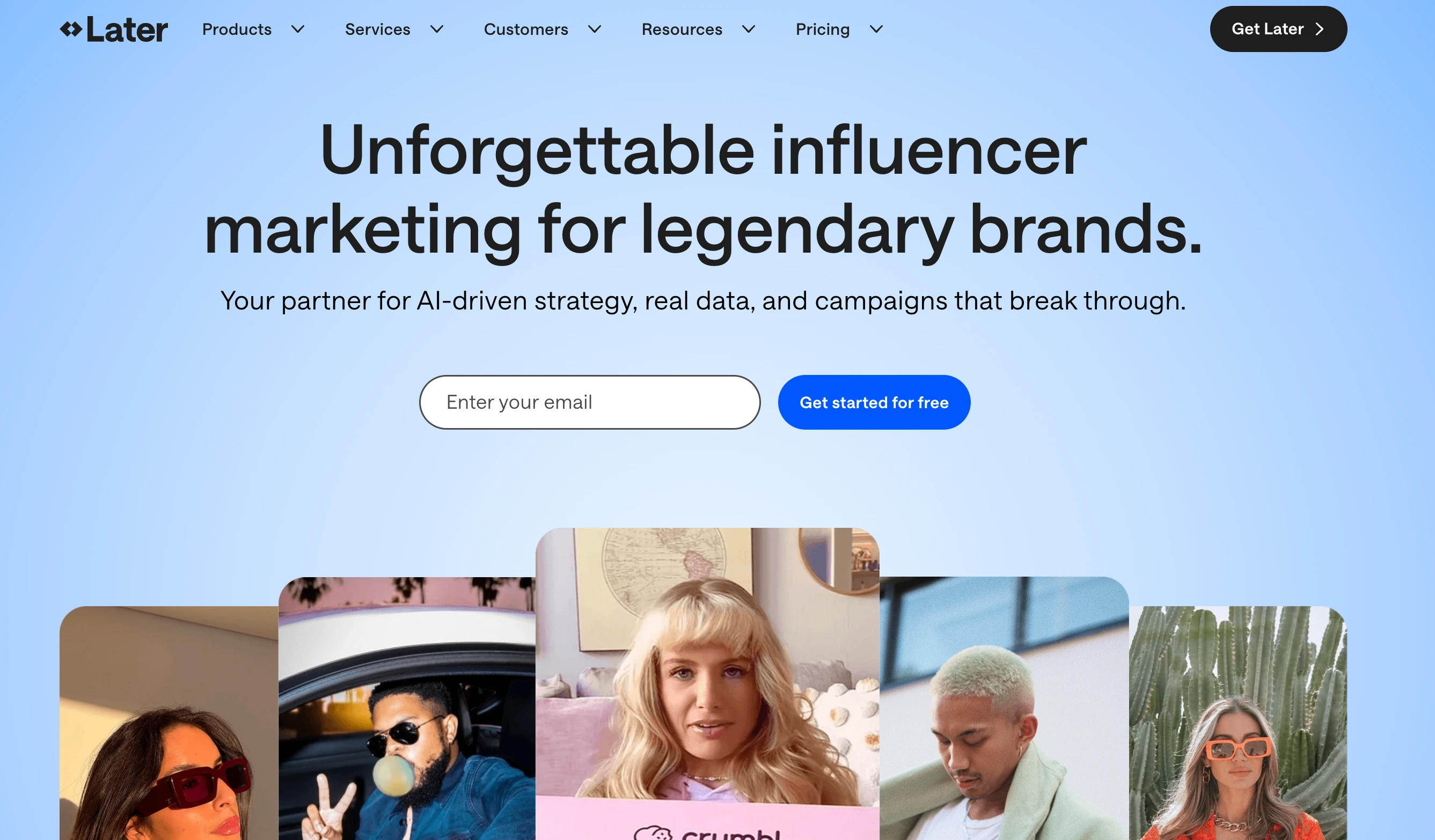
There's a real catch for hotels, though. Later does not support Google Business Profile, the single most important local surface for a property, so reviews and map-pack presence would have to live in another tool entirely, and it dropped X/Twitter in 2025. Its Linkin.bio page (on every plan) is a genuine asset for routing followers to a booking page, but the wide gap between its G2 rating (4.5) and Trustpilot score (1.3/5 across 329 reviews, heavy on billing complaints) is a caution. Treat Later as a visual front-end you pair with something that handles Google and reviews, not an all-in-one.
At a glance
- Pricing: $25 Starter / $50 Growth / $110 Scale per mo; limited free plan, 14-day trial
- Best for hotels: Visual-first properties and resorts that live on Instagram
- Ratings: 4.5/5 on G2 (347 reviews), 1.3/5 on Trustpilot (329)
How it fits: Excellent for visual planning and UGC; the missing Google Business support means most hotels will run it alongside a review tool.
Verdict: The Instagram and UGC pick: beautiful visual planning, but not a complete hotel solution on its own.
Learn more: Later pricing, Later reviews, and the best Later alternatives.
7. Metricool: Best for Analytics & Paid Campaigns
Metricool is the pick for hotels that want to measure what social is doing for them, and it ranks high in our wider comparison of social media analytics tools. Its analytics are its whole identity (competitor benchmarking, unlimited historical data, and clean custom reports), and it uniquely folds in paid-ad management for Facebook, Instagram, Google, and TikTok campaigns, so you can plan organic content and the ads that fill rooms in the same place.
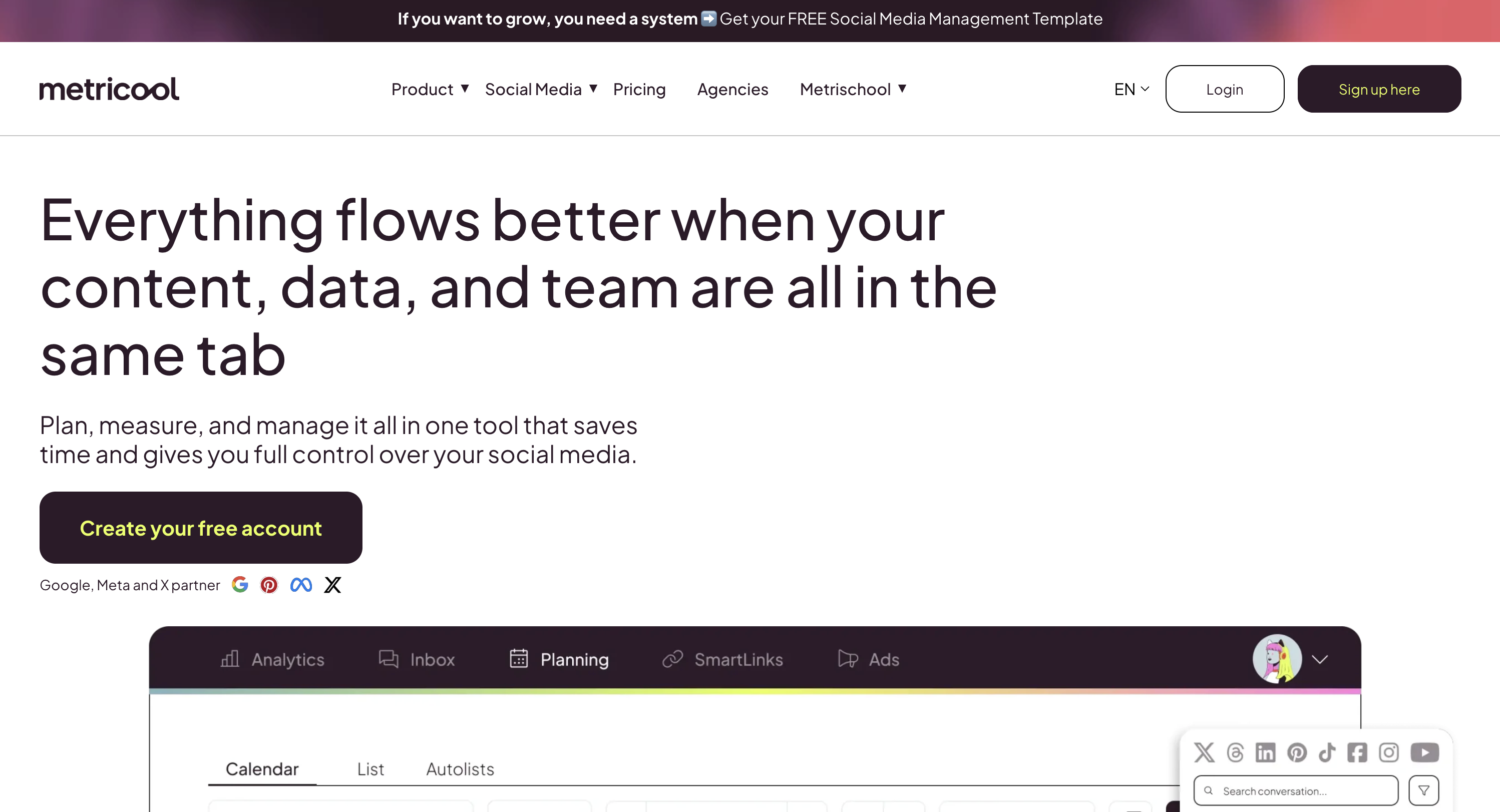
It's also genuinely affordable: a free plan to test the analytics, then paid plans from $25/month, with SmartLinks (its link-in-bio) for routing followers to your booking page and trackable performance on every post. The trade-offs are real for a hotel, though: it leans analytical rather than creative: AI captions, image generation, and rich post previews are thin, and its inbox covers the major networks but lacks the automated moderation and review-site depth a reputation-heavy property may want. X/Twitter is a $5/month add-on, and the free plan excludes LinkedIn and X entirely.
At a glance
- Pricing: Free (1 brand) / Starter from $25/mo / Advanced from $67/mo; free plan, no trial needed
- Best for hotels: Properties and groups that want deep analytics, competitor tracking, and ad management on a budget
- Ratings: 4.5/5 on G2 (83 reviews), 4.2/5 on Trustpilot (519), 4.8/5 on Capterra (ease of use)
How it fits: Ideal if reporting and ROI tracking drive your decisions; less suited to a property that wants an all-in-one for content creation and guest engagement.
Verdict: The analytics-and-ads pick: the most affordable way to measure social's impact on bookings and run paid campaigns, if you can live with lighter content tools.
Learn more: Metricool pricing, Metricool reviews, and the best Metricool alternatives.
8. Sendible: Best for Hospitality Marketing Agencies
Sendible is designed for agencies running social for multiple clients, which describes the marketing firms many hotels outsource to. Its calling card is white-label client dashboards and branded reports, so an agency can hand each property a client-facing portal under its own brand, plus a Priority Inbox and Client Connect approval links for sign-off. Budget for it properly though: white label is a $349/mo add-on sold only on Elite ($299/mo) and above, so the branded setup starts at $648/mo. Our comparison of white label social media management tools shows which tools include it in-plan.
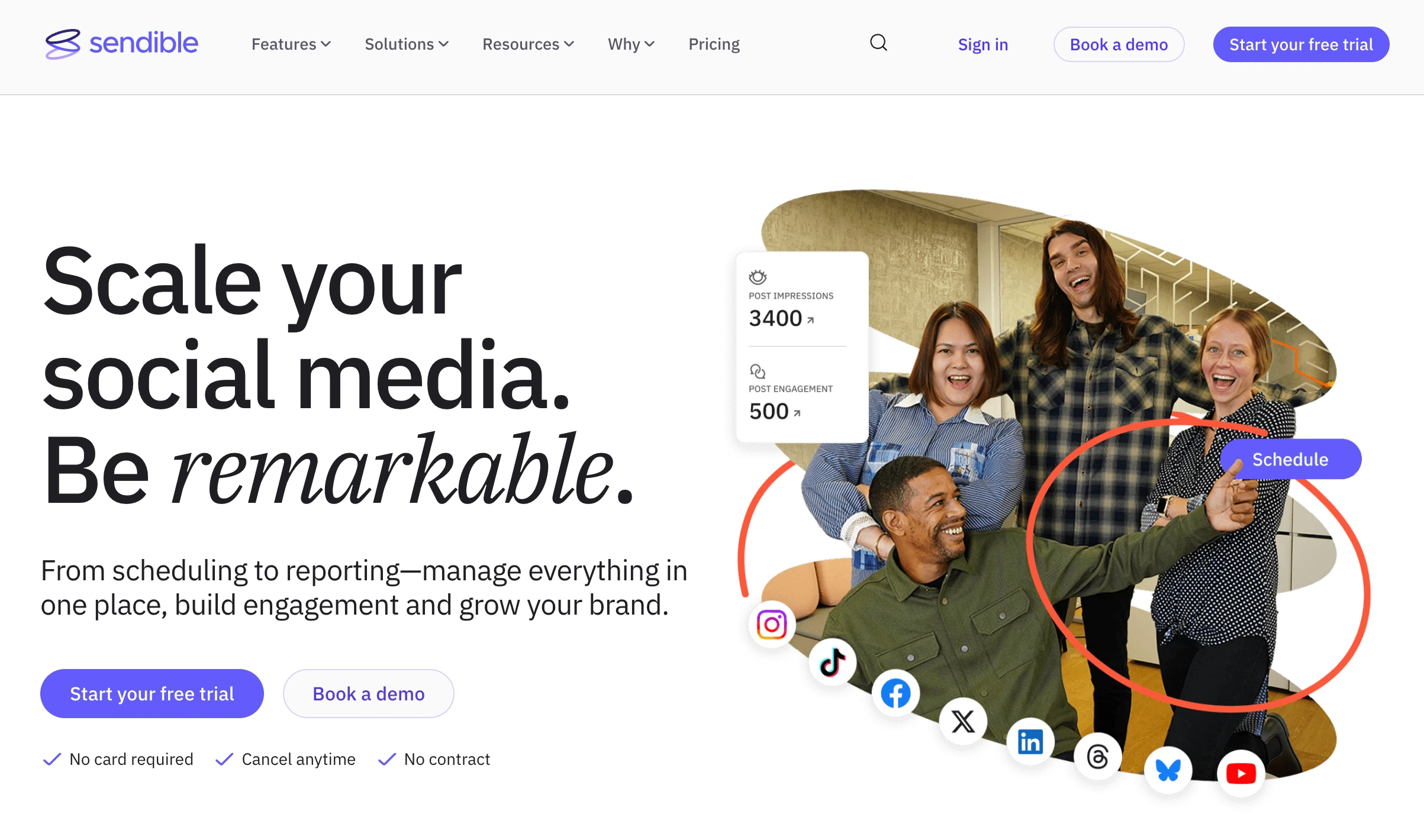
Where Sendible shines is the agency workflow rather than the feature sheet. A hospitality marketing firm can run a dozen properties from one dashboard, group profiles by client, and route posts through approval links so a hotel signs off without ever logging in, and it does support Google Business. Where it thins out is content creation: there's no AI image generation, no built-in link-in-bio, and no Pinterest, so a visually-driven property doing its own marketing may find it limiting.
At a glance
- Pricing: $35 Core → $99 Plus → $199 Premium → $299 Elite → $750 Enterprise, with unlimited users on every tier; 14-day trial
- Best for hotels: Agencies managing social for several hospitality clients
- Ratings: 4.5/5 on G2 (899 reviews)
How it fits: If you're a single property, this is more than you need; if you're the agency serving hotels, the white-label workflow is the draw, provided the $648/mo floor works against what you bill the properties.
Verdict: The agency pick: white-label dashboards and client approvals make it strong for firms managing multiple hospitality accounts.
Learn more: Sendible pricing, Sendible reviews, and the best Sendible alternatives.
9. SocialPilot: Best Budget Multi-Property Management
SocialPilot delivers agency-style features (bulk scheduling, multi-account management, white-label reports) at a fraction of enterprise prices, which makes it a practical middle ground for a small hotel group watching its budget. It supports Google Business alongside the major networks.
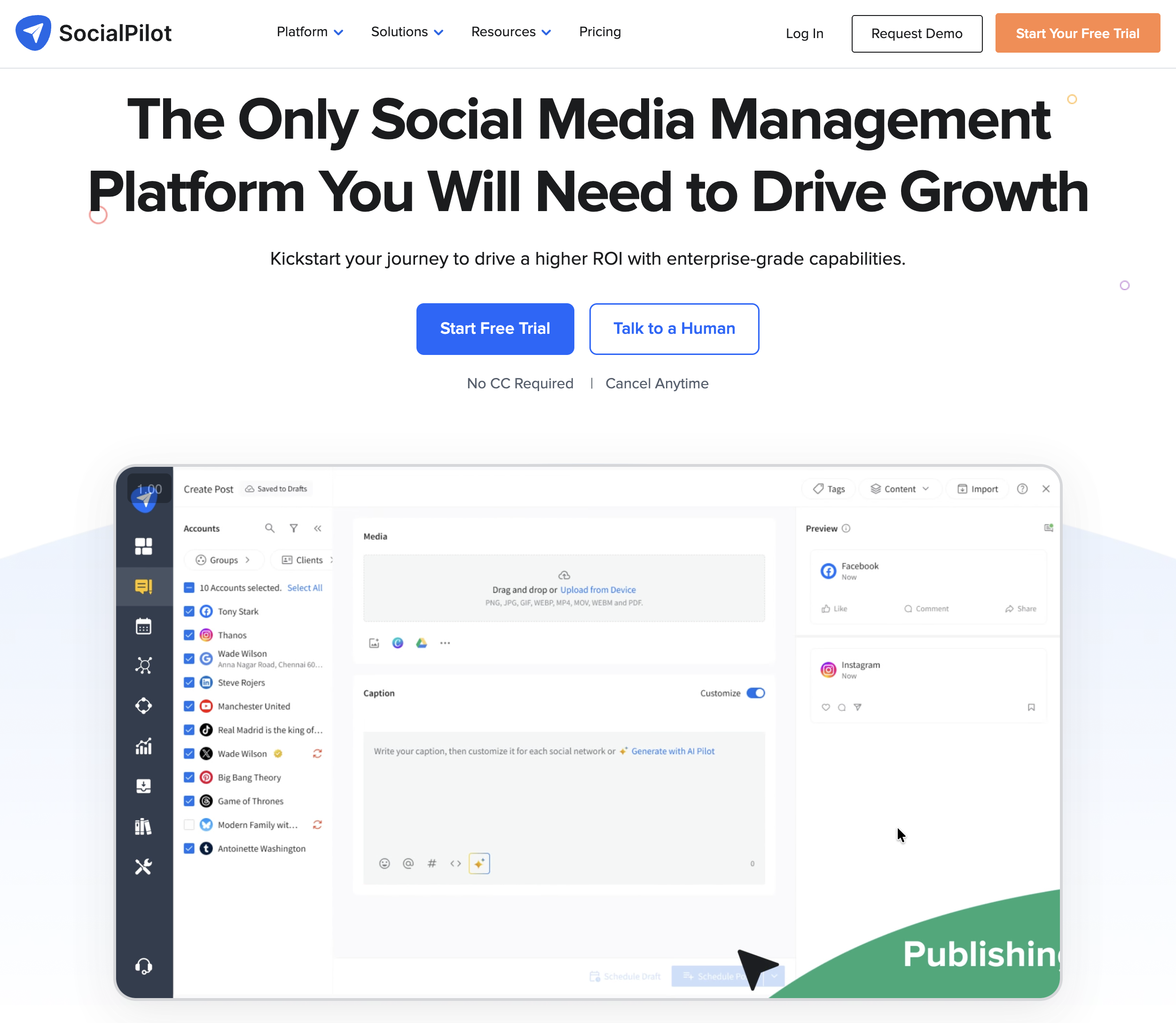
Cost-per-property is where it earns its place. A group can bulk-upload a month of posts for every location in a single CSV, then send each property a white-labeled performance report from the Premium tier up, all for $30–$100 a month. You pay for that value in polish: the dashboard is busy, analytics are basic with no sentiment analysis, and it layers small per-account and per-user fees on lower tiers. But little else delivers this much multi-property reach this cheaply.
At a glance
- Pricing: $30 Essentials / $50 Standard / $100 Premium / $200 Ultimate per mo; 14-day trial
- Best for hotels: Budget-conscious multi-property groups and small agencies
- Ratings: 4.5/5 on G2 (841 reviews), 4.4/5 on Capterra
How it fits: Great value for managing multiple properties; the interface is functional rather than polished.
Verdict: The best value for multi-property hotel management: white-label reports on Premium and bulk scheduling at a low price.
Learn more: SocialPilot pricing, SocialPilot reviews, and the best SocialPilot alternatives.
10. Buffer: Best for Independent & Boutique Hotels
Buffer is the easiest way for an independent or boutique hotel to start. Its interface is the cleanest in the category, it has a genuinely useful free plan for three channels, and paid plans are just $6 per channel per month: so a single property can get organized without a budget conversation.
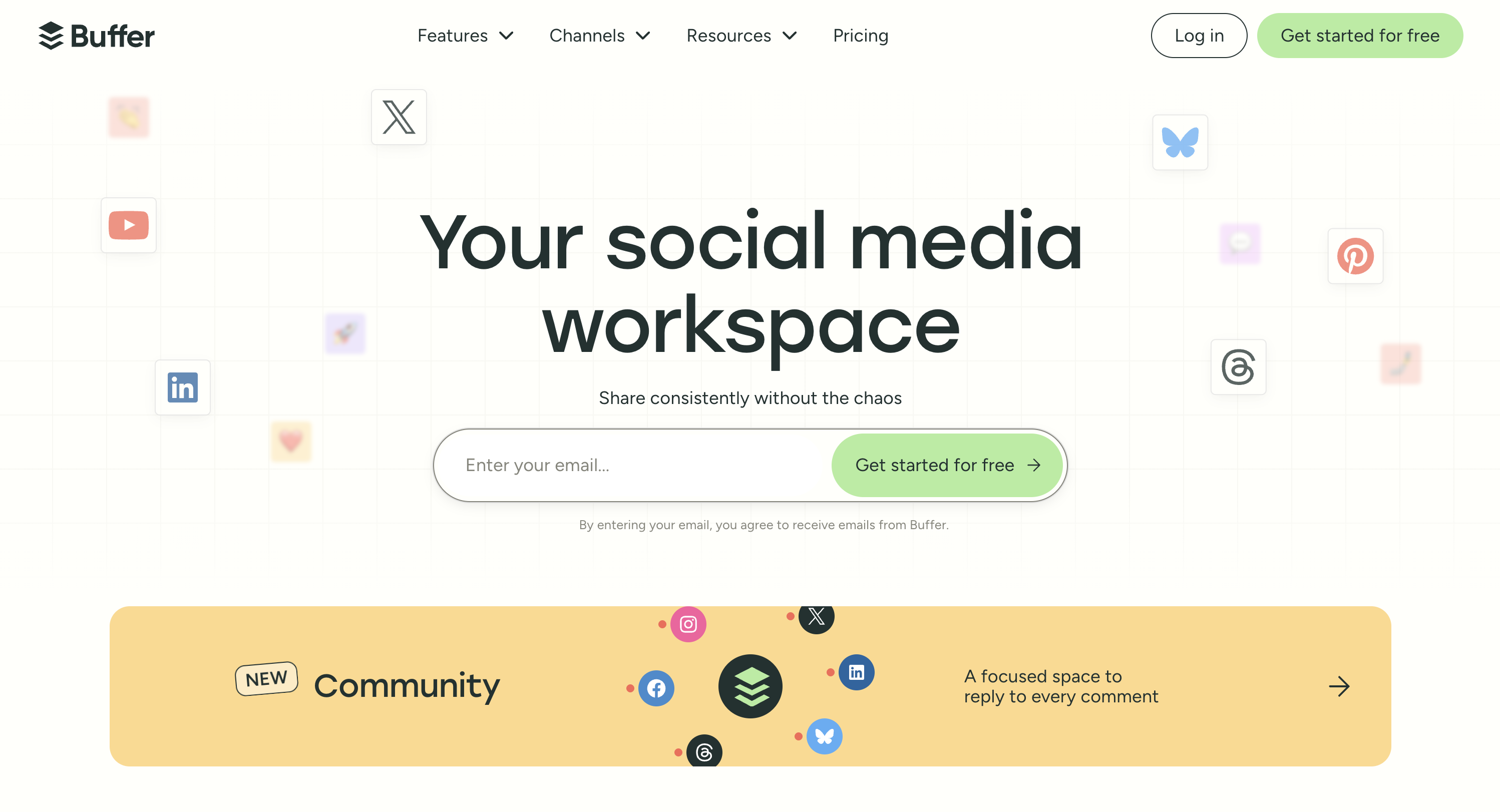
The simplicity cuts both ways. Buffer publishes to Google Business and includes a Start Page link-in-bio, but its analytics are basic, its community inbox only covers Instagram, Facebook, and LinkedIn (not TikTok or X), and there's no review management or UGC tooling. For a boutique hotel that mainly wants to schedule consistent, good-looking posts, that's a fair trade; for a property that lives on guest engagement and reviews, you'll outgrow it.
At a glance
- Pricing: Free (3 channels) / $6 per channel (Essentials) / $12 per channel (Team) per mo; 14-day trial on paid
- Best for hotels: Independent and boutique properties getting started
- Ratings: 4.3/5 on G2 (1,023 reviews), 2.1/5 on Trustpilot (93)
How it fits: Perfect for a small property that wants simple, consistent posting; light on engagement and analytics.
Verdict: The simplest, cheapest start: great for a single boutique hotel, limited once reviews and engagement matter.
Learn more: Buffer pricing, Buffer reviews, and the best Buffer alternatives.
11. Loomly: Best for Brand-Consistent Approvals
Loomly is built around one thing hotels with strict brand standards care about: approval workflows. Every paid plan includes structured, multi-step sign-off, so a post moves from draft to review to published with a clear trail, which matters when corporate marketing must approve what each property publishes.
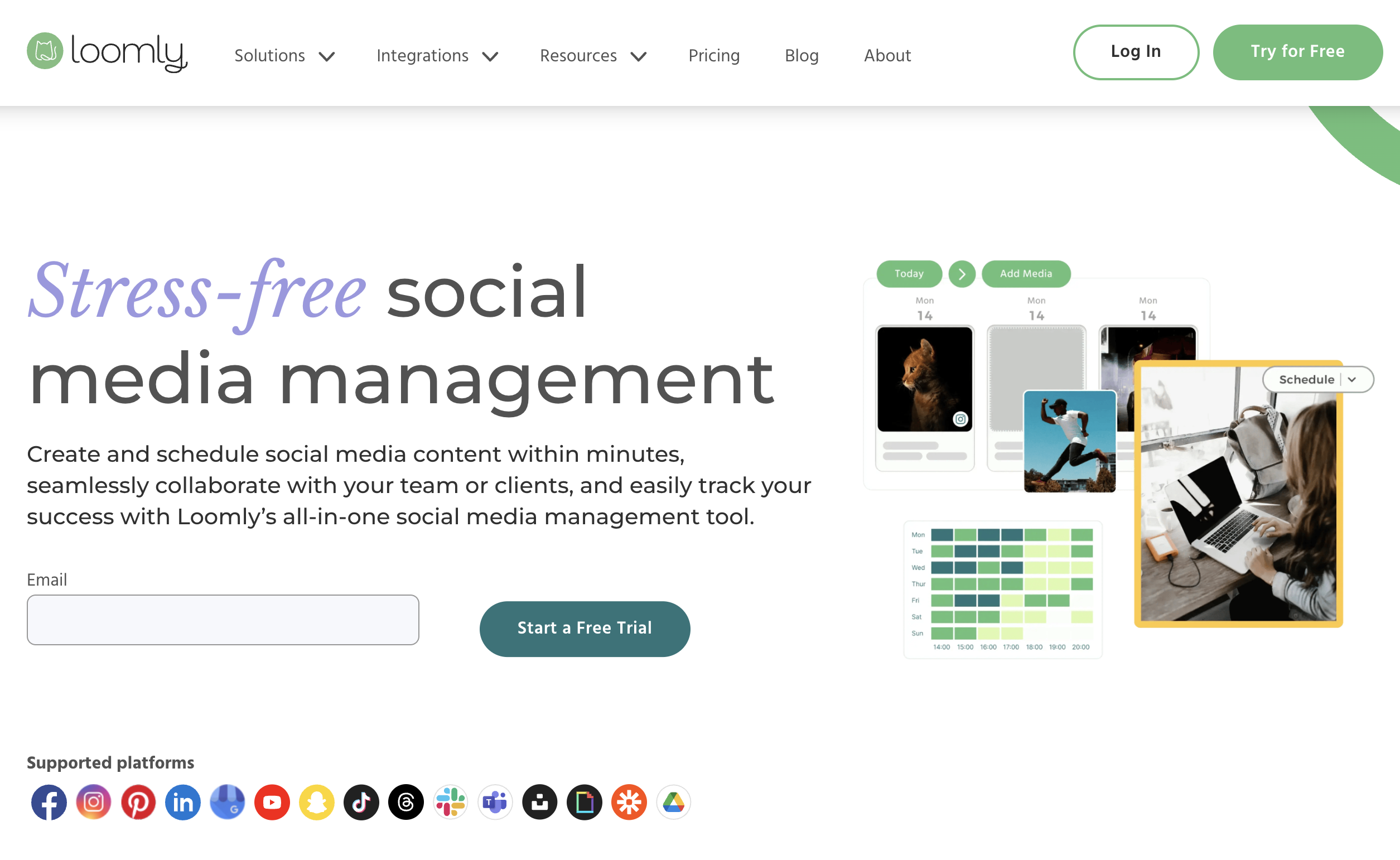
Beyond approvals, it's a clean, easy-to-learn content calendar with Google Business support and post previews. The limits show up fast for hotels, though: there's no social inbox on any plan and no link-in-bio, so guest engagement and booking-link routing live elsewhere. Pricing is also awkward: a $65 Starter jumps straight to a $332 Beyond tier with nothing in between, and the 2025 pricing overhaul drew heavy renewal-hike complaints (Trustpilot sits at 1.7/5).
At a glance
- Pricing: $65 Starter → $332 Beyond; no free plan, 15-day trial
- Best for hotels: Brands that need a formal review-and-approve step on every post
- Ratings: 4.6/5 on G2 (1,793 reviews)
How it fits: Strong if approvals are your priority; there's a steep gap between the $65 and $332 tiers, and there's no inbox or link-in-bio.
Verdict: The approval-workflow pick: a good fit if brand-consistency sign-off is the main thing you need software to enforce.
Learn more: Loomly pricing, Loomly reviews, and the best Loomly alternatives.
Side-by-Side Comparison: All 11 Tools
| Tool | Starting price | Google Business | Review replies | Link-in-bio | AI images | Free plan/trial |
|---|---|---|---|---|---|---|
| PostPlanify | From $39/mo per property | ✅ | ✅ (via inbox) | ✅ | ✅ | 7-day trial |
| Sprout Social | $99/seat/mo | ✅ | ✅ | ❌ | ❌ | 30-day trial |
| Hootsuite | $99/user/mo | ✅ | Add-on | ❌ | ❌ | 14-day trial |
| Agorapulse | $99/user/mo | ✅ | ✅ (via inbox) | ✅ | ❌ | 30-day trial |
| Vista Social | $99/mo | ✅ | ✅ (6 sites) | ✅ | Via Canva | 14-day trial |
| Later | $25/mo | ❌ | ❌ | ✅ | ❌ | Limited free |
| Metricool | Free / $25/mo | ✅ | ❌ | ✅ | ❌ | Free plan |
| Sendible | $35/mo | ✅ | Limited | ❌ | ❌ | 14-day trial |
| SocialPilot | $30/mo | ✅ | Limited | ❌ | ❌ | 14-day trial |
| Buffer | Free / $6/channel | ✅ | ❌ | ✅ | ❌ | Free plan |
| Loomly | $65/mo | ✅ | ❌ | ❌ | ❌ | 15-day trial |
Turn Social Discovery Into Direct Bookings (Not OTA Commissions)
Social media is brilliant at the top of the funnel and terrible at the bottom, unless you engineer the hand-off. As Skift puts it, "inspiration does not equal intent": a traveler can fall in love with your rooftop bar on TikTok and still book you through Booking.com, handing an online travel agency 15–30% of the room rate in commission. And the dependency is growing: OTAs supplied 63.4% of independent-hotel bookings in 2025, up from 61.3% the year before (Cloudbeds).
The math is worth internalizing: a direct booking is worth about $519 on average versus $320 through an OTA, and direct guests cancel far less often (~11% vs. ~22%). Every follower you convert on your own site is both a bigger and a more reliable booking.
This is where your social tool quietly earns its keep:
- A link-in-bio that points at your booking engine, not just your homepage: one tap from inspiration to your own checkout.
- Trackable links (UTMs) on every social post, so you can see which content actually drives direct revenue.
- Fast, visible review replies: responding to reviews makes travelers 77% more likely to book, and it's a trust signal that favors your direct listing over an anonymous OTA one.
- Consistent Google Business posting, so high-intent "hotels near me" searchers land on your profile with current photos and offers and can book direct.
When you compare the tools above, weigh the link-in-bio, tracking, and Google/review features as heavily as scheduling: they're what turn a follower into a booking you don't pay commission on.
Hotel Social Media Strategy: Platforms, Content, and Frequency
Which platforms should a hotel focus on?
- Instagram: the default home of travel inspiration and your most important visual channel; Reels drive the most discovery.
- Google Business Profile: tied with Instagram for importance, because it captures high-intent "hotels near me" searchers and hosts the reviews that decide bookings.
- TikTok: the fastest-growing discovery engine, especially for Gen Z and millennial travelers; authentic room tours and local tips outperform polished ads.
- Facebook: still a reach-and-advertising workhorse and a common review destination, skewing to older travelers.
- YouTube & Pinterest: property tours and destination guides with long shelf lives; Pinterest is strong for weddings and trip planning.
- LinkedIn: worth it mainly for corporate travel, MICE (meetings and events), and group sales.
Start with one or two platforms done well: almost always Instagram and Google Business, before expanding.
What should a hotel post? A weekly content mix
Aim for 3–5 posts per week, rotating a few proven pillars (our content calendar examples show how to lay these out across a month):
- Short-form vertical video (Reels/TikTok): room reveals, pool and sunset shots, F&B; the highest-reach format by far
- User-generated content: reshared guest photos and videos (with permission); the most trusted content in travel
- Behind-the-scenes and staff: a concierge's local tip or a chef's prep; authentic content routinely outperforms polished brand posts
- Local-area and destination guides: position the hotel as the local expert and capture planning-stage travelers
- Food & beverage: restaurant, bar, and breakfast content that also cross-sells on-property spend (if F&B is the bigger business, see our tools for restaurants)
- Seasonal and event promos: tied to demand cycles, local events, and shoulder-season fill goals
How should a hotel handle reviews and messages?
Respond to every review, positive or negative, within a day, and keep replies to negative reviews calm, specific, and solution-oriented; travelers read how you handle criticism, not just the star rating. A unified inbox that pulls Google, Instagram, and Facebook into one queue, with team assignment and ideally multi-language support, is what makes this realistic for a busy property. Route by who can actually fix it: F&B complaints to the restaurant manager, spa feedback to the spa lead, room issues to the duty manager. Assignment is what turns a shared queue into somebody's job rather than everybody's problem.
How to Choose the Right Tool for Your Hotel
- Independent or boutique hotel: Start with PostPlanify (Google Business + reviews + AI visuals + a booking link, from $39/mo for one property) or Buffer for a free, bare-bones start.
- Multi-property group: PostPlanify, where each property is its own workspace and the per-property rate drops as you add them ($155/mo for five, $250/mo for ten), or SocialPilot for budget multi-account scheduling.
- Large chain or brand: Sprout Social or Hootsuite for enterprise analytics, listening, and governance across markets.
- Reputation- and review-focused property: Vista Social for native management of Google, Yelp, and Facebook reviews, or Agorapulse for the strongest unified inbox.
- Data-driven marketer: Metricool for deep analytics, competitor tracking, and paid-ad management on a budget.
- Visual-first resort or lifestyle hotel: Later for grid planning and UGC, paired with a tool that covers Google Business.
- Hospitality marketing agency: Sendible for white-label client dashboards.
- Brand-standards-driven group: Loomly or PostPlanify for structured approval sign-off before anything publishes.
Frequently Asked Questions
What is the best social media management platform for hotels?
For most hotels, PostPlanify is the best all-around choice: it's the only tool here that bundles Google Business publishing and review replies, AI captions and images for visual content, a link-in-bio that routes guests to your direct booking engine, and approval workflows for brand consistency, priced per property from $39/mo with unlimited team members. The best fit still depends on your needs: Sprout Social or Hootsuite for large chains that need enterprise analytics and governance, Vista Social for managing Google, Yelp, and Facebook reviews in one affordable all-in-one, Agorapulse for engagement-heavy properties, Later for visual, Instagram-first resorts, Metricool for analytics and paid campaigns, Sendible for agencies running white-label dashboards, SocialPilot for budget multi-property scheduling, and Buffer for an independent hotel wanting a free, simple start.
Which social media platform is best for a hotel?
Instagram and Google Business Profile are the two most important: Instagram for visual discovery and Reels, and Google Business for high-intent local searchers and the reviews that decide bookings. TikTok is the fastest-growing channel for reaching younger travelers, and Facebook remains useful for advertising and reach. Most hotels should master Instagram and Google first, then expand.
How often should a hotel post on social media?
Three to five times per week is the sweet spot for most properties, enough to stay visible in discovery feeds without exhausting a small team. Consistency matters more than volume; batching a week or two of visual content in one session with a scheduling tool is the realistic way to keep it up.
How do hotels get more direct bookings from social media?
Route the demand to your own booking engine before an OTA captures it: use a link-in-bio that points to your direct-booking page, add trackable UTM links to posts so you can see what converts, reply to reviews (which makes travelers 77% more likely to book), and keep your Google Business Profile current so high-intent searchers can book direct. Direct bookings are worth more (about $519 vs. $320 via an OTA) and cancel less often, so shifting even a few points of your mix from OTA to direct meaningfully improves revenue.
How do I get guests to post and tag my hotel on Instagram?
Make it easy and worth it: create a branded hashtag, add tasteful signage with your handle in photogenic spots (lobby, rooftop, the room), and prompt guests at check-out. Then reshare the best guest content, with permission, which both rewards the guest and signals to future travelers that real people love the stay. A tool with UGC collection makes gathering rights and organizing that content manageable.
How should a hotel respond to negative reviews on Google and TripAdvisor?
Respond promptly, stay calm, and be specific: thank the guest, acknowledge the issue, explain what you're doing about it, and offer to continue the conversation offline. Travelers read your response as much as the complaint, so a professional reply can turn a bad review into a trust signal. Responding at all matters: hotels that reply to reviews see meaningfully more booking interest than those that stay silent.
Do hotels really need to be on TikTok?
For hotels targeting Gen Z and millennial travelers, increasingly yes: TikTok has become a major travel-discovery engine (see our roundup of TikTok scheduling tools), and authentic, low-production room tours and local tips often outperform polished ads. If your guests skew older or corporate, prioritize Instagram, Google, and Facebook first and treat TikTok as an experiment rather than a mandate.
How do I manage social media for multiple hotel properties?
Give each property its own workspace rather than one shared account. That keeps calendars, assets, permissions, and analytics separate, so a GM sees their property and head office sees the group. Look for three things specifically: roles that let a property post without touching another's content, approval workflows so corporate signs off on brand-sensitive posts, and a shared media library so every location pulls from the same approved photography. Pricing model matters more than feature count here, because per-seat tools charge for every GM, front-office poster, and agency you add across every property. PostPlanify prices per property from $39/mo with unlimited team members, so a five-property group is $155/mo however many people touch it. Remember that outlets with their own Google listing, like a hotel restaurant or spa, need covering too.
Is PostPlanify a good tool for a hotel?
Yes, it's our top pick for most properties. It covers Google Business publishing and review replies, AI captions and images for room and F&B content, a link-in-bio that drives direct bookings, approval workflows for brand consistency, and analytics across all 10 platforms, priced per property from $39/mo. Because the bill follows properties rather than seats, it scales just as well from a single boutique hotel to a multi-property group: team members and approvers are unlimited on every plan, and each property you add is billed in a cheaper band. Large chains that need deep enterprise social listening and cross-market benchmarking may want a dedicated suite for that layer alongside it.
Making the Switch
Moving to a new tool is painless: your Instagram, Facebook, and Google Business accounts live on those platforms, not inside your old scheduler, so you reconnect with a secure login and pick up where you left off. Set your posting schedule, add your team with the right approval permissions, load your best property photography and consented guest content into the media library, and point your link-in-bio at your direct booking page to start capturing commission-free reservations.
If PostPlanify fits your property, you can start a free trial here.
Related Reading
- Social Media Scheduler for Hotels & Hospitality
- Best Social Media Management Tools for Dental Clinics
- Best Time to Post on Social Media in 2026
- Google Business Character Counter
- Best Social Media Tools for Franchises and Multi-Location Brands
- Best Social Media Management Tools for Restaurants
- Best Social Media Management Tools for Real Estate
- All Industries
PostPlanifyAll your social media in one simple dashboard
Schedule posts, track analytics, and reply to comments/DMs without switching tabs.
Engagement
+18%
Views
52.8k
About the Author

Hasan Cagli
Founder of PostPlanify, a content and social media scheduling platform. He focuses on building systems that help businesses, agencies, and teams plan, publish, and manage content and social media more efficiently across platforms.


