


The biggest social media trends for 2027 are AI answers becoming a discovery channel, ads that build themselves, brands paying to boost creator content, social commerce passing $100 billion in the US, and a split between US and global TikTok. Every trend below is backed by something that measurably happened in 2026, and each one ends with what agencies should do about it.
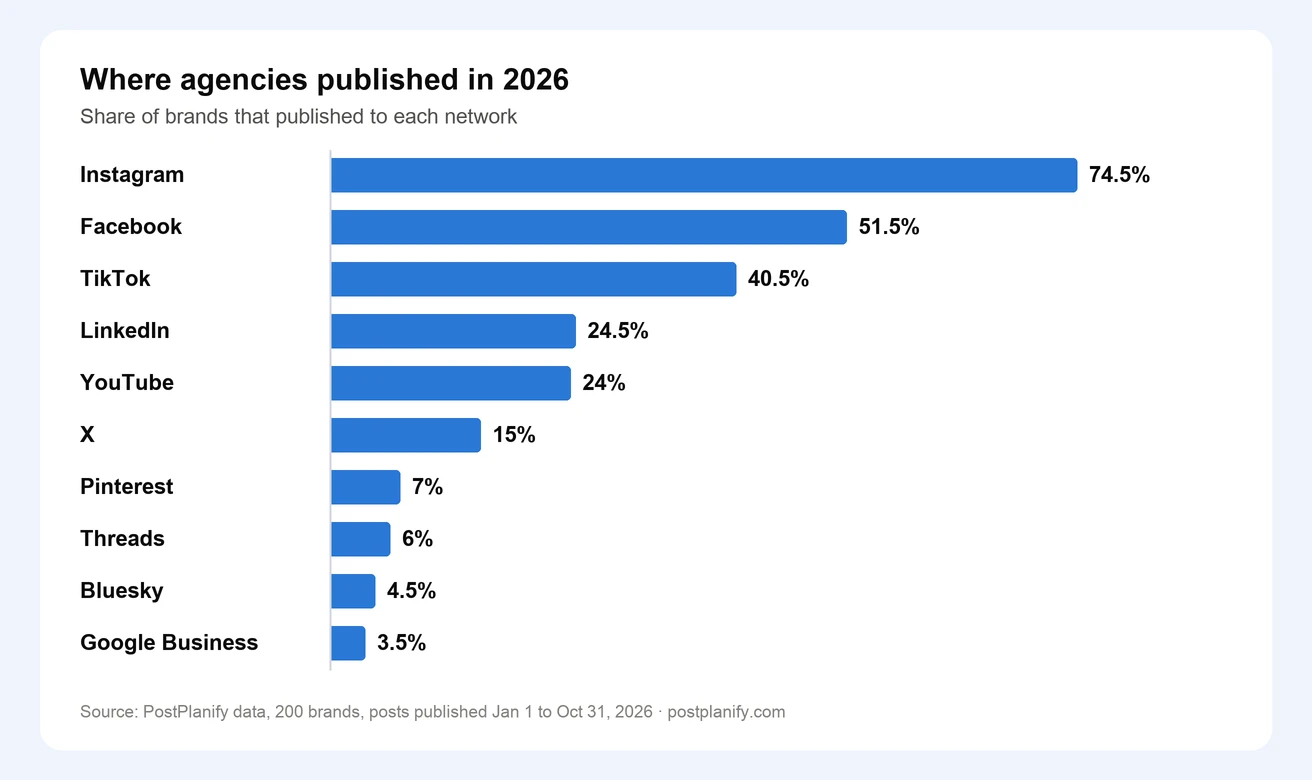
We also looked at our own data. We also looked at our own data. In PostPlanify's analysis of 7,384 posts published by 200 brands in 2026, the median piece of content went to three networks, Instagram was the most-used network (74.5% of brands), and only 6% of brands published to Threads, even though Threads passed X in daily mobile users.
Social Media Trends 2027 at a Glance
| # | Trend | What happened in 2026 | What to do in 2027 |
|---|---|---|---|
| 1 | AI answers become a discovery channel | ChatGPT referral traffic rose 101% from January to August | Make content easy for AI to quote, and show up on YouTube |
| 2 | Ads build themselves | Meta pushed AI-built campaigns toward the default | Sell creative strategy and testing, not campaign setup |
| 3 | Brands pay to boost creator content | Boosting creator posts heads for $14.15B in 2027 | Budget for amplification, not just sponsorships |
| 4 | Social commerce passes $100B | US social commerce crossed $100B, TikTok Shop grew fast | Make every product post shoppable |
| 5 | Two TikToks | A US joint venture took over TikTok and retrained the algorithm | Re-baseline TikTok benchmarks, keep other channels warm |
| 6 | Threads becomes the text platform | Threads passed X in daily mobile users | Add Threads to every text-first plan |
| 7 | Age gates spread | Australia's under-16 ban got stricter, others followed | Check how much of your reach depends on teens |
| 8 | People beat pages on LinkedIn | Employee and founder content keeps outperforming brand pages | Build employee and founder posting into client plans |
| 9 | "Human-made" becomes a selling point | Over half of social users worry about undisclosed AI content | Disclose AI use and put real people on camera |
| 10 | Budgets get tighter, proof matters more | US ad growth is forecast to slow to 9.4% in 2027 | Report results clients can tie to revenue |
How We Picked These Trends
Most social media predictions are opinions with a year in the title. For this list of social media marketing trends, we only included a trend if something measurable happened in 2026 to support it: a forecast from eMarketer or the IAB, platform data from Similarweb or BrightEdge, a change in law, or a platform announcement. Every number links to where it came from.
We also checked each trend against PostPlanify's own data: 7,384 posts published through PostPlanify by 200 brands between January 1 and October 31, 2026.
1. AI Answers Become a Discovery Channel
What happened in 2026: People increasingly ask ChatGPT and Google's AI answers instead of scrolling feeds or search results. Referral traffic from ChatGPT increased 101% from January to August 2026, and ChatGPT made up 95.1% of all AI referral traffic by August, according to BrightEdge.
Social content feeds those answers. In an Ahrefs study of 75,000 brands, YouTube mentions had the strongest correlation with how often a brand appeared in ChatGPT, Google AI Mode and AI Overviews (a correlation of about 0.74), ahead of backlinks.
What changes in 2027: Social posts stop being only for followers. They become source material that AI tools read, summarize and recommend. A brand that's talked about clearly on YouTube, Reddit and LinkedIn gets named in AI answers. A brand that isn't gets skipped.
What agencies should do:
- Write posts and video titles that answer real questions plainly, the way someone would ask them.
- Get clients on YouTube, even with simple explainer videos. It's the platform most tied to AI visibility.
- Keep brand names, product names and claims consistent across every channel, so AI tools don't get mixed signals.
2. Ads Build Themselves
What happened in 2026: Meta spent the year moving advertisers toward AI-built campaigns, where the system writes the copy, makes variations of the creative, picks the audience and moves budget on its own. The Wall Street Journal reported in 2025 that Meta's goal is to let brands launch a campaign from little more than a product image and a budget by the end of 2026.
What changes in 2027: Setting up campaigns becomes a button, not a billable skill. What still needs people is deciding what to say, producing enough strong creative for the AI to test, and judging whether the results are real.
What agencies should do:
- Reposition paid social services around creative strategy, creative volume and testing, not campaign setup.
- Produce more variations of each idea. AI-run campaigns reward having many creatives to choose from.
- Keep a human check on brand safety and claims. Automated ads still need someone to approve what goes out under a client's name.
3. Brands Pay to Boost Creator Content
What happened in 2026: Creator marketing grew up. US brands will spend $13.7 billion on influencer marketing by 2027, up from $10.5 billion in 2026, according to eMarketer. And 57% of ad buyers named influencer ads and partnerships as their top investment priority for 2026, up from 48% in 2025, per the IAB.
What changes in 2027: The money moves from paying creators to make content toward paying platforms to show it. eMarketer forecasts that US spending on boosting creator content will match creator sponsorship revenue at $14.15 billion in 2027, then pass it in 2028.
What agencies should do:
- Add an amplification line to every creator budget, so good creator posts get paid reach.
- Negotiate usage rights up front, so clients can run creator content as ads.
- Track creator posts like ads, with cost per result, not just views.
4. Social Commerce Passes $100 Billion
What happened in 2026: US social commerce passed $100 billion in 2026, up 18% from $87 billion in 2025, according to eMarketer. TikTok Shop made up 18.2% of US social commerce and is forecast to reach 24.1% by 2027. Our social commerce statistics cover the full breakdown.
What changes in 2027: For product brands, social stops being the top of the funnel and becomes the whole funnel. People discover, compare and buy without leaving the app.
What agencies should do:
- Make product posts shoppable wherever the platform allows it.
- Plan creator and live content around specific products and offers, not just awareness.
- Report sales from social for ecommerce clients, not just engagement.
5. Two TikToks
What happened in 2026: TikTok's US business moved to a new joint venture in January 2026. Oracle, Silver Lake and MGX each hold 15%, and ByteDance keeps 19.9%. The US recommendation algorithm is being retrained on US user data held in Oracle's cloud, according to Search Engine Land.
What changes in 2027: US TikTok and global TikTok will drift apart, and TikTok trends that take off in one may not travel to the other. What works in the US feed may not match what works elsewhere, and reach benchmarks from 2025 may no longer hold.
What agencies should do:
- Set fresh TikTok benchmarks for each client from 2026 data, not older numbers.
- Watch reach on US accounts separately from international ones.
- Keep Reels and Shorts versions of every TikTok, so clients aren't exposed if TikTok reach drops.
6. Threads Becomes the Text Platform
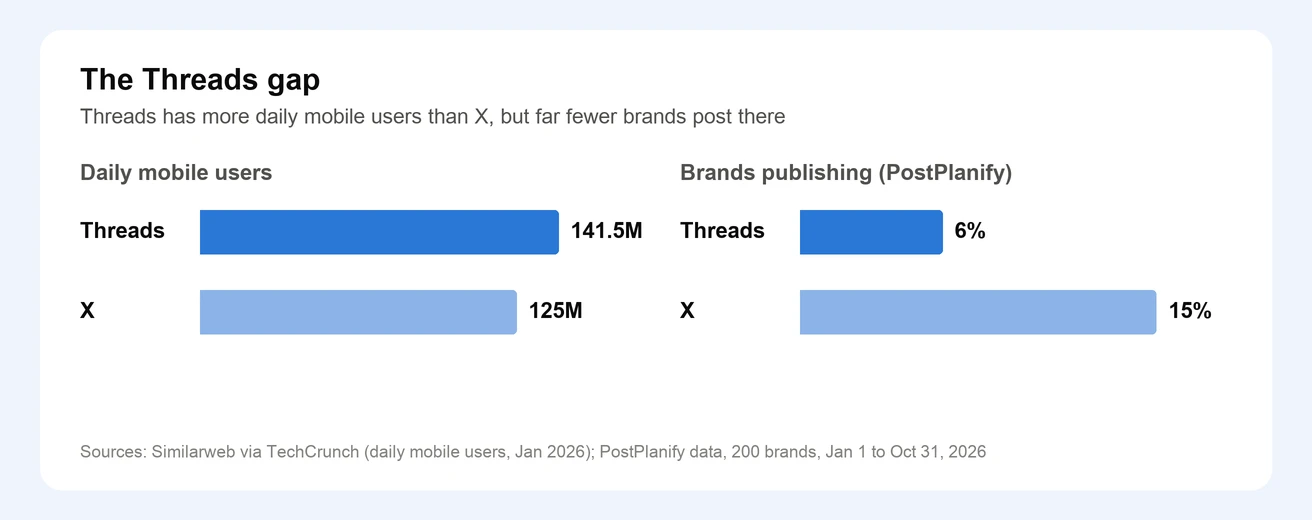
What happened in 2026: Threads passed X in daily mobile users. Similarweb estimated Threads at 141.5 million daily active users on iOS and Android in January 2026, against about 125 million for X, as TechCrunch reported. X still leads on the web and in the US, but the gap is closing.
What changes in 2027: For most brands, Threads becomes the default place for short text posts, conversation and quick updates, especially because it connects to Instagram audiences.
What agencies should do:
- Add Threads to the plan for any client posting text-first content. In PostPlanify's 2026 data, only 6% of brands published to Threads versus 15% to X, so early movers still have room.
- Keep X for clients whose audience is clearly still there, such as tech, finance and news.
- Repurpose LinkedIn and X posts for Threads instead of writing everything from scratch. Our guide on how to schedule Threads posts covers the setup.
7. Age Gates Spread
What happened in 2026: Australia's ban on social media accounts for under-16s, which started in December 2025, got tougher enforcement powers in 2026. Indonesia introduced its own under-16 ban in March 2026, and the UK and Spain announced plans for similar rules, per Bloomberg and other reports.
What changes in 2027: More countries will require platforms to verify ages and keep younger teens off. Brands that rely on teen audiences will lose some reach, and age checks will add friction for everyone.
What agencies should do:
- Check how much of each client's audience is under 18 in platform analytics.
- Shift youth-focused brands toward parents, creators and channels where age rules matter less.
- Keep an eye on new laws in the countries your clients sell into.
8. People Beat Pages on LinkedIn
What happened in 2026: LinkedIn kept rewarding people over company pages. Audiences trust employees more than CEOs or influencers, according to the Edelman Trust Barometer cited in Hootsuite's 2026 trends report, and employee advocacy was one of the report's headline trends. In PostPlanify's 2026 data, 24.5% of brands published to LinkedIn, and 58.8% of their LinkedIn posts included video, while PDF document posts made up just 0.6% (57 accounts).
What changes in 2027: Of all the LinkedIn trends, this one matters most for B2B clients. Brand pages on LinkedIn act more like a home base, while most reach comes from founders, executives and employees posting as themselves.
What agencies should do:
- Offer founder and executive posting as part of LinkedIn retainers.
- Give employees ready-made posts and visuals they can share in their own words.
- Measure the combined reach of people and the page, not just page followers. Our guide on what to post on LinkedIn has formats that work.
9. "Human-Made" Becomes a Selling Point
What happened in 2026: AI content became normal, and people noticed. 52% of social users are concerned about brands posting AI-generated content without saying so, and 46% are not comfortable with brands using AI influencers, according to Sprout Social. Meanwhile, only 26% of consumers think AI-made creator content performs better than the real thing, per Billion Dollar Boy research reported by eMarketer.
What changes in 2027: With AI content everywhere, real faces, real voices and visible behind-the-scenes work stand out. Brands that are open about how they use AI keep trust. Brands that hide it risk losing it.
What agencies should do:
- Use AI for drafting, editing and repurposing, but keep real people at the center of the content.
- Label AI-generated visuals where platforms or clients expect it.
- Build content around client staff, customers and real stories that AI can't copy. Our AI in social media statistics cover where AI helps and where it hurts.
10. Budgets Get Tighter, Proof Matters More
What happened in 2026: 2026 was a big year for ad spending. US social media ad spending was forecast to grow 16.5%, according to the IAB, helped by the World Cup in North America and a record midterm election cycle.
What changes in 2027: Those one-off boosts go away. eMarketer projects US media ad spending growth will slow to 9.4% in 2027, according to its September forecast. When budgets grow more slowly, clients look harder at what each channel delivers.
What agencies should do:
- Tie monthly reports to business results such as leads, sales and bookings, not only reach.
- Show clients what changed because of your work, month over month.
- Use our list of social media KPIs to report to clients to build a report clients actually read.
 PostPlanify
All your social media in one simple dashboard
Schedule posts, track analytics, and reply to comments/DMs without switching tabs.

Engagement
+18%
Views
52.8k
What Agencies Actually Published in 2026: PostPlanify Data
In PostPlanify's analysis of 7,384 posts published by 200 brands between January 1 and October 31, 2026, five patterns stood out. Most of these brands are agencies and the businesses they manage, so this is a view of what professional social media teams actually published, not what they said in a survey.
1. Instagram leads, and most brands run three or more networks
Instagram was the most-used network: 74.5% of brands published there in 2026. Facebook followed at 51.5%, then TikTok at 40.5%, LinkedIn at 24.5% and YouTube at 24%.
2. The Threads gap
Threads passed X in daily mobile users in 2026, but brands haven't caught up. In PostPlanify's data, only 6% of brands published to Threads, compared with 15% that published to X. We call this the Threads gap: an audience that has already moved, and a brand presence that hasn't. For agencies, it's one of the easiest openings of 2027.
3. The three-network default
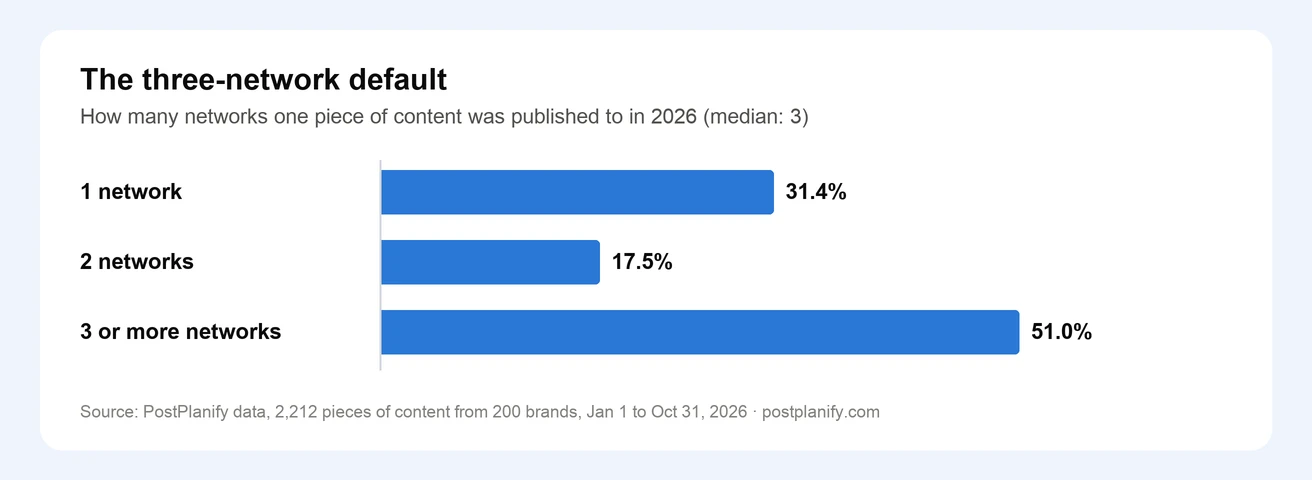
Cross-posting is now the normal way to publish. In PostPlanify's 2026 data, the median piece of content went to three networks, and 51% of 2,212 content pieces were published to three or more. Only 31.4% went to a single network. That's why adapting each version to its platform matters more than ever: the content is going everywhere either way.
4. Stories are back in the plan
About one in five Instagram posts (19.6%) and Facebook posts (22.7%) published through PostPlanify in 2026 were Stories. On Instagram, that's up from 5.1% in 2025, though the 2025 sample was much smaller (36 accounts), so treat the change as a direction rather than a precise number.
5. TikTok is no longer video-only
28.8% of TikTok posts published through PostPlanify in 2026 were photo posts rather than videos, up from 1.8% in 2025 (91 and 81 accounts). TikTok's photo carousels have become a real format for brands, which makes repurposing Instagram carousels to TikTok an easy win.
Methodology: posts published through PostPlanify between January 1 and October 31, 2026 (7,384 posts, 200 brands). Shares are shown instead of totals because our customer base grew during the year. The 2025 comparisons use the same January to October window, but the 2025 sample was smaller (62 brands) and weighted toward TikTok creators, so year-over-year changes are directional. Networks with fewer than 30 accounts are not used for format findings.
Social Media Trends That Are Fading in 2027
The future of social media rewards answers, people and proof. Some habits are losing value as these shifts take hold:
- Chasing viral sounds. Trend-jacking still works for some accounts, but steady series and clear answers build more lasting reach.
- Follower count as the main metric. Reach increasingly comes from recommendations, AI answers and creators, not followers. Report results, not audience size.
- Treating X as the default text channel. For most brands it's now one option among several, not the first stop.
- One-size-fits-all posting. Half of all content now goes to three or more networks (PostPlanify data), so copying the exact same post everywhere is common. It also works worse than ever. Adapt the format to each platform.
A 2027 Planning Checklist for Agencies
These social media trends for agencies come down to eight changes. Use this to update client plans for the new year:
- Audit where each client's reach comes from: feeds, search, AI answers and creators.
- Re-baseline TikTok with 2026 data, and keep Reels and Shorts versions ready.
- Add Threads for text-first clients, and decide where X still earns its place.
- Add an amplification budget to every creator partnership.
- Plan founder and employee posts for B2B clients on LinkedIn.
- Set a clear AI policy with each client: what you use AI for, and what you disclose.
- Move reports toward revenue: leads, sales and bookings alongside reach and engagement.
- Check audience age for youth-focused brands.
Running this across many clients is easier when publishing, approvals and reports live in one place. PostPlanify lets agencies schedule to every major network, including Threads and Bluesky, collect client approvals and send branded reports from one dashboard, with unlimited users on every plan.
PostPlanifyAll your social media in one simple dashboard
Schedule posts, track analytics, and reply to comments/DMs without switching tabs.
Engagement
+18%
Views
52.8k
Frequently Asked Questions
What is the biggest social media trend for 2027?
The biggest social media trend for 2027 is AI answers becoming a discovery channel. Referral traffic from ChatGPT rose 101% from January to August 2026 (BrightEdge), and social content, especially YouTube, is one of the main sources AI tools draw on when they recommend brands.
What will be the most used social media platform in 2027?
YouTube and Facebook will remain the most used platforms in the US. Pew Research found that 84% of US adults use YouTube and 71% use Facebook. Among agencies, Instagram leads: in PostPlanify's data, 74.5% of 200 brands published to Instagram in 2026. The fastest-moving change is among text platforms, where Threads passed X in daily mobile users in 2026.
What social media trends are going out in 2027?
Chasing viral sounds, measuring success by follower count, and posting identical content to every network are all losing value. Reach increasingly comes from recommendations, creators and AI answers rather than followers.
How will AI change social media marketing in 2027?
AI will build more of the ads, draft more of the content and decide more of what people see, including in AI answers. The parts that stay human are strategy, creative ideas, brand judgment and real people on camera, which audiences increasingly value.
Will TikTok still matter for brands in 2027?
Yes. TikTok remains one of the most important platforms for reach and social commerce, and TikTok Shop is forecast to hold 24.1% of US social commerce by 2027 (eMarketer). The difference is that US TikTok now runs on a retrained US algorithm, so brands should set fresh benchmarks rather than rely on older results.
How should agencies prepare for social media in 2027?
Agencies should re-baseline TikTok, add Threads for text-first clients, budget for boosting creator content, build founder and employee posting into LinkedIn plans, agree on an AI policy with each client, and tie reporting to revenue. Threads is the quickest win: only 6% of brands published there in 2026, according to PostPlanify's data from 200 brands, even though it has more daily mobile users than X.
Related: AI in Social Media Statistics 2026 | Short-Form Video Statistics 2026 | Social Commerce Statistics 2026 | Social Media Engagement Rate Benchmarks 2026 | Social Media Agency Statistics | Social Media KPIs to Report to Clients
PostPlanifyAll your social media in one simple dashboard
Schedule posts, track analytics, and reply to comments/DMs without switching tabs.
Engagement
+18%
Views
52.8k
About the Author

Hasan Cagli
Founder of PostPlanify, a social media management platform for agencies and teams. He focuses on building systems that help businesses, agencies, and teams plan, publish, and manage content and social media more efficiently across platforms.


