


CoSchedule is one of the most established marketing planning software platforms available, and it earns its 4.3/5 on G2 from 152 reviews. The drag-and-drop calendar is well designed, and the marketing suite around it (campaign planning, project management, Kanban views, team coordination) gives large marketing departments genuine workflow value.
But it was built as a marketing suite, not a social media scheduler, and the 2026 pricing shows it. Starter is $39/month ($29 billed annually) and allows a single user. No plan includes X/Twitter, which bills at $16 per profile per month. Social profiles cap at 3 to 5, with each extra at $5/month. A 3-person team lands on Professional at $88/month for 5 profiles. G2 reviewers also flag customer support, with cancellation requests reportedly ignored for months.
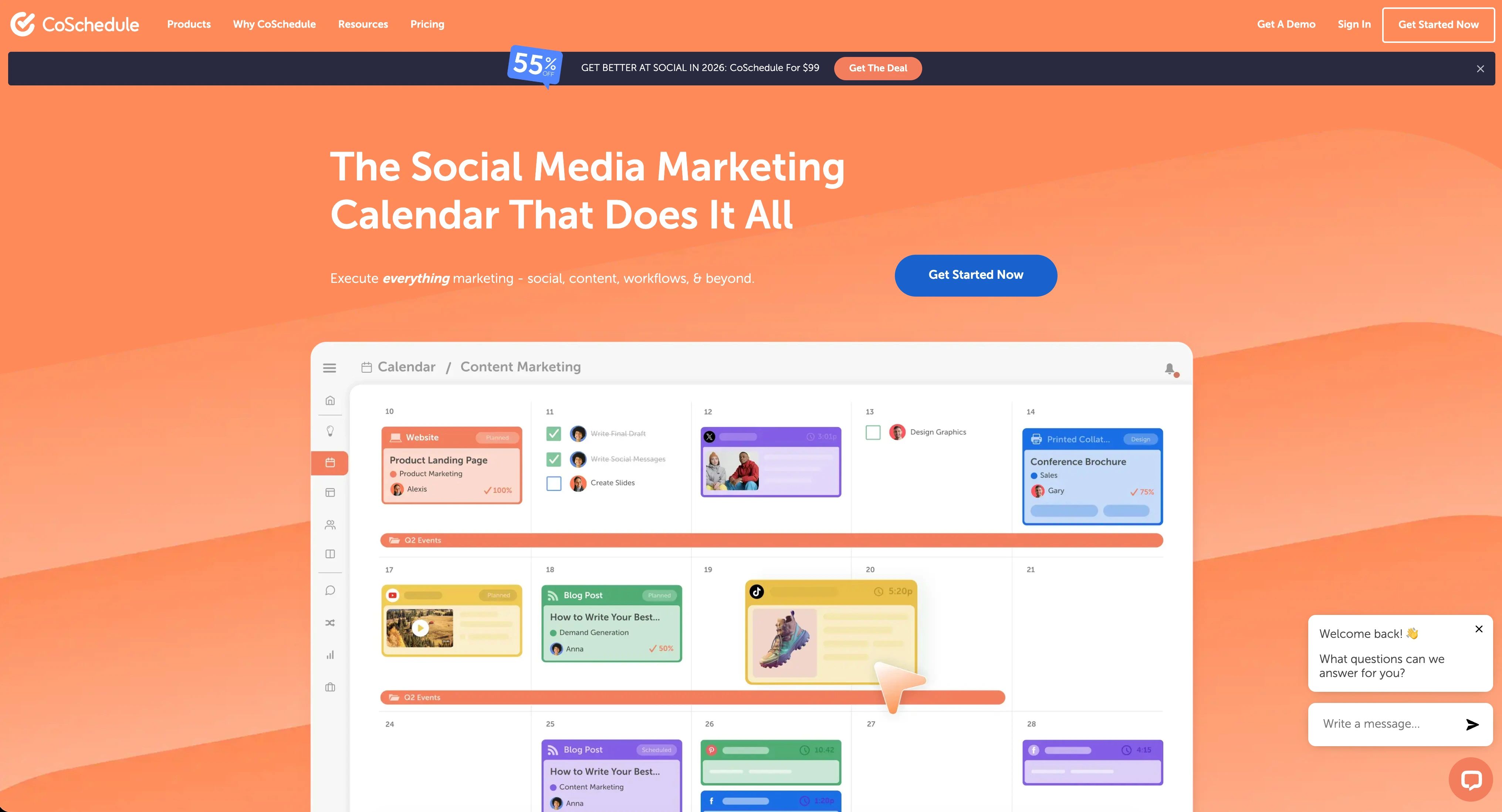
For teams that need social media scheduling across all platforms without per-user fees, profile caps, or marketing suite complexity, there are strong alternatives worth considering.
Quick Answer: What Is the Best CoSchedule Alternative in 2026?
For most teams leaving CoSchedule, the best alternative is PostPlanify: priced per client workspace from $39/mo with unlimited team members, all 10 platforms including X/Twitter at no extra charge, and a social inbox plus full analytics on every plan. No user ceilings, no per-profile surcharges.
Quick picks by use case:
- Content-calendar continuity: Loomly is the closest feature match, with post inspiration and a drag-and-drop calendar.
- Simplest scheduling: Buffer starts free, with X/Twitter included on every plan.
- Engagement-first teams: Agorapulse has the strongest unified inbox on this list.
- Agencies needing white-label dashboards: Sendible beats CoSchedule Professional on both features and seat limits.
- Bulk publishing at scale: SocialPilot ships 500-post CSV uploads.
- Enterprise governance and social listening: Hootsuite is the category leader.
- Deepest analytics: Sprout Social delivers unmatched reporting and listening depth.
- Instagram visual planning: Later has the best drag-and-drop grid preview in the category.
How I Evaluated These CoSchedule Alternatives
I scored each of the 12 CoSchedule competitors on the dimensions that matter most when you're leaving, not feature-count marketing. Pricing structure carries the most weight because it's the #1 CoSchedule pain point. For each tool, I looked at:
| Evaluation area | What I checked |
|---|---|
| Pricing structure (25%) | Flat vs. per-user/per-channel, profile caps, and per-profile surcharges: how the bill behaves as you add people and accounts. |
| Platform coverage (20%) | Whether X/Twitter and every network you post to is included on all plans, not billed as a per-profile add-on the way CoSchedule charges for X/Twitter. |
| Calendar & planning (15%) | Drag-and-drop content calendar, post inspiration, and visual planning depth versus CoSchedule's marketing calendar. |
| AI capabilities (15%) | Caption generation, image generation, and content suggestions, and which plan unlocks them. |
| Team & approvals (15%) | Approval workflows, roles, and collaboration without per-seat fees. |
| Analytics (10%) | Cross-platform reporting, historical trends, and client-ready exports in the base price. |
Pricing comes directly from each vendor's public pricing page (verified October 2026, monthly rates unless stated), and ratings are aggregated from G2, Capterra, and Trustpilot, weighted toward what matters most to CoSchedule switchers (cost at scale, platform gating, support).
Quick Picks: Best CoSchedule Alternatives at a Glance
| Tool | Best For | Starting Price | Free Plan |
|---|---|---|---|
| PostPlanify | Best overall alternative | From $39/mo per workspace | 7-day free trial |
| Loomly | Content calendars and post ideas | $65/mo | No (15-day trial) |
| Buffer | Simplicity and budget | Free / $6/channel/mo | Yes (3 channels) |
| SocialBee | Content categories and recycling | $29/mo | 14-day trial |
| Agorapulse | Social inbox and CRM | $99/user/mo | No (30-day trial) |
| Sendible | Agency client management | $35/mo | 14-day trial |
| SocialPilot | Bulk scheduling at scale | $20/mo | 14-day trial |
| Metricool | Analytics and free plan | Free / $25/mo | Yes (1 brand) |
| Planable | Approval workflows | Free / $39/workspace/mo | Yes (50 posts) |
| Hootsuite | Enterprise governance | $99/user/mo | 14-day trial |
| Sprout Social | Enterprise analytics and listening | $99/seat/mo | 30-day trial |
| Later | Instagram visual planning | $25/mo | Limited free |
1. PostPlanify: Best Overall CoSchedule Alternative
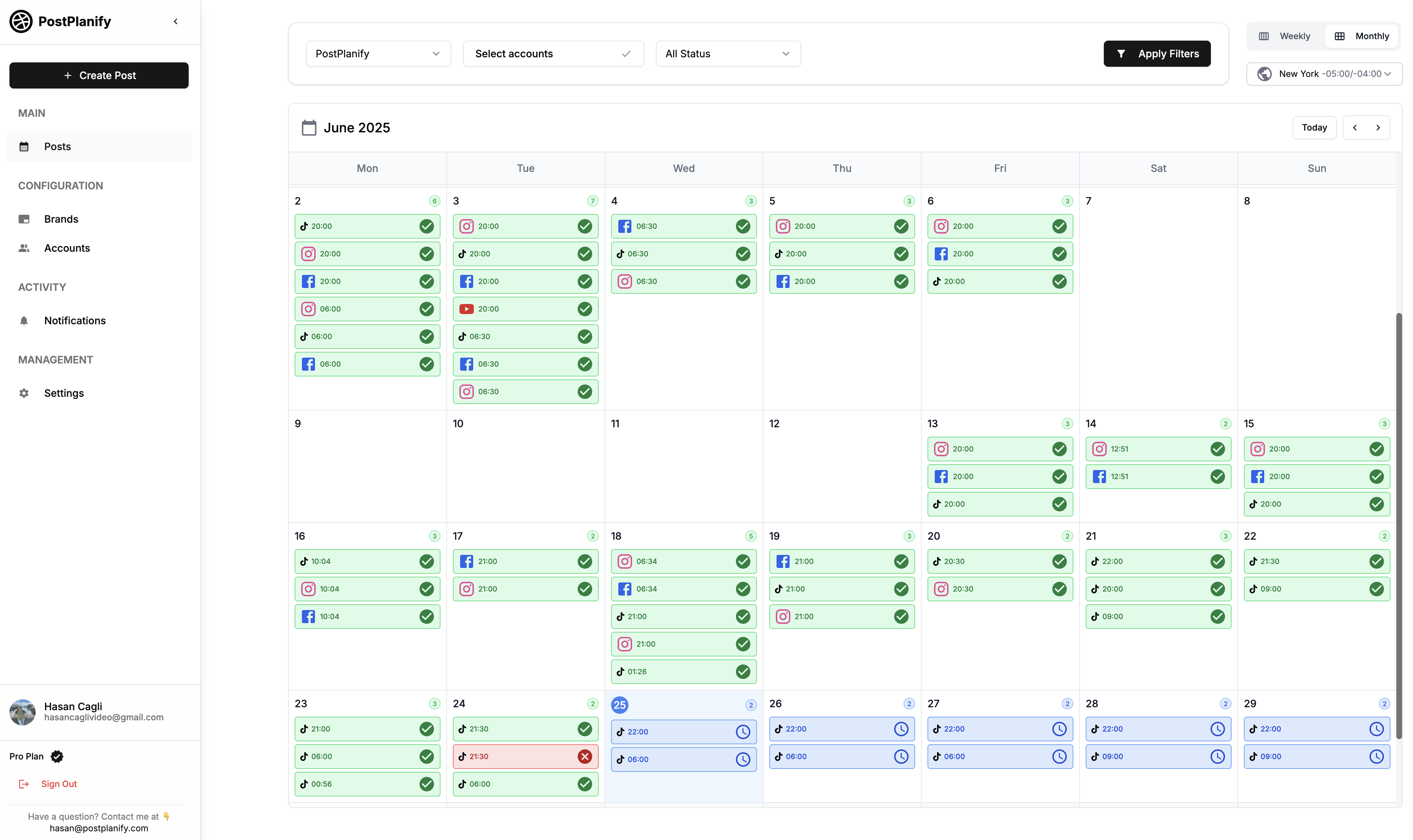
PostPlanify is a modern social media management platform built for agencies, teams, and businesses who want a clean publishing experience with unlimited team members and no platform restrictions. Where CoSchedule's $39/month Starter allows one user and bills X/Twitter separately, PostPlanify includes all 10 platforms on every plan and never charges for a teammate.
The publishing flow is built for social media, not wrapped in a marketing suite: captions, media, platform-specific previews and scheduling controls on one screen. AI caption and image generation, best time to post and full analytics come on every plan. CoSchedule matches the AI tooling but gates AI Insights to Professional, and caps who can use it at one user on Starter, three on Professional.
At a glance: PostPlanify
- Pricing: Per client workspace on a graduated scale. Growth from $39/mo for the first workspace ($31/mo billed yearly), $155/mo for 5, $250/mo for 10, up to 100. Premium from $99/mo per workspace with a 3-workspace minimum ($99/mo), Scale from $199/mo with a 5-workspace minimum ($199/mo). Unlimited team members on every plan
- Accounts per workspace: 4 on Growth, 6 on Premium, 8 on Scale
- Platforms: 10 including X/Twitter at no extra charge, Pinterest, TikTok, YouTube, LinkedIn, Threads, Bluesky, and Google Business
- Free trial: 7 days, plus a 14-day money-back guarantee
- User ratings: 5/5 on G2
- Best for: Teams and agencies frustrated by CoSchedule's one-user Starter plan, its 3-user ceiling on Professional, $5-per-profile surcharges, the $16-per-profile X/Twitter add-on, and cancellation-support issues. Billing is per client workspace, so team size never changes the price
Key features:
- Schedule to 10 platforms: Instagram, Facebook, TikTok, X (Twitter), YouTube, LinkedIn, Threads, Pinterest, Bluesky, and Google Business
- AI-powered caption generator, with AI brand voice and a knowledge base on Premium
- AI image generation, 200 images a month on Growth, 400 on Premium, 800 on Scale
- Native Canva and Google Drive integration inside the media library
- Platform-specific post previews (carousels, reels, shorts, feed posts)
- Bulk scheduling up to 20 posts at once via the content calendar, on every plan
- First comment scheduling
- Best time to post suggestions, on every plan
- Approval workflows, single and multi-step, with team comments and mentions (Premium)
- Unlimited team members and client reviewers on every plan, with roles and permissions from Growth
- Link-in-bio builder
- Social inbox across 7 platforms (Instagram, Facebook, LinkedIn, Google Business, YouTube, Threads, Bluesky), on every plan
- Analytics across all connected platforms on every plan, with advanced analytics and scheduled client reports on Premium
- Fully white-labeled dashboard, client emails, and reports on Scale, with no "Powered by" branding
Pricing
| Plan | Starts at | Includes | Each extra workspace | Social accounts |
|---|---|---|---|---|
| Growth | $39/mo | 1 workspace | from $29, cheaper as you add more | 4 per workspace |
| Premium | $99/mo | 3 workspaces | from $39, cheaper as you add more | 6 per workspace |
| Scale | $199/mo | 5 workspaces | from $39, cheaper as you add more | 8 per workspace |
Unlimited team members on every plan, no per-seat fees. Yearly billing saves 20%. All plans include a 7-day free trial with a 14-day money-back guarantee.
Pros vs CoSchedule:
- X/Twitter included at no extra charge, where CoSchedule bills it at $16 per profile per month on every tier
- Unlimited team members and client reviewers, where Starter allows one user and Professional stops at three
- 4 accounts per workspace on Growth, 6 on Premium and 8 on Scale, with no $5-per-profile surcharge
- A full social inbox on every plan, where CoSchedule's Starter inbox reaches Facebook and Instagram only
- 14-day money-back guarantee, which CoSchedule does not offer
Cons:
- No marketing suite features (campaign planning, project management, Kanban boards)
- No marketing calendar with cross-team coordination
- No free plan (7-day trial; CoSchedule retired its Free Calendar and now offers a 14-day trial only, so if a permanent free tier is the requirement, see our best free social media management tools roundup)
- Newer platform with a smaller user base
- Premium starts at three client workspaces and Scale at five, so a single-brand team wanting approvals pays for three
- Approval workflows less flexible than CoSchedule's higher-tier approval system
- No ReQueue-style auto-rescheduling
How it compares to CoSchedule:
- PostPlanify Growth ($39/mo, one client workspace): 4 accounts across all 10 platforms, unlimited users, AI tools, and full analytics included.
- CoSchedule Starter ($39/mo, $29 annually): 3 profiles, one user only, and X/Twitter costs $16 per profile per month on top.
- CoSchedule Professional ($59/mo, $49 annually): 5 profiles and 2 users, a third user at $29/month, and no fourth user at any price.
- PostPlanify Premium ($99/mo for three client workspaces): 18 accounts, unlimited users, approvals, client reports, and MCP access.
- PostPlanify Scale ($199/mo for five client workspaces): 40 accounts, unlimited users, and full white labeling.
- The trade-off: CoSchedule's marketing suite features (campaign planning, project management, Kanban views) have no equivalent in PostPlanify. If you need a dedicated marketing agency project management platform, CoSchedule is more comprehensive. For social media scheduling specifically, PostPlanify delivers more features at a predictable price.
You can check our CoSchedule pricing breakdown and CoSchedule reviews for more details.
 PostPlanify
All your social media in one simple dashboard
Schedule posts, track analytics, and reply to comments/DMs without switching tabs.

Engagement
+18%
Views
52.8k
2. Loomly: Best for Content Calendars
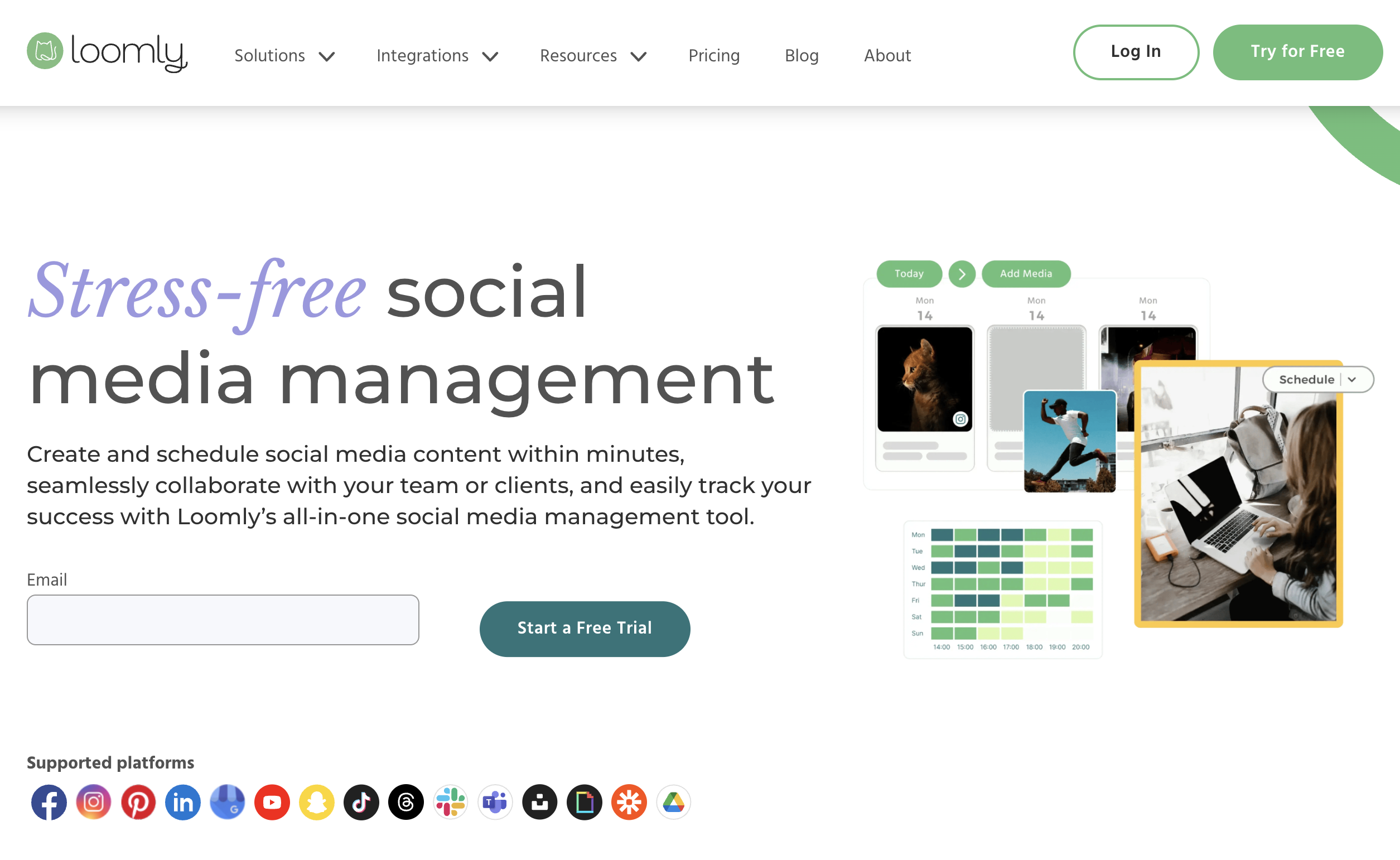
Loomly is the closest competitor to CoSchedule in terms of calendar-centric workflow. Both tools are built around the idea that content should be planned, reviewed, and organized visually on a calendar. But Loomly is focused specifically on social media, not wrapped inside a marketing suite, and includes content inspiration, interaction management, and approval workflows without per-user pricing.
If you love CoSchedule's calendar approach but want a social-focused tool that includes all platforms, content ideas, and interaction management without per-user fees, Loomly is the most natural alternative. See our full CoSchedule vs Loomly comparison for a detailed breakdown.
At a glance: Loomly
- Pricing: $65/mo Starter ($49/mo billed yearly, $588/year; 12 accounts, 3 users) → $332/mo Beyond ($249/mo yearly, $2,988/year; 60 accounts, unlimited users) → custom Enterprise for 61+ accounts. No free plan, 15-day trial
- Platforms: 9 including X/Twitter, Pinterest, Google Business, Snapchat (no Threads, no Bluesky)
- Free trial: 15 days on paid plans
- User ratings: 4.6/5 on G2 (1,793), 1.7/5 on Trustpilot (26)
- Best for: Marketing teams that picked CoSchedule for the calendar experience: multi-step approval chains, post inspiration, and a visual calendar with content library at a flat rate (3 users on Starter, unlimited users on Beyond)
Key features:
- Content calendar with drag-and-drop scheduling
- Post ideas based on trending topics, holidays, and RSS feeds
- Multi-step approval workflows with custom review chains
- Real-time collaboration with @mentions and commenting
- Interaction management (comments and mentions from one inbox)
- Content library for brand assets
- Canva, Unsplash, and Giphy integrations
- Supports 9 platforms including Snapchat
Pros:
- Calendar-centric workflow similar to CoSchedule without the marketing suite bloat
- Content inspiration with trending topics, holidays, and RSS suggestions (CoSchedule has AI templates but not content ideas)
- All platforms including X/Twitter on every plan (CoSchedule bills X/Twitter at $16 per profile per month on every plan)
- 12 accounts on Starter vs CoSchedule's 3-5 profiles
- Unlimited posts on all plans
- Interaction management included (no extra fees)
- Multi-step approval workflows on all paid plans
- No per-user pricing on Starter, flat $65/month for 3 users
Cons:
- Significant pricing gap, Starter ($65/mo) to Beyond ($332/mo) is a $267 jump
- No AI content or image generation
- No marketing suite features (campaign planning, project management)
- Visual previews less polished than some competitors
- Analytics less deep than dedicated analytics platforms
- No free plan, entry is the $65/mo Starter (15-day trial)
How it compares to CoSchedule:
Loomly and CoSchedule both center on content calendar workflows, but Loomly strips away the marketing suite and focuses on social media.
- Loomly Starter ($65/mo): 3 users, 12 accounts, all platforms including X/Twitter, unlimited posts, approval workflows, and interaction management.
- CoSchedule Starter ($39/mo): 3 profiles, one user only, no interaction management beyond a Facebook and Instagram inbox.
- CoSchedule Professional with 3 users ($88/mo): $59 plus $29 for the third user, with 5 profiles and X/Twitter still billed per profile.
- Loomly also adds content inspiration that CoSchedule does not offer.
- The trade-off: CoSchedule's marketing suite features (Kanban boards, campaign tracking, project management) go far beyond social scheduling. If your team needs cross-channel marketing coordination, CoSchedule provides tools Loomly does not. For social-only scheduling with a strong calendar, Loomly is more focused and more scalable.
User ratings: Loomly holds a 4.6/5 on G2 (1,793 reviews) and a 1.7/5 on Trustpilot (26 reviews).
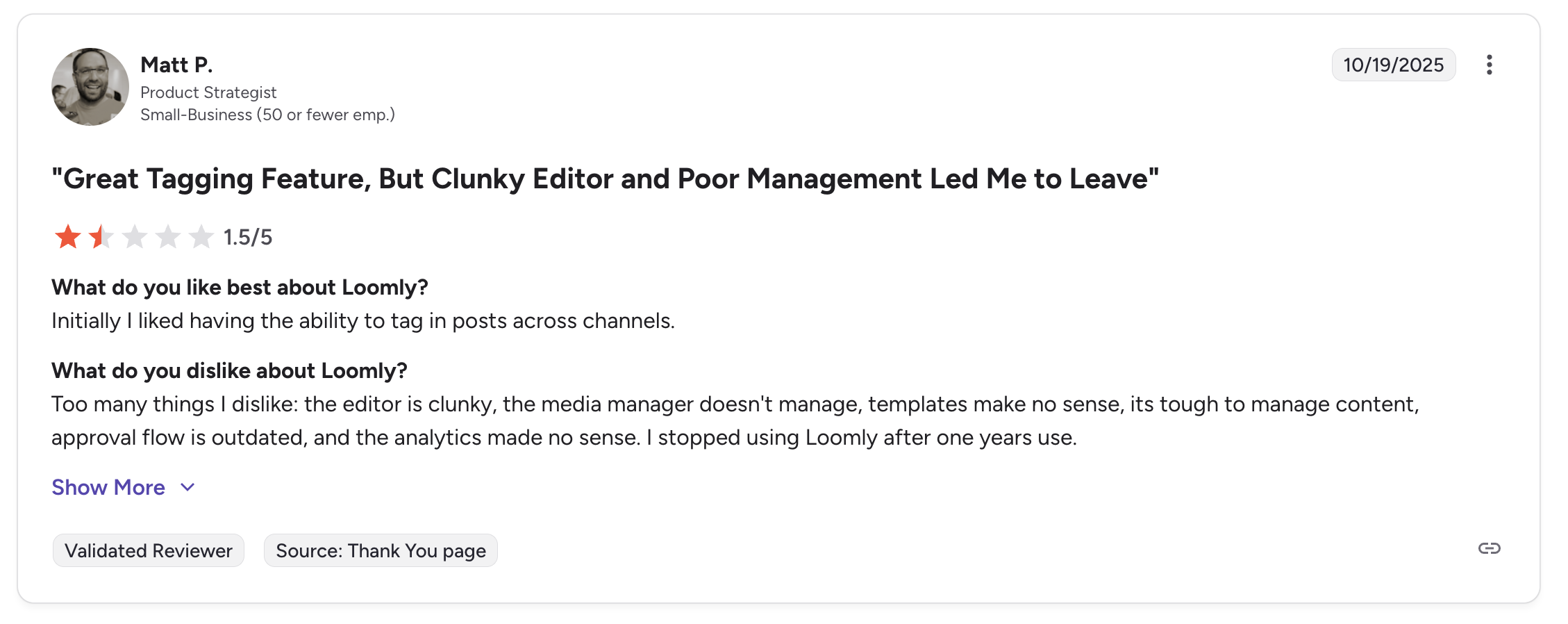
"Initially I liked having the ability to tag in posts across channels... Too many things I dislike: the editor is clunky, the media manager doesn't manage, templates make no sense, its tough to manage content, approval flow is outdated, and the analytics made no sense. I stopped using Loomly after one years use.", Matt P., Product Strategist (Small Business), 1.5/5 on G2, Oct 2025
For more details, see our best Loomly alternatives, Loomly pricing breakdown, Loomly reviews, and CoSchedule vs Loomly comparison.
3. Buffer: Best for Simple Scheduling
Buffer is the antidote to CoSchedule's marketing suite complexity. Where CoSchedule wraps social scheduling inside campaign planning, project management, and team coordination features, Buffer strips everything down to what matters: write a post, pick a time, schedule it. No marketing suite overhead, no Kanban boards, no campaign tracking: just clean, fast social media publishing.
If CoSchedule's complexity is your main frustration and you want the simplest possible social scheduling experience, Buffer is the cleanest alternative. See our full Buffer vs CoSchedule comparison for a detailed breakdown.
At a glance: Buffer
- Pricing: Free (3 channels, 10 scheduled posts per channel, 30-day analytics history) → $6/channel/mo Essentials ($5 billed yearly) → $12/channel/mo Team ($10 yearly, unlimited users, branded reports)
- Platforms: 11 including X/Twitter, Pinterest, Google Business, Bluesky, Mastodon
- Free trial: Free plan available (no credit card required)
- User ratings: 4.3/5 on G2 (1,023), 2.1/5 on Trustpilot (93)
- Best for: Solopreneurs and small teams who find CoSchedule's marketing-suite complexity overwhelming: simplest scheduling UX with X/Twitter included on every plan and a genuinely useful free plan
Key features:
- Simple, intuitive scheduling interface
- AI-powered caption assistant with unlimited usage
- Community inbox for managing comments and messages
- Landing page builder (Start Page)
- Instagram first comment scheduling
- Supports 11 platforms: Instagram, Facebook, X, LinkedIn, TikTok, YouTube, Pinterest, Google Business, Threads, Bluesky, Mastodon
Pros:
- 11 platforms including X/Twitter on all plans (CoSchedule bills X/Twitter at $16 per profile per month on every plan)
- AI caption assistant included on all paid plans
- Per-channel pricing is transparent and predictable
- Simplest interface on this list, no marketing suite overhead
- Community inbox included (CoSchedule's Starter inbox covers Facebook and Instagram only)
- Free plan with 3 channels
- Start Page landing page builder included
- Unlimited posts on all paid plans
Cons:
- Per-channel pricing adds up, 10 channels costs $60-$120/month
- No marketing calendar or campaign planning features
- No content calendar with Kanban views
- No content categories or recycling
- Analytics less deep than dedicated tools
- No AI image generation
- No approval workflows on any plan
- No bulk scheduling
- Trustpilot rating is 2.1/5 (93 reviews)
How it compares to CoSchedule:
Buffer and CoSchedule are on opposite ends of the complexity spectrum.
- Buffer Free: 3 channels across 11 platforms including X/Twitter. CoSchedule Free: 1 profile with 15 messages.
- Buffer Essentials (10 channels, $60/mo): Unlimited posts across all platforms. CoSchedule Starter (10 profiles, $74/mo): $39 plus $35 in extra profile fees, one user, and X/Twitter still billed at $16 per profile.
- The trade-off: CoSchedule's marketing calendar, campaign planning, project management, and team coordination features have no equivalent in Buffer. Buffer is purely a social scheduler, nothing more, nothing less. If you need marketing project management, CoSchedule provides it. If you just need to schedule posts across every platform, Buffer does it with far less friction.
User ratings: Buffer holds a 4.3/5 on G2 (1,023 reviews) and a 2.1/5 on Trustpilot (93 reviews).
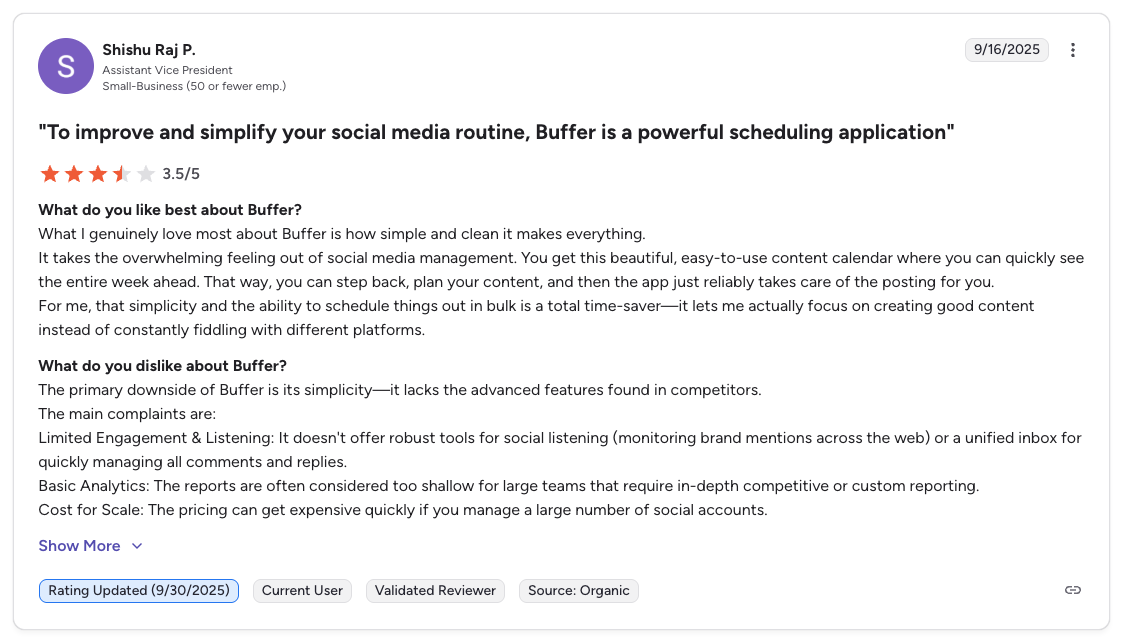
"What I genuinely love most about Buffer is how simple and clean it makes everything... The primary downside of Buffer is its simplicity: it lacks the advanced features found in competitors. Limited Engagement & Listening... Basic Analytics... Cost for Scale.", Shishu Raj P., Assistant Vice President (Small Business), 3.5/5 on G2, Sep 2025
For more details, see our best Buffer alternatives, Buffer pricing breakdown, Buffer reviews, and Buffer vs CoSchedule comparison.
PostPlanifyAll your social media in one simple dashboard
Schedule posts, track analytics, and reply to comments/DMs without switching tabs.
Engagement
+18%
Views
52.8k
4. SocialBee: Best for Content Categories
SocialBee fills the content organization gap that CoSchedule addresses with marketing campaigns but in a social-first way. SocialBee's category-based scheduling system lets you organize posts into content buckets (promotional, educational, curated, personal) and automatically rotate them across platforms, keeping your feed balanced without manual scheduling every post.
For teams that want organized content planning similar to CoSchedule's campaign approach but specifically designed for social media, SocialBee delivers structured posting with AI tools, recycling, and evergreen content at a fraction of CoSchedule's per-user cost. See our full SocialBee vs CoSchedule comparison for details.

At a glance: SocialBee
- Pricing: $29/mo Bootstrap ($24 yearly; 5 profiles, 1 workspace) → $49/mo Accelerate ($40 yearly; 10 profiles, post approval) → $99/mo Pro ($82 yearly; 25 profiles across 5 workspaces) → agency plans Pro50 $149/mo and Pro100 $274/mo
- Platforms: 10 including X/Twitter, Pinterest, Google Business, Bluesky, Threads
- Free trial: 14 days (no credit card required)
- User ratings: 4.8/5 on G2 (472), 4.1/5 on Trustpilot (51)
- Best for: Content marketers who liked CoSchedule's campaign planning but want category-based evergreen recycling across 10 platforms at a flat rate, no per-user fees
Key features:
- Category-based content scheduling with evergreen recycling
- AI-powered caption generator (Copilot) with no credit limits
- Content variations to avoid repetitive posts
- RSS feed auto-posting
- Canva integration inside the editor
- Supports 10 platforms: Instagram, Facebook, X, LinkedIn, TikTok, YouTube, Pinterest, Google Business, Threads, Bluesky
Pros:
- Category-based scheduling organizes content like CoSchedule campaigns but for social specifically
- All platforms including X/Twitter on every plan (CoSchedule bills X/Twitter at $16 per profile per month on every plan)
- Evergreen content recycling keeps posts running automatically
- AI captions without credit limits on all plans
- Unlimited posts on all plans
- Content variations prevent repetitive feeds
- RSS auto-posting included
- 25 profiles on Pro vs CoSchedule's 5 with per-profile fees
Cons:
- No marketing suite features (campaign planning, project management, Kanban boards)
- No social inbox
- No AI image generation
- No free plan ($29/mo minimum; CoSchedule no longer has one either)
- Multi-user access only on Pro ($99/mo for 3 users)
- No approval workflows
- Profile limits on every plan (5/10/25)
- Analytics are less comprehensive than some competitors
How it compares to CoSchedule:
SocialBee's content categories solve the same organizational problem as CoSchedule's marketing campaigns, structuring content for consistent, balanced posting, but without the project management layer.
- SocialBee Bootstrap ($29/mo): 5 profiles across 9 platforms, unlimited posts, AI captions, and content recycling.
- CoSchedule Starter ($39/mo, 1 user): 3 profiles, ReQueue limited to 5 groups, and X/Twitter billed per profile.
- SocialBee Pro ($99/mo): 3 users, 25 profiles, everything included.
- CoSchedule Professional (3 users, $88/mo): 5 profiles and 10 ReQueue groups, with X/Twitter still billed per profile.
- The trade-off: CoSchedule's marketing suite (Kanban boards, campaign tracking, project coordination) goes beyond social scheduling. SocialBee is social-only but provides content organization tools CoSchedule lacks: category rotation, evergreen recycling, and content variations.
User ratings: SocialBee holds a 4.8/5 on G2 (472 reviews) and a 4.1/5 on Trustpilot (51 reviews).
For more details, see our best SocialBee alternatives, SocialBee pricing breakdown, SocialBee reviews, and SocialBee vs CoSchedule comparison.
5. Agorapulse: Best for Social Inbox and CRM
Agorapulse fills the engagement gap that CoSchedule barely addresses. CoSchedule's inbox covers Facebook and Instagram only on Starter and widens to 9 networks on Professional, but Agorapulse has the most powerful unified inbox in the social media management space, with automated moderation rules, social CRM, ROI tracking, and message assignment.
For teams where audience engagement is as important as content scheduling, Agorapulse provides the engagement infrastructure that CoSchedule's marketing-suite approach does not prioritize. See our full Agorapulse vs CoSchedule comparison for details.

At a glance: Agorapulse
- Pricing: $99/user/mo Standard ($79 annual) → $149/user/mo Professional ($119 annual, approvals) → $199/user/mo Advanced ($149 annual, benchmarking); 10 profiles per user on every tier. No free plan, 30-day trial
- Platforms: 11 including X/Twitter, Google Business, Reddit, Bluesky, Threads
- Free trial: 30 days (no credit card required)
- User ratings: 4.5/5 on G2 (967), 4.0/5 on Trustpilot (57)
- Best for: Community managers and engagement-first agencies who need a real unified inbox, social CRM, and ROI tracking, features CoSchedule's marketing calendar doesn't address
Key features:
- Unified social inbox with automated moderation rules and message assignment
- Social CRM with contact history, notes, and labeling
- ROI tracking, tie social activity to website conversions
- Content queues with category-based scheduling
- Competitor analysis and benchmarking (Advanced plan)
- Approval workflows (Professional plan)
- Supports 11 platforms including Google Business, Reddit, and Bluesky
Pros:
- Best social inbox on this list with automated moderation (CoSchedule's is basic, and Starter covers Facebook and Instagram only)
- Social CRM tracks conversation history per contact (CoSchedule has no CRM)
- ROI tracking connects social activity to conversions (CoSchedule lacks this)
- All platforms including X/Twitter on every plan (CoSchedule bills X/Twitter at $16 per profile per month on every plan)
- Unlimited posts on all plans
- Approval workflows on Professional plan
- 30-day free trial (longest on this list)
- Analytics included on all plans
Cons:
- Per-user pricing ($99-$199/user), significantly more expensive per user than CoSchedule
- 3-person team costs $297/month on Standard
- No marketing suite features (campaign planning, project management)
- No content categories or recycling
- No AI image generation
- Canva integration locked behind Professional ($149/user)
- Limited content planning tools compared to CoSchedule's marketing calendar
How it compares to CoSchedule:
Agorapulse and CoSchedule serve different primary use cases. CoSchedule excels at marketing calendar coordination. Agorapulse excels at audience engagement: unified inbox, social CRM, automated moderation, and ROI tracking.
- Agorapulse Standard ($99/user/mo): All platforms including X/Twitter, unlimited posts, social inbox, and analytics.
- CoSchedule Starter ($39/mo): Cheaper, but one user only, X/Twitter billed per profile, and the inbox covers Facebook and Instagram only.
- CoSchedule Professional ($59/mo): Widens the inbox to 9 networks and adds AI reply drafting, but still caps profiles and users.
- The trade-off: CoSchedule's marketing suite features (Kanban boards, campaign tracking, project management) are genuinely useful for marketing department coordination. Agorapulse is the stronger social media management platform; CoSchedule is the stronger marketing project management tool.
User ratings: Agorapulse holds a 4.5/5 on G2 (967 reviews) and a 4.0/5 on Trustpilot (57 reviews).
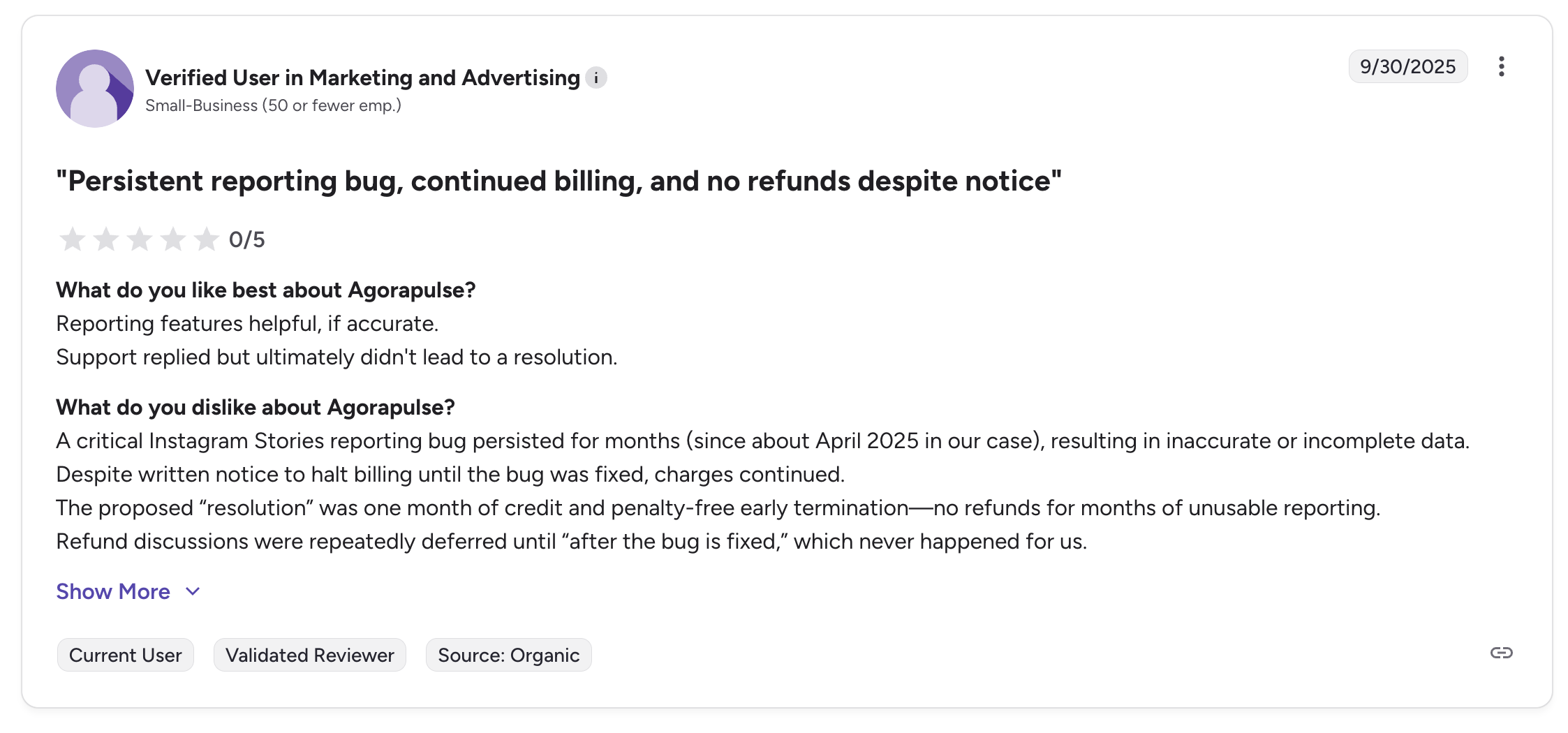
"A critical Instagram Stories reporting bug persisted for months (since about April 2025 in our case), resulting in inaccurate or incomplete data. Despite written notice to halt billing until the bug was fixed, charges continued.", Verified user in Marketing and Advertising (Small-Business), 0/5 on G2, Sep 2025
For more details, see our best Agorapulse alternatives, Agorapulse pricing breakdown, Agorapulse reviews, and Agorapulse vs CoSchedule comparison.
PostPlanifyAll your social media in one simple dashboard
Schedule posts, track analytics, and reply to comments/DMs without switching tabs.
Engagement
+18%
Views
52.8k
6. Sendible: Best for Agencies
Sendible provides the agency infrastructure that CoSchedule's Professional plan addresses but with more dedicated social media management features. White-label dashboards, client-specific reports, a Priority Inbox with sentiment analysis, and scaling up to 100 profiles and 20 users, all with unlimited scheduling and flat-rate pricing instead of CoSchedule's per-user model.
For agencies that have been using CoSchedule Professional or Suite for client management, Sendible provides comparable white-label and client tools with a social-first approach. See our full CoSchedule vs Sendible comparison for details.

At a glance: Sendible
- Pricing: $35/mo Core (1 workspace, 6 profiles) → $99/mo Plus (3 workspaces, 18 profiles, approvals) → $199/mo Premium (7 workspaces, 42 profiles, branded reports) → $299/mo Elite (15 workspaces, 90 profiles) → $750/mo Enterprise (50 workspaces, 300 profiles). Unlimited users on every plan; white label is a paid add-on
- Platforms: 10 including X/Twitter, Google Business, WordPress, Bluesky, Threads (no Pinterest)
- Free trial: 14 days (no credit card required)
- User ratings: 4.5/5 on G2 (899), 2.3/5 on Trustpilot (8)
- Best for: Agencies that outgrew CoSchedule's 3-user ceiling: white-label dashboards, client Connect portals, 250+ report modules, and scaling to 100 profiles and 20 users at flat-rate pricing
Key features:
- White-label reporting and dashboards
- Client dashboards for stakeholder access
- Priority Inbox with sentiment analysis
- Smart Queues for content recycling
- Assignment and approval workflows (Plus plan)
- CRM integrations (Google Analytics, Canva)
- Supports 10 platforms: Facebook, Instagram, X, LinkedIn, TikTok, YouTube, Google Business, WordPress, Threads, Bluesky
Pros:
- White-label reporting for agencies (CoSchedule puts white-label reports and client calendars on Professional)
- Client dashboards for stakeholder access
- Priority Inbox with sentiment analysis (CoSchedule's inbox is basic)
- All platforms including X/Twitter on every plan (CoSchedule bills X/Twitter at $16 per profile per month on every plan)
- Flat-rate pricing, no per-user fees
- Scales to 100 profiles and 20 users
- Unlimited posts on all plans
- Assignment and approval workflows from the Plus plan
- Smart Queues for content recycling
Cons:
- No marketing suite features (campaign planning, project management, Kanban boards)
- No free plan (14-day trial, the same as CoSchedule's)
- No AI image generation
- White-label costs $539/mo minimum ($299 Advanced + $240 add-on)
- Creator plan is single-user only
- Visual previews less polished than some competitors
- Trustpilot rating is 2.3/5 (8 reviews)
How it compares to CoSchedule:
Sendible provides the agency tools CoSchedule offers on Professional (social message approvals, white-label reports and client calendars, and a 9-network inbox), but with flat-rate pricing instead of per-user fees.
- Sendible Plus ($99/mo): 3 client workspaces, 18 profiles, unlimited users, all platforms including X/Twitter, unlimited posts, approvals, and Priority Inbox.
- CoSchedule Professional: cannot take a fourth user at all, so a 4-person agency has to move to Suite on a sales call.
- At 20 profiles: Sendible stays at its plan price. CoSchedule Professional adds $75/month in profile fees on top of $59, and still stops at 3 users.
- The trade-off: CoSchedule's marketing suite features (Kanban boards, campaign tracking, marketing project management) are broader than Sendible's social-focused feature set. Sendible is the stronger agency social media platform; CoSchedule is more comprehensive as a marketing suite.
User ratings: Sendible holds a 4.5/5 on G2 (899 reviews) and a 2.3/5 on Trustpilot (8 reviews).
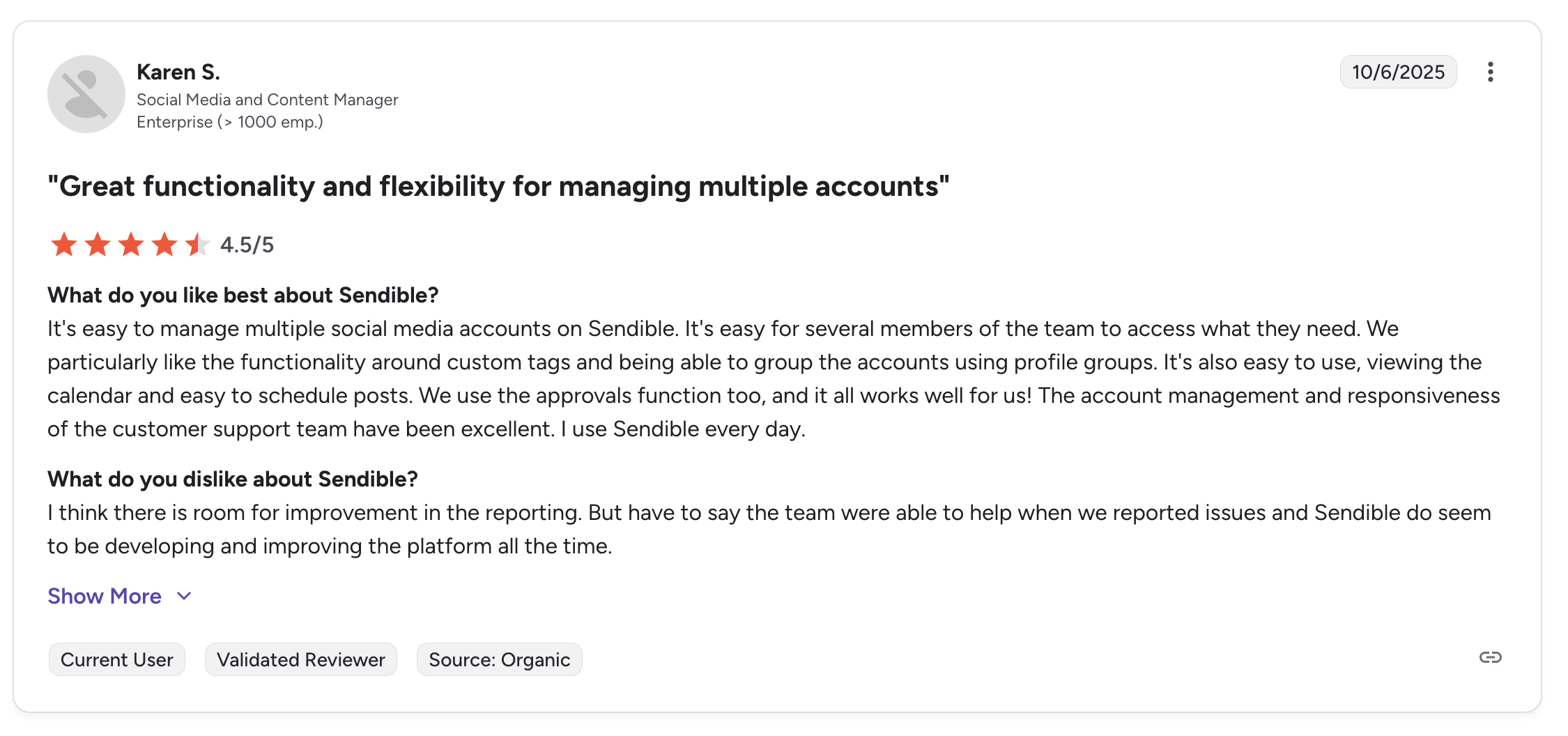
"It's easy to manage multiple social media accounts on Sendible. It's easy for several members of the team to access what they need... The account management and responsiveness of the customer support team have been excellent.", Karen S., Social Media and Content Manager (Enterprise), 4.5/5 on G2, Oct 2025
For more details, see our best Sendible alternatives, Sendible pricing breakdown, Sendible reviews, and CoSchedule vs Sendible comparison.
7. SocialPilot: Best for Bulk Scheduling
SocialPilot is built for high-volume publishing at scale. CSV bulk scheduling for 500 posts, plus white-label reports and client approval workflows from Premium, and a social inbox, all with unlimited scheduling across up to 50 accounts. Where CoSchedule's marketing suite focuses on planning complexity, SocialPilot focuses on publishing volume.
For teams and agencies that schedule large volumes of content and need scalable social media management without marketing suite overhead, SocialPilot delivers volume without per-user pricing constraints. See our full CoSchedule vs SocialPilot comparison for details.

At a glance: SocialPilot
- Pricing: $20/mo Essentials ($17 yearly; 5 accounts, 1 user) → $40/mo Standard ($34 yearly; 10 accounts, 3 users) → $100/mo Premium ($85 yearly; 20 accounts, 6 users, unlimited client seats) → $200/mo Ultimate ($170 yearly; 40 accounts, unlimited users)
- Platforms: 11 including X/Twitter, Pinterest, Google Business, Bluesky, Reddit, Threads
- Free trial: 14 days
- User ratings: 4.5/5 on G2 (841), 3.0/5 on Trustpilot (34)
- Best for: Agencies that need CSV bulk scheduling (500 posts), white-label reports, client approvals, and flat-rate pricing: scaling to 40 accounts where CoSchedule caps at 5 profiles with $5/profile surcharges
Key features:
- CSV bulk scheduling (up to 500 posts at once)
- White-label reports on Premium and above
- Social inbox for comments and messages (Standard+)
- Client approval workflows
- AI assistant for caption generation
- Content curation and RSS feeds
- Supports 11 platforms including X/Twitter, Pinterest, Google Business, Bluesky, Reddit, and Threads
Pros:
- CSV bulk scheduling for 500 posts (CoSchedule's Bulk Import tops out at 365 messages)
- All platforms including X/Twitter on every plan (CoSchedule bills X/Twitter at $16 per profile per month on every plan)
- Flat-rate pricing, no per-user fees
- Up to 40 accounts on Ultimate vs CoSchedule's 5 with per-profile fees
- Social inbox on Standard and above (CoSchedule's Starter inbox is Facebook and Instagram only)
- White-label reports for agencies
- Client approval workflows included
- Unlimited posts on all plans
- AI caption assistant included
Cons:
- No marketing suite features (campaign planning, project management, Kanban boards)
- No free plan ($30/mo minimum; CoSchedule no longer has one either)
- No AI image generation
- Interface is functional but not visually modern
- Analytics are basic compared to dedicated analytics tools
- No content calendar with Kanban views
- Essentials plan is single-user only
- Trustpilot rating is 3.0/5 (34 reviews), mostly refund and support complaints
How it compares to CoSchedule:
SocialPilot focuses on publishing volume where CoSchedule focuses on marketing coordination.
- SocialPilot Standard ($40/mo): 3 users, 10 accounts, all platforms, unlimited posts, and a social inbox; client seats and white-label reports start on Premium.
- CoSchedule Starter ($39/mo): 3 profiles, one user, and an inbox limited to Facebook and Instagram.
- SocialPilot Ultimate ($200/mo): Unlimited users, 40 accounts. CoSchedule at a $200 budget: Professional plus profile add-ons, still capped at 3 users.
- The trade-off: CoSchedule's marketing suite (campaign planning, Kanban boards, project management) is more sophisticated for marketing coordination. SocialPilot is the better high-volume social media publishing tool; CoSchedule is the better marketing project management platform.
User ratings: SocialPilot holds a 4.5/5 on G2 (841 reviews) and a 3.0/5 on Trustpilot (34 reviews).

"SocialPilot is robust in saving time when managing multiple social sites, where they are all consolidated in one dashboard... facilitates the role assigning aspects, and ensures that the approval process is speedily executed.", Graziana C., IT Manager (Financial Services, Small Business), 4.5/5 on G2, Dec 2025
For more details, see our best SocialPilot alternatives, SocialPilot pricing breakdown, SocialPilot reviews, and CoSchedule vs SocialPilot comparison.
8. Metricool: Best for Analytics and Free Plan
Metricool fills two gaps CoSchedule leaves open: deep cross-platform analytics and a generous free plan. CoSchedule includes social analytics and report scheduling on every plan, but reserves AI Insights for Professional and above, and it has no free tier at all. Metricool provides competitor analysis, hashtag tracking, ad performance metrics for Google/Meta/TikTok Ads, best time to post, and Looker Studio integration for custom dashboards.
For data-driven marketers who need analytics that go beyond CoSchedule's basic social reports, Metricool delivers deeper data at a fraction of the cost. See our full Metricool vs CoSchedule comparison for a detailed breakdown.
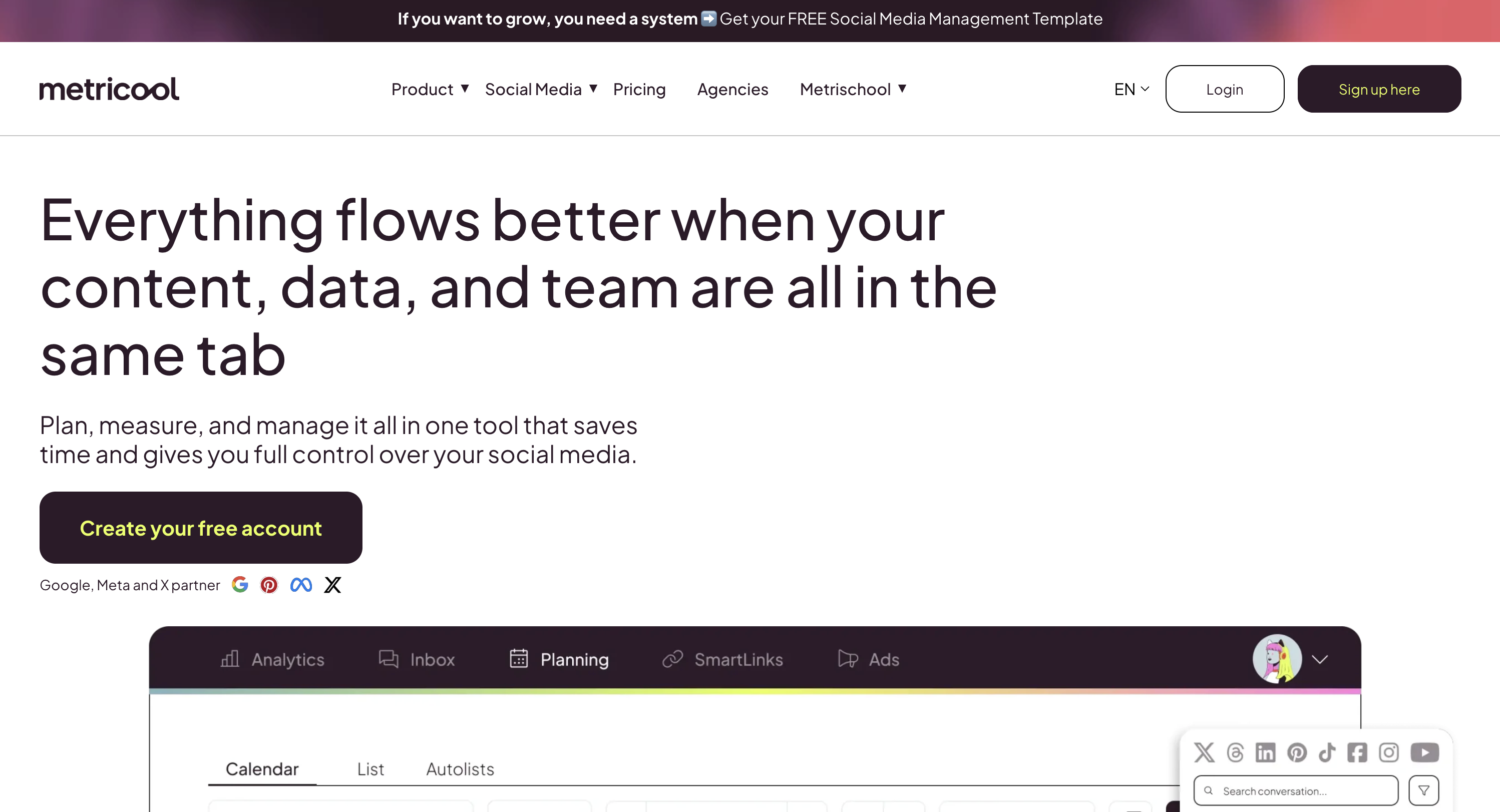
At a glance: Metricool
- Pricing: Free (1 brand, 30-day analytics history) → Starter $25/mo (5 brands) or $45/mo (10 brands) → Advanced $67/mo (15 brands), $107/mo (25) or $210/mo (50) → custom Enterprise; yearly billing cuts each by roughly 20%
- Platforms: 11 including X/Twitter ($5/mo add-on), Pinterest, Google Business, Threads, Bluesky, and Twitch
- Free trial: Free plan available, no time limit
- User ratings: 4.5/5 on G2 (83), 4.1/5 on Trustpilot
- Best for: Data-driven marketers who want cross-platform analytics, competitor tracking for 100 profiles, and ad management, far deeper data than CoSchedule's Starter analytics analytics
Key features:
- Free plan with analytics (1 brand, 50 posts/month)
- Competitor analysis and benchmarking (up to 100 competitors)
- Ad management (Google Ads, Meta Ads, TikTok Ads)
- Hashtag tracker
- Best time to post recommendations
- SmartLinks (link-in-bio pages)
- Looker Studio integration for custom dashboards
- Supports 11 platforms including Twitch
Pros:
- Analytics across all platforms (CoSchedule analytics are basic social reports)
- Competitor tracking for up to 100 profiles (CoSchedule has no competitor tracking)
- Ad management for Google/Meta/TikTok Ads (CoSchedule has no ad tracking)
- All platforms including X/Twitter on every plan (CoSchedule bills X/Twitter at $16 per profile per month on every plan)
- Generous free plan, 1 brand, 50 posts/month, full analytics (CoSchedule's free plan has 1 profile, 15 messages)
- Unlimited scheduling on paid plans
- Best time to post based on cross-platform data
- No per-user or per-profile fees
Cons:
- No marketing suite features (campaign planning, project management, Kanban boards)
- No AI image generation
- No content recycling or categories
- Team features gated behind Advanced plan
- Publishing tools less refined than dedicated schedulers
- No social inbox
- No approval workflows
- No content calendar with advanced views
How it compares to CoSchedule:
Metricool's analytics are in a different league: competitor tracking, ad management, Looker Studio integration, and cross-platform best time to post are all capabilities CoSchedule either lacks or offers only in basic form.
- Metricool Free: 50 posts/month with full analytics. CoSchedule Free: 1 profile, 15 messages.
- Metricool Starter ($25/mo): Unlimited scheduling across 9 platforms including X/Twitter. CoSchedule Starter ($39/mo): Cheaper, but one user only and X/Twitter billed per profile and all platforms CoSchedule's base plan locks out.
- The trade-off: CoSchedule's marketing calendar, campaign planning, and team coordination features are far more comprehensive for marketing department workflows. Metricool is the stronger analytics platform; CoSchedule is the stronger marketing planning tool.
User ratings: Metricool holds a 4.5/5 on G2 (83 reviews) and a 4.2/5 on Trustpilot (586 reviews).
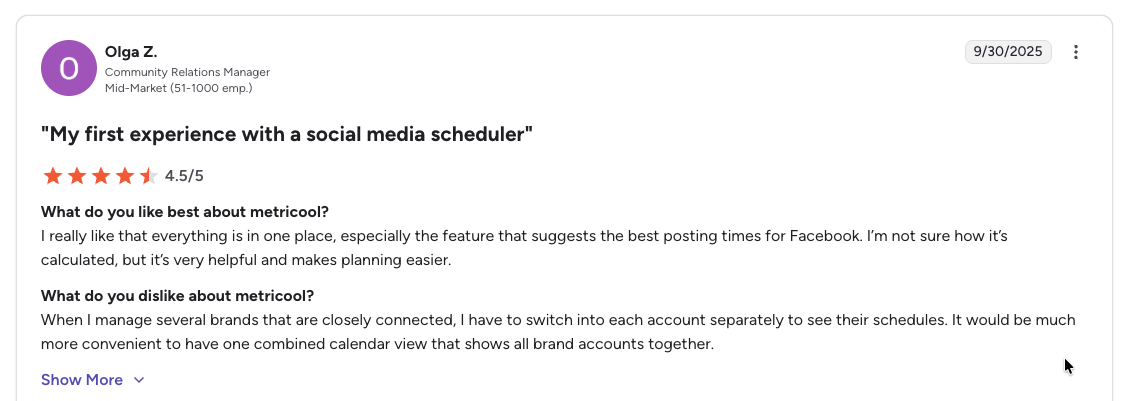
"I really like that everything is in one place, especially the feature that suggests the best posting times for Facebook... When I manage several brands that are closely connected, I have to switch into each account separately to see their schedules.", Olga Z., Community Relations Manager (Mid-Market), 4.5/5 on G2, Sep 2025
For more details, see our best Metricool alternatives, Metricool pricing breakdown, Metricool reviews, and Metricool vs CoSchedule comparison.
9. Planable: Best for Approval Workflows
Planable provides the content approval and collaboration experience that CoSchedule offers on its higher-tier plans, but does it better. Planable's 4-tier approval system (none, optional, required, multi-level), pixel-perfect visual previews, and real-time inline commenting on posts are the most refined collaboration tools in the social media space. Unlimited collaborators on every plan means your entire team reviews content without per-user fees.
For teams where content approval is the workflow priority and CoSchedule's marketing suite features are unnecessary, Planable delivers a more polished collaboration experience. See our full CoSchedule vs Planable comparison for details.

At a glance: Planable
- Pricing: Free (first 50 posts, no time limit) → $39/workspace/mo Basic ($33 yearly; 4 pages, 60 posts/mo, optional approvals) → $59/workspace/mo Pro ($49 yearly; 10 pages, 150 posts/mo, required approvals, public API); custom Enterprise. Analytics (+$12/workspace/mo), social inbox (+$7.50) and listening (+$82.50) are add-ons
- Platforms: 9 including X/Twitter, Pinterest, Google Business, Threads (no Bluesky)
- Free trial: Free plan available
- User ratings: 4.6/5 on G2 (937), 4.5/5 on Trustpilot (69)
- Best for: Teams and client-agency setups that picked CoSchedule for campaign collaboration: best-in-class multi-stakeholder content review UX with unlimited users on every paid plan
Key features:
- 4-tier approval system: none, optional, required, multi-level
- Pixel-perfect visual post previews
- Real-time inline commenting on post content
- Unlimited collaborators on all plans
- Content calendar with drag-and-drop
- Supports universal content, social, blogs, newsletters
- Supports 8 platforms: Instagram, Facebook, X, LinkedIn, TikTok, YouTube, Pinterest, Google Business
Pros:
- Most flexible approval workflows available (CoSchedule has social message approvals on Professional and full approval workflows only on Suite)
- Pixel-perfect visual previews more polished than CoSchedule's preview
- Real-time inline collaboration on post content
- Unlimited collaborators on all plans (CoSchedule charges per user)
- Universal content support, social, blogs, newsletters (CoSchedule only)
- No per-user pricing, flat rate per workspace
- Content calendar with drag-and-drop
Cons:
- Post limits cap every plan, 50 total on Free, 60/month on Basic, 150/month on Pro
- Per-workspace pricing penalizes agencies managing multiple clients
- Analytics is a $9/month add-on (not included in base plans)
- Engagement management is a $5/month add-on
- No AI tools at all, no caption generation, no image generation
- No content recycling, no bulk scheduling
- No social inbox
- No marketing suite features
How it compares to CoSchedule:
Planable and CoSchedule overlap on approval workflows and content calendars, but approach them differently.
- Planable's 4-tier approval system: More flexible than CoSchedule's, which offers social message approvals on Professional and reserves full approval workflows for Suite.
- Planable unlimited collaborators: A 10-person team pays the same workspace price. CoSchedule user caps: a 10-person team cannot be accommodated on Starter or Professional at all.
- Planable Basic ($39/workspace/mo): Approval workflows and unlimited collaborators for the same price as one CoSchedule user, but caps posts at 60/month and charges extra for analytics.
- The trade-off: CoSchedule's marketing suite (campaign planning, project management, Kanban boards, ReQueue) goes far beyond what Planable offers. Planable is a collaboration layer; CoSchedule is a marketing coordination platform. If collaboration is the priority, Planable is superior. If marketing coordination is the priority, CoSchedule provides tools Planable does not.
User ratings: Planable holds a 4.6/5 on G2 (937 reviews) and a 4.5/5 on Trustpilot (69 reviews).
For more details, see our best Planable alternatives, Planable pricing breakdown, Planable reviews, and CoSchedule vs Planable comparison.
10. Hootsuite: Best for Enterprise Governance
Hootsuite is the enterprise end of the CoSchedule alternative spectrum. Where CoSchedule is a marketing calendar bolted onto basic social scheduling, Hootsuite is a full enterprise social media platform with listening, ad management, governance, competitor benchmarking, and multi-level approval chains built in.
For teams that outgrew CoSchedule Professional and need enterprise-scale features, Hootsuite is the category leader.

At a glance: Hootsuite
- Pricing: $99/user/mo Standard (10 accounts) → $199/user/mo Professional (unlimited accounts) → $399/user/mo Advanced (approvals) → custom Enterprise; prices are per seat on annual billing
- Platforms: 10+ including X/Twitter, Google Business, Reddit, Threads, and WhatsApp
- Free trial: 14 days, no credit card required (no free plan)
- User ratings: 4.3/5 on G2 (6,615), 1.3/5 on Trustpilot
- Best for: Enterprise marketing teams that outgrew CoSchedule's scope: social listening, multi-level approval governance, competitor benchmarking, and employee advocacy at scale, with X/Twitter included on every plan
Key features:
- 10+ platforms including X/Twitter, Google Business Profile, Reddit, Threads, WhatsApp
- OwlyGPT AI assistant and caption generator
- Centralized inbox with DM automations
- Bulk scheduling (up to 350 posts on Advanced)
- Social listening and brand monitoring (Talkwalker add-on)
- Competitor benchmarking (5 competitors Standard, 20 Advanced)
- Multi-level approval chains and user roles
- Employee advocacy (Enterprise)
Pros:
- X/Twitter included on every plan (CoSchedule bills X at $16 per profile per month on every plan)
- Enterprise-grade social listening and governance (CoSchedule has neither)
- Multi-level approval chains at enterprise scale
- Bulk scheduling at 350 posts (CoSchedule's Bulk Import handles 365, so this is a wash)
- Industry-leading analytics and competitor benchmarking
- Centralized inbox with DM automations
Cons:
- Dramatically more expensive than CoSchedule ($99/user/mo and up, against CoSchedule Starter at $39/mo)
- No free plan (CoSchedule no longer offers one either)
- Steep learning curve, built for enterprise governance
- Interface feels dated compared to newer tools
- No marketing calendar depth equivalent to CoSchedule's campaign planning
- Trustpilot rating of 1.5/5 reflects billing and cancellation complaints
- Social listening requires paid Talkwalker add-on
How it compares to CoSchedule:
Hootsuite and CoSchedule sit at different ends of the market. Hootsuite is enterprise-first; CoSchedule is a marketing-calendar-first tool for mid-market teams.
- Hootsuite Standard ($99/user/mo): 10 accounts per user with a centralized inbox, listening and competitor benchmarking; approvals need Advanced at $399/user.
- CoSchedule Professional ($59/mo): 5 profiles, 2 users, marketing calendar and campaign planning, with Kanban views reserved for Suite.
- The trade-off: Hootsuite costs far more per user but delivers enterprise capabilities CoSchedule lacks. For pure marketing-calendar workflows, CoSchedule remains better at campaign planning depth.
User ratings: Hootsuite holds a 4.3/5 on G2 (6,615 reviews) and a 1.5/5 on Trustpilot (540+ reviews).
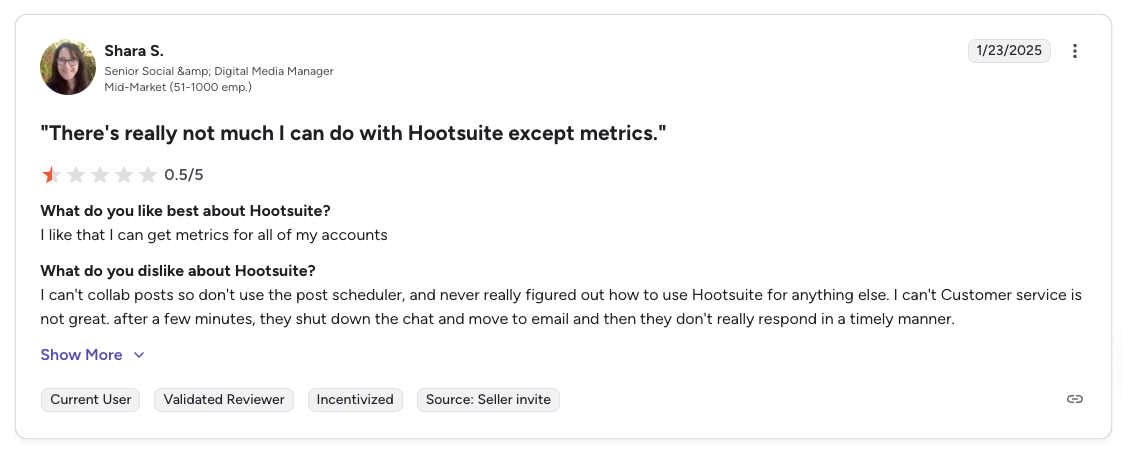
"There's really not much I can do with Hootsuite except metrics. I can't collab posts so don't use the post scheduler... Customer service is not great.", Shara S., Senior Social & Digital Media Manager (Mid-Market), 0.5/5 on G2, Jan 2025
For more details, see our best Hootsuite alternatives, Hootsuite pricing breakdown, and Hootsuite reviews.
11. Sprout Social: Best for Enterprise Analytics
Sprout Social is the enterprise analytics and listening alternative to CoSchedule. Where CoSchedule's social analytics are basic, Sprout Social provides unlimited custom reports, competitor benchmarking, AI-powered sentiment analysis, helpdesk integrations, and deep listening capabilities.
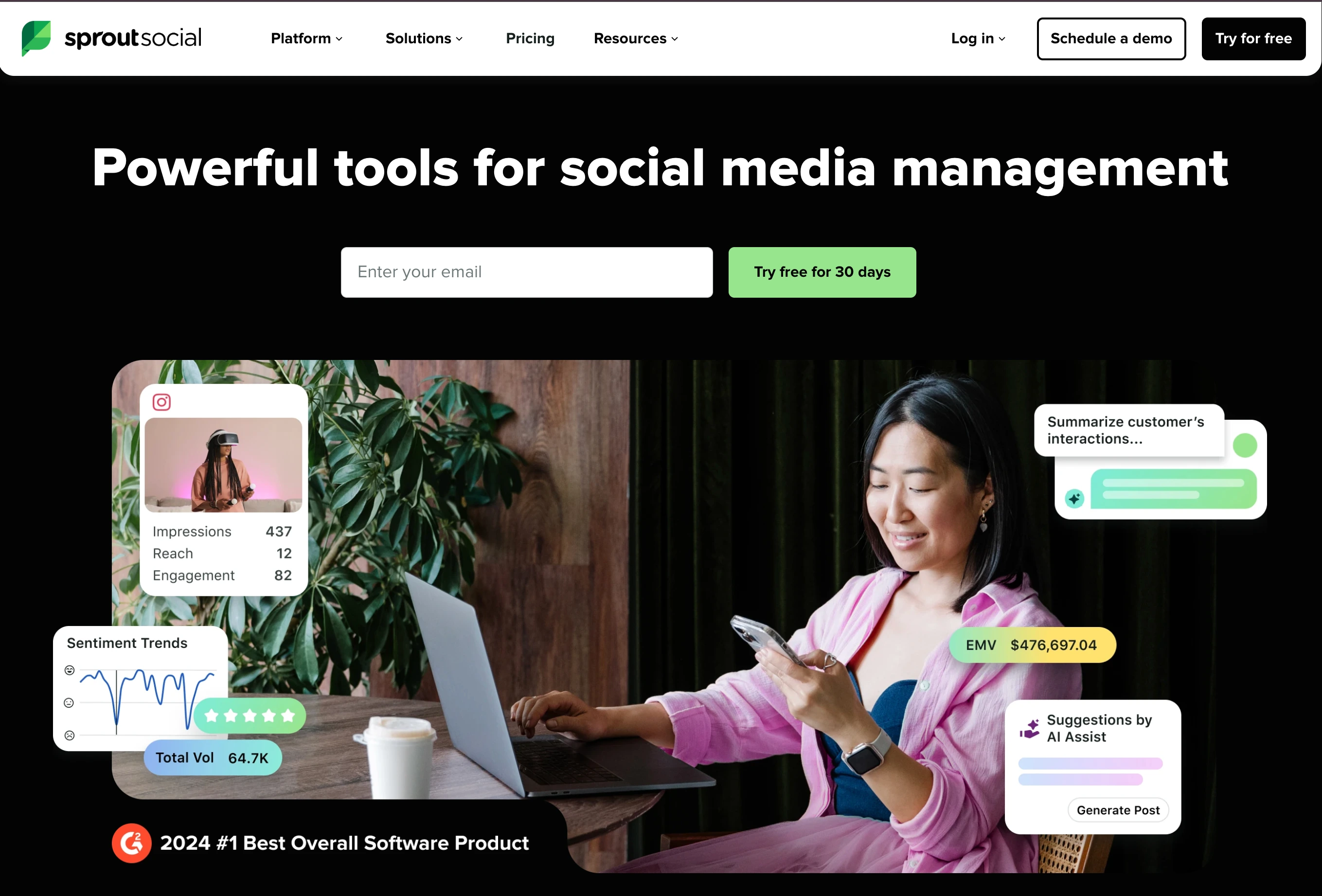
At a glance: Sprout Social
- Pricing: $99/seat/mo Essentials ($79 billed yearly, 5 profiles) → $199/seat/mo Standard (5 profiles) → $299/seat/mo Professional (unlimited profiles) → $399/seat/mo Advanced → custom Enterprise
- Platforms: 10+ including X/Twitter, Google Business, Reddit, Threads, and WhatsApp
- Free trial: 30 days (no free plan)
- User ratings: 4.4/5 on G2 (5,700+), 1.9/5 on Trustpilot (79)
- Best for: Mid-market and enterprise teams that need deepest-on-this-list analytics, AI sentiment analysis, social listening, and helpdesk integrations, all of which fix CoSchedule's basic-analytics gap at enterprise scale
Key features:
- Publishing, inbox, analytics, listening, and CRM in one platform
- Unlimited custom reports with presentation-ready dashboards
- AI-powered sentiment analysis and message tagging (Advanced)
- Competitor reporting and paid ad insights (Professional+)
- Helpdesk integrations (Zendesk, Salesforce) on Advanced
- Multi-step approval workflows with message tasking
- Social listening add-on for brand and industry monitoring
- 10+ platforms including X/Twitter, Google Business, Reddit, Threads, WhatsApp
Pros:
- Deepest analytics on this list (CoSchedule's analytics are basic by comparison)
- Social listening, sentiment analysis, and competitor tracking built in
- X/Twitter included on every plan
- Cross-functional workflows (marketing + customer service in one inbox)
- Enterprise-grade governance and reporting
- Multi-step approval workflows at enterprise scale
- #1 on multiple G2 category leader reports
Cons:
- Per-seat pricing is dramatically more expensive than CoSchedule
- 3-person team on Professional costs $897/mo
- Standard plan caps profiles at 5 (same as CoSchedule Professional)
- No marketing calendar depth equivalent to CoSchedule's campaign planning
- No AI image generation
- Trustpilot rating of 1.9/5 reflects contract lock-in complaints
How it compares to CoSchedule:
Sprout Social and CoSchedule serve different tiers. Sprout Social is enterprise-first; CoSchedule is a marketing-calendar tool for mid-market teams. If the calendar is the part you are shopping for, see our roundup of the best content calendar tools.
- Sprout Social Standard ($199/seat/mo): 5 profiles, full inbox, publishing, Smart Inbox, approvals, X/Twitter included.
- CoSchedule Professional ($59/mo): 5 profiles, 2 users, marketing calendar and campaign planning.
- The trade-off: Sprout Social is ~4× more expensive per seat but delivers analytics, listening, and engagement depth CoSchedule cannot match.
User ratings: Sprout Social holds a 4.4/5 on G2 (5,700+ reviews) and a 1.9/5 on Trustpilot (79 reviews).
For more details, see our best Sprout Social alternatives, Sprout Social pricing breakdown, and Sprout Social reviews.
12. Later: Best for Instagram Visual Planning
Later is the visual-planning alternative to CoSchedule for Instagram-first creators and e-commerce brands. Where CoSchedule treats social as one channel in a broader marketing suite, Later is built tightly around the Instagram feed aesthetic, with an industry-leading drag-and-drop grid preview, Linkin.bio included on all paid plans, and hashtag tools tuned for Instagram growth.

At a glance: Later
- Pricing: $25/mo Starter (8 profiles, 1 social set, 30 posts/profile) → $50/mo Growth (16 profiles, 2 social sets, 180 posts/profile, 2 users) → $110/mo Scale (48 profiles, 6 social sets, unlimited posts, 4 users). Yearly billing is 25% off, extra social sets $15/mo each. Annual
- Platforms: 8 (Instagram, Facebook, Threads, Pinterest, TikTok, LinkedIn, YouTube, Snapchat, no X/Twitter, no Google Business)
- Free trial: Limited free plan
- User ratings: 4.5/5 on G2 (347), 1.7/5 on Trustpilot, "Bad" score
- Best for: Visual-first Instagram creators who want drag-and-drop grid planning plus Linkin.bio, a different kind of tool than CoSchedule's marketing calendar
Key features:
- Drag-and-drop Instagram grid preview (industry-leading)
- Linkin.bio landing page on all paid plans
- Hashtag suggestions and performance tracking
- Best time to post recommendations
- Media library with Unsplash integration
- Social sets that bundle cross-platform profiles
- AI caption credits (limited by plan)
- Analytics and reporting on all paid plans
Pros:
- Best-in-class Instagram visual grid planner (CoSchedule has a grid preview, but not a drag-and-drop visual planner)
- Linkin.bio included on paid plans
- Hashtag tracker and suggestions tuned for Instagram
- Clean mobile app for on-the-go scheduling
- Analytics included on all paid plans
- No per-user fees
Cons:
- No X/Twitter scheduling, Later dropped support in 2023 (CoSchedule at least offers it as a paid add-on)
- No Google Business Profile support
- Post caps on Starter (30/profile) and Growth (180/profile)
- AI caption credits are capped per plan
- No marketing calendar depth like CoSchedule's campaign planning
- No approval workflows
- Trustpilot rating is 1.7/5 citing auto-renewal complaints
How it compares to CoSchedule:
Later and CoSchedule serve very different audiences. Later is Instagram-first and visual-focused; CoSchedule is marketing-calendar-first and text-focused.
- Later Starter ($25/mo): 8 profiles, 1 user, visual grid planner, Linkin.bio, Instagram-first tooling.
- CoSchedule Starter ($39/mo): 3 profiles, one user, X/Twitter billed per profile, basic marketing calendar.
- The trade-off: Later is cheaper and best-in-class for Instagram visual planning, but lacks X/Twitter, approval workflows, and marketing calendar depth. Choose based on your primary workflow.
User ratings: Later holds a 4.5/5 on G2 (347 reviews) and a 1.7/5 on Trustpilot, "Bad" score.
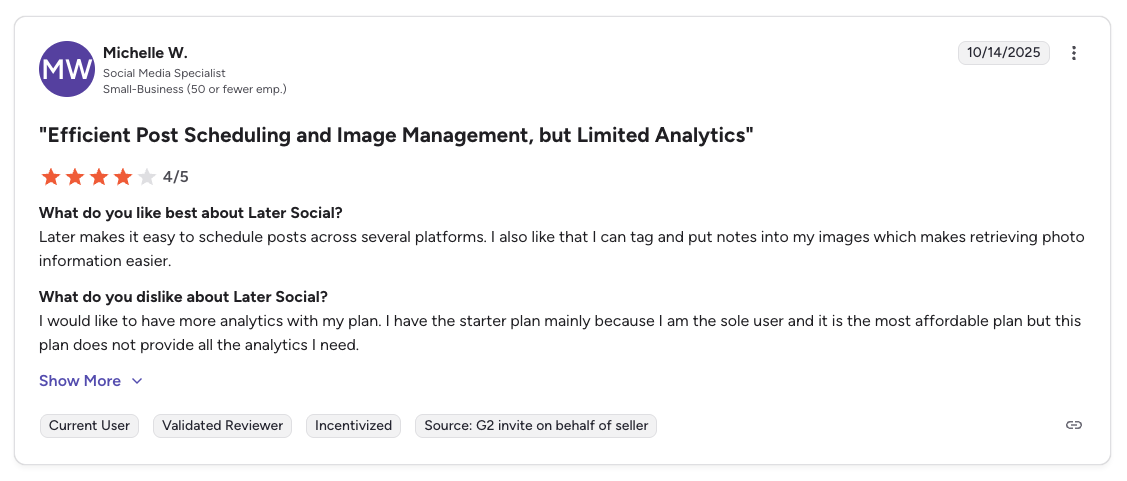
"Later makes it easy to schedule posts across several platforms. I also like that I can tag and put notes into my images which makes retrieving photo information easier. I would like to have more analytics with my plan.", Michelle W., Social Media Specialist (Small Business), 4/5 on G2, Oct 2025
For more details, see our best Later alternatives, Later pricing breakdown, and Later reviews.
PostPlanifyAll your social media in one simple dashboard
Schedule posts, track analytics, and reply to comments/DMs without switching tabs.
Engagement
+18%
Views
52.8k
Full Pricing Comparison: All 12 CoSchedule Alternatives
Here is a side-by-side pricing comparison. All prices shown are monthly billing rates unless noted.
| Tool | Solo User | 3-Person Team | 10+ Accounts |
|---|---|---|---|
| CoSchedule (baseline) | $39/mo Starter (3 profiles, 1 user, X extra) | $88/mo Professional (3 users max) | $59/mo Professional (5 profiles, 2 users) |
| PostPlanify | $39/mo Growth (1 workspace, 4 accounts) | $39/mo Growth (unlimited users) | $99/mo Premium (3 workspaces, approvals) |
| Loomly | $65/mo Starter (12 accounts) | $65/mo Starter (3 users, 12 accounts) | $65/mo Starter |
| Buffer | Free (3 channels) | $12/channel Team (unlimited users) | ~$60/mo ($6/channel annual) |
| SocialBee | $29/mo Bootstrap (5 profiles) | $99/mo Pro (25 profiles, 5 workspaces) | $49/mo Accelerate (10 profiles) |
| Agorapulse | $99/user/mo Standard | $297/mo Standard (3 users) | $99/user/mo (10 profiles) |
| Sendible | $35/mo Core (6 profiles) | $35/mo Core (unlimited users) | $99/mo Plus (18 profiles, approvals) |
| SocialPilot | $20/mo Essentials (5 accounts) | $40/mo Standard (3 users, 10 accounts) | $100/mo Premium (20 accounts) |
| Metricool | Free (1 brand) | $67/mo Advanced (15 brands) | $45/mo Starter (10 brands) |
| Planable | Free (50 total) or $39/workspace | $39/workspace (unlimited users) | $59/workspace Pro (10 pages) |
| Hootsuite | $99/user/mo Standard | $297/mo Standard (3 users) | $99/user/mo Standard (10 accounts) |
| Sprout Social | $99/seat/mo Essentials (5 profiles) | $297/mo Essentials (3 seats) | $199/seat/mo Standard (5 profiles) |
| Later | $25/mo Starter (8 profiles) | $50/mo Growth (2 users, 16 profiles) | $110/mo Scale (4 users, 48 profiles) |
Key takeaway: CoSchedule's user caps are now the core pain point. Starter allows one user, Professional stops at three, and X/Twitter is billed at $16 per profile per month on both. The same team gets unlimited users on PostPlanify Growth ($39/mo per client workspace), 18 profiles on Sendible Traction ($89/mo), or 15 accounts on SocialPilot Standard ($50/mo), all with X/Twitter included. Buffer (free) and Metricool (free) offer the cheapest entry points. For enterprise listening and analytics, Sprout Social and Hootsuite are the premium options but come with per-seat/per-user pricing.
How CoSchedule Alternatives Compare by Use Case
CoSchedule's marketing calendar and campaign planning are genuinely strong, but hard user caps, X/Twitter billed per profile, $5-per-profile surcharges, marketing-suite complexity, and persistent customer-support complaints push many users to switch. Here is the fastest way to match a tool to your priority:
- Best CoSchedule alternative for teams: PostPlanify: from $39/mo per client workspace with unlimited team members, AI captions and image generation on every plan, X/Twitter included, social inbox and full analytics on every plan, and approval workflows on Premium.
- Best for calendar continuity: Loomly ($65/mo): closest feature match with multi-step approvals, content inspiration, and a drag-and-drop calendar.
- Best for simplest scheduling: Buffer (free or $6/channel annual): 11 platforms with X/Twitter included and the strongest free plan.
- Best for content recycling: SocialBee ($29/mo): category-based evergreen scheduling across 10 platforms at a flat rate.
- Best for engagement-first teams: Agorapulse ($99/user/mo): unified inbox with social CRM and ROI tracking.
- Best for agencies: Sendible ($29 to $299/mo) for white-label reports and client dashboards that beat CoSchedule Professional on features and seat limits.
- Best for bulk publishing: SocialPilot (from $20/mo): CSV upload for 500 posts, scaling to 40 accounts on Ultimate.
- Best free plan for analytics: Metricool: 50 posts/mo with cross-platform analytics, competitor tracking, and ad management on the free tier.
- Best for content approval UX: Planable (free or $39/workspace): best-in-class multi-stakeholder approval with unlimited users on every paid plan.
- Best for enterprise governance: Hootsuite (from $99/user/mo): social listening and competitor benchmarking at scale, with approvals on Advanced at $399/user.
- Best for enterprise analytics: Sprout Social ($199/seat/mo): unlimited custom reports, sentiment analysis, helpdesk integrations.
- Best for Instagram visual planning: Later ($25/mo): drag-and-drop grid preview and Linkin.bio included.
- Keep CoSchedule if campaign planning with Kanban boards, custom fields, and intake forms across marketing teams is core to your workflow. No social tool on this list replicates that marketing-suite depth; if the operations half is what you actually need, our best marketing agency project management software roundup covers the tools built for it.
Frequently Asked Questions About CoSchedule Alternatives
What is the best CoSchedule alternative?
For most teams leaving CoSchedule, PostPlanify is the best overall alternative: priced per client workspace from $39/mo with unlimited team members, X/Twitter included on every plan at no extra charge, AI captions and image generation plus a social inbox and full analytics on every plan, and approval workflows on Premium, all without CoSchedule's user caps, $5-per-profile surcharges, the $16-per-profile X/Twitter add-on, or its cancellation-support complaints. If you specifically want CoSchedule's calendar feel, Loomly is the closest match; for the simplest free start, Buffer; and for agencies, Sendible. The right pick depends on your workflow, but PostPlanify is the one most CoSchedule switchers settle on.
Who are CoSchedule's main competitors?
On the social side, the closest CoSchedule competitors are PostPlanify, Loomly, Buffer, SocialBee, Agorapulse, Sendible, SocialPilot, Metricool, Planable, Hootsuite, Sprout Social and Later. On the marketing-suite side it competes with project tools rather than schedulers, which is why no social-first tool here replicates its Kanban boards and intake forms.
Is CoSchedule free?
No. CoSchedule retired its Free Calendar plan and now offers a 14-day free trial only. Both self-serve plans are paid: Starter at $39/month ($29 annually) and Professional at $59/month ($49 annually). Among the alternatives here, Buffer, Metricool and Planable still have genuinely free tiers, with no analytics, no social inbox, and no collaboration features. For comparison, Metricool's free plan includes 50 posts/month with full analytics across all platforms.
Does CoSchedule support X/Twitter?
Only as a paid add-on. X/Twitter is excluded from every CoSchedule base plan and bills separately at $16 per profile per month on Starter and Professional, or as an add-on on Suite. Every alternative on this list includes X/Twitter on all paid plans.
Which CoSchedule alternatives publish to Google Business Profile?
All of them except Later, which supports neither Google Business Profile nor X/Twitter. CoSchedule publishes to Google Business Profiles on every plan as well, so this is rarely the reason to switch.
What is the best free CoSchedule alternative?
Metricool offers the strongest free plan: 1 brand, 50 posts/month, and full analytics including competitor tracking and best time to post. Buffer's free plan includes 3 channels across 11 platforms. Both include X/Twitter, which CoSchedule's free plan does not.
How much does CoSchedule cost for a team of 3?
A 3-person team cannot use Starter at all, which allows one user. On Professional it is $88/month: $59 for the plan with 2 users included, plus $29 for the third. That buys 5 profiles, and X/Twitter is another $16 per profile per month. A fourth user is not available on either self-serve plan ($49+ × 3 users) with 5 profiles. Additional profiles cost $5/month each.
Is CoSchedule good for agencies?
CoSchedule Professional includes white-label reports, white-label client calendars, and social message approvals at $59/month ($49 annually). However, the 3-user ceiling makes it unworkable for larger agency teams. Sendible and SocialPilot offer comparable agency features with flat-rate pricing: Sendible's Traction plan at $89/month includes 4 users and 24 profiles.
Can you cancel CoSchedule easily?
Multiple G2 reviewers report significant difficulties canceling CoSchedule subscriptions. Reviews describe cancellation requests being ignored for months, no option to cancel directly within the app, and repeated refund requests going unanswered. This is a notable concern when evaluating CoSchedule.
Making the Switch
Migrating from CoSchedule to any of these tools is straightforward. Your social media accounts, followers, and published content are tied to the platforms (Instagram, Facebook, X, etc.), not to CoSchedule. When you connect your accounts to a new tool, everything is already there.
Here is a simple migration process:
- Export your data from CoSchedule: Download your content calendar, campaign plans, and analytics data. Document your posting schedules and any workflow automations you have set up. If you use CoSchedule's WordPress integration, note which posts are connected.
- Sign up for your chosen alternative: Most tools offer free plans or trials ranging from 7 to 30 days. Take advantage of the trial to test the workflow before committing.
- Connect your social accounts: Use OAuth to link your profiles. This takes seconds per platform. If you were on Starter or Professional (where X/Twitter is a paid add-on), verify your new tool includes all the platforms you need.
- Recreate your posting schedule: Set up your content calendar, time slots, and posting cadence in the new tool. If you relied on CoSchedule's campaign view or Kanban boards, look for equivalent calendar and workflow features. Our guide on how to schedule social media posts covers this step in detail.
- Set up team workflows: If you used CoSchedule's approval workflows or task assignments, configure the equivalent in your new tool. Most alternatives include approval workflows on their team plans.
- Cancel CoSchedule: Once you have verified everything works in the new tool, cancel your CoSchedule subscription. Multiple G2 reviewers report difficulties with cancellation, so initiate the process early and document your cancellation request in writing.
If PostPlanify is the right fit for your workflow, you can start your free trial here.
Related Reading
- 15 Best Buffer Alternatives in 2026, If you are comparing Buffer alongside CoSchedule
- 16 Best Hootsuite Alternatives in 2026, If you are comparing Hootsuite alongside CoSchedule
- 10 Best Sprout Social Alternatives in 2026, If you are comparing Sprout Social alongside CoSchedule
- 13 Best Later Alternatives in 2026, If you are comparing Later alongside CoSchedule
- 11 Best Agorapulse Alternatives in 2026, If you are comparing Agorapulse alongside CoSchedule
- 11 Best Sendible Alternatives in 2026, If you are comparing Sendible alongside CoSchedule
- 11 Best SocialPilot Alternatives in 2026, If you are comparing SocialPilot alongside CoSchedule
- 11 Best Metricool Alternatives in 2026, If you are comparing Metricool alongside CoSchedule
- 12 Best Loomly Alternatives in 2026, If you are comparing Loomly alongside CoSchedule
- 12 Best SocialBee Alternatives in 2026, If you are comparing SocialBee alongside CoSchedule
- 12 Best Vista Social Alternatives in 2026, If you are comparing Vista Social alongside CoSchedule
- 12 Best Publer Alternatives in 2026, If you are comparing Publer alongside CoSchedule
- 12 Best Planable Alternatives in 2026, If you are comparing Planable alongside CoSchedule
- 12 Best Tailwind Alternatives in 2026, If you are comparing Tailwind alongside CoSchedule
- 12 Best Iconosquare Alternatives in 2026, If you are comparing Iconosquare alongside CoSchedule
- 12 Best Zoho Social Alternatives in 2026, If you are comparing Zoho Social alongside CoSchedule
- 12 Best Pallyy Alternatives in 2026, If you are comparing Pallyy alongside CoSchedule
- CoSchedule Pricing Breakdown, Full plan and cost analysis
- CoSchedule Reviews, What real users say about CoSchedule
- Best Social Media Management Platform, Broader comparison across all categories
- Social Media Scheduling Tools Guide, Everything you need to know about scheduling
- All Alternatives, Browse all social media management alternatives
- Best Social Media Management Tools for Teams
- Best Marketing Planning Software
PostPlanifyAll your social media in one simple dashboard
Schedule posts, track analytics, and reply to comments/DMs without switching tabs.
Engagement
+18%
Views
52.8k
About the Author

Hasan Cagli
Founder of PostPlanify, a content and social media scheduling platform. He focuses on building systems that help businesses, agencies, and teams plan, publish, and manage content and social media more efficiently across platforms.


